fuel filter CHEVROLET LOW CAB FORWARD 2018 User Guide
[x] Cancel search | Manufacturer: CHEVROLET, Model Year: 2018, Model line: LOW CAB FORWARD, Model: CHEVROLET LOW CAB FORWARD 2018Pages: 358, PDF Size: 6.32 MB
Page 209 of 358
Chevrolet Low Cab Forward Owner Manual (GMNA-Localizing-U.S.-
11254764) - 2018 - crc - 12/5/16
208 Driving and Operating
At temperatures below 0 °C (32 °F),
it is recommended to switch to Ultra
Low Sulfur Diesel fuel with no
biodiesel content, or to blends with
biodiesel containing less than 5% by
volume. At these extreme cold
temperatures, biodiesel blends
higher than 5% by volume may
cause fuel filter plugging and
system gelling, which can lead to
vehicle operability problems.
Fuels improperly blended for cold
temperature operation may result in
restricted fuel filters and degraded
vehicle performance. The vehicle is
equipped with a fuel heating system
to provide a level of protection
against filter plugging from gelling or
waxing of conventional diesel fuel
and biodiesel blends. If the
operating temperature is far below
the temperature at which gelling or
waxing of the fuel occurs, the
system will not prevent all cases of
filter plugging.
If the vehicle experiences a fuel
filter restriction, the on-board
monitoring system will alert the
driver that the fuel filter requiresservice. The fuel filter, however, will
not prevent all damage caused by
poor quality biodiesel.
Biodiesel Blends
Use biodiesel blends that meet the
ASTM specification D6751.
Retail pumps dispensing blends
containing up to 5% biodiesel (B5)
are not required to be labeled with
the concentration of biodiesel.
Blends up to B5 must meet ASTM
D975 (Grades No. 2-D or No. 1-D
S15 Ultra Low Sulfur Diesel). When
refueling with a biodiesel blend
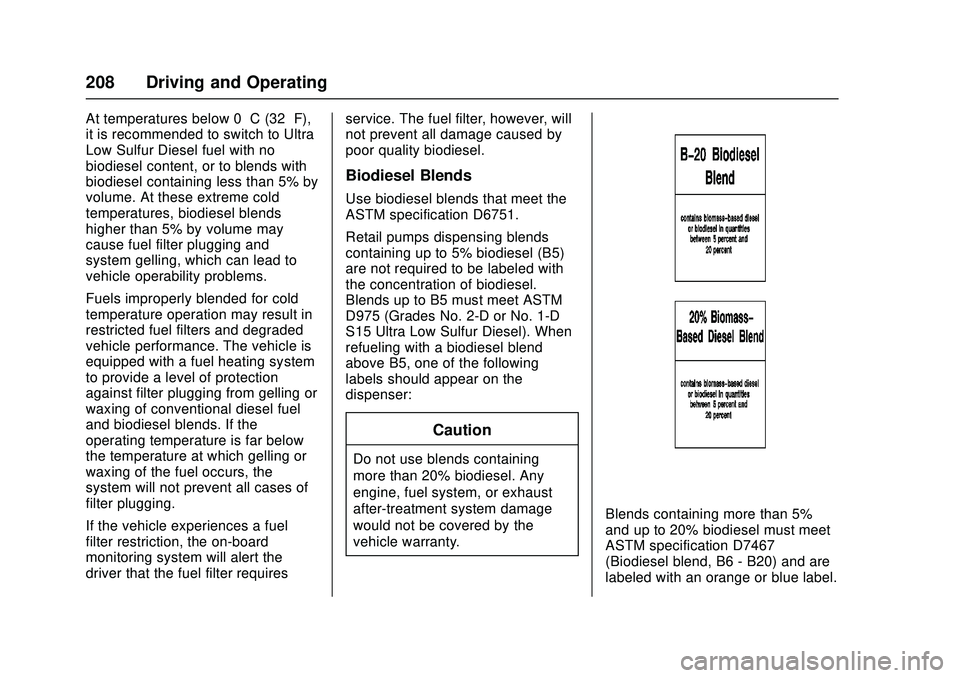
above B5, one of the following
labels should appear on the
dispenser:
Caution
Do not use blends containing
more than 20% biodiesel. Any
engine, fuel system, or exhaust
after-treatment system damage
would not be covered by the
vehicle warranty.
Blends containing more than 5%
and up to 20% biodiesel must meet
ASTM specification D7467
(Biodiesel blend, B6 - B20) and are
labeled with an orange or blue label.
Page 210 of 358
Chevrolet Low Cab Forward Owner Manual (GMNA-Localizing-U.S.-
11254764) - 2018 - crc - 12/5/16
Driving and Operating 209
To reduce the risk of poor quality
fuel, purchase biodiesel blends from
a fuel supplier or fueling station
which sells BQ-9000 certified
biodiesel. See www.bq-9000.org for
a list of certified marketers.
Biodiesel Blends in Canada
Biodiesel blends that meet the CAN/
CGSB-3.522 specifications up to
20% (B20) can be used. Do not use
biodiesel blends above 20%, as
they may damage the engine and
fuel system.
Cold Weather Operation
Diesel fuel is sensitive to
temperature. All diesel fuel has a
certain amount of paraffin
components, which are high in
energy value and help improve fuel
economy. But, when temperatures
are below -7 °C (20 °F), the paraffin
components begin turning into wax
flakes. If temperatures are low
enough, these flakes can obstruct
the fuel filters and stop fuel from
reaching the engine.At low temperatures, wax flakes are
more likely to form in Number 2-D
fuel than in Number 1-D (or
"winterized" Number 2-D) fuel. For
best operation at temperatures
below -7 °C (20 °F), use Number
1-D, or Number 2-D which has been
blended with Number 1-D for winter
use. When temperatures are
consistently below (or near) -18 °C
(0 °F), use Number 1-D if at all
possible. Bear in mind, however,
that even Number 1-D fuel will form
wax flakes when temperatures are
extremely low.
Do not use home heating oil or
gasoline in your diesel engine;
either may cause engine damage.
The addition of kerosene will not
unplug a filter plugged with wax.
Warming a "waxed" filter to a
temperature of 0 °C to 10 °C (32 °F
to 50 °F) will return the wax to
solution. Filter replacement is not
normally required.
Water in Fuel
During refueling, it is possible for
water (and other contaminants) to
be pumped into your fuel tank along
with the diesel fuel. This can occur if
a service station does not regularly
inspect and clean its fuel tanks, or if
a service station receives
contaminated fuel from its
supplier(s).
To protect your engine from
contaminated fuel, there is a water
separator system on the engine
which allows you to drain excess
water from the fuel.
{Warning
The drained water/diesel fuel
mixture is flammable, and could
be hot. To help avoid personal
injury or death and/or property
damage, do not touch the fuel
coming from the water separator
drain valve, and do not expose
the fuel to open flames or sparks.
(Continued)
Page 211 of 358
Chevrolet Low Cab Forward Owner Manual (GMNA-Localizing-U.S.-
11254764) - 2018 - crc - 12/5/16
210 Driving and Operating
Warning (Continued)
Be sure you do not overfill the
drain pan. Heat (such as from the
engine) can cause the fuel to
expand. If the container is too full,
fuel could be forced out of the
pan. This could lead to a fire and
the risk of personal injury and/or
vehicle damage.
Biocides
In warm or humid weather, fungus,
and/or bacteria may form in diesel
fuel if there is water in the fuel.
Fungus or bacteria can cause fuel
system damage by plugging the fuel
lines, fuel filters or injector. They
can also cause fuel system
corrosion.
If fungus or bacteria has caused fuel
system problems, you should have
your authorized dealer correct these
problems. Then, use a diesel fuel
biocide to sterilize the fuel system
(follow the biocide manufacturer's
instructions). Biocides are available
from your dealer, service stations, parts stores and other automotive
places. See your authorized dealer
for advice on using biocides in your
area and for recommendations on
which biocides you should use.
Smoke Suppressants
Because of extensive testing of
treated fuel versus untreated fuel,
the use of a smoke suppressant
additive is not recommended
because of the greater possibility of
stuck rings and guttered valves,
resulting from excessive ash
deposits.
Water Separator
The purpose of the water separator
is to separate any water from the
fuel that may have formed in the
fuel tank due to condensation.
The water separator is located on
the bottom of the fuel filter.
Caution
Remaining water that is not
discharged from the water
separator could freeze and
damage the vehicle.
If the warning light comes on
while the engine is in operation,
promptly drain the water from the
water separator (fuel filter).
Continuing to drive with the light
remaining on could damage the
fuel injection system. If this
happens, have the vehicle
checked and serviced by the
nearest dealer.
Draining Water from the Fuel
Filter
Clean off any fuel that has adhered
to the vehicle body.
Starting the engine immediately
after draining the water from the fuel
filter requires a little more time than
usual. If the engine does not start in
10 seconds, wait for a while and try
again.
Page 212 of 358

Chevrolet Low Cab Forward Owner Manual (GMNA-Localizing-U.S.-
11254764) - 2018 - crc - 12/5/16
Driving and Operating 211
Fuel will be mixed in the drained
water. Dispose of it in a method
conforming to the regulatory
requirements in your state.
If the water separator (fuel filter)
requires frequent draining, have the
fuel system inspected at your
dealer.
Pre Fuel Filter (Chassis-side)1. Attach a plastic hose to the drain plug (2) on the bottom of
the chassis-side fuel filter and
put the other end of the hose in
a container placed beneath the
filter. 2. Loosen the drain plug and
move the priming pump (1) up
and down by hand between
10 and 20 times.
3. Fully tighten the drain plug (2) and move the priming pump (1)
several times.
Fuel Filter (Engine-side)1. Attach a plastic hose to the drain plug (2) on the bottom of
the engine-side fuel filter (1)
and put the other end of the
hose in a container placed
beneath the filter.
2. Loosen the drain plug andmove the priming pump up and
down by hand between 10 and
20 times.
3. Fully tighten the drain plug and move the priming pump several
times.
4. Test run the engine and check that there are no fuel leaks
from the drain plug of the
engine-side fuel filter. Also
check that the water separator
(fuel filter) warning light
stays off.
Page 213 of 358
Chevrolet Low Cab Forward Owner Manual (GMNA-Localizing-U.S.-
11254764) - 2018 - crc - 12/5/16
212 Driving and Operating
Running Out of Fuel
When the Fuel Tank is Empty
When the fuel tank is empty, air will
enter the fuel system, so refueling
alone will not be enough to restart
the engine. Use the following
methods to bleed the fuel system.
Bleeding the Fuel System
Steps for Refueling1. Follow the directions in "Parking Brake Lever" under
Parking Brake 0200. 2. Select the correct fuel (See
"Diesel Fuel Requirement and
Fuel System"). Follow any
posted safety rules. Stand to
the side, never above or
opposite the filler opening.
3. Check that the fuel cap is tight, and see to it that engine oil,
engine coolant in the reservoir,
and washer fluid, etc. are at
proper levels. Then do the
Driver Daily Checklist.
See Owner Checks and Services
0 317.
Driving your vehicle until the fuel
tank is empty may activate the
check engine malfunction indicator
light. You do not need to have your
vehicle checked. After refueling,
perform the following:
. Bleed the fuel system.
. Start, turn off and restart the
engine three or four times.
. The check engine malfunction
indicator light will be cancelled. Before Starting the Engine
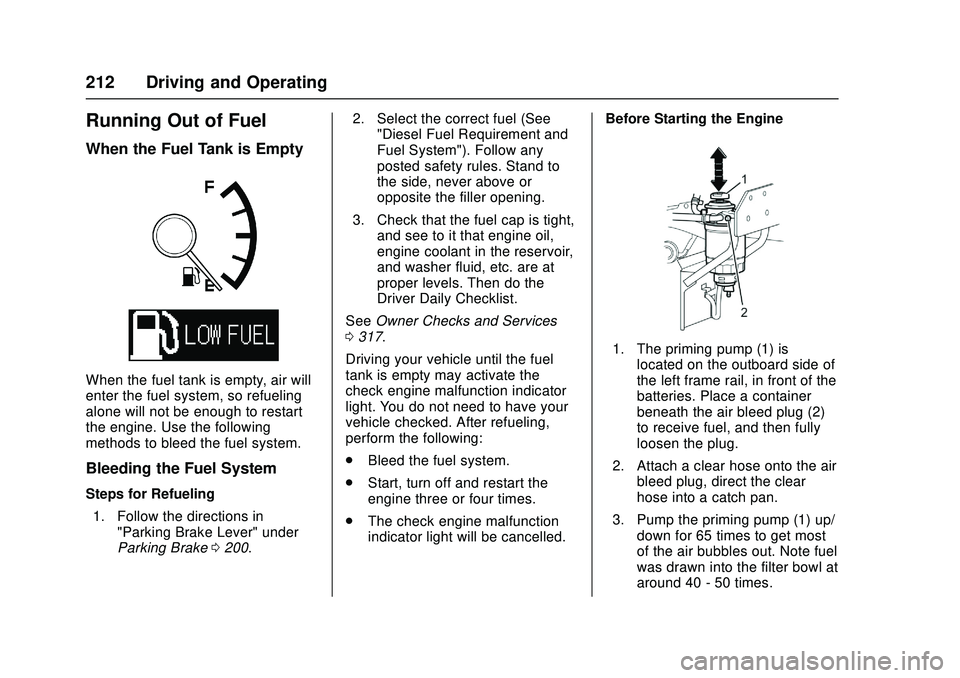
1. The priming pump (1) is
located on the outboard side of
the left frame rail, in front of the
batteries. Place a container
beneath the air bleed plug (2)
to receive fuel, and then fully
loosen the plug.
2. Attach a clear hose onto the air bleed plug, direct the clear
hose into a catch pan.
3. Pump the priming pump (1) up/ down for 65 times to get most
of the air bubbles out. Note fuel
was drawn into the filter bowl at
around 40 - 50 times.
Page 218 of 358

Chevrolet Low Cab Forward Owner Manual (GMNA-Localizing-U.S.-
11254764) - 2018 - crc - 12/5/16
Vehicle Care 217
Vehicle Care
General Information
General Information . . . . . . . . . . 218
California Proposition65 Warning . . . . . . . . . . . . . . . . . 218
California Perchlorate Materials Requirements . . . . . 218
Accessories and Modifications . . . . . . . . . . . . . . . . 218
Vehicle Checks
Doing Your OwnService Work . . . . . . . . . . . . . . . 218
Cab Tilting . . . . . . . . . . . . . . . . . . . . 220
Engine Compartment Overview . . . . . . . . . . . . . . . . . . . . 222
Engine Cover . . . . . . . . . . . . . . . . . 222
Engine Oil . . . . . . . . . . . . . . . . . . . . 223
Automatic Transmission Fluid . . . . . . . . . . . . . . . . . . . . . . . . 229
Engine Air Cleaner/Filter . . . . . . 231
Engine Coolant . . . . . . . . . . . . . . . 231
Engine Overheating . . . . . . . . . . 237
Power Steering Fluid . . . . . . . . . 240
Washer Fluid . . . . . . . . . . . . . . . . . 241
Brakes . . . . . . . . . . . . . . . . . . . . . . . 242
Brake Fluid . . . . . . . . . . . . . . . . . . . 246
Battery . . . . . . . . . . . . . . . . . . . . . . . . 247
Fuel Filter . . . . . . . . . . . . . . . . . . . . 248 Rear Axle (Gear Oil Viscosity
Chart) . . . . . . . . . . . . . . . . . . . . . . . 249
Rear Axle (Oil Level Check) . . . . . . . . . . . . . . . . . . . . . . 249
Noise Control System . . . . . . . . 250
Automatic Transmission Shift
Lock Control Function
Check . . . . . . . . . . . . . . . . . . . . . . . 251
Wiper Blade Replacement . . . . 252
Headlamp Aiming
Headlamp Aiming . . . . . . . . . . . . 254
Bulb Replacement
Bulb Replacement . . . . . . . . . . . . 254
Headlamps and Front Turn Signal . . . . . . . . . . . . . . . . . . . . . . . 257
Roofmarker Lamps . . . . . . . . . . . 261
Sidemarker Lamps (Including Turn Signal and Cornering
Lamps) . . . . . . . . . . . . . . . . . . . . . . 261
Taillamps, Turn Signal, Stoplamps, and Back-Up
Lamps . . . . . . . . . . . . . . . . . . . . . . 263
License Plate Lamp . . . . . . . . . . 263
Interior Lamps . . . . . . . . . . . . . . . . 264
Electrical System
Electrical System Overload . . . 264
Wheels and Tires
Wheels and Tires . . . . . . . . . . . . . 272 Tire Pressure . . . . . . . . . . . . . . . . . 284
Tire Rotation . . . . . . . . . . . . . . . . . 284
If a Tire Goes Flat . . . . . . . . . . . . 287
Jump Starting
Jump Starting - North
America . . . . . . . . . . . . . . . . . . . . . 287
Towing the Vehicle
Towing the Vehicle . . . . . . . . . . . 291
Appearance Care
Exterior Care . . . . . . . . . . . . . . . . . 293
Interior Care . . . . . . . . . . . . . . . . . . 299
Page 220 of 358

Chevrolet Low Cab Forward Owner Manual (GMNA-Localizing-U.S.-
11254764) - 2018 - crc - 12/5/16
Vehicle Care 219
Warning (Continued)
vehicle or its equipment. If you
have any questions about
carrying out some service, have
the work done by a skilled
technician.
To prevent personal injury, keep
hands, tools and clothing clear of
the engine cooling fan when the
engine is running.
The engine, exhaust pipe and
radiator will be hot immediately
after the vehicle is driven. Be
careful around these parts to
prevent burns. Perform all checks
when the engine is cold.
Do not perform work near an
open flame or other heat sources.
Do not let the engine run in poorly
ventilated garages or sheds. This
could cause carbon monoxide
poisoning.(Continued)
Warning (Continued)
Performing maintenance work on
a truck or chassis can be
dangerous. In trying to do some
jobs, you can be seriously injured.
Do your own maintenance work
only if you have the required
know-how and the proper tools
and equipment for the job. If you
have any doubts, contact your
dealer.
You and others could be seriously
injured.
Pull firmly on the parking brake
lever and move the selector lever to
"P" and make sure the shift indicator
displays "P".
Make sure to turn off the engine and
remove the key from the engine
control switch before performing any
checks.
Select a place with a solid and level
surface to perform the checking and
maintenance work. Make sure to chock the wheels. It would be very
dangerous if the vehicle started
to move.
When performing work on the
electrical system, begin by turning
the engine control switch to the
"LOCK" position, wait at least
3 minutes, and then disconnect the
negative cable from the negative
terminal on battery. If the negative
cable is disconnected within
3 minutes, the engine control
module may malfunction.
When working on the fuel line or
fuel filter, remove the fuel tank filler
cap. The fuel system is under
pressure and the fuel will overspill
unless the pressure is relieved,
possibly leading to combustion or
a fire.
Do not make engine adjustments
yourself. Be sure to consult your
dealer.
Use only appropriate tools.
Oils, brake fluid and engine coolant
have lubrication, cooling and rust
prevention functions. If these liquids
deteriorate through loss or
Page 224 of 358
Chevrolet Low Cab Forward Owner Manual (GMNA-Localizing-U.S.-
11254764) - 2018 - crc - 12/5/16
Vehicle Care 223
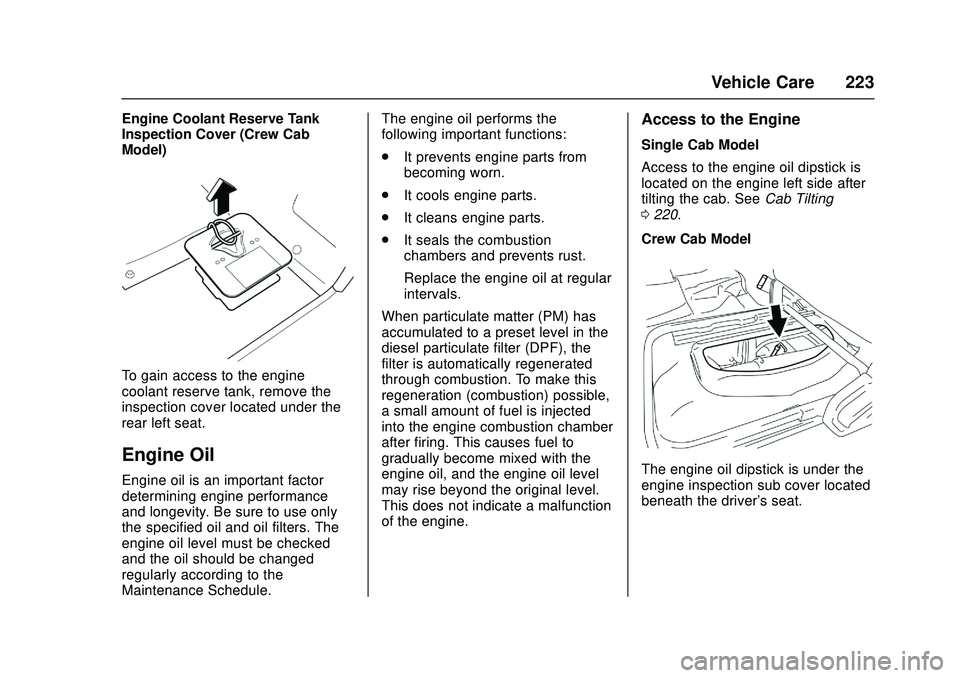
Engine Coolant Reserve Tank
Inspection Cover (Crew Cab
Model)
To gain access to the engine
coolant reserve tank, remove the
inspection cover located under the
rear left seat.
Engine Oil
Engine oil is an important factor
determining engine performance
and longevity. Be sure to use only
the specified oil and oil filters. The
engine oil level must be checked
and the oil should be changed
regularly according to the
Maintenance Schedule.The engine oil performs the
following important functions:
.
It prevents engine parts from
becoming worn.
. It cools engine parts.
. It cleans engine parts.
. It seals the combustion
chambers and prevents rust.
Replace the engine oil at regular
intervals.
When particulate matter (PM) has
accumulated to a preset level in the
diesel particulate filter (DPF), the
filter is automatically regenerated
through combustion. To make this
regeneration (combustion) possible,
a small amount of fuel is injected
into the engine combustion chamber
after firing. This causes fuel to
gradually become mixed with the
engine oil, and the engine oil level
may rise beyond the original level.
This does not indicate a malfunction
of the engine.
Access to the Engine
Single Cab Model
Access to the engine oil dipstick is
located on the engine left side after
tilting the cab. See Cab Tilting
0 220.
Crew Cab Model
The engine oil dipstick is under the
engine inspection sub cover located
beneath the driver's seat.
Page 226 of 358

Chevrolet Low Cab Forward Owner Manual (GMNA-Localizing-U.S.-
11254764) - 2018 - crc - 12/5/16
Vehicle Care 225
If the engine has been running, wait
at least 30 minutes before checking.
Adding the Engine Oil
When the engine oil level is near or
below the "MIN" mark on the oil
dipstick, remove the oil filler cap (1)
and add the oil. Remove the oil
dipstick (2) at this time. Use only the
specified engine oil.
Caution
When adding oil, be careful not to
spill any, but keep a workshop rag
handy just in case there are any
spills. If any oil should spill onto
the engine, carefully wipe it away.
If this precaution is not taken, the
spilled oil could ignite and a fire
could spread.
Do not leave flammable items,
such as rags or gloves, in the
engine compartment. They could
cause a fire. You and others could
be seriously injured.
Engine oil lubricates and cools the
engine's internal components. The
quality of the oil is degraded and the
quantity of oil is reduced by
evaporation, discharge and
combustion during the operation of
the engine. Continually using the
same oil without checking the level,
or without replenishing and
changing it could cause seizure or
damage to the engine. Prevent dirt from entering the filler
port when adding the oil. If foreign
matter mixes with the oil, it could
damage the engine.
Adding oil above the "FULL" mark
on the oil dipstick could result in
faulty engine operation. Be sure to
check the oil level by using the oil
dipstick.
Failure to use the recommended
engine oil could result in engine or
DPF breakdown, or in poor fuel
efficiency. Be sure to use the
recommended engine oil.
Choosing the Right Quality Oil
If you do not use the oil intended for
a vehicle equipped with a Diesel
Particulate Filter (DPF), both the
engine and the DPF may break
down and fuel economy may
decrease. Be sure, therefore, to use
the oil intended for vehicles
equipped with DPF.
GM recommends engine oil that
supports DPF (Low ash oil). Use of
engine oil that does not support low
ash will increase the PM produced
by engine combustion.
Page 227 of 358
Chevrolet Low Cab Forward Owner Manual (GMNA-Localizing-U.S.-
11254764) - 2018 - crc - 12/5/16
226 Vehicle Care
Consequently, the maintenance
interval of the DPF filter will be
reduced.
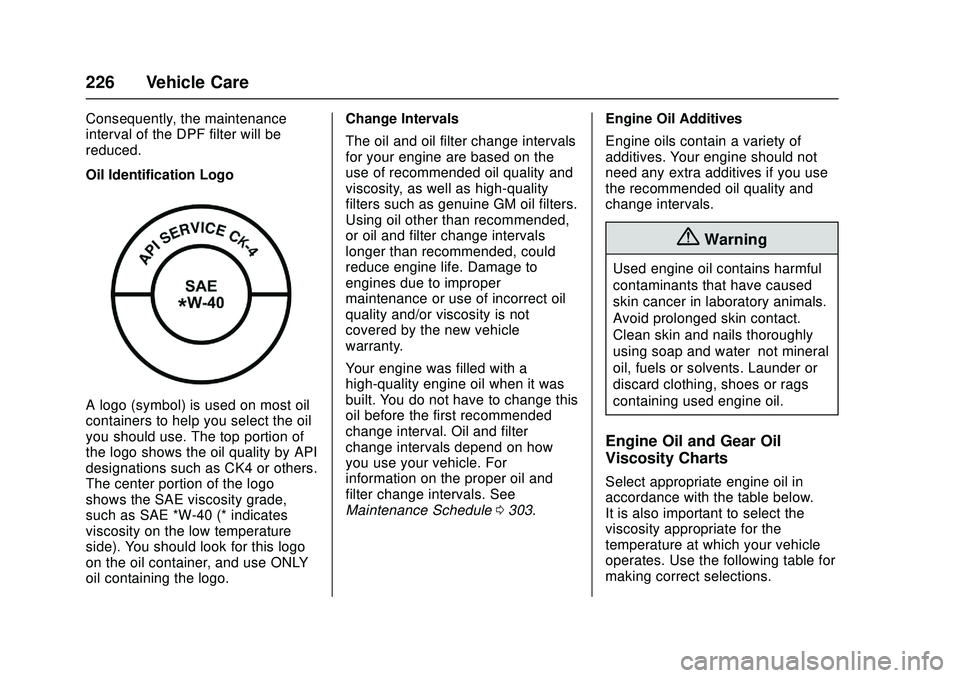
Oil Identification Logo
A logo (symbol) is used on most oil
containers to help you select the oil
you should use. The top portion of
the logo shows the oil quality by API
designations such as CK4 or others.
The center portion of the logo
shows the SAE viscosity grade,
such as SAE *W-40 (* indicates
viscosity on the low temperature
side). You should look for this logo
on the oil container, and use ONLY
oil containing the logo.Change Intervals
The oil and oil filter change intervals
for your engine are based on the
use of recommended oil quality and
viscosity, as well as high-quality
filters such as genuine GM oil filters.
Using oil other than recommended,
or oil and filter change intervals
longer than recommended, could
reduce engine life. Damage to
engines due to improper
maintenance or use of incorrect oil
quality and/or viscosity is not
covered by the new vehicle
warranty.
Your engine was filled with a
high-quality engine oil when it was
built. You do not have to change this
oil before the first recommended
change interval. Oil and filter
change intervals depend on how
you use your vehicle. For
information on the proper oil and
filter change intervals. See
Maintenance Schedule
0303. Engine Oil Additives
Engine oils contain a variety of
additives. Your engine should not
need any extra additives if you use
the recommended oil quality and
change intervals.
{Warning
Used engine oil contains harmful
contaminants that have caused
skin cancer in laboratory animals.
Avoid prolonged skin contact.
Clean skin and nails thoroughly
using soap and water–not mineral
oil, fuels or solvents. Launder or
discard clothing, shoes or rags
containing used engine oil.
Engine Oil and Gear Oil
Viscosity Charts
Select appropriate engine oil in
accordance with the table below.
It is also important to select the
viscosity appropriate for the
temperature at which your vehicle
operates. Use the following table for
making correct selections.