weight CHEVROLET LOW CAB FORWARD 2018 User Guide
[x] Cancel search | Manufacturer: CHEVROLET, Model Year: 2018, Model line: LOW CAB FORWARD, Model: CHEVROLET LOW CAB FORWARD 2018Pages: 358, PDF Size: 6.32 MB
Page 251 of 358
Chevrolet Low Cab Forward Owner Manual (GMNA-Localizing-U.S.-
11254764) - 2018 - crc - 12/5/16
250 Vehicle Care
Checking the Oil Level
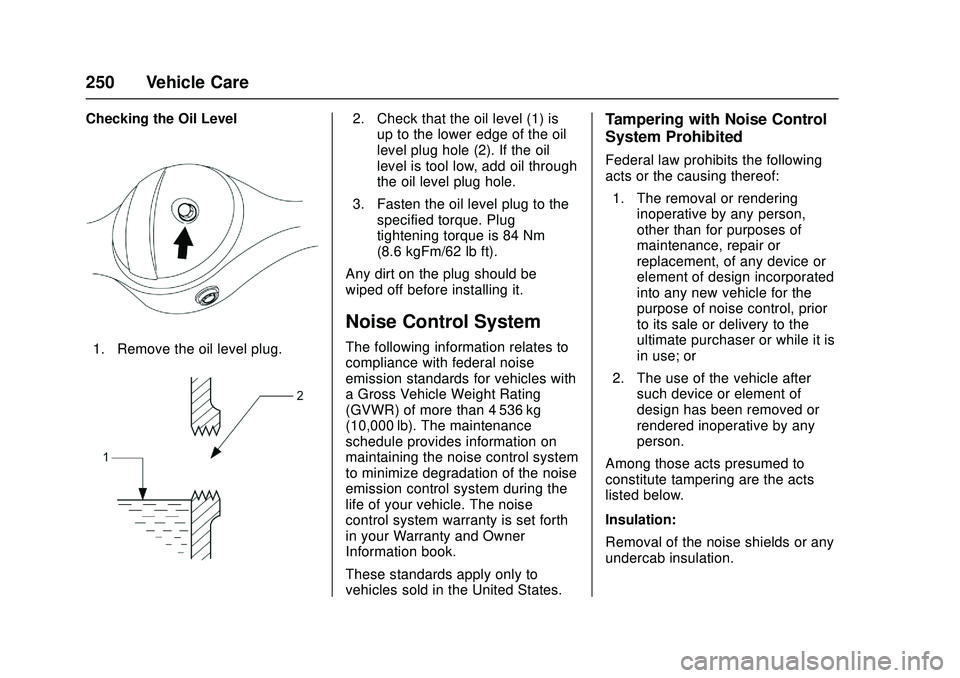
1. Remove the oil level plug.
2. Check that the oil level (1) isup to the lower edge of the oil
level plug hole (2). If the oil
level is tool low, add oil through
the oil level plug hole.
3. Fasten the oil level plug to the specified torque. Plug
tightening torque is 84 Nm
(8.6 kgFm/62 lb ft).
Any dirt on the plug should be
wiped off before installing it.
Noise Control System
The following information relates to
compliance with federal noise
emission standards for vehicles with
a Gross Vehicle Weight Rating
(GVWR) of more than 4 536 kg
(10,000 lb). The maintenance
schedule provides information on
maintaining the noise control system
to minimize degradation of the noise
emission control system during the
life of your vehicle. The noise
control system warranty is set forth
in your Warranty and Owner
Information book.
These standards apply only to
vehicles sold in the United States.
Tampering with Noise Control
System Prohibited
Federal law prohibits the following
acts or the causing thereof: 1. The removal or rendering inoperative by any person,
other than for purposes of
maintenance, repair or
replacement, of any device or
element of design incorporated
into any new vehicle for the
purpose of noise control, prior
to its sale or delivery to the
ultimate purchaser or while it is
in use; or
2. The use of the vehicle after such device or element of
design has been removed or
rendered inoperative by any
person.
Among those acts presumed to
constitute tampering are the acts
listed below.
Insulation:
Removal of the noise shields or any
undercab insulation.
Page 274 of 358
Chevrolet Low Cab Forward Owner Manual (GMNA-Localizing-U.S.-
11254764) - 2018 - crc - 12/5/16
Vehicle Care 273
Tire Inflation
{Warning
To reduce the risk of loss of
vehicle control and personal
injury:
Tires must be properly inflated,
and your vehicle must not be
overloaded (see the information
onInformation on Loading the
Vehicle 058 and "Tire Load and
Inflation Table" under Tire
Pressure 0284).
Be sure to keep tires properly
inflated. A tire that is run while
seriously underinflated may
overheat to the point where the
tire may lose air suddenly and/or
catch fire, possibly resulting in
personal injury and/or property
damage.
See “Tire Load and Inflation Table”
under Tire Pressure 0284. In no case should the front or rear
tire load exceed the maximum
recommended gross axle weight
rating (front GAWR or rear GAWR).
The efficiency of the vehicle will be
upset if air pressure in the tires are
not equal. Balanced inflation results
when the tires on the same axle
carry the same air pressure.
A difference in pressure between
the front and rear tires may be
permissible within certain limitations,
however, there should not be a
difference in pressures between the
right and left tires on the same axle.
Always use a truck tire pressure
gauge (a pocket-type gauge is not
advised) when checking inflation
pressures. Visual inspection of tires
for inflation pressures is not enough,
especially in the case of radial tires.
Underinflated radial tires may look
similar to correctly inflated radial
tires. If the inflation pressure on a
tire is found to be low frequently,
have your dealer correct the cause.
Be sure to install the tire inflation
valve caps to prevent dirt and
moisture from getting into the valve core, which could cause air leakage.
An underinflated tire in a dual wheel
assembly is harder to notice than
one in a single wheel assembly. The
properly inflated dual tire carries its
own load plus that of the
underinflated tire. Both tires can
overheat, which may result in
property damage and/or personal
injury (see previous WARNING).
Tires Used or Stored for a Long
Period of Time
Tires are a rubber product and
degrade over time, even if they are
not being used. If any of your tires is
5 to 7 years old or more, please
have them inspected for safe
driving. For further information,
please check with the tire
manufacturer.
Dual Tire Operation
The outer tire of a pair on dual
wheel installations generally wears
faster than the inner tire. If this
occurs, reverse the position of the
tires to equalize wear and get better
tire life.
Page 275 of 358
Chevrolet Low Cab Forward Owner Manual (GMNA-Localizing-U.S.-
11254764) - 2018 - crc - 12/5/16
274 Vehicle Care
In addition, when trucks are driven
continuously on high-crown roads,
an increase in air pressure of
35 kPa (5 psi) in the outer tire of a
dual tire operation will prolong outer
tire life. Be sure not to exceed the
inflation pressure limits shown on
the“VIN, Weight Rating, and
Greenhouse Gas (GHG) Emissions
Plate.” SeeVehicle Identification
Number (VIN) 0330.
Wheel and Tire Balancing
Proper tire balancing provides the
best riding comfort and helps to
reduce tire tread wear.
Out-of-balance tires can cause
annoying vehicle vibration and
uneven tire wear, such as cupping
and flat spots. See your authorized
dealer for wheel balancing.
Front End Alignment
Proper front end alignment improves
tire tread mileage. Your vehicle's
front end suspension parts should
be inspected often and aligned
when needed. (See the
Maintenance Schedule for more
information.) Improper alignment will
not cause the vehicle to vibrate; however, improper toe-in alignment
will cause front tires to roll at an
angle that will result in faster tire
wear. Incorrect caster or camber
alignment will cause your front tires
to wear unevenly, and may cause
the vehicle to "pull" to the left or
right.
Tire Traction
A decrease in driving, cornering and
braking traction occurs when water,
snow, ice, gravel or other material is
on the road surface. Driving
practices and vehicle speed should
be adjusted to the road conditions.
When driving on wet or slushy
roads, it is possible for a wedge of
water to build up between the tire
and road surface. This is known as
hydroplaning, and may cause partial
or complete loss of traction, vehicle
control and stopping ability; this
condition is also more likely with
worn tires.
To reduce the chance of traction
loss, follow these tips:
.
Slow down during rainstorms or
when roads are slushy. .
Slow down if the road has
standing water or puddles.
. Replace tires when front tread
depth is 3.2 mm (4/32 in.) and
rear tread depth is 1.6 mm
(2/32 in.).
. Keep tires properly inflated.
Tire Replacement
Recommendations
{Warning
Do not mix different construction
types of tires on your vehicle such
as radial, bias and bias-belted
tires except in emergencies,
because vehicle handling could
be affected and may result in loss
of vehicle control, or personal
injury or death.
Consult your dealer before
replacing wheels. Never use
wheels that are not designed for
the vehicle. Doing so would
impede safe vehicle operation.
Page 277 of 358
Chevrolet Low Cab Forward Owner Manual (GMNA-Localizing-U.S.-
11254764) - 2018 - crc - 12/5/16
276 Vehicle Care
Recommended replacement tire for Greenhouse Gas (GHG) emissions
Tire sizeTire makerTire name Rolling
resistance
LT215/85R16E BRIDGESTONE CORPORATION
Duravis R250 LRRA
THE YOKOHAMA RUBBER CO., LTD. TY213A MC2 LRRA
225/70R19.5F BRIDGESTONE CORPORATION
M895Z LRRA
THE YOKOHAMA RUBBER CO., LTD. TY287 MC2 LRRA
If the original equipment tires are
low rolling tires, it is recommended
to use the LRRA tires shown in the
above table.
Refer to the emission control
identifiers on Greenhouse Gas
(GHG) emission plate for your
original equipment tires. Also,
please refer to “VIN, Weight Rating,
and Greenhouse Gas (GHG)
Emissions Plate” for the location of
the Greenhouse Gas (GHG)
emission plate. See Vehicle
Identification Number (VIN) 0330. Wheel Replacement
Recommendations
Wheels must be replaced if they
become damaged (for example:
bent, heavily rusted, leak air) or if
wheel nuts often become loose. Do
not use bent wheels that have been
straightened and do not use inner
tubes in leaking wheels which are
designed for tubeless tires. Such
wheels may have structural damage
and could fail without warning.
When replacing wheels for any
reason, the new wheels should be
equal in load capacity, diameter,
width, offset and mounting types to
those originally installed in your
vehicle. A wheel of the wrong size or type
may adversely affect wheel and
bearing life, brake cooling,
speedometer/odometer calibration,
stopping ability, headlight aim,
bumper height, vehicle ground
clearance and tire or tire chain
clearance on the body and chassis.
Replacement with "used" wheels is
not advised. They may have been
subjected to harsh treatment or very
high mileage and could fail without
warning.
Page 278 of 358
Chevrolet Low Cab Forward Owner Manual (GMNA-Localizing-U.S.-
11254764) - 2018 - crc - 12/5/16
Vehicle Care 277
{Warning
Consult your dealer before
replacing wheels. Never use
wheels that are not designed for
the vehicle. Doing so would
impede safe vehicle operation.
The use of wheels and/or tires with
higher load carrying limits than
originally equipped on your vehicle
does not in itself increase the
GAWR or the GVWR of the vehicle.
Replacement wheels can be
obtained from the authorized dealer
or tire dealer. Checking Tires
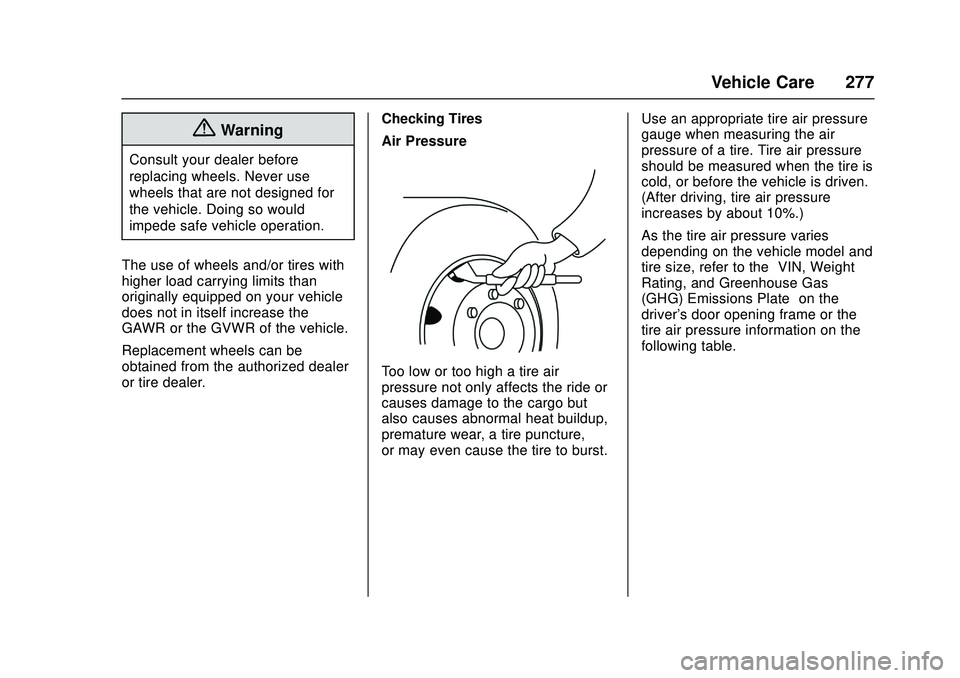
Air Pressure
Too low or too high a tire air
pressure not only affects the ride or
causes damage to the cargo but
also causes abnormal heat buildup,
premature wear, a tire puncture,
or may even cause the tire to burst.Use an appropriate tire air pressure
gauge when measuring the air
pressure of a tire. Tire air pressure
should be measured when the tire is
cold, or before the vehicle is driven.
(After driving, tire air pressure
increases by about 10%.)
As the tire air pressure varies
depending on the vehicle model and
tire size, refer to the
“VIN, Weight
Rating, and Greenhouse Gas
(GHG) Emissions Plate” on the
driver's door opening frame or the
tire air pressure information on the
following table.
Page 279 of 358
Chevrolet Low Cab Forward Owner Manual (GMNA-Localizing-U.S.-
11254764) - 2018 - crc - 12/5/16
278 Vehicle Care
Tire sizeTire air pressure
kPa (psi) GVW
kg (lb.)
Front RearFront Rear
LT215/85R16E LT215/85R16E 550 (80)550 (80) 6 577
(14,500)
225/70R19.5F 225/70R19.5F 590 (85)590 (85) 7 258
(16,000)
225/70R19.5F 225/70R19.5F 620 (90)620 (90) 8 142
(17,950)
225/70R19.5F 225/70R19.5F 660 (95)660 (95) 8 845
(19,500)
See “VIN, Weight Rating, and
Greenhouse Gas (GHG) Emissions
Plate” underVehicle Identification
Number (VIN) 0330.
See “Tire Load and Inflation Table”
under Tire Pressure 0284.
{Warning
Insufficiently inflated or worn-out
tires are highly dangerous as they
easily skid and can even burst.
(Continued)
Warning (Continued)
Should they burst, the tires may
burn and this could cause a fire in
the vehicle.
If you drive on under-inflated or
flat tires, the wheel studs will be
placed under excessive stress.
Under such conditions, the bolts
(Continued)
Warning (Continued)
may break and the wheel may
detach from the vehicle, possibly
causing an accident.
Over-inflated tires result in a
harsh ride and are likely to cause
damage to the cargo.
Under-inflated tires build up heat(Continued)
Page 282 of 358
Chevrolet Low Cab Forward Owner Manual (GMNA-Localizing-U.S.-
11254764) - 2018 - crc - 12/5/16
Vehicle Care 281
Damaged Tires
{Danger
It is dangerous to mount the
wrong size tire on a wheel. If you
do so, the tire/wheel can explode
as air is being added. This
explosion may result in severe
personal injury or death. To learn
which wheels and tires are
correct, look at the "VIN, Weight
Rating, and Greenhouse Gas
(GHG) Emissions Plate" on the
left side rear pillar panel below
the striker (single cab) or on the
left center pillar panel beside the
shoulder seat belt anchor (crew
cab). Wheel size is also stamped
on the side of each wheel.
To help avoid personal injury and
property damage if a wheel must
be changed, seek expert tire
services if you can. If you must
remove the wheel without any
such help, do the following:(Continued)
Danger (Continued)
.If the tire looks as if it may
be underinflated, stand to
the side and check whether
the wheel assembly
appears normal by
comparing it to another
wheel assembly on the
vehicle.
. Let the air out of the tire by
taking out the valve core.
If you have a way to put air
back in a tire, note that it is
good safety practice to let
the air out of both tires of a
dual assembly before taking
off the damaged tire and rim
assembly from the vehicle.
After letting out the air, take
off the tire and rim assembly
and install a spare tire and
rim assembly.
If your vehicle is equipped
with a differential lock
system or limited slip
differential (LSD), it might
(Continued)
Danger (Continued)
start moving when the
engine power is transmitted
to the rear axle even when
one of the wheels on the
axle is raised clear of the
ground. Do not start the
engine with any rear wheel
in contact with the ground.
If you are not fully
experienced on the
procedures to follow, and/or
are not equipped with the
proper tools and equipment,
again, do not attempt to
raise the vehicle, or remove
or install the tire and wheel
assembly—seek expert tire
services.
. Do not put air back in a tire
that has been run flat, or is
seriously low on air, without
first having the tire taken off
the wheel and the tire
checked for damage.
(Continued)
Page 294 of 358
Chevrolet Low Cab Forward Owner Manual (GMNA-Localizing-U.S.-
11254764) - 2018 - crc - 12/5/16
Vehicle Care 293
After Towing
After towing the vehicle, block the
rear wheels and install axle shafts
or driveshaft.
Apply the parking brake before
disconnecting from the towing
vehicle. Check and fill rear axle with
oil, if required.
Rear End Towing
When towing a vehicle with rear
wheels raised, secure the steering
wheel to maintain straight-ahead
position. Make certain that the front
axle is not loaded beyond the front
axle gross axle weight rating
(GAWR) as indicated on the
vehicle's VIN and weight rating
plate.
Special Towing Instructions1. All state and local laws regarding such items as
warning signals, night
illumination, speed, etc., must
be followed. 2. Safety chains must be used.
3. No vehicle should ever be
towed over 88 km/h (55 mph).
4. Loose or protruding parts of damaged vehicles should be
secured prior to moving.
5. A safety chain system completely independent of the
primary lifting and towing
attachment must be used.
6. Operators should refrain from going under a vehicle which is
being lifted by the towing
equipment unless the vehicle is
adequately supported by safety
stands.
7. No towing operation which for any reason jeopardizes the
safety of the wrecker operator
or any bystanders or other
motorists should be attempted.Appearance Care
Exterior Care
Exterior Finish
The paint finish on your vehicle
provides beauty, depth of color,
gloss retention and durability.
While cleaning the vehicle, do not
grip the roofmarker lights to prevent
damage or water leakage.
Washing
The best way to preserve your
vehicle's finish is to keep it clean by
washing it often.
Wash the vehicle in lukewarm or
cold water. Do not use hot water or
wash your vehicle in the direct rays
of the sun. Do not use strong soap
or chemical detergents. All cleaning
agents should be flushed promptly
from the surface and not allowed to
dry on the finish.
These vehicles are designed to
operate under normal environmental
conditions to withstand natural
elements. However, unusual
Page 331 of 358
Chevrolet Low Cab Forward Owner Manual (GMNA-Localizing-U.S.-
11254764) - 2018 - crc - 12/5/16
330 Technical Data
Technical Data
Vehicle Identification
Vehicle IdentificationNumber (VIN) . . . . . . . . . . . . . . . 330
Vehicle Data
Capacities andSpecifications . . . . . . . . . . . . . . . 335
Engine Drive Belt Routing . . . . 341
Vehicle Identification
Vehicle Identification
Number (VIN)
The VIN and engine number are
necessary for registering your
vehicle. They are also necessary
when your vehicle undergoes official
inspections. Provide your dealer
with these numbers when you are
having the vehicle repaired or when
ordering replacement parts. The
Dealer will be able to do the
requested jobs more competently
and quickly.
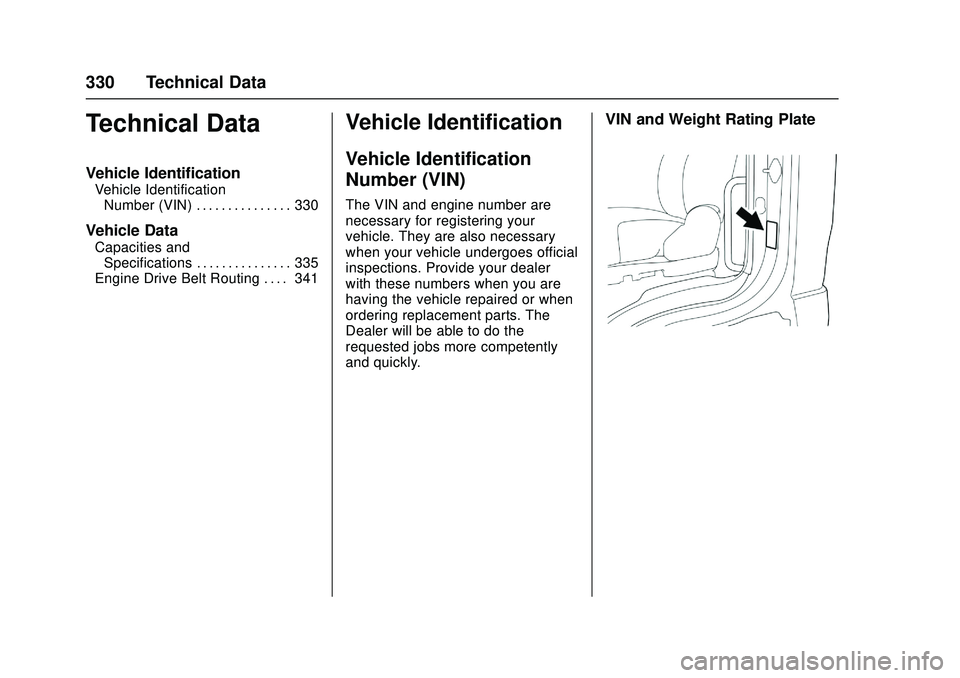
VIN and Weight Rating Plate
Page 332 of 358

Chevrolet Low Cab Forward Owner Manual (GMNA-Localizing-U.S.-
11254764) - 2018 - crc - 12/5/16
Technical Data 331
The "Vehicle Certification and
Greenhouse Gas (GHG) Emissions
Plate" shows the manufacturer's
gross vehicle weight rating (GVWR),
the front and rear gross axle weightratings (GAWRs), as well as the VIN
and emissions information for your
vehicle.
This plate is located on the left side
rear pillar panel below the striker
(single cab) or on the left center
pillar panel beside the shoulder seat
belt anchor (crew cab).
The VIN is a legal identifier of your
vehicle. It not only appears on the
VIN plate; but also on the vehicle
certificates of title and registration.
The VIN specifically identifies a
vehicle by code.
See
“Overloading” underInformation
on Loading the Vehicle 058.
The VIN contains multiple pieces of
information including the vehicle
and engine model codes as shown
below.