ECO mode CHEVROLET LOW CAB FORWARD 2018 Owner's Guide
[x] Cancel search | Manufacturer: CHEVROLET, Model Year: 2018, Model line: LOW CAB FORWARD, Model: CHEVROLET LOW CAB FORWARD 2018Pages: 358, PDF Size: 6.32 MB
Page 156 of 358
Chevrolet Low Cab Forward Owner Manual (GMNA-Localizing-U.S.-
11254764) - 2018 - crc - 12/5/16
Driving and Operating 155
Engine Alarm and
Automatic Shutdown
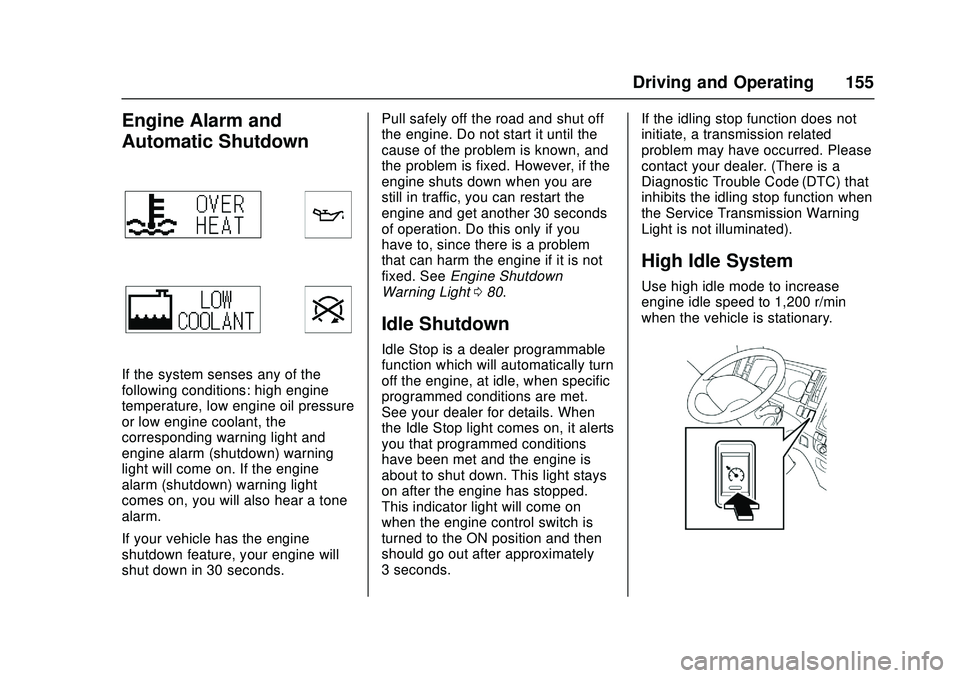
If the system senses any of the
following conditions: high engine
temperature, low engine oil pressure
or low engine coolant, the
corresponding warning light and
engine alarm (shutdown) warning
light will come on. If the engine
alarm (shutdown) warning light
comes on, you will also hear a tone
alarm.
If your vehicle has the engine
shutdown feature, your engine will
shut down in 30 seconds.Pull safely off the road and shut off
the engine. Do not start it until the
cause of the problem is known, and
the problem is fixed. However, if the
engine shuts down when you are
still in traffic, you can restart the
engine and get another 30 seconds
of operation. Do this only if you
have to, since there is a problem
that can harm the engine if it is not
fixed. See
Engine Shutdown
Warning Light 080.
Idle Shutdown
Idle Stop is a dealer programmable
function which will automatically turn
off the engine, at idle, when specific
programmed conditions are met.
See your dealer for details. When
the Idle Stop light comes on, it alerts
you that programmed conditions
have been met and the engine is
about to shut down. This light stays
on after the engine has stopped.
This indicator light will come on
when the engine control switch is
turned to the ON position and then
should go out after approximately
3 seconds. If the idling stop function does not
initiate, a transmission related
problem may have occurred. Please
contact your dealer. (There is a
Diagnostic Trouble Code (DTC) that
inhibits the idling stop function when
the Service Transmission Warning
Light is not illuminated).
High Idle System
Use high idle mode to increase
engine idle speed to 1,200 r/min
when the vehicle is stationary.
Page 157 of 358

Chevrolet Low Cab Forward Owner Manual (GMNA-Localizing-U.S.-
11254764) - 2018 - crc - 12/5/16
156 Driving and Operating
Activating High Idle Mode
Follow the below procedure to
activate the high idle mode:1. Set the parking brake.
2. Set the selector lever in P (Park) or N (Neutral) position.
3. Do not press the brake pedal. 4. Press the cruise control main
switch to set it to ON. At this
time, the operation indicating
light will turn to green.
5. Turn and hold the cruise control set switch in the SET
position. After approximately
3 seconds the cruise control
set indicator light will begin to
flash slowly and the engine idle
will increase to 1,200 r/min.
Canceling High Idle Mode
Any of the following actions will
cancel high idle mode.
. The cruise control main switch is
set to OFF.
. The brake pedal is pressed.
. The parking brake is released.
. The selector lever is moved from
P (Park) or N (Neutral) position.
. The accelerator pedal is
pressed, accelerating the engine
beyond the engine speed
threshold.
The cruise set indicator light will
stop flashing and the engine speed
will return to normal.
Engine Checks Before
Operating
Checks Before Operating
Allow the engine to warm up before
placing the engine under heavy load
driving. While the engine is warming
up under light load, the following
checks should be made:
1. Observe the red engine oil pressure warning light. The
light should go out when the
engine is running. If it stays on,
shut the engine off and find the
cause.
2. Look at the engine coolant temperature gauge. If the
gauge reaches the H (HOT)
area, stop the engine and find
the cause of the overheating.
3. Check that the battery warning light has gone out. The light
should go off and stay off at
normal idle speeds. If the light
does not go out or comes on
during normal operation, have
the charging system checked.
Page 195 of 358

Chevrolet Low Cab Forward Owner Manual (GMNA-Localizing-U.S.-
11254764) - 2018 - crc - 12/5/16
194 Driving and Operating
Selector Lever
Move the selector lever (2) to make
a shift into each gear position.
P (Parking) :Used when the
vehicle is parked or when starting
the engine. The P position is to be
used with the parking brake. The P
and N positions are the two
positions in which the engine can be
started.
R (Reverse) : Used when backing
up the vehicle. Bring the truck to a
complete stop before moving the
selector to the R position. N (Neutral) :
Can be used when
starting the engine, but for safety,
get in the habit of starting the
engine in the P position. The N
position is used should it become
necessary to tow your truck.
D (Drive) : The D position is for all
normal forward driving. The system
automatically selects the gear
according to the vehicle speed.
Press the overdrive off switch (3) to
switch to the overdrive ON position
for greater fuel economy.
2 (Second) : May be used when
driving on downhill roads or when
the engine brake is required. Select
the 2 position at speeds below
40 km/h (25 MPH) when traveling
down a moderate grade. Return the
selector to the D position for normal
driving.
1 (Low) : Used on steep downhill
roads or when strong engine
braking is required. Return the
selector to the D position for normal
driving.
{Warning
When pulling away, always
visually check the position of the
selector lever for safety.
Only push the button for gear
selection when necessary.
Pushing the button unnecessarily
may result in unintended gear
selection.
Never move the selector to the P
position when the truck is in
motion.
Do not run the vehicle with the
transmission in neutral. Not only
will the engine brake not function,
but the transmission will also be
damaged. You and others could
be seriously injured.
When repeatedly shifting between
forward and reverse gears for a
multiple-point turn, firmly press the
brake pedal and confirm that the
vehicle is completely stopped before
operating the selector lever.
Page 199 of 358
Chevrolet Low Cab Forward Owner Manual (GMNA-Localizing-U.S.-
11254764) - 2018 - crc - 12/5/16
198 Driving and Operating
ABS Operation Indications and
Signs
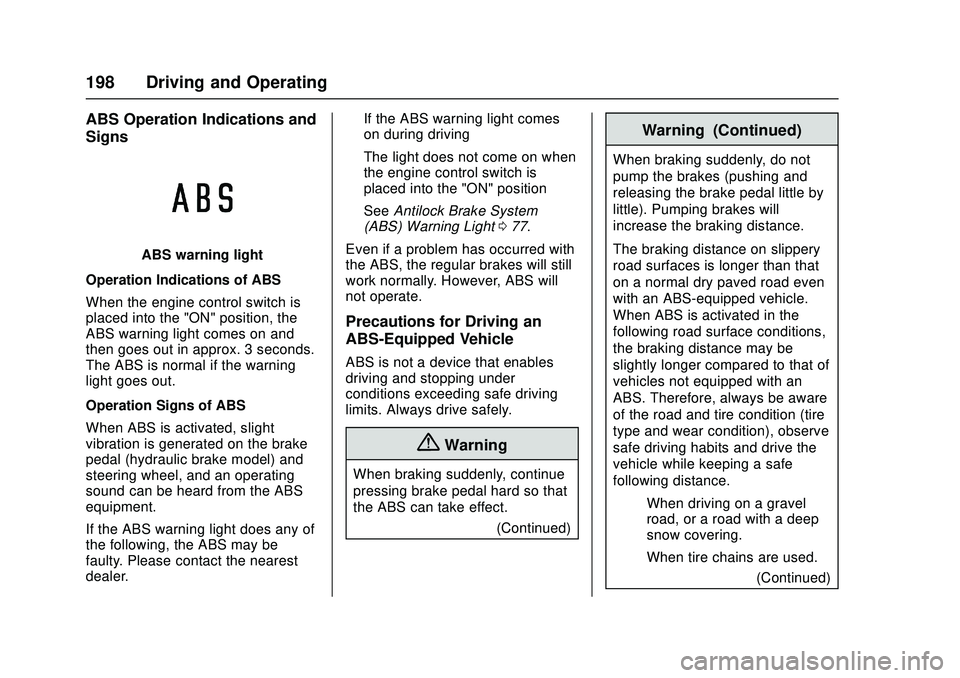
ABS warning light
Operation Indications of ABS
When the engine control switch is
placed into the "ON" position, the
ABS warning light comes on and
then goes out in approx. 3 seconds.
The ABS is normal if the warning
light goes out.
Operation Signs of ABS
When ABS is activated, slight
vibration is generated on the brake
pedal (hydraulic brake model) and
steering wheel, and an operating
sound can be heard from the ABS
equipment.
If the ABS warning light does any of
the following, the ABS may be
faulty. Please contact the nearest
dealer. ‐
If the ABS warning light comes
on during driving
‐ The light does not come on when
the engine control switch is
placed into the "ON" position
See Antilock Brake System
(ABS) Warning Light 077.
Even if a problem has occurred with
the ABS, the regular brakes will still
work normally. However, ABS will
not operate.
Precautions for Driving an
ABS-Equipped Vehicle
ABS is not a device that enables
driving and stopping under
conditions exceeding safe driving
limits. Always drive safely.
{Warning
When braking suddenly, continue
pressing brake pedal hard so that
the ABS can take effect. (Continued)
Warning (Continued)
When braking suddenly, do not
pump the brakes (pushing and
releasing the brake pedal little by
little). Pumping brakes will
increase the braking distance.
The braking distance on slippery
road surfaces is longer than that
on a normal dry paved road even
with an ABS-equipped vehicle.
When ABS is activated in the
following road surface conditions,
the braking distance may be
slightly longer compared to that of
vehicles not equipped with an
ABS. Therefore, always be aware
of the road and tire condition (tire
type and wear condition), observe
safe driving habits and drive the
vehicle while keeping a safe
following distance.
‐ When driving on a gravel
road, or a road with a deep
snow covering.
‐ When tire chains are used.
(Continued)
Page 208 of 358
Chevrolet Low Cab Forward Owner Manual (GMNA-Localizing-U.S.-
11254764) - 2018 - crc - 12/5/16
Driving and Operating 207
"winterized" Number 2-D (a blend of
Number 1-D and Number 2-D). This
blended fuel is usually called
Number 2-D also, but can be used
in colder temperatures than Number
2-D fuel which has not been
"winterized". Check with the service
station operator to be sure you get
the properly blended fuel.
Do not use fuels other than those
recommended in this manual. Doing
so may adversely affect the engine.DIESEL FUEL/APPLICABLE
STANDARD (Sulfur content below 15ppm)
ASTM
(AMERICAN
SOCIETY FOR
TESTING and
MATERIALS) Based on D975
Number 1–D
S15 or Number
2-D S15 (below
15 ppm)
Biodiesel
Biodiesel, may also be referred to
as FAME blended (Fatty-acid methyl
ester) fuel is a renewable fuel
produced from vegetable oils or
animal fats that have been
chemically modified to make it
compatible with diesel fuel.
Caution
Do not use home-made biodiesel
or home test kits because the
quality cannot be verified by
approved scientific methods. Do
not use raw vegetable oil or other
unmodified bio-oils, fats,
or blends of vegetable oil with
diesel. They could damage the
fuel system and engine, and
damages would not be covered
by the vehicle warranty.
Caution
Do not use blends containing
more than 20% biodiesel. Any
engine, fuel system, or exhaust
after-treatment system damage
would not be covered by the
vehicle warranty.
As a renewable fuel, biodiesel
provides some environmental
benefits. However, biodiesel has
unique properties and needs to be handled differently than diesel fuel.
Its use presents additional risks and
may not be appropriate in all
situations. Certain vehicle operating
modes increase these risks and
should be avoided. Read further to
determine if your driving habits are
compatible with the use of biodiesel.
Biodiesel fuel quality degrades with
time and exposure to high
temperature quicker than Ultra Low
Sulfur Diesel fuel. More frequent
refueling provides the best
opportunity to have a supply of fresh
fuel. Storage at hot ambient
temperatures will accelerate
biodiesel degradation.
Owners who use very little fuel,
or who have vehicles or fuel stored
for extended periods of time, should
avoid the use of biodiesel blended
fuels above 5% by volume. When
vehicles are stored for longer than
one month, they should be run out
of biodiesel to below one-quarter
tank, refueled with Ultra Low Sulfur
Diesel fuel, and driven several miles
before storage.
Page 224 of 358
Chevrolet Low Cab Forward Owner Manual (GMNA-Localizing-U.S.-
11254764) - 2018 - crc - 12/5/16
Vehicle Care 223
Engine Coolant Reserve Tank
Inspection Cover (Crew Cab
Model)
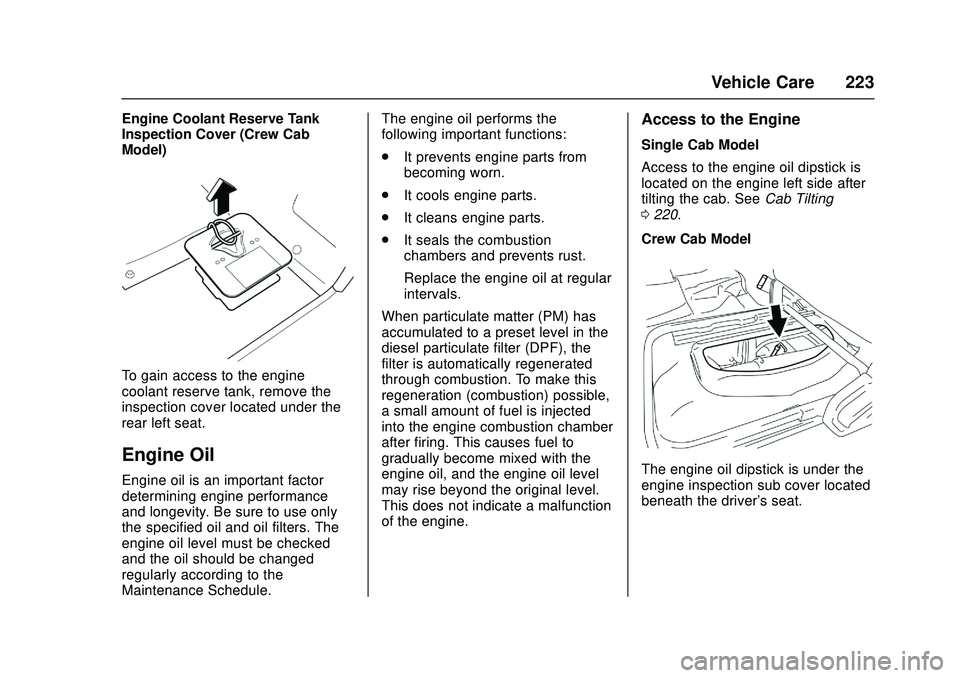
To gain access to the engine
coolant reserve tank, remove the
inspection cover located under the
rear left seat.
Engine Oil
Engine oil is an important factor
determining engine performance
and longevity. Be sure to use only
the specified oil and oil filters. The
engine oil level must be checked
and the oil should be changed
regularly according to the
Maintenance Schedule.The engine oil performs the
following important functions:
.
It prevents engine parts from
becoming worn.
. It cools engine parts.
. It cleans engine parts.
. It seals the combustion
chambers and prevents rust.
Replace the engine oil at regular
intervals.
When particulate matter (PM) has
accumulated to a preset level in the
diesel particulate filter (DPF), the
filter is automatically regenerated
through combustion. To make this
regeneration (combustion) possible,
a small amount of fuel is injected
into the engine combustion chamber
after firing. This causes fuel to
gradually become mixed with the
engine oil, and the engine oil level
may rise beyond the original level.
This does not indicate a malfunction
of the engine.
Access to the Engine
Single Cab Model
Access to the engine oil dipstick is
located on the engine left side after
tilting the cab. See Cab Tilting
0 220.
Crew Cab Model
The engine oil dipstick is under the
engine inspection sub cover located
beneath the driver's seat.
Page 243 of 358

Chevrolet Low Cab Forward Owner Manual (GMNA-Localizing-U.S.-
11254764) - 2018 - crc - 12/5/16
242 Vehicle Care
Follow the instructions provided with
the windshield washer fluid
regarding the ratio for mixing with
tap water.
Poor quality products, engine
coolant, and soapy water must not
be used. Failure to observe this
precaution can result in nozzle
blockage or damage to painted
surfaces.
The washer should never be used
while the tank is empty. Operating
the washer with the tank empty can
result in motor damage.
Brakes
For the most effective braking and
for maximum life from brake system
components, follow these
suggestions:
.Keep any obstructions from
interfering with brake pedal
travel.
. Keep tires properly inflated.
Improperly inflated tires can
reduce the efficiency of the
brakes. Follow the recommendations for
brake checks in the Maintenance
Schedule.
GM replacement brake lining
material is recommended for this
vehicle to maintain the balance
between front and rear brake
performance. GM replacement
brake parts have been carefully
selected to provide the proper brake
balance for purposes of both
stopping distance and controllability
over the full range of operating
conditions. Installation of front or
rear brake lining material with
performance different from that of
the replacement parts
recommended for this vehicle can
change the intended brake balance
of this vehicle.
Checking the Brake Electric
Vacuum Pump (4500HD/
4500XD Series)
1. Turn the engine control switch
to the "ON" position (do not
start the engine), and press the
brake pedal several times. 2. Check for the noisy sound of
the electric vacuum pump
inside the instrument panel at
the same time as vacuum
warning buzzer sound, and
check that the brake low
vacuum warning light
comes on.
3. Then, start the engine. The main vacuum pump driven by
the engine will start running.
If the electric vacuum pump
operation (noisy sound) and
the vacuum warning buzzer
stop, and the brake low
vacuum warning light goes off
thereafter, the operation is
normal.
4. If you cannot hear the noisy sound or the noisy sound stays
on all the time, have the
vehicle inspected by the
nearest dealer immediately.Hydraulic Brake Booster (HBB)
The 5500HD, 5500XD models are
equipped with an HBB system. HBB
is a brake booster device that
Page 301 of 358
Chevrolet Low Cab Forward Owner Manual (GMNA-Localizing-U.S.-
11254764) - 2018 - crc - 12/5/16
300 Vehicle Care
cleaning products contain these
compounds. Be sure to read
cleaning product labels carefully.
Air fresheners (liquid, solid, gel or
plate types) must not come into
direct contact with, or spill onto,
interior components such as the air
conditioning or audio system.
Compounds contained in these
products can cause discoloration,
staining or peeling of paint.
Glass cleaners that contain these
compounds must not be used to
clean the inside of the windshield or
window glass. To clean the glass,
wipe it using a cloth wet with warm
or cold water.
To avoid possible permanent
discoloration of light colored seats,
Do not let materials with non-fast
colors come into contact with seat
trim materials until these materials
are totally dry. This includes certain
types of casual clothing, such as
colored denims, corduroys, leathers
and suedes; also decorative paper,
With the use of modern trim
materials, it is very important that
you use proper cleaning techniquesand cleaners. Failing to do this on
the first cleaning may result in water
spots, spot rings or setting of stains
or soilage - all of which are more
difficult to remove in a second
cleaning.
Dust and loose dirt that collect on
interior fabric should be removed
often with a vacuum cleaner or soft
bristle brush. Wipe vinyl or leather
trim regularly with a clean, damp
cloth. Normal trim soils, spots or
stains can be cleaned with these
cleaners.
Remember these basic steps before
cleaning:
.
Remove stains as quickly as
possible before they
become "set".
. Use a clean cloth or sponge,
and change to a clean area
often. A soft brush maybe used
if stains persist.
. Use solvent-type cleaners only
in a well ventilated area: also, do
not saturate the stained area. .
If a ring forms after spot
cleaning, clean the entire area
immediately.
. Follow specific instructions on
cleaner labels.
General Cleaning of Soiled or
Water Spotted Fabric Type
Trim with Foam Type Cleaner
Vacuum the area thoroughly to
remove any loose dirt.
Always clean a whole trim panel or
section. Mask surrounding trim
along stitch or welt lines.
Use suds on a clean sponge. Do
not brush wet suede. Do not
saturate the material or rub it
harshly. Immediately after cleaning,
remove suds with a sponge and
rinse with a clean wet sponge. Wipe
off remaining residue with a slightly
damp absorbent towel or cloth.
Important —Immediately after
wiping, force-dry the fabric with an
air hose. A heat dryer or heat lamp
may be used. Use caution with a
heat dryer or lamp to help prevent
damage.
Page 324 of 358

Chevrolet Low Cab Forward Owner Manual (GMNA-Localizing-U.S.-
11254764) - 2018 - crc - 12/5/16
Service and Maintenance 323
Additional
Maintenance and Care
Owner Safety and Routine
Maintenance
Listed below are vehicle checks
which should be made periodically
by either the owner or a qualified
technician to ensure proper
performance and safety of your
vehicle. Take any problems promptly
to a technician for service advice.
For your safety and that of others,
any of the safety-related
components that may have been
damaged in an accident should be
checked and necessary repairs
performed before operating your
vehicle.
At the minimum, these routine
checks should be made every
6 months or 16,000 km
(10,000 miles), whichever comes
first. Whenever repairs are
necessary, have them completed
before operating the vehicle.A: Parking Brake :
Park on a fairly
steep hill and hold the vehicle with
the parking brake only. This checks
holding ability.
Before checking item (B) below, be
sure to have enough room around
the vehicle. Then firmly apply both
the parking brake see Parking
Brake 0200 and the regular brakes.
Do not use the accelerator pedal.
If the engine starts, be ready to turn
off the engine control switch at
once. Take these precautions
because the vehicle could move
without warning and possibly cause
injury or property damage.
B: Starter Safety Switch : Check
by trying to start the engine in each
gear. The starter should crank only
at selector position "P" or "N".
C: Transmission Shift Indicator :
Check that the indicator points to
the gear chosen.
D: Steering : Be alert for any
changes in steering action. An
inspection or service is needed
when: the steering wheel is harder to turn or has too much free play,
or when there are strange sounds
when turning or parking.
E: Wheel Alignment, Balance, and
Tires :
Check tires for abnormal
wear or damage. Also, check for
damaged wheels. A pull right or left
on a straight and level road may
show the need for a wheel
alignment. A vibration of the
steering wheel or seat at normal
highway speeds may mean a wheel
balancing is needed. Check tire
pressure when the tires are "cold,"
at least monthly, and whenever the
vehicle is serviced.
Check the pressure more often if
daily checks show it's needed.
(Refer to "Recommended Daily
(Pre-operation) Inspections" under
Owner Checks and Services 0317).
Change tire pressure as needed
when changing loads.
F: Brakes : Be alert to illumination
of the brake system warning light or
brake low vacuum warning light
(4500HD, 4500XD models) or the
tone alarm, or changes in braking
action, such as repeated pulling to
Page 345 of 358

Chevrolet Low Cab Forward Owner Manual (GMNA-Localizing-U.S.-
11254764) - 2018 - crc - 12/5/16
344 Customer Information
Membership Benefits
E:Download owner manuals and
view vehicle-specific how-to videos.
G: View maintenance schedules,
alerts, and OnStar Vehicle
Diagnostic Information. Schedule
service appointments.
I: View and print dealer-recorded
service records and self-recorded
service records.
D: Select a preferred dealer and
view locations, maps, phone
numbers, and hours.
r: Track your vehicle’s warranty
information.
J: View active recalls by Vehicle
Identification Number (VIN). See
Vehicle Identification Number (VIN)
0 330.
H:View GM Card, SiriusXM
Satellite radio (if equipped), and
OnStar account information (if
equipped).
F: Chat with online help
representatives.
See my.chevrolet.com to register
your vehicle.
GM Mobility
Reimbursement Program
This program is available to
qualified applicants for cost
reimbursement of eligible
aftermarket adaptive equipment
required for the vehicle, such as
hand controls or a wheelchair/
scooter lift for the vehicle.
For more information on the limited
offer, visit www.gmmobility.com or
call the GM Mobility Assistance
Center at 1-800-323-9935. Text
Telephone (TTY) users, call
1-800-833-9935.
Roadside Assistance
Program
Call 1-888-899-1327. (Text
Telephone (TTY): 1-888-889-2438.) Service is available 24 hours a day,
365 days a year.
Calling for Assistance
When calling Roadside Assistance,
have the following information
ready:
.
Your name, home address, and
home telephone number.
. Telephone number of your
location.
. Location of the vehicle.
. Model, year, color, and license
plate number of the vehicle.
. Odometer reading, Vehicle
Identification Number (VIN), and
delivery date of the vehicle.
. Description of the problem.
Coverage
Services are provided for the
duration of the vehicle’s powertrain
warranty.
Anyone driving the vehicle is
covered.