belt CHEVROLET LOW CAB FORWARD 2018 Owner's Guide
[x] Cancel search | Manufacturer: CHEVROLET, Model Year: 2018, Model line: LOW CAB FORWARD, Model: CHEVROLET LOW CAB FORWARD 2018Pages: 358, PDF Size: 6.32 MB
Page 74 of 358
Chevrolet Low Cab Forward Owner Manual (GMNA-Localizing-U.S.-
11254764) - 2018 - crc - 12/5/16
Instruments and Controls 73
needle should stay in the safety
zone. SeeEngine Overheating
0 237.
{Warning
If the engine coolant temperature
gauge shows an overheat
condition or you have any other
reason to suspect the engine may
be overheating, continued
operation of the engine, even for
a short time, may result in a fire
and the risk of personal injury and
severe vehicle damage. Take
immediate action as outlined in
Engine Overheating. See Engine
Overheating 0237.
Caution
If the needle goes up above the
upper limit and enters the H zone,
the engine is likely to overheat.
Immediately pull safely off the
road out of the way of traffic and
(Continued)
Caution (Continued)
take the necessary actions to
deal with engine overheating.
If the needle nears the H zone but
does not cross into it, this is not a
problem, but check the engine
coolant level in the reservoir. Add
engine coolant as necessary.
See “Engine Overheat Warning
Light” under Driver Information
Center (DIC) 082 and Engine
Coolant 0231.
Diesel Exhaust Fluid
(DEF) Gauge
The DEF gauge is part of the Driver
Information Center (DIC). See
Driver Information Center (DIC)
082.
Seat Belt Reminders
Seat Belt Warning Light
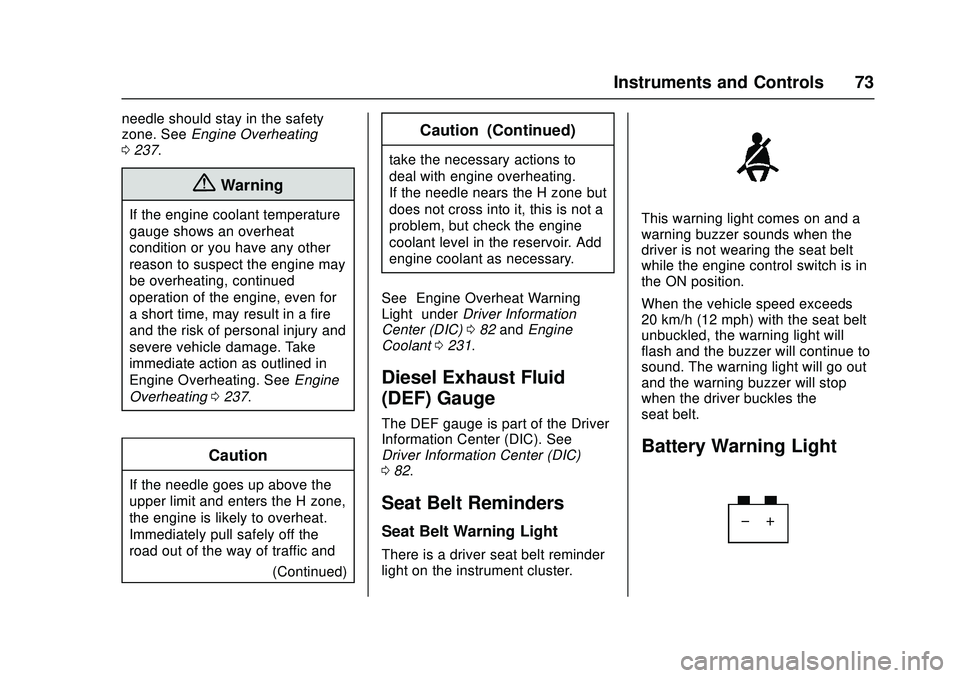
There is a driver seat belt reminder
light on the instrument cluster.
This warning light comes on and a
warning buzzer sounds when the
driver is not wearing the seat belt
while the engine control switch is in
the ON position.
When the vehicle speed exceeds
20 km/h (12 mph) with the seat belt
unbuckled, the warning light will
flash and the buzzer will continue to
sound. The warning light will go out
and the warning buzzer will stop
when the driver buckles the
seat belt.
Battery Warning Light
Page 75 of 358

Chevrolet Low Cab Forward Owner Manual (GMNA-Localizing-U.S.-
11254764) - 2018 - crc - 12/5/16
74 Instruments and Controls
This light comes on briefly when the
ignition is turned on, but the engine
is not running, as a check to show
the light is working. It should go out
when the engine is started.
If the light stays on, or comes on
while driving, there may be a
problem with the electrical charging
system (such as a loose or broken
fan belt). Pull off to a safe place well
clear of traffic and contact your
dealer. Driving while this light is on
could drain the battery.
Check and Corrective Action1. Check to see if the fan belt is broken or loose.
2. If the fan belt is loose, adjust the tension.
3. If the fan belt is broken or there is no abnormality in the fan
belt, see your dealer for
service.
See Battery 0247, Jump Starting -
North America 0287, and Engine
Drive Belt Routing 0341.Malfunction Indicator
Lamp (Check Engine
Light)
This light should come on to show
that it is working when the engine
control switch is turned to the ON
position, and then should go out
after the engine is started.
If this light stays on or comes on
while the engine is running, it
indicates a malfunction with the
engine electronic emission control
system. Avoid driving at high
speeds and have the vehicle
inspected by your dealer.
If this light comes on when the fuel
tank is empty, you do not need to
have your vehicle serviced. See
Running Out of Fuel 0212. If this light comes on intermittently
or continuously while driving,
service is required. Even if the
vehicle is drivable and does not
require towing, see your dealer as
soon as possible. Continued driving
without having the system serviced
could cause damage to the
emission control system. It could
also affect fuel economy and
drivability.Service Vehicle Soon
Light
This light comes on briefly when the
engine control switch is in the ON
position, but the engine is not
running, as a check to show the
light is working. It should go out
when the engine is started.
Page 76 of 358
Chevrolet Low Cab Forward Owner Manual (GMNA-Localizing-U.S.-
11254764) - 2018 - crc - 12/5/16
Instruments and Controls 75
If the light stays on, or comes on
while driving, the vehicle control
system may be malfunctioning. Take
the vehicle to your dealer for service
as soon as possible.
Brake System Warning
Light (Parking Brake
Light)
This light should come on briefly
when the engine control switch is
turned to the ON position, and then
should go out after the engine is
started.
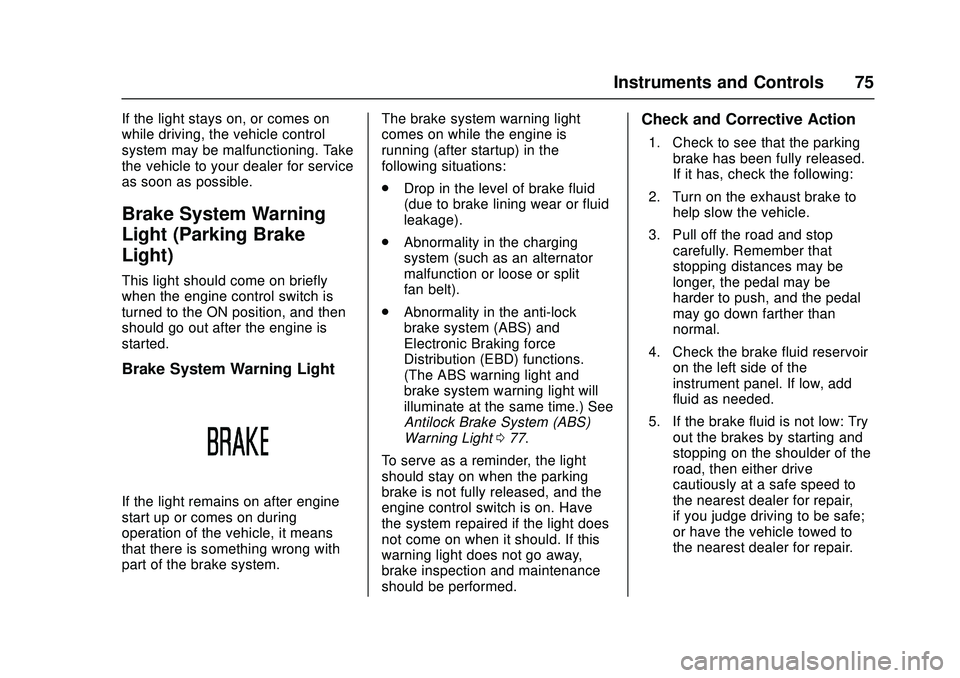
Brake System Warning Light
If the light remains on after engine
start up or comes on during
operation of the vehicle, it means
that there is something wrong with
part of the brake system.The brake system warning light
comes on while the engine is
running (after startup) in the
following situations:
.
Drop in the level of brake fluid
(due to brake lining wear or fluid
leakage).
. Abnormality in the charging
system (such as an alternator
malfunction or loose or split
fan belt).
. Abnormality in the anti-lock
brake system (ABS) and
Electronic Braking force
Distribution (EBD) functions.
(The ABS warning light and
brake system warning light will
illuminate at the same time.) See
Antilock Brake System (ABS)
Warning Light 077.
To serve as a reminder, the light
should stay on when the parking
brake is not fully released, and the
engine control switch is on. Have
the system repaired if the light does
not come on when it should. If this
warning light does not go away,
brake inspection and maintenance
should be performed.
Check and Corrective Action
1. Check to see that the parking brake has been fully released.
If it has, check the following:
2. Turn on the exhaust brake to help slow the vehicle.
3. Pull off the road and stop carefully. Remember that
stopping distances may be
longer, the pedal may be
harder to push, and the pedal
may go down farther than
normal.
4. Check the brake fluid reservoir on the left side of the
instrument panel. If low, add
fluid as needed.
5. If the brake fluid is not low: Try out the brakes by starting and
stopping on the shoulder of the
road, then either drive
cautiously at a safe speed to
the nearest dealer for repair,
if you judge driving to be safe;
or have the vehicle towed to
the nearest dealer for repair.
Page 77 of 358

Chevrolet Low Cab Forward Owner Manual (GMNA-Localizing-U.S.-
11254764) - 2018 - crc - 12/5/16
76 Instruments and Controls
Continued driving without the
necessary repairs could be
dangerous.
If this warning light stays on, see
your dealer.
The regular braking system is a split
system designed so that one part
will provide some braking if there is
a loss of hydraulic pressure in the
other part of the system.
{Warning
If this warning light comes on
while the engine is running,
immediately stop the vehicle at a
safe place well clear of traffic and
contact your dealer for inspection.
When the brake system warning
light is illuminated, brake
effectiveness may be decreased.
When this happens, strongly
press the brake pedal.
See Brakes 0242.
Parking Brake Light
This indicator light comes on when
the parking brake lever is pulled
with the engine control switch on.
This light also stays on when the
parking brake is not fully released
and the engine control switch is on.
If this warning light stays on, see
your dealer.
The illumination of the parking brake
light does not necessarily ensure
firm application of the parking brake.
The parking brake lever must be
sufficiently pulled up and locked.
Be careful not to drive the vehicle
with the parking brake lever still
pulled up.
Brake Low Vacuum Warning
Light
This light should come on briefly
when the engine control switch is
turned to the ON position, and then
should go out after the engine is
started. If the light does not come
on when the engine control switch is
turned to ON, it could indicate a
burned out bulb or a blown fuse.
Have the system repaired if the light
does not come on during this check.
The warning light and buzzer will
come on simultaneously when the
brake booster ’s vacuum or pressure
becomes insufficient either during
driving or when the engine control
switch is in the ON position, or when
there is an abnormality in the
charging system, such as an
alternator malfunction or loosening
or splitting of the fan belt or
whenever the hydraulic brake
Page 92 of 358

Chevrolet Low Cab Forward Owner Manual (GMNA-Localizing-U.S.-
11254764) - 2018 - crc - 12/5/16
Instruments and Controls 91
the decimal point indicate hours
while the figure on the right side
indicates 1/10 of an hour.
Warning Buzzers
A warning buzzer may not sound if
there is a problem with the buzzer
system. If this occurs, the system
needs to be inspected. See your
dealer.
A warning buzzer sounds under the
following conditions:
.Seat belt —continuous beep.
See Seat Belt Reminders 073.
. Brake booster —continuous
beep. See Brake System
Warning Light (Parking Brake
Light) 075.
. Engine overheat —
continuous beep
. Low engine coolant —beep
. Engine alarm and automatic
shutdown —beep
. Diesel particulate filter (DPF)
switch regeneration —three
short beeps or three long beeps .
Selective catalytic reduction
(SCR) system —one short
beep, three short beeps, nine
quick beeps, continuous beep
See Diesel Exhaust Fluid 0170 and
Engine Alarm and Automatic
Shutdown 0155.
Page 142 of 358

Chevrolet Low Cab Forward Owner Manual (GMNA-Localizing-U.S.-
11254764) - 2018 - crc - 12/5/16
Driving and Operating 141
SymptomCauseCorrective Action Reference
Black exhaust smoke Engine Control system
faulty
4-
The air cleaner clogged
4-
Fuel system faulty
4-
Exhaust system clogged
4-
Exhaust injector
4-
Diesel particulate filter
(DPF) faulty
4-
Engine is overheating No engine coolant Add engine coolant
See
Engine
Coolant 0231
Front of radiator is
clogged with dirt Wash clean with tap
waterSee
Exterior Care
0 293
Radiator cap not
sufficiently tightened Make sure it is firmly
tightened or replace the
radiator cap
-
Fan belt loose Adjust the tension or
replace the beltSee
Engine Drive
Belt Routing 0341
Engine coolant dirty
4-
Fan clutch is faulty
4-
Radiator cap dirty or
faulty Clean or replace -
Page 151 of 358

Chevrolet Low Cab Forward Owner Manual (GMNA-Localizing-U.S.-
11254764) - 2018 - crc - 12/5/16
150 Driving and Operating
Before pulling away, perform a
thorough safety check, making sure
there are no children or obstructions
around the vehicle. Take off the
chocks after confirming that the
parking brake is securely applied.
Sit behind the wheel, adjust the seat
position, and buckle up the seat
belt. The passengers are also
required to buckle up the seat belts.
Adjust the positions of the steering
wheel and mirrors. Lock the doors.
Turn the power of the dome light or
accessories OFF before starting the
engine. SeeSeat Position 038,
Seat Belts 043, Steering Wheel
Adjustment 065, and Mirrors033.
Keep the Floor Around the
Driver's Seat Clean and Tidy
{Warning
It is extremely dangerous to have
empty cans, empty bottles or
other items rolling around on the
floor because they could get
trapped under the brake pedal (Continued)
Warning (Continued)
and prevent brake application.
For proper pedal operation, it is
also essential to lay floor mats
properly. Incorrectly installed floor
mats would hinder free movement
of the pedals.
Do not use the dashboard pocket
or the top of the dashboard as a
place to put items that could roll,
which could interfere with your
driving. You and others could be
seriously injured.
Choose Your Footwear Suitable
for Driving
{Warning
Choose footwear that ensures
proper operation of pedals when
driving the vehicle. Use of
footwear unsuitable for driving
may cause an accident. Starting the Engine
Do not keep the engine control
switch in the START position for
more than about 10 seconds.
Operating the starter for too long
might cause starter and battery
failure or may result in overheating.
When the engine does not start,
wait for 20 to 30 seconds and then
turn the engine control switch again.
Before starting the engine sit in the
driver seat, check that the parking
brake is firmly engaged, the selector
lever is in the P or N (P is preferred)
position and the shift indicator also
shows P or N, and firmly press the
brake pedal to start the engine.
When stopped on a slope, start the
engine with the selector lever in the
P position. See
Ignition Positions
0 148.
1. Make sure that the selector lever is in the P or N position
and firmly press the brake
pedal.
Page 219 of 358

Chevrolet Low Cab Forward Owner Manual (GMNA-Localizing-U.S.-
11254764) - 2018 - crc - 12/5/16
218 Vehicle Care
General Information
Your authorized dealer has trained
technicians and genuine parts to
service your vehicle properly. For
expert advice and quality service,
see your authorized dealer.
California Proposition
65 Warning
Most motor vehicles, including this
one, as well as many of its service
parts and fluids, contain and/or emit
chemicals known to the State of
California to cause cancer and birth
defects or other reproductive harm.
Engine exhaust, many parts and
systems (including some inside the
vehicle), many fluids and some
component wear by-products
contain and/or emit these
chemicals.
California Perchlorate
Materials Requirements
Certain types of automotive
applications, such as airbag
initiators, seat belt pretensioners,
and lithium batteries contained inremote keyless transmitters, may
contain perchlorate materials.
Special handling may be necessary.
For additional information, see
www.dtsc.ca.gov/hazardouswaste/
perchlorate.
Accessories and
Modifications
Factory-Approved Accessories
Your dealer can furnish a wide
range of comfort, convenience, and
safety accessories, especially
designed for you and your new
truck. They can install all of the
safety accessories you will need to
comply with local, state and D.O.T.
regulations and advise you how to
comply with these regulations.
Be sure to ask your authorized
dealer about the accessories.
Vehicle Checks
Doing Your Own
Service Work
Precautions for Checking and
Adjustments
Your authorized dealer has trained
technicians and genuine parts to
service your vehicle properly. For
expert advice and quality service,
see your authorized dealer.
{Warning
To help avoid personal injury, take
care when doing any
maintenance or making any
check or repair. Follow
manufacturer's instructions for all
materials used during service and
maintenance of this vehicle.
If used or handled improperly,
they may be hazardous. Improper
or incomplete service can also
affect the vehicle and result in
personal injury, or damage to the
(Continued)
Page 221 of 358

Chevrolet Low Cab Forward Owner Manual (GMNA-Localizing-U.S.-
11254764) - 2018 - crc - 12/5/16
220 Vehicle Care
contamination, it will cause a
decline in the performance of the
parts and such problems as seizure
or malfunctioning. Replenish or
change these liquids when
performing the checks (daily and
periodic checks) as required by the
relevant regulations or in
accordance with the Maintenance
Schedule (when either the specified
driving distance or period of time,
whichever comes first, has expired).
Confirm that all systems and
components are normal after
performing the work.
Do not leave the removed parts or
tools in the engine compartment.
They could damage the equipment if
caught in the belts or other moving
components.
Dirty water, dirt and other impurities
seriously impair the effectiveness of
the oil, grease and fluids, and
damage the parts. Exercise all due
caution to prevent waste or other
refuse from coming in contact with
parts or materials that have been
removed when changing or
replenishing them.Do not step on the engine or climb
onto it. You could cause an engine
failure by, for example, damaging
the cylinder head cover or various
connectors.
Electric Welding
Careless electric welding of vehicle
parts can cause welding current to
flow back through the vehicle’s
ground circuit and damage electrical
and electronic parts so that they do
not function normally. Whenever
electric welding is necessary,
consult your dealer.
Cab Tilting
Before Tilting the Cab (Single Cab
Model)
{Warning
To help avoid personal injury and
property damage:
(Continued)
Warning (Continued)
.Park the vehicle on level
ground and check that there
is enough space in front of
and above the cab.
. Set the parking brake firmly
and block the front wheels.
. Move the selector lever in
the "P" position.
. Secure loose articles in
the cab.
. Stop the engine.
. Close the cab door.
. Keep the area surrounding
the cab clear.
You and others could be seriously
injured.
Tilting the Cab 1. Check that all personnel are clear of the cab.
2. Read the label on the rear of the cab.
Page 240 of 358
Chevrolet Low Cab Forward Owner Manual (GMNA-Localizing-U.S.-
11254764) - 2018 - crc - 12/5/16
Vehicle Care 239
Warning (Continued)
refilling, and replacement of
coolant only when its temperature
has cooled.
When removing the radiator cap
and reserve tank cap, use a thick
cloth to cover the cap and turn it
little by little.
You and others could be seriously
injured.
4. If no steam or engine coolant can be seen or heard from the
engine compartment:
.Tilt the cab or open the
engine access cover.
‐If the engine coolant is
boiling, wait until it stops
before proceeding.
‐ Look at the see-through
reserve tank. The
engine coolant level
should be between the
"MAX" and "MIN" lines
on the reserve tank. ‐
If necessary, pour
engine coolant (See
Engine Coolant 0231
for the proper coolant
and water mixture) into
the reserve tank only,
not directly into the
radiator. Also, do not
check engine coolant
level at the radiator.
. Make sure the fan belts are
not broken, or off the
pulleys, and that the fan
turns when the engine is
started. Make sure the fan
blade and pulleys are not
broken.
. Check the radiator hoses
and connections, heater
hoses and connections,
radiator, water pump, EGR
cooler, and SCR system
and hoses for leakage.
If you do not find a leak or
other problem, carefully add
engine coolant to the
reserve tank. If the engine coolant level in
the reserve tank is at the
correct level but there is still
an indication on the
instrument panel of an
overheat condition:
You must let the engine
cool first. You may then add
engine coolant directly to
the radiator. See
“Adding
Engine Coolant” under
Engine Coolant 0231.
5. Inspect to see if there is any dirt, etc. attached to the front
surface of the radiator. Also,
inspect to see if there is
anything blocking the core.
If there is anything attached,
clean and remove it.
6. After the inspection, regardless of the vehicle condition, please
contact the nearest dealer.
Once the engine coolant
temperature gauge no longer
signals an overheat condition, you
can resume driving at a reduced
speed. Return to normal driving