belt CHEVROLET LOW CAB FORWARD 2018 Owner's Guide
[x] Cancel search | Manufacturer: CHEVROLET, Model Year: 2018, Model line: LOW CAB FORWARD, Model: CHEVROLET LOW CAB FORWARD 2018Pages: 358, PDF Size: 6.32 MB
Page 275 of 358
Chevrolet Low Cab Forward Owner Manual (GMNA-Localizing-U.S.-
11254764) - 2018 - crc - 12/5/16
274 Vehicle Care
In addition, when trucks are driven
continuously on high-crown roads,
an increase in air pressure of
35 kPa (5 psi) in the outer tire of a
dual tire operation will prolong outer
tire life. Be sure not to exceed the
inflation pressure limits shown on
the“VIN, Weight Rating, and
Greenhouse Gas (GHG) Emissions
Plate.” SeeVehicle Identification
Number (VIN) 0330.
Wheel and Tire Balancing
Proper tire balancing provides the
best riding comfort and helps to
reduce tire tread wear.
Out-of-balance tires can cause
annoying vehicle vibration and
uneven tire wear, such as cupping
and flat spots. See your authorized
dealer for wheel balancing.
Front End Alignment
Proper front end alignment improves
tire tread mileage. Your vehicle's
front end suspension parts should
be inspected often and aligned
when needed. (See the
Maintenance Schedule for more
information.) Improper alignment will
not cause the vehicle to vibrate; however, improper toe-in alignment
will cause front tires to roll at an
angle that will result in faster tire
wear. Incorrect caster or camber
alignment will cause your front tires
to wear unevenly, and may cause
the vehicle to "pull" to the left or
right.
Tire Traction
A decrease in driving, cornering and
braking traction occurs when water,
snow, ice, gravel or other material is
on the road surface. Driving
practices and vehicle speed should
be adjusted to the road conditions.
When driving on wet or slushy
roads, it is possible for a wedge of
water to build up between the tire
and road surface. This is known as
hydroplaning, and may cause partial
or complete loss of traction, vehicle
control and stopping ability; this
condition is also more likely with
worn tires.
To reduce the chance of traction
loss, follow these tips:
.
Slow down during rainstorms or
when roads are slushy. .
Slow down if the road has
standing water or puddles.
. Replace tires when front tread
depth is 3.2 mm (4/32 in.) and
rear tread depth is 1.6 mm
(2/32 in.).
. Keep tires properly inflated.
Tire Replacement
Recommendations
{Warning
Do not mix different construction
types of tires on your vehicle such
as radial, bias and bias-belted
tires except in emergencies,
because vehicle handling could
be affected and may result in loss
of vehicle control, or personal
injury or death.
Consult your dealer before
replacing wheels. Never use
wheels that are not designed for
the vehicle. Doing so would
impede safe vehicle operation.
Page 282 of 358
Chevrolet Low Cab Forward Owner Manual (GMNA-Localizing-U.S.-
11254764) - 2018 - crc - 12/5/16
Vehicle Care 281
Damaged Tires
{Danger
It is dangerous to mount the
wrong size tire on a wheel. If you
do so, the tire/wheel can explode
as air is being added. This
explosion may result in severe
personal injury or death. To learn
which wheels and tires are
correct, look at the "VIN, Weight
Rating, and Greenhouse Gas
(GHG) Emissions Plate" on the
left side rear pillar panel below
the striker (single cab) or on the
left center pillar panel beside the
shoulder seat belt anchor (crew
cab). Wheel size is also stamped
on the side of each wheel.
To help avoid personal injury and
property damage if a wheel must
be changed, seek expert tire
services if you can. If you must
remove the wheel without any
such help, do the following:(Continued)
Danger (Continued)
.If the tire looks as if it may
be underinflated, stand to
the side and check whether
the wheel assembly
appears normal by
comparing it to another
wheel assembly on the
vehicle.
. Let the air out of the tire by
taking out the valve core.
If you have a way to put air
back in a tire, note that it is
good safety practice to let
the air out of both tires of a
dual assembly before taking
off the damaged tire and rim
assembly from the vehicle.
After letting out the air, take
off the tire and rim assembly
and install a spare tire and
rim assembly.
If your vehicle is equipped
with a differential lock
system or limited slip
differential (LSD), it might
(Continued)
Danger (Continued)
start moving when the
engine power is transmitted
to the rear axle even when
one of the wheels on the
axle is raised clear of the
ground. Do not start the
engine with any rear wheel
in contact with the ground.
If you are not fully
experienced on the
procedures to follow, and/or
are not equipped with the
proper tools and equipment,
again, do not attempt to
raise the vehicle, or remove
or install the tire and wheel
assembly—seek expert tire
services.
. Do not put air back in a tire
that has been run flat, or is
seriously low on air, without
first having the tire taken off
the wheel and the tire
checked for damage.
(Continued)
Page 300 of 358
Chevrolet Low Cab Forward Owner Manual (GMNA-Localizing-U.S.-
11254764) - 2018 - crc - 12/5/16
Vehicle Care 299
Interior Care
General
Remove dust and dirt from the
interior of the cab using an
automotive cleaner or vacuum
cleaner, and gently wipe surfaces
clean using a cloth wet with warm or
cold water.
{Warning
Water should never be sprayed
directly into the interior of the cab
when cleaning. Failure to observe
this precaution can lead to vehicle
malfunction and possibly to fire if
water should enter the audio
system or other electrical
components located underneath
the floor carpet.
Petroleum ether, gasoline and
other organic solvents should not
be used to clean seat belts. In
addition, seat belt webbing should
be neither bleached nor redyed.
Failure to observe these(Continued)
Warning (Continued)
precautions can lead to the
performance or strength of the
seat belts being impaired. In the
case of a collision, therefore, the
seat belts could be insufficiently
effective, and serious
life-threatening injuries could
result. When cleaning, use warm
water in which a small amount of
neutral detergent has been
dissolved to gently wipe the seat
belts.
Follow the manufacturer's advice
whenever cleaning agents or
other chemicals are used, inside
or outside the vehicle. Some
cleaners may be poisonous or
flammable, and improper use may
cause personal injury or damage.
When cleaning the inside or
outside of the vehicle, do not use
volatile cleaning solvents, such as
acetone, lacquer thinners, enamel
reducers, nail polish removers; or
such cleaning materials as(Continued)
Warning (Continued)
laundry soaps, bleaches or
reducing agents, except as noted
in the following fabric cleaning
advice on stain removal. Never
use carbon tetrachloride,
gasoline, benzene or naphtha for
any cleaning purpose.
Open all vehicle doors for
ventilation when ANY cleaning
agents or other chemicals are
used in the interior. Overexposure
to some vapors may result in a
health problem that is more likely
to occur in small, unventilated
spaces.
You and others could be seriously
injured.
The interior of the vehicle must
never be cleaned using acidic or
alkaline solvents, or petroleum
ether, gasoline, and other organic
solvents. Failure to observe this
precaution can result in
discoloration and staining. It should
be noted that certain types of
Page 308 of 358

Chevrolet Low Cab Forward Owner Manual (GMNA-Localizing-U.S.-
11254764) - 2018 - crc - 12/5/16
Service and Maintenance 307
No. Service Interval16 000 km/10,000 mi
24 000 km/15,000 mi
32 000 km/20,000 mi
48 000 km/30,000 mi
64 000 km/40,000 mi
72 000 km/45,000 mi
80 000 km/50,000 mi
96 000 km/60,000 mi
112 000 km/70,000 mi
120 000 km/75,000 mi
128 000 km/80,000 mi
144 000 km/90,000 mi
160 000 km/100,000 mi
168 000 km/105,000 mi
176 000 km/110,000 mi
Service intervals
months or
kilometers
(miles)
whichever
occurs first (1)
5 Pre-fuel filter/water
separator
- R - R - R - R - R - R - R - or every
24 months
6 Air cleaner filter - - - - - - - - - - - - - - - indicator (3)
7 Damage to air intake
ducts and hoses - I - I - I - I - I - I - I - or every
12 months
8 Drive belts I - I I I - I I I - I I I - I or every
12 months
9 Engine bolt torques - - - - - - I - - - - - I - -
10 Rotate tires Every 10 400 km (6,500 miles)
11 Engine cooling system I - I I I - I I I - I I I - I or every
12 months
12 Engine coolant Every 12 months: I
Every 24 months: R (when dealer recommended coolant is used)
13 Exhaust system I - I I I - I I I - I I I - I
14 DPF (clean filter) - - - - - - - - - - - - C - - or every
3,000 hours
Page 314 of 358

Chevrolet Low Cab Forward Owner Manual (GMNA-Localizing-U.S.-
11254764) - 2018 - crc - 12/5/16
Service and Maintenance 313
rocker shaft bracket nuts before
checking and adjusting valve
clearance.
Check and adjust valve clearance
every 80 000 km (50,000 miles) or
12 months whichever occurs first.
3. Engine Oil and Oil Filter :
Change at interval noted below
depending upon driving conditions.
•Normal Service —Change every
16 000 km (10,000 miles) or
12 months whichever occurs first.
• Severe Service —Change every
8 000 km (5,000 miles) or 3 months
if you often drive under one or more
of these conditions: (a) driving in
dusty areas, (b) frequent idling or
idling for long periods, (c) driving
6 km (4 miles) or less in freezing
weather, or other short trips in cold
weather, where the engine does not
thoroughly warm up.
Change oil and filter as soon as you
can after driving in a dust storm.
When recommended oil is used, it
conforms to this maintenance
schedule. (Recommended oil: CK-4
(API designations)) 4. Fuel Filter :
Replace the fuel
filter every 24 000 km (15,000 miles)
or more frequently if clogged or
replace when the fuel filter indicator
light comes on (if equipped).
5. Pre-Fuel Filter/Water
separator : Replace the fuel filter
every 24 000 km (15,000 miles) or
more frequently if clogged or
replace when the fuel filter indicator
light comes on (if equipped).
6. Air Cleaner Filter : The level of
dirt in the air cleaner element can
be checked against the indicator.
Replace the air cleaner filter when
the Driver Information Center (DIC)
shows "CHECK AIR FILTER".
7. Damage to Air Intake Ducts and
Hoses : Check for damage of air
intake ducts and hoses and that
those are correctly installed every
24 000 km (15,000 miles) or
12 months. Replace or adjust those
if necessary. 8. Drive Belts :
Check belt driving
the fan, alternator or A/C
compressor every 16 000 km
(10,000 miles). Look for cracks,
fraying, wear, and proper tension.
9. Engine Bolt Torques : Loosened
bolts result in lower engine output.
Check and adjust manifold
mounting, and injectors to correct
torque every 80 000 km
(50,000 miles).
10. Rotate Tires : To equalize wear,
rotate tires and adjust tire pressures
every 10 400 km (6,500 miles). See
Tire Rotation 0284.
11. Engine Cooling System : At
12 months or 16 000 km
(10,000 miles) intervals, wash
radiator cap and filler neck with
clean water, pressure test system
and radiator cap for proper pressure
holding capacity, tighten hose
clamps and inspect condition of all
cooling and heater hoses. Replace
hoses if cracked, swollen or
otherwise deteriorated. Have the
hoses replaced by your authorized
dealer.
Page 318 of 358

Chevrolet Low Cab Forward Owner Manual (GMNA-Localizing-U.S.-
11254764) - 2018 - crc - 12/5/16
Service and Maintenance 317
Owner Checks and
Services
Before Driving
Proper care and driving is important
not only for extended service life of
your vehicle, but also for improved
fuel and oil economy. Drive carefully
and defensively. Be sure you know
how to use your truck and its
equipment before operating it.
Starting and Operating
Proper care and operation will not
only extend the service life of your
vehicle but also improve fuel
economy.
Check Around the Vehicle Before
Starting the Engine
Before pulling away, perform a
thorough safety check, making sure
there are no children or obstructions
around the vehicle.
Take off the chocks after confirming
that the parking brake is securely
applied. Sit behind the wheel, adjust
the seat position, and buckle up the
seat belt. The passengers are alsorequired to buckle up the seat belts.
Adjust the positions of the steering
wheel and mirrors. Lock the doors.
Turn the power of the dome light or
accessories OFF before starting the
engine.
Engine Conditions
Checking the Engine for
Startability and Abnormal Noises
1. Make sure the parking brake is securely engaged. Step firmly
on the brake pedal.
2. Make sure the selector lever is in "P" or "N" position.
For safety, firmly press the
brake pedal before starting the
engine.
3. Turn the engine control switch to start the engine.
Check that the engine starts
quickly with no abnormal
noises. Checking Condition of the Engine
at Low Speeds and during
Acceleration
1. Make sure the transmission is in the "P" or "N" position and
the parking brake is securely
engaged.
2. Turn the engine control switch to start the engine, and run it to
warm up.
3. Check that the engine is running at a speed within the
standard idle speed range.
During regeneration of the
diesel particulate filter (DPF),
the engine idle speed may
increase.
4. Drive the vehicle, making sure the accelerator pedal does not
stick when gradually
accelerating, the engine speed
rises smoothly and it does not
knock.
Page 319 of 358

Chevrolet Low Cab Forward Owner Manual (GMNA-Localizing-U.S.-
11254764) - 2018 - crc - 12/5/16
318 Service and Maintenance
Recommended Daily
(Pre-operation) Inspections
These checks are in addition to, not
instead of, any legally required daily
inspections. See related topics
under "Maintenance Schedule",
especially if problems are found.
For safe and comfortable driving,
keep record of the distances driven
and the condition of the vehicle
during operation. Perform
inspections at appropriate intervals,
and perform maintenance in
accordance with the findings of the
inspections. If an inspection reveals
an abnormality or there was an
abnormality the previous time the
vehicle was driven, have the vehicle
repaired by the nearest dealer
before it is driven again.1. Components that showed abnormalities during the
previous operation
.Check components that
showed abnormalities
during the previous
operation 2. Checks performed at the
engine
.Fan belt looseness and
damage
. Engine oil level
. Engine coolant level
. Power steering fluid level
3. Checks performed from the driver's seat
.Brake fluid level
. Brake pedal free play
. Operation of meters,
gauges and warning/
indicator lights
. Engine startability,
abnormal noise and color of
exhaust gases
. Parking brake lever stroke
. Windshield washer fluid
spray condition and
windshield wiper
effectiveness
. Windshield washer fluid
level .
Steering wheel position and
free play
. Operation of horn and turn
signal lights
. Door lock operation
4. Checks performed during a walk around the vehicle
.Illumination, flashing,
contamination, damage and
obstruction of lights
. Contamination, damage ad
obstruction of windows,
mirrors and reflectors
. Leaf spring damage
. Oil, engine coolant, fuel,
brake fluid and power
steering fluid leaks
. Water separator
5. Checking wheels and tires .Air pressure
. Cracks and other damage
. Abnormal wear
. Tread depth
. Mounting condition of all
wheel nuts
Page 325 of 358
Chevrolet Low Cab Forward Owner Manual (GMNA-Localizing-U.S.-
11254764) - 2018 - crc - 12/5/16
324 Service and Maintenance
one side, unusual sounds when
braking, increased brake pedal
travel or harder pedal. The front and
rear brakes are attached to an auto
adjuster mechanism. If there are no
defects, as the pedal travel is
properly maintained, adjustments
are not necessary. Check regularly
that the brake fluid reservoir
(left-hand side of the instrument
panel) or HBB reservoir (5500HD,
5500XD models: left side behind the
cab) is properly filled and check for
fluid leaks. Any of these conditions
could indicate the need for brake
system inspection and/or service.
G: Exhaust System :Be alert for
any changes in the sound of the
exhaust system or any smell of
fumes. These are signs the system
may be leaking. Have it checked
and/or repaired at once. (Refer to
"Engine Exhaust Emissions Caution
(Carbon Monoxide)" under Engine
Exhaust 0159).
H: Windshield Wipers and
Washers : Check operation and
condition of the wiper blades. Check
the flow of the washer spray. I: Defroster :
Turn the outlet
selector knob to "Defroster" and the
fan speed control knob to the fully
clockwise position. Then check the
airflow from the ducts at the inside
base of the windshield.
J: Rearview Mirrors and Sun
Visors : Check that friction joints
hold mirrors and sun visors in place.
K: Horn : Sound the horn, now and
then, to be sure it works.
L: Lap-Shoulder Belts : Check the
seat belt system (including webbing,
buckles, latch plates and anchors)
for proper operation, and for
damage.
M: Seat Adjusters : When
adjusting the driver's manual seat,
be sure the seat adjusters latch by
pushing the seat forward and
backward. Do not attempt to adjust
the seat when the vehicle is in
motion.
N: Lamps : Check panel lighting,
warning lamps, indicator lamps and
interior lamps. On the outside,
check: license plate lamps, side
marker lamps, reflectors on outside mirrors, headlamps, parking lamps,
identification and clearance lamps,
taillights, brake lamps, turn signals,
cornering lamps, backup lamps and
hazard warning flashers. Have
headlamp aim checked immediately
if beams seem improperly aimed.
O: Glass, Mirrors, Lights and/or
Reflectors Condition :
Look for
broken, scratched, dirty or damaged
glass, mirrors, lamps or reflectors
that could reduce the view or
visibility, or cause injury. Replace,
clean or repair promptly.
P: Door Latches : Check that doors
close, latch and lock tightly. Check
for broken, damaged or missing
parts that might prevent tight
latching.
Q :Tilt Cab (Driving Position) : Be
sure the tilt lever is down and
locked.
R: Fluid Leaks : Check for fuel,
water, oil or other fluid leaks by
looking at the surface beneath the
vehicle after it has been parked for
a while. If you notice diesel fumes or
fluid at any time, have the cause
found and corrected at once.
Page 331 of 358
Chevrolet Low Cab Forward Owner Manual (GMNA-Localizing-U.S.-
11254764) - 2018 - crc - 12/5/16
330 Technical Data
Technical Data
Vehicle Identification
Vehicle IdentificationNumber (VIN) . . . . . . . . . . . . . . . 330
Vehicle Data
Capacities andSpecifications . . . . . . . . . . . . . . . 335
Engine Drive Belt Routing . . . . 341
Vehicle Identification
Vehicle Identification
Number (VIN)
The VIN and engine number are
necessary for registering your
vehicle. They are also necessary
when your vehicle undergoes official
inspections. Provide your dealer
with these numbers when you are
having the vehicle repaired or when
ordering replacement parts. The
Dealer will be able to do the
requested jobs more competently
and quickly.
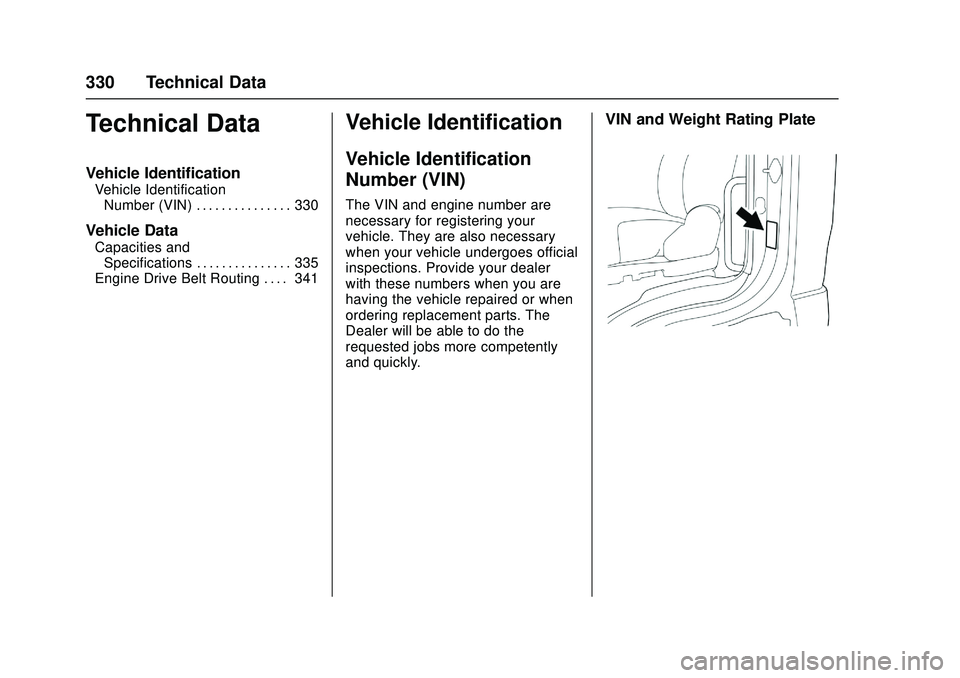
VIN and Weight Rating Plate
Page 332 of 358

Chevrolet Low Cab Forward Owner Manual (GMNA-Localizing-U.S.-
11254764) - 2018 - crc - 12/5/16
Technical Data 331
The "Vehicle Certification and
Greenhouse Gas (GHG) Emissions
Plate" shows the manufacturer's
gross vehicle weight rating (GVWR),
the front and rear gross axle weightratings (GAWRs), as well as the VIN
and emissions information for your
vehicle.
This plate is located on the left side
rear pillar panel below the striker
(single cab) or on the left center
pillar panel beside the shoulder seat
belt anchor (crew cab).
The VIN is a legal identifier of your
vehicle. It not only appears on the
VIN plate; but also on the vehicle
certificates of title and registration.
The VIN specifically identifies a
vehicle by code.
See
“Overloading” underInformation
on Loading the Vehicle 058.
The VIN contains multiple pieces of
information including the vehicle
and engine model codes as shown
below.