fuel CHEVROLET LOW CAB FORWARD 2018 Owner's Guide
[x] Cancel search | Manufacturer: CHEVROLET, Model Year: 2018, Model line: LOW CAB FORWARD, Model: CHEVROLET LOW CAB FORWARD 2018Pages: 358, PDF Size: 6.32 MB
Page 141 of 358

Chevrolet Low Cab Forward Owner Manual (GMNA-Localizing-U.S.-
11254764) - 2018 - crc - 12/5/16
140 Driving and Operating
SymptomCauseCorrective Action Reference
Unsteady engine speed There is water or air in
the fuel system
Drain water from fuel
filter or bleed the systemSee
Running Out
of Fuel 0212 or
Water in Fuel
0 209
Fuel system is faulty
4-
White exhaust smoke Engine not sufficiently
warming up
Allow the engine to
warm up
-
Too much engine oil Correct the oil level See
Engine Oil
0 223
Engine Control system
faulty
4-
Fuel system faulty
4-
Exhaust injector
4-
Continuous idling for a
long period (more than
two hours) With the vehicle
stationary in a place
where it will not obstruct
traffic, hold down the
accelerator pedal and
check that white smoke
is not emitted
-
Page 142 of 358

Chevrolet Low Cab Forward Owner Manual (GMNA-Localizing-U.S.-
11254764) - 2018 - crc - 12/5/16
Driving and Operating 141
SymptomCauseCorrective Action Reference
Black exhaust smoke Engine Control system
faulty
4-
The air cleaner clogged
4-
Fuel system faulty
4-
Exhaust system clogged
4-
Exhaust injector
4-
Diesel particulate filter
(DPF) faulty
4-
Engine is overheating No engine coolant Add engine coolant
See
Engine
Coolant 0231
Front of radiator is
clogged with dirt Wash clean with tap
waterSee
Exterior Care
0 293
Radiator cap not
sufficiently tightened Make sure it is firmly
tightened or replace the
radiator cap
-
Fan belt loose Adjust the tension or
replace the beltSee
Engine Drive
Belt Routing 0341
Engine coolant dirty
4-
Fan clutch is faulty
4-
Radiator cap dirty or
faulty Clean or replace -
Page 143 of 358
Chevrolet Low Cab Forward Owner Manual (GMNA-Localizing-U.S.-
11254764) - 2018 - crc - 12/5/16
142 Driving and Operating
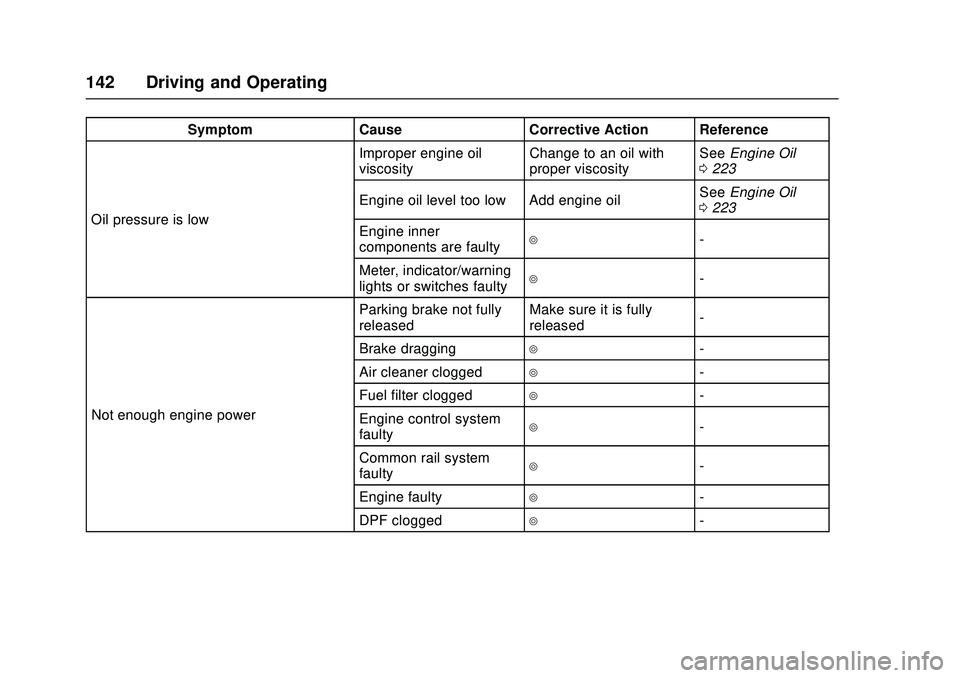
SymptomCauseCorrective Action Reference
Oil pressure is low Improper engine oil
viscosity
Change to an oil with
proper viscositySee
Engine Oil
0 223
Engine oil level too low Add engine oil See
Engine Oil
0 223
Engine inner
components are faulty
4-
Meter, indicator/warning
lights or switches faulty
4-
Not enough engine power Parking brake not fully
released
Make sure it is fully
released
-
Brake dragging
4-
Air cleaner clogged
4-
Fuel filter clogged
4-
Engine control system
faulty
4-
Common rail system
faulty
4-
Engine faulty
4-
DPF clogged
4-
Page 147 of 358

Chevrolet Low Cab Forward Owner Manual (GMNA-Localizing-U.S.-
11254764) - 2018 - crc - 12/5/16
146 Driving and Operating
Emergencies (Disabled
Vehicle)
When the Vehicle
Breaks Down
When the Vehicle Stops While
Driving
The brake booster will no longer
operate and brake effectiveness will
be reduced. If the engine cannot be
started, promptly have the vehicle
inspected and repaired.
If the engine stopped because the
vehicle ran out of fuel while driving,
refueling alone will not be enough to
restart the engine. Bleed the fuel
system after refueling the vehicle.
When the Fuel Tank is Empty
SeeRunning Out of Fuel 0212.
When the Engine Stalls and
Cannot Be Restarted
Move the selector lever to the "N"
position and push the vehicle to a
safe place.
{Warning
Vehicle operations will change, so
stop the vehicle in a safe place
with the following in mind.
The power steering system will
not work so the steering wheel
will be hard to turn. It will require
more strength than during normal
operation.
As the brake booster will no
longer be functional, brake
effectiveness will be greatly
reduced. Be sure to apply more
pressure than usual to the brake
pedal.
If the power assist steering
system goes out because the
engine has stopped or the assist
system has malfunctioned, the
vehicle can still be steered.
However, much greater effort is
needed, especially in sharp turns
or at low speeds.
You and others could be seriously
injured. When the Vehicle Breaks Down
During Driving
1. Use the hazard warning flasher any time to warn other drivers,
day or night, and pull the
vehicle immediately over to a
safe place that does not
impede traffic (shoulder). Place
triangle reflectors to alert other
traffic to the presence of your
vehicle.
2. If the vehicle can be exited safely, have the other
passengers get out and wait in
a safe place.
3. If the vehicle can be exited safely, walk to a safe place and
take appropriate measures by
using the closest
telephone, etc.
See Hazard Warning Flashers 094.
Page 148 of 358
Chevrolet Low Cab Forward Owner Manual (GMNA-Localizing-U.S.-
11254764) - 2018 - crc - 12/5/16
Driving and Operating 147
If There is a Fuel Leak
{Danger
Leaking fuel from the vehicle is
dangerous due to possible
combustion or explosion. Stop the
engine immediately.
You and others could be seriously
injured or killed.
Starting and
Operating
New Vehicle Break-In
Good vehicle care begins with
proper break-in. While every new
vehicle goes through rigid factory
and dealer inspection and tests
before delivery, the care you give
your vehicle during the initial
break-in period can pay off in longer
life, better performance and more
economical operation.
It is therefore always recommended
that during the initial 1 000 km
(600 mile) break-in period, the
following few simple precautions are
carefully observed.
Follow the recommendations listed
below:
.Warm up the engine by driving
easily for the first few minutes
before placing it under load.
. Do not drive for extended
periods at any one constant
speed, either fast or slow, during
the first 800 km (500 miles). .
Use the correct gear to maintain
the desired road speed without
lugging the engine.
. Avoid racing the engine,
full-throttle starts and aggressive
application of brakes when
stopping.
. Keep tires properly inflated for
the load carried.
. Check lubricant levels in the
engine and transmission weekly.
. Keep speeds below 80 km/h
(50 MPH) for the first 800 km
(500 miles).
. Use the lowest gear ratio
available when starting a loaded
vehicle and when climbing
slopes to avoid lugging the
engine.
. It is recommended that the
engine speed is restricted to
2,300 r/min.
Mechanical Driveshaft Brake
Burnish Procedure
It is recommended that the
driveshaft mounted parking brake
be burnished as part of the new
Page 150 of 358

Chevrolet Low Cab Forward Owner Manual (GMNA-Localizing-U.S.-
11254764) - 2018 - crc - 12/5/16
Driving and Operating 149
The starting circuit, engine alarm
circuits and accessory circuits are
all controlled by the engine control
switch.1 LOCK :Lock is in the position
fully counterclockwise. In this
position, the key can be inserted or
removed. To place the engine
control switch in the LOCK position,
press and hold the key in the ACC
position and then turn it to the
LOCK position. If you will leave the
vehicle, remove the key and turn the
steering wheel until it locks. The
steering wheel will be locked to help
prevent theft.
2 ACC : Accessory is in the first
position clockwise. In this position,
the audio and other accessories can
be used with the engine stopped.
3 ON : This ON position is in the
second position clockwise. The key
stays in this position while the
engine is running. Engine control,
warning circuits, gauge circuits, and
accessory circuits are energized.
The engine cylinder heaters or glow
plugs are also turned on when the
switch is in the ON position. The
wait-to-start light will come on and
stay on until the glow plugs are heated enough. When this light
goes off, turn the switch to the
START position.
4 START :
On all engines, start is in
the position furthest clockwise. The
engine is started in this position.
Turn the key against spring
pressure to energize the starter.
When key is released, spring
pressure returns it to the ON
position. Release the key as soon
as the engine has started.
If the key cannot be turned from the
LOCK position to the ON position,
lightly move the steering wheel
clockwise and counterclockwise
while trying to turn the key.
Starting and Stopping the
Vehicle
Check around the Vehicle before
Starting the Engine
Proper care and operation will not
only extend the service life of your
vehicle but also improve fuel
economy.
Page 152 of 358

Chevrolet Low Cab Forward Owner Manual (GMNA-Localizing-U.S.-
11254764) - 2018 - crc - 12/5/16
Driving and Operating 151
2. When the engine control switchis turned to the ON position,
the wait-to-start light comes on
and it goes out in about
1 second when the engine is
warm, to about 10 seconds
when the engine is cold.
3. After confirming that the wait-to-start light has gone out,
turn the engine control switch
to the START position to start
the engine. Release the engine
control switch as soon as the
engine starts.
4. Do not crank the engine for more than 10 seconds at a
time. If the engine does not
start, wait 20 to 30 seconds
with the engine control switch
in the LOCK or ACC position
before trying to start again. It is normal for the vacuum warning
buzzer to sound for a few seconds
after the engine has started.
After the engine has started, check
to be sure the selector lever is still
in the P position.
This engine has an automatic
warm-up system that increases
engine idle speed and applies the
exhaust brake. Allow sufficient time
to let the engine circulate lubricant
oil before driving. This usually
requires 30 seconds to 2 minutes
depending on ambient conditions.
See
Brake System Warning Light
(Parking Brake Light) 075.
The turbocharged engine should be
started in a way which ensures the
bearings supporting the rotating
parts of the turbocharger are
sufficiently lubricated. Do not race a
cold engine.
At low ambient temperatures, a cold
engine may emit more smoke than
usual.
Do not drive the truck until the
engine has had sufficient time to
circulate the lubricant oil. This usually requires 30 seconds to
2 minutes depending on ambient
conditions. This will help reduce
white start-up smoke.
Preheating :
Diesel engines are
compression ignited, which makes
them difficult to start when they are
cold because the compression
alone cannot create a temperature
high enough for fuel to ignite.
Preheating means warming the
compressed air inside the
combustion chambers to facilitate
engine starting. Be sure to start the
engine after the wait-to-start light
has gone out.
Start : Do not press the accelerator
pedal at the engine start. The
accelerator opening degree at the
engine start is electronically
controlled.
Warm-up : Do not race the engine
to speed warm-up.
Page 153 of 358
Chevrolet Low Cab Forward Owner Manual (GMNA-Localizing-U.S.-
11254764) - 2018 - crc - 12/5/16
152 Driving and Operating
Cold Weather Starting
If you plan ahead for cold weather,
starting and driving your vehicle
should be no problem. The following
tips will help ensure good starting in
cold weather.
Oil gets thicker as it gets colder,
which slows down the engine
cranking speed. The diesel engine
functions by the heat of
compression (and glow plugs when
cold), rather than through the use of
spark plugs as in a gasoline engine.
So, your engine must crank faster
than a gasoline engine before it will
start.
To be sure the engine can turn fast
enough to start, use SAE 10W-40
viscosity engine oil when prevailing
temperatures drop below 0 °C
(32 °F). See the oil quality and oil
viscosity recommendations. Using
the proper viscosity oil will make
starting easier down to -23 °C
(-10 °F). When prevailing
temperatures drop below -23 °C
(-10 °F), the engine block heater
may be needed for starting. See
Engine Heater0154. Maintenance Items to Aid Cold
Weather Starting
Since the basic principle of diesel
engine ignition is based on
compression, the diesel engine is
somewhat harder to start than a
gasoline engine when the
temperature is below freezing.
To help prevent hard starting
problems, special attention should
be given to following normal
maintenance items:
1. Neglecting to have the fuel filter and water separator
serviced can be one of the
major contributors to hard
starting. If water is permitted to
accumulate in the primary filter,
it will freeze and make starting
the engine impossible.
2. Make sure the fuel tank vent is open.
3. Always refuel at the end of a day's operation. Moisture will
condense in an empty tank;
therefore, the tank should be filled before leaving the vehicle
standing for an extended
period.
Do not use starting aids in the air
intake system. Such aids can cause
immediate engine damage. See
Fuel for Diesel Engines 0206.
Stopping the Engine
When stopping the engine, take the
following steps: 1. Bring the vehicle to a complete stop.
2. Firmly apply the parking brake.
3. Move the selector lever to the P position and make sure that
the shift indicator shows P.
4. Allow the engine to idle for approximately 3 minutes.
5. Turn the engine control switch to the ACC or LOCK position.
Do not shut down the engine
immediately after driving the vehicle.
Otherwise, a seizure or other
failures may result.
Page 158 of 358
Chevrolet Low Cab Forward Owner Manual (GMNA-Localizing-U.S.-
11254764) - 2018 - crc - 12/5/16
Driving and Operating 157
4. Check that the brake lowvacuum warning light is out
and that the vacuum buzzer is
not sounding. It is normal for
the warning buzzer to sound
for a few seconds after the
engine starts. If the light and
buzzer remain on, do not drive
the vehicle until the cause has
been found and corrected.
5. Look at the brake system warning light. It should be out
when the parking brake is
released and the engine is
running. If it stays on, it could
mean that the brake fluid level
is low. Check the brake fluid
reservoir. This condition must
be corrected before moving the
vehicle.
{Warning
To reduce the chance of personal
injury and/or vehicle damage due
to engine overheating, never
leave the engine idling without an
alert driver present. If the engine
(Continued)
Warning (Continued)
should overheat, as indicated by
the engine coolant temperature
gauge, immediate action is
required to correct the condition.
Continued operation of the
engine, even for a short time, may
result in a fire.
Do not engage the exhaust brake
while the engine is idling as this
may cause engine overheating.
You and others could be seriously
injured.
Avoid Unnecessary Idling of the
Diesel Engine
If the diesel engine idles too long,
the engine coolant temperature will
fall below the operating range. Low
engine operating temperature
causes several conditions that are
harmful to engine operation and life.
Incomplete combustion of fuel in an
engine that is not fully warmed-up
causes crankcase dilution and
forms lacquer and gummy deposits on valves, pistons, and rings. It also
causes rapid accumulation of
sludge within the engine.
Parking over Things
That Burn
{Warning
Exhaust parts and gases become
very hot when the DPF is being
regenerated.
Parking over flammable items
could allow them to touch hot
exhaust parts under your vehicle
and cause them to ignite. Do not
park over papers, leaves, grass
or other things that can burn. You
and others could be seriously
injured.
Keep Flammable Material Away
from the Vehicle
The exhaust pipe is extremely hot
immediately after vehicle operation.
Before parking, make sure the area
is free of flammable material (for
Page 161 of 358

Chevrolet Low Cab Forward Owner Manual (GMNA-Localizing-U.S.-
11254764) - 2018 - crc - 12/5/16
160 Driving and Operating
Warning (Continued)
or corroded exhaust system or
cab. Do not run the engine in
confined areas (such as garages,
next to a building or near another
stopped vehicles with engine
running) any more than needed to
move the vehicle.
When the vehicle has to be
stopped in an unconfined area
with the engine running for any
more than a few minutes, take the
following steps:. Adjust the heating or cooling
system to force outside air
into the cab.
. With temperature and outlet
selector knob in any
position:
. Set the air selector lever to
the fresh air position.
. Set the fan speed control
knob to the maximum speed
position.
(Continued)
Warning (Continued)
.Keep the exhaust tailpipe
area clear of snow and
other material to help
reduce the buildup of
exhaust gases under the
vehicle.
This is particularly important when
parked in blizzard conditions. You
and others could be seriously
injured.
See Climate Control Systems 0115
and Maintenance Schedule 0303.
Running the Vehicle
While Parked
Caution
To reduce the chance of personal
injury and/or vehicle damage due
to engine overheating, never
leave the engine idling without an
alert driver present. If the engine
(Continued)
Caution (Continued)
should overheat, as indicated by
the engine coolant temperature
gauge, immediate action is
required to correct the condition.
Continued operation of the
engine, even for a short time, may
result in a fire. Do not engage the
exhaust brake while the engine is
idling as this may cause engine
overheating.
Avoid Unnecessary Idling of the
Diesel Engine
If the engine idles too long, the
engine coolant temperature will fall
below the operating range. Low
engine operating temperature
causes several conditions that are
harmful to engine operation and life.
Incomplete combustion of fuel in an
engine that is not fully warmed-up
causes crankcase dilution and
forms lacquer and gummy deposits
on valves, pistons, and rings. It also
causes rapid accumulation of
sludge within the engine.