fuel CHEVROLET LOW CAB FORWARD 2018 Workshop Manual
[x] Cancel search | Manufacturer: CHEVROLET, Model Year: 2018, Model line: LOW CAB FORWARD, Model: CHEVROLET LOW CAB FORWARD 2018Pages: 358, PDF Size: 6.32 MB
Page 228 of 358
Chevrolet Low Cab Forward Owner Manual (GMNA-Localizing-U.S.-
11254764) - 2018 - crc - 12/5/16
Vehicle Care 227
Engine Oil
Engine oil viscosity (thickness) has
an effect on fuel economy and
cold-weather starting. Lower
viscosity engine oils can provide
better fuel economy; however,
higher temperature weather
conditions require higher viscosity
engine oils for satisfactory
lubrication.
When choosing an oil, consider the
range of temperature your vehicle
will be operated in before the next
oil change. Then, select the
recommended oil viscosity from the
chart.
Do not use any viscosity of oil not
recommended. Such oils could
cause engine damage.
Page 229 of 358
Chevrolet Low Cab Forward Owner Manual (GMNA-Localizing-U.S.-
11254764) - 2018 - crc - 12/5/16
228 Vehicle Care
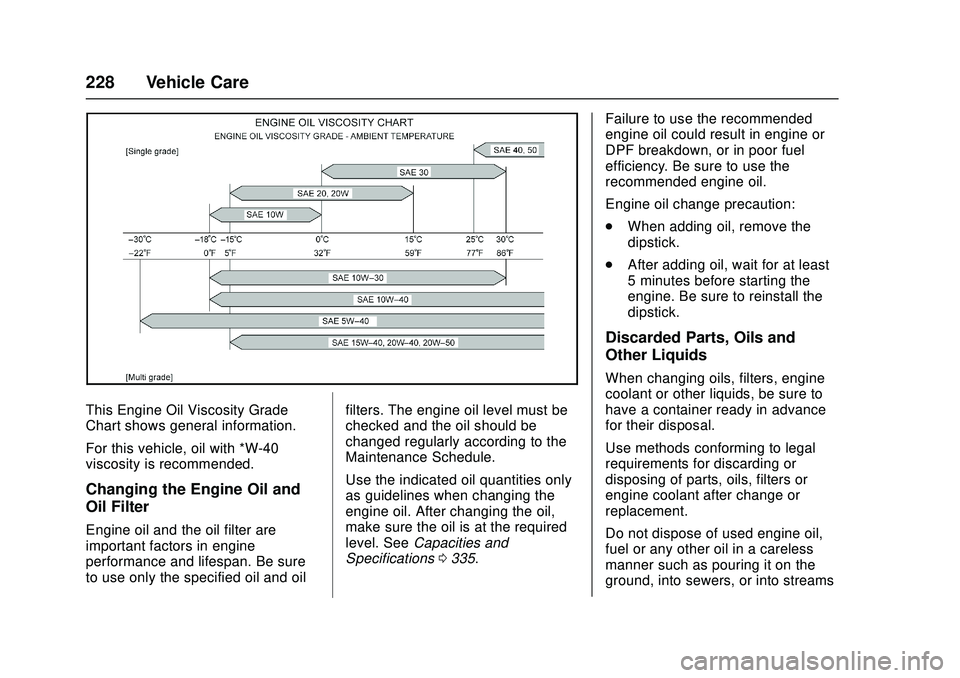
This Engine Oil Viscosity Grade
Chart shows general information.
For this vehicle, oil with *W-40
viscosity is recommended.
Changing the Engine Oil and
Oil Filter
Engine oil and the oil filter are
important factors in engine
performance and lifespan. Be sure
to use only the specified oil and oilfilters. The engine oil level must be
checked and the oil should be
changed regularly according to the
Maintenance Schedule.
Use the indicated oil quantities only
as guidelines when changing the
engine oil. After changing the oil,
make sure the oil is at the required
level. See
Capacities and
Specifications 0335. Failure to use the recommended
engine oil could result in engine or
DPF breakdown, or in poor fuel
efficiency. Be sure to use the
recommended engine oil.
Engine oil change precaution:
.
When adding oil, remove the
dipstick.
. After adding oil, wait for at least
5 minutes before starting the
engine. Be sure to reinstall the
dipstick.
Discarded Parts, Oils and
Other Liquids
When changing oils, filters, engine
coolant or other liquids, be sure to
have a container ready in advance
for their disposal.
Use methods conforming to legal
requirements for discarding or
disposing of parts, oils, filters or
engine coolant after change or
replacement.
Do not dispose of used engine oil,
fuel or any other oil in a careless
manner such as pouring it on the
ground, into sewers, or into streams
Page 232 of 358

Chevrolet Low Cab Forward Owner Manual (GMNA-Localizing-U.S.-
11254764) - 2018 - crc - 12/5/16
Vehicle Care 231
.Dipstick H (HOT) —
Transmission fluid
temperature Approx.
70 - 80 °C (158 - 176 °F).
. The “C (COLD)” range on
the dipstick is a guide used
by your dealer for
specialized equipment used
to replace or service the
automatic transmission
fluid. When performing your
own inspections, always
use the “H (HOT)” range
after warming up the
vehicle.
The fluid must be hot to
ensure an accurate check.
The fluid level rises as
temperature increases.
6. If the fluid level is too low, add the specified fluid through the
dipstick guide tube. Also, check
whether there are no fluid
leaks.
7. Insert the dipstick securely into position.{Warning
Be extremely careful not to burn
yourself when checking the oil
level if the engine temperature is
high. Protect yourself with
gloves etc.
You and others could be seriously
injured.
Discarded parts, oil, grease and
fluids could have an adverse effect
on the environment. It is difficult to
dispose of these, so have your
dealer handle all checks and
replacements.
Engine Air Cleaner/Filter
Air Cleaner
Use of clogged air cleaner element
not only causes a deterioration in
the engine output but also increased
fuel consumption and dark exhaust
smoke. Be sure to use a genuine air cleaner
element. If other air cleaner element
is used, it may cause the sensor to
output a wrong signal.
See
Maintenance Schedule 0303.
Air Cleaner Indicator Light
When the air cleaner indicator light
comes on, check the air cleaner
element. If the air cleaner element is
clogged, replace the air cleaner
element.
See Vehicle Messages 086.
See Maintenance Schedule 0303.
Engine Coolant
Protection of Engine Against
Overcooling
Overcooling of the engine not only
accelerates wear of the vital engine
parts but also hurts fuel economy.
Engine Coolant in Cold
Weather
To prevent the engine damage due
to freezing of the engine coolant,
mix the coolant and water at the
ratio of 50/50.
Page 249 of 358

Chevrolet Low Cab Forward Owner Manual (GMNA-Localizing-U.S.-
11254764) - 2018 - crc - 12/5/16
248 Vehicle Care
Danger (Continued)
battery. Personal injury
(particularly to eyes) or property
damage may result from battery
explosion, battery fluid or
electrical (short circuit) burns. You
and others could be seriously
injured or killed.
If the negative cable is disconnected
from the negative terminal on the
battery within 3 minutes after turning
the engine control switch to the
"LOCK" position, the engine control
module may malfunction.
Checking the Battery
Your new vehicle is equipped with
DELKOR batteries. They need no
periodic electrolyte level
maintenance. Its top is permanently
sealed (except for two small vent
holes) and has no filler caps. You
will never have to add water.
Remember to check and recharge
the battery as necessary, as well as
keep connection clean. The hydrometer (green-eye test
indicator) in the top of each battery
(if equipped) provides information
for testing purposes only.
If the vehicle is not going to be
driven for 30 days or longer,
disconnect the ground cable from
the negative (–) terminal of the
batteries to prevent discharge.
For full power needs at replacement
time, a battery with the same
specifications, as shown on the
original battery's label, is
recommended.
{Warning
Battery posts, terminals and
related accessories contain lead
and lead compounds, chemicals
known to the State of California to
cause cancer and reproductive
harm. Wash hands after handling.
You and others could be seriously
injured.
Fuel Filter
Change the fuel filter in accordance
with the Maintenance Schedule or
when the fuel filter indicator light
(amber) comes on.
Drain the water when the water
separator (fuel filter) warning light
comes on. (Drain the water from the
chassis-side fuel filter and
engine-side fuel filter.)
Failure to replace the fuel filter when
needed may lead to fuel system
damage. Your authorized dealer can
inspect your fuel filter and replace
your fuel filter, if needed.
Page 271 of 358

Chevrolet Low Cab Forward Owner Manual (GMNA-Localizing-U.S.-
11254764) - 2018 - crc - 12/5/16
270 Vehicle Care
No. Description16 TAIL LAMP
17 CIGAR LIGHTER
18 CORNERING LAMP
19 POWER ACC
20 BLOWER MOTOR Fuse and Relay Location
–Cab Exterior
Fuse and Relay Location
Fuse locations (2): No. Description Rating
1 MARKER LIGHT 20A
2 TAIL MAIN 20A
3 FUEL HEATER 15A
4 SCR 20A
5 PM SENSOR 15A No. Description Rating
6 RR DOME LIGHT 15A
7 CONDENSER FAN 20A
8 A/C 10A
Page 272 of 358
Chevrolet Low Cab Forward Owner Manual (GMNA-Localizing-U.S.-
11254764) - 2018 - crc - 12/5/16
Vehicle Care 271
Relay locations (1):No. Description
1 STARTER
2 PM SENSOR
3 NOX & DEF SENSOR
4 A/C COMPRESSOR
5 CONDENSER FAN
6 RR DOME LIGHT
7 SCR HEATER VALVE
8 MARKER LIGHT
9 –
10 –
11 FUEL HEATER When Slow-blow Fuses Blow Out
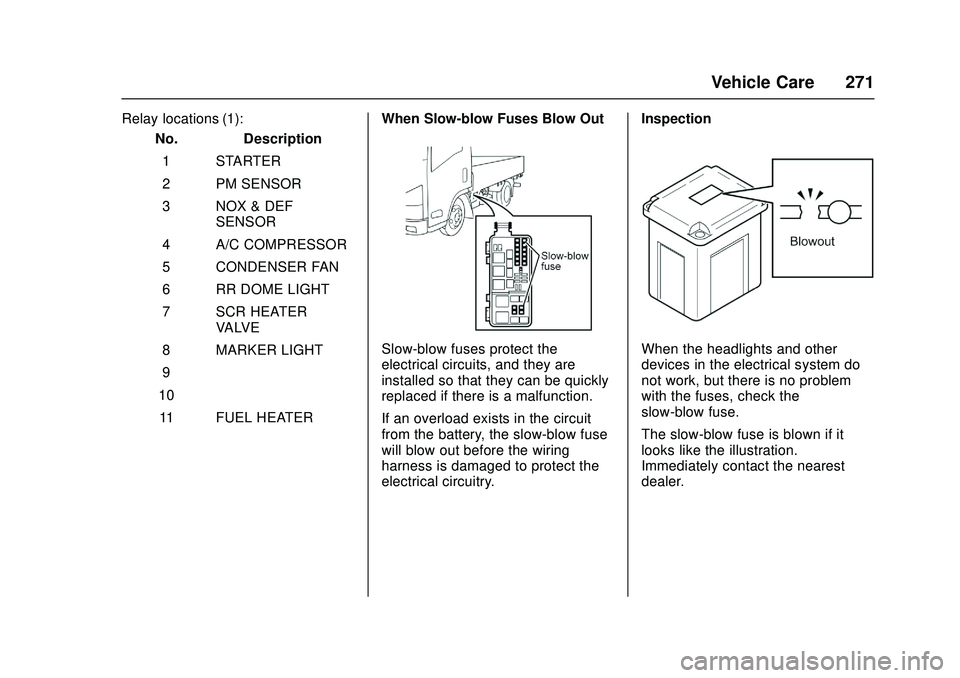
Slow-blow fuses protect the
electrical circuits, and they are
installed so that they can be quickly
replaced if there is a malfunction.
If an overload exists in the circuit
from the battery, the slow-blow fuse
will blow out before the wiring
harness is damaged to protect the
electrical circuitry. InspectionWhen the headlights and other
devices in the electrical system do
not work, but there is no problem
with the fuses, check the
slow-blow fuse.
The slow-blow fuse is blown if it
looks like the illustration.
Immediately contact the nearest
dealer.
Page 298 of 358
Chevrolet Low Cab Forward Owner Manual (GMNA-Localizing-U.S.-
11254764) - 2018 - crc - 12/5/16
Vehicle Care 297
form when rinsing with water. Clean
the blade by wiping with a cloth
soaked in a solution of one-half
water and one-half methanol
alcohol. Then rinse the blade with
water.
The windshield wiper arms may be
swung out, away from the glass, to
provide easy access for cleaning.
Do not hang on to the roofmarker
lights while cleaning the windshield
or damage may occur (resulting in
possible water leakage).
External Diesel Engine
Cleaning
The engine does not need periodic
cleaning, nor is it recommended.
If you insist on cleaning the engine,
clean it only when it is cold, never
when it is warm or hot, and never
when the engine is running.
Spraying or pouring water or other
fluids on your engine when it is
warm or hot, or when it is running,
can cause serious damage to the
engine and its components,
particularly the fuel supply pump.
Handling the Radiator and
Charge Air Cooler
Cleaning the Radiator Core and
Charge Air Cooler Core
Cooling efficiency is compromised
when there is dirt or dust plugging
air passages in the radiator core
and charge air cooler core. This can
also cause corrosion of these cores.
Wash the radiator core with tap
water every 24 months.
Make sure to turn the engine off and
remove the key from the engine
control switch before cleaning
cores.The engine, exhaust pipe, and
radiator will be hot immediately after
the vehicle is driven. Be careful
around these parts to prevent burns.
Clean the engine when it is cold.
Do not clean the radiator, charge air
cooler and their surrounding areas
using water that is supplied under
high pressure. Doing so may cause
damage.
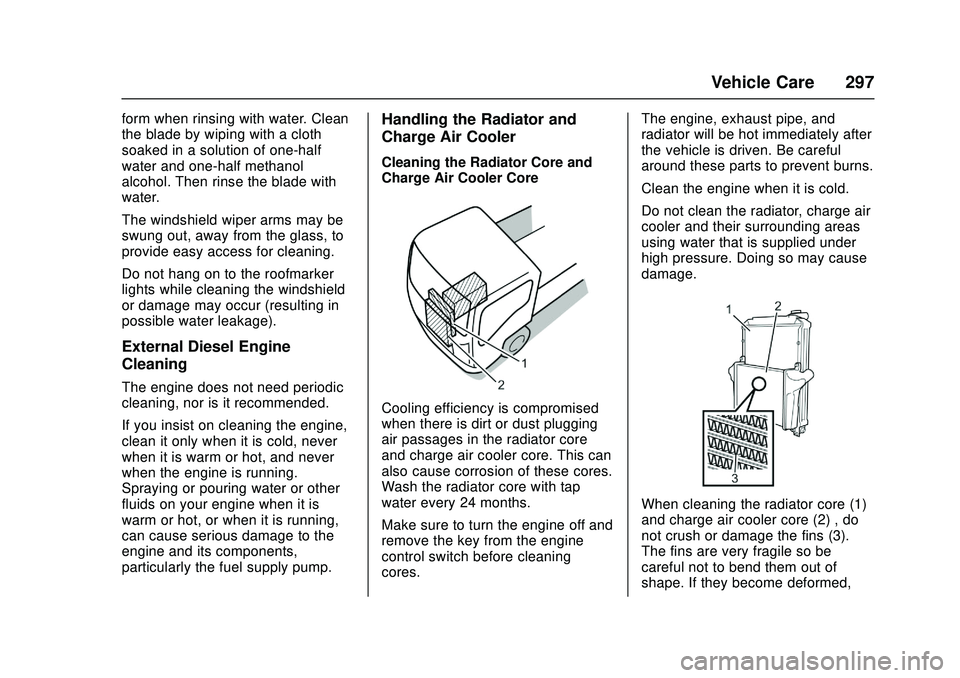
When cleaning the radiator core (1)
and charge air cooler core (2) , do
not crush or damage the fins (3).
The fins are very fragile so be
careful not to bend them out of
shape. If they become deformed,
Page 299 of 358
Chevrolet Low Cab Forward Owner Manual (GMNA-Localizing-U.S.-
11254764) - 2018 - crc - 12/5/16
298 Vehicle Care
their cooling efficiency will be
impaired. Before cleaning, take
steps to ensure that no water will
splash onto the surrounding
electrical components and wires.
If stubborn dirt still remains even
after the radiator core and charge
air cooler core have been cleaned,
have the vehicle inspected and
serviced.
Corrosion Protection
Your vehicle has been designed and
built to resist corrosion. Special
materials and protective finishes
were used on most parts of your
vehicle when it was built to help
maintain good appearance,
strength, and reliable operation.
However, some parts which
normally are not visible (such as
those under the vehicle and under
the hood) are such that surface rust
will not affect their reliability. So
corrosion protection is not needed
or used on these parts.Sheet Metal Damage
If your vehicle is damaged and
requires sheet metal repair or
replacement, make sure the body
repair shop applies anti-corrosion
material to the parts repaired or
replaced so that corrosion protection
is restored. (Also see "Finish
Damage" which follows.)
Foreign Material Deposits
Calcium chloride and other salts,
ice-melting agents, road oil and tar,
tree sap, bird droppings, chemicals
from industrial chimneys and other
foreign matter may damage vehicle
finishes if left on painted surfaces.
Prompt washing may not completely
remove all of these deposits. Other
cleaners may be needed. When
using chemical cleaners, be sure
they are safe for use on painted
surfaces.
Finish Damage
Any stone chips, fractures or deep
scratches in the finish should be
repaired promptly. Bare metal will
corrode quickly and may develop
into major repair expense. Minorchips and scratches can be repaired
with touch up materials available
from your authorized dealer or other
service outlets. Larger areas of
finish damage can be corrected in
your dealer's body and paint shop.
Underbody Maintenance
Corrosive materials used for ice and
snow removal, and dust control can
collect on the underbody. If these
materials are not removed,
accelerated corrosion (rust) can
occur on underbody parts such as
fuel lines, frames, floor pan and
exhaust system even though they
have been provided with corrosion
protection.
At least every spring, flush these
materials from the underbody with
plain water. Take care to clean well
any areas where mud and other
debris can collect. Sediment packed
in closed areas of the frame should
be loosened before being flushed.
If desired, your authorized dealer
can do this for you.
Page 307 of 358
Chevrolet Low Cab Forward Owner Manual (GMNA-Localizing-U.S.-
11254764) - 2018 - crc - 12/5/16
306 Service and Maintenance
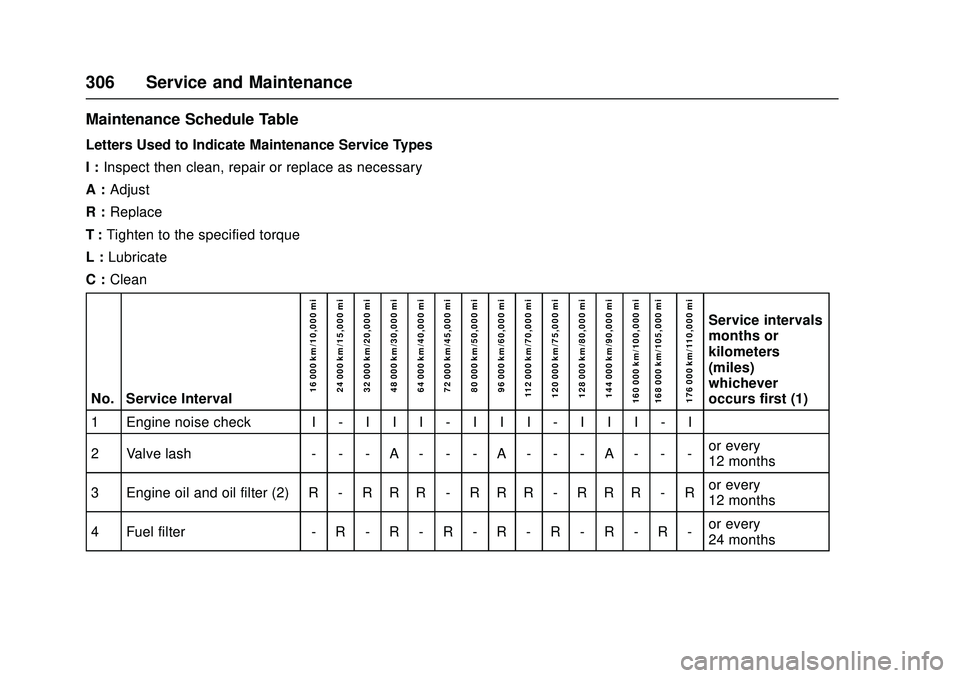
Maintenance Schedule Table
Letters Used to Indicate Maintenance Service Types
I :Inspect then clean, repair or replace as necessary
A : Adjust
R : Replace
T : Tighten to the specified torque
L : Lubricate
C : Clean
No. Service Interval
16 000 km/10,000 mi
24 000 km/15,000 mi
32 000 km/20,000 mi
48 000 km/30,000 mi
64 000 km/40,000 mi
72 000 km/45,000 mi
80 000 km/50,000 mi
96 000 km/60,000 mi
112 000 km/70,000 mi
120 000 km/75,000 mi
128 000 km/80,000 mi
144 000 km/90,000 mi
160 000 km/100,000 mi
168 000 km/105,000 mi
176 000 km/110,000 mi
Service intervals
months or
kilometers
(miles)
whichever
occurs first (1)
1 Engine noise check I - I I I - I I I - I I I - I
2 Valve lash - - - A - - - A - - - A - - - or every
12 months
3 Engine oil and oil filter (2) R - R R R - R R R - R R R - R or every
12 months
4 Fuel filter - R - R - R - R - R - R - R - or every
24 months
Page 308 of 358

Chevrolet Low Cab Forward Owner Manual (GMNA-Localizing-U.S.-
11254764) - 2018 - crc - 12/5/16
Service and Maintenance 307
No. Service Interval16 000 km/10,000 mi
24 000 km/15,000 mi
32 000 km/20,000 mi
48 000 km/30,000 mi
64 000 km/40,000 mi
72 000 km/45,000 mi
80 000 km/50,000 mi
96 000 km/60,000 mi
112 000 km/70,000 mi
120 000 km/75,000 mi
128 000 km/80,000 mi
144 000 km/90,000 mi
160 000 km/100,000 mi
168 000 km/105,000 mi
176 000 km/110,000 mi
Service intervals
months or
kilometers
(miles)
whichever
occurs first (1)
5 Pre-fuel filter/water
separator
- R - R - R - R - R - R - R - or every
24 months
6 Air cleaner filter - - - - - - - - - - - - - - - indicator (3)
7 Damage to air intake
ducts and hoses - I - I - I - I - I - I - I - or every
12 months
8 Drive belts I - I I I - I I I - I I I - I or every
12 months
9 Engine bolt torques - - - - - - I - - - - - I - -
10 Rotate tires Every 10 400 km (6,500 miles)
11 Engine cooling system I - I I I - I I I - I I I - I or every
12 months
12 Engine coolant Every 12 months: I
Every 24 months: R (when dealer recommended coolant is used)
13 Exhaust system I - I I I - I I I - I I I - I
14 DPF (clean filter) - - - - - - - - - - - - C - - or every
3,000 hours