steering wheel CHEVROLET LOW CAB FORWARD 2018 Owner's Guide
[x] Cancel search | Manufacturer: CHEVROLET, Model Year: 2018, Model line: LOW CAB FORWARD, Model: CHEVROLET LOW CAB FORWARD 2018Pages: 358, PDF Size: 6.32 MB
Page 145 of 358
Chevrolet Low Cab Forward Owner Manual (GMNA-Localizing-U.S.-
11254764) - 2018 - crc - 12/5/16
144 Driving and Operating
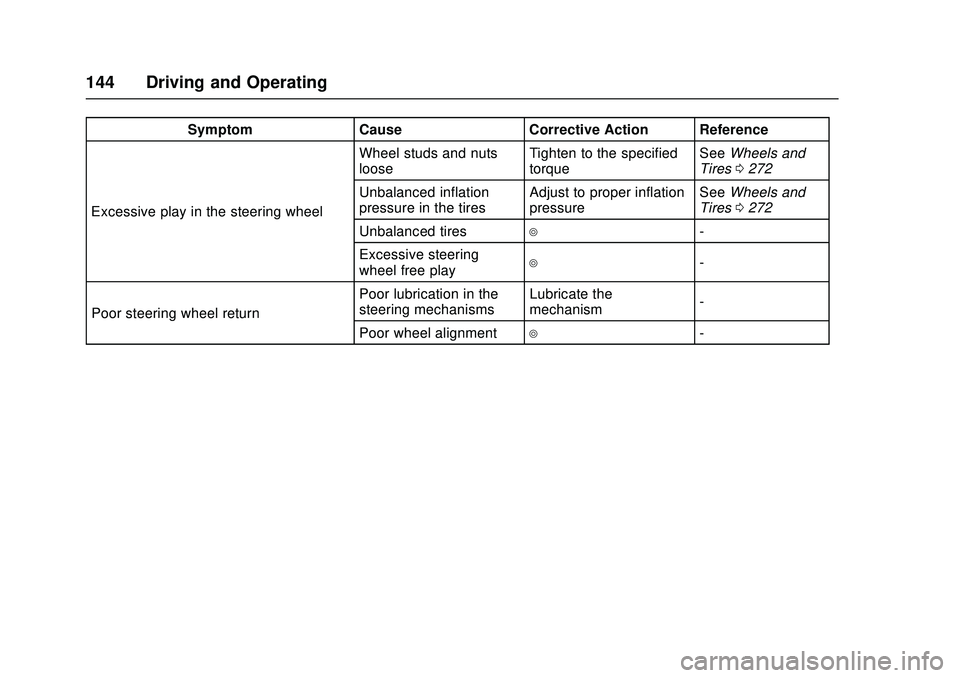
SymptomCauseCorrective Action Reference
Excessive play in the steering wheel Wheel studs and nuts
loose
Tighten to the specified
torqueSee
Wheels and
Tires 0272
Unbalanced inflation
pressure in the tires Adjust to proper inflation
pressureSee
Wheels and
Tires 0272
Unbalanced tires
4-
Excessive steering
wheel free play
4-
Poor steering wheel return Poor lubrication in the
steering mechanisms
Lubricate the
mechanism
-
Poor wheel alignment
4-
Page 147 of 358

Chevrolet Low Cab Forward Owner Manual (GMNA-Localizing-U.S.-
11254764) - 2018 - crc - 12/5/16
146 Driving and Operating
Emergencies (Disabled
Vehicle)
When the Vehicle
Breaks Down
When the Vehicle Stops While
Driving
The brake booster will no longer
operate and brake effectiveness will
be reduced. If the engine cannot be
started, promptly have the vehicle
inspected and repaired.
If the engine stopped because the
vehicle ran out of fuel while driving,
refueling alone will not be enough to
restart the engine. Bleed the fuel
system after refueling the vehicle.
When the Fuel Tank is Empty
SeeRunning Out of Fuel 0212.
When the Engine Stalls and
Cannot Be Restarted
Move the selector lever to the "N"
position and push the vehicle to a
safe place.
{Warning
Vehicle operations will change, so
stop the vehicle in a safe place
with the following in mind.
The power steering system will
not work so the steering wheel
will be hard to turn. It will require
more strength than during normal
operation.
As the brake booster will no
longer be functional, brake
effectiveness will be greatly
reduced. Be sure to apply more
pressure than usual to the brake
pedal.
If the power assist steering
system goes out because the
engine has stopped or the assist
system has malfunctioned, the
vehicle can still be steered.
However, much greater effort is
needed, especially in sharp turns
or at low speeds.
You and others could be seriously
injured. When the Vehicle Breaks Down
During Driving
1. Use the hazard warning flasher any time to warn other drivers,
day or night, and pull the
vehicle immediately over to a
safe place that does not
impede traffic (shoulder). Place
triangle reflectors to alert other
traffic to the presence of your
vehicle.
2. If the vehicle can be exited safely, have the other
passengers get out and wait in
a safe place.
3. If the vehicle can be exited safely, walk to a safe place and
take appropriate measures by
using the closest
telephone, etc.
See Hazard Warning Flashers 094.
Page 149 of 358

Chevrolet Low Cab Forward Owner Manual (GMNA-Localizing-U.S.-
11254764) - 2018 - crc - 12/5/16
148 Driving and Operating
vehicle break-in procedure.
Increased parking brake
performance will result when the
parking brake is burnished as
specified below:
.Make 10 moderate stops, using
the hand brake, from 16 km/h
(10 MPH) while spacing the
stops a minimum of 4 km
(2.5 miles) apart.
. Operate the vehicle at 32 km/h
(20 MPH) between stops.
Pedals
Sit in a correct driving position on
the seat and operate the brake
pedal (1) and accelerator pedal (2)
with your right foot. To avoid
accidentally pressing the wrong
pedal, check the pedal positions
and practice putting your foot on the
desired pedal.
{Warning
A can or bottle rolling on the floor
may prevent brake pedal
operation if it is caught under the
pedal. This is very dangerous.
A floor mat must be placed
correctly. An incorrectly installed
floor mat may hinder the free
movement of each pedal. You
and others could be seriously
injured.
Ignition Positions
Engine Control Switch
{Warning
While driving, never turn the
engine control switch to the
LOCK position. The key could be
removed from the switch, which
then locks the steering wheel.
This is extremely dangerous.
You and others could be seriously
injured.
Caution
After starting the engine, do not
turn the engine control switch to
the START position. Otherwise,
the starter motor may be
damaged.
Using electrical devices such as
the audio system for an extended
time period with the engine
stopped can completely discharge
the battery.
Page 150 of 358

Chevrolet Low Cab Forward Owner Manual (GMNA-Localizing-U.S.-
11254764) - 2018 - crc - 12/5/16
Driving and Operating 149
The starting circuit, engine alarm
circuits and accessory circuits are
all controlled by the engine control
switch.1 LOCK :Lock is in the position
fully counterclockwise. In this
position, the key can be inserted or
removed. To place the engine
control switch in the LOCK position,
press and hold the key in the ACC
position and then turn it to the
LOCK position. If you will leave the
vehicle, remove the key and turn the
steering wheel until it locks. The
steering wheel will be locked to help
prevent theft.
2 ACC : Accessory is in the first
position clockwise. In this position,
the audio and other accessories can
be used with the engine stopped.
3 ON : This ON position is in the
second position clockwise. The key
stays in this position while the
engine is running. Engine control,
warning circuits, gauge circuits, and
accessory circuits are energized.
The engine cylinder heaters or glow
plugs are also turned on when the
switch is in the ON position. The
wait-to-start light will come on and
stay on until the glow plugs are heated enough. When this light
goes off, turn the switch to the
START position.
4 START :
On all engines, start is in
the position furthest clockwise. The
engine is started in this position.
Turn the key against spring
pressure to energize the starter.
When key is released, spring
pressure returns it to the ON
position. Release the key as soon
as the engine has started.
If the key cannot be turned from the
LOCK position to the ON position,
lightly move the steering wheel
clockwise and counterclockwise
while trying to turn the key.
Starting and Stopping the
Vehicle
Check around the Vehicle before
Starting the Engine
Proper care and operation will not
only extend the service life of your
vehicle but also improve fuel
economy.
Page 151 of 358

Chevrolet Low Cab Forward Owner Manual (GMNA-Localizing-U.S.-
11254764) - 2018 - crc - 12/5/16
150 Driving and Operating
Before pulling away, perform a
thorough safety check, making sure
there are no children or obstructions
around the vehicle. Take off the
chocks after confirming that the
parking brake is securely applied.
Sit behind the wheel, adjust the seat
position, and buckle up the seat
belt. The passengers are also
required to buckle up the seat belts.
Adjust the positions of the steering
wheel and mirrors. Lock the doors.
Turn the power of the dome light or
accessories OFF before starting the
engine. SeeSeat Position 038,
Seat Belts 043, Steering Wheel
Adjustment 065, and Mirrors033.
Keep the Floor Around the
Driver's Seat Clean and Tidy
{Warning
It is extremely dangerous to have
empty cans, empty bottles or
other items rolling around on the
floor because they could get
trapped under the brake pedal (Continued)
Warning (Continued)
and prevent brake application.
For proper pedal operation, it is
also essential to lay floor mats
properly. Incorrectly installed floor
mats would hinder free movement
of the pedals.
Do not use the dashboard pocket
or the top of the dashboard as a
place to put items that could roll,
which could interfere with your
driving. You and others could be
seriously injured.
Choose Your Footwear Suitable
for Driving
{Warning
Choose footwear that ensures
proper operation of pedals when
driving the vehicle. Use of
footwear unsuitable for driving
may cause an accident. Starting the Engine
Do not keep the engine control
switch in the START position for
more than about 10 seconds.
Operating the starter for too long
might cause starter and battery
failure or may result in overheating.
When the engine does not start,
wait for 20 to 30 seconds and then
turn the engine control switch again.
Before starting the engine sit in the
driver seat, check that the parking
brake is firmly engaged, the selector
lever is in the P or N (P is preferred)
position and the shift indicator also
shows P or N, and firmly press the
brake pedal to start the engine.
When stopped on a slope, start the
engine with the selector lever in the
P position. See
Ignition Positions
0 148.
1. Make sure that the selector lever is in the P or N position
and firmly press the brake
pedal.
Page 198 of 358

Chevrolet Low Cab Forward Owner Manual (GMNA-Localizing-U.S.-
11254764) - 2018 - crc - 12/5/16
Driving and Operating 197
Warning (Continued)
ABS does not prevent accidents if
you do not drive safely. Drive the
vehicle at a safe speed.
Install tires of the specified size,
same brand and same tread
design (including winter tires) on
all wheels. If different tires are
installed, the braking distance
becomes longer and directional
control stability of the vehicle
decreases. This is very
dangerous.
Steering during sudden braking
(when the ABS is working) will
feel slightly different than it does
when the brakes are not applied.
Operate the steering wheel
carefully keeping this in mind.
Driving in sand or on a muddy road
may adversely affect the brakes and
ABS sensors. Wash the vehicle to
remove sand and mud after
operating the vehicle in sandy or
muddy conditions. Before washing the vehicle, provide
necessary protection to prevent
water from being splashed on the
ABS components (sensors and
actuators). Especially when using
high-pressure washing, be careful
not to allow water to be directly
sprayed onto the ABS components
and their harness connectors.
These are not signs of ABS
malfunction:
.
Soon after you start the engine
and the vehicle starts moving,
the sound of motor or valve
working may be heard from the
rear of the vehicle or underside
of the cab. This sound is from a
self-check by the ABS system
and is normal. In addition, you
may also feel some vibration if
the brake pedal is pressed at
this time.
. When ABS is operating,
vibration is felt on the brake
pedal and steering wheel and
you may hear the system
operating. This is normal when
ABS is properly operating. .
The exhaust brake may release
when ABS is activated and the
exhaust brake is in operation.
. ABS is more likely to be
activated when the brake is
applied during cornering or
driving over a bump. This is
because inside wheels or
wheels that have gone over a
bump tend to lock.
. ABS is not activated immediately
after starting the vehicle. It is
activated only when the vehicle
speed reaches approx. 10 km/h
(6 MPH). ABS operation is
inactive when the vehicle speed
reduces to approx. 5 km/h
(3 MPH).
Page 199 of 358
Chevrolet Low Cab Forward Owner Manual (GMNA-Localizing-U.S.-
11254764) - 2018 - crc - 12/5/16
198 Driving and Operating
ABS Operation Indications and
Signs
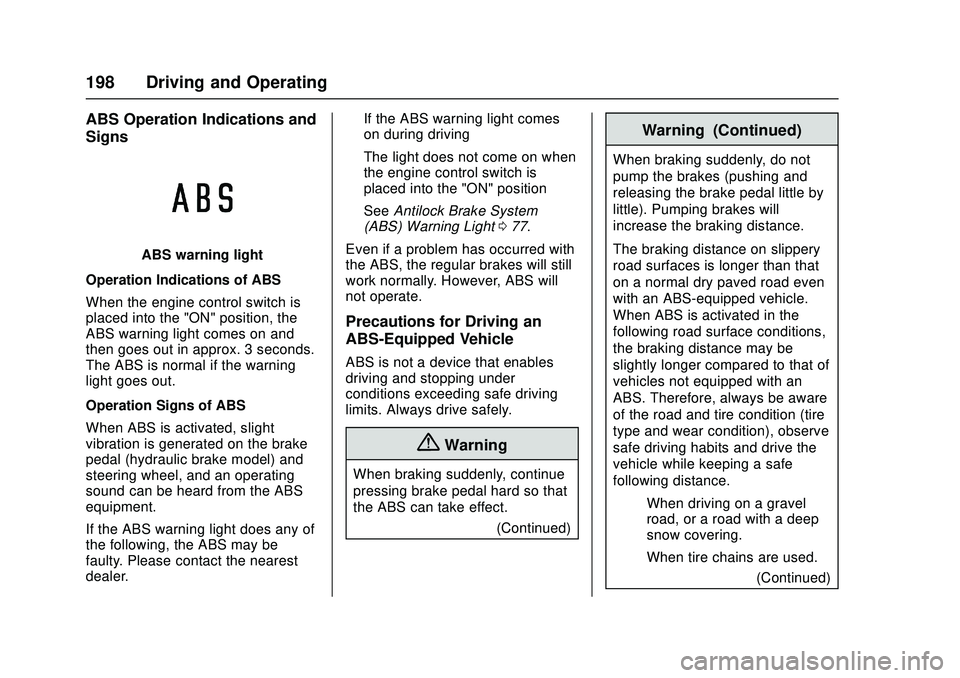
ABS warning light
Operation Indications of ABS
When the engine control switch is
placed into the "ON" position, the
ABS warning light comes on and
then goes out in approx. 3 seconds.
The ABS is normal if the warning
light goes out.
Operation Signs of ABS
When ABS is activated, slight
vibration is generated on the brake
pedal (hydraulic brake model) and
steering wheel, and an operating
sound can be heard from the ABS
equipment.
If the ABS warning light does any of
the following, the ABS may be
faulty. Please contact the nearest
dealer. ‐
If the ABS warning light comes
on during driving
‐ The light does not come on when
the engine control switch is
placed into the "ON" position
See Antilock Brake System
(ABS) Warning Light 077.
Even if a problem has occurred with
the ABS, the regular brakes will still
work normally. However, ABS will
not operate.
Precautions for Driving an
ABS-Equipped Vehicle
ABS is not a device that enables
driving and stopping under
conditions exceeding safe driving
limits. Always drive safely.
{Warning
When braking suddenly, continue
pressing brake pedal hard so that
the ABS can take effect. (Continued)
Warning (Continued)
When braking suddenly, do not
pump the brakes (pushing and
releasing the brake pedal little by
little). Pumping brakes will
increase the braking distance.
The braking distance on slippery
road surfaces is longer than that
on a normal dry paved road even
with an ABS-equipped vehicle.
When ABS is activated in the
following road surface conditions,
the braking distance may be
slightly longer compared to that of
vehicles not equipped with an
ABS. Therefore, always be aware
of the road and tire condition (tire
type and wear condition), observe
safe driving habits and drive the
vehicle while keeping a safe
following distance.
‐ When driving on a gravel
road, or a road with a deep
snow covering.
‐ When tire chains are used.
(Continued)
Page 200 of 358

Chevrolet Low Cab Forward Owner Manual (GMNA-Localizing-U.S.-
11254764) - 2018 - crc - 12/5/16
Driving and Operating 199
Warning (Continued)
‐When driving over road
joints or bumps such as
light reflectors on the road.
‐ When driving on a bumpy
road, stone-paved road or
track.
‐ When driving over an iron
plate or manhole lid.
ABS does not work for wheel skid
during a standing start,
acceleration and cornering which
do not involve braking. On a very
slippery icy road, tires may lose
grip and steering wheel operation
may not be able to control the
vehicle's direction, resulting in
very unstable driving. Always
drive the vehicle observing a safe
speed well matched with both
road surface and tire conditions,
and avoid sudden braking.
If powerful engine braking is
applied on a very slippery icy
road, the drive wheels may be (Continued)
Warning (Continued)
locked (the ABS then does not
work), resulting in loss of vehicle
control.
When ABS is activated, a slight
vibration (especially when the
road surface is different between
right and left wheels) and pulling
may be felt on the brake pedal
and steering wheel. In addition,
an operating sound is produced
from the ABS actuators. This
does not indicate any abnormal
condition. Stay calm and operate
the steering wheel properly.
Electronic Braking force
Distribution (EBD)
EBD is a function that uses the ABS
to distribute braking force ideally
between the front and rear wheels
in order to compensate for changes
in load conditions or any shift of the
load due to acceleration or
deceleration, thus preventing
premature locking of the rear
wheels.
{Warning
If a problem should occur with the
EBD function, the ABS warning
light and the brake system
warning light will come on
simultaneously.
The rear wheels will lock more
easily if there is a problem with
the EBD function. Have it
checked and serviced at the
nearest dealer as soon as
possible. You and others could be
seriously injured.
When the EBD operates, the brake
pedal may push back slightly or you
may hear a sound similar to that
generated by the ABS when
operational. Neither of them
indicates any abnormal condition.
Page 218 of 358

Chevrolet Low Cab Forward Owner Manual (GMNA-Localizing-U.S.-
11254764) - 2018 - crc - 12/5/16
Vehicle Care 217
Vehicle Care
General Information
General Information . . . . . . . . . . 218
California Proposition65 Warning . . . . . . . . . . . . . . . . . 218
California Perchlorate Materials Requirements . . . . . 218
Accessories and Modifications . . . . . . . . . . . . . . . . 218
Vehicle Checks
Doing Your OwnService Work . . . . . . . . . . . . . . . 218
Cab Tilting . . . . . . . . . . . . . . . . . . . . 220
Engine Compartment Overview . . . . . . . . . . . . . . . . . . . . 222
Engine Cover . . . . . . . . . . . . . . . . . 222
Engine Oil . . . . . . . . . . . . . . . . . . . . 223
Automatic Transmission Fluid . . . . . . . . . . . . . . . . . . . . . . . . 229
Engine Air Cleaner/Filter . . . . . . 231
Engine Coolant . . . . . . . . . . . . . . . 231
Engine Overheating . . . . . . . . . . 237
Power Steering Fluid . . . . . . . . . 240
Washer Fluid . . . . . . . . . . . . . . . . . 241
Brakes . . . . . . . . . . . . . . . . . . . . . . . 242
Brake Fluid . . . . . . . . . . . . . . . . . . . 246
Battery . . . . . . . . . . . . . . . . . . . . . . . . 247
Fuel Filter . . . . . . . . . . . . . . . . . . . . 248 Rear Axle (Gear Oil Viscosity
Chart) . . . . . . . . . . . . . . . . . . . . . . . 249
Rear Axle (Oil Level Check) . . . . . . . . . . . . . . . . . . . . . . 249
Noise Control System . . . . . . . . 250
Automatic Transmission Shift
Lock Control Function
Check . . . . . . . . . . . . . . . . . . . . . . . 251
Wiper Blade Replacement . . . . 252
Headlamp Aiming
Headlamp Aiming . . . . . . . . . . . . 254
Bulb Replacement
Bulb Replacement . . . . . . . . . . . . 254
Headlamps and Front Turn Signal . . . . . . . . . . . . . . . . . . . . . . . 257
Roofmarker Lamps . . . . . . . . . . . 261
Sidemarker Lamps (Including Turn Signal and Cornering
Lamps) . . . . . . . . . . . . . . . . . . . . . . 261
Taillamps, Turn Signal, Stoplamps, and Back-Up
Lamps . . . . . . . . . . . . . . . . . . . . . . 263
License Plate Lamp . . . . . . . . . . 263
Interior Lamps . . . . . . . . . . . . . . . . 264
Electrical System
Electrical System Overload . . . 264
Wheels and Tires
Wheels and Tires . . . . . . . . . . . . . 272 Tire Pressure . . . . . . . . . . . . . . . . . 284
Tire Rotation . . . . . . . . . . . . . . . . . 284
If a Tire Goes Flat . . . . . . . . . . . . 287
Jump Starting
Jump Starting - North
America . . . . . . . . . . . . . . . . . . . . . 287
Towing the Vehicle
Towing the Vehicle . . . . . . . . . . . 291
Appearance Care
Exterior Care . . . . . . . . . . . . . . . . . 293
Interior Care . . . . . . . . . . . . . . . . . . 299
Page 244 of 358

Chevrolet Low Cab Forward Owner Manual (GMNA-Localizing-U.S.-
11254764) - 2018 - crc - 12/5/16
Vehicle Care 243
utilizes hydraulic pressure from the
HBB pump integral with the power
steering pump.
If the brake booster warning light
comes on or a warning buzzer
continues to sound, there may be a
problem with the HBB.
If this warning light comes on while
driving, immediately stop your
vehicle at a safe place well clear of
traffic and promptly contact the
nearest dealer for inspection.
Hydraulic brake booster (HBB)
characteristics
In the 5500HD, 5500XD models, an
unusual sound from under the
instrument panel may be heard from
the hydraulic system while brakes
are used. It does not mean trouble.
It is not a sign of malfunction.
If you pump the brakes with the
engine off, a squeaking sound can
be heard. This comes from the
auxiliary accumulator. It is not a
malfunction. With the engine
running, a similar sound can be
heard during sudden braking.Another characteristic of the HBB
system is that the brake pedal may
be pressed easily to the floor with
the vehicle at a stop. This is not a
sign of malfunction.
When the engine is running, the
system automatically charges the
accumulator whenever pressure has
been reduced after braking. Auto
charge may be activated without
braking, depending on temperature
changes in the accumulator. During
auto charge, a hissing and clicking
sound can be heard. This is not a
malfunction.
With the engine running, a booming
sound can be heard during hard
braking. This comes from the
brake-fluid pump. It is not a
malfunction.
Applying continuous hard braking
for a long time will lead to
considerable temperature rise in the
HBB pump. Such overworking of the
brakes is best avoided.
Vacuum or hydraulic power
assisted brakes
If the engine stops, do not pump the
brakes. The system is designed to
stop the vehicle with reserve power
assist if the brake pedal is held
down. This reserve is greatly
reduced each time you apply and
release the brakes. If, when you
turn the steering wheel during
braking, the vehicle does not turn,
release some pressure from the
brake pedal.
In a Vehicle Equipped with an
HBB, Do Not Keep the Brake
Pedal Pressed for an Extended
Period
Caution
Failure to follow the above
instruction will cause the oil inside
the HBB oil pump to get very hot.
This could damage the HBB tank
and deteriorate seals and also
could cause damage to the HBB
oil pump, HBB unit and/or HBB
(Continued)