brake light CHEVROLET LOW CAB FORWARD 2018 Service Manual
[x] Cancel search | Manufacturer: CHEVROLET, Model Year: 2018, Model line: LOW CAB FORWARD, Model: CHEVROLET LOW CAB FORWARD 2018Pages: 358, PDF Size: 6.32 MB
Page 243 of 358

Chevrolet Low Cab Forward Owner Manual (GMNA-Localizing-U.S.-
11254764) - 2018 - crc - 12/5/16
242 Vehicle Care
Follow the instructions provided with
the windshield washer fluid
regarding the ratio for mixing with
tap water.
Poor quality products, engine
coolant, and soapy water must not
be used. Failure to observe this
precaution can result in nozzle
blockage or damage to painted
surfaces.
The washer should never be used
while the tank is empty. Operating
the washer with the tank empty can
result in motor damage.
Brakes
For the most effective braking and
for maximum life from brake system
components, follow these
suggestions:
.Keep any obstructions from
interfering with brake pedal
travel.
. Keep tires properly inflated.
Improperly inflated tires can
reduce the efficiency of the
brakes. Follow the recommendations for
brake checks in the Maintenance
Schedule.
GM replacement brake lining
material is recommended for this
vehicle to maintain the balance
between front and rear brake
performance. GM replacement
brake parts have been carefully
selected to provide the proper brake
balance for purposes of both
stopping distance and controllability
over the full range of operating
conditions. Installation of front or
rear brake lining material with
performance different from that of
the replacement parts
recommended for this vehicle can
change the intended brake balance
of this vehicle.
Checking the Brake Electric
Vacuum Pump (4500HD/
4500XD Series)
1. Turn the engine control switch
to the "ON" position (do not
start the engine), and press the
brake pedal several times. 2. Check for the noisy sound of
the electric vacuum pump
inside the instrument panel at
the same time as vacuum
warning buzzer sound, and
check that the brake low
vacuum warning light
comes on.
3. Then, start the engine. The main vacuum pump driven by
the engine will start running.
If the electric vacuum pump
operation (noisy sound) and
the vacuum warning buzzer
stop, and the brake low
vacuum warning light goes off
thereafter, the operation is
normal.
4. If you cannot hear the noisy sound or the noisy sound stays
on all the time, have the
vehicle inspected by the
nearest dealer immediately.Hydraulic Brake Booster (HBB)
The 5500HD, 5500XD models are
equipped with an HBB system. HBB
is a brake booster device that
Page 244 of 358

Chevrolet Low Cab Forward Owner Manual (GMNA-Localizing-U.S.-
11254764) - 2018 - crc - 12/5/16
Vehicle Care 243
utilizes hydraulic pressure from the
HBB pump integral with the power
steering pump.
If the brake booster warning light
comes on or a warning buzzer
continues to sound, there may be a
problem with the HBB.
If this warning light comes on while
driving, immediately stop your
vehicle at a safe place well clear of
traffic and promptly contact the
nearest dealer for inspection.
Hydraulic brake booster (HBB)
characteristics
In the 5500HD, 5500XD models, an
unusual sound from under the
instrument panel may be heard from
the hydraulic system while brakes
are used. It does not mean trouble.
It is not a sign of malfunction.
If you pump the brakes with the
engine off, a squeaking sound can
be heard. This comes from the
auxiliary accumulator. It is not a
malfunction. With the engine
running, a similar sound can be
heard during sudden braking.Another characteristic of the HBB
system is that the brake pedal may
be pressed easily to the floor with
the vehicle at a stop. This is not a
sign of malfunction.
When the engine is running, the
system automatically charges the
accumulator whenever pressure has
been reduced after braking. Auto
charge may be activated without
braking, depending on temperature
changes in the accumulator. During
auto charge, a hissing and clicking
sound can be heard. This is not a
malfunction.
With the engine running, a booming
sound can be heard during hard
braking. This comes from the
brake-fluid pump. It is not a
malfunction.
Applying continuous hard braking
for a long time will lead to
considerable temperature rise in the
HBB pump. Such overworking of the
brakes is best avoided.
Vacuum or hydraulic power
assisted brakes
If the engine stops, do not pump the
brakes. The system is designed to
stop the vehicle with reserve power
assist if the brake pedal is held
down. This reserve is greatly
reduced each time you apply and
release the brakes. If, when you
turn the steering wheel during
braking, the vehicle does not turn,
release some pressure from the
brake pedal.
In a Vehicle Equipped with an
HBB, Do Not Keep the Brake
Pedal Pressed for an Extended
Period
Caution
Failure to follow the above
instruction will cause the oil inside
the HBB oil pump to get very hot.
This could damage the HBB tank
and deteriorate seals and also
could cause damage to the HBB
oil pump, HBB unit and/or HBB
(Continued)
Page 246 of 358

Chevrolet Low Cab Forward Owner Manual (GMNA-Localizing-U.S.-
11254764) - 2018 - crc - 12/5/16
Vehicle Care 245
low, add fluid up to the "MAX" line.
Be sure to use Dexron VI ATF fluid
when adding fluid. The brake
booster reservoir is located behind
the cab on the left side.
Brake Pedal
Stroke
Shut off the engine and press the
brake pedal about 10 times strongly,
then check the brake pedal for free
play by lightly pushing it by hand
until you feel resistance.Free play (measured at the tip of
pedal)
5 - 10 mm (0.20 - 0.39 in) (4500HD/4500XD)
24 - 29 mm (0.95 - 1.14 in) (5500HD/5500XD)1. Clearance from the floor.
2. Brake pedal bracket.
Next, start the engine, and wait at
least 1 minute. Then press the
brake pedal and measure the
clearance (1) of the pedal from the floor (that is, the distance between
the brake pedal bracket (2) and the
brake pedal arm).
Clearance between the brake
pedal and the brake pedal bracket with a pressure of 490 N (110 lbs)
applied to the brake pedal
35 mm (1.38 in) or more (4500HD/ 4500XD)
Clearance between the brake
pedal and the brake pedal bracket with a pressure of 294 N (66 lbs) applied to the brake pedal
35 mm (1.38 in) or more (4500HD/ 4500XD/5500HD/5500XD)
If, after continued pressing of the
brake pedal, the clearance slowly
decreases or the pedal action feels
spongy, air may be trapped in the
brake hydraulic circuit. Have your
vehicle inspected at the nearest
dealer as soon as possible.
Page 277 of 358
Chevrolet Low Cab Forward Owner Manual (GMNA-Localizing-U.S.-
11254764) - 2018 - crc - 12/5/16
276 Vehicle Care
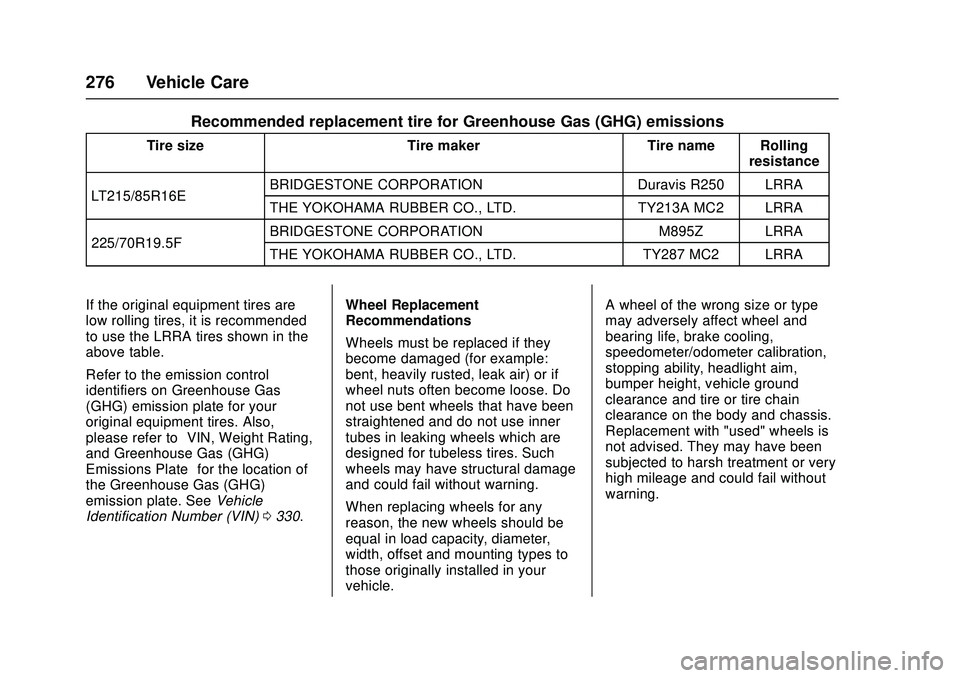
Recommended replacement tire for Greenhouse Gas (GHG) emissions
Tire sizeTire makerTire name Rolling
resistance
LT215/85R16E BRIDGESTONE CORPORATION
Duravis R250 LRRA
THE YOKOHAMA RUBBER CO., LTD. TY213A MC2 LRRA
225/70R19.5F BRIDGESTONE CORPORATION
M895Z LRRA
THE YOKOHAMA RUBBER CO., LTD. TY287 MC2 LRRA
If the original equipment tires are
low rolling tires, it is recommended
to use the LRRA tires shown in the
above table.
Refer to the emission control
identifiers on Greenhouse Gas
(GHG) emission plate for your
original equipment tires. Also,
please refer to “VIN, Weight Rating,
and Greenhouse Gas (GHG)
Emissions Plate” for the location of
the Greenhouse Gas (GHG)
emission plate. See Vehicle
Identification Number (VIN) 0330. Wheel Replacement
Recommendations
Wheels must be replaced if they
become damaged (for example:
bent, heavily rusted, leak air) or if
wheel nuts often become loose. Do
not use bent wheels that have been
straightened and do not use inner
tubes in leaking wheels which are
designed for tubeless tires. Such
wheels may have structural damage
and could fail without warning.
When replacing wheels for any
reason, the new wheels should be
equal in load capacity, diameter,
width, offset and mounting types to
those originally installed in your
vehicle. A wheel of the wrong size or type
may adversely affect wheel and
bearing life, brake cooling,
speedometer/odometer calibration,
stopping ability, headlight aim,
bumper height, vehicle ground
clearance and tire or tire chain
clearance on the body and chassis.
Replacement with "used" wheels is
not advised. They may have been
subjected to harsh treatment or very
high mileage and could fail without
warning.
Page 290 of 358
Chevrolet Low Cab Forward Owner Manual (GMNA-Localizing-U.S.-
11254764) - 2018 - crc - 12/5/16
Vehicle Care 289
{Warning
For safety and the protection of
the vehicle, do not push-start the
vehicle.
Never tow the vehicle to start
because a surge forward when
the engine starts could cause a
collision with the tow vehicle.
Also, this vehicle has a 12-volt
battery, 12-volt starting system
and a negative ground electrical
system; be sure the vehicle or
equipment used to jump start your
engine is also 12-volt. Use of any
other system may damage the
vehicle's electrical components.
Under no circumstances should
the battery's positive and negative
terminals be put in contact with
one another.
When connecting the cables,
under no circumstances should
the clips be allowed to touch each
other.(Continued)
Warning (Continued)
Do not disconnect a battery
terminal with the engine running.
It could cause a breakdown in the
electrical system.
You and others could be seriously
injured.
If you notice battery fluid leaking,
have an inspection carried out
immediately by the nearest dealer.
Diesel engine vehicles have more
than one battery because of the
higher torque required to start a
diesel engine. This procedure can
be used to start a single-battery
vehicle from any of the diesel
vehicle's batteries. However, at low
temperatures, it may not be possible
to start a diesel engine from a single
battery from another vehicle. 1. Use a vehicle that has a charged battery with the same
voltage. Make sure that the
other vehicle also has a 12-volt
starting system, and that it is the negative (–) terminal which
is grounded (attached to the
engine block, or frame rail).
2. Position the vehicle with the good (charged) battery so that
the booster (jumper) cables will
reach. But never let the
vehicles touch. Also, be sure
the booster cables to be used
do not have loose or missing
insulation.
3. In both vehicles, turn off the ignition (engine control) switch
and all lights and accessories
except the hazard flasher or
any lights needed for the work
area. In both vehicles, apply
the parking brake firmly and
move the selector lever to the
"P" position.
Page 294 of 358
Chevrolet Low Cab Forward Owner Manual (GMNA-Localizing-U.S.-
11254764) - 2018 - crc - 12/5/16
Vehicle Care 293
After Towing
After towing the vehicle, block the
rear wheels and install axle shafts
or driveshaft.
Apply the parking brake before
disconnecting from the towing
vehicle. Check and fill rear axle with
oil, if required.
Rear End Towing
When towing a vehicle with rear
wheels raised, secure the steering
wheel to maintain straight-ahead
position. Make certain that the front
axle is not loaded beyond the front
axle gross axle weight rating
(GAWR) as indicated on the
vehicle's VIN and weight rating
plate.
Special Towing Instructions1. All state and local laws regarding such items as
warning signals, night
illumination, speed, etc., must
be followed. 2. Safety chains must be used.
3. No vehicle should ever be
towed over 88 km/h (55 mph).
4. Loose or protruding parts of damaged vehicles should be
secured prior to moving.
5. A safety chain system completely independent of the
primary lifting and towing
attachment must be used.
6. Operators should refrain from going under a vehicle which is
being lifted by the towing
equipment unless the vehicle is
adequately supported by safety
stands.
7. No towing operation which for any reason jeopardizes the
safety of the wrecker operator
or any bystanders or other
motorists should be attempted.Appearance Care
Exterior Care
Exterior Finish
The paint finish on your vehicle
provides beauty, depth of color,
gloss retention and durability.
While cleaning the vehicle, do not
grip the roofmarker lights to prevent
damage or water leakage.
Washing
The best way to preserve your
vehicle's finish is to keep it clean by
washing it often.
Wash the vehicle in lukewarm or
cold water. Do not use hot water or
wash your vehicle in the direct rays
of the sun. Do not use strong soap
or chemical detergents. All cleaning
agents should be flushed promptly
from the surface and not allowed to
dry on the finish.
These vehicles are designed to
operate under normal environmental
conditions to withstand natural
elements. However, unusual
Page 318 of 358

Chevrolet Low Cab Forward Owner Manual (GMNA-Localizing-U.S.-
11254764) - 2018 - crc - 12/5/16
Service and Maintenance 317
Owner Checks and
Services
Before Driving
Proper care and driving is important
not only for extended service life of
your vehicle, but also for improved
fuel and oil economy. Drive carefully
and defensively. Be sure you know
how to use your truck and its
equipment before operating it.
Starting and Operating
Proper care and operation will not
only extend the service life of your
vehicle but also improve fuel
economy.
Check Around the Vehicle Before
Starting the Engine
Before pulling away, perform a
thorough safety check, making sure
there are no children or obstructions
around the vehicle.
Take off the chocks after confirming
that the parking brake is securely
applied. Sit behind the wheel, adjust
the seat position, and buckle up the
seat belt. The passengers are alsorequired to buckle up the seat belts.
Adjust the positions of the steering
wheel and mirrors. Lock the doors.
Turn the power of the dome light or
accessories OFF before starting the
engine.
Engine Conditions
Checking the Engine for
Startability and Abnormal Noises
1. Make sure the parking brake is securely engaged. Step firmly
on the brake pedal.
2. Make sure the selector lever is in "P" or "N" position.
For safety, firmly press the
brake pedal before starting the
engine.
3. Turn the engine control switch to start the engine.
Check that the engine starts
quickly with no abnormal
noises. Checking Condition of the Engine
at Low Speeds and during
Acceleration
1. Make sure the transmission is in the "P" or "N" position and
the parking brake is securely
engaged.
2. Turn the engine control switch to start the engine, and run it to
warm up.
3. Check that the engine is running at a speed within the
standard idle speed range.
During regeneration of the
diesel particulate filter (DPF),
the engine idle speed may
increase.
4. Drive the vehicle, making sure the accelerator pedal does not
stick when gradually
accelerating, the engine speed
rises smoothly and it does not
knock.
Page 319 of 358

Chevrolet Low Cab Forward Owner Manual (GMNA-Localizing-U.S.-
11254764) - 2018 - crc - 12/5/16
318 Service and Maintenance
Recommended Daily
(Pre-operation) Inspections
These checks are in addition to, not
instead of, any legally required daily
inspections. See related topics
under "Maintenance Schedule",
especially if problems are found.
For safe and comfortable driving,
keep record of the distances driven
and the condition of the vehicle
during operation. Perform
inspections at appropriate intervals,
and perform maintenance in
accordance with the findings of the
inspections. If an inspection reveals
an abnormality or there was an
abnormality the previous time the
vehicle was driven, have the vehicle
repaired by the nearest dealer
before it is driven again.1. Components that showed abnormalities during the
previous operation
.Check components that
showed abnormalities
during the previous
operation 2. Checks performed at the
engine
.Fan belt looseness and
damage
. Engine oil level
. Engine coolant level
. Power steering fluid level
3. Checks performed from the driver's seat
.Brake fluid level
. Brake pedal free play
. Operation of meters,
gauges and warning/
indicator lights
. Engine startability,
abnormal noise and color of
exhaust gases
. Parking brake lever stroke
. Windshield washer fluid
spray condition and
windshield wiper
effectiveness
. Windshield washer fluid
level .
Steering wheel position and
free play
. Operation of horn and turn
signal lights
. Door lock operation
4. Checks performed during a walk around the vehicle
.Illumination, flashing,
contamination, damage and
obstruction of lights
. Contamination, damage ad
obstruction of windows,
mirrors and reflectors
. Leaf spring damage
. Oil, engine coolant, fuel,
brake fluid and power
steering fluid leaks
. Water separator
5. Checking wheels and tires .Air pressure
. Cracks and other damage
. Abnormal wear
. Tread depth
. Mounting condition of all
wheel nuts
Page 320 of 358

Chevrolet Low Cab Forward Owner Manual (GMNA-Localizing-U.S.-
11254764) - 2018 - crc - 12/5/16
Service and Maintenance 319
6. Checks performed after theengine startup
.Oil, engine coolant, fuel,
brake fluid and power
steering fluid leaks
. Inspect the exhaust system,
checking that the tailpipe is
clear
7. Checks performed while driving the vehicle
.Brake effectiveness
. Engine abnormal noises
Keep the Floor Around the Driver
Seat Clean and Tidy
{Warning
It is extremely dangerous to have
empty cans, empty bottles,
or other items rolling around on
the floor because they could get
trapped under the brake pedal
and prevent brake application.
For proper pedal operation, it is
also essential to lay floor mats (Continued)
Warning (Continued)
properly. Incorrectly installed floor
mats would hinder free movement
of the pedals.
Do not use the dashboard pocket
or the top of the dashboard as a
place to put items that could roll,
which could interfere with your
driving. You and others could be
seriously injured.
Choose Your Footwear Suitable
for Driving
{Warning
Choose footwear that ensures
proper operation of pedals when
driving the vehicle. Use of
footwear unsuitable for driving
may cause an accident. The
driver could be seriously injured
when not wearing the proper
footwear.
Electrical System
Following the after-delivery service,
it is the owner's responsibility to
check all wiring periodically for
cracked, chafed or oil-soaked
insulation and maintain it in a clean
and tight condition to ensure
satisfactory operation of the
electrical system.
Headlights and Turn Signal
Lights
Turn the engine control switch to the
"ON" position, and then check the
way in which the headlights, turn
signal lights, and other exterior
lights come on and flash. In
addition, press the brake pedal to
confirm whether the stop lights
come on, and shift the transmission
to "R" position to confirm whether
the back up lights come on. Also
examine the lights for discoloration,
damage, and looseness.
Page 324 of 358

Chevrolet Low Cab Forward Owner Manual (GMNA-Localizing-U.S.-
11254764) - 2018 - crc - 12/5/16
Service and Maintenance 323
Additional
Maintenance and Care
Owner Safety and Routine
Maintenance
Listed below are vehicle checks
which should be made periodically
by either the owner or a qualified
technician to ensure proper
performance and safety of your
vehicle. Take any problems promptly
to a technician for service advice.
For your safety and that of others,
any of the safety-related
components that may have been
damaged in an accident should be
checked and necessary repairs
performed before operating your
vehicle.
At the minimum, these routine
checks should be made every
6 months or 16,000 km
(10,000 miles), whichever comes
first. Whenever repairs are
necessary, have them completed
before operating the vehicle.A: Parking Brake :
Park on a fairly
steep hill and hold the vehicle with
the parking brake only. This checks
holding ability.
Before checking item (B) below, be
sure to have enough room around
the vehicle. Then firmly apply both
the parking brake see Parking
Brake 0200 and the regular brakes.
Do not use the accelerator pedal.
If the engine starts, be ready to turn
off the engine control switch at
once. Take these precautions
because the vehicle could move
without warning and possibly cause
injury or property damage.
B: Starter Safety Switch : Check
by trying to start the engine in each
gear. The starter should crank only
at selector position "P" or "N".
C: Transmission Shift Indicator :
Check that the indicator points to
the gear chosen.
D: Steering : Be alert for any
changes in steering action. An
inspection or service is needed
when: the steering wheel is harder to turn or has too much free play,
or when there are strange sounds
when turning or parking.
E: Wheel Alignment, Balance, and
Tires :
Check tires for abnormal
wear or damage. Also, check for
damaged wheels. A pull right or left
on a straight and level road may
show the need for a wheel
alignment. A vibration of the
steering wheel or seat at normal
highway speeds may mean a wheel
balancing is needed. Check tire
pressure when the tires are "cold,"
at least monthly, and whenever the
vehicle is serviced.
Check the pressure more often if
daily checks show it's needed.
(Refer to "Recommended Daily
(Pre-operation) Inspections" under
Owner Checks and Services 0317).
Change tire pressure as needed
when changing loads.
F: Brakes : Be alert to illumination
of the brake system warning light or
brake low vacuum warning light
(4500HD, 4500XD models) or the
tone alarm, or changes in braking
action, such as repeated pulling to