fuel filter CHEVROLET LOW CAB FORWARD 2019 User Guide
[x] Cancel search | Manufacturer: CHEVROLET, Model Year: 2019, Model line: LOW CAB FORWARD, Model: CHEVROLET LOW CAB FORWARD 2019Pages: 382, PDF Size: 5.95 MB
Page 193 of 382
Chevrolet Low Cab Forward 5.2L Diesel Engine 4500/5500 Series (GMNA-
Localizing-U.S.-12407814) - 2019 - crc - 12/13/17
192 Driving and Operating
Warning (Continued)
Do not dilute DEF with water.
Do not add substances such as
gasoline or diesel fuel to the DEF
tank. You and others could be
seriously injured.
Caution
When opening the DEF tank cap,
be careful not to let dirt or other
foreign matter enter inside the
DEF tank. Intrusion of foreign
matter can cause a clogging of
the filter or affect the quality of
DEF, which may result in a SCR
system failure.
If DEF is spilled on the body or
frame, it may cause generation of
rust, so wipe it off and then rinse
it away with water.When DEF dries it will leave a
crystalline residue, this condition is
normal. Wash with water or wipe
away the residue to prevent it from
entering the DEF tank.
Adding DEF in Cold Weather
DEF freezes at low temperature but
the engine coolant circulates to
thaw the DEF tank and to prevent
DEF from freezing. Vehicle can be
driven normally when DEF is frozen.
If the refill diesel exhaust fluid (DEF)
warning light is on and the
remaining DEF in the DEF tank is
frozen, the warning lights, indicator
lights and restriction will not be
canceled until the DEF thaws even
if the DEF tank is refilled.
It is not recommended parking the
vehicle for long periods with the refill
diesel exhaust fluid (DEF) warning
light on in cold weather. The DEF
gauge will not register correctly
should the DEF freeze in this
condition causing the DEF low level
warning system not to reset when DEF is added. Take the following
actions to avoid this condition in
cold weather:
1. Refill the DEF as soon as possible after parking the
vehicle.
2. Turn the engine control switch to the ON position from the
LOCK position.
3. Wait for the warning buzzers and warning lights to turn off.
4. If the buzzer does not stop, return the engine control switch
back to the LOCK position and
add more DEF, and then start
over from step (2) above.
5. Turn the engine control switch to the LOCK position.
The DEF freezes at approximately
−11 °C (12 °F).
In cold weather, when the vehicle is
left without performing these actions
and the DEF tank freezes, the low
DEF level warnings and indicators
may not turn off when DEF is added
until after the tank defrosts.
Page 230 of 382
Chevrolet Low Cab Forward 5.2L Diesel Engine 4500/5500 Series (GMNA-
Localizing-U.S.-12407814) - 2019 - crc - 12/13/17
Driving and Operating 229
Caution
Do not use blends containing
more than 20% biodiesel. Any
engine, fuel system, or exhaust
after-treatment system damage
would not be covered by the
vehicle warranty.
As a renewable fuel, biodiesel
provides some environmental
benefits. However, biodiesel has
unique properties and needs to be
handled differently than diesel fuel.
Its use presents additional risks and
may not be appropriate in all
situations. Certain vehicle operating
modes increase these risks and
should be avoided. Read further to
determine if your driving habits are
compatible with the use of biodiesel.
Biodiesel fuel quality degrades with
time and exposure to high
temperature quicker than Ultra Low
Sulfur Diesel fuel. More frequent
refueling provides the best
opportunity to have a supply of fresh fuel. Storage at hot ambient
temperatures will accelerate
biodiesel degradation.
Owners who use very little fuel,
or who have vehicles or fuel stored
for extended periods of time, should
avoid the use of biodiesel blended
fuels above 5% by volume. When
vehicles are stored for longer than
one month, they should be run out
of biodiesel to below one-quarter
tank, refueled with Ultra Low Sulfur
Diesel fuel, and driven several miles
before storage.
At temperatures below 0 °C (32 °F),
it is recommended to switch to Ultra
Low Sulfur Diesel fuel with no
biodiesel content, or to blends with
biodiesel containing less than 5% by
volume. At these extreme cold
temperatures, biodiesel blends
higher than 5% by volume may
cause fuel filter plugging and
system gelling, which can lead to
vehicle operability problems.
Fuels improperly blended for cold
temperature operation may result in
restricted fuel filters and degraded
vehicle performance. The vehicle is
equipped with a fuel heating system
to provide a level of protection
against filter plugging from gelling or
waxing of conventional diesel fuel
and biodiesel blends. If the
operating temperature is far below
the temperature at which gelling or
waxing of the fuel occurs, the
system will not prevent all cases of
filter plugging.
If the vehicle experiences a fuel
filter restriction, the on-board
monitoring system will alert the
driver that the fuel filter requires
service. The fuel filter, however, will
not prevent all damage caused by
poor quality biodiesel.
Biodiesel Blends
Use biodiesel blends that meet the
ASTM specification D6751.
Retail pumps dispensing blends
containing up to 5% biodiesel (B5)
are not required to be labeled with
the concentration of biodiesel.
Page 231 of 382
Chevrolet Low Cab Forward 5.2L Diesel Engine 4500/5500 Series (GMNA-
Localizing-U.S.-12407814) - 2019 - crc - 12/13/17
230 Driving and Operating
Blends up to B5 must meet ASTM
D975 (Grades No. 2-D or No. 1-D
S15 Ultra Low Sulfur Diesel). When
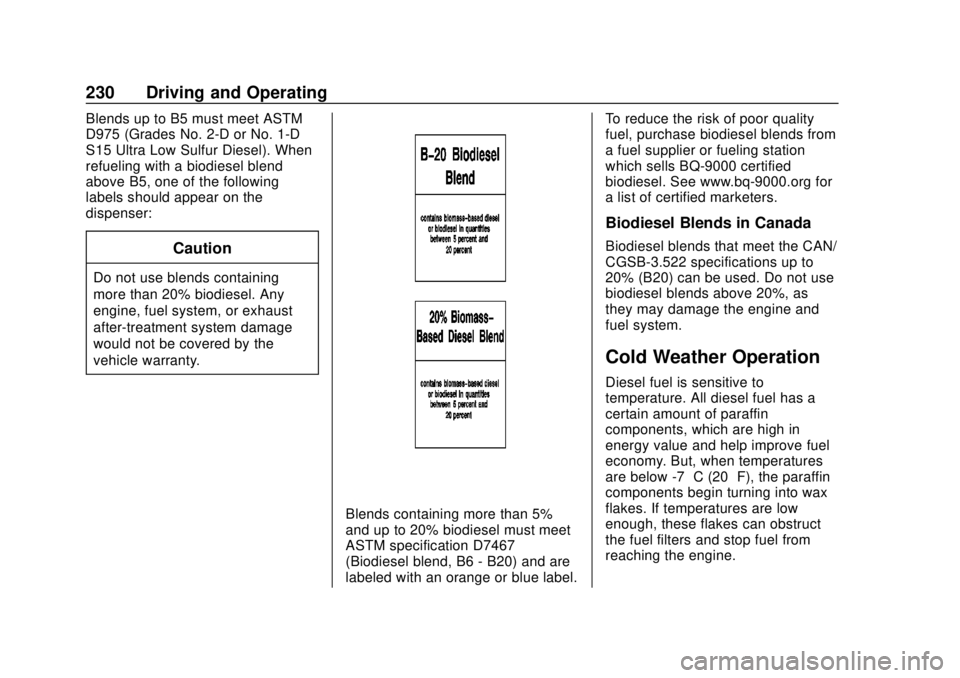
refueling with a biodiesel blend
above B5, one of the following
labels should appear on the
dispenser:
Caution
Do not use blends containing
more than 20% biodiesel. Any
engine, fuel system, or exhaust
after-treatment system damage
would not be covered by the
vehicle warranty.
Blends containing more than 5%
and up to 20% biodiesel must meet
ASTM specification D7467
(Biodiesel blend, B6 - B20) and are
labeled with an orange or blue label.To reduce the risk of poor quality
fuel, purchase biodiesel blends from
a fuel supplier or fueling station
which sells BQ-9000 certified
biodiesel. See www.bq-9000.org for
a list of certified marketers.
Biodiesel Blends in Canada
Biodiesel blends that meet the CAN/
CGSB-3.522 specifications up to
20% (B20) can be used. Do not use
biodiesel blends above 20%, as
they may damage the engine and
fuel system.
Cold Weather Operation
Diesel fuel is sensitive to
temperature. All diesel fuel has a
certain amount of paraffin
components, which are high in
energy value and help improve fuel
economy. But, when temperatures
are below -7 °C (20 °F), the paraffin
components begin turning into wax
flakes. If temperatures are low
enough, these flakes can obstruct
the fuel filters and stop fuel from
reaching the engine.
Page 232 of 382
Chevrolet Low Cab Forward 5.2L Diesel Engine 4500/5500 Series (GMNA-
Localizing-U.S.-12407814) - 2019 - crc - 12/13/17
Driving and Operating 231
At low temperatures, wax flakes are
more likely to form in Number 2-D
fuel than in Number 1-D (or
"winterized" Number 2-D) fuel. For
best operation at temperatures
below -7 °C (20 °F), use Number
1-D, or Number 2-D which has been
blended with Number 1-D for winter
use. When temperatures are
consistently below (or near) -18 °C
(0 °F), use Number 1-D if at all
possible. Bear in mind, however,
that even Number 1-D fuel will form
wax flakes when temperatures are
extremely low.
Do not use home heating oil or
gasoline in your diesel engine;
either may cause engine damage.
The addition of kerosene will not
unplug a filter plugged with wax.
Warming a "waxed" filter to a
temperature of 0 °C to 10 °C (32 °F
to 50 °F) will return the wax to
solution. Filter replacement is not
normally required.Water in Fuel
During refueling, it is possible for
water (and other contaminants) to
be pumped into your fuel tank along
with the diesel fuel. This can occur if
a service station does not regularly
inspect and clean its fuel tanks, or if
a service station receives
contaminated fuel from its
supplier(s).
To protect your engine from
contaminated fuel, there is a water
separator system on the engine
which allows you to drain excess
water from the fuel.
{Warning
The drained water/diesel fuel
mixture is flammable, and could
be hot. To help avoid personal
injury or death and/or property
damage, do not touch the fuel
coming from the water separator
drain valve, and do not expose
the fuel to open flames or sparks.(Continued)
Warning (Continued)
Be sure you do not overfill the
drain pan. Heat (such as from the
engine) can cause the fuel to
expand. If the container is too full,
fuel could be forced out of the
pan. This could lead to a fire and
the risk of personal injury and/or
vehicle damage.
Biocides
In warm or humid weather, fungus,
and/or bacteria may form in diesel
fuel if there is water in the fuel.
Fungus or bacteria can cause fuel
system damage by plugging the fuel
lines, fuel filters or injector. They
can also cause fuel system
corrosion.
If fungus or bacteria has caused fuel
system problems, you should have
your authorized dealer correct these
problems. Then, use a diesel fuel
biocide to sterilize the fuel system
(follow the biocide manufacturer's
instructions). Biocides are available
Page 233 of 382

Chevrolet Low Cab Forward 5.2L Diesel Engine 4500/5500 Series (GMNA-
Localizing-U.S.-12407814) - 2019 - crc - 12/13/17
232 Driving and Operating
from your dealer, service stations,
parts stores and other automotive
places. See your authorized dealer
for advice on using biocides in your
area and for recommendations on
which biocides you should use.
Smoke Suppressants
Because of extensive testing of
treated fuel versus untreated fuel,
the use of a smoke suppressant
additive is not recommended
because of the greater possibility of
stuck rings and guttered valves,
resulting from excessive ash
deposits.
Water Separator
The purpose of the water separator
is to separate any water from the
fuel that may have formed in the
fuel tank due to condensation.
The water separator is located on
the bottom of the fuel filter.
Caution
Remaining water that is not
discharged from the water
separator could freeze and
damage the vehicle.
If the warning light comes on
while the engine is in operation,
promptly drain the water from the
water separator (fuel filter).
Continuing to drive with the light
remaining on could damage the
fuel injection system. If this
happens, have the vehicle
checked and serviced by the
nearest dealer.
Draining Water from the Fuel
Filter
Clean off any fuel that has adhered
to the vehicle body.
Starting the engine immediately
after draining the water from the fuel
filter requires a little more time than
usual. If the engine does not start in
10 seconds, wait for a while and try
again.Fuel will be mixed in the drained
water. Dispose of it in a method
conforming to the regulatory
requirements in your state.
If the water separator (fuel filter)
requires frequent draining, have the
fuel system inspected at your
dealer.Pre Fuel Filter (Chassis-side)
1. Attach a plastic hose to the drain plug (2) on the bottom of
the chassis-side fuel filter and
put the other end of the hose in
a container placed beneath the
filter.
Page 234 of 382

Chevrolet Low Cab Forward 5.2L Diesel Engine 4500/5500 Series (GMNA-
Localizing-U.S.-12407814) - 2019 - crc - 12/13/17
Driving and Operating 233
2. Loosen the drain plug andmove the priming pump (1) up
and down by hand between
10 and 20 times.
3. Fully tighten the drain plug (2) and move the priming pump (1)
several times.
Fuel Filter (Engine-side)
1. Attach a plastic hose to the drain plug (2) on the bottom of
the engine-side fuel filter (1)
and put the other end of the
hose in a container placed
beneath the filter.
2. Loosen the drain plug andmove the priming pump up and
down by hand between 10 and
20 times.
3. Fully tighten the drain plug and move the priming pump several
times.
4. Test run the engine and check that there are no fuel leaks
from the drain plug of the
engine-side fuel filter. Also
check that the water separator
(fuel filter) warning light
stays off.
Running Out of Fuel
When the Fuel Tank is Empty
When the fuel tank is empty, air will
enter the fuel system, so refueling
alone will not be enough to restart
the engine. Use the following
methods to bleed the fuel system.
Bleeding the Fuel System
Steps for Refueling
1. Follow the directions in "Parking Brake Lever" under
Parking Brake 0220.
Page 235 of 382

Chevrolet Low Cab Forward 5.2L Diesel Engine 4500/5500 Series (GMNA-
Localizing-U.S.-12407814) - 2019 - crc - 12/13/17
234 Driving and Operating
2. Select the correct fuel (See"Diesel Fuel Requirement and
Fuel System"). Follow any
posted safety rules. Stand to
the side, never above or
opposite the filler opening.
3. Check that the fuel cap is tight, and see to it that engine oil,
engine coolant in the reservoir,
and washer fluid, etc. are at
proper levels. Then do the
Driver Daily Checklist.
See Owner Checks and Services
0 340.
Driving your vehicle until the fuel
tank is empty may activate the
check engine malfunction indicator
light. You do not need to have your
vehicle checked. After refueling,
perform the following:
. Bleed the fuel system.
. Start, turn off and restart the
engine three or four times.
. The check engine malfunction
indicator light will be cancelled. Before Starting the Engine
1. The priming pump (1) is
located on the outboard side of
the left frame rail, in front of the
batteries. Place a container
beneath the air bleed plug (2)
to receive fuel, and then fully
loosen the plug.
2. Attach a clear hose onto the air bleed plug, direct the clear
hose into a catch pan.
3. Pump the priming pump (1) up/ down for 65 times to get most
of the air bubbles out. Note fuel
was drawn into the filter bowl at
around 40 - 50 times. 4. Fully retighten the air bleed
plug (2) and wipe off any fuel
that may have adhered to the
plug or surrounding area.
5. Continue to operate the pump for 50 times.
6. Start the engine.
7. If the engine does not start, repeat steps 5 and 6 as
necessary until it does start.
After Starting the Engine 1. Without pressing the accelerator pedal, start the
engine.
2. After the engine has started, allow it to idle for about
5 seconds.
3. Fully press the accelerator pedal and increase the engine
speed to the maximum speed
for 10 seconds. (Repeat this
operation several times.)
Page 240 of 382

Chevrolet Low Cab Forward 5.2L Diesel Engine 4500/5500 Series (GMNA-
Localizing-U.S.-12407814) - 2019 - crc - 12/13/17
Vehicle Care 239
Vehicle Care
General Information
General Information . . . . . . . . . . 240
California Proposition65 Warning . . . . . . . . . . . . . . . . . 240
California Perchlorate Materials Requirements . . . . . 240
Accessories and Modifications . . . . . . . . . . . . . . . . 240
Vehicle Checks
Doing Your OwnService Work . . . . . . . . . . . . . . . 241
Cab Tilting . . . . . . . . . . . . . . . . . . . . 243
Engine Compartment Overview . . . . . . . . . . . . . . . . . . . . 244
Engine Cover . . . . . . . . . . . . . . . . . 245
Engine Oil . . . . . . . . . . . . . . . . . . . . 245
Automatic Transmission Fluid . . . . . . . . . . . . . . . . . . . . . . . . 251
Engine Air Cleaner/Filter . . . . . . 253
Engine Coolant . . . . . . . . . . . . . . . 253
Engine Overheating . . . . . . . . . . 259
Power Steering Fluid . . . . . . . . . 262
Washer Fluid . . . . . . . . . . . . . . . . . 262
Brakes . . . . . . . . . . . . . . . . . . . . . . . 263
Brake Fluid . . . . . . . . . . . . . . . . . . . 268
Battery - North America . . . . . . 269 Fuel Filter . . . . . . . . . . . . . . . . . . . . 270
Rear Axle (Gear Oil Viscosity
Chart) . . . . . . . . . . . . . . . . . . . . . . . 271
Rear Axle (Oil Level Check) . . . . . . . . . . . . . . . . . . . . . . 272
Noise Control System . . . . . . . . 272
Automatic Transmission Shift Lock Control Function
Check . . . . . . . . . . . . . . . . . . . . . . . 274
Wiper Blade Replacement . . . . 275
Headlamp Aiming
Headlamp Aiming . . . . . . . . . . . . 277
Bulb Replacement
Bulb Replacement . . . . . . . . . . . . 277
Headlamps and Front Turn Signal . . . . . . . . . . . . . . . . . . . . . . . 280
Roofmarker Lamps . . . . . . . . . . . 284
Sidemarker Lamps (Including Turn Signal and Cornering
Lamps) . . . . . . . . . . . . . . . . . . . . . . 284
Taillamps, Turn Signal, Stoplamps, and Back-Up
Lamps . . . . . . . . . . . . . . . . . . . . . . 286
License Plate Lamp . . . . . . . . . . 286
Interior Lamps . . . . . . . . . . . . . . . . 287
Electrical System
Electrical System Overload . . . 287
Wheels and Tires
Wheels and Tires . . . . . . . . . . . . . 295
Tire Pressure . . . . . . . . . . . . . . . . . 307
Tire Rotation . . . . . . . . . . . . . . . . . 307
If a Tire Goes Flat . . . . . . . . . . . . 310
Jump Starting
Jump Starting - North America . . . . . . . . . . . . . . . . . . . . . 311
Towing the Vehicle
Towing the Vehicle . . . . . . . . . . . 315
Appearance Care
Exterior Care . . . . . . . . . . . . . . . . . 317
Interior Care . . . . . . . . . . . . . . . . . . 323
Page 243 of 382

Chevrolet Low Cab Forward 5.2L Diesel Engine 4500/5500 Series (GMNA-
Localizing-U.S.-12407814) - 2019 - crc - 12/13/17
242 Vehicle Care
chock the wheels. It would be very
dangerous if the vehicle started
to move.
When performing work on the
electrical system, begin by turning
the engine control switch to the
"LOCK" position, wait at least
3 minutes, and then disconnect the
negative cable from the negative
terminal on battery. If the negative
cable is disconnected within
3 minutes, the engine control
module may malfunction.
When working on the fuel line or
fuel filter, remove the fuel tank filler
cap. The fuel system is under
pressure and the fuel will overspill
unless the pressure is relieved,
possibly leading to combustion or
a fire.
Do not make engine adjustments
yourself. Be sure to consult your
dealer.
Use only appropriate tools.Oils, brake fluid and engine coolant
have lubrication, cooling and rust
prevention functions. If these liquids
deteriorate through loss or
contamination, it will cause a
decline in the performance of the
parts and such problems as seizure
or malfunctioning. Replenish or
change these liquids when
performing the checks (daily and
periodic checks) as required by the
relevant regulations or in
accordance with the Maintenance
Schedule (when either the specified
driving distance or period of time,
whichever comes first, has expired).
Confirm that all systems and
components are normal after
performing the work.
Do not leave the removed parts or
tools in the engine compartment.
They could damage the equipment if
caught in the belts or other moving
components.
Dirty water, dirt and other impurities
seriously impair the effectiveness of
the oil, grease and fluids, and
damage the parts. Exercise all due
caution to prevent waste or otherrefuse from coming in contact with
parts or materials that have been
removed when changing or
replenishing them.
Do not step on the engine or climb
onto it. You could cause an engine
failure by, for example, damaging
the cylinder head cover or various
connectors.
Electric Welding
Careless electric welding of vehicle
parts can cause welding current to
flow back through the vehicle’s
ground circuit and damage electrical
and electronic parts so that they do
not function normally. Whenever
electric welding is necessary,
consult your dealer.
Page 247 of 382

Chevrolet Low Cab Forward 5.2L Diesel Engine 4500/5500 Series (GMNA-
Localizing-U.S.-12407814) - 2019 - crc - 12/13/17
246 Vehicle Care
and the oil should be changed
regularly according to the
Maintenance Schedule.
The engine oil performs the
following important functions:
.It prevents engine parts from
becoming worn.
. It cools engine parts.
. It cleans engine parts.
. It seals the combustion
chambers and prevents rust.
Replace the engine oil at regular
intervals.
When particulate matter (PM) has
accumulated to a preset level in the
diesel particulate filter (DPF), the
filter is automatically regenerated
through combustion. To make this
regeneration (combustion) possible,
a small amount of fuel is injected
into the engine combustion chamber
after firing. This causes fuel to
gradually become mixed with the
engine oil, and the engine oil level
may rise beyond the original level.
This does not indicate a malfunction
of the engine.Access to the Engine
Single Cab Model
Access to the engine oil dipstick is
located on the engine left side after
tilting the cab. See Cab Tilting
0 243.
Crew Cab Model
The engine oil dipstick is under the
engine inspection sub cover located
beneath the driver's seat.
Checking the Engine Oil Level
Press the engine oil level check
switch. If engine oil level is low the
red oil pressure warning light will
turn on. If the engine oil level is
above the "OK", the green oil level
indicator will turn on.
The oil level varies while the engine
is running, right after it is stopped,
and on sloping ground. When
checking the oil level, be sure the
vehicle is on level ground while the
engine is cool.