heater CHEVROLET LOW CAB FORWARD 2019 User Guide
[x] Cancel search | Manufacturer: CHEVROLET, Model Year: 2019, Model line: LOW CAB FORWARD, Model: CHEVROLET LOW CAB FORWARD 2019Pages: 382, PDF Size: 5.95 MB
Page 173 of 382

Chevrolet Low Cab Forward 5.2L Diesel Engine 4500/5500 Series (GMNA-
Localizing-U.S.-12407814) - 2019 - crc - 12/13/17
172 Driving and Operating
Do not race the engine or quickly
accelerate before the engine has
sufficiently warmed up. Oil would
not have adequately reached and
lubricated components, and a
breakdown may result.
The exhaust pipe becomes
extremely hot while the engine is
idling. Before warming up the
engine, make sure there is no
flammable material, such as grass,
waste paper, oil, or old tires near the
exhaust pipe.
Engine Warm-up System
During cold ambient conditions, the
automatic engine warm-up system
operates to reduce engine warm-up
time during idling.
Automatic Engine Warm-up :
When the engine is idling with the
engine coolant temperature below
62 °C (144 °F), the engine warm-up
system automatically closes the
exhaust brake and increases engine
idle speed so that the engine is
warmed more quickly. Warm-up is
cancelled when the accelerator
pedal is pressed, and resumedwhen the pedal is released.
Warm-up is automatically cancelled
entirely after the engine coolant
temperature rises above 65 °C
(149 °F).
Winter Cover
.
Do not cover the front of the
radiator with newspapers,
cardboard or any other
flammable material to raise the
engine coolant temperature.
. If you allow the engine to warm
up but the engine coolant
temperature does not rise, have
the nearest dealer inspect the
thermostat.
Radiator Grille Covers
{Warning
Radiator shutters, winter fronts,
or grille covers are not to be used
and may cause the engine's
radiator cooling fan to fatigue
from the alternate unloading and (Continued)
Warning (Continued)
loading of the blades as they
pass by the masked area
followed by the unmasked area.
After the fan has been fatigued, it
may suddenly break apart while
rotating, possibly causing
personal injury to anyone
standing nearby, and equipment
damage. You and others could be
seriously injured.
Engine Heater
Engine Block and Oil Pan Heater
If the vehicle is parked in a garage,
the block and pan heaters should
not be needed until the garage
temperature drops below −23°C
(−10°F) regardless of outside
temperature.
Page 174 of 382

Chevrolet Low Cab Forward 5.2L Diesel Engine 4500/5500 Series (GMNA-
Localizing-U.S.-12407814) - 2019 - crc - 12/13/17
Driving and Operating 173
The engine block and oil pan
heaters are designed to warm the
block and oil pan areas that will let
the engine run faster. To use the
heaters:1. On single cab vehicles, tilt the cab.
2. Unwrap the electrical cord and remove the protective cap.
3. Plug the cord into any three-prong 110 volt outlet
(normal household current).
It may require several hours to
sufficiently heat the engine.
Outside temperature, oil
viscosity, etc., will affect how
long the block and oil pan
heater should remain plugged
in. Contact your dealer for the
conditions in your area.
4. After using the heater(s), be sure to restore the cord
properly, to help keep it away
from moving engine parts. If the cord is too short, use a heavy
duty, three-prong extension cord. Do
not use an extension cord such as
you would use for a lamp, because
the cord may overheat.
The engine should go through a
warm-up period to warm up the
engine oil before placing engine
under load. This will ensure proper
lubrication of the engine. See
Cab
Tilting 0243.
Engine Alarm and
Automatic Shutdown
If the system senses any of the
following conditions: high engine
temperature, low engine oil pressure
or low engine coolant, the
corresponding warning light and
engine alarm (shutdown) warning
light will come on. If the engine
alarm (shutdown) warning light
comes on, you will also hear a tone
alarm.
If your vehicle has the engine
shutdown feature, your engine will
shut down in 30 seconds.
Pull safely off the road and shut off
the engine. Do not start it until the
cause of the problem is known, and
the problem is fixed. However, if the
engine shuts down when you are
still in traffic, you can restart the
engine and get another 30 seconds
of operation. Do this only if you
have to, since there is a problem
that can harm the engine if it is not
fixed. See Engine Shutdown
Warning Light 080.
Page 194 of 382
Chevrolet Low Cab Forward 5.2L Diesel Engine 4500/5500 Series (GMNA-
Localizing-U.S.-12407814) - 2019 - crc - 12/13/17
Driving and Operating 193
Make sure to stop the engine before
adding the DEF. SeeWarning
Buzzers 091.
When DEF Freezes
Engine coolant circulates through
the DEF tank to thaw it when frozen
and prevent it from freezing while
the engine is running. The vehicle
can be driven normally when DEF is
frozen in the DEF tank.
If the Refill DEF warning light is on
and the remaining DEF in the DEF
tank is frozen, the vehicle low level
warning system cannot be reset by
adding DEF. The DEF gauge will not
register correctly should the
remaining DEF freeze at this level.
Move the vehicle to a location to
allow the DEF to thaw. Once the
DEF is thawed the DEF gauge
should read correctly allowing the
low level warning system to reset.
To avoid this condition follow the
instructions for Adding DEF in Cold
Weather.{Warning
Do not warm up the DEF tank
using a burner, heater, etc. You
and others could be seriously
injured.
DEF Storage
Seal the container and store it in an
indoor place with good ventilation
avoiding direct sunlight.
When storing DEF, the shelf life
varies depending on the room
temperature of the storage place.
For details, please contact the
distributor of the DEF.
For storage of DEF, seal the
container to prevent the moisture
from evaporating.
Even when DEF has been frozen,
its quality is maintained when it is
thawed. It can be used as it is. To store or carry DEF, use the
original container in which the DEF
was kept at the time of purchase.
Also, if other containers are used,
prepare a clean container for
exclusive use, which can be a
polyethylene resin tank (PE) or
stainless steel container, and do not
introduce foreign matter such as
water or contamination.
DEF Disposal
Do not dispose of DEF and the
empty container into lakes, marine
areas, rivers, etc. DEF must be
disposed of in a method conforming
to the regulatory requirements in
your state.
Page 257 of 382

Chevrolet Low Cab Forward 5.2L Diesel Engine 4500/5500 Series (GMNA-
Localizing-U.S.-12407814) - 2019 - crc - 12/13/17
256 Vehicle Care
{Warning
For storage, close the cap of
coolant container securely and
keep it in a place inaccessible to
children.
You and others could be seriously
injured.
Using any coolant other than that
recommended by your dealer could
cause damage to the engine,
radiator or heater core. In particular,
use of coolants containing borate
salts or silicates may result in
engine or radiator corrosion,
causing engine coolant leaks and
other problems.
To dilute the coolant, use distilled
water or deionized water.
Do not use the coolant at any
coolant concentration other than
that specified. If the coolant
concentration is 60% or higher,
overheating is likely to occur, while
if it is 30% or lower, anti-corrosion
function is not provided sufficiently. Using coolant at any coolant
concentration other than that
specified may reduce anti-freezing
performance, and engine coolant
may freeze.
If the engine coolant decreases
rapidly, stop the vehicle in a safe
place and contact your dealer for
advice and repair.
Checking the Engine Coolant
Level
For the single cab model, the
engine coolant reserve tank is
located behind the front-right wheel.
See
Cab Tilting 0243.
For the crew cab model, the engine
coolant reserve tank is under the
access panel beneath the left rear
seat. See Engine Cover 0245.
When the engine has cooled down,
make sure that the fluid level in the
engine coolant reserve tank is no
lower than the “MIN”line. In
addition, carefully remove the
radiator cap and check to see if it is
damaged. Check that the engine
coolant is full to the filler neck.
Check the engine coolant level only
when it is cold.
Page 261 of 382

Chevrolet Low Cab Forward 5.2L Diesel Engine 4500/5500 Series (GMNA-
Localizing-U.S.-12407814) - 2019 - crc - 12/13/17
260 Vehicle Care
If Steam Is Not Coming from the
Engine CompartmentIf the engine coolant temperature
gauge shows an overheat condition,
or you have reason to suspect the
engine may be overheating, take
the following steps:1. Operate the hazard warning flasher and pull the vehicle
immediately over to a safe
place that does not impede
traffic and park it.
2. Idle the engine and wait until the engine coolant temperature
drops to safety zone. If your air
conditioner (if equipped) is on,
turn it off. And turn on the
heater to help the engine
expel heat.
3. When the needle of the engine coolant temperature gauge
returns to the middle of the
safety zone, stop the engine.
If the needle of engine coolant
temperature gauge does not
drop inside into the safety
zone, turn the engine off and
have your vehicle serviced at
the nearest dealer. When the cooling fan for the
radiator is not turning, turn off
the engine immediately.
{Warning
Even when the engine has been
stopped, the engine coolant in the
radiator remains under pressure.
Immediately removing the radiator
cap could cause steam or hot
water to blow out, and you could
be scalded as a result. The
engine coolant in the reserve tank
may also be hot. Immediately
removing the cap could cause hot
water to blow out, and possibly
scald you. Perform inspection,
refilling, and replacement of
coolant only when its temperature
has cooled.
When removing the radiator cap
and reserve tank cap, use a thick
cloth to cover the cap and turn it
little by little.
You and others could be seriously
injured.
Page 262 of 382

Chevrolet Low Cab Forward 5.2L Diesel Engine 4500/5500 Series (GMNA-
Localizing-U.S.-12407814) - 2019 - crc - 12/13/17
Vehicle Care 261
4. If no steam or engine coolantcan be seen or heard from the
engine compartment:
.Tilt the cab or open the
engine access cover.
‐If the engine coolant is
boiling, wait until it stops
before proceeding.
‐ Look at the see-through
reserve tank. The
engine coolant level
should be between the
"MAX" and "MIN" lines
on the reserve tank.
‐ If necessary, pour
engine coolant (See
Engine Coolant 0253
for the proper coolant
and water mixture) into
the reserve tank only,
not directly into the
radiator. Also, do not
check engine coolant
level at the radiator.
. Make sure the fan belts are
not broken, or off the
pulleys, and that the fan
turns when the engine is started. Make sure the fan
blade and pulleys are not
broken.
. Check the radiator hoses
and connections, heater
hoses and connections,
radiator, water pump, EGR
cooler, and SCR system
and hoses for leakage.
If you do not find a leak or
other problem, carefully add
engine coolant to the
reserve tank.
If the engine coolant level in
the reserve tank is at the
correct level but there is still
an indication on the
instrument panel of an
overheat condition:
You must let the engine
cool first. You may then add
engine coolant directly to
the radiator. See “Adding
Engine Coolant” under
Engine Coolant 0253. 5. Inspect to see if there is any
dirt, etc. attached to the front
surface of the radiator. Also,
inspect to see if there is
anything blocking the core.
If there is anything attached,
clean and remove it.
6. After the inspection, regardless of the vehicle condition, please
contact the nearest dealer.
Once the engine coolant
temperature gauge no longer
signals an overheat condition, you
can resume driving at a reduced
speed. Return to normal driving
after about 10 minutes if the gauge
pointer does not again show an
overheat condition.
When tap water only has been used
for engine coolant in an emergency,
change the engine coolant as soon
as possible.
Engine damage may be caused if
an overheating engine is suddenly
refilled with water. Instead, refill
slowly.
Page 292 of 382
Chevrolet Low Cab Forward 5.2L Diesel Engine 4500/5500 Series (GMNA-
Localizing-U.S.-12407814) - 2019 - crc - 12/13/17
Vehicle Care 291
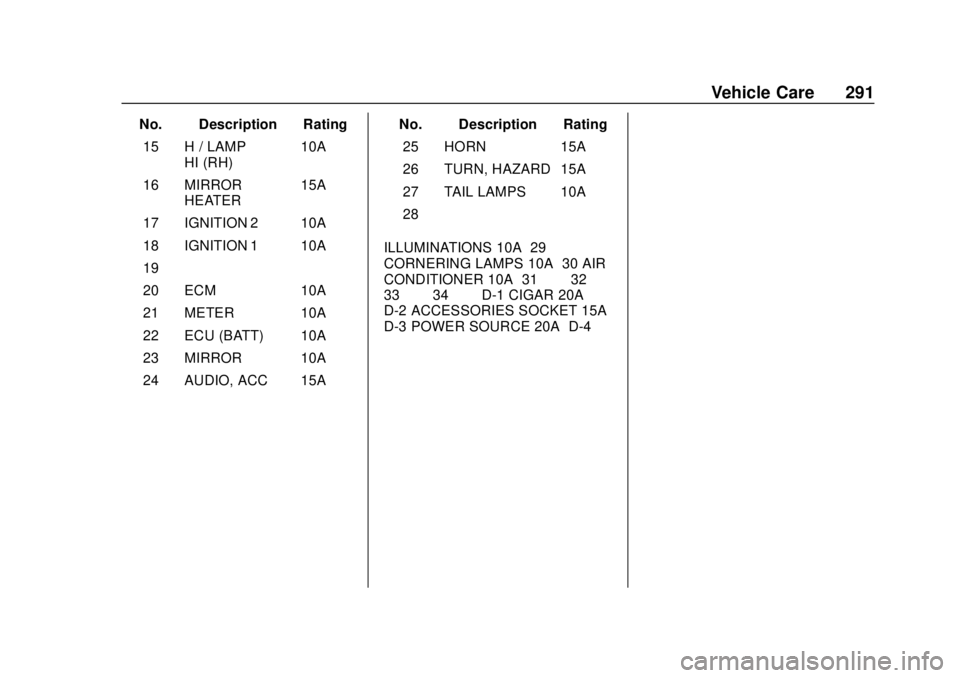
No. Description Rating15 H / LAMP HI (RH) 10A
16 MIRROR HEATER 15A
17 IGNITION 2 10A
18 IGNITION 1 10A
19 – –
20 ECM 10A
21 METER 10A
22 ECU (BATT) 10A
23 MIRROR 10A
24 AUDIO, ACC 15A No. Description Rating
25 HORN 15A
26 TURN, HAZARD 15A
27 TAIL LAMPS 10A
28
ILLUMINATIONS 10A 29
CORNERING LAMPS 10A 30 AIR
CONDITIONER 10A 31 – –32– –
33 – – 34– – D-1 CIGAR 20A
D-2 ACCESSORIES SOCKET 15A
D-3 POWER SOURCE 20A D-4
– –
Page 295 of 382

Chevrolet Low Cab Forward 5.2L Diesel Engine 4500/5500 Series (GMNA-
Localizing-U.S.-12407814) - 2019 - crc - 12/13/17
294 Vehicle Care
No. Description Rating8 A/C 10A
Relay locations (1): No. Description
1 STARTER
2 ECM MAIN
3 NOX & DEF SENSOR
4 A/C COMPRESSOR
5 CONDENSER FAN
6 RR DOME LIGHT
7 SCR HEATER VALVE
8 MARKER LIGHT
9 –
10 –
11 FUEL HEATER When Slow-blow Fuses Blow Out
Slow-blow fuses protect the
electrical circuits, and they are
installed so that they can be quickly
replaced if there is a malfunction.
If an overload exists in the circuit
from the battery, the slow-blow fuse
will blow out before the wiring
harness is damaged to protect the
electrical circuitry. InspectionWhen the headlights and other
devices in the electrical system do
not work, but there is no problem
with the fuses, check the
slow-blow fuse.
The slow-blow fuse is blown if it
looks like the illustration.
Immediately contact the nearest
dealer.
Page 337 of 382

Chevrolet Low Cab Forward 5.2L Diesel Engine 4500/5500 Series (GMNA-
Localizing-U.S.-12407814) - 2019 - crc - 12/13/17
336 Service and Maintenance
3. Engine Oil and Oil Filter :
Change at interval noted below
depending upon driving conditions.
•Normal Service —Change every
16 000 km (10,000 miles) or
12 months whichever occurs first.
• Severe Service —Change every
8 000 km (5,000 miles) or 3 months
if you often drive under one or more
of these conditions: (a) driving in
dusty areas, (b) frequent idling or
idling for long periods, (c) driving
6 km (4 miles) or less in freezing
weather, or other short trips in cold
weather, where the engine does not
thoroughly warm up.
Change oil and filter as soon as you
can after driving in a dust storm.
When recommended oil is used, it
conforms to this maintenance
schedule. (Recommended oil: CK-4
(API designations))
4. Fuel Filter : Replace the fuel
filter every 24 000 km (15,000 miles)
or more frequently if clogged or
replace when the fuel filter indicator
light comes on (if equipped). 5. Pre-Fuel Filter/Water
separator :
Replace the fuel filter
every 24 000 km (15,000 miles) or
more frequently if clogged or
replace when the fuel filter indicator
light comes on (if equipped).
6. Air Cleaner Filter : The level of
dirt in the air cleaner element can
be checked against the indicator.
Replace the air cleaner filter when
the Driver Information Center (DIC)
shows "CHECK AIR FILTER".
7. Damage to Air Intake Ducts and
Hoses : Check for damage of air
intake ducts and hoses and that
those are correctly installed every
24 000 km (15,000 miles) or
12 months. Replace or adjust those
if necessary.
8. Drive Belts : Check belt driving
the fan, alternator or A/C
compressor every 16 000 km
(10,000 miles). Look for cracks,
fraying, wear, and proper tension.
9. Engine Bolt Torques : Loosened
bolts result in lower engine output.
Check and adjust manifold mounting, and injectors to correct
torque every 80 000 km
(50,000 miles).
10. Rotate Tires :
To equalize wear,
rotate tires and adjust tire pressures
every 10 400 km (6,500 miles). See
Tire Rotation 0307.
11. Engine Cooling System : At
12 months or 16 000 km
(10,000 miles) intervals, wash
radiator cap and filler neck with
clean water, pressure test system
and radiator cap for proper pressure
holding capacity, tighten hose
clamps and inspect condition of all
cooling and heater hoses. Replace
hoses if cracked, swollen or
otherwise deteriorated. Have the
hoses replaced by your authorized
dealer.
12. Engine Coolant : Inspect the
engine coolant every 12 months.
Replace the engine coolant every
24 months, drain the engine coolant
by opening the drain plug at the
bottom of the radiator core, flush
and refill the engine cooling system
with a new engine coolant. Refer to
"Preparing Engine Coolant" in
Page 376 of 382

Chevrolet Low Cab Forward 5.2L Diesel Engine 4500/5500 Series (GMNA-
Localizing-U.S.-12407814) - 2019 - crc - 12/13/17
Index 375
DevicesAuxiliary . . . . . . . . . . . . . . . . . . . . . . .117
Diesel Engine Engine Alarm andAutomatic Shutdown . . . . . . . . 173
Diesel Exhaust Fluid . . . . . . . . 24, 189
Diesel Exhaust Fluid (DEF) Gauge . . . . . . . . . . . . . . . . . . . . . . . . . 72
Diesel Exhaust Fluid (DEF) Warning Light . . . . . . . . . . . . . . . . . . 80
Diesel Particulate Filter . . . . . . . . . 180
Distracted Driving . . . . . . . . . . . . . . . 139
Dome Lamps . . . . . . . . . . . . . . . . . . . . 96
Door
Locks . . . . . . . . . . . . . . . . . . . . . . . . . . . 30
Power Locks . . . . . . . . . . . . . . . . . . . . 33
Drive Belt Routing, Engine . . . . . . 363
Driver Behavior . . . . . . . . . . . . . . . . . 139
Driver Information Center (DIC) . . . . . . . . . . . . . . . . . . . 82
Driving
Emergencies . . . . . . . . . . . . 154, 164
For Better Fuel Economy . . . . . . . 24
Hill and Mountain Roads . . . . . . 150
If the Vehicle is Stuck . . . . . . . . . 153
Wet Roads . . . . . . . . . . . . . . . . . . . 149
Winter . . . . . . . . . . . . . . . . . . . . . . . . 151E
Electrical Equipment,Add-On . . . . . . . . . . . . . . . . . . . . . . . 236
Electrical System Overload . . . . . . . . . . . . . . . . . . . . . 287
Emergencies . . . . . . . . . . . . . . 154, 164
Engine Air Cleaner/Filter . . . . . . . . . . . . . 253
Alarm and AutomaticShutdown . . . . . . . . . . . . . . . . . . . 173
Check Light (Malfunction Indicator) . . . . . . . . . . . . . . . . . . . . . . 73
Checks Before Operating . . . . . 175
Compartment Overview . . . . . . . 244
Coolant . . . . . . . . . . . . . . . . . . . . . . . 253
Coolant Temperature Gauge . . . . 72
Cover . . . . . . . . . . . . . . . . . . . . . . . . . 245
Drive Belt Routing . . . . . . . . . . . . 363
Exhaust . . . . . . . . . . . . . . . . . . . . . . 177
Heater . . . . . . . . . . . . . . . . . . . . . . . . 172
High Idle System . . . . . . . . . . . . . 174
Oil Pressure Light . . . . . . . . . . . . . . 79
Overheating . . . . . . . . . . . . . . . . . . 259
Reduced Power Light . . . . . . . . . . . 81
Running While Parked . . . . . . . . 179
Shutdown Warning Light . . . . . . . . 80
Engine Oil Level Indicator Light . . . . . . . . . . . . 79 Engines
Diesel Fuel . . . . . . . . . . . . . . . . . . . 227
Exhaust Brake . . . . . . . . . . . . . . . . . . 222
Exhaust Brake Light . . . . . . . . . . . . . 77
Exhaust Fluid Diesel . . . . . . . . . . . . . . . . . . . . . . . . 189
Extender, Seat Belt . . . . . . . . . . . . . . 49
Exterior Lamp Controls . . . . . . . . . . 92
F
Filter . . . . . . . . . . . . . . . . . . . . . . . . . . . . 180 Fuel . . . . . . . . . . . . . . . . . . . . . . . . . . 270
Filter, Engine Air Cleaner . . . . . . . . . . . 253
Fixed Mast Antenna . . . . . . . . . . . . 102
Flash-to-Pass . . . . . . . . . . . . . . . . . . . . 93
Flashers, Hazard Warning . . . . . . . 94
Flat Tire . . . . . . . . . . . . . . . . . . . . . . . . 310
Fluid Automatic Transmission . . . . . . 251
Brakes . . . . . . . . . . . . . . . . . . . . . . . . 268
Diesel Exhaust . . . . . . . . . . . . . . . . . 24
Power Steering . . . . . . . . . . . . . . . 262
Washer . . . . . . . . . . . . . . . . . . . . . . . 262
Frequency Statement Radio . . . . . . . . . . . . . . . . . . . . . . . . . 370
Front Seat Position Seats Adjustment . . . . . . . . . . . . . . . . . . . . . 38