oil temperature CHEVROLET LOW CAB FORWARD 2019 User Guide
[x] Cancel search | Manufacturer: CHEVROLET, Model Year: 2019, Model line: LOW CAB FORWARD, Model: CHEVROLET LOW CAB FORWARD 2019Pages: 382, PDF Size: 5.95 MB
Page 232 of 382
Chevrolet Low Cab Forward 5.2L Diesel Engine 4500/5500 Series (GMNA-
Localizing-U.S.-12407814) - 2019 - crc - 12/13/17
Driving and Operating 231
At low temperatures, wax flakes are
more likely to form in Number 2-D
fuel than in Number 1-D (or
"winterized" Number 2-D) fuel. For
best operation at temperatures
below -7 °C (20 °F), use Number
1-D, or Number 2-D which has been
blended with Number 1-D for winter
use. When temperatures are
consistently below (or near) -18 °C
(0 °F), use Number 1-D if at all
possible. Bear in mind, however,
that even Number 1-D fuel will form
wax flakes when temperatures are
extremely low.
Do not use home heating oil or
gasoline in your diesel engine;
either may cause engine damage.
The addition of kerosene will not
unplug a filter plugged with wax.
Warming a "waxed" filter to a
temperature of 0 °C to 10 °C (32 °F
to 50 °F) will return the wax to
solution. Filter replacement is not
normally required.Water in Fuel
During refueling, it is possible for
water (and other contaminants) to
be pumped into your fuel tank along
with the diesel fuel. This can occur if
a service station does not regularly
inspect and clean its fuel tanks, or if
a service station receives
contaminated fuel from its
supplier(s).
To protect your engine from
contaminated fuel, there is a water
separator system on the engine
which allows you to drain excess
water from the fuel.
{Warning
The drained water/diesel fuel
mixture is flammable, and could
be hot. To help avoid personal
injury or death and/or property
damage, do not touch the fuel
coming from the water separator
drain valve, and do not expose
the fuel to open flames or sparks.(Continued)
Warning (Continued)
Be sure you do not overfill the
drain pan. Heat (such as from the
engine) can cause the fuel to
expand. If the container is too full,
fuel could be forced out of the
pan. This could lead to a fire and
the risk of personal injury and/or
vehicle damage.
Biocides
In warm or humid weather, fungus,
and/or bacteria may form in diesel
fuel if there is water in the fuel.
Fungus or bacteria can cause fuel
system damage by plugging the fuel
lines, fuel filters or injector. They
can also cause fuel system
corrosion.
If fungus or bacteria has caused fuel
system problems, you should have
your authorized dealer correct these
problems. Then, use a diesel fuel
biocide to sterilize the fuel system
(follow the biocide manufacturer's
instructions). Biocides are available
Page 249 of 382

Chevrolet Low Cab Forward 5.2L Diesel Engine 4500/5500 Series (GMNA-
Localizing-U.S.-12407814) - 2019 - crc - 12/13/17
248 Vehicle Care
Caution
When adding oil, be careful not to
spill any, but keep a workshop rag
handy just in case there are any
spills. If any oil should spill onto
the engine, carefully wipe it away.
If this precaution is not taken, the
spilled oil could ignite and a fire
could spread.
Do not leave flammable items,
such as rags or gloves, in the
engine compartment. They could
cause a fire. You and others could
be seriously injured.
Engine oil lubricates and cools the
engine's internal components. The
quality of the oil is degraded and the
quantity of oil is reduced by
evaporation, discharge and
combustion during the operation of
the engine. Continually using the
same oil without checking the level,
or without replenishing and
changing it could cause seizure or
damage to the engine. Prevent dirt from entering the filler
port when adding the oil. If foreign
matter mixes with the oil, it could
damage the engine.
Adding oil above the "FULL" mark
on the oil dipstick could result in
faulty engine operation. Be sure to
check the oil level by using the oil
dipstick.
Failure to use the recommended
engine oil could result in engine or
DPF breakdown, or in poor fuel
efficiency. Be sure to use the
recommended engine oil.
Choosing the Right Quality Oil
If you do not use the oil intended for
a vehicle equipped with a Diesel
Particulate Filter (DPF), both the
engine and the DPF may break
down and fuel economy may
decrease. Be sure, therefore, to use
the oil intended for vehicles
equipped with DPF.
GM recommends engine oil that
supports DPF (Low ash oil). Use of
engine oil that does not support low
ash will increase the PM produced
by engine combustion.Consequently, the maintenance
interval of the DPF filter will be
reduced.
Oil Identification Logo
A logo (symbol) is used on most oil
containers to help you select the oil
you should use. The top portion of
the logo shows the oil quality by API
designations such as CK4 or others.
The center portion of the logo
shows the SAE viscosity grade,
such as SAE *W-40 (* indicates
viscosity on the low temperature
side). You should look for this logo
on the oil container, and use ONLY
oil containing the logo.
Page 250 of 382
Chevrolet Low Cab Forward 5.2L Diesel Engine 4500/5500 Series (GMNA-
Localizing-U.S.-12407814) - 2019 - crc - 12/13/17
Vehicle Care 249
Change Intervals
The oil and oil filter change intervals
for your engine are based on the
use of recommended oil quality and
viscosity, as well as high-quality
filters such as genuine GM oil filters.
Using oil other than recommended,
or oil and filter change intervals
longer than recommended, could
reduce engine life. Damage to
engines due to improper
maintenance or use of incorrect oil
quality and/or viscosity is not
covered by the new vehicle
warranty.
Your engine was filled with a
high-quality engine oil when it was
built. You do not have to change this
oil before the first recommended
change interval. Oil and filter
change intervals depend on how
you use your vehicle. For
information on the proper oil and
filter change intervals. See
Maintenance Schedule0327. Engine Oil Additives
Engine oils contain a variety of
additives. Your engine should not
need any extra additives if you use
the recommended oil quality and
change intervals.
{Warning
Used engine oil contains harmful
contaminants that have caused
skin cancer in laboratory animals.
Avoid prolonged skin contact.
Clean skin and nails thoroughly
using soap and water–not mineral
oil, fuels or solvents. Launder or
discard clothing, shoes or rags
containing used engine oil.
Engine Oil and Gear Oil
Viscosity Charts
Select appropriate engine oil in
accordance with the table below.
It is also important to select the
viscosity appropriate for the
temperature at which your vehicle
operates. Use the following table for
making correct selections. Engine Oil
Engine oil viscosity (thickness) has
an effect on fuel economy and
cold-weather starting. Lower
viscosity engine oils can provide
better fuel economy; however,
higher temperature weather
conditions require higher viscosity
engine oils for satisfactory
lubrication.
When choosing an oil, consider the
range of temperature your vehicle
will be operated in before the next
oil change. Then, select the
recommended oil viscosity from the
chart.
Do not use any viscosity of oil not
recommended. Such oils could
cause engine damage.
Page 254 of 382

Chevrolet Low Cab Forward 5.2L Diesel Engine 4500/5500 Series (GMNA-
Localizing-U.S.-12407814) - 2019 - crc - 12/13/17
Vehicle Care 253
.Dipstick H (HOT) —
Transmission fluid
temperature Approx. 70 -
80 °C (158 - 176 °F).
. The “C (COLD)” range on
the dipstick is a guide used
by your dealer for
specialized equipment used
to replace or service the
automatic transmission
fluid. When performing your
own inspections, always
use the “H (HOT)” range
after warming up the
vehicle.
The fluid must be hot to
ensure an accurate check.
The fluid level rises as
temperature increases.
6. If the fluid level is too low, add the specified fluid through the
dipstick guide tube. Also, check
whether there are no fluid
leaks.
7. Insert the dipstick securely into position.{Warning
Be extremely careful not to burn
yourself when checking the oil
level if the engine temperature is
high. Protect yourself with
gloves etc.
You and others could be seriously
injured.
Discarded parts, oil, grease and
fluids could have an adverse effect
on the environment. It is difficult to
dispose of these, so have your
dealer handle all checks and
replacements.
Engine Air Cleaner/Filter
Air Cleaner
Using a clogged air cleaner element
not only reduces engine output but
also causes increased fuel
consumption and an increased DPF
regeneration frequency. Be sure to use a genuine air cleaner
element. If a different air cleaner
element is used, it may cause the
sensor to output a wrong signal.
See
Maintenance Schedule 0327.
Air Cleaner Indicator Light
When the air cleaner indicator light
comes on, check the air cleaner
element. If the air cleaner element is
clogged, replace the air cleaner
element.
See Vehicle Messages 086.
See Maintenance Schedule 0327.
Engine Coolant
Protection of Engine Against
Overcooling
Overcooling of the engine not only
accelerates wear of the vital engine
parts but also hurts fuel economy.
Page 256 of 382
Chevrolet Low Cab Forward 5.2L Diesel Engine 4500/5500 Series (GMNA-
Localizing-U.S.-12407814) - 2019 - crc - 12/13/17
Vehicle Care 255
Warning (Continued)
eyes are still irritated or otherwise
feel abnormal, seek immediate
medical attention.
If the engine coolant gets on your
skin, rinse it off using a soap with
a large amount of water. Also,
if abnormality is seen, seek
medical attention.
Engine coolant is flammable, and
therefore, it must be kept away
from flames and other heat
sources. Engine coolant also
could ignite if it comes in contact
with a hot surface, such as the
exhaust manifold. Exercise
caution to prevent this from
happening.
You and others could be seriously
injured.
Preparing Engine Coolant
To prevent engine damage due to
freezing of the engine coolant and
to protect the cooling system from corrosion, use a mixture of the
recommended type antifreeze and
water. If the engine of the vehicle is
at
−30 °C (−22 °F) or above, the
coolant concentration should be
50%. Direct use of “50/50
Pre-diluted” product which is already
diluted to 50% concentration is
recommended. If the outside
temperature engine or vehicle is
used at −30 °C (−22 °F) or below,
coolant concentration of 55% is
recommended.
It is the owner ’s responsibility to:
. Maintain the engine cooling
system freeze protection at or
above −30 °C (−22 °F) (at or
below −30 °C (−22 °F) in colder
climates to ensure protection
against corrosion and loss of
engine coolant from boiling.
A 50/50 (55/45 for colder
climates) mixture of the
recommended type antifreeze
and water will provide freeze
protection to at or above −30 °C
(−22 °F), (at or below −30 °C
(−22 °F) in colder climates) and
boil protection to 128 °C (262 °F). Periodic replacement
of engine coolant is needed to
replenish the anticorrosion
additives that wear out with use.
Engine coolant that has become
dark in color shows that it needs
to be changed.
. Use only the recommended
coolant. See Recommended
Fluids and Lubricants 0349.
. Do not use methanol-base
antifreeze, alcohol or plain water
alone in your vehicle at any time.
They will boil at a lower point
than that at which the engine
coolant temperature gauge will
warn of overheating, and they do
not provide proper protection
against corrosion.
Engine Coolant Quantity
For the quantity of engine coolant,
see Capacities and Specifications
0 357. After changing the engine
coolant, check that the engine
coolant is up to the specified level.
Page 260 of 382

Chevrolet Low Cab Forward 5.2L Diesel Engine 4500/5500 Series (GMNA-
Localizing-U.S.-12407814) - 2019 - crc - 12/13/17
Vehicle Care 259
Engine Overheating
When the Engine Overheats
The engine cooling system may
overheat if the engine coolant level
is too low, if there is a sudden loss
of engine coolant (such as radiator
hose failure), or if other problems
occur. It may also temporarily
overheat during severe operating
conditions such as:
.Climbing a long hill on a hot day.
. Stopping after high-speed
driving.
. Idling for long periods in traffic.
If engine power drops and the
needle on the engine coolant
temperature gauge goes up above
the upper limit of the safety zone
and enters the "H" zone, the engine
is overheating. The engine overheat
warning light will come on and the
warning buzzer will sound. Either
steam or boiling engine coolant will
squirt out of the radiator. The
vehicle will also have an “OVERHEAT”
message displayed. Take the
following corrective actions
immediately.{Warning
To help avoid being burned:
Do not tilt the cab or open the
engine access cover if you see or
hear steam or engine coolant
escaping from the engine
compartment. Wait until no steam
or engine coolant can be seen or
heard before tilting the cab or
opening the engine cover.
Do not remove the radiator cap or
engine coolant reserve tank cap if
the engine coolant in the tank is
boiling. Also do not remove the
radiator cap while the engine and
radiator are still hot. Scalding fluid
and steam can be blown out
under pressure if either cap is
taken off too soon.
You and others could be seriously
injured. If Steam Is Coming from the
Engine Compartment
{Warning
If the engine coolant temperature
gauge shows an overheat
condition or you have other
reasons to suspect the engine
may be overheating, continued
operation of the engine (other
than as described here) even for
a short period of time may cause
a fire and the result in personal
injury and severe vehicle
damage. Take immediate action
as outlined.
You and others could be seriously
injured.
If you see or hear escaping steam
or have any other reason to suspect
there is a serious overheat
condition, stop and park the vehicle
as soon as it is safe to do so, turn
on the hazard warning flasher and
then turn off the engine immediately
and safely exit the vehicle.
Page 262 of 382

Chevrolet Low Cab Forward 5.2L Diesel Engine 4500/5500 Series (GMNA-
Localizing-U.S.-12407814) - 2019 - crc - 12/13/17
Vehicle Care 261
4. If no steam or engine coolantcan be seen or heard from the
engine compartment:
.Tilt the cab or open the
engine access cover.
‐If the engine coolant is
boiling, wait until it stops
before proceeding.
‐ Look at the see-through
reserve tank. The
engine coolant level
should be between the
"MAX" and "MIN" lines
on the reserve tank.
‐ If necessary, pour
engine coolant (See
Engine Coolant 0253
for the proper coolant
and water mixture) into
the reserve tank only,
not directly into the
radiator. Also, do not
check engine coolant
level at the radiator.
. Make sure the fan belts are
not broken, or off the
pulleys, and that the fan
turns when the engine is started. Make sure the fan
blade and pulleys are not
broken.
. Check the radiator hoses
and connections, heater
hoses and connections,
radiator, water pump, EGR
cooler, and SCR system
and hoses for leakage.
If you do not find a leak or
other problem, carefully add
engine coolant to the
reserve tank.
If the engine coolant level in
the reserve tank is at the
correct level but there is still
an indication on the
instrument panel of an
overheat condition:
You must let the engine
cool first. You may then add
engine coolant directly to
the radiator. See “Adding
Engine Coolant” under
Engine Coolant 0253. 5. Inspect to see if there is any
dirt, etc. attached to the front
surface of the radiator. Also,
inspect to see if there is
anything blocking the core.
If there is anything attached,
clean and remove it.
6. After the inspection, regardless of the vehicle condition, please
contact the nearest dealer.
Once the engine coolant
temperature gauge no longer
signals an overheat condition, you
can resume driving at a reduced
speed. Return to normal driving
after about 10 minutes if the gauge
pointer does not again show an
overheat condition.
When tap water only has been used
for engine coolant in an emergency,
change the engine coolant as soon
as possible.
Engine damage may be caused if
an overheating engine is suddenly
refilled with water. Instead, refill
slowly.
Page 266 of 382
Chevrolet Low Cab Forward 5.2L Diesel Engine 4500/5500 Series (GMNA-
Localizing-U.S.-12407814) - 2019 - crc - 12/13/17
Vehicle Care 265
Another characteristic of the HBB
system is that the brake pedal may
be pressed easily to the floor with
the vehicle at a stop. This is not a
sign of malfunction.
When the engine is running, the
system automatically charges the
accumulator whenever pressure has
been reduced after braking. Auto
charge may be activated without
braking, depending on temperature
changes in the accumulator. During
auto charge, a hissing and clicking
sound can be heard. This is not a
malfunction.
With the engine running, a booming
sound can be heard during hard
braking. This comes from the
brake-fluid pump. It is not a
malfunction.
Applying continuous hard braking
for a long time will lead to
considerable temperature rise in the
HBB pump. Such overworking of the
brakes is best avoided.Vacuum or hydraulic power
assisted brakes
If the engine stops, do not pump the
brakes. The system is designed to
stop the vehicle with reserve power
assist if the brake pedal is held
down. This reserve is greatly
reduced each time you apply and
release the brakes. If, when you
turn the steering wheel during
braking, the vehicle does not turn,
release some pressure from the
brake pedal.
In a Vehicle Equipped with an
HBB, Do Not Keep the Brake
Pedal Pressed for an Extended
Period
Caution
Failure to follow the above
instruction will cause the oil inside
the HBB oil pump to get very hot.
This could damage the HBB tank
and deteriorate seals and also
could cause damage to the HBB
oil pump, HBB unit and/or HBB
(Continued)
Caution (Continued)
hosing. Eventual leakage of HBB
oil, sudden increase in brake
pedal resistance and fire could
unexpectedly result in a crash.
Hydraulic Brake Booster (HBB)
Fluid (5500HD/5500XD Series)
The HBB system has been
designed to use Dexron VI ATF
fluid. If any other fluid is used with
this system, rubber components
may be damaged, oil may leak and
the system may malfunction. It is
important to remember that the fluid
used in the hydro-booster is
completely different in
characteristics from the brake fluid
used in the master and wheel
cylinders.
If hydro-booster fluid and brake fluid
from the master cylinder are
mistakenly mixed together and
used, rubber components will
deteriorate as a result of insufficient
lubrication. Any resultant oil leakage
or system malfunction can in turn
Page 272 of 382
Chevrolet Low Cab Forward 5.2L Diesel Engine 4500/5500 Series (GMNA-
Localizing-U.S.-12407814) - 2019 - crc - 12/13/17
Vehicle Care 271
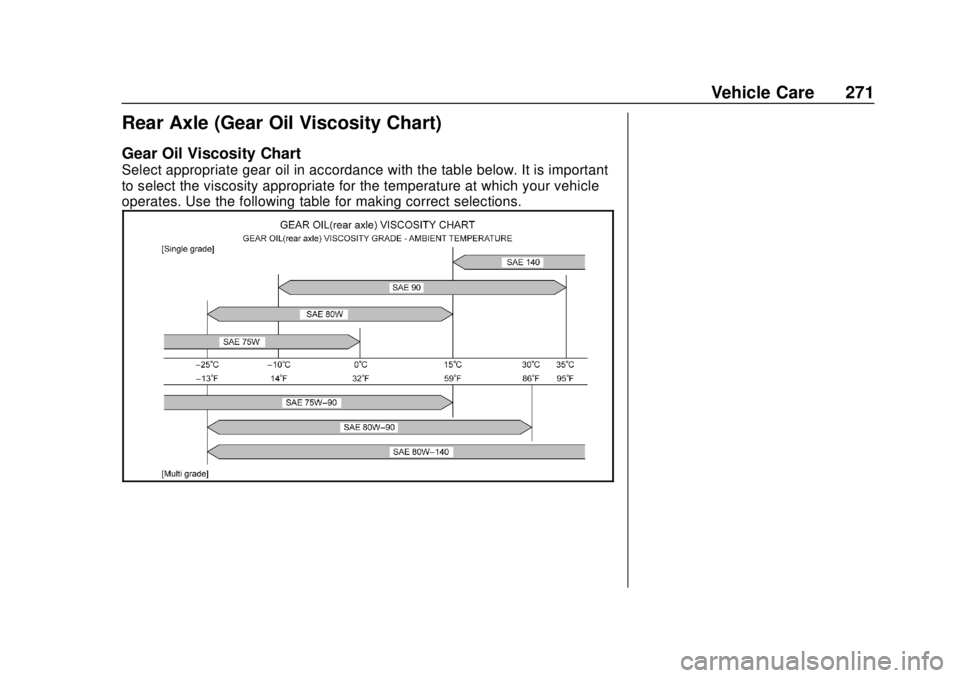
Rear Axle (Gear Oil Viscosity Chart)
Gear Oil Viscosity Chart
Select appropriate gear oil in accordance with the table below. It is important
to select the viscosity appropriate for the temperature at which your vehicle
operates. Use the following table for making correct selections.
Page 320 of 382
Chevrolet Low Cab Forward 5.2L Diesel Engine 4500/5500 Series (GMNA-
Localizing-U.S.-12407814) - 2019 - crc - 12/13/17
Vehicle Care 319
this precaution can lead to heat
deformation and breakage of plastic
components, or to water leaks into
the cab. When using an automatic
car or truck-wash, ensure that a
distance of at least 0.4 m
(15.75 inches) is maintained
between the nozzle and the vehicle,
and when washing door windows,
that the spray is perpendicular to
the surface of the glass.
Ensure that all detergent is fully
washed and wiped away.
Particularly in the case of strong
alkaline detergents (typically those
for industrial uses), there is a
danger that hairline cracks can
develop in lighting-cluster lenses if
the vehicle is operated without
detergent being fully wiped away.
Always read the detergent
manufacturer's instructions carefully
before use. Airborne dirt that
adheres to plastic front bumpers as
a result of rain, for example, can be
difficult to remove. In such a case,
use a commercially-available
cleaner to clean away the dirt, and
then apply a wax for use with plastic
components.Vehicle Storage
In order to maintain your vehicle's
attractive appearance as long as
possible, special consideration must
be given to its storage location.
If the vehicle is stored or kept for an
extended period of time in any of
the following locations, a chemical
change may occur in the paint work,
resulting in staining, discoloration,
rusting, and corrosion of
components.
.Locations where a large amount
of oily matter, soot, heavy smoke
or metal powder can adhere to
the vehicle.
. Areas around pharmaceutical
plants and other facilities that
discharge chemical matter.
. Coastal areas
. Locations where a large amount
of dead bugs, bird droppings or
tree sap can adhere to the
vehicle.
Polishing and Waxing
Periodic polishing and waxing is
recommended to remove built-up
residue and eliminate any
"weathered" appearance.
Your authorized dealer offers
several polishes and cleaners which
have proven value in maintaining
original finish appearance and
durability.
Painted and chrome-plated surfaces
should be waxed once or twice a
month, or whenever water is being
poorly repelled on the surfaces.
Ensure that wax is not applied in
direct sunlight, and that the
temperature of the painted surface
is no more than 40 °C (104 °F).
Always follow the instructions
provided with your wax product.
Do not use wax containing abrasive
material. Failure to observe this
precaution can lead to scratching of
painted surfaces or plastic
components.