ATF CHEVROLET LOW CAB FORWARD 2020 Owner's Manual
[x] Cancel search | Manufacturer: CHEVROLET, Model Year: 2020, Model line: LOW CAB FORWARD, Model: CHEVROLET LOW CAB FORWARD 2020Pages: 374, PDF Size: 6.18 MB
Page 65 of 374

Chevrolet Low Cab Forward 5.2L Diesel Engine 4500 HD/XD/5500 HD/XD
Owner Manual (GMNA-Localizing-U.S.-13337621) - 2020 - crc - 12/5/18
64 Instruments and Controls
Brake Low Vacuum Warning
Light
This light should come on briefly
when the engine control switch is
turned to the ON position, and then
should go out after the engine is
started. If the light does not come
on when the engine control switch is
turned to ON, it could indicate a
burned out bulb or a blown fuse.
Have the system repaired if the light
does not come on during this check.
The warning light and buzzer will
come on simultaneously when the
brake booster’s vacuum or pressure
becomes insufficient either during
driving or when the engine control
switch is in the ON position, or when
there is an abnormality in the
charging system, such as an
alternator malfunction or loosening
or splitting of the fan belt or whenever the hydraulic brake
booster (HBB) becomes faulty. The
warning buzzer will stop sounding
when the parking brake is engaged.
On 4500HD and 4500XD, the brake
low vacuum warning light and
warning buzzer should come on to
indicate low vacuum reserve for
brake power assist. At the same
time, the Back up Electric Vacuum
Pump operates.
(5500HD, 5500XD models) When
the HBB pressure is low, and/or the
HBB fluid (Dexron
–VI) level is low,
the light and warning buzzer should
come on. Do not use brake fluid in
the brake booster reservoir. Use
only Dexron –VI ATF.
If this happens while driving:
. Do not pump the brakes. The
system is designed to stop the
truck with reserve power assist if
the pedal is held down. This
reserve is greatly reduced each
time you apply and release the
brakes.
. Stopping distance may be
longer. .
You may have to push much
harder on the brake pedal.
. Have the vehicle repaired before
you continue driving.
The buzzer stops when the selector
lever is shifted to the P position.
{Warning
Do not drive while the buzzer
sounds as the brakes are not
operating to their full capacity.
You and others could be seriously
injured.
Antilock Brake System
(ABS) Warning Light
This light comes on briefly when the
engine control switch is turned to
the ON position, and then should go
Page 67 of 374

Chevrolet Low Cab Forward 5.2L Diesel Engine 4500 HD/XD/5500 HD/XD
Owner Manual (GMNA-Localizing-U.S.-13337621) - 2020 - crc - 12/5/18
66 Instruments and Controls
If this light comes on while driving, it
indicates that there is a malfunction
in the automatic transmission’s
electronic control system. If the
warning light is on, see your dealer
for service.
Automatic Transmission
Fluid Temperature
Warning Light
This light comes on briefly when the
engine control switch is in the ON
position as a check to show the light
is working. It should go out when
the engine is started.
The Automatic Transmission Fluid
(ATF) Temperature warning light
comes on if the ATF temperature is
high. This usually occurs when the
transmission is overfilled and maybe accompanied by leakage of fluid
from the transmission
breather hose.
If the light stays on, or comes on
while driving, slow down and pull off
the road. Stop the vehicle at a safe
place and put the vehicle in
P (Park). With the engine idling, wait
until the light goes off. If the light
goes off, you can drive the vehicle
again. Continuing to drive while this
light is on may damage the
transmission. While this light is on,
the transmission cannot operate in
all gears. If you attempt to shift
gears, the vehicle may not continue
to move. If you cannot drive to a
dealer immediately, have the vehicle
towed.
Caution
Driving with the ATF warning light
constantly on can cause serious
mechanical damage to the
automatic transmission.
See Automatic Transmission 0196.
Overdrive Off Light
This light should come on briefly
when the engine control switch is
turned on as a check to make sure
the light is working. It should go out
automatically.
This light comes on when the
overdrive off switch on the selector
lever is turned on. Overdrive will not
operate even when the automatic
transmission is in D, unless engine
speed is excessive.
Page 202 of 374

Chevrolet Low Cab Forward 5.2L Diesel Engine 4500 HD/XD/5500 HD/XD
Owner Manual (GMNA-Localizing-U.S.-13337621) - 2020 - crc - 12/5/18
Driving and Operating 201
Driving conditionsSelector lever position
Normal uphill road D (overdrive off switch ON)
Steep uphill, steep slope, mountain
road with many sharp curves 2 or 1
Long uphill road 2
Downhill driving:
Do not overuse the foot brake. This
will cause the brakes to overheat,
reducing their effectiveness. On
long downward slopes or sharp
downhill sections of road, use the
engine brake together with the foot
brakes to control the speed.
When the selector lever is in the D
position, you can drive with the
overdrive off switch ON to allow a
gentle engine brake to be applied.
Push the overdrive off switch to the
ON position at speeds below
101 km/h (63 MPH) to increase
engine braking action when
traveling downgrade. You can increase engine braking by
driving with the selector lever in the
2 position.
To apply a stronger engine brake on
sharp downhill sections, shift the
selector lever to the 1 position when
required.
See
Control of a Vehicle 0130.
Driving at Low Speeds for
Sustained Periods
Any low speed applications such as
sweeper, road marking machinery,
trash collectors, highway striping or
moving, etc. require the following
treatment to prevent the automatic
transmission fluid (ATF) from
overheating:
Select 1 position during low speed
operation under 18 km/h (11 MPH). Select 2 position during low speed
operation under 36 km/h (22 MPH).
See
Automatic Transmission Fluid
Temperature Warning Light 066.
To Stop Your Vehicle 1. To temporarily stop the vehicle, press the brake pedal firmly
while the selector lever is in D.
2. Use the parking brake as required. Press the brake pedal
firmly, and firmly apply the
parking brake.
If the vehicle is stationary for a
long time, move the selector
lever into the N or P position.
If the selector lever is kept in
D, the temperature of the
automatic transmission fluid
increases due to heat from the
torque converter.
To ensure reliable brake application,
be sure to use your right foot to
press the brake pedal.
When leaving the driver's seat,
follow the When Parking Your
Vehicle procedure.
Page 253 of 374

Chevrolet Low Cab Forward 5.2L Diesel Engine 4500 HD/XD/5500 HD/XD
Owner Manual (GMNA-Localizing-U.S.-13337621) - 2020 - crc - 12/5/18
252 Vehicle Care
Power Steering Fluid
The power steering fluid level must
be checked and it must be changed
according to the Maintenance
Schedule. SeeMaintenance
Schedule 0317.
When replenishing power steering
fluid or flushing the power steering
system, always use ATF
(Dexron
®-VI). Failure to use the
proper fluid may damage the power
steering system seals and hoses,
leading to fluid leakage.
Checking the Power Steering
Fluid Level
The fluid level is correct if it is
between the “MAX”and“MIN” lines
on the power steering fluid tank.
If the level is lower that the “MIN”
line, add fluid up to the “MAX”line.
The reserve tank is located at the
rear of the engine compartment on
the right. When you have finished
checking the fluid level, securely
reinstall the cap and cover.
{Warning
Before adding fluid, clean the
area around the cap and pour
fluid from a clean jug or filler.
Foreign matter getting in the tank
may cause power steering system
failure.
Do not mix the recommended
power steering fluid with fluids of
other brands. Due to chemical
reactions, any mixture of
differently branded fluids may
cause failure of the system.
You and others could be seriously
injured.
Washer Fluid
Windshield Washer Fluid
The windshield washer is equipped
on the windshield wiper arm.
Check the level of fluid in the
windshield washer fluid tank. In
addition, spray windshield washer
fluid and operate the windshield
wipers to check for any areas not
Page 256 of 374

Chevrolet Low Cab Forward 5.2L Diesel Engine 4500 HD/XD/5500 HD/XD
Owner Manual (GMNA-Localizing-U.S.-13337621) - 2020 - crc - 12/5/18
Vehicle Care 255
Another characteristic of the HBB
system is that the brake pedal may
be pressed easily to the floor with
the vehicle at a stop. This is not a
sign of malfunction.
When the engine is running, the
system automatically charges the
accumulator whenever pressure has
been reduced after braking. Auto
charge may be activated without
braking, depending on temperature
changes in the accumulator. During
auto charge, a hissing and clicking
sound can be heard. This is not a
malfunction.
With the engine running, a booming
sound can be heard during hard
braking. This comes from the
brake-fluid pump. It is not a
malfunction.
Applying continuous hard braking
for a long time will lead to
considerable temperature rise in the
HBB pump. Such overworking of the
brakes is best avoided.Vacuum or hydraulic power
assisted brakes
If the engine stops, do not pump the
brakes. The system is designed to
stop the vehicle with reserve power
assist if the brake pedal is held
down. This reserve is greatly
reduced each time you apply and
release the brakes. If, when you
turn the steering wheel during
braking, the vehicle does not turn,
release some pressure from the
brake pedal.
In a Vehicle Equipped with an
HBB, Do Not Keep the Brake
Pedal Pressed for an Extended
Period
Caution
Failure to follow the above
instruction will cause the oil inside
the HBB oil pump to get very hot.
This could damage the HBB tank
and deteriorate seals and also
could cause damage to the HBB
oil pump, HBB unit and/or HBB
(Continued)
Caution (Continued)
hosing. Eventual leakage of HBB
oil, sudden increase in brake
pedal resistance and fire could
unexpectedly result in a crash.
Hydraulic Brake Booster (HBB)
Fluid (5500HD/5500XD Series)
The HBB system has been
designed to use Dexron VI ATF
fluid. If any other fluid is used with
this system, rubber components
may be damaged, oil may leak and
the system may malfunction. It is
important to remember that the fluid
used in the hydro-booster is
completely different in
characteristics from the brake fluid
used in the master and wheel
cylinders.
If hydro-booster fluid and brake fluid
from the master cylinder are
mistakenly mixed together and
used, rubber components will
deteriorate as a result of insufficient
lubrication. Any resultant oil leakage
or system malfunction can in turn
Page 257 of 374

Chevrolet Low Cab Forward 5.2L Diesel Engine 4500 HD/XD/5500 HD/XD
Owner Manual (GMNA-Localizing-U.S.-13337621) - 2020 - crc - 12/5/18
256 Vehicle Care
lead to dragging brakes or other
major brake problems. As such,
mixing of these two fluids can
ultimately lead to vehicle fire or
other serious crashes.
When the pump operates while the
engine is running, the fluid in the
hydro-booster will become hot.
During normal braking, the
temperature in piping and within the
hydro-booster can rise above
100 °C (212 °F). For this reason,
special care will be required when
working with hydro-booster
components. If the hydro-booster is
to be removed from the vehicle,
shut off the engine and then allow at
least 30 minutes for it to cool down
before beginning this operation.
Even when the engine is stopped,
the hydro-booster's accumulator will
remain in a highly-pressurized
condition for a significant period of
time. Before removing the
hydro-booster or piping from the
vehicle, stop the engine and press
the brake pedal at least 10 times in
order to lower the accumulator
pressure to atmospheric pressure.This is of particular importance
when removing components such
as the accumulator or pressure
switch from the hydro-booster.
If these operations are attempted
while the accumulator is still at a
high pressure, hydro-booster fluid
may spray out.
Checking the Hydro-booster Fluid
Level
Check the hydro-booster fluid level
and change the fluid according to
the Maintenance Schedule.
The hydro-booster fluid level is
correct if it is between the "MAX"
and "MIN" lines. If the level is too
low, add fluid up to the "MAX" line.
Be sure to use Dexron VI ATF fluid
when adding fluid. The brake
booster reservoir is located behind
the cab on the left side.
Brake Pedal
Stroke
Shut off the engine and press the
brake pedal about 10 times strongly,
then check the brake pedal for free
play by lightly pushing it by hand
until you feel resistance.
Page 329 of 374
Chevrolet Low Cab Forward 5.2L Diesel Engine 4500 HD/XD/5500 HD/XD
Owner Manual (GMNA-Localizing-U.S.-13337621) - 2020 - crc - 12/5/18
328 Service and Maintenance
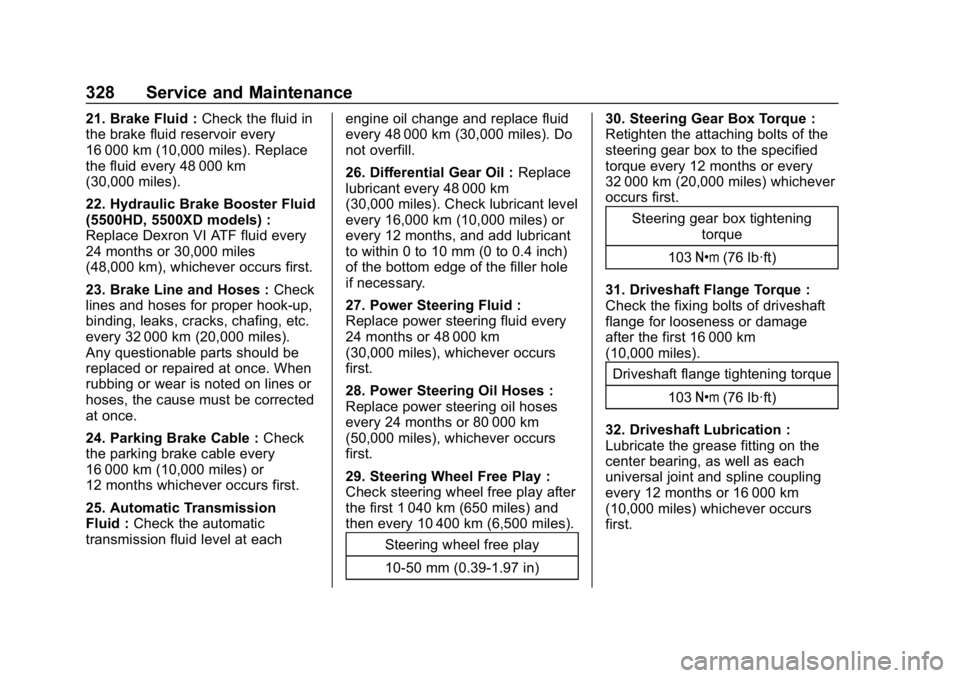
21. Brake Fluid :Check the fluid in
the brake fluid reservoir every
16 000 km (10,000 miles). Replace
the fluid every 48 000 km
(30,000 miles).
22. Hydraulic Brake Booster Fluid
(5500HD, 5500XD models) :
Replace Dexron VI ATF fluid every
24 months or 30,000 miles
(48,000 km), whichever occurs first.
23. Brake Line and Hoses : Check
lines and hoses for proper hook-up,
binding, leaks, cracks, chafing, etc.
every 32 000 km (20,000 miles).
Any questionable parts should be
replaced or repaired at once. When
rubbing or wear is noted on lines or
hoses, the cause must be corrected
at once.
24. Parking Brake Cable : Check
the parking brake cable every
16 000 km (10,000 miles) or
12 months whichever occurs first.
25. Automatic Transmission
Fluid : Check the automatic
transmission fluid level at each engine oil change and replace fluid
every 48 000 km (30,000 miles). Do
not overfill.
26. Differential Gear Oil :
Replace
lubricant every 48 000 km
(30,000 miles). Check lubricant level
every 16,000 km (10,000 miles) or
every 12 months, and add lubricant
to within 0 to 10 mm (0 to 0.4 inch)
of the bottom edge of the filler hole
if necessary.
27. Power Steering Fluid :
Replace power steering fluid every
24 months or 48 000 km
(30,000 miles), whichever occurs
first.
28. Power Steering Oil Hoses :
Replace power steering oil hoses
every 24 months or 80 000 km
(50,000 miles), whichever occurs
first.
29. Steering Wheel Free Play :
Check steering wheel free play after
the first 1 040 km (650 miles) and
then every 10 400 km (6,500 miles).
Steering wheel free play
10-50 mm (0.39-1.97 in) 30. Steering Gear Box Torque :
Retighten the attaching bolts of the
steering gear box to the specified
torque every 12 months or every
32 000 km (20,000 miles) whichever
occurs first.
Steering gear box tightening torque
103 Y(76 lb·ft)
31. Driveshaft Flange Torque :
Check the fixing bolts of driveshaft
flange for looseness or damage
after the first 16 000 km
(10,000 miles). Driveshaft flange tightening torque
103Y(76 lb·ft)
32. Driveshaft Lubrication :
Lubricate the grease fitting on the
center bearing, as well as each
universal joint and spline coupling
every 12 months or 16 000 km
(10,000 miles) whichever occurs
first.