instrument panel CHEVROLET MALIBU 1997 5.G Owners Manual
[x] Cancel search | Manufacturer: CHEVROLET, Model Year: 1997, Model line: MALIBU, Model: CHEVROLET MALIBU 1997 5.GPages: 354, PDF Size: 18.87 MB
Page 19 of 354
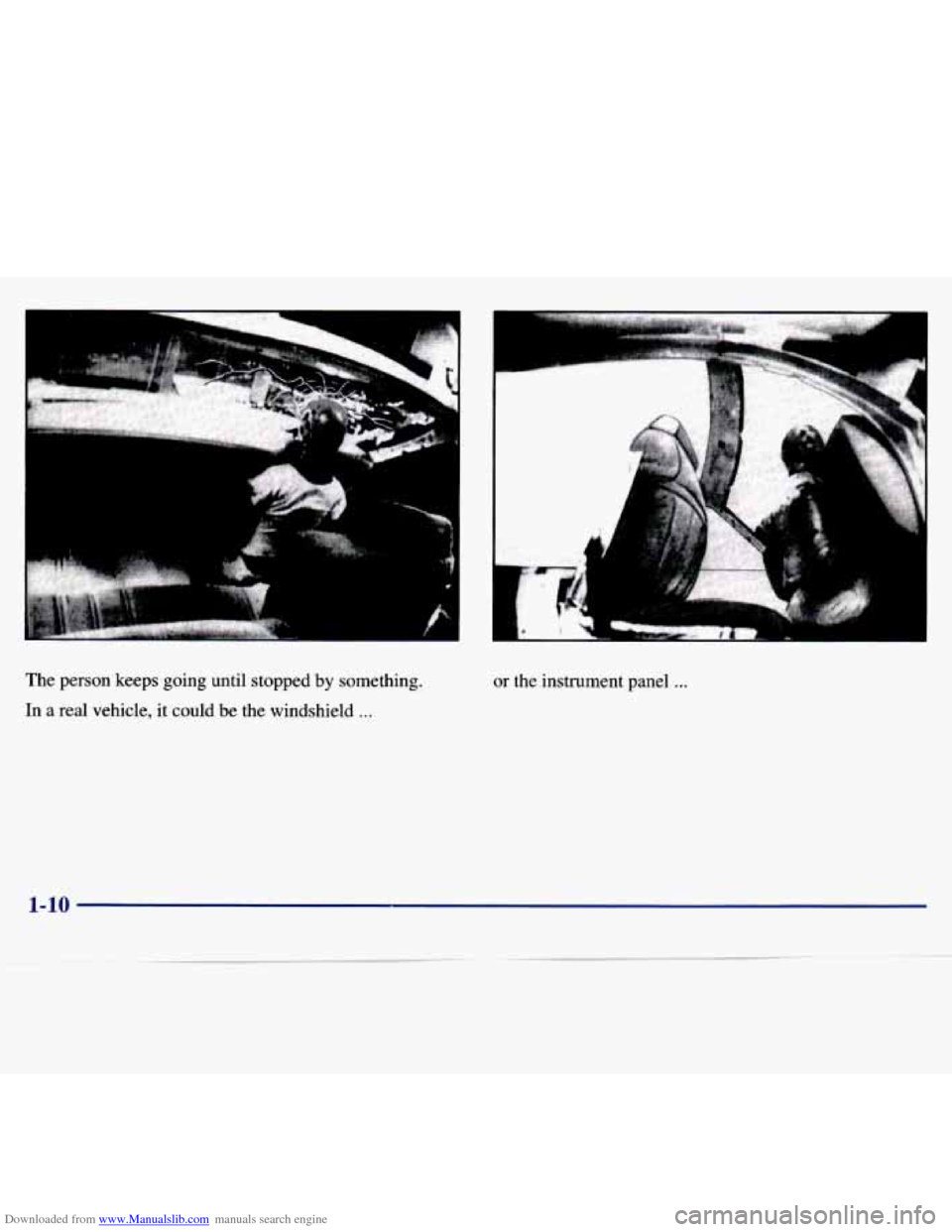
Downloaded from www.Manualslib.com manuals search engine The person keeps going until stopped by something.
In
a real vehicle, it could be the windshield ...
or the instrument panel ...
1-10
Page 31 of 354
Downloaded from www.Manualslib.com manuals search engine Air bags inflate with great force, faster than the
blink
of an eye. If you’re too close to an inflating
air bag, it could seriously injure you. Safety belts
help keep you in position before and during a
crash. Always wear your safety belt, even with air
bags, The driver should
sit as far back as possible
while still maintaining control of the vehicle.
An inflating
air bag can seriously injure small
children. Always secure children properly in your
vehicle. To read how, see the part of this manual
called “Children” and the caution label on the
right front passenger’s safety belt.
There is an air bag readiness
light
on the instrument
panel, which shows the air bag symbol.
The system checks the air bag electrical system for
malfunctions. The light tells you if there is an electrical
problem. See “Air Bag Readiness Light”
in the Index
for more information.
1-22
Page 32 of 354
Downloaded from www.Manualslib.com manuals search engine How the Air Bag System Works
E
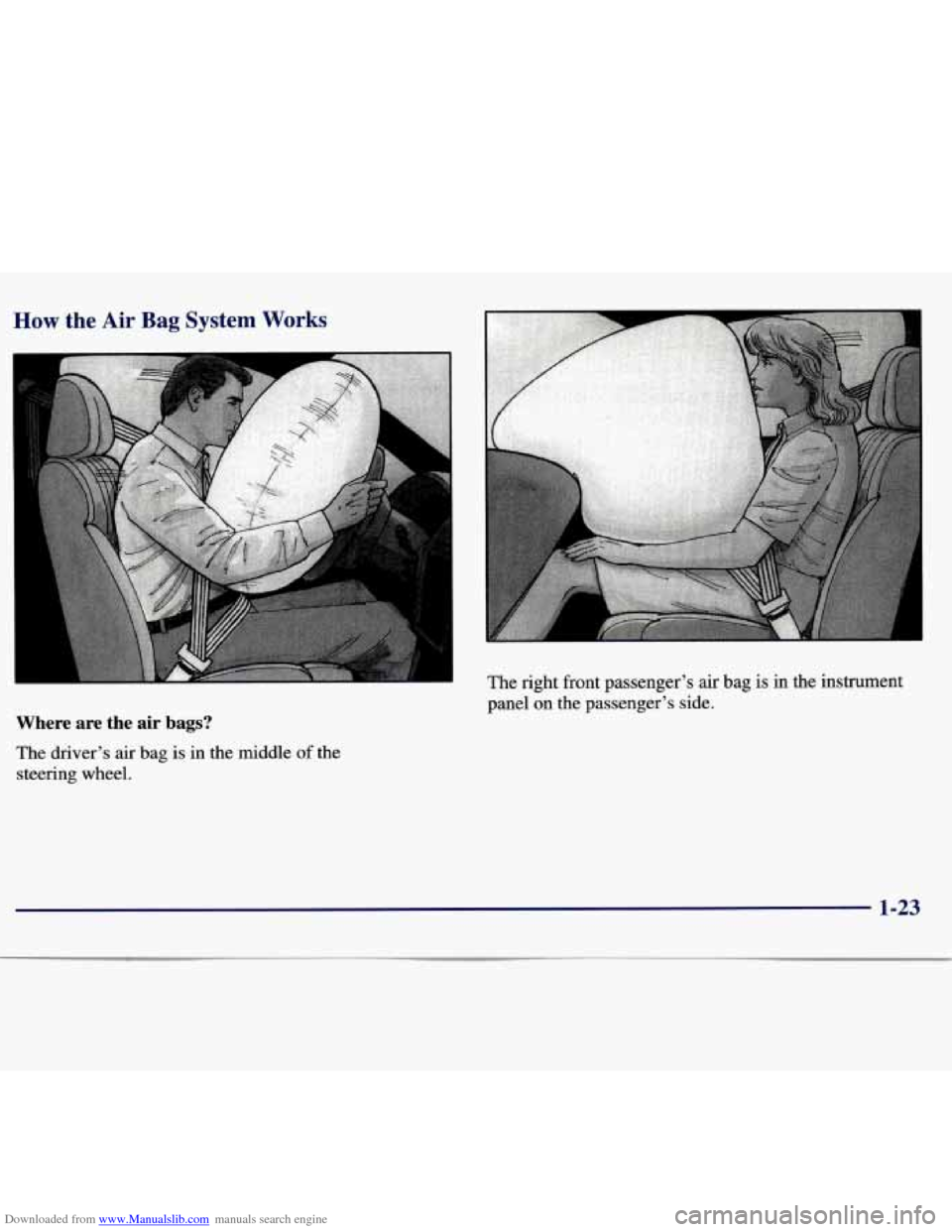
I The right front passenger’s air bag is in the instrument
panel on the passenger’s side.
Where are the air bags?
The driver’s air bag is in the middle of the
steering wheel.
1-23
Page 34 of 354
Downloaded from www.Manualslib.com manuals search engine What makes an air bag inflate?
In an impact of sufficient severity, the air bag sensing
system detects that the vehicle is in a crash. The sensing
system triggers a release of gas from the inflator, which
inflates the air bag. The inflator, air bag and related
hardware are all part of the air bag modules inside the
steering wheel and
in the instrument panel in front of the
right front passenger.
How does an air bag restrain?
In moderate to severe frontal or near-frontal collisions,
even belted occupants can contact the steering wheel or
the instrument panel. Air bags supplement the protection
provided by safety belts. Air bags distribute the force
of
the impact more evenly over the occupant’s upper body,
stopping the occupant more gradually. But air bags
would not help you in many types of collisions,
including rollovers, rear impacts and side impacts,
primarily because an occupant’s motion is not toward
those air bags. Air bags should never be regarded as
anything more than a supplement to safety belts,
and then only in moderate to severe frontal
or
near-frontal collisions.
What will you see after an air bag inflates?
After an air bag inflates, it quickly deflates, so quickly
that
some people may not even realize the air bag
inflated. Some components of the air bag module
-- the
steering wheel hub for the driver’s air bag, or the
instrument panel for the right front passenger’s
bag
-- will be hot for a short time. The parts of the bag
that come into contact with you may be warm, but not
too hot to touch. There will be some smoke and dust
coming from vents
in the deflated air bags. Air bag
inflation doesn’t prevent the driver from seeing or from
being able to steer the vehicle, nor does it stop people
from leaving the vehicle.
When an air bag inflates, therc dust in the air.
This dust could cause breathing problems for
people with a history of asthma or other
breathing trouble.
To avoid this, everyone in the
vehicle should get out as soon as it is safe to do
so.
If you have breathing problems but can’t get out
of the vehicle after an air bag inflates, then get
fresh air by opening a window or door.
1-25
Page 35 of 354
Downloaded from www.Manualslib.com manuals search engine In many crashes severe enough to inflate an air bag,
windshields
are broken by vehicle deformation.
Additional windshield breakage may also occur from
the right front passenger air bag.
e
a
Air bags are designed to inflate only once. After they
inflate, you’ll need some new parts for your air bag
system.
If you don’t get them, the air bag system
won’t be there to help protect you in another crash.
A new system will include air bag modules and
possibly other
parts. The service manual for your
vehicle covers the need to replace other parts.
Your vehicle is equipped with a crash sensing and
diagnostic module, which records information
about the air bag system. The module records
information about the readiness
of the system, when
the sensors are activated and driver’s safety belt
usage at deployment.
Let only qualified technicians work on your air
bag system. Improper service can mean that your air bag system won’t work properly. See your dealer
for service.
NOTICE:
~~
If you damage the covering for the driver’s or the
right front passenger’s
air bag, the bag may not
work properly.
You may have to replace the air
bag module in the steering wheel or both the air
bag module and the instrument panel for the
right front passenger’s
air bag. Do not open or
break the
air bag coverings.
1-26
Page 58 of 354
Downloaded from www.Manualslib.com manuals search engine Section 2 Features and Controls
2-2
2-4
2-5
2-6 2- 8
2-1
1
2-13 2-13
2- 14
2-
17
2-18
2-22
2-22
2-26
Here you can learn about the many standard and optional featur\
es on your Chevrolet, and information
on starting,
shifting and braking. Also explained are the instrument panel and the warning systems that tell you if everything is
working properly
-- and what to do if you have a problem.
Important Information About Keys
Door Locks Operation of Child Security Locks
Keyless Entry System
Battery Replacement for Keyless
Entry System
Preventing Theft
of Your Vehicle
New Vehicle “Break-In”
Ignition Positions
Tips on Starting Your Engine
Using the Engine Coolant Heater
Automatic Transaxle Operation
Second-Gear Start
Parking Brake Guidelines
Important Information on Engine Exhaust 2-27
2-28
2-29
2-30
2-30
2-33
2-36 2-37
2-3 8
2-40
2-42
2-47
2-48
2-52 Operation
of Your Windows
Adjusting the Tilt Steering Wheel
Functions of the Multifunction Lever
How to Use the High/Low Beam
Headlamp Changer
Windshield Wipers and Fluid
Using Cruise Control
Exterior Lamps Daytime Running Lamps (DRL)
Interior Lamps Rearview Mirrors
Storage Compartments
Sunroof
Instrument Panel Overview
All About Your Warning Lights and Gages
Page 62 of 354
Downloaded from www.Manualslib.com manuals search engine Power Door Locks (If Equipped)
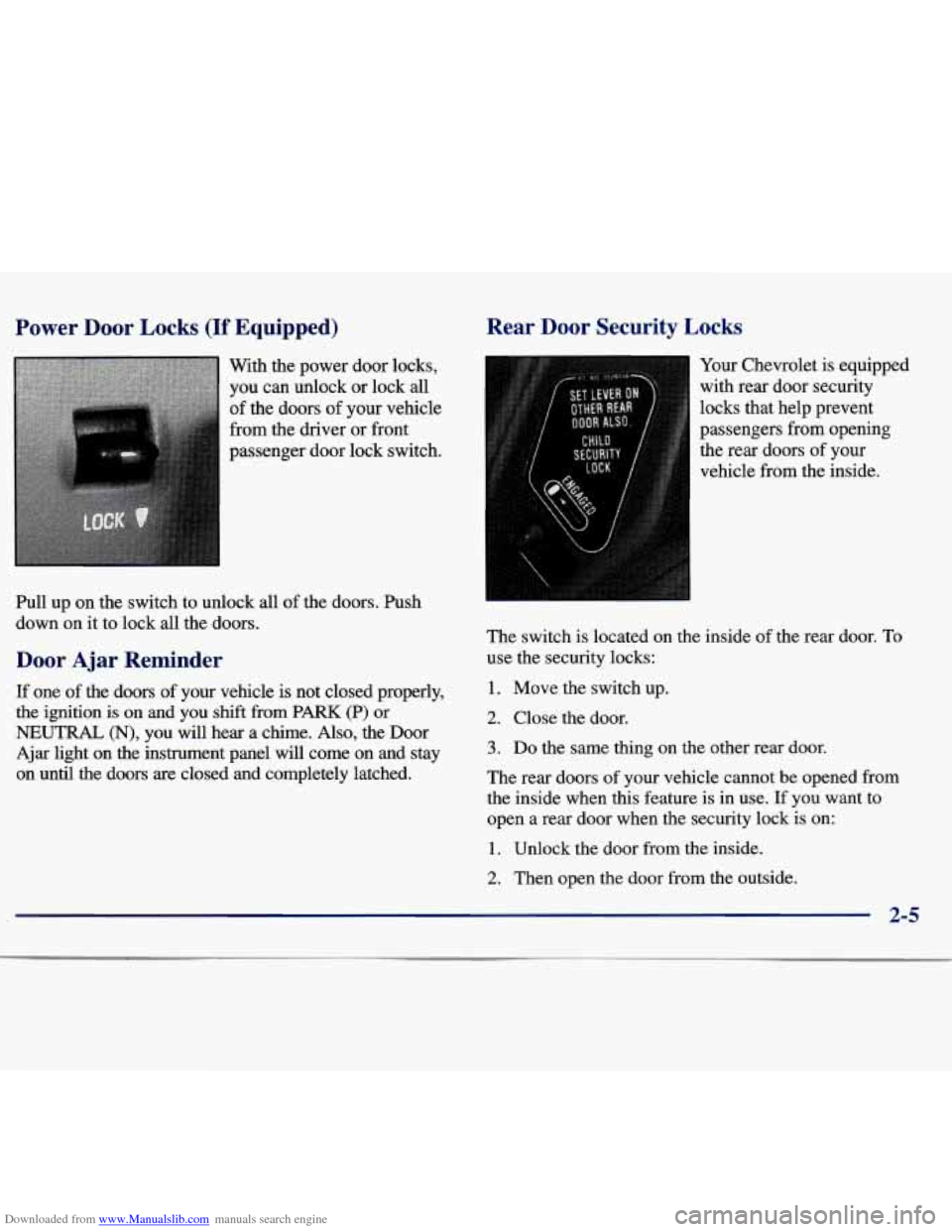
With the power door locks,
you can unlock or lock
all
of the doors of your vehicle
from the driver or front
passenger door lock switch.
Pull up on the switch to unlock all of the doors. Push
down on it to lock
all the doors.
Door Ajar Reminder
If one of the doors of your vehicle is not closed properly,
the ignition is on and you shift from PARK (P) or
NEUTRAL (N), you will hear a chime. Also, the Door
Ajar light on the instrument panel will come on and stay
on until the doors are closed and completely latched.
Rear Door Security Locks
-
Your Chevrolet is equipped
with rear door security
locks that help prevent
passengers from opening
the rear doors
of your
vehicle from the inside.
The switch is located on the inside of the rear door.
To
use the security locks:
1. Move the switch up.
2. Close the door.
3. Do the same thing on the other rear door.
The rear doors of your vehicle cannot be opened from
the inside when this feature is in use.
If you want to
open
a rear door when the security lock is on:
1. Unlock the door from the inside.
2. Then open the door from the outside.
2-5
Page 67 of 354
Downloaded from www.Manualslib.com manuals search engine Trunk Remote Trunk Release
To unlock the trunk from the outside, insert the key and
turn the trunk lock cvlinder.
It can be dangerous to drive with the trunk lid
open because carbon monoxide
(CO) gas can
come into your vehicle.
You can’t see or smell
CO. It can cause unconsciousness and even death.
If you must drive with the trunk lid open or if
electrical wiring or other cable connections must
pass through the seal between the body and the
trunk lid:
Make sure all windows are shut.
%MI the fan on your heating or cooling
system
to its highest speed with the setting on
VENT. That will force outside air into your
vehicle.
See “Comfort Controls” in the Index.
instrument panel, open them all the
way.
If you have air outlets on or under the
See “Engine Exhaust” in the Index.
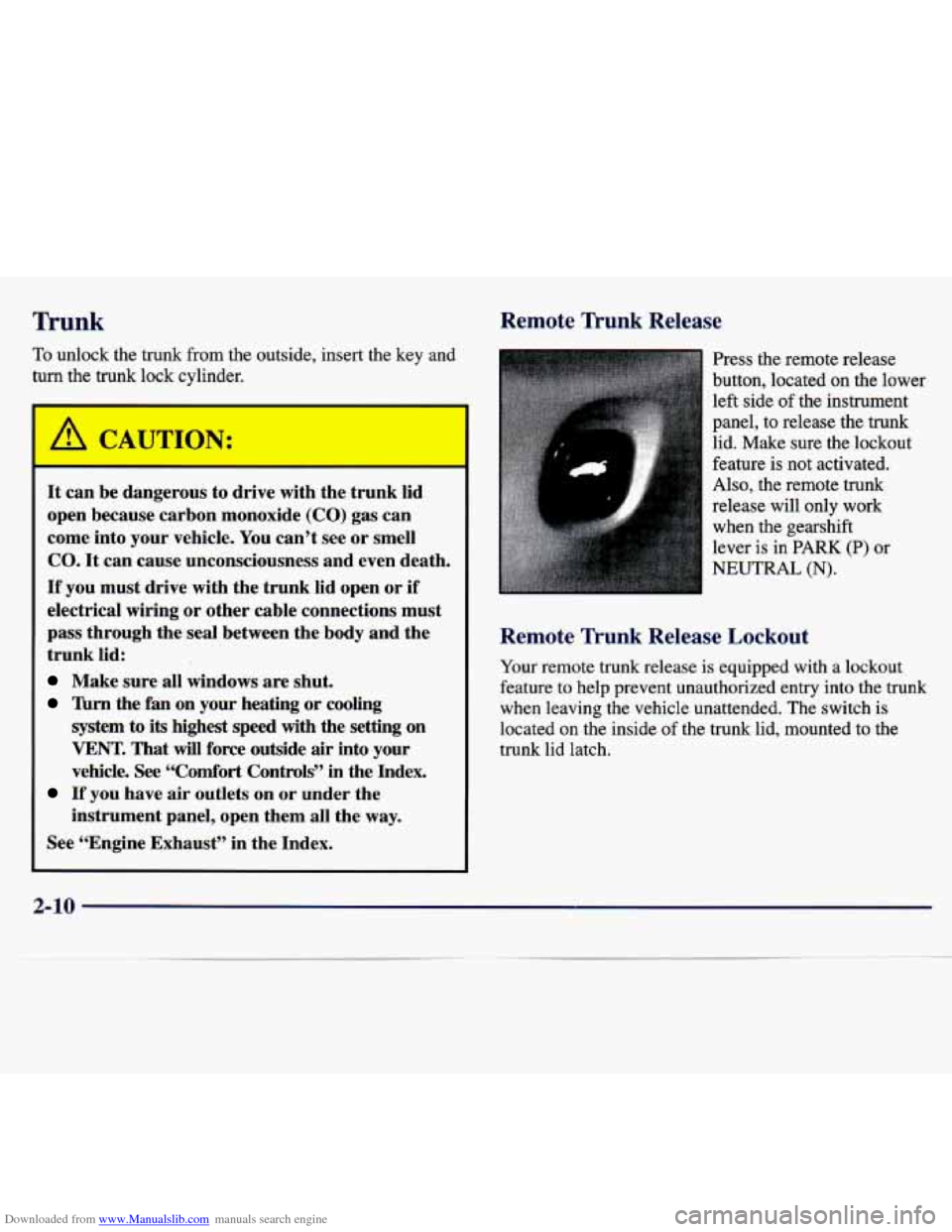
Press the remote release
button, located on the lower left side
of the instrument
panel, to release the trunk
lid. Make sure the lockout
feature is not activated.
Also, the remote trunk
release will only work
when the gearshift
lever is in
PARK (P) or
NEUTRAL (N).
Remote Trunk Release Lockout
Your remote trunk release is equipped with a lockout
feature to help prevent unauthorized entry into the trunk
when leaving the vehicle unattended. The switch
is
located on the inside of the trunk lid, mounted to the
trunk lid latch.
2-10
Page 68 of 354
Downloaded from www.Manualslib.com manuals search engine ..
I
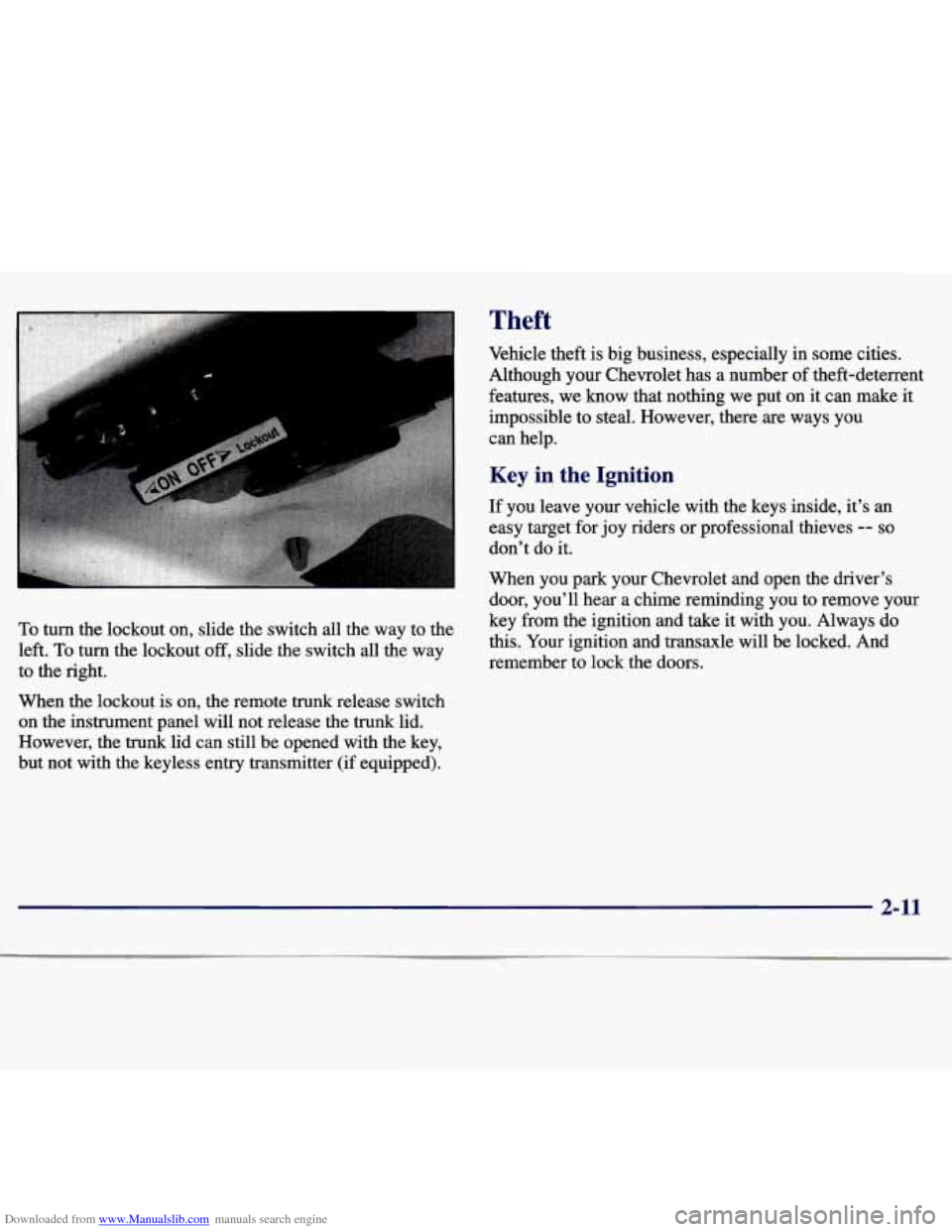
To turn the lockout on, slide the switch all the way to the
left.
To turn the lockout off, slide the switch all the way
to the right.
When
the lockout is on, the remote trunk release switch
on the instrument panel
will not release the trunk lid.
However, the
trunk lid can still be opened with the key,
but not with the keyless entry transmitter
(if equipped).
Theft
Vehicle theft is big business, especially in some cities.
Although your Chevrolet has a number of theft-deterrent
features, we know that nothing we put on it can make
it
impossible to steal. However, there are ways you
can help.
Key in the Ignition
If you leave your vehicle with the keys inside, it’s an
easy target for joy riders or professional thieves
-- so
don’t do it.
When you park your Chevrolet and open the driver’s
door, you’ll hear a chime reminding you to remove your
key from the ignition and take it with you. Always do
this. Your ignition and transaxle will be locked. And
remember to lock the doors.
2-11
Page 71 of 354
Downloaded from www.Manualslib.com manuals search engine ACC (Accessory) (B): This position unlocks the
transaxle.
It also lets you use things like the radio and
windshield wipers when the engine is not running. To
use ACC, push in the key and turn it to the right. Use
this position if
your vehicle must be pushed or towed,
but never
try to push-start your vehicle.
ON (C): This position unlocks the ignition and
transaxle. This position is also where the key returns
after you start your engine and release the switch. The
switch stays in
ON when the engine is running. But even
when the engine is not running, you
can use ON to
operate your electrical power accessories, and to display some instrument panel warning lights.
START (D): This position starts the engine. When the
engine starts, release
the key. The ignition switch will
return to
ON for normal driving.
Starting Your Engine
Move your shift lever to PARK (P) or NEUTRAL (N).
Your engine won’t start in any other position -- that’s a
safety feature. To restart when you’re already moving,
use NEUTRAL (N) only.
I NOTICE:
Don’t try to shift to PARK (P) if your Chevrolet
is moving. If you do, you could damage the
transaxle. Shift to PARK
(P) only when your
vehicle is stopped.
Starting Your 2.4 Liter Engine
1. Without pushing the accelerator pedal, turn your
ignition key to START. When the engine starts, let
go of the key. The idle speed will go down as your
engine gets warm.
I NOTICE:
Holding your key in START for longer than
15 seconds at a time will cause your battery to be
drained much sooner. And the excessive heat can damage your starter motor.
2-14