cooling CHEVROLET MALIBU 1998 User Guide
[x] Cancel search | Manufacturer: CHEVROLET, Model Year: 1998, Model line: MALIBU, Model: CHEVROLET MALIBU 1998Pages: 362, PDF Size: 19.35 MB
Page 209 of 362
Downloaded from www.Manualslib.com manuals search engine I
A CAUTION: I
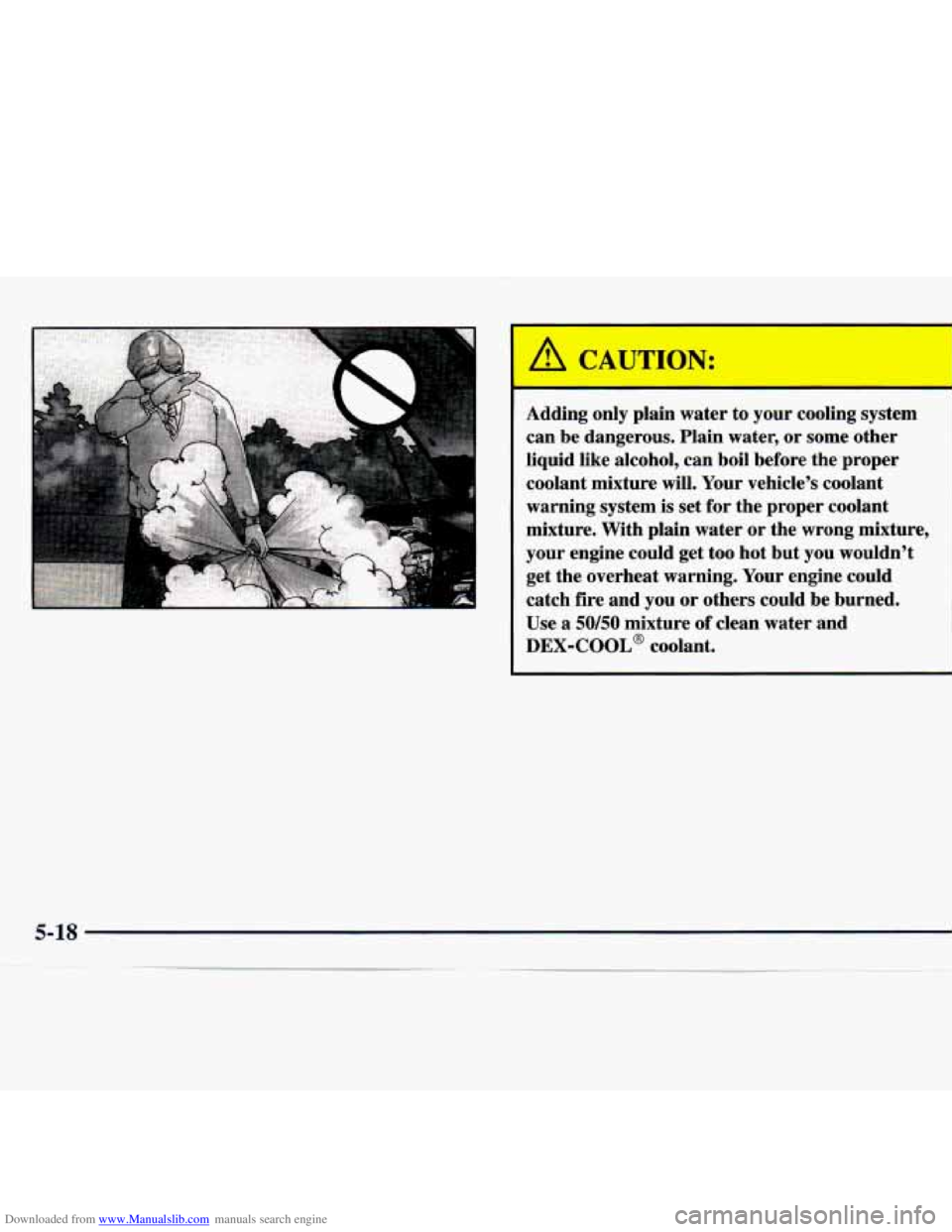
Adding only plain water to your cooling system
can be dangerous. Plain water, or some other
liquid like alcohol, can boil before the proper
coolant mixture will. Your vehicle's coolant
warning system
is set for the proper coolant
mixture. With plain water or the wrong mixture,
your engine could get too hot but you wouldn't
get the overheat warning. Your engine could
catch fire and you or others could be burned.
Use a
50/50 mixture of clean water and
DEX-COOL@ coolant.
Page 210 of 362
Downloaded from www.Manualslib.com manuals search engine NOTICE:
In cold weather, water can freeze and crack the
engine, radiator, heater core and other parts.
So
use the recommended coolant. 1
A CAUTION:
I
You can be burned if you spill coolant on hot
engine parts. Coolant contains ethylene glycol
and
it will burn if the engine parts are hot
enough. Don’t spill coolant on
a hot engine.
I
k
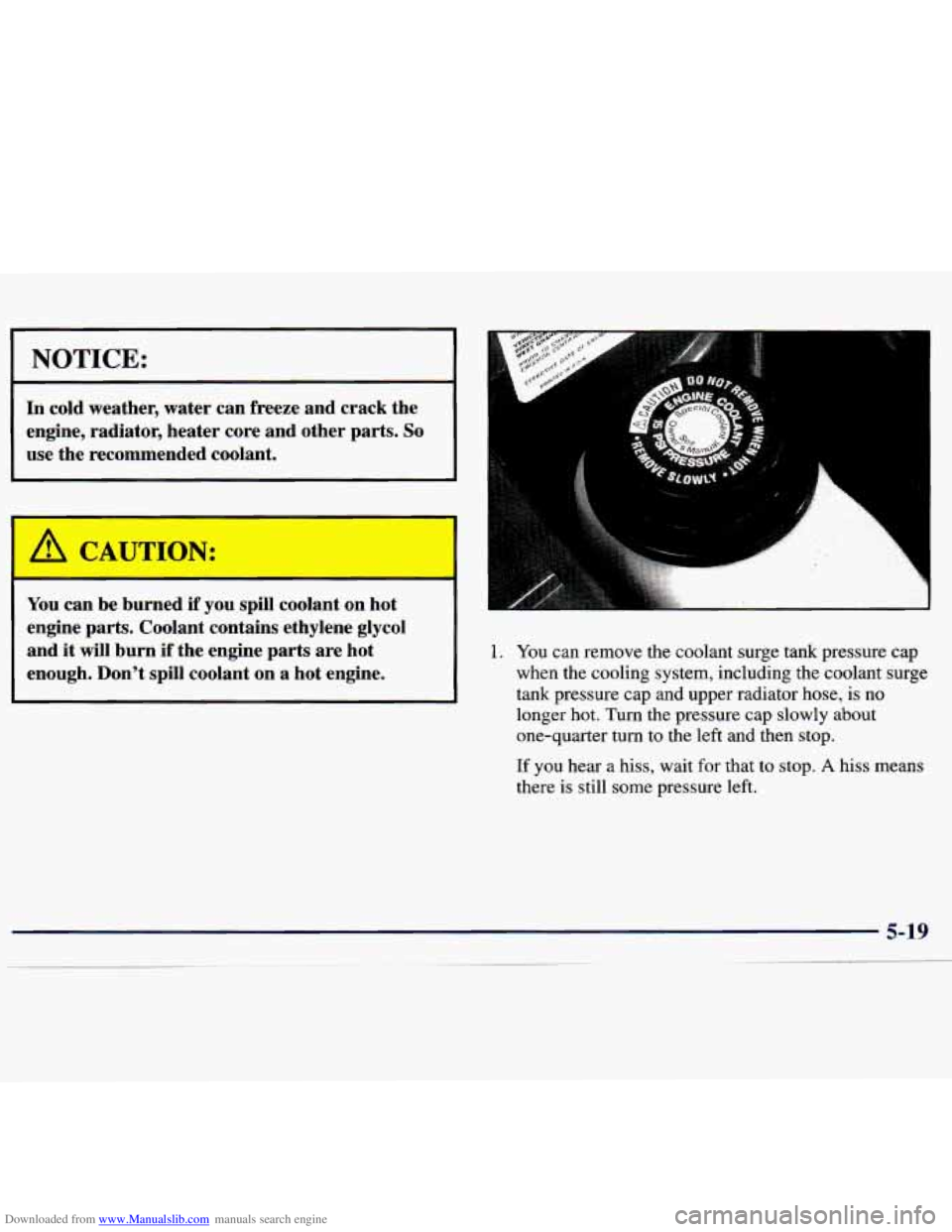
1. You can remove the coolant surge tank pressure cap
when the cooling system, including
the coolant surge
tank pressure cap and upper radiator hose, is
no
longer hot. Turn the pressure cap slowly about
one-quarter
turn to the left and then stop.
If you hear a hiss, wait for that to stop. A hiss means
there
is still some pressure left.
Page 212 of 362
Downloaded from www.Manualslib.com manuals search engine .. .
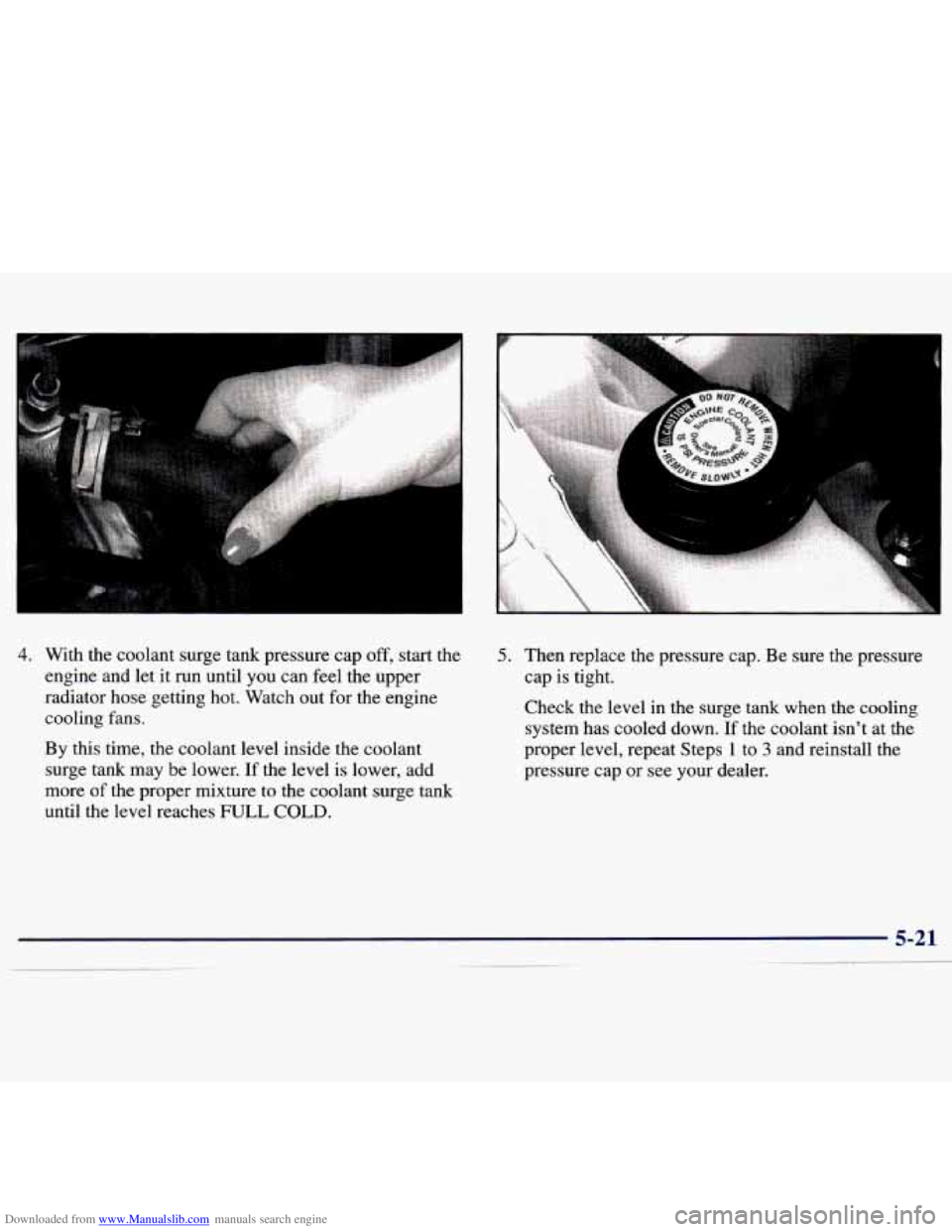
4. With the coolant surge tank pressure cap off, start the
engine and let it run until
you can feel the upper
radiator hose getting hot. Watch out for the engine
cooling fans.
By this time, the coolant level inside the coolant
surge
tank may be lower. If the level is lower, add
more of the proper mixture to the coolant surge tank
until the level reaches
FULL COLD.
5. Then replace the pressure cap. Be sure the pressure
cap
is tight.
Check the level in the surge tank when the
cooling
system has cooled down. If the coolant isn't at the
proper level, repeat Steps
1 to 3 and reinstall the
pressure cap or
see your dealer.
5-21
Page 245 of 362
Downloaded from www.Manualslib.com manuals search engine NOTICE:
-
We recommend you use only fluid labeled
DEXRON@-III, because
fluid with that label is
made especially for your automatic transaxle.
Damage caused by fluid other than DEXRON-III
is not covered by your new vehicle warranty.
Engine Coolant
The cooling s stem in your vehicle is filled with
DEX-COOL engine coolant.
This coolant is designed
to remain in your vehicle for 5 years or 150,000 miles
(240 000 km) whichever occurs first, if you add only
DEX-COOL’ extended life coolant.
The following explains your cooling system and how to
add coolant when it is low.
If you have a problem with
engine overheating, see “Engine Overheating” in
the Index.
8
A 50/50 mixture of water and DEX-COOL@ coolant wilk
0 Give freezing protection down to -34°F (-37’C).
0 Give boiling protection up to 265 OF ( 129 O C).
0 Protect against rust and corrosion.
0 Help keep the proper engine temperature.
0 Let the warning lights and gages work as they should.
~~
NOTICE:
When adding coolant, it is important that you
use only DEX-COOL@ (silicate-free) coolant.
If coolant other than DEX-COOL is added. to
the system, premature engine, heater core or
radiator corrosion may result.
In addition, the
engine coolant will require change sooner
-- at
30,000 miles (50 000 km) or 24 months,
whichever
occurs first. Damage caused by the
use of coolant other than DEX-COOL@ is not
covered by
your new vehicle warranty.
6-20 I
Page 246 of 362
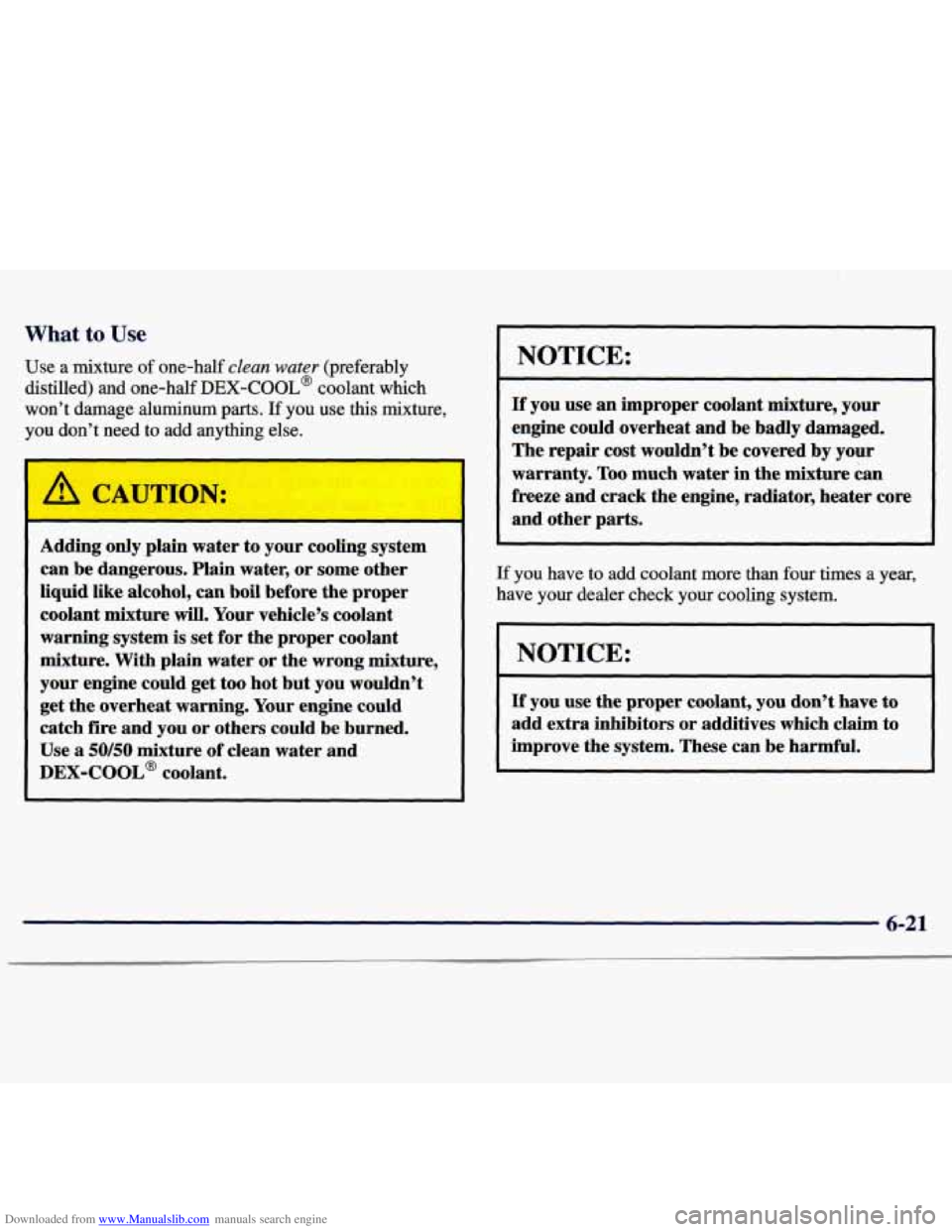
Downloaded from www.Manualslib.com manuals search engine What to Use
Use a mixture of one-half clean water (preferably
distilled) and one-half
DEX-COOL@ coolant which
won’t damage aluminum
parts. If you use this mixture,
YOU don’t need to add anything else.
I A CAUTION:
Adding only plain water to your cooling system
can be dangerous. Plain water, or some other
liquid like alcohol, can boil before the proper
coolant mixture
will. Your vehicle’s coolant
warning system is set for the proper coolant
mixture. With plain water or the wrong mixture,
your engine could .get too hot but you wouldn’t
get the overheat warning. Your engine could
catch fire and you or others could be burned.
Use a
50/50 mixture of clean water and
DEX-COOL@ coolant.
NOTICE:
If you use an improper coolant mixture, your
engine could overheat and be badly damaged.
The repair cost wouldn’t be covered by your
warranty.
Too much water in the mixture can
freeze and crack the engine, radiator, heater core
and other parts.
If you have to add coolant more than four times a year,
have your dealer check your cooling system.
NOTICE:
If you use the proper coolant, you don’t have to
add extra inhibitors or additives which claim to
improve the system. These can be harmful.
6-21
Page 269 of 362
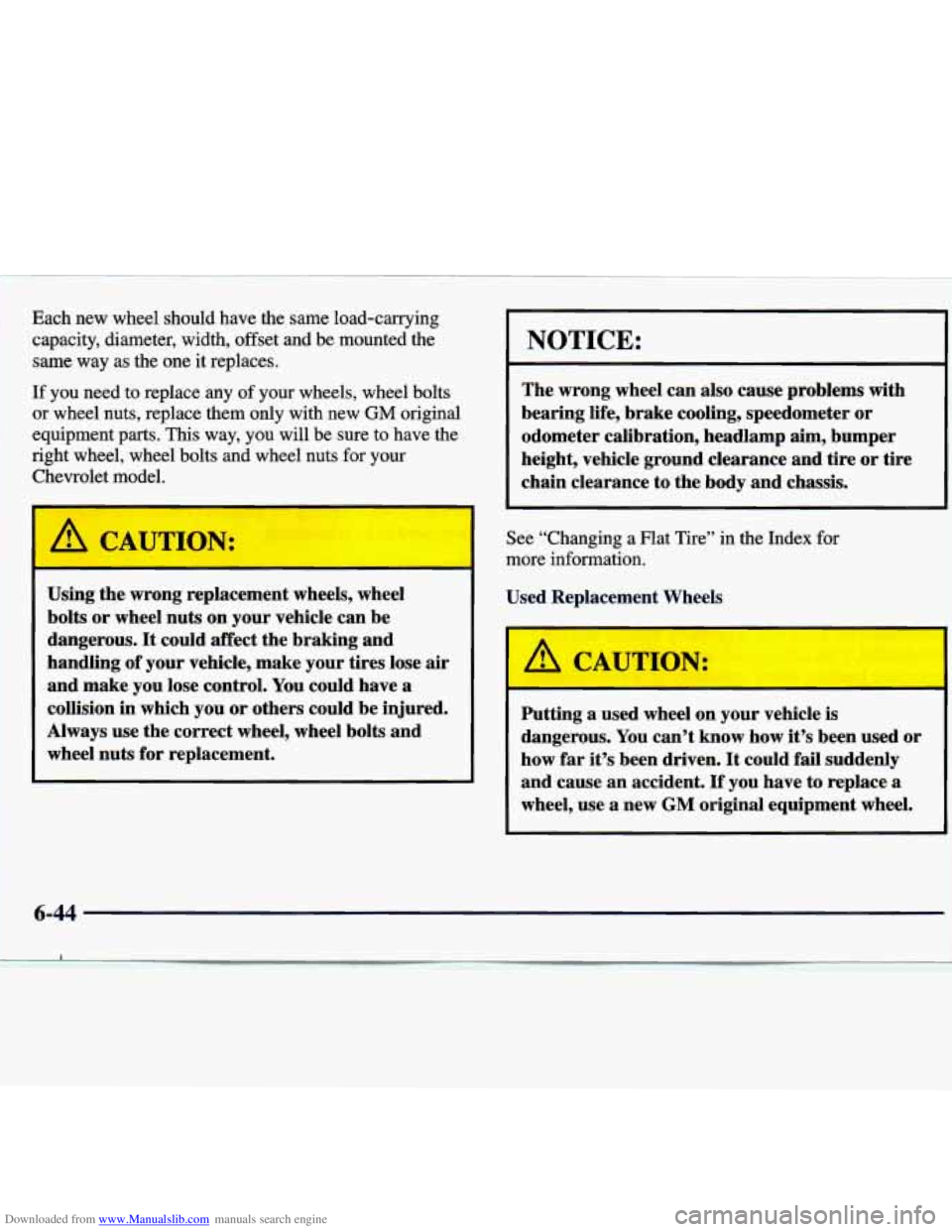
Downloaded from www.Manualslib.com manuals search engine Each new wheel should have the same load-carrying
capacity, diameter, width, offset and be mounted the same way as the one it replaces.
If you need to replace any of your wheels, wheel bolts
or wheel nuts, replace them only with new GM original
equipment
parts. This way, you will be sure to have the
right wheel, wheel bolts and wheel nuts for your Chevrolet model.
Using the wrong replacement wheels, wheel
bolts
or wheel nuts on your vehicle can be
dangerous.
It could affect the braking and
handling of your vehicle, make your tires lose air
and make you lose control. You could have
a
collision in which you or others could be injured.
Always use the correct wheel, wheel bolts and
wheel nuts for replacement.
NOTICE: -
The wrong wheel can also cause problems with
bearing life, brake cooling, speedometer or
odometer calibration, headlamp aim, bumper
height, vehicle ground clearance and tire or tire
chain clearance to the body and chassis.
See “Changing a Flat Tire” in the Index for
more information.
Used Replacement Wheels
A CAUTION: I
I
Putting a used wheel on your vehicle is
dangerous. You can’t know how it’s been used
or
how far it’s been driven. It could fail suddenly
and cause an accident. If you have to replace
a
wheel, use a new GM original equipment wheel.
Page 285 of 362
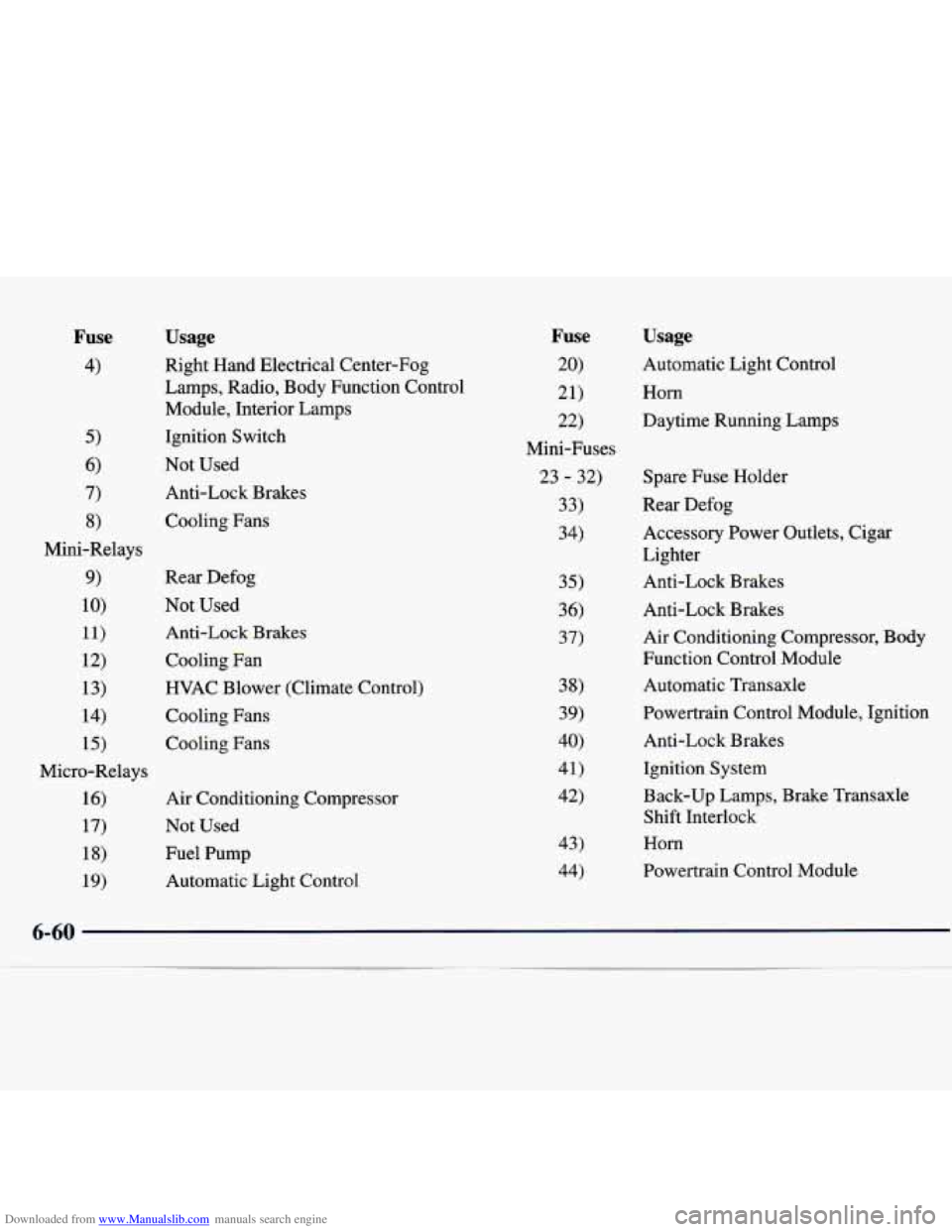
Downloaded from www.Manualslib.com manuals search engine Fuse
4)
Usage
Right Hand Electrical Center-Fog
Lamps, Radio, Body Function Control
Module, Interior Lamps
Ignition Switch
Not Used
Anti-Lock Brakes
Cooling Fans
Mini-Relays
9) Rear Defog
10) Not Used
11) Anti-Lock Brakes
12) Cooling Fan
13) HVAC Blower (Climate Control)
14) Cooling Fans
15) Cooling Fans
16) Air Conditioning Compressor
17) Not Used
1% Fuel Pump
19) Automatic Light Control
Micro-Relays
Fuse
20)
21)
22)
Mini-Fuses
23
- 32)
33)
34)
35)
36)
37)
43)
44)
Usage
Automatic Light Control
Horn
Daytime Running
Lamps
Spare Fuse Holder
Rear Defog
Accessory Power Outlets, Cigar
Lighter
Anti-Lock Brakes
Anti-Lock Brakes
Air Conditioning Compressor, Body
Function Control Module
Automatic Transaxle
Powertrain Control Module, Ignition Anti-Lock Brakes
Ignition System Back-up Lamps, Brake Transaxle
Shift Interlock
Horn
Powertrain Control Module
Page 286 of 362
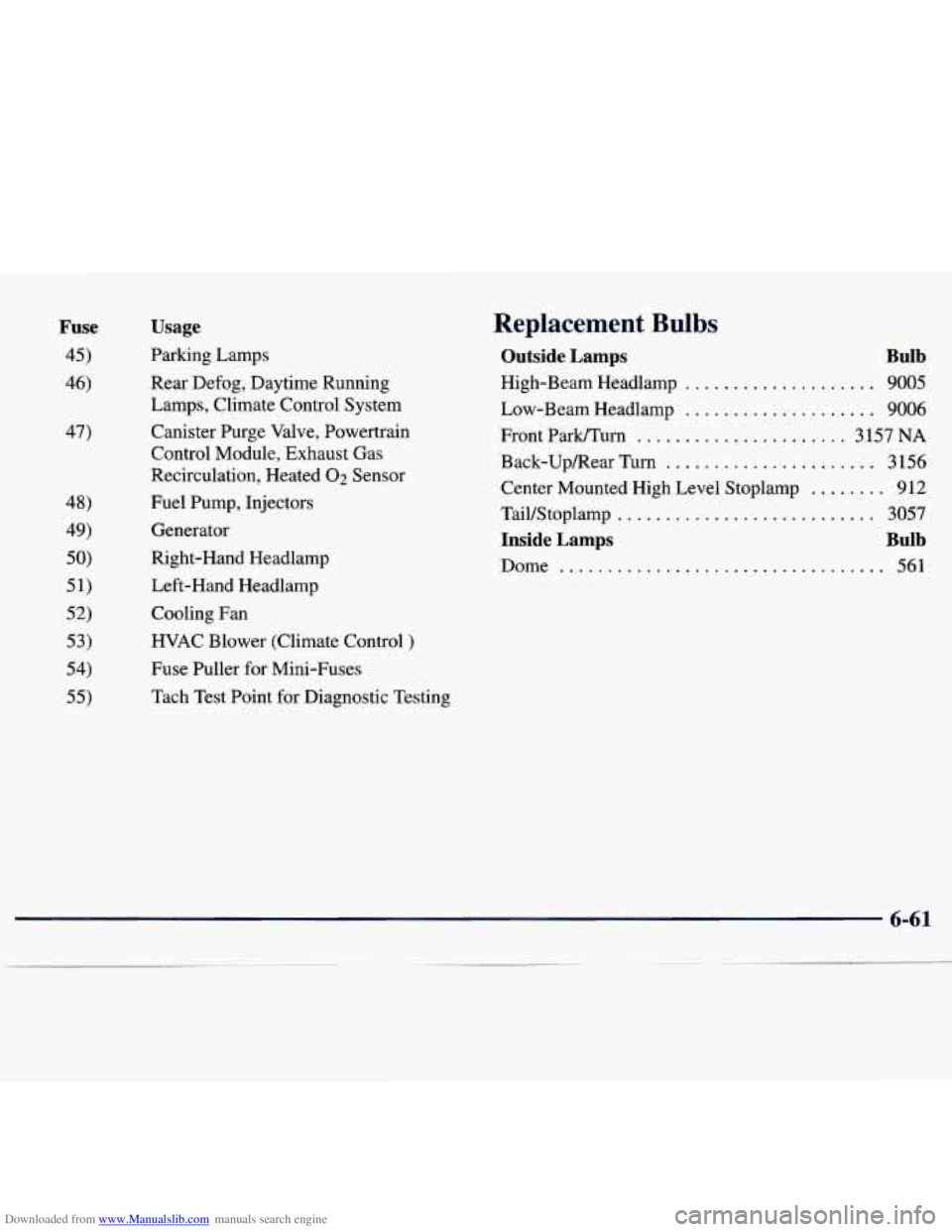
Downloaded from www.Manualslib.com manuals search engine Fuse
45)
46)
47)
Usage
Parking Lamps
Rear Defog, Daytime Running
Lamps, Climate Control System
Canister Purge Valve, Powertrain
Control Module, Exhaust Gas
Recirculation, Heated
02 Sensor
Fuel Pump, Injectors
Generator
Right-Hand Headlamp
Left-Hand Headlamp
Cooling Fan
HVAC Blower (Climate Control
)
Fuse Puller for Mini-Fuses
Tach Test Point
for Diagnostic Testing
Replacement Bulbs
Outside Lamps Bulb
High-Beam Headlamp .................... 9005
Low-Beam Headlamp
.................... 9006
Front Park/Turn
...................... 3157 NA
Back-UpRear Turn ...................... 3156
Center Mounted High Level Stoplamp
........ 912
Tail/Stoplamp
........................... 3057
Inside Lamps Bulb
Dome .................................. 561
6-61
Page 287 of 362
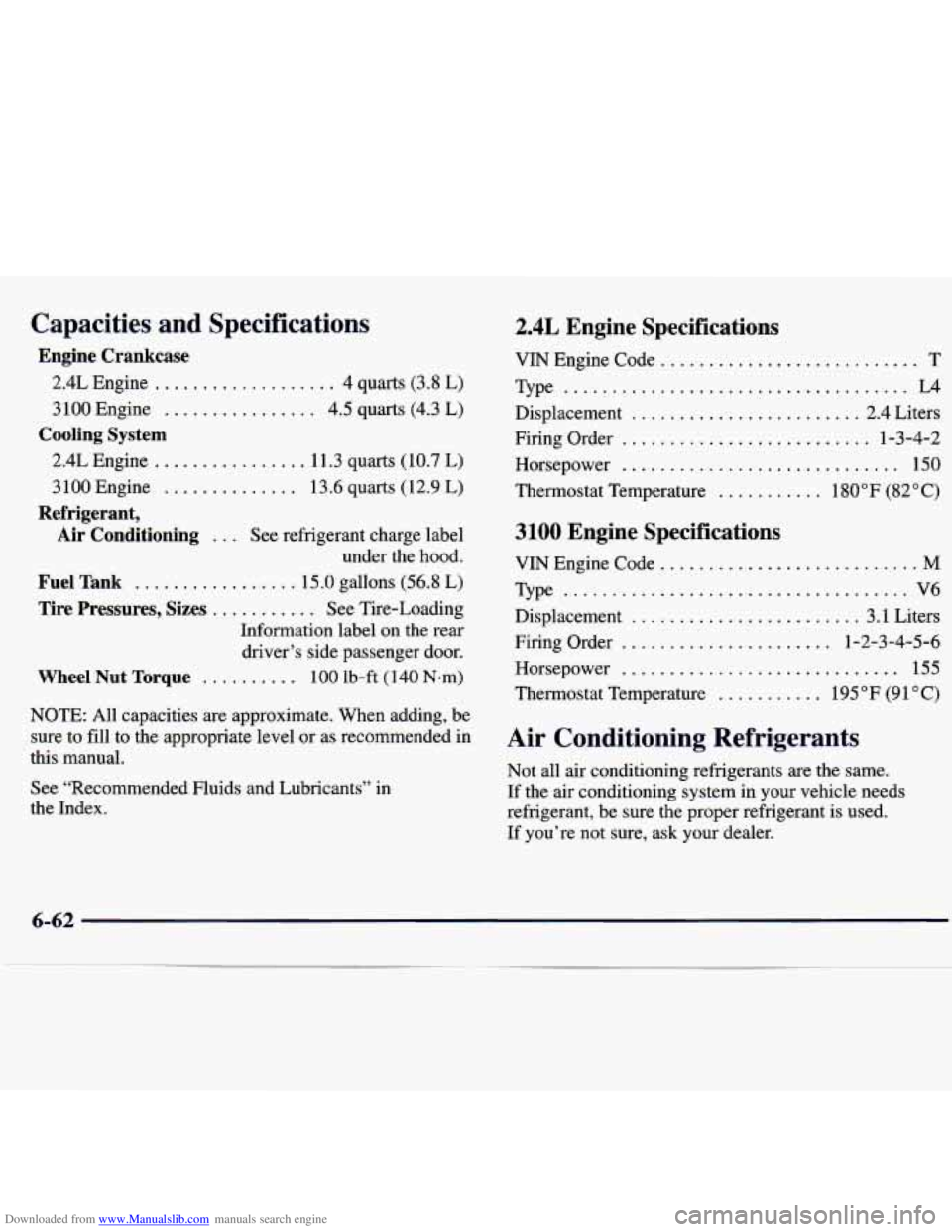
Downloaded from www.Manualslib.com manuals search engine Capacities and Specifications
Engine Crankcase
2.4L Engine ................... 4 quarts (3.8 L)
3 100 Engine
................ 4.5 quarts (4.3 L)
2.4LEngine ................ 11.3quarts(10.7L)
3100 Engine .............. 13.6 quarts (12.9 L)
Air Conditioning ... See refrigerant charge label
under the hood.
Fuel Tank ................. 15.0 gallons (56.8 L)
Information label on the rear
driver’s side passenger door.
Wheel Nut Torque .......... 100 lb-ft (140 Nsm)
Cooling System
Refrigerant,
Tire Pressures, Sizes
........... See Tire-Loading
NOTE: All capacities are approximate. When adding, be
sure to fill
to the appropriate level or as recommended in
this manual.
See “Recommended Fluids and Lubricants” in
the Index.
2.4L Engine Specifications
VIN Engine Code ........................... T
Type .................................... L4
Displacement ........................ 2.4 Liters
Firing Order
.......................... 1-3-4-2
Horsepower
............................. 150
Thermostat Temperature ........... 180°F (82°C)
3100 Engine Specifications
VIN Engine Code ........................... M
Type .................................... V6
Displacement
........................ 3.1 Liters
Firing Order
...................... 1-2-3-4-5-6
Horsepower
............................. 155
Thermostat Temperature
........... 195 OF (9 1 O C)
Air Conditioning Refrigerants
Not all air conditioning refrigerants are the same.
If the air conditioning system in your vehicle needs
refrigerant,
be sure the proper refrigerant is used.
If you’re not sure, ask your dealer.
6-62
Page 296 of 362
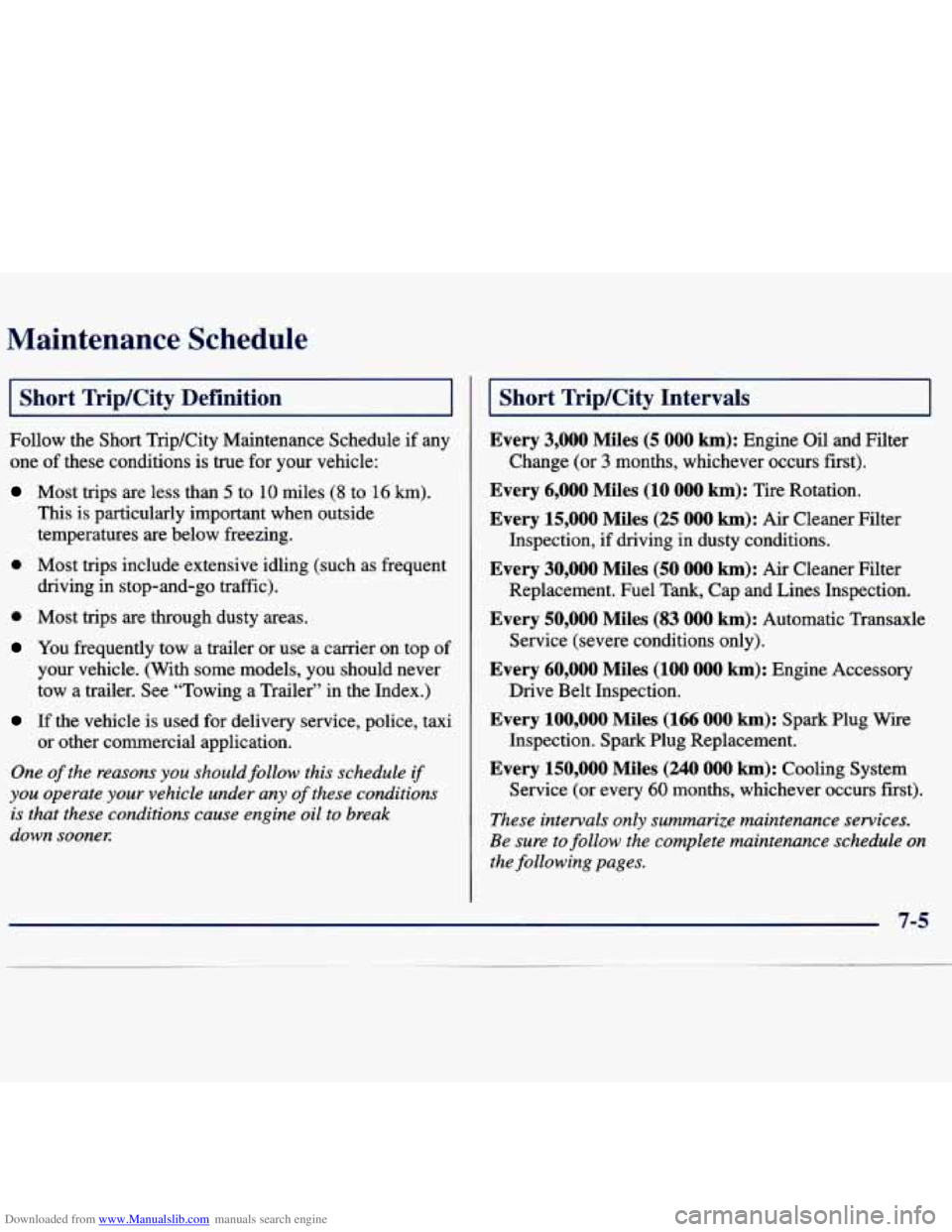
Downloaded from www.Manualslib.com manuals search engine Maintenance Schedule
I Short Trip/City Definition I
Follow the Short TripKity Maintenance Schedule if any
one of these conditions is true for your vehicle:
Most trips are less than 5 to 10 miles (8 to 16 km).
This is particularly important when outside
temperatures are below freezing.
0 Most trips include extensive idling (such as frequent
driving in stop-and-go traffic).
0 Most trips are through dusty areas.
You frequently tow a trailer or use a carrier on top of
your vehicle. (With some models, you should never
tow a trailer. See “Towing a Trailer”
in the Index.)
If the vehicle is used for delivery service, police, taxi
or other commercial application.
One of the reasons you should follow this schedule if
you operate your vehicle under any of these conditions
is that these conditions cause engine
oil to break
down soonex
Short Trip/City Intervals
Every 3,000 Miles (5 000 km): Engine Oil and Filter
Change (or
3 months, whichever occurs first).
Every 6,000 Miles (10 000 km): Tire Rotation.
Every 15,000 Miles (25 000 km): Air Cleaner Filter
Inspection, if driving in dusty conditions.
Every 30,000 Miles (50 000 km): Air Cleaner Filter
Replacement. Fuel Tank, Cap
and Lines Inspection.
Every 50,000 Miles (83 000 km): Automatic Transaxle
Service (severe conditions only).
Every 60,000 Miles (100 000 km): Engine Accessory
Drive Belt Inspection.
Every 100,000 Miles (166 000 km): Spark Plug Wire
Inspection. Spark Plug Replacement.
Every 150,000 Miles (240 000 km): Cooling System
Service (or every
60 months, whichever occurs first).
These intervals only summarize maintenance services.
Be sure
to follow the complete maintenance schedule on
the following pages.
7-5