cooling CHEVROLET MALIBU 1998 Owners Manual
[x] Cancel search | Manufacturer: CHEVROLET, Model Year: 1998, Model line: MALIBU, Model: CHEVROLET MALIBU 1998Pages: 362, PDF Size: 19.35 MB
Page 3 of 362
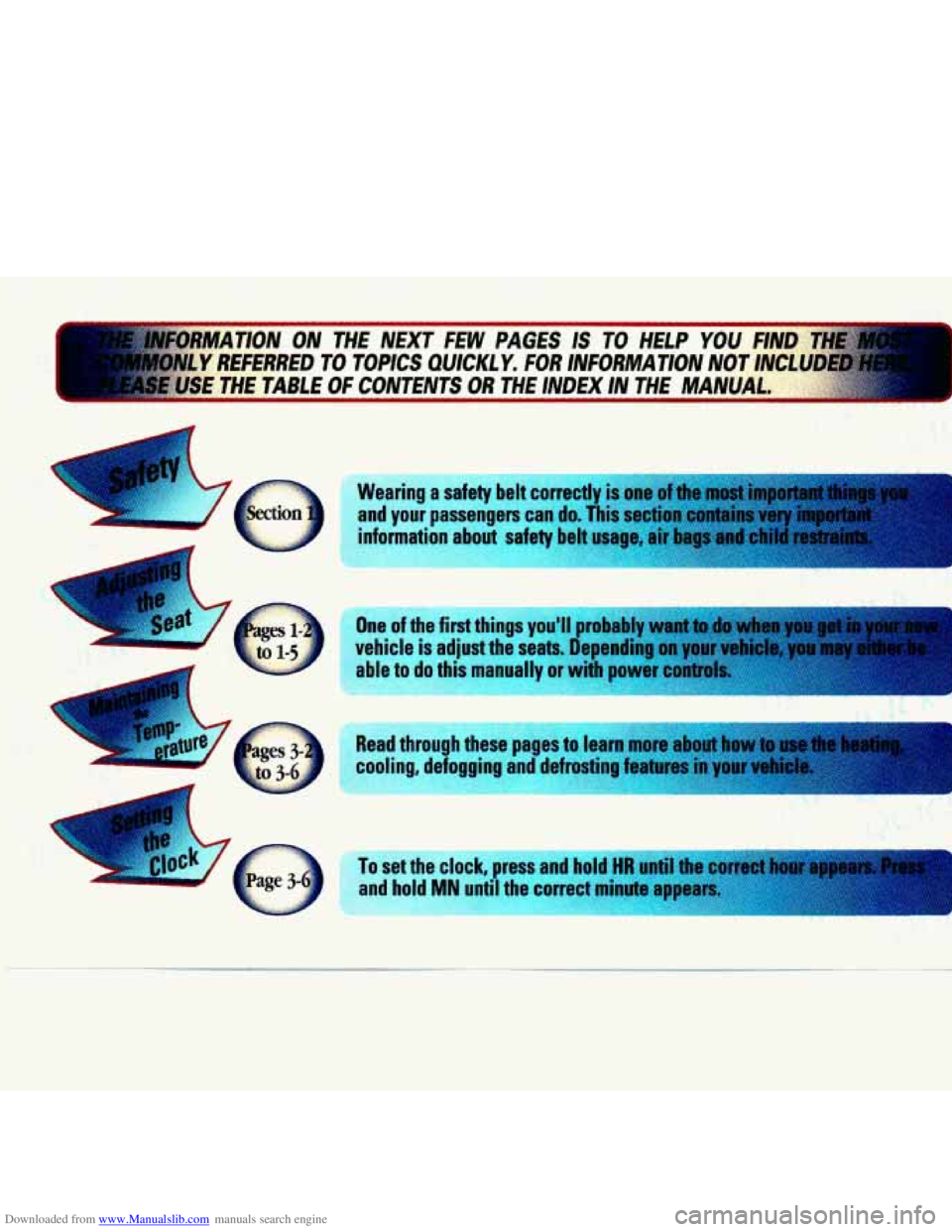
Downloaded from www.Manualslib.com manuals search engine Wearing a si !ry uelt c
and your passengers can 110. Thls I
information about safety belt usage, alr
One
of the first things you II pro1
vehicle is adjust the seats. Depl
able to do this manually or with pa zr (
I_.I
.. I
Read through these pages to learn m*r*
cooling, defogging and defrosting
Page 75 of 362
Downloaded from www.Manualslib.com manuals search engine I’runk Remote Trunk Release
To unlock the trunk from the outside, insert the key and
turn the trunk lock cylinder.
It can be dangerous to drive with the trunk lid
open because carbon monoxide
(CO) gas can
come into your vehicle. You can’t see or smell
CO. It can cause unconsciousness and even death.
If you must drive with the trunk lid open or if
electrical wiring or other cable connections must
pass through the seal between the body and the
trunk lid:
Make sure all windows are shut.
%hrn the fan on your heating or cooling
system to
its highest speed with the setting on
VENT. That will force outside air into your
vehicle.
See ‘6Comfort Controls” in the Index.
instrument panel, open them all the way.
If you have air outlets on or under the
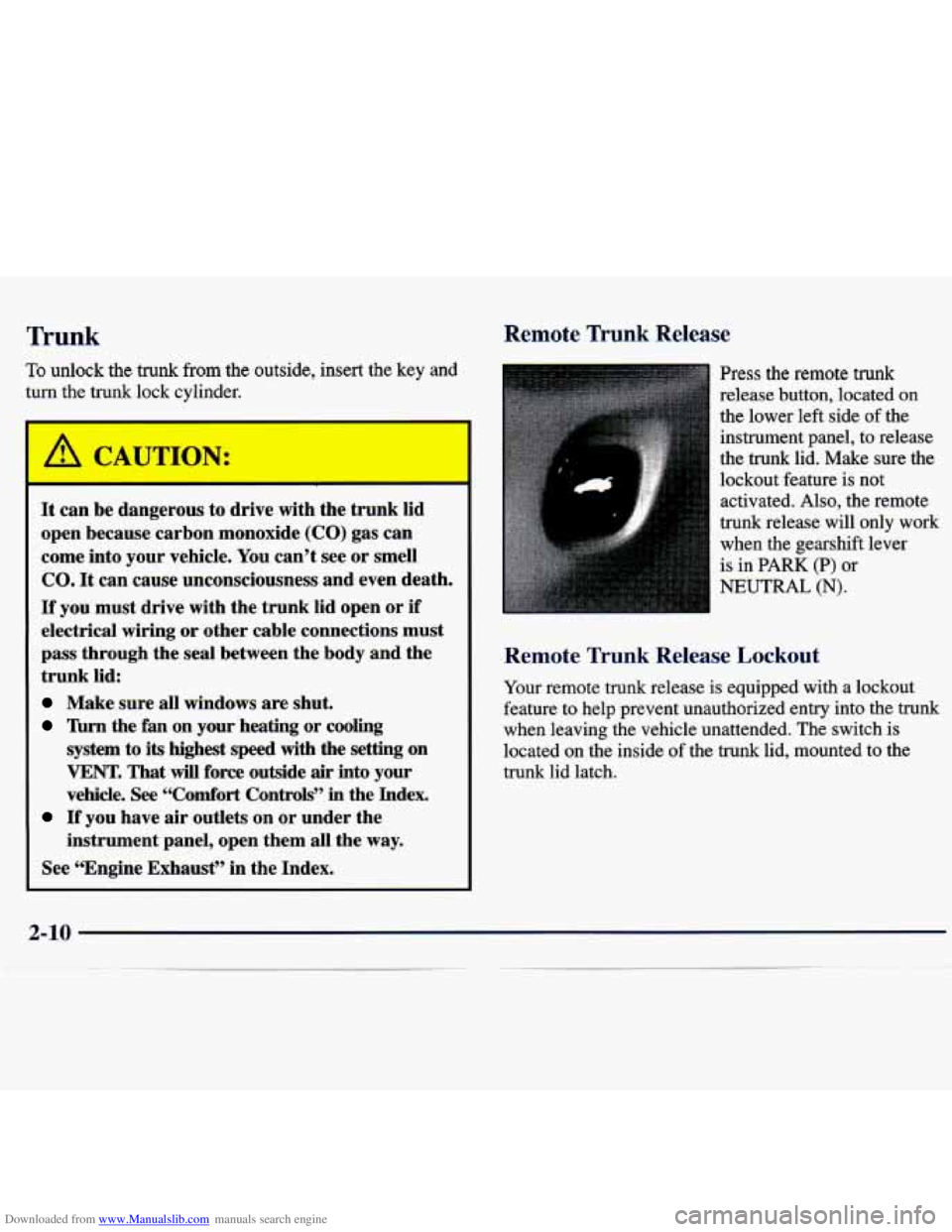
See “Engine Exhaust” in the Index. Press the remote trunk
release button, located on
the lower left side of the
instrument panel, to release
the trunk lid. Make sure the
lockout feature is not
activated. Also, the remote
trunk release will only work
when the gearshift lever
is in PARK (P)
or
NEUTRAL (N).
Remote Trunk Release Lockout
Your remote trunk release is equipped with a lockout
feature to help prevent unauthorized entry into the trunk when leaving the vehicle unattended. The switch is
located on the inside of the trunk lid, mounted to the
trunk lid latch.
2-10
Page 131 of 362
Downloaded from www.Manualslib.com manuals search engine For quick cool-down on very hot days, use vent with the
temperature knob
all the way in the blue area and the
NC and recirculation buttons pressed. If this setting is
used for long periods of time, the air in your vehicle
may become too dry.
For normal cooling on hot days, use vent with the
temperature knob
in the blue area and the A/C button
pushed
in. The system will bring in outside air and cool it.
Heating
On cold days, use FLOOR and the outside air button
with the temperature knob all the way in the red area.
The system will bring in outside air, heat it and send it to
the floor outlets.
Your vehicle has heat ducts that are directed toward
the rear seat. Keep the area under the front seats clear
of obstructions
so the heated air can reach the rear
seat passengers.
If your vehicle has an engine coolant heater, you can
use it to help your system provide warm air faster when
it’s cold outside (0°F (-18°C) or lower). An engine
coolant heater wms the coolant your engine and
heating system uses to provide heat. See “Engine
Coolant Heater” in the Index.
Defogging and Defrosting Windows
Your system has two settings for clearing the front and
side windows. For each setting, adjust the temperature
control as desired.
To defrost the front window quickly, rotate the
temperature control knob all the way in the red area.
Use defrost and adjust the fan to the highest speed.
To warm passengers while keeping the front window
clean, use defog.
Your vehicle is equipped with side window defogger
vents. The side window defogger vents are located on
the outside of the side instrument panel vents.
To defrost
the side windows, rotate the temperature control knob
all
the way in the red area. Use FLOOR and adjust the
fan to the highest speed.
To control fogging of the
windows, rotate the temperature control knob all the
way in the red area. Use DEFOG and adjust the fan to
the highest speed.
To defog the side windows while using air conditioning,
use BI-LEVEL and adjust the fan to the highest speed and press the
A/C button. For additional airflow to the
side windows, aim the side vents toward the windows
and close the center vents.
Recirculation will not work in defrost and defog. This is
done to prevent recirculation of humid inside air and
allow the system to work properly.
3-4
Page 132 of 362
Downloaded from www.Manualslib.com manuals search engine Rear Window Defogger (If Equipped)
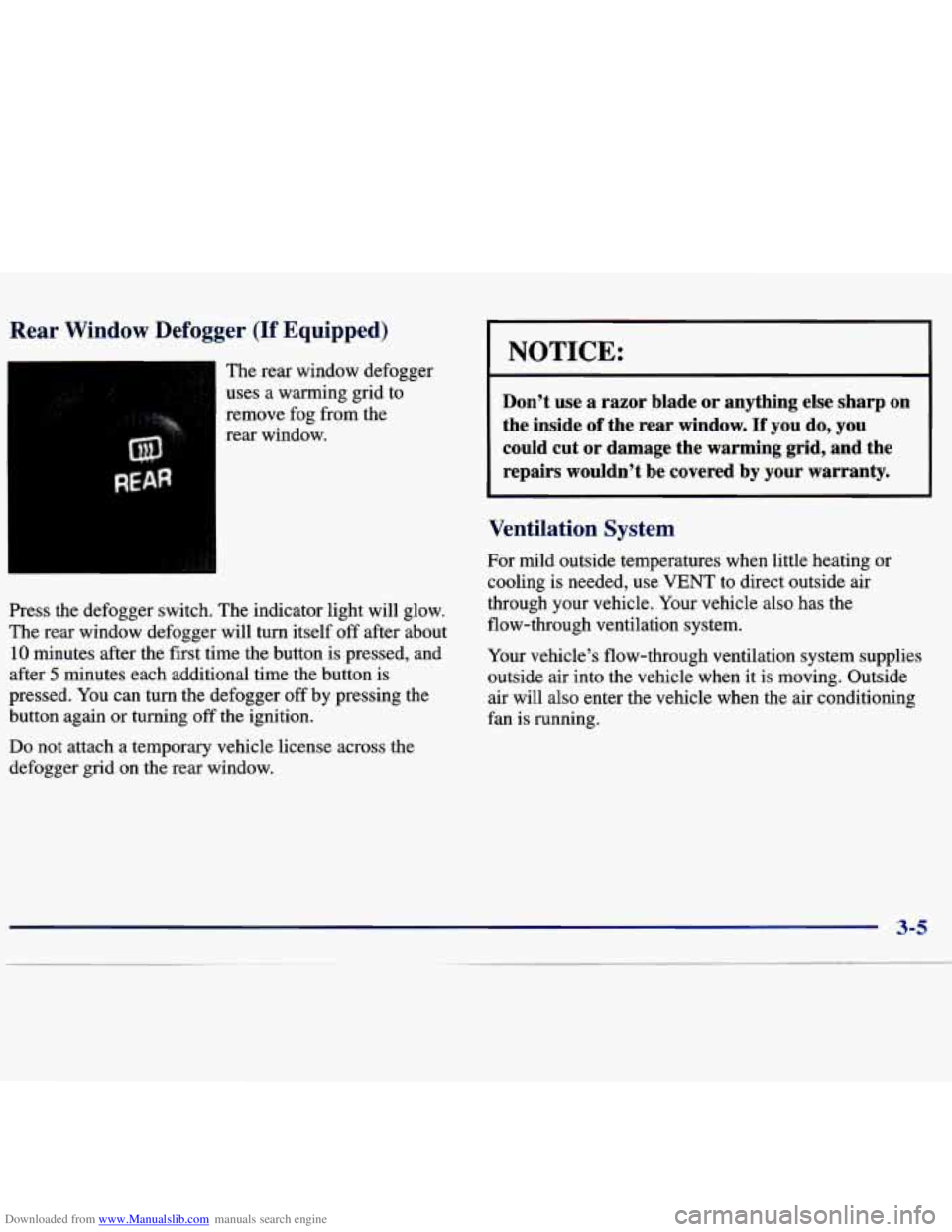
The rear window defogger
uses a warming grid to
remove fog from the
rear window.
Press the defogger switch. The indicator light will glow.
The rear window defogger will turn itself
off after about
10 minutes after the first time the button is pressed, and
after
5 minutes each additional time the button is
pressed. You can turn the defogger
off by pressing the
button again or turning
off the ignition.
Do not attach a temporary vehicle license across the
defogger grid on the rear window.
NOTICE:
Don’t use a razor blade or anything else sharp on
the inside
of the rear window. If you do, you
could cut or damage the warming grid, and the
repairs wouldn’t be covered by your warranty.
Ventilation System
For mild outside temperatures when little heating or
cooling is needed, use VENT to direct outside air
through your vehicle. Your vehicle also has the
flow-through ventilation system.
Your vehicle’s flow-through ventilation system supplies
outside air into
the vehicle when it is moving. Outside
air will also enter the vehicle when the air conditioning
fan is running.
Page 174 of 362
Downloaded from www.Manualslib.com manuals search engine If you drive regularly in steep country, or if you’re
planning to visit there, here are some tips that can make
your trips safer and more enjoyable.
0 Keep your vehicle in good shape. Check all fluid
levels and also the brakes, tires, cooling system
and transaxle. These parts can work hard on
mountain roads.
0 Know how to go down hills. The most important
thing to know
is this: let your engine do some of the
slowing down. Shift to a lower gear when you
go
down a steep or long hill.
i If you don’t shift down, your brakes could
~ get so hot that they wouldn’t work well. You
would then have poor braking or even none going
down
a hill. You could crash. Shift down to let
your engine assist your brakes on
a steep
downhill slope. Coasting
dow
in NEUTRAL (N) or with the
ignition
off is dangerous. Your brakes will have to
do all the work of slowing down. They could get so
hot that they wouldn’t work well. You would then
have poor braking or even none going down
a hill.
You could crash. Always have your engine running
and your vehicle in gear when you go downhill.
0
0
0
a
Know how to go uphill. Drive in the highest
gear possible.
Stay in your own lane when driving on two-lane
roads in hills or mountains. Don’t swing wide or cut
across the center
of the road. Drive at speeds that let
you stay in your own lane.
As you go over the top of a hill, be alert. There could
be something in your lane, like a stalled car
or an
accident.
You may see highway signs on mountains that warn of
special problems. Examples are long grades, passing or
no-passing zones, a
falling rocks area or winding
roads. Be alert to these and take appropriate action.
Page 191 of 362
Downloaded from www.Manualslib.com manuals search engine Maintenance When Trailer Towing
Your vehicle will need service more often when you’re
pulling a trailer. See
the Maintenance Schedule for more
on this. Things that are especially important in trailer
operation are automatic transaxle fluid (don’t overfill),
engine oil, belt, cooling system and brake adjustment.
Each
of these is covered in this manual, and the Index
will help you find them quickly. If you’re trailering, it’s
a good idea to review these sections before you start
your trip.
Check periodically to see that all hitch nuts and bolts
are tight.
Engine Cooling When Trailer Towing
Your cooling system may temporarily overheat during
severe operating conditions. See “Engine Overheating”
in the Index.
Towing A Trailer
(Except
3100 V6 Engine)
Your vehicle is neither designed nor intended to tow
a trailer.
Page 192 of 362
Downloaded from www.Manualslib.com manuals search engine 0 Section 5 Problems on the Road
Here you’ll find what to do about some problems that can occur on the road.
5-2
5 -2
5-3
5-8
5-12
Hazard Warning Flashers
Other Warning Devices
Jump Starting
Towing Your Vehicle
Engine Overheating 5- 15
5-22
5-22
5-32
5-33
Cooling System
If a Tire Goes Flat
Changing a Flat Tire
Compact Spare Tire
If You’re Stuck: In Sand, Mud,
Ice or Snow
Page 206 of 362
Downloaded from www.Manualslib.com manuals search engine Cooling System
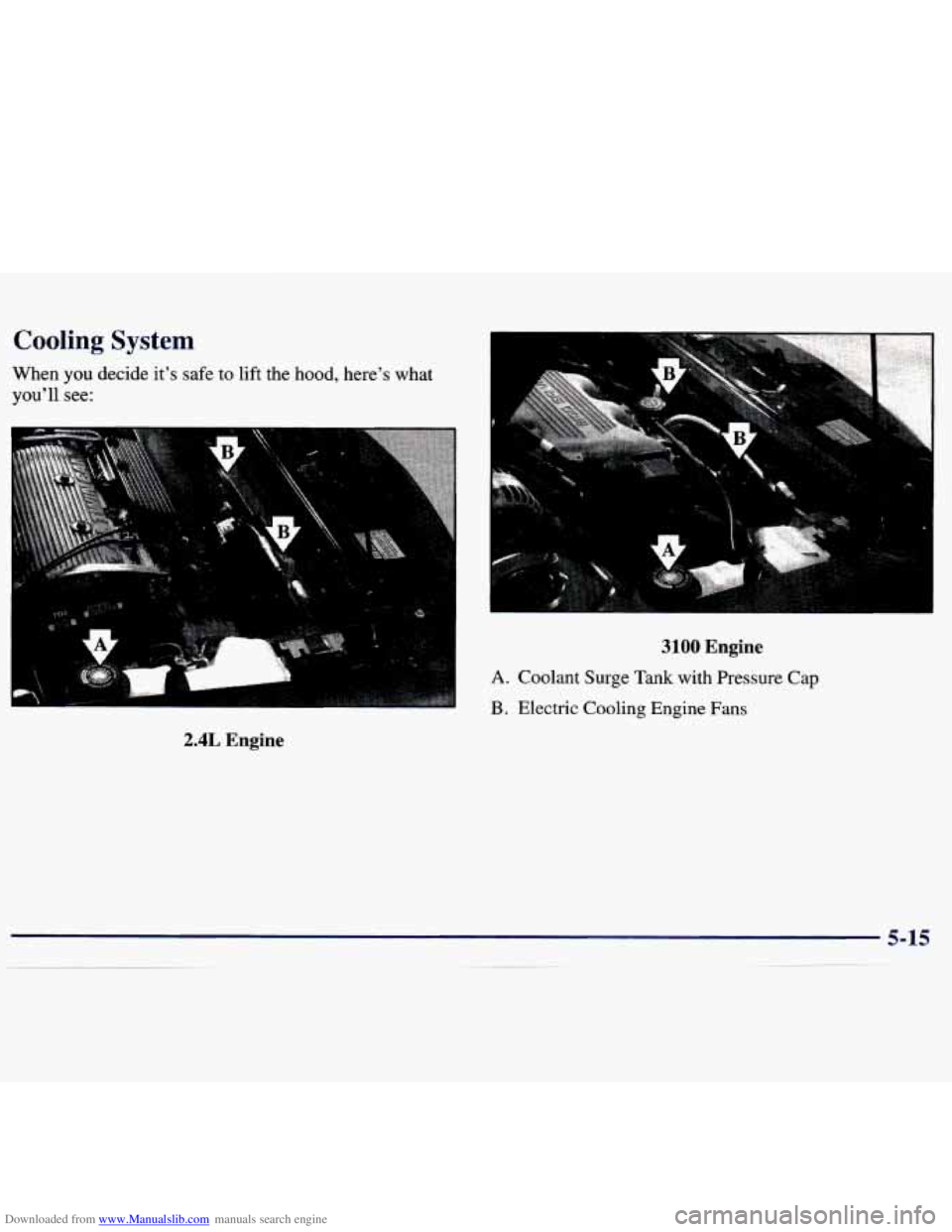
When you decide it’s safe to lift the hood, here’s what
you’ll
see:
2.4L Engine
3100 Engine
A. Coolant Surge Tank with Pressure Lap
B. Electric Cooling Engine Fans
Page 207 of 362
Downloaded from www.Manualslib.com manuals search engine h ‘JTTION:
An electric engine cooling fan under the hood can
start
up even when the engine is not running and
can injure you. Keep hands, clothing and tools
away
-i from any underhood electric fan.
If the coolant inside the coolant surge tank is boiling,
don’t do anything else until it
cools down.
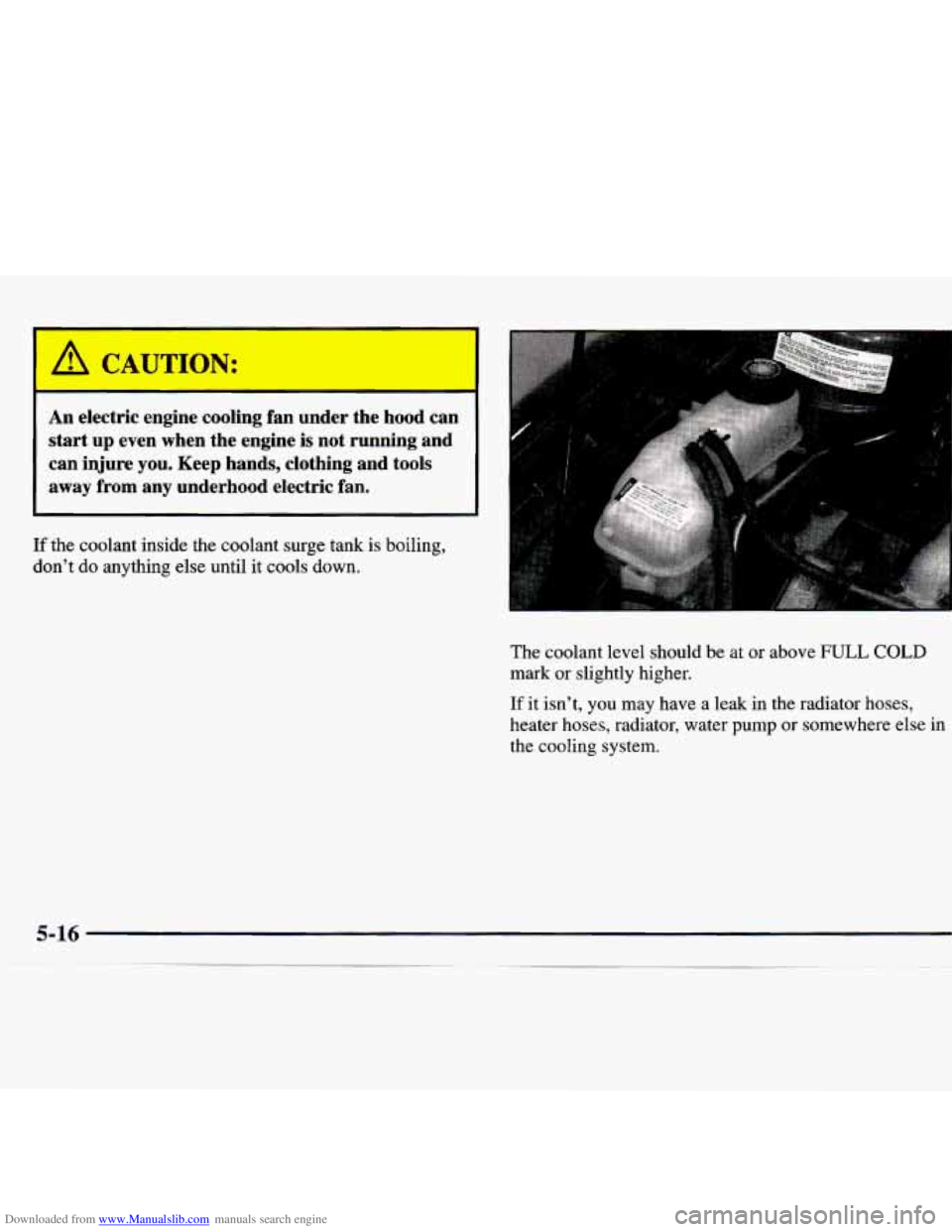
The coolant level should
be at or above FULL COLD
mark or slightly higher.
If it isn’t, you may have a leak in the radiator hoses,
heater hoses, radiator, water
pump or somewhere else in
the cooling system.
Page 208 of 362
Downloaded from www.Manualslib.com manuals search engine Heater and radiator hoses, and other engine
parts, can be
very hot. Don’t touch them. If you
do, you can be burned.
Don’t run the engine
if there is a leak. If you run
the engine, it could lose all coolant. That could
cause an engine fire, and you could be burned.
Get any leak fixed before you drive the vehicle.
NOTICE:
Engine damage from running your engine
without coolant isn’t covered by your warranty.
If there seems to be no leak, with the engine on, check to
see if the electric engine cooling fans are running.
If the
engine is overheating, both fans should be running.
If
they aren’t, your vehicle needs service.
How to Add Coolant to the Coolant
Surge Tank
If you haven’t found a problem yet, but the coolant level
isn’t at FULL COLD mark or slightly higher, add a
50/50 mixture of clean water (preferably distilled) and
DEX-COOL’ coolant at the coolant surge tank, but be
sure the cooling system, including the coolant surge tank
pressure cap, is cool before you do it. (See “Engine
Coolant” in the Index for more information.)
Steam and scalding liquids from a hot cooling
system can blow out and burn you badly. They
are under pressure, and if you turn the coolant
surge tank pressure cap
-- even a little -- they
can come out at high speed. Never turn the cap
when the cooling system, including the coolant
surge tank pressure cap, is hot. Wait for the
cooling system and coolant surge tank pressure
cap to cool if you ever have to turn the
pressure cap.
5-17