ECU CHEVROLET MALIBU 1998 Owner's Manual
[x] Cancel search | Manufacturer: CHEVROLET, Model Year: 1998, Model line: MALIBU, Model: CHEVROLET MALIBU 1998Pages: 362, PDF Size: 19.35 MB
Page 180 of 362
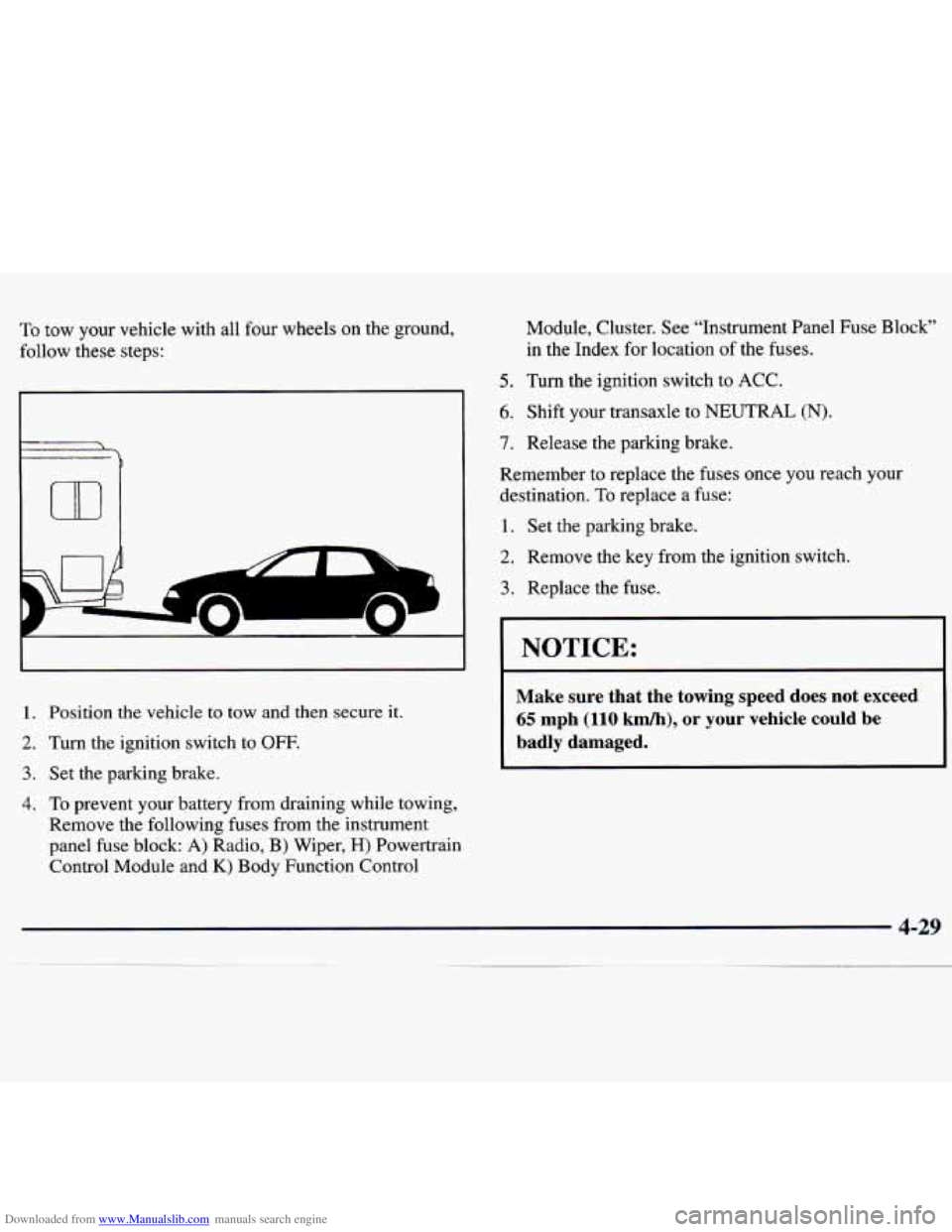
Downloaded from www.Manualslib.com manuals search engine To tow your vehicle with all four wheels on the ground,
follow these steps: Module,
Cluster. See “Instrument Panel Fuse Block”
in the Index for location of the fuses.
5. Turn the ignition switch to ACC.
6. Shift your transaxle to NEUTRAL (N).
7. Release the parking brake.
Remember to replace the fuses once you reach your
destination.
To replace a fuse:
1. Set the parking brake.
2. Remove the key from the ignition switch.
3. Replace the fuse.
I NOTICE:
1. Position the vehicle to tow and then secure it.
2. Turn the ignition switch to OFF.
3. Set the parking brake.
4. To prevent your battery from draining while towing,
Remove the following fuses from the instrument
panel fuse block: A) Radio,
B) Wiper, H) Powertrain
Control Module and
K) Body Function Control
Make sure that the towing speed does not exceed
65 mph (110 km/h), or your vehicle could be
badly damaged.
Page 183 of 362
Downloaded from www.Manualslib.com manuals search engine A CAUTION:
Things you put inside your vehicle can strike
and injure people in
a sudden stop or turn, or in
a crash.
0 Put things in the trunk of your vehicle. In a
trunk, put them as far forward as you can,
Try to spread the weight evenly.
Never stack heavier things, like suitcases,
inside the vehicle
so that some of them are
above the tops
of the seats.
Don’t leave an unsecured child restraint in
your vehicle.
When you carry something inside the
vehicle, secure
it whenever you can.
Don’t leave a seat folded down unless you
need to.
Towing a Trailer
I
A CAUTION:
I
’ If you don’t use the correct equipment and drive
~ properly, you can lose control when you pull a
trailer. For example, if the trailer is too heavy, the
~ brakes may not work well -- or even at all. You
and your passengers could be seriously injured.
You may also damage your vehicle; the resulting
repairs would not be covered by your warranty.
Pull
a trailer only if you have followed all the
steps in this section. Ask your dealer
for advice
and information about towing a trailer with
your vehicle,
Do not tow a trailer if your vehicle is equipped with the
2.4L engine.
Page 187 of 362
Downloaded from www.Manualslib.com manuals search engine Safety Chains
You should always attach chains between your vehicle
and your trailer. Cross the safety chains under the tongue
of the trailer
so that the tongue will not drop to the road
if it becomes separated from the hitch. Instructions
about safety chains may be provided by the hitch
manufacturer or by the trailer manufacturer. Follow the
manufacturer’s recommendation for attaching safety
chains and do not attach them to the bumper. Always
leave just enough slack
so you can turn with your rig.
And, never allow safety chains to drag on the ground.
Trailer Brakes
Does your trailer have its own brakes?
Be sure to read and follow the instructions for the trailer
brakes
so you’ll be able to install, adjust and maintain
them properly. And because you have anti-lock brakes,
do not
try to tap into your vehicle’s brake system. If you
do, both systems won’t work well, or at all.
Driving with a Trailer
Towing a trailer requires a certain amount of experience.
Before setting out for the open road, you’ll want to get
to know your rig. Acquaint yourself with the feel of
handling and braking with the added weight
of the
trailer. And always keep in mind that the vehicle you are
driving is now a good deal longer and not nearly as
responsive as your vehicle is by itself.
Before you start, check the trailer hitch and platform (and attachments), safety chains, electrical connector,
lamps, tires and mirror adjustment. If the trailer has
electric brakes, start your vehicle and trailer moving and
then apply the trailer brake controller by hand to be sure the brakes are working.
This lets you check your
electrical connection at the same time.
During your trip, check occasionally to be sure that the
load is secure, and that the lamps and any trailer brakes are still working.
Page 200 of 362
Downloaded from www.Manualslib.com manuals search engine To help avoid inpry to you or others:
0 Never let passengers ride in a vehicle that is
Never tow faster than safe or posted speeds.
Never tow with damaged parts not
fully secured.
0 Never get under your vehicle after it has
been lifted by the tow truck.
0 Always secure the vehicle on each side with
separate safety chains when towing it.
Never use J-hooks. Use T-hooks instead.
being towed.
A CA TION:
A vehicle can fall from a
car carrier if it isn’t
adequately secured. This can cause a collision,
serious personal injury and vehicle damage. The
vehicle should be tightly secured with chains or
steel cables before it is transported.
Don’t use substitutes (ropes, leather straps,
canvas webbing, etc.) that can be cut by sharp
edges underneath the towed vehicle. Always use
T-hooks inserted in the T-hook slots. Never use
J-hooks. They will damage drivetrain and
suspension components.
When your vehicle is being towed, turn the ignition key
to ACC. The steering wheel should be clamped in a
straight-ahead position, with
a clamping device
designed for towing service. The transaxle should be in
NEUTRAL (N) and the parking brake released.
Page 221 of 362
Downloaded from www.Manualslib.com manuals search engine NOTICE:
Improperly tightened wheel nuts can lead to
brake pulsation and rotor damage,
To avoid
expensive brake repairs, evenly tighten the wheel
nuts in the proper sequence and
to the proper
torque specification.
Don't try to put a wheel cover on your compact spare
tire.
It won't fit. Store the wheel cover and wheel nut
caps
in the trunk until you have the flat tire repaired
or replaced.
I NOTICE:
Wheel covers won't fit on your compact spare. If
you try to put a wheel cover on your compact
spare, you could damage the cover or the spare.
Storing the Flat Tire and Tools
I A CAUTION:
F-- -
Storing a jack, a tire or other equipment in the
passenger compartment
of the vehicle could
cause injury, In a sudden stop or collision, loose
equipment could strike someone. Store all these
in the proper place.
Store the jack and wheel wrench in the foam tray. Place
the foam tray
in the spare tire compartment. Store the
flat tire in the compact spare tire compartment. Place the
tire in the compartment, then secure the adapter and
wing nut.
Page 261 of 362
Downloaded from www.Manualslib.com manuals search engine 7.
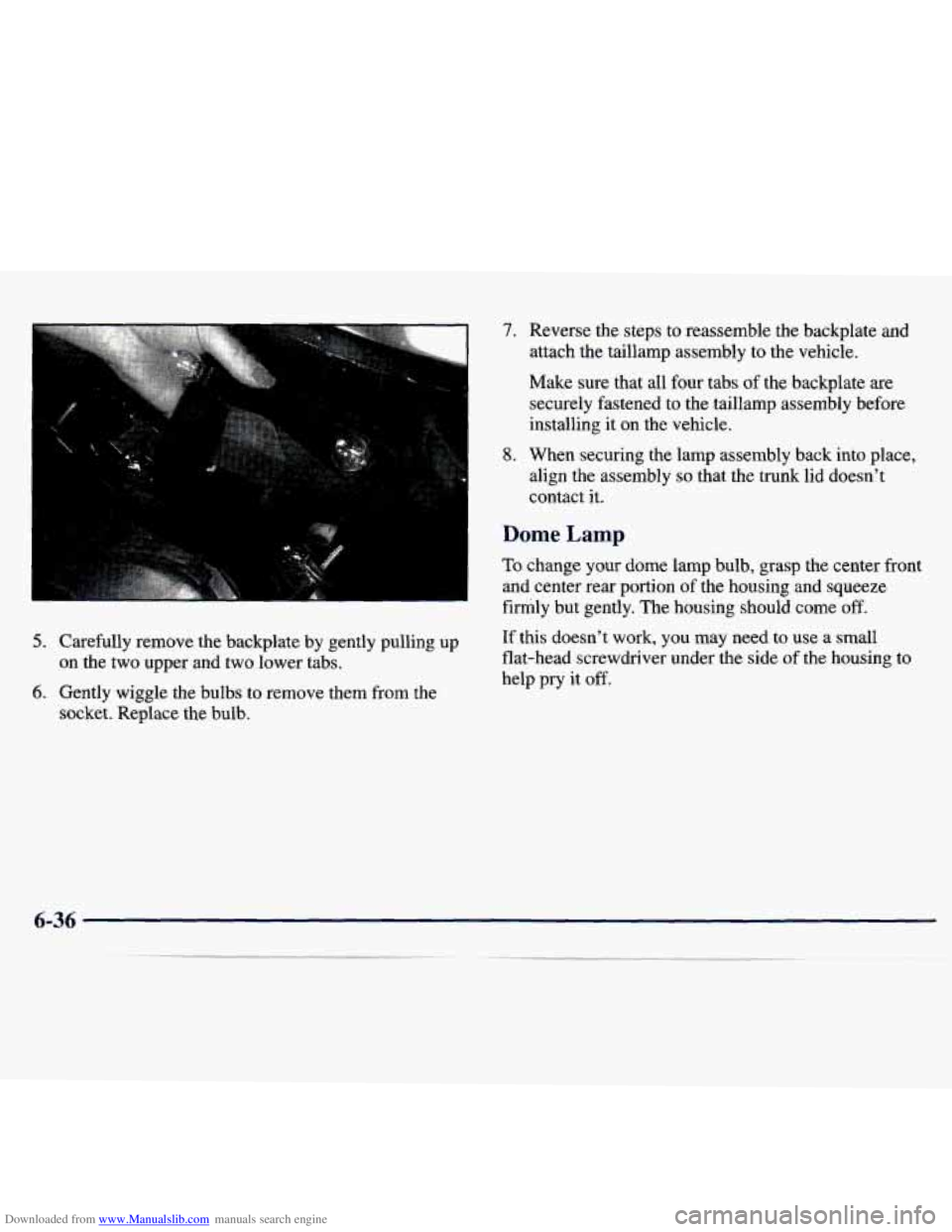
5. Carefully remove the backplate by gently pulling up on the two upper and two lower tabs.
6. Gently wiggle the bulbs to remove them from the
socket. Replace the bulb.
8.
Reverse the steps to reassemble the backplate and
attach the taillamp assembly to the vehicle.
Make sure that all four tabs of the backplate
are
securely fastened to the taillamp assembly before
installing it on the vehicle.
When securing the lamp assembly back into place,
align the assembly so that the trunk lid doesn’t
contact
it.
Dome Lamp
To change your dome lamp bulb, grasp the center front
and center rear portion
of the housing and squeeze
firmly but gently. The housing should come
off.
If this doesn’t work, you may need to use a small
flat-head screwdriver under the side
of the housing to
help pry it off.
Page 270 of 362
Downloaded from www.Manualslib.com manuals search engine r rire Chains
NOTICE:
Use tire chains only where legal and only when
you must. Use only
SAE Class “S” type chains
that are the proper size
for your tires. Install
them on the front tires and tighten them as
tightly as possible with the ends securely
fastened. Drive slowly and follow the chain
manufacturer’s instructions.
If you can hear the
chains contacting your vehicle, stop and retighten
them.
If the contact continues, slow down until it
stops. Driving too fast or spinning the wheels
with chains on will damage your vehicle.
Appearance Care
Remember, cleaning products can be hazardous. Some
are toxic. Others can burst into flame if you strike a
match or get them on a hot part of the vehicle. Some are
dangerous if you breathe their fumes in a closed space.
When you use anything from a container to clean your
vehicle, be sure to follow the manufacturer’s warnings and instructions. And always open your
doors or
windows when you’re cleaning the inside.
Never use these to clean your vehicle:
Gasoline
Benzene
Naphtha
Carbon Tetrachloride
0 Acetone
0 Paint Thinner
0 Turpentine
Lacquer Thinner
Nail Polish Remover
They can all be hazardous
-- some more than
others
-- and they can all damage your vehicle, too.
Don’t use any
of these unless this manual says you can.
In many uses, these will damage your vehicle:
0 Alcohol
0 Laundry Soap
0 Bleach
0 Reducing Agents
Page 281 of 362
Downloaded from www.Manualslib.com manuals search engine Fuses and Circuit Breakers
The wiring circuits in your vehicle are protected from
short circuits by a combination of fuses, circuit breakers
and fusible thermal links in the wiring itself.
Look at
the silver-colored band inside the fuse. If the
band is broken or melted, replace the fuse. Be sure you
replace a bad fuse with a new one of the identical size
and rating.
If you ever have a problem on the road and don’t have a
spare fuse, you can borrow one that has the same
amperage. Just pick a feature of your vehicle that you
can get along without
-- like the radio or cigarette
lighter
-- and use its fuse, if it is the correct amperage.
Replace it as soon as you can. Also, there are spare fuses
in the left side instrument panel door.
There are three fuse blocks in your vehicle: two
instrument panel fuse blocks and the engine
compartment fuse block.
Instrument Panel Fuse Block
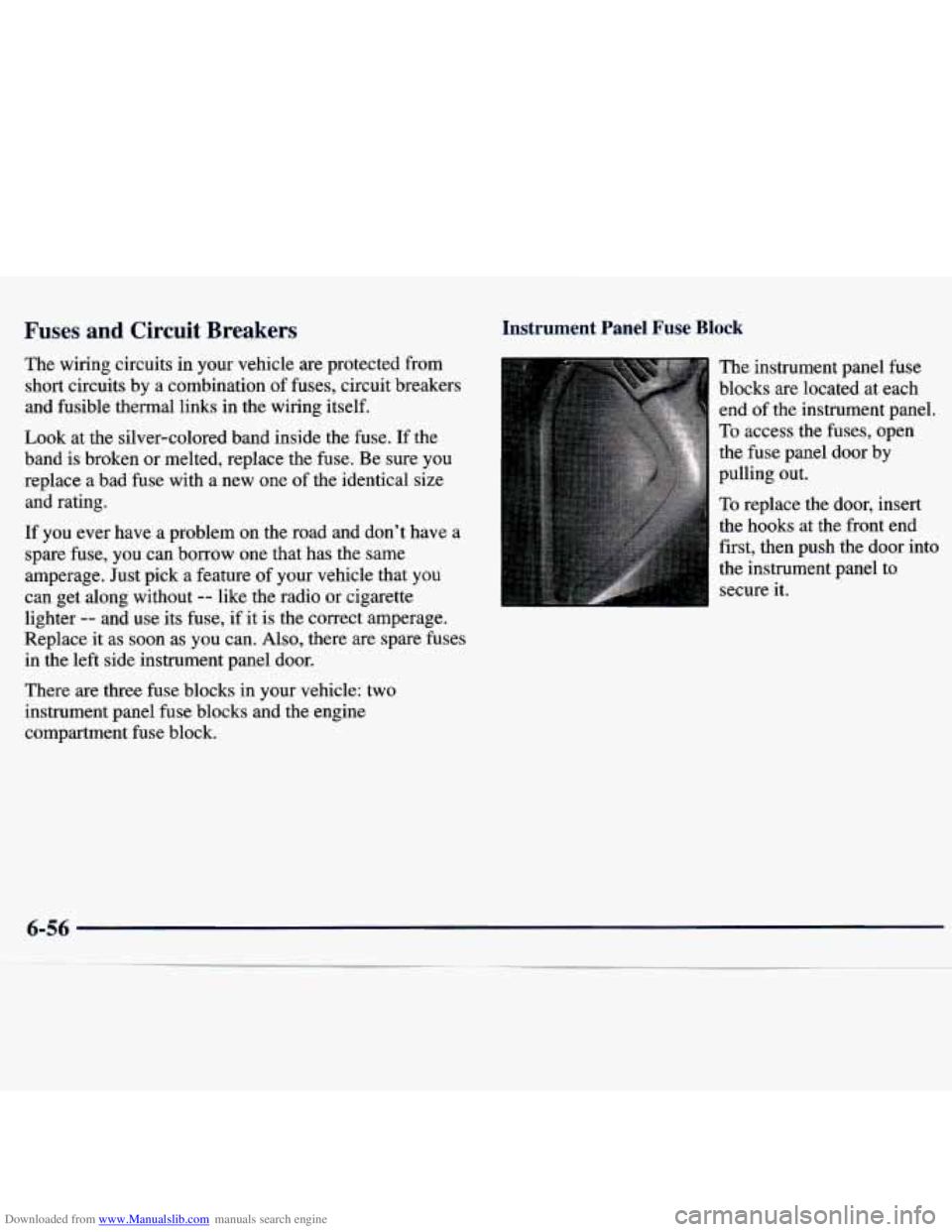
The instrument panel fuse
blocks are located at each end of the instrument panel.
To access the fuses, open
the fuse panel door by
pulling out.
To replace the door, insert
the hooks at the front end
first, then push the door into
the instrument panel to
secure it.
6-56
Page 347 of 362
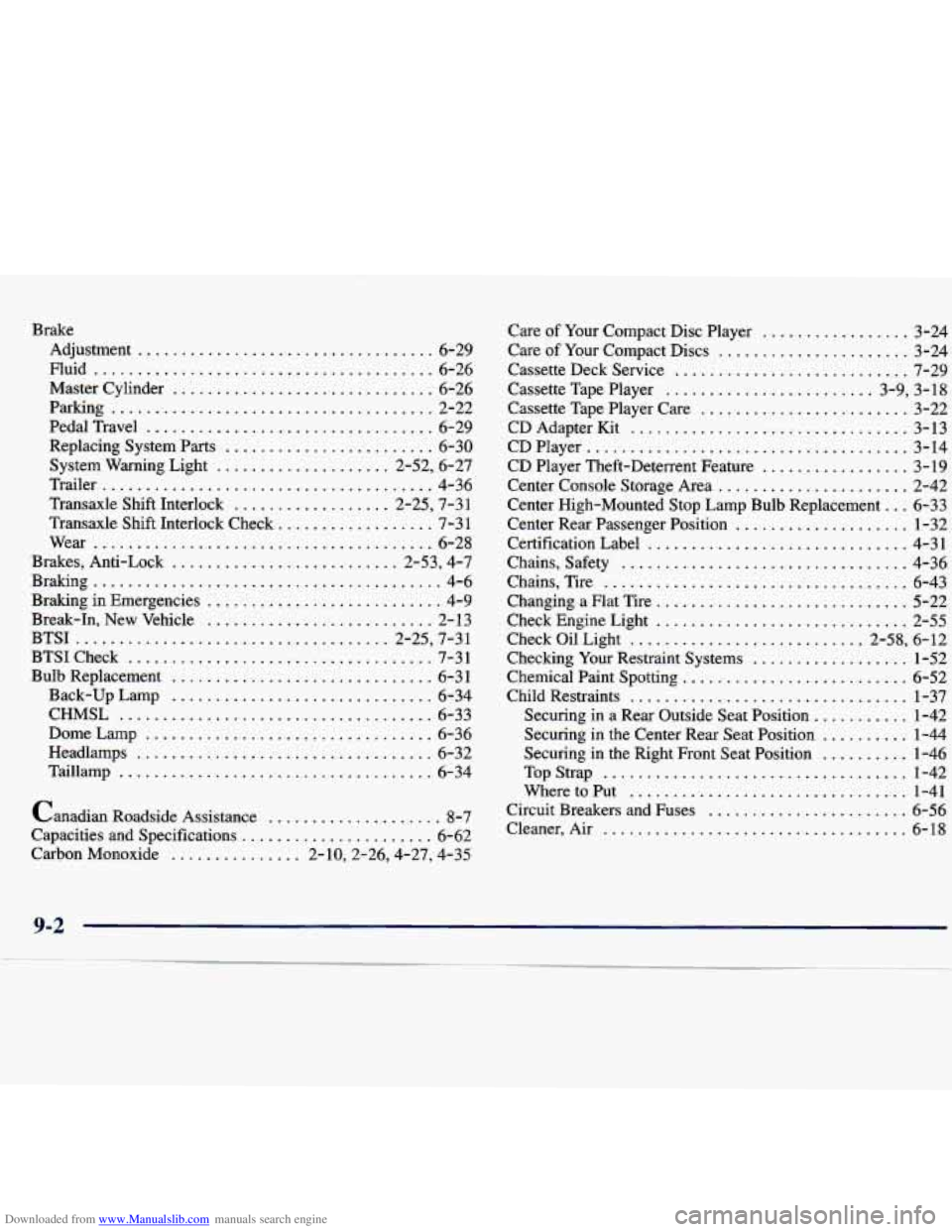
Downloaded from www.Manualslib.com manuals search engine Brake Adjustment
.................................. 6-29
Fluid
....................................... 6-26
Master Cylinder
.............................. 6-26
Parking
..................................... 2-22
Pedal Travel
................................. 6-29
Replacing System Parts
........................ 6-30
System Warning Light
.................... 2-52, 6-27
Trailer
...................................... 4-36
Transaxle Shift Interlock
.................. 2-25, 7-31
Transaxle Shift Interlock Check
.................. 7-3 1
Wear
....................................... 6-28
Brakes, Anti-Lock
.......................... 2-53, 4-7
Braking
........................................ 4-6
Braking
in Emergencies ........................... 4-9
Break-In, New Vehicle
.......................... 2- 13
BTSI
.................................... 2-25, 7-31
BTSICheck
................................... 7-31
Bulb Replacement
.............................. 6-3 1
Back-up Lamp
.............................. 6-34
Dome Lamp
................................. 6-36
Headlamps
.................................. 6-32
CHMSL
.................................... 6-33
Taillamp
.................................... 6-34
Canadian Roadside Assistance
.................... 8-7
Capacities and Specifications
...................... 6-62
Carbon Monoxide
............... 2.10.2.26.4.27. 4.35 Care
of Your
Compact Disc Player ................. 3-24
Care of Your Compact Discs
...................... 3-24
Cassette Deck Service
........................... 7-29
Cassette Tape Player
........................ 3.9, 3.18
Cassette Tape Player Care
........................ 3-22
CD Adapter Kit
................................ 3-13
CDPlayer
..................................... 3-14
CD Player Theft-Deterrent Feature
................. 3-19
Center Console Storage Area
...................... 2-42
Center High-Mounted Stop Lamp Bulb Replacement
... 6-33
Center Rear Passenger Position
.................... 1-32
Certification Label
.............................. 4-31
Chains. Safety
................................. 4-36
Chains. Tire
................................... 6-43
Changing a Flat Tire
............................. 5-22
Check Engine Light
............................. 2-55
Check Oil Light
........................... 2-58. 6-12
Checking Your Restraint Systems
.................. 1-52
Chemical Paint Spotting
.......................... 6-52
Child Restraints
................................ 1-37
Securing in a Rear Outside Seat Position
........... 1-42
Securing in the Center Rear Seat Position
.......... 1-44
Securing
in the Right Front Seat Position .......... 1-46
TopStrap
................................... 1-42
Wheretoput
................................ 1-41
Circuit Breakers and Fuses
....................... 6-56
Cleaner. Air
................................... 6-18
Page 353 of 362
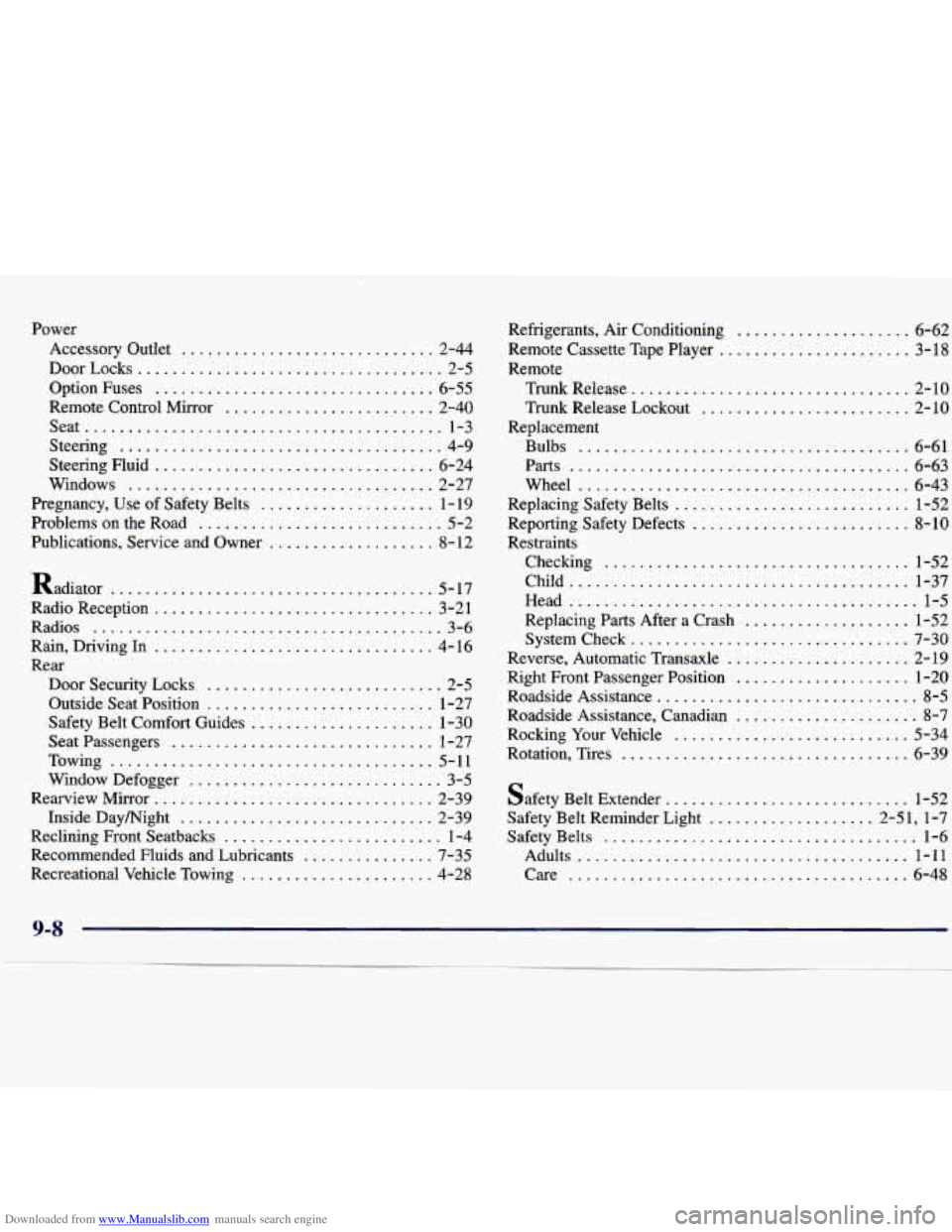
Downloaded from www.Manualslib.com manuals search engine Power Accessory Outlet
............................. 2-44
DoorLocks
................................... 2-5
Option Fuses
................................ 6-55
Remote Control Mirror
........................ 2-40
Seat
......................................... 1-3
Steering
..................................... 4-9
Steering Fluid
................................ 6-24
Windows
................................... 2-27
Pregnancy. Use of Safety Belts
.................... 1 - 19
Problems on the Road
............................ 5-2
Publications. Service and Owner
................... 8-12
Radiator
..................................... 5 . 17
Radio Reception
................................ 3-21
Rain. Driving
In ................................ 4- 16
Door Security Locks
........................... 2-5
Outside Seat Position
.......................... 1-27
Safety Belt Comfort Guides
..................... 1-30
Seatpassengers
.............................. 1-27
Radios
........................................ 3-6
Rear
Towing
..................................... 5-11
Window Defogger
............................. 3-5
Rearview Mirror
................................ 2-39
Reclining Front Seatbacks
......................... 1-4
Recommended Fluids and Lubricants
............... 7-35
Recreational Vehicle Towing
...................... 4-28
Inside
Daymight
............................. 2-39 Refrigerants. Air Conditioning
.................... 6-62
Remote Cassette Tape Player
...................... 3-18
Remote Trunk Release
................................ 2-10
Trunk Release Lockout ........................ 2-10
Bulbs
...................................... 6-61
Parts ....................................... 6-63
Wheel ...................................... 6-43
Replacement
Replacing Safety Belts
........................... 1-52
Reporting Safety Defects
......................... 8-10
Restraints Checking
................................... 1-52
Child
....................................... 1-37
Head
........................................ 1-5
Replacing Parts After a Crash
................... 1-52
Systemcheck
................................ 7-30
Reverse. Automatic Transaxle
..................... 2-19
Right Front Passenger Position
.................... 1-20
Roadside Assistance
.............................. 8-5
Roadside Assistance. Canadian
..................... 8-7
Rocking Your Vehicle
........................... 5-34
Rotation. Tires
................................. 6-39
Safety Belt Extender
............................ 1-52
Safety Belt Reminder Light
................... 2.51. 1-7
Safety Belts
.................................... 1-6
Adults ...................................... 1-11
Care ....................................... 6-48