check engine CHEVROLET MALIBU 1998 Owner's Guide
[x] Cancel search | Manufacturer: CHEVROLET, Model Year: 1998, Model line: MALIBU, Model: CHEVROLET MALIBU 1998Pages: 362, PDF Size: 19.35 MB
Page 187 of 362
Downloaded from www.Manualslib.com manuals search engine Safety Chains
You should always attach chains between your vehicle
and your trailer. Cross the safety chains under the tongue
of the trailer
so that the tongue will not drop to the road
if it becomes separated from the hitch. Instructions
about safety chains may be provided by the hitch
manufacturer or by the trailer manufacturer. Follow the
manufacturer’s recommendation for attaching safety
chains and do not attach them to the bumper. Always
leave just enough slack
so you can turn with your rig.
And, never allow safety chains to drag on the ground.
Trailer Brakes
Does your trailer have its own brakes?
Be sure to read and follow the instructions for the trailer
brakes
so you’ll be able to install, adjust and maintain
them properly. And because you have anti-lock brakes,
do not
try to tap into your vehicle’s brake system. If you
do, both systems won’t work well, or at all.
Driving with a Trailer
Towing a trailer requires a certain amount of experience.
Before setting out for the open road, you’ll want to get
to know your rig. Acquaint yourself with the feel of
handling and braking with the added weight
of the
trailer. And always keep in mind that the vehicle you are
driving is now a good deal longer and not nearly as
responsive as your vehicle is by itself.
Before you start, check the trailer hitch and platform (and attachments), safety chains, electrical connector,
lamps, tires and mirror adjustment. If the trailer has
electric brakes, start your vehicle and trailer moving and
then apply the trailer brake controller by hand to be sure the brakes are working.
This lets you check your
electrical connection at the same time.
During your trip, check occasionally to be sure that the
load is secure, and that the lamps and any trailer brakes are still working.
Page 189 of 362
Downloaded from www.Manualslib.com manuals search engine Turn Signals When Towing a Trailer
When you tow a trailer, your vehicle may need
additional wiring. Check with your dealer. The green
arrows on
your instrument panel will flash whenever
you signal a turn or lane change. Properly hooked up,
the trailer lamps will also flash, telling other drivers
you’re about to turn, change lanes
or stop.
When towing a trailer, the green arrows on your
instrument panel will flash for turns even
if the bulbs on
the trailer are burned out. Thus, you may think drivers
behind you are seeing your signal when they are not. It’s
important to check occasionally to be sure the trailer
bulbs are still working.
Driving On Grades
NOTICE:
Do not tow on steep continuous grades exceeding
6 miles (9.6 km). Extended, higher than normal
engine and transaxle temperatures may result and damage your vehicle. Frequent stops are
very important
to allow the engine and transaxle
to
cool.
Reduce speed and shift to a lower gear before you start
down a long
or steep downgrade. If you don’t shift
down, you might have to
use your brakes so much that
they would get hot and no longer work well.
On a long uphill grade, shift down and reduce your
speed to around
45 mph (70 km/h) to reduce the
possibility
of engine and transaxle overheating.
Pay attention to the engine coolant gage.
If the indicator
is in the red area, turn
off the air conditioning to reduce
engine load (see “Engine Overheating” in the Index).
Page 191 of 362
Downloaded from www.Manualslib.com manuals search engine Maintenance When Trailer Towing
Your vehicle will need service more often when you’re
pulling a trailer. See
the Maintenance Schedule for more
on this. Things that are especially important in trailer
operation are automatic transaxle fluid (don’t overfill),
engine oil, belt, cooling system and brake adjustment.
Each
of these is covered in this manual, and the Index
will help you find them quickly. If you’re trailering, it’s
a good idea to review these sections before you start
your trip.
Check periodically to see that all hitch nuts and bolts
are tight.
Engine Cooling When Trailer Towing
Your cooling system may temporarily overheat during
severe operating conditions. See “Engine Overheating”
in the Index.
Towing A Trailer
(Except
3100 V6 Engine)
Your vehicle is neither designed nor intended to tow
a trailer.
Page 194 of 362
Downloaded from www.Manualslib.com manuals search engine Jump Starting
If your battery has run down, you may want to use
another vehicle and some jumper cables to start your
vvehicle. But please follow the steps here
to do
it safely.
I
Batteries can hurt you. They can be dangerous
because:
0 They contain acid that can burn you.
0 They contain gas that can explode or ignite.
0 They contain enough electricity to
If you don’t follow these steps exactly, some or all
of these things can hurt you.
burn
you.
NOTICE:
Ignoring these steps could result in costly damage
to your vehicle that wouldn’t be covered by
your warranty.
Trying to
start your vehicle by pushing or pulling
it won’t work, and
it could damage your vehicle.
1. Check the other vehicle. It must have a 12-volt
battery with a negative ground system.
I NOTICE:
If the other system isn’t a 12-volt system with a
negative ground, both vehicles can be damaged.
Page 196 of 362
Downloaded from www.Manualslib.com manuals search engine 5. Find the positive (+) and negative (-) terminals on
each battery.
Using
a match near a battery can cause battery
gas to explode. People have been hurt doing this,
and some have been blinded. Use
a flashlight if
you need more light.
Be
sure the battery has enough water. You don’t
need to add water to the
AC Delco Freedom@
battery installed in every new
GM vehicle. But
if a battery has fiier caps, be sure the right
amount of fluid is there.
If it is low, add water to
take
care of that first. If you don’t, explosive gas
could be present.
Battery fluid contains acid that can burn you.
Don’t get
it on you. If you accidentally get it in
your eyes or on your skin, flush the place with
water and get medical help immediately.
6. Check that the jumper cables don’t have loose or
missing insulation.
If they do, you could get a shock.
The vehicles could be damaged, too. Before you
connect the cables, here are some things
you should
know. .Positive (+) will go to positive (+) and
negative
(-) will go to negative (-) or a metal engine
part. Don’t connect positive
(+) to negative (-) or
you’ll get
a short that would damage the battery and
maybe other parts, too.
Fans
or other moving engine parts can injure you
badly. Keep your hands away from moving parts
once the engine is running.
5-5
Page 208 of 362
Downloaded from www.Manualslib.com manuals search engine Heater and radiator hoses, and other engine
parts, can be
very hot. Don’t touch them. If you
do, you can be burned.
Don’t run the engine
if there is a leak. If you run
the engine, it could lose all coolant. That could
cause an engine fire, and you could be burned.
Get any leak fixed before you drive the vehicle.
NOTICE:
Engine damage from running your engine
without coolant isn’t covered by your warranty.
If there seems to be no leak, with the engine on, check to
see if the electric engine cooling fans are running.
If the
engine is overheating, both fans should be running.
If
they aren’t, your vehicle needs service.
How to Add Coolant to the Coolant
Surge Tank
If you haven’t found a problem yet, but the coolant level
isn’t at FULL COLD mark or slightly higher, add a
50/50 mixture of clean water (preferably distilled) and
DEX-COOL’ coolant at the coolant surge tank, but be
sure the cooling system, including the coolant surge tank
pressure cap, is cool before you do it. (See “Engine
Coolant” in the Index for more information.)
Steam and scalding liquids from a hot cooling
system can blow out and burn you badly. They
are under pressure, and if you turn the coolant
surge tank pressure cap
-- even a little -- they
can come out at high speed. Never turn the cap
when the cooling system, including the coolant
surge tank pressure cap, is hot. Wait for the
cooling system and coolant surge tank pressure
cap to cool if you ever have to turn the
pressure cap.
5-17
Page 212 of 362
Downloaded from www.Manualslib.com manuals search engine .. .
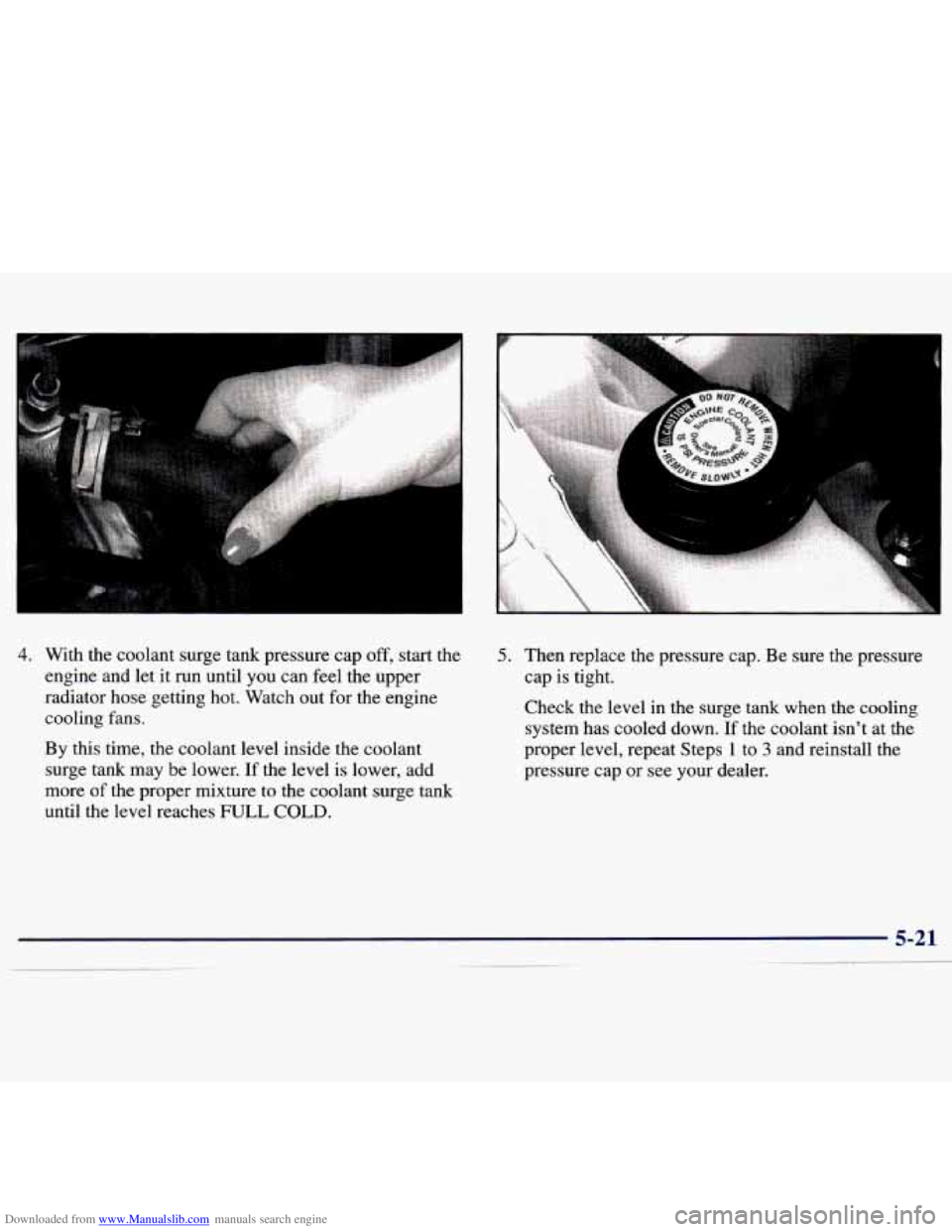
4. With the coolant surge tank pressure cap off, start the
engine and let it run until
you can feel the upper
radiator hose getting hot. Watch out for the engine
cooling fans.
By this time, the coolant level inside the coolant
surge
tank may be lower. If the level is lower, add
more of the proper mixture to the coolant surge tank
until the level reaches
FULL COLD.
5. Then replace the pressure cap. Be sure the pressure
cap
is tight.
Check the level in the surge tank when the
cooling
system has cooled down. If the coolant isn't at the
proper level, repeat Steps
1 to 3 and reinstall the
pressure cap or
see your dealer.
5-21
Page 223 of 362
Downloaded from www.Manualslib.com manuals search engine ‘F
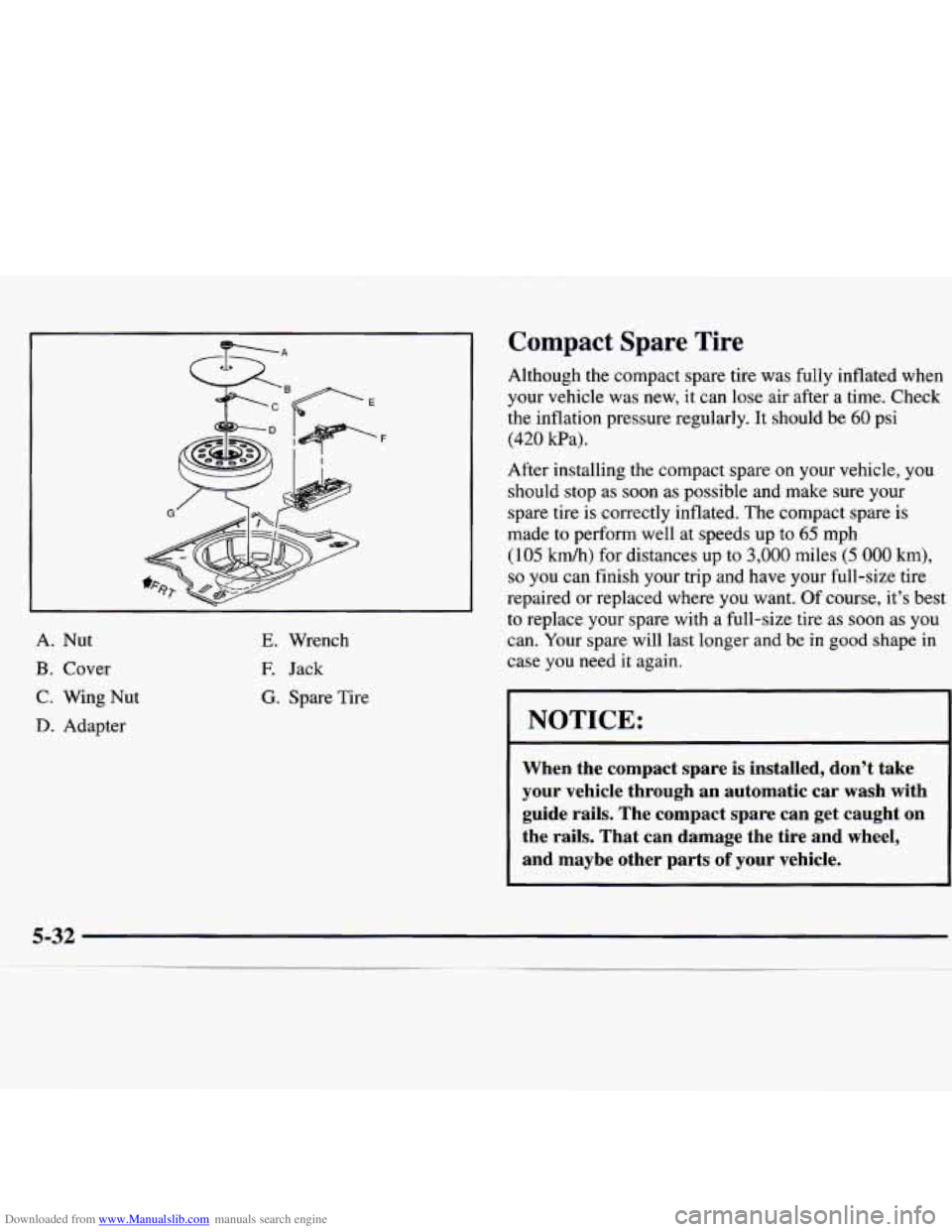
A. Nut
B. Cover
C. Wing Nut
D. Adapter
E. Wrench
E Jack
G. Spare Tire
Compact Spare Tire
Although the compact spare tire was fully inflated when
your vehicle was new, it can lose air after a time. Check
the inflation pressure regularly.
It should be 60 psi
(420 kPa).
After installing the compact spare on your vehicle, you
should stop as soon as possible and make sure your
spare tire is correctly inflated. The compact spare is
made to perform well at speeds up to 65 mph
(105 kdh) for distances up to
3,000 miles (5 000 km),
so you can finish your trip and have your full-size tire
repaired or replaced where you want. Of course, it’s best
to replace your spare with a full-size tire as soon as you
can. Your spare will last longer and be in good shape in
case you need it again.
I NOTICE:
When the compact spare is installed, don’t take
your vehicle through an automatic car wash with
guide rails. The compact spare can get caught on
the rails. That can damage the tire and wheel,
and maybe other parts
of your vehicle.
Page 226 of 362
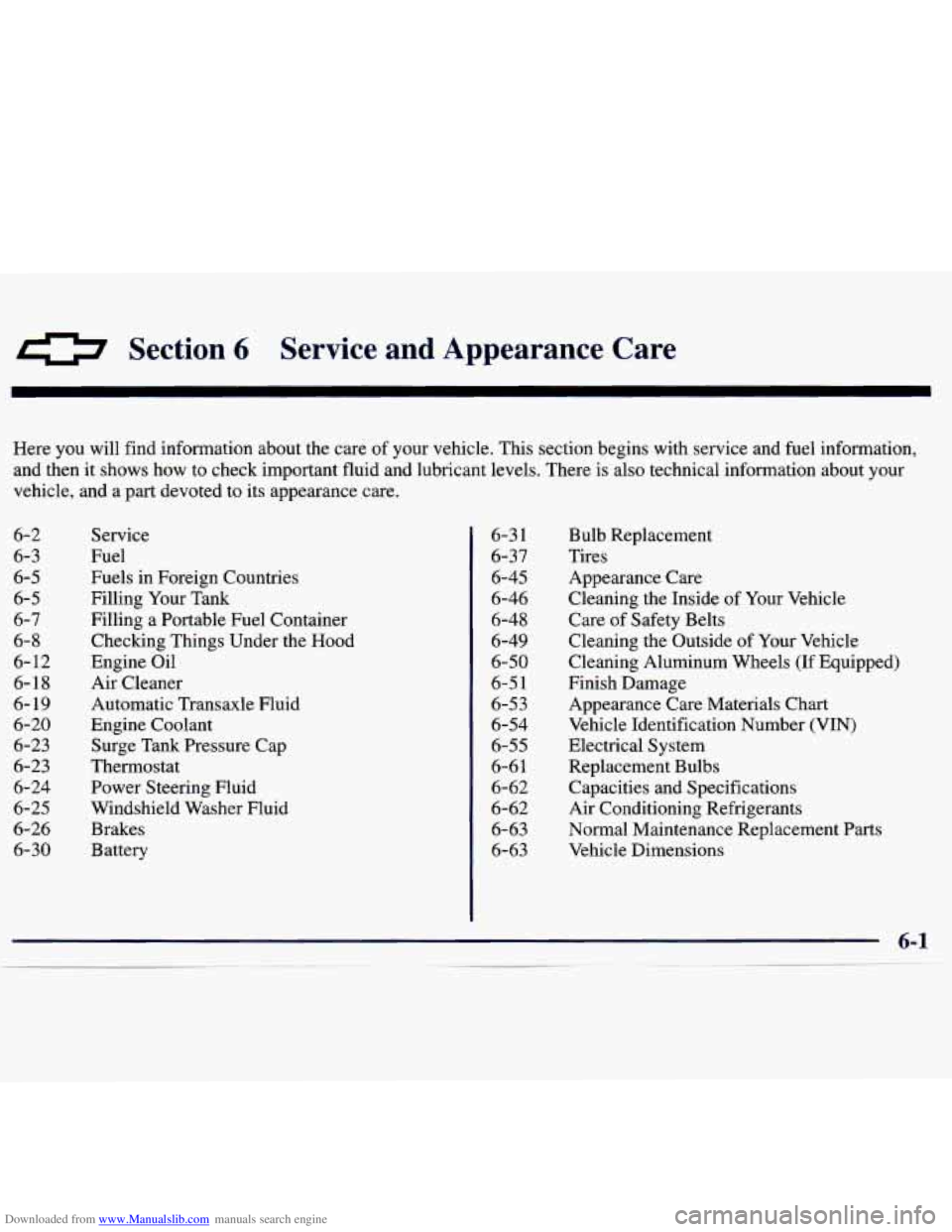
Downloaded from www.Manualslib.com manuals search engine Section 6 Service and Appearance Care
Here you will find information about the care of your vehicle. This section begins with service and fuel information,
and then it
shows how to check important fluid and lubricant levels. There is also technical information about your
vehicle, and a part devoted to its appearance care.
6-2
6-3
6-5
6- 5
6-7
6- 8
6- 12
6-18 6- 19
6-20
6-23
6-23
6-24
6-25
6- 26
6-30 Service
Fuel
Fuels in Foreign Countries
Filling Your Tank
Filling a Portable Fuel Container
Checking Things Under the Hood
Engine Oil
Air Cleaner
Automatic Transaxle Fluid
Engine Coolant
Surge Tank Pressure Cap
Thermostat
Power Steering Fluid
Windshield Washer Fluid
Brakes
Battery 6-3
1
6-37
6-45
6-46
6-48
6-49
6-50
6-5 1 6-53
6-54
6-55
6-6
1
6-62
6-62
6-63
6-63 Bulb Replacement
Tires Appearance Care
Cleaning the Inside of Your Vehicle
Care of Safety Belts
Cleaning the Outside of Your Vehicle
Cleaning Aluminum Wheels (If Equipped)
Finish Damage Appearance Care Materials Chart
Vehicle Identification Number (VIN)
Electrical System
Replacement Bulbs Capacities and Specifications
Air Conditioning Refrigerants
Normal Maintenance Replacement Parts
Vehicle Dimensions
Page 228 of 362
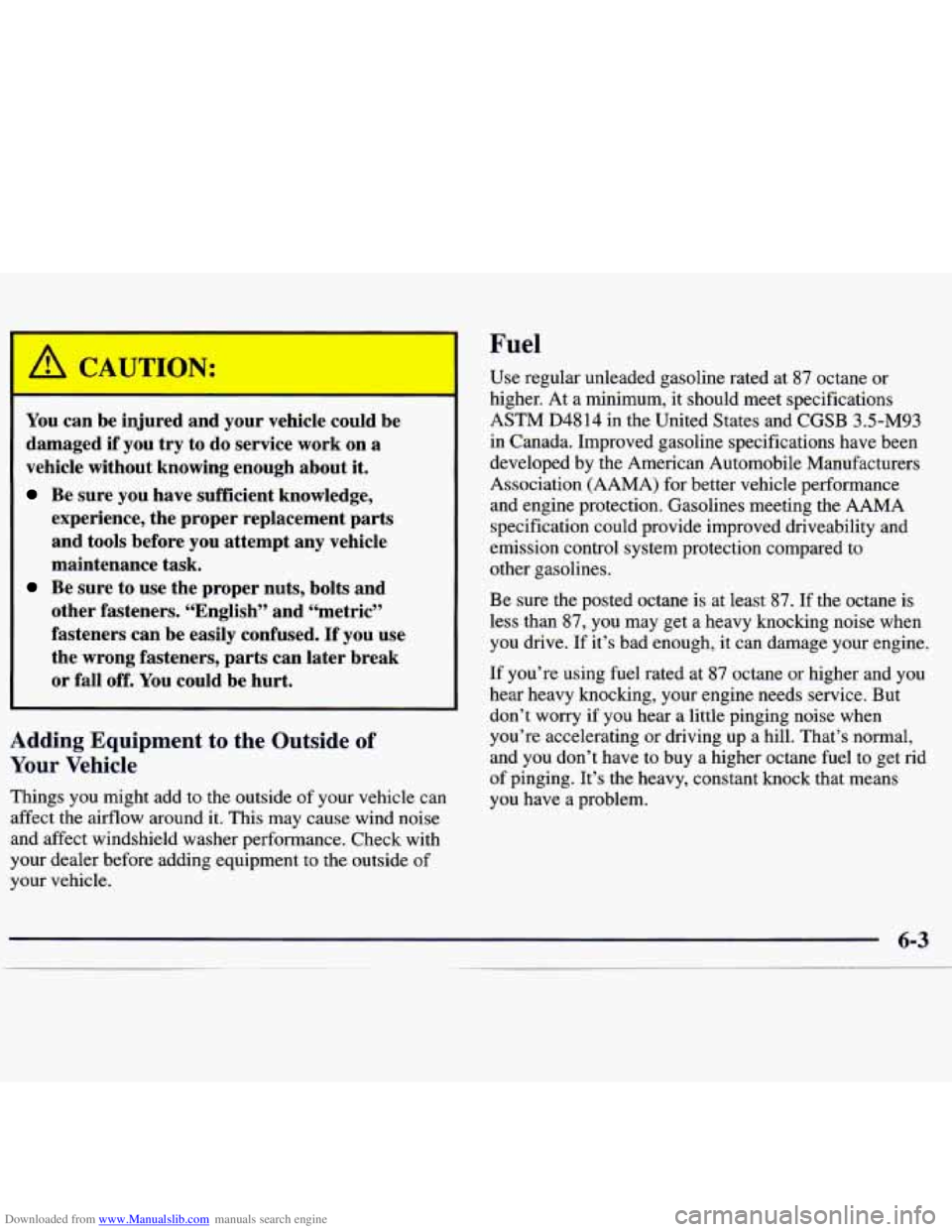
Downloaded from www.Manualslib.com manuals search engine Fuel
You can be injured and your vehicle could be
damaged
if you try to do service work on a
vehicle without knowing enough about
it.
Be sure you have sufficient knowledge,
experience, the proper replacement
parts
and tools before you attempt any vehicle
maintenance task.
Be sure to use the proper nuts, bolts and
other fasteners. “English” and “metric”
fasteners can be easily confused.
If you use
the wrong fasteners, parts can later break
or fall off. You could be hurt.
Adding Equipment to the Outside of
Your Vehicle
Things you might add to the outside of your vehicle can
affect the airflow around it. This may cause wind noise
and affect windshield washer performance. Check with
your dealer before adding equipment to the outside of
your vehicle. Use regular unleaded gasoline rated at 87 octane or
higher.
At a minimum, it should meet specifications
ASTM D4814 in the United States and CGSB 3.5-M93
in Canada. Improved gasoline specifications have been
developed by
the American Automobile Manufacturers
Association (AAMA) for better vehicle performance
and engine protection. Gasolines meeting the AAMA
specification could provide improved driveability and
emission control system protection compared to
other gasolines.
Be sure the posted octane
is at least 87. If the octane is
less than 87, you may get a heavy knocking noise when
you drive. If it’s bad enough,
it can damage your engine.
If you’re using fuel rated at 87 octane or higher and you
hear heavy knocking, your engine needs service. But
don’t worry
if you hear a little pinging noise when
you’re accelerating or driving up a hill. That’s normal,
and you don’t have to buy a higher octane fuel to get rid
of pinging. It’s the heavy, constant knock that means
you have a problem.