coolant temperature CHEVROLET MALIBU 1998 Owners Manual
[x] Cancel search | Manufacturer: CHEVROLET, Model Year: 1998, Model line: MALIBU, Model: CHEVROLET MALIBU 1998Pages: 362, PDF Size: 19.35 MB
Page 83 of 362
Downloaded from www.Manualslib.com manuals search engine To Use the Engine Coolant Heater
1. Turn off the engine.
2. Open the hood and unwrap the electrical cord.
3. Plug it into a normal, grounded 110-volt AC outlet.
Plugging the cord
i~ 1 an ungrounded outlet
could cause an electrical shock. Also, the wrong
kind
of extension cord could overheat and cause
a fire. You could be seriously injured. Plug the
cord into
a properly grounded three-prong
110-volt AC outlet.
If the cord won’t reach, use a
heavy-duty three-prong extension cord rated for
at least 15 amps.
4. Before starting the engine, be sure to unplug and store
the cord as it was before to keep it away from moving
engine
parts. If you don’t, it could be damaged.
How long should you keep the coolant heater plugged
in? The answer depends on the outside temperature, the
kind of oil you have, and some other things. Instead of
trying to list everything here, we ask that you contact
your dealer in the area where you’ll be parking your
vehicle. The dealer can give you the best advice for that
particular area.
Automatic Transaxle Operation
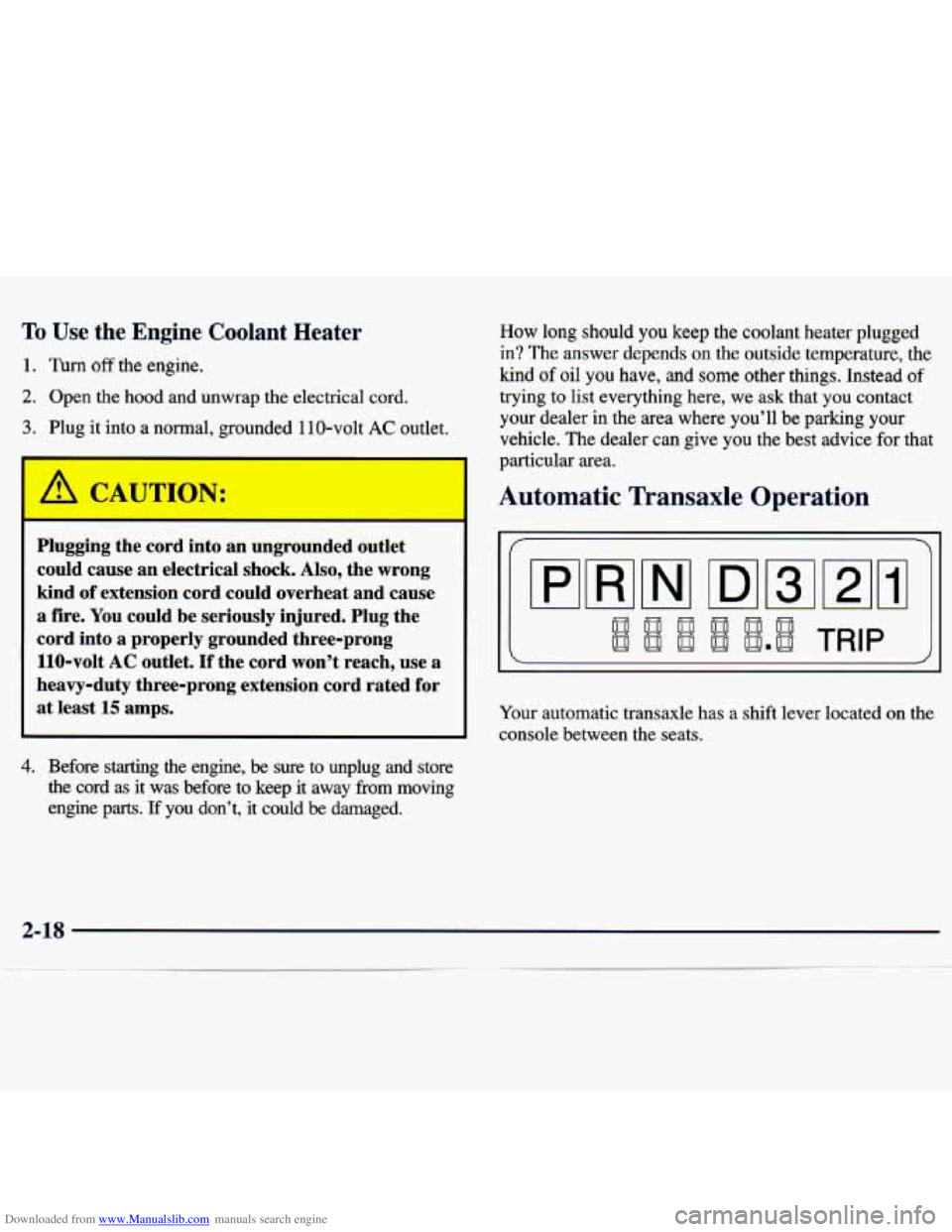
Your automatic transaxle has a shift lever located on the
console between the seats.
2-18
Page 119 of 362
Downloaded from www.Manualslib.com manuals search engine Engine Coolant Temperature Gage
0
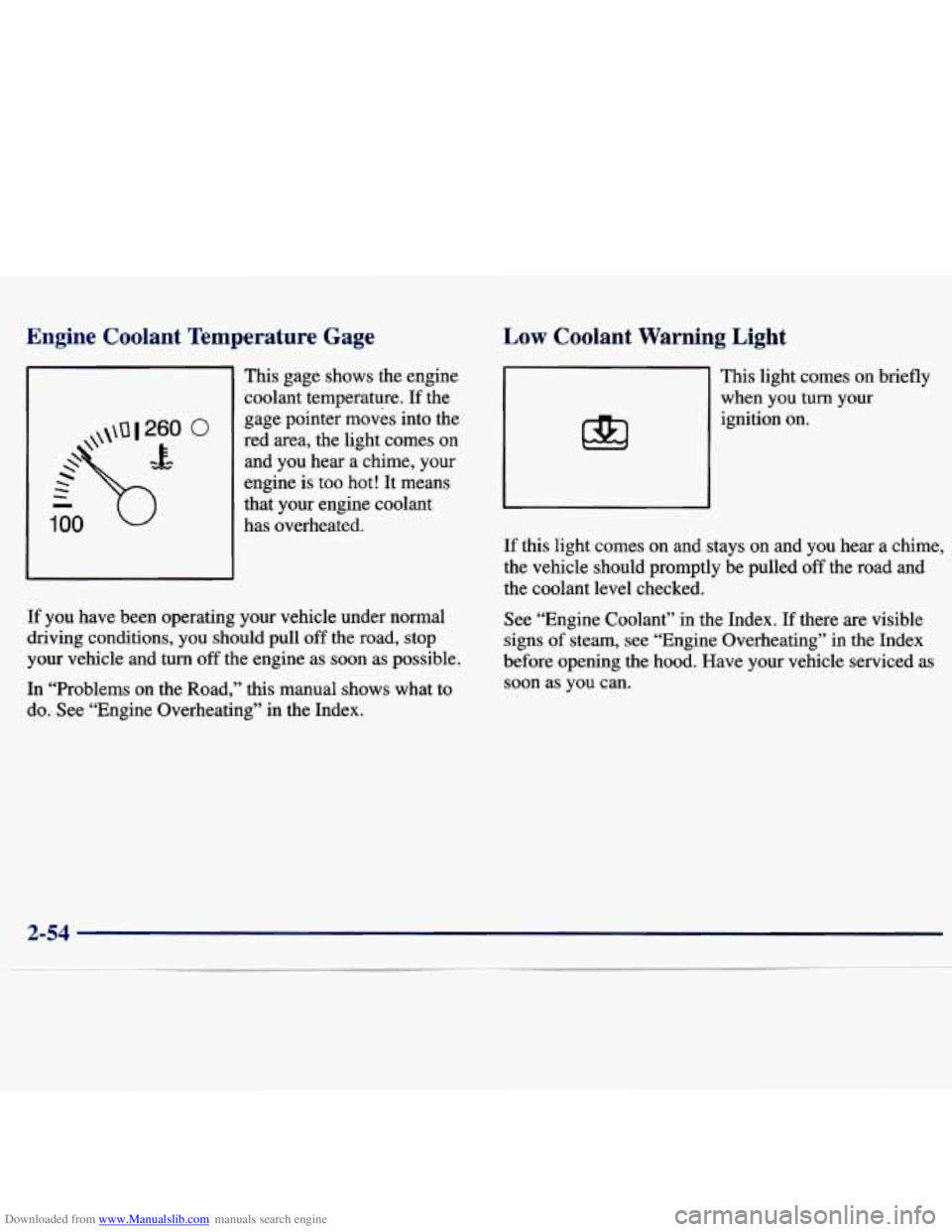
This gage shows the engine
coolant temperature.
If the
gage pointer moves into the
red area, the light comes on
and you hear a chime, your
engine is too hot! It means
that your engine coolant
has overheated.
If you have been operating your vehicle under normal driving conditions, you should pull
off the road, stop
your vehicle
and turn off the engine as soon as possible.
In “Problems on the Road,” this manual shows what to
do. See “Engine Overheating” in the Index.
Low Coolant Warning Light
&I This light comes on briefly
I when you turn your
If this light comes on and stays on and you hear a chime,
the vehicle should promptly be pulled off the road and
the coolant level checked.
See “Engine Coolant” in the Index. If there are visible
signs
of steam, see “Engine Overheating” in the Index
before opening the hood. Have your vehicle serviced as
soon as you can.
Page 131 of 362
Downloaded from www.Manualslib.com manuals search engine For quick cool-down on very hot days, use vent with the
temperature knob
all the way in the blue area and the
NC and recirculation buttons pressed. If this setting is
used for long periods of time, the air in your vehicle
may become too dry.
For normal cooling on hot days, use vent with the
temperature knob
in the blue area and the A/C button
pushed
in. The system will bring in outside air and cool it.
Heating
On cold days, use FLOOR and the outside air button
with the temperature knob all the way in the red area.
The system will bring in outside air, heat it and send it to
the floor outlets.
Your vehicle has heat ducts that are directed toward
the rear seat. Keep the area under the front seats clear
of obstructions
so the heated air can reach the rear
seat passengers.
If your vehicle has an engine coolant heater, you can
use it to help your system provide warm air faster when
it’s cold outside (0°F (-18°C) or lower). An engine
coolant heater wms the coolant your engine and
heating system uses to provide heat. See “Engine
Coolant Heater” in the Index.
Defogging and Defrosting Windows
Your system has two settings for clearing the front and
side windows. For each setting, adjust the temperature
control as desired.
To defrost the front window quickly, rotate the
temperature control knob all the way in the red area.
Use defrost and adjust the fan to the highest speed.
To warm passengers while keeping the front window
clean, use defog.
Your vehicle is equipped with side window defogger
vents. The side window defogger vents are located on
the outside of the side instrument panel vents.
To defrost
the side windows, rotate the temperature control knob
all
the way in the red area. Use FLOOR and adjust the
fan to the highest speed.
To control fogging of the
windows, rotate the temperature control knob all the
way in the red area. Use DEFOG and adjust the fan to
the highest speed.
To defog the side windows while using air conditioning,
use BI-LEVEL and adjust the fan to the highest speed and press the
A/C button. For additional airflow to the
side windows, aim the side vents toward the windows
and close the center vents.
Recirculation will not work in defrost and defog. This is
done to prevent recirculation of humid inside air and
allow the system to work properly.
3-4
Page 189 of 362
Downloaded from www.Manualslib.com manuals search engine Turn Signals When Towing a Trailer
When you tow a trailer, your vehicle may need
additional wiring. Check with your dealer. The green
arrows on
your instrument panel will flash whenever
you signal a turn or lane change. Properly hooked up,
the trailer lamps will also flash, telling other drivers
you’re about to turn, change lanes
or stop.
When towing a trailer, the green arrows on your
instrument panel will flash for turns even
if the bulbs on
the trailer are burned out. Thus, you may think drivers
behind you are seeing your signal when they are not. It’s
important to check occasionally to be sure the trailer
bulbs are still working.
Driving On Grades
NOTICE:
Do not tow on steep continuous grades exceeding
6 miles (9.6 km). Extended, higher than normal
engine and transaxle temperatures may result and damage your vehicle. Frequent stops are
very important
to allow the engine and transaxle
to
cool.
Reduce speed and shift to a lower gear before you start
down a long
or steep downgrade. If you don’t shift
down, you might have to
use your brakes so much that
they would get hot and no longer work well.
On a long uphill grade, shift down and reduce your
speed to around
45 mph (70 km/h) to reduce the
possibility
of engine and transaxle overheating.
Pay attention to the engine coolant gage.
If the indicator
is in the red area, turn
off the air conditioning to reduce
engine load (see “Engine Overheating” in the Index).
Page 203 of 362
Downloaded from www.Manualslib.com manuals search engine Engine Overheating
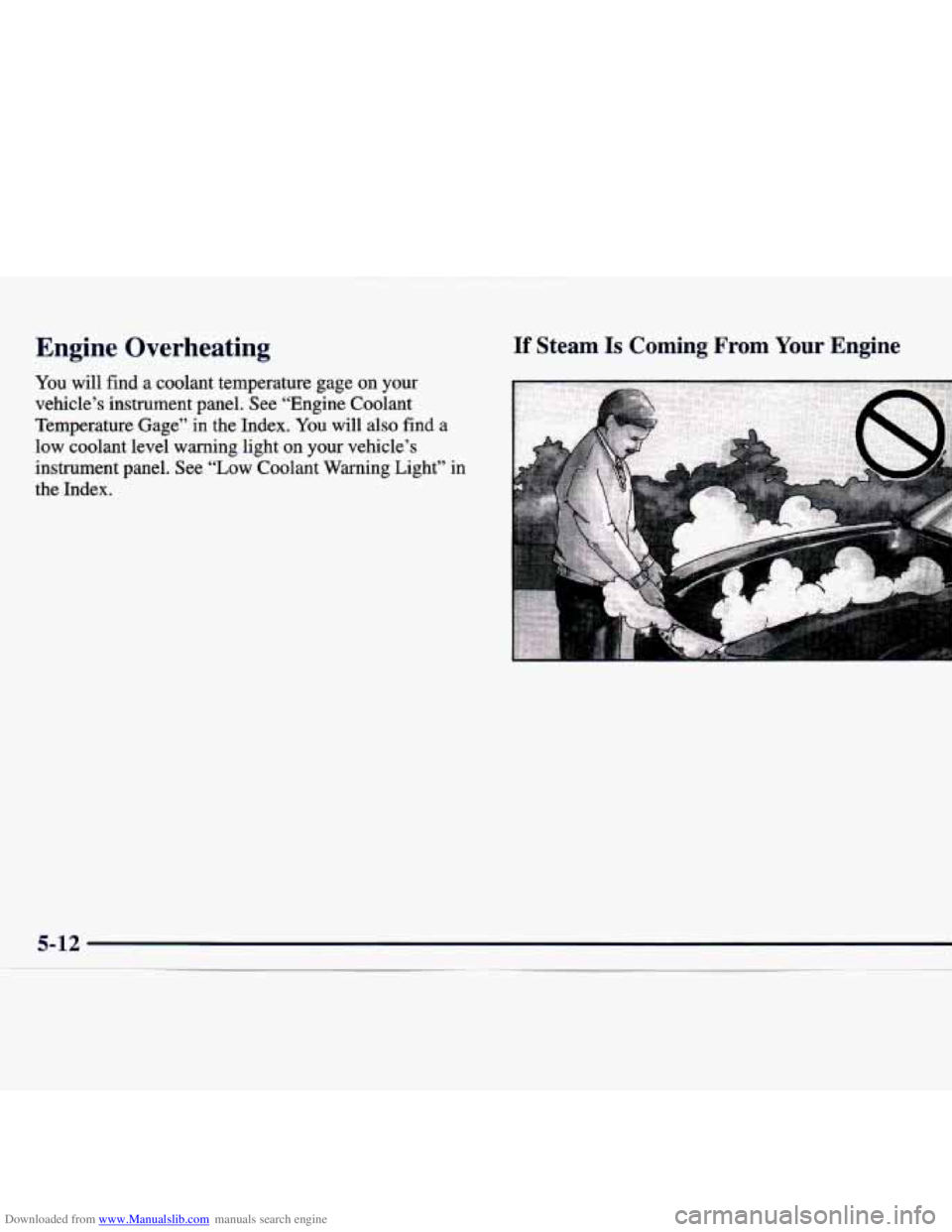
You will find a coolant temperature gage on your
vehicle’s instrument panel. See “Engine Coolant
Temperature Gage” in the Index.
You will also find a
low coolant level warning light on your vehicle’s
instrument panel. See
“Low Coolant Warning Light” in
the Index.
If Steam Is Coming From Your Engine
Page 245 of 362
Downloaded from www.Manualslib.com manuals search engine NOTICE:
-
We recommend you use only fluid labeled
DEXRON@-III, because
fluid with that label is
made especially for your automatic transaxle.
Damage caused by fluid other than DEXRON-III
is not covered by your new vehicle warranty.
Engine Coolant
The cooling s stem in your vehicle is filled with
DEX-COOL engine coolant.
This coolant is designed
to remain in your vehicle for 5 years or 150,000 miles
(240 000 km) whichever occurs first, if you add only
DEX-COOL’ extended life coolant.
The following explains your cooling system and how to
add coolant when it is low.
If you have a problem with
engine overheating, see “Engine Overheating” in
the Index.
8
A 50/50 mixture of water and DEX-COOL@ coolant wilk
0 Give freezing protection down to -34°F (-37’C).
0 Give boiling protection up to 265 OF ( 129 O C).
0 Protect against rust and corrosion.
0 Help keep the proper engine temperature.
0 Let the warning lights and gages work as they should.
~~
NOTICE:
When adding coolant, it is important that you
use only DEX-COOL@ (silicate-free) coolant.
If coolant other than DEX-COOL is added. to
the system, premature engine, heater core or
radiator corrosion may result.
In addition, the
engine coolant will require change sooner
-- at
30,000 miles (50 000 km) or 24 months,
whichever
occurs first. Damage caused by the
use of coolant other than DEX-COOL@ is not
covered by
your new vehicle warranty.
6-20 I
Page 248 of 362
Downloaded from www.Manualslib.com manuals search engine Adding Coolant
If you need more coolant, add the proper DEX-COOL'
coolant mixture at the surge tank, but only when the
engine
is cool.
/A C A UTION:
-
You can be burned if you spill coolant on hot
engine parts. Coolant contains ethylene glycol,
and
it will burn if the engine parts are hot
enough. Don't spill coolant on a hot engine.
When redacing the pressure cap, make sure it
is tight.
Surge Tank Pressure Cap
I NOTICE:
Your pressure cap is an 15 psi (105 kPa)
pressure-type cap and must be tightly installed to
prevent coolant loss and possible engine damage
from overheating.
When you replace your surge tank pressure cap, a
GM
cap is recommended.
Thermostat
Engine coolant temperature is controlled by a thermostat
in the engine coolant system. The thermostat stops the
flow of coolant through the radiator until the coolant
reaches a preset temperature.
When you replace your thermostat, an ACDelco@
thermostat
is recommended.
6-23
Page 250 of 362
Downloaded from www.Manualslib.com manuals search engine Windshield Washer Fluid
What to Use
When you need windshield washer fluid, be sure to read
the manufacturer’s instructions before use. If you will be
operating your vehicle in an area where the temperature
may fall below freezing, use a fluid that has sufficient
protection against freezing.
Adding Washer Fluid
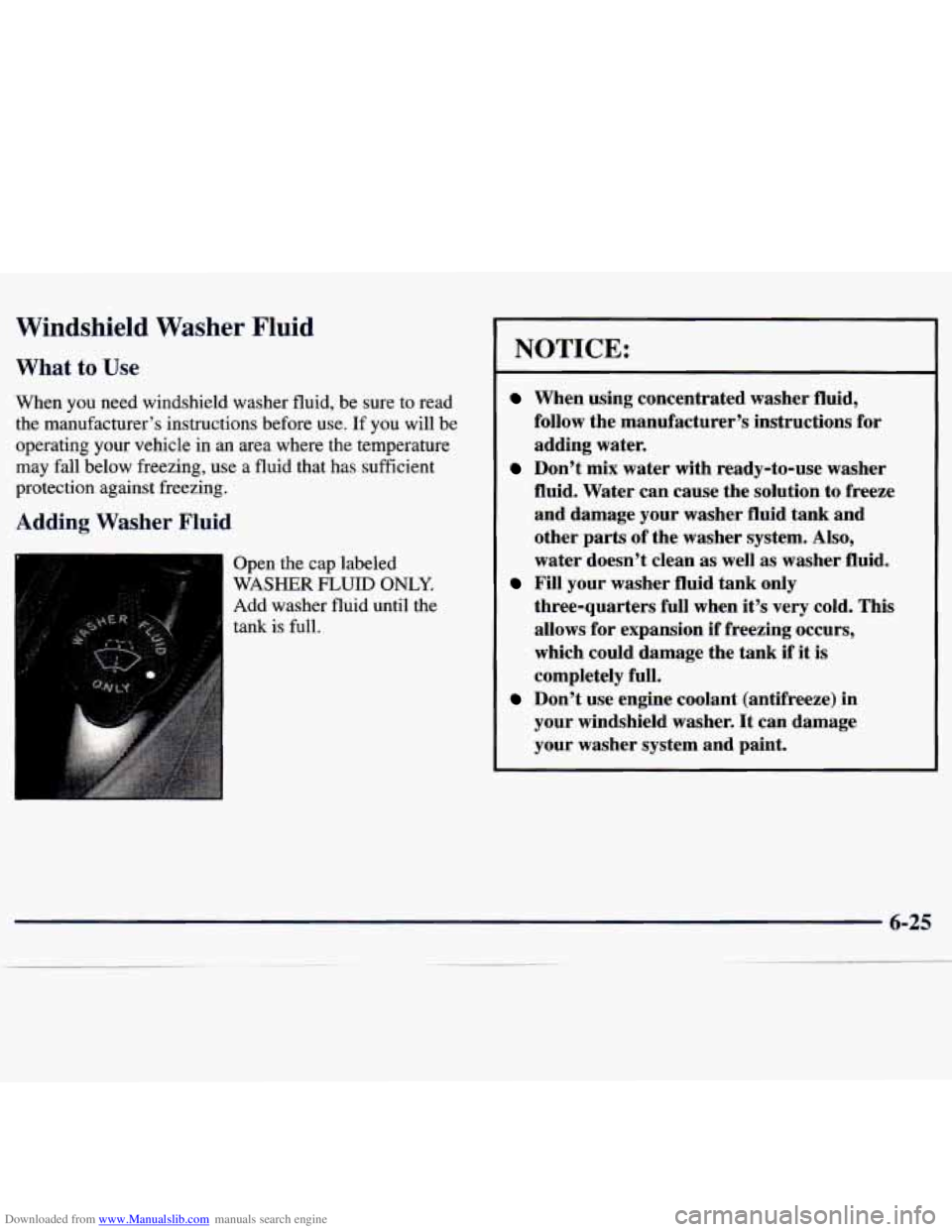
Open the cap labeled
WASHER
FLUID 0NL.Y.
Add washer fluid until the tank
is full.
NOTICE:
When using concentrated washer fluid,
follow the manufacturer’s instructions for
adding water.
Don’t mix water with ready-to-use washer
fluid. Water can cause the solution to freeze
and damage your washer fluid tank and
other parts of the washer system. Also,
water doesn’t clean
as well as washer fluid.
three-quarters full when
it’s very cold. This
allows for expansion if freezing occurs,
which could damage the tank if it is
completely full.
Don’t use engine coolant (antifreeze) in
your windshield washer.
It can damage
your washer system and paint.
Fill your washer fluid tank only
6-25
Page 350 of 362
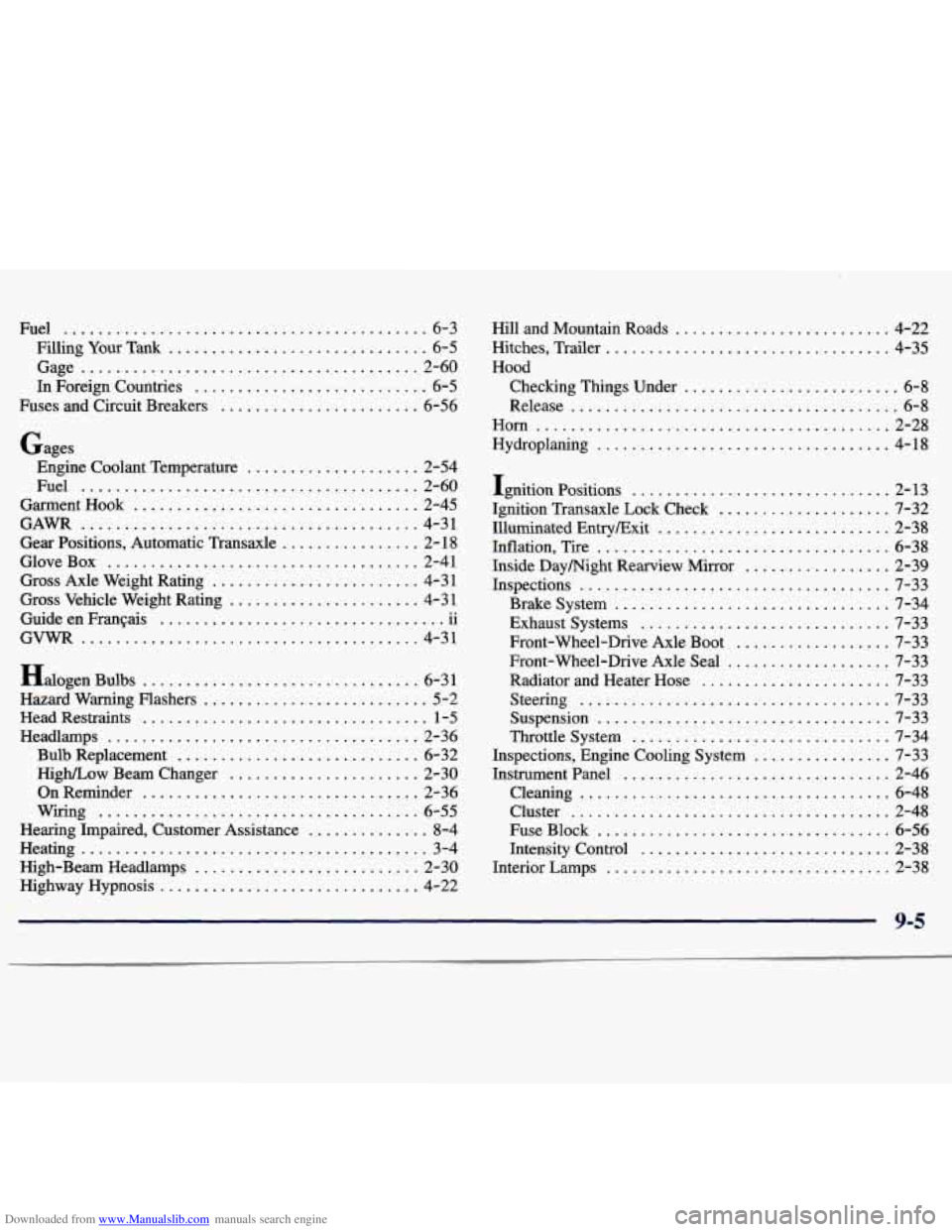
Downloaded from www.Manualslib.com manuals search engine Fuel .......................................... 6-3
FillingYourTank
.............................. 6-5
Gage
....................................... 2-60
In Foreign Countries ........................... 6-5
Fuses and Circuit Breakers
....................... 6-56
Gages Engine Coolant Temperature
.................... 2-54
Fuel
....................................... 2-60
GarmentHook
................................. 2-45
GAM
....................................... 4-31
Gear Positions. Automatic Transaxle
................ 2- 18
GloveBox
.................................... 2-41
Gross Axle Weight Rating
........................ 4-31
Gross Vehicle Weight Rating
...................... 4-31
Guide en Francais
u
GVWR ....................................... 4-31
.. .................................
Halogen Bulbs ................................ 6-31
Hazard Warning Flashers
.......................... 5-2
Head Restraints
................................. 1-5
Headlamps .................................... 2-36
Bulb Replacement
............................ 6-32
High/Low Beam Changer
...................... 2-30
OnReminder
................................ 2-36
Wiring
..................................... 6-55
Hearing Impaired. Customer Assistance
.............. 8-4
Heating
........................................ 3-4
High-BeamHeadlamps
.......................... 2-30
Highway Hypnosis
.............................. 4-22 HillandMountainRoads
......................... 4-22
Hitches. Trailer
................................. 4-35
Hood Checking Things Under
......................... 6-8
Release
...................................... 6-8
Horn
......................................... 2-28
Hydroplaning
.................................. 4-18
Ignition Positions
..............
Ignition Transaxle Lock Check ....
Illuminated Entryfixit ...........
Inflation. Tire ..................
Inside Daymight Rearview Mirror .
Inspections ....................
Brake System ................
Exhaust Systems .............
Front-Wheel-Drive Axle Boot . .
Front-Wheel-Drive Axle Seal ...
Radiator and Heater Hose ......
Steering ....................
Suspension ..................
Throttle System ..............
Inspections. Engine Cooling System
Instrument Panel
...............
Cleaning ....................
Cluster .....................
Fuse Block ..................
Intensity Control .............
Interior Lamps .................
................ 2-13
................ 7-32
................ 2-38
................ 6-38
................ 2-39
................ 7-33
................ 7-34
................ 7-33
................ 7-33
................ 7-33
................ 7-33
................ 7-33
................ 7-33
................ 7-34
................ 7-33
................ 2-46
................ 6-48
................ 2-48
................ 6-56
................ 2-38
................ 2-38
Page 355 of 362
Downloaded from www.Manualslib.com manuals search engine Speech Impaired. Customer Assistance ............... 8-4
Speedometer
................................... 2-49
SRS ......................................... 1-20
Stains, Cleaning
................................ 6-46
Starter Switch Check
............................ 7-3 1
Starting Your Engine
............................ 2- 14
Steam
........................................ 5-12
Steering
....................................... 4-9
In Emergencies
............................... 4- 10
Power
....................................... 4-9
Tips
......................................... 4-9
Wheel, Tilt
.................................. 2-28
Storage Compartments
........................... 2-41
Storage, Vehicle
................................ 6-30
Stuck:
In Sand, Mud, Ice or Snow .................. 5-33
Sun Visors
.................................... 2-44
Sunroof
....................................... 2-45
Supplemental Restraint System
.................... 1-20
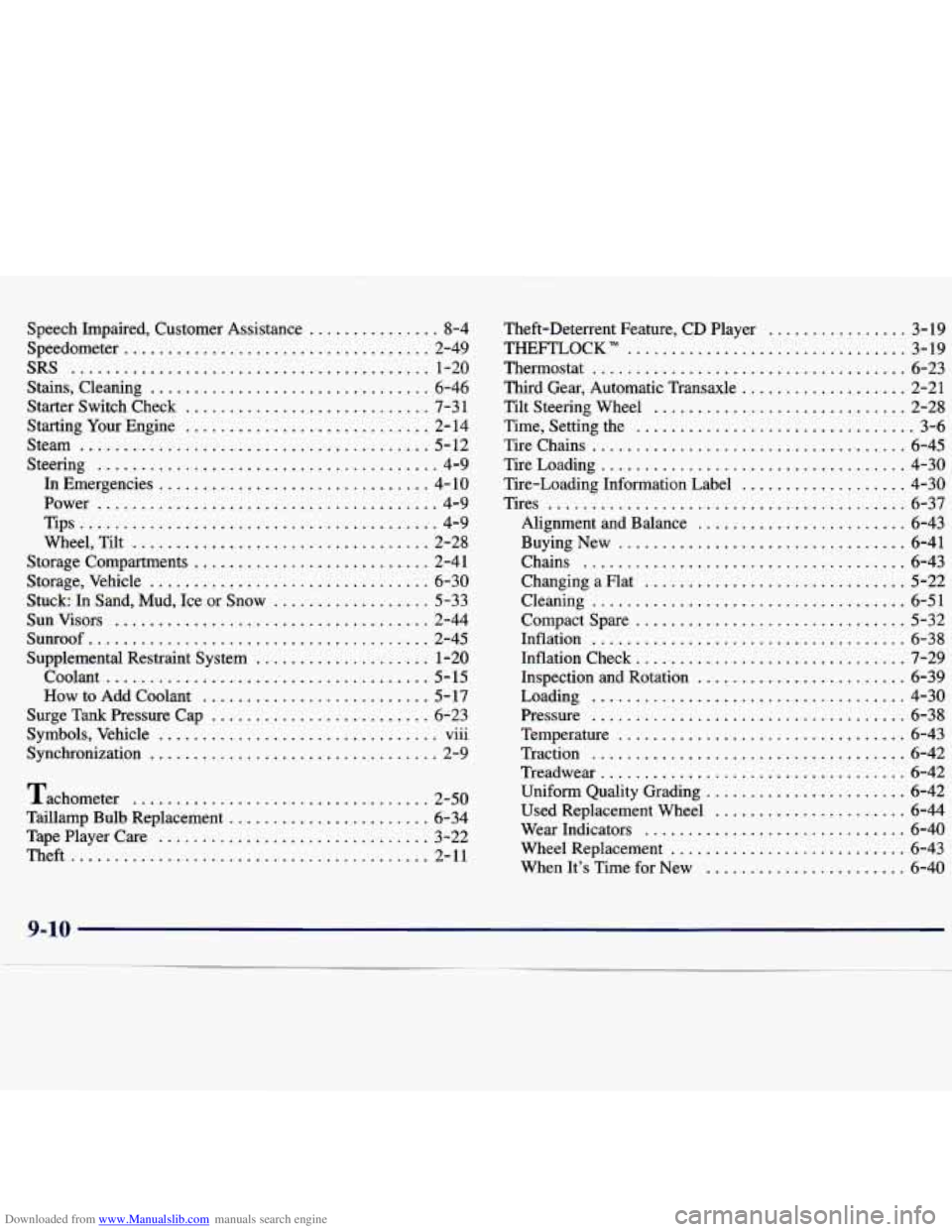
Coolant
..................................... 5-15
How to Add Coolant
.......................... 5-17
Surge Tank Pressure Cap
......................... 6-23
Symbols, Vehicle
................................ vm
Synchronization ................................. 2-9
...
Tachometer .................................. 2-50
Taillamp Bulb Replacement
....................... 6-34
TapePlayerCare
............................... 3-22
Theft
......................................... 2-11 Theft-Deterrent Feature.
CD Player ................ 3-19
Thermostat
.................................... 6-23
Third Gear. Automatic Transaxle
................... 2-21
Tilt Steering Wheel
............................. 2-28
Time. Setting the
................................. 3-6
Tire Chains
.................................... 6-45
TireLoading
................................... 4-30
Tire-Loading Information Label
................... 4-30
Tires
......................................... 6-37
Alignment and Balance
........................ 6-43
BuyingNew
................................. 6-41
Chains
..................................... 6-43
ChangingaFlat
.............................. 5-22
Cleaning
.................................... 6-51
Compact Spare
............................... 5-32
Inflation
.................................... 6-38
Inflation Check ............................... 7-29
Inspection and Rotation
........................ 6-39
Loading
.................................... 4-30
Pressure
.................................... 6-38
Temperature
................................. 6-43
Traction
.................................... 6-42
Treadwe
ar ................................... 6-42
Uniform Quality Grading
....................... 6-42
Used Replacement Wheel
...................... 6-44
Wear Indicators
.............................. 6-40
Wheel Replacement
........................... 6-43
When It’s Time for New
....................... 6-40
THEFTLOCK
................................ 3-19
9-10