ECU CHEVROLET MALIBU 2003 5.G Owner's Manual
[x] Cancel search | Manufacturer: CHEVROLET, Model Year: 2003, Model line: MALIBU, Model: CHEVROLET MALIBU 2003 5.GPages: 326, PDF Size: 2.41 MB
Page 75 of 326

Emergency Trunk Release Handle
Notice:The emergency trunk release handle is not
designed to be used to tie down the trunk lid or
as an anchor point when securing items in the trunk.
Improper use of the emergency trunk release
handle could damage it.
There is a glow-in-the-dark emergency trunk release
handle located inside the trunk on the trunk latch. This
handle will glow following exposure to light. Pull the
release handle up to open the trunk from the inside.
Trap-Resistant Trunk Kit
To help prevent a child from becoming trapped in your
trunk, you can order a trap-resistant trunk kit from
your dealer. This kit includes:
·a modi®ed trunk latch,
·a lighted release handle, and
·seatback tethers (for vehicles with folding rear
seatbacks).
See your dealer for additional information.
2-13
Page 177 of 326
Winter Driving
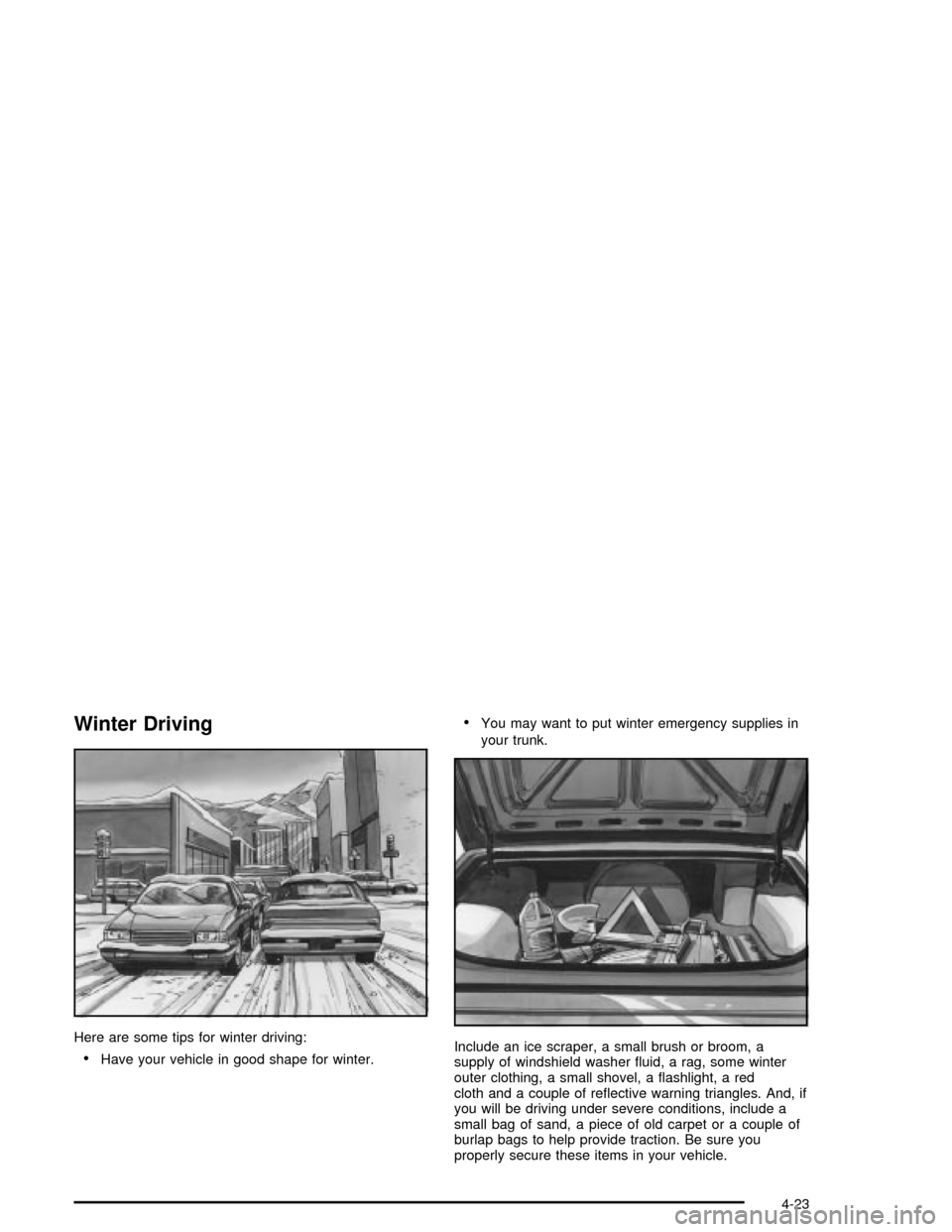
Here are some tips for winter driving:
·Have your vehicle in good shape for winter.
·You may want to put winter emergency supplies in
your trunk.
Include an ice scraper, a small brush or broom, a
supply of windshield washer ¯uid, a rag, some winter
outer clothing, a small shovel, a ¯ashlight, a red
cloth and a couple of re¯ective warning triangles. And, if
you will be driving under severe conditions, include a
small bag of sand, a piece of old carpet or a couple of
burlap bags to help provide traction. Be sure you
properly secure these items in your vehicle.
4-23
Page 183 of 326

With the proper preparation and equipment, many
vehicle can be towed in these ways. See ªDinghy
Towingº and ªDolly Towingº, following.
Here are some important things to consider before you
do recreational vehicle towing:
·What's the towing capacity of the towing vehicle?
Be sure you read the tow vehicle manufacturer's
recommendations.
·How far will you tow? Some vehicles have
restrictions on how far and how long they can tow.
·Do you have the proper towing equipment?
See your dealer or trailering professional for
additional advice and equipment recommendations.
·Is your vehicle ready to be towed? Just as you
would prepare your vehicle for a long trip, you'll
want to make sure your vehicle is prepared to be
towed. See
Before Leaving on a Long Trip on
page 4-20.
Dinghy Towing
To tow your vehicle with all four wheels on the ground,
follow these steps:
1. Position the vehicle to tow and then secure it.
2. Turn the ignition switch to OFF.
3. Set the parking brake.
4-29
Page 187 of 326
{CAUTION:
Do not load your vehicle any heavier than the
GVWR, or either the maximum front or rear
GAWR. If you do, parts on your vehicle can
break, and it can change the way your vehicle
handles. These could cause you to lose
control and crash. Also, overloading can
shorten the life of your vehicle.
{CAUTION:
Things you put inside your vehicle can strike
and injure people in a sudden stop or turn, or
in a crash.
·Put things in the trunk of your vehicle. In a
trunk, put them as far forward as you can.
Try to spread the weight evenly.
·Never stack heavier things, like suitcases,
inside the vehicle so that some of them
are above the tops of the seats.
·Do not leave an unsecured child restraint
in your vehicle.
·When you carry something inside the
vehicle, secure it whenever you can.
·Do not leave a seat folded down unless
you need to.
4-33
Page 192 of 326

Before you start, check the trailer hitch and platform
(and attachments), safety chains, electrical connector,
lamps, tires and mirror adjustment. If the trailer has
electric brakes, start your vehicle and trailer moving and
then apply the trailer brake controller by hand to be
sure the brakes are working. This lets you check your
electrical connection at the same time.
During your trip, check occasionally to be sure that the
load is secure, and that the lamps and any trailer
brakes are still working.
Following Distance
Stay at least twice as far behind the vehicle ahead as
you would when driving your vehicle without a trailer.
This can help you avoid situations that require
heavy braking and sudden turns.
Passing
You'll need more passing distance up ahead when
you're towing a trailer. And, because you're a good deal
longer, you'll need to go much farther beyond the
passed vehicle before you can return to your lane.
Backing Up
Hold the bottom of the steering wheel with one hand.
Then, to move the trailer to the left, just move that hand
to the left. To move the trailer to the right, move your
hand to the right. Always back up slowly and, if possible,
have someone guide you.
Making Turns
Notice:Making very sharp turns while trailering
could cause the trailer to come in contact with the
vehicle. Your vehicle could be damaged. Avoid
making very sharp turns while trailering.
When you're turning with a trailer, make wider turns than
normal. Do this so your trailer won't strike soft shoulders,
curbs, road signs, trees or other objects. Avoid jerky or
sudden maneuvers. Signal well in advance.
Turn Signals When Towing a Trailer
When you tow a trailer, your vehicle may need additional
wiring. Check with your dealer. The arrows on your
instrument panel will ¯ash whenever you signal a turn or
lane change. Properly hooked up, the trailer lamps
will also ¯ash, telling other drivers you're about to turn,
change lanes or stop.
4-38
Page 241 of 326
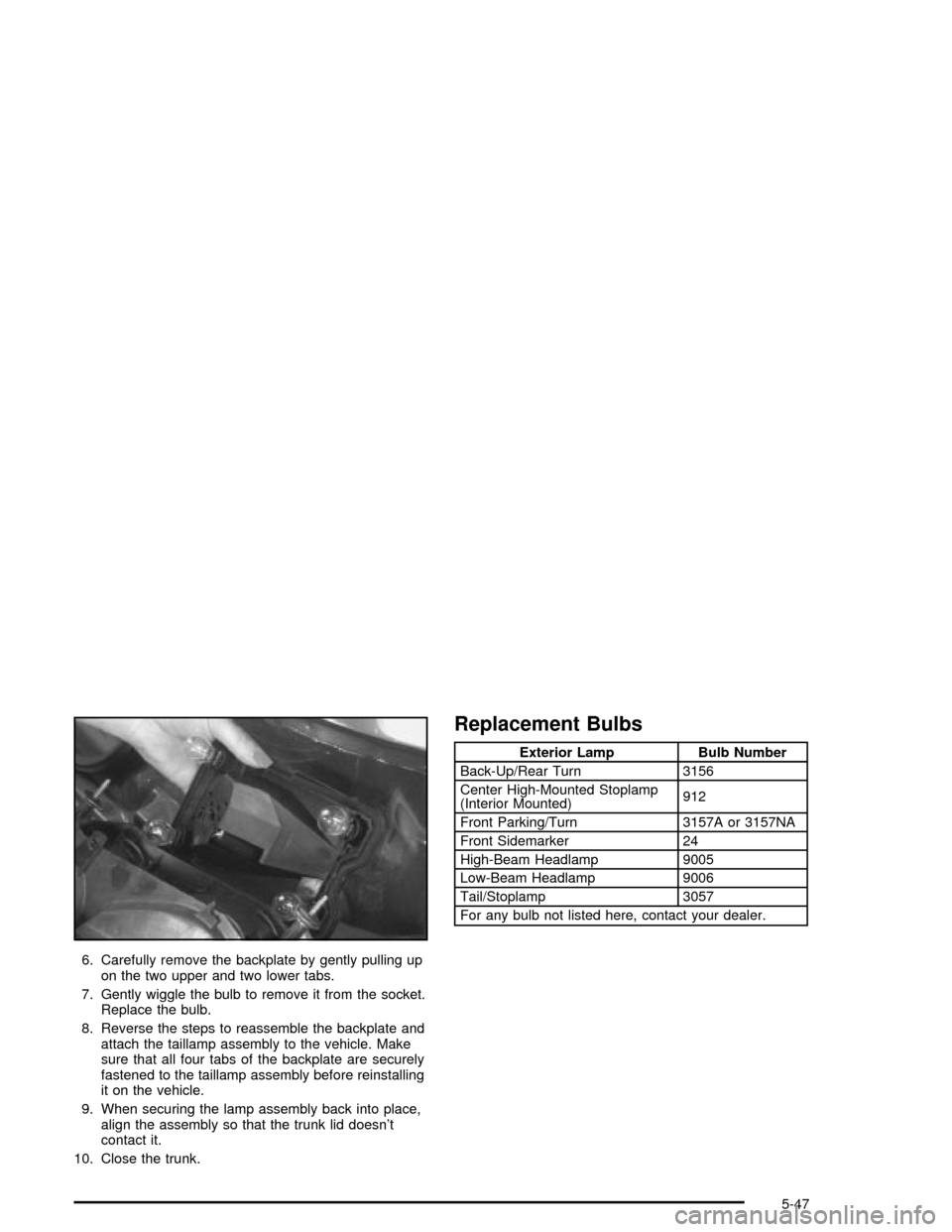
6. Carefully remove the backplate by gently pulling up
on the two upper and two lower tabs.
7. Gently wiggle the bulb to remove it from the socket.
Replace the bulb.
8. Reverse the steps to reassemble the backplate and
attach the taillamp assembly to the vehicle. Make
sure that all four tabs of the backplate are securely
fastened to the taillamp assembly before reinstalling
it on the vehicle.
9. When securing the lamp assembly back into place,
align the assembly so that the trunk lid doesn't
contact it.
10. Close the trunk.
Replacement Bulbs
Exterior Lamp Bulb Number
Back-Up/Rear Turn 3156
Center High-Mounted Stoplamp
(Interior Mounted)912
Front Parking/Turn 3157A or 3157NA
Front Sidemarker 24
High-Beam Headlamp 9005
Low-Beam Headlamp 9006
Tail/Stoplamp 3057
For any bulb not listed here, contact your dealer.
5-47
Page 249 of 326
{CAUTION:
Using the wrong replacement wheels, wheel
bolts or wheel nuts on your vehicle can be
dangerous. It could affect the braking and
handling of your vehicle, make your tires lose
air and make you lose control. You could have
a collision in which you or others could be
injured. Always use the correct wheel, wheel
bolts and wheel nuts for replacement.
Notice:The wrong wheel can also cause problems
with bearing life, brake cooling, speedometer or
odometer calibration, headlamp aim, bumper height,
vehicle ground clearance and tire or tire chain
clearance to the body and chassis.
See
Changing a Flat Tire on page 5-57for more
information.
Used Replacement Wheels
{CAUTION:
Putting a used wheel on your vehicle is
dangerous. You can't know how it's been used
or how far it's been driven. It could fail suddenly
and cause a crash. If you have to replace a
wheel, use a new GM original equipment wheel.
Tire Chains
Notice:Use tire chains only where legal and only
when you must. Use only SAE Class ªSº type chains
that are the proper size for your tires. Install them
on the front tires and tighten them as tightly as
possible with the ends securely fastened. Drive
slowly and follow the chain manufacturer's
instructions. If you can hear the chains contacting
your vehicle, stop and retighten them. If the contact
continues, slow down until it stops. Driving too
fast or spinning the wheels with chains on will
damage your vehicle.
5-55
Page 259 of 326
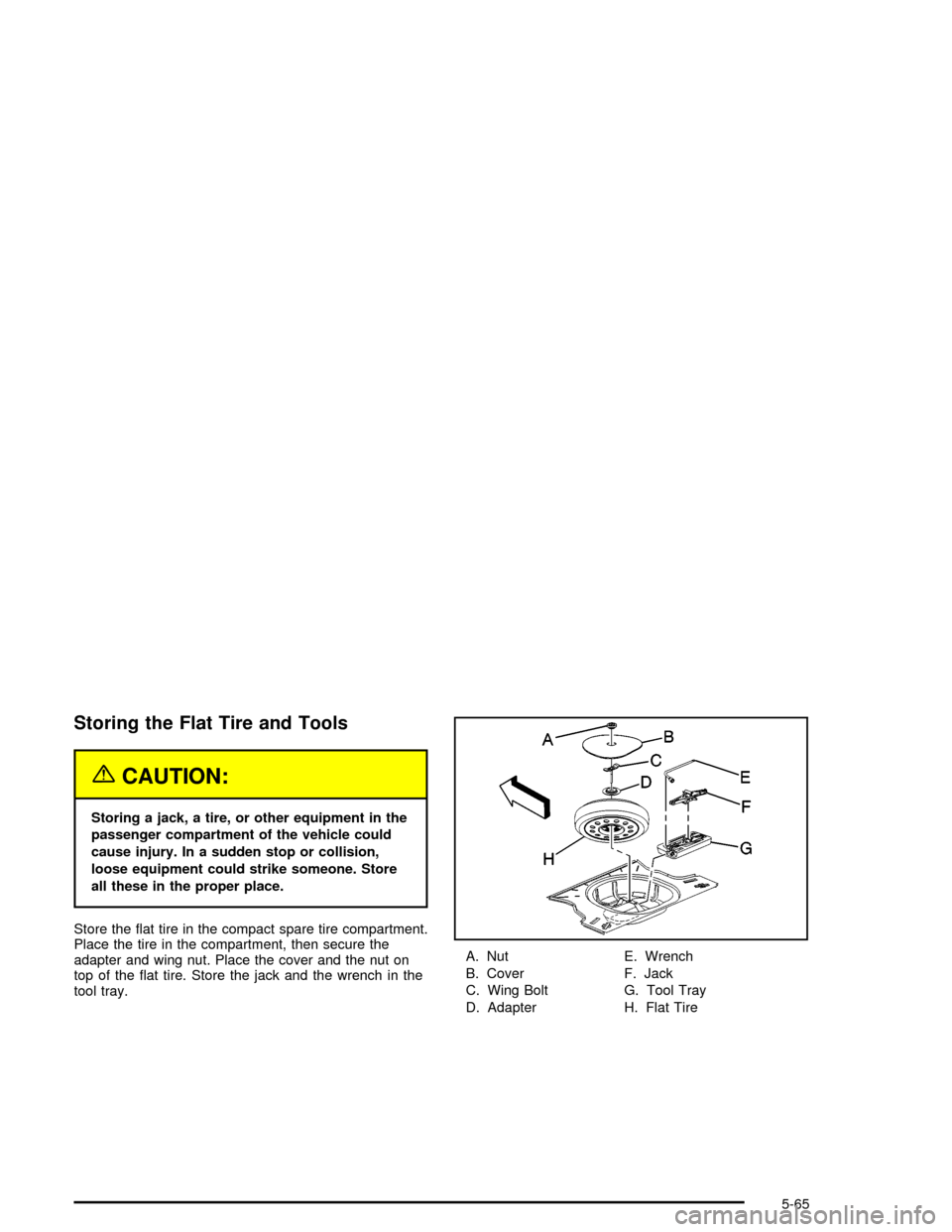
Storing the Flat Tire and Tools
{CAUTION:
Storing a jack, a tire, or other equipment in the
passenger compartment of the vehicle could
cause injury. In a sudden stop or collision,
loose equipment could strike someone. Store
all these in the proper place.
Store the ¯at tire in the compact spare tire compartment.
Place the tire in the compartment, then secure the
adapter and wing nut. Place the cover and the nut on
top of the ¯at tire. Store the jack and the wrench in the
tool tray.A. Nut
B. Cover
C. Wing Bolt
D. AdapterE. Wrench
F. Jack
G. Tool Tray
H. Flat Tire
5-65
Page 271 of 326
Fuses and Circuit Breakers
The wiring circuits in your vehicle are protected from
short circuits by a combination of fuses, circuit breakers
and fusible thermal links in the wiring itself.
Look at the silver-colored band inside the fuse. If the
band is broken or melted, replace the fuse. Be sure you
replace a bad fuse with a new one of the identical
size and rating.
If you ever have a problem on the road and don't have
a spare fuse, you can borrow one that has the same
amperage. Just pick a feature of your vehicle that
you can get along without ± like the radio or cigarette
lighter ± and use its fuse, if it is the correct amperage.
Replace it as soon as you can.
There are three fuse blocks in your vehicle: two
instrument panel fuse blocks and the engine
compartment fuse block.
There is a fuse puller located on the engine
compartment fuse block. It can be used to easily
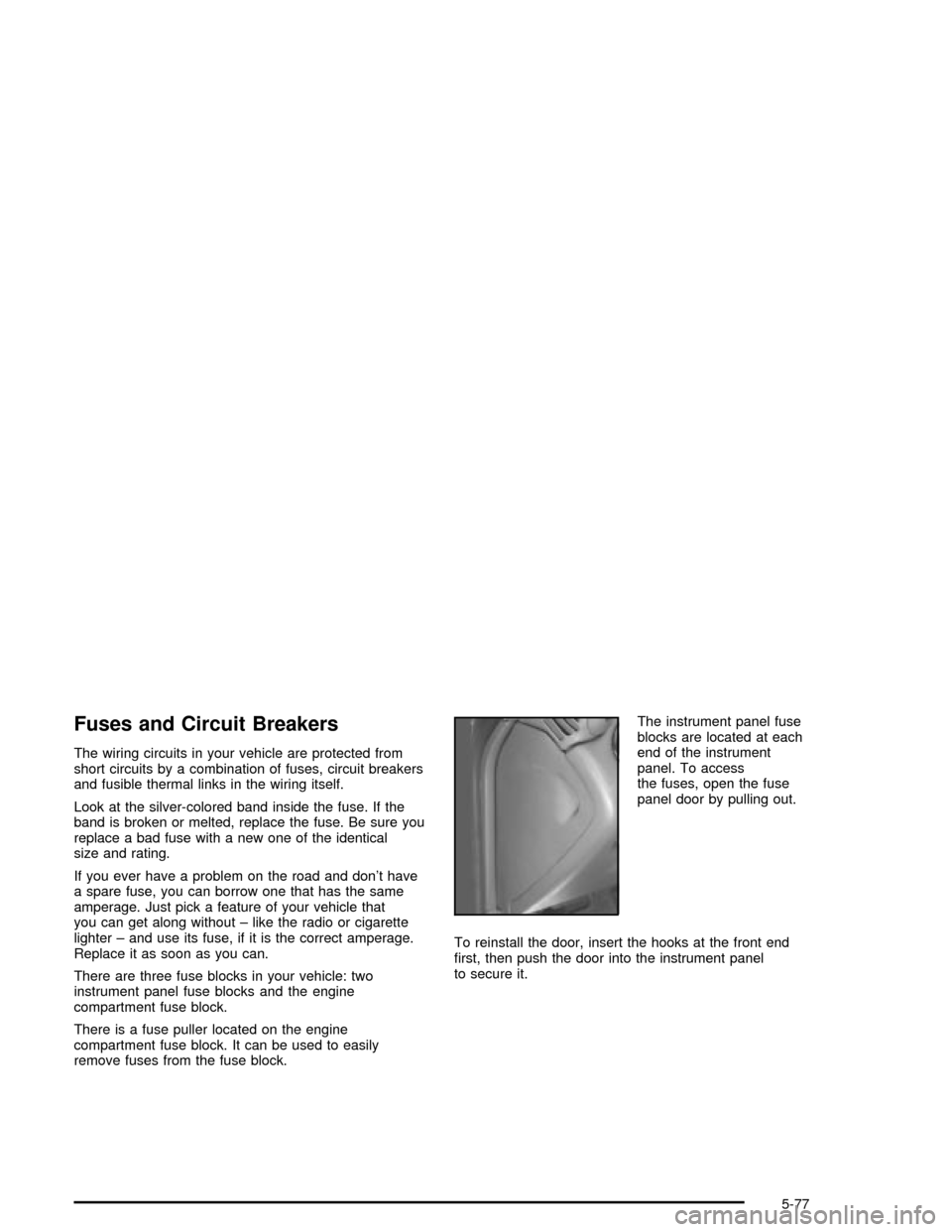
remove fuses from the fuse block.The instrument panel fuse
blocks are located at each
end of the instrument
panel. To access
the fuses, open the fuse
panel door by pulling out.
To reinstall the door, insert the hooks at the front end
®rst, then push the door into the instrument panel
to secure it.
5-77
Page 315 of 326

Charging System Light....................................3-27
Check...........................................................3-30
Engine Light...............................................3-30
Check Engine Light.........................................3-30
Checking Coolant............................................5-20
Checking Engine Oil........................................5-13
Checking Things Under the Hood....................... 5-9
Checking Your Restraint Systems......................1-54
Chemical Paint Spotting...................................5-73
Child Restraints..............................................1-35
Child Restraint Systems...............................1-35
Infants and Young Children...........................1-31
Lower Anchorages and Top Tethers for
Children (LATCH System)..........................1-40
Older Children.............................................1-28
Securing a Child Restraint Designed
for the LATCH System..............................1-41
Securing a Child Restraint in a Center
Rear Seat Position...................................1-44
Securing a Child Restraint in a Rear
Outside Seat Position...............................1-42
Securing a Child Restraint in the Right
Front Seat Position...................................1-46
Top Strap...................................................1-38
Top Strap Anchor Location............................1-39
Where to Put the Restraint...........................1-38
Chime Level Adjustment..................................3-59Cigarette Lighter.............................................3-17
Cleaning........................................................5-68
Inside of Your Vehicle..................................5-68
Outside of Your Vehicle................................5-71
Underbody Maintenance...............................5-73
Weatherstrips..............................................5-70
Cleaning Aluminum Wheels..............................5-72
Cleaning Exterior Lamps/Lenses.......................5-71
Cleaning Fabric/Carpet....................................5-68
Cleaning Glass Surfaces..................................5-70
Cleaning Interior Plastic Components.................5-70
Cleaning Leather............................................5-69
Cleaning the Top of the Instrument Panel...........5-70
Cleaning Tires................................................5-72
Cleaning Vinyl................................................5-69
Cleaning Windshield and Wiper Blades..............5-72
Climate Control System...................................3-17
Outlet Adjustment........................................3-21
Compact Disc Messages.................3-41, 3-47, 3-56
Compact Spare Tire........................................5-66
Control of a Vehicle.......................................... 4-5
Coolant.........................................................3-29
Engine Temperature Gage............................3-29
Heater, Engine............................................2-19
Low Warning Light.......................................3-29
Surge Tank Pressure Cap.............................5-21
Cooling System..............................................5-24
3