ECU CHEVROLET MALIBU 2003 5.G User Guide
[x] Cancel search | Manufacturer: CHEVROLET, Model Year: 2003, Model line: MALIBU, Model: CHEVROLET MALIBU 2003 5.GPages: 326, PDF Size: 2.41 MB
Page 48 of 326
4. If the child restraint is forward-facing, attach the
top strap to the top strap anchor. SeeTop Strap
on page 1-38. Tighten the top strap according to
the child restraint instructions.
5. Push and pull the child restraint in different
directions to be sure it is secure.
To remove the child restraint, simply unhook the top
strap from the top tether anchor and then disconnect
the anchor points.
Securing a Child Restraint in a
Rear Outside Seat Position
If your child restraint is equipped with the LATCH
system, seeLower Anchorages and Top Tethers
for Children (LATCH System) on page 1-40. SeeTop Strap on page 1-38if the child restraint has one.If your child restraint does not have the LATCH system,
you will be using the lap-shoulder belt to secure the
child restraint. Be sure to follow the instructions
that came with the child restraint. Secure the child in the
child restraint when and as the instructions say.
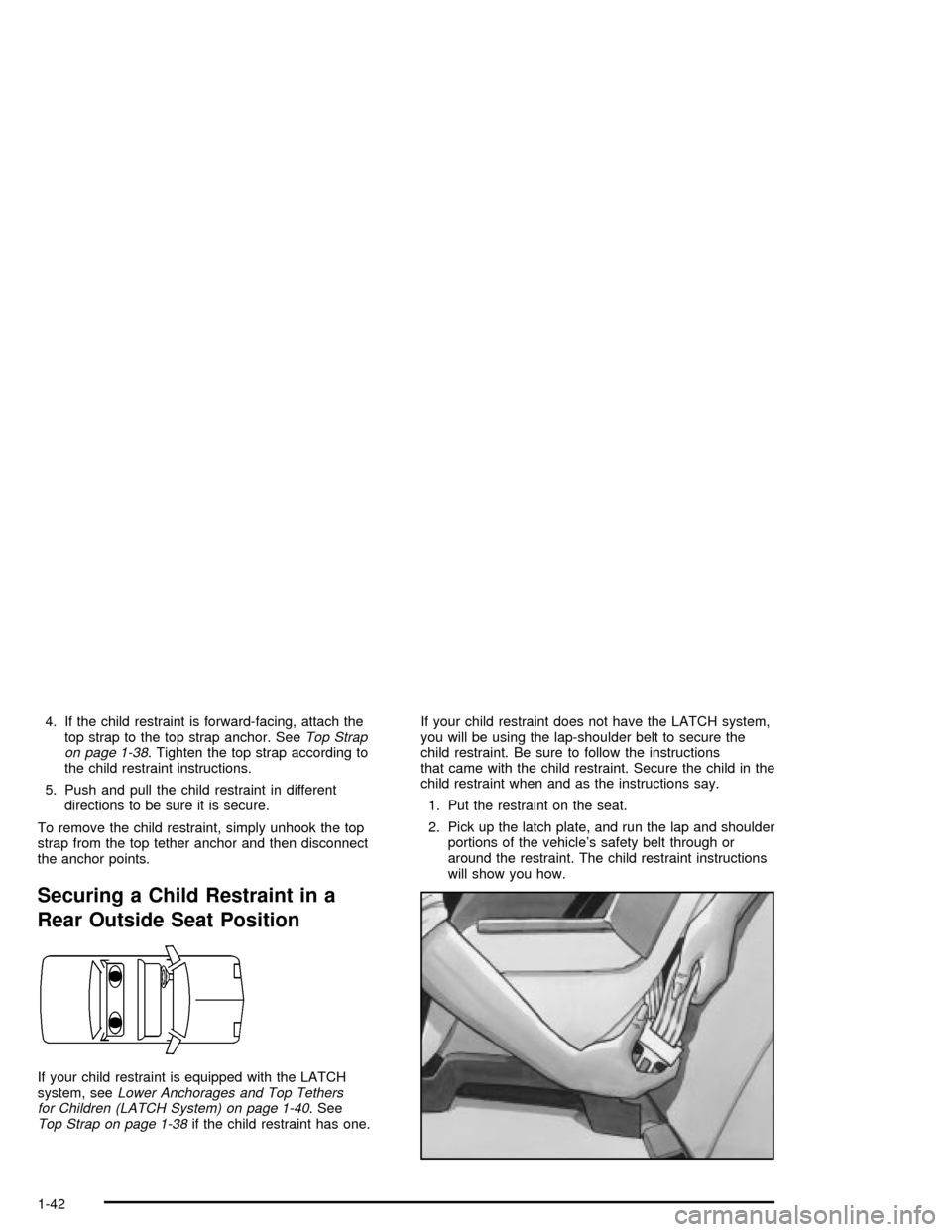
1. Put the restraint on the seat.
2. Pick up the latch plate, and run the lap and shoulder
portions of the vehicle's safety belt through or
around the restraint. The child restraint instructions
will show you how.
1-42
Page 49 of 326
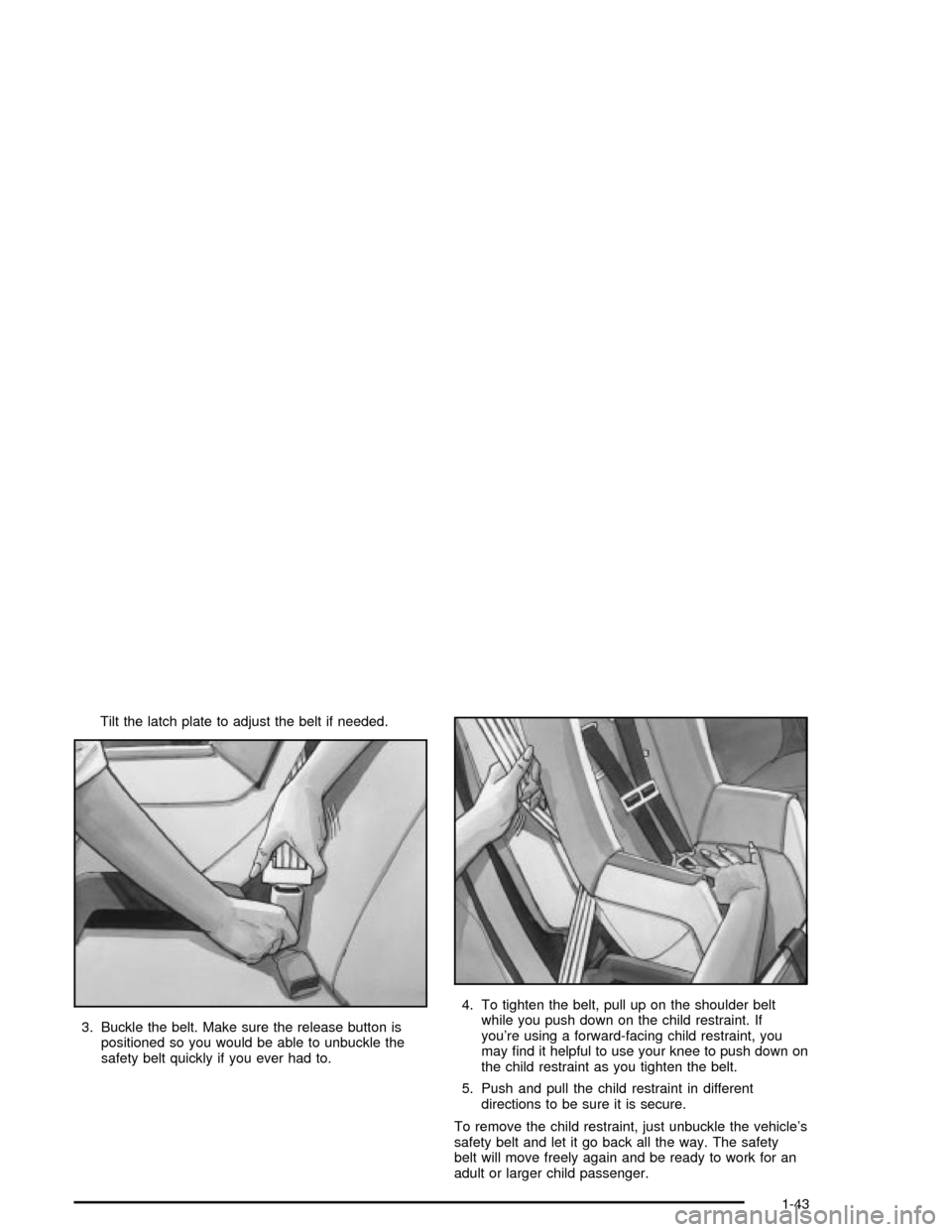
Tilt the latch plate to adjust the belt if needed.
3. Buckle the belt. Make sure the release button is
positioned so you would be able to unbuckle the
safety belt quickly if you ever had to.4. To tighten the belt, pull up on the shoulder belt
while you push down on the child restraint. If
you're using a forward-facing child restraint, you
may ®nd it helpful to use your knee to push down on
the child restraint as you tighten the belt.
5. Push and pull the child restraint in different
directions to be sure it is secure.
To remove the child restraint, just unbuckle the vehicle's
safety belt and let it go back all the way. The safety
belt will move freely again and be ready to work for an
adult or larger child passenger.
1-43
Page 50 of 326
Securing a Child Restraint in a
Center Rear Seat Position
If your child restraint is equipped with the LATCH
system, seeLower Anchorages and Top Tethers
for Children (LATCH System) on page 1-40. SeeTop Strap on page 1-38if the child restraint has one.
If your child restraint does not have the LATCH system,
you will be using the lap belt to secure the child
restraint. Be sure to follow the instructions that came
with the child restraint. Secure the child in the child
restraint when and as the instructions say. See
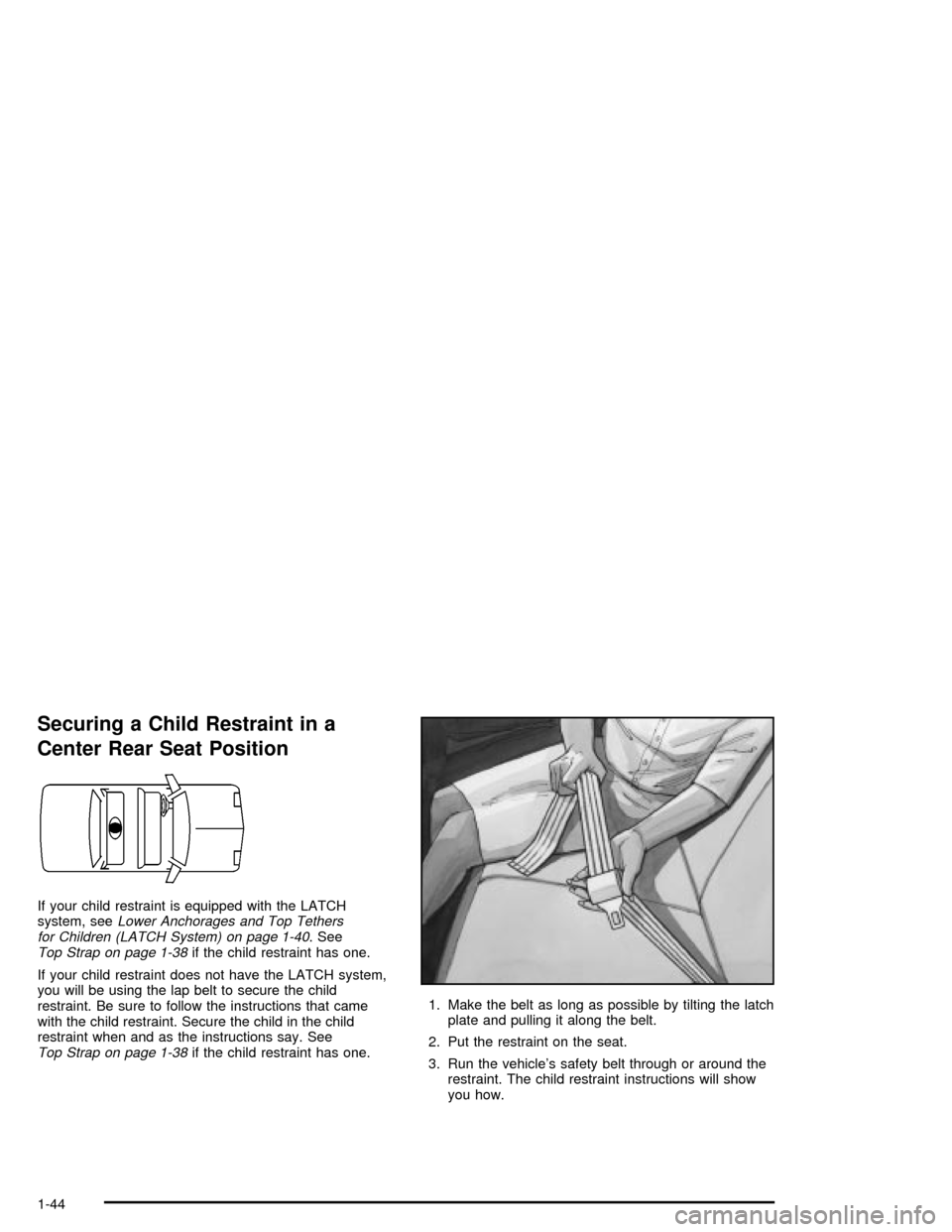
Top Strap on page 1-38if the child restraint has one.1. Make the belt as long as possible by tilting the latch
plate and pulling it along the belt.
2. Put the restraint on the seat.
3. Run the vehicle's safety belt through or around the
restraint. The child restraint instructions will show
you how.
1-44
Page 51 of 326
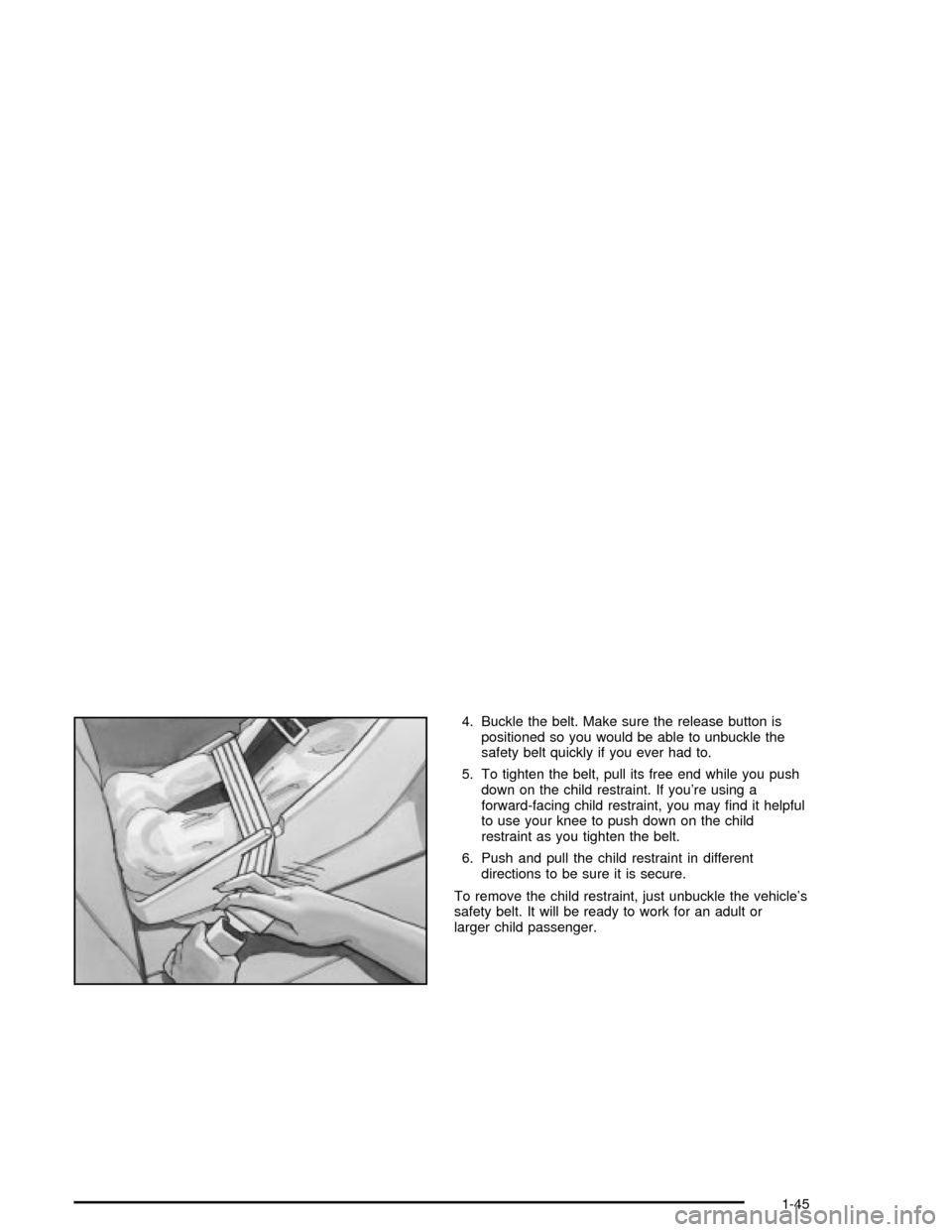
4. Buckle the belt. Make sure the release button is
positioned so you would be able to unbuckle the
safety belt quickly if you ever had to.
5. To tighten the belt, pull its free end while you push
down on the child restraint. If you're using a
forward-facing child restraint, you may ®nd it helpful
to use your knee to push down on the child
restraint as you tighten the belt.
6. Push and pull the child restraint in different
directions to be sure it is secure.
To remove the child restraint, just unbuckle the vehicle's
safety belt. It will be ready to work for an adult or
larger child passenger.
1-45
Page 52 of 326
Securing a Child Restraint in the
Right Front Seat Position
If your child restraint is equipped with the LATCH
system, seeLower Anchorages and Top Tethers
for Children (LATCH System) on page 1-40. SeeTop Strap on page 1-38if the child restraint has one.
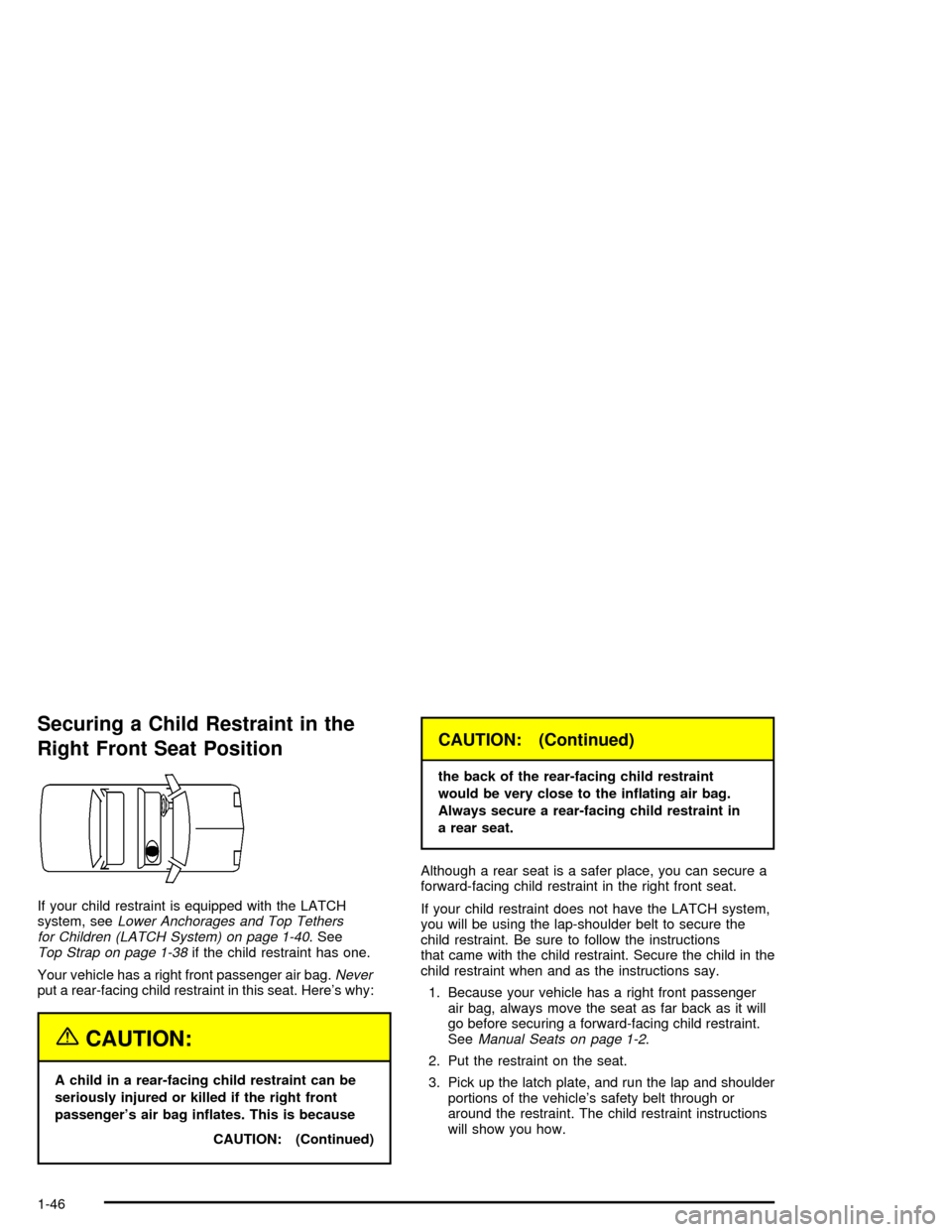
Your vehicle has a right front passenger air bag.
Neverput a rear-facing child restraint in this seat. Here's why:
{CAUTION:
A child in a rear-facing child restraint can be
seriously injured or killed if the right front
passenger's air bag in¯ates. This is because
CAUTION: (Continued)
CAUTION: (Continued)
the back of the rear-facing child restraint
would be very close to the in¯ating air bag.
Always secure a rear-facing child restraint in
a rear seat.
Although a rear seat is a safer place, you can secure a
forward-facing child restraint in the right front seat.
If your child restraint does not have the LATCH system,
you will be using the lap-shoulder belt to secure the
child restraint. Be sure to follow the instructions
that came with the child restraint. Secure the child in the
child restraint when and as the instructions say.
1. Because your vehicle has a right front passenger
air bag, always move the seat as far back as it will
go before securing a forward-facing child restraint.
See
Manual Seats on page 1-2.
2. Put the restraint on the seat.
3. Pick up the latch plate, and run the lap and shoulder
portions of the vehicle's safety belt through or
around the restraint. The child restraint instructions
will show you how.
1-46
Page 54 of 326
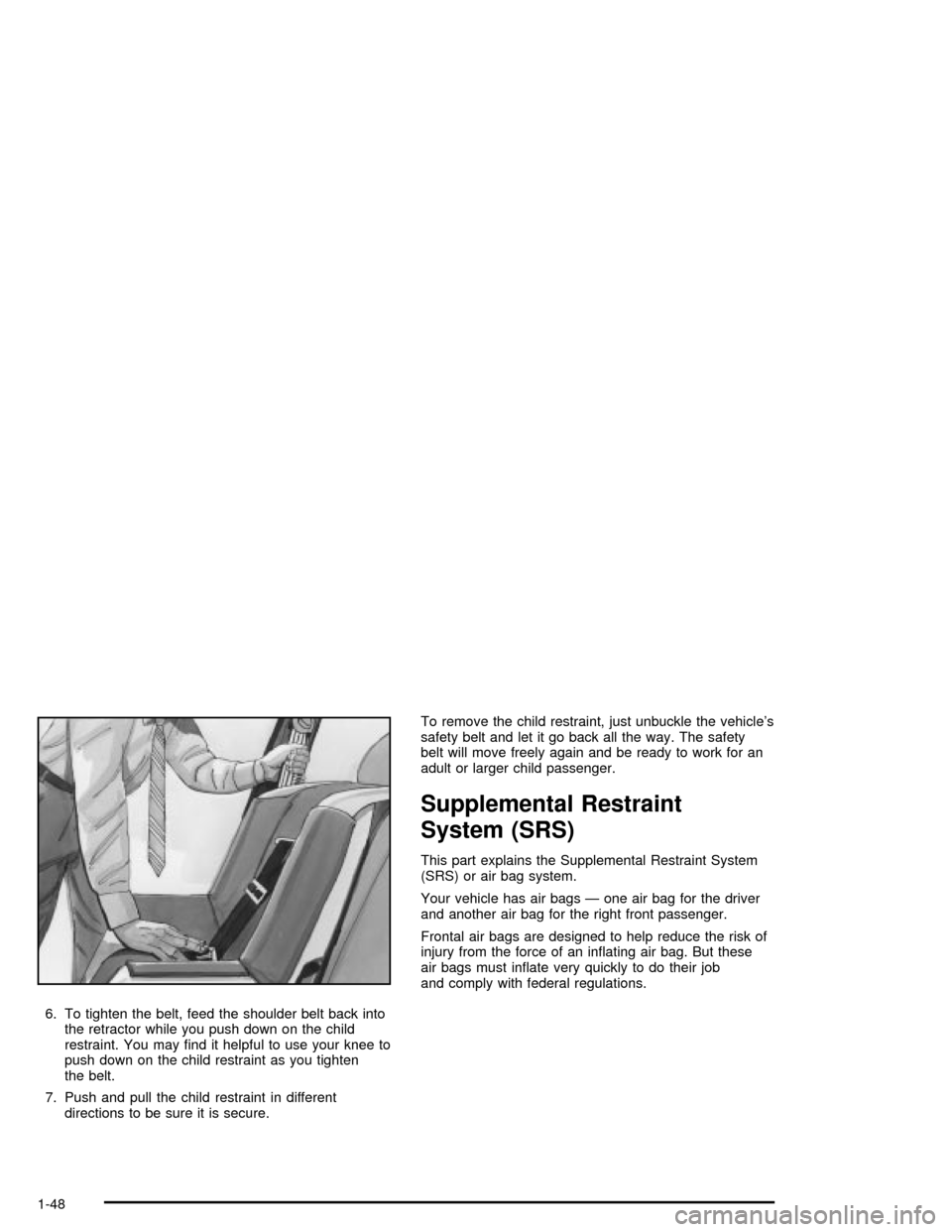
6. To tighten the belt, feed the shoulder belt back into
the retractor while you push down on the child
restraint. You may ®nd it helpful to use your knee to
push down on the child restraint as you tighten
the belt.
7. Push and pull the child restraint in different
directions to be sure it is secure.To remove the child restraint, just unbuckle the vehicle's
safety belt and let it go back all the way. The safety
belt will move freely again and be ready to work for an
adult or larger child passenger.
Supplemental Restraint
System (SRS)
This part explains the Supplemental Restraint System
(SRS) or air bag system.
Your vehicle has air bags Ð one air bag for the driver
and another air bag for the right front passenger.
Frontal air bags are designed to help reduce the risk of
injury from the force of an in¯ating air bag. But these
air bags must in¯ate very quickly to do their job
and comply with federal regulations.
1-48
Page 56 of 326
{CAUTION:
Anyone who is up against, or very close to,
any air bag when it in¯ates can be seriously
injured or killed. Air bags plus lap-shoulder
belts offer the best protection for adults, but
not for young children and infants. Neither the
vehicle's safety belt system nor its air bag
system is designed for them. Young children
and infants need the protection that a child
restraint system can provide. Always secure
children properly in your vehicle. To read how,
see
Older Children on page 1-28 and Infants
and Young Children on page 1-31.
There is a air bag
readiness light on the
instrument panel, which
shows the air bag symbol.The system checks the air bag electrical system for
malfunctions. The light tells you if there is an electrical
problem. See
Air Bag Readiness Light on page 3-26.
Where Are the Air Bags?
The driver's air bag is in the middle of the steering
wheel.
1-50
Page 63 of 326

Keys...............................................................2-2
Remote Keyless Entry System.........................2-3
Remote Keyless Entry System Operation...........2-4
Doors and Locks.............................................2-7
Door Locks....................................................2-7
Power Door Locks..........................................2-8
Door Ajar Reminder........................................2-8
Delayed Locking.............................................2-8
Programmable Automatic Door Locks................2-9
Rear Door Security Locks..............................2-10
Lockout Protection........................................2-11
Leaving Your Vehicle....................................2-11
Trunk..........................................................2-11
Windows........................................................2-14
Manual Windows..........................................2-14
Power Windows............................................2-15
Sun Visors...................................................2-15
Theft-Deterrent Systems..................................2-15
Passlock
ž....................................................2-16
Starting and Operating Your Vehicle................2-16
New Vehicle Break-In....................................2-16Ignition Positions..........................................2-17
Starting Your Engine.....................................2-18
Engine Coolant Heater..................................2-19
Automatic Transaxle Operation.......................2-20
Parking Brake..............................................2-23
Shifting Into Park (P).....................................2-23
Shifting Out of Park (P).................................2-25
Parking Over Things That Burn.......................2-26
Engine Exhaust............................................2-26
Running Your Engine While You Are Parked.......2-27
Mirrors...........................................................2-28
Manual Rearview Mirror.................................2-28
Outside Remote Control Mirrors......................2-28
Outside Power Mirrors...................................2-29
Outside Convex Mirror...................................2-29
Storage Areas................................................2-30
Glove Box...................................................2-30
Cupholder(s)................................................2-30
Center Console Storage Area.........................2-30
Garment Hooks............................................2-30
Sunroof.........................................................2-31
Section 2 Features and Controls
2-1
Page 72 of 326

Rear Door Security Locks
Your vehicle has rear door security locks that help
prevent passengers from opening the rear doors of your
vehicle from the inside.
The lever for this feature
is located on the inside of
the rear door.
To use the security locks, do the following:
1. Slide the lever up.
2. Close the door.
3. Do the same thing to the other rear door.The rear doors on your vehicle cannot be opened from
the inside when this feature is in use. If you want to
open a rear door while the security lock is on, do
the following:
1. Unlock the door from the inside.
2. Then open the door from the outside.
If you do not cancel the security lock feature, adults or
older children who ride in the rear won't be able to
open the rear door from the inside. You should let adults
and older children know how these security locks
work, and how to cancel the locks.
To cancel a rear door lock, do the following:
1. Unlock the door from the inside and open it from
the outside.
2. Slide the lever down.
3. Do the same to the other rear door.
The rear doors will now work normally.
2-10
Page 73 of 326
Lockout Protection
Lockout protection is intended to provide enhanced
security and convenience. This feature prevents a driver
who has left the key in the ignition from locking the
doors, using the power door locks while any door
is open.
To override this feature, when the key is in the ignition
and any door is open, press and hold down the
power door lock switch for three seconds.
This feature cannot guarantee that you will never be
locked out of your vehicle. If you don't leave the key in
the ignition, or if you use the manual door lock or
the remote keyless entry transmitter, you could still lock
your key inside your vehicle. Always remember to
take your key with you.
Leaving Your Vehicle
If you are leaving your vehicle, open your door and set
the locks from the inside, then get out and close the door.
Trunk
To unlock the trunk from the outside, insert the key and
turn the trunk lock cylinder. When closing the trunk
lid, close from the center to ensure it fully latches.
{CAUTION:
It can be dangerous to drive with the trunk lid
open because carbon monoxide (CO) gas can
come into your vehicle. You can't see or smell
CO. It can cause unconsciousness and even
death. If you must drive with the trunk lid open
or if electrical wiring or other cable
connections must pass through the seal
between the body and the trunk lid:
·Make sure all other windows are shut.
·Turn the fan on your heating or cooling
system to its highest speed and select the
control setting that will force outside air
into your vehicle. See ªClimate Control
Systemº in the Index.
·If you have air outlets on or under the
instrument panel, open them all the way.
See ªEngine Exhaustº in the Index.
2-11