wheel size CHEVROLET MALIBU 2012 7.G Owners Manual
[x] Cancel search | Manufacturer: CHEVROLET, Model Year: 2012, Model line: MALIBU, Model: CHEVROLET MALIBU 2012 7.GPages: 398, PDF Size: 6.06 MB
Page 28 of 398
Black plate (22,1)Chevrolet Malibu Owner Manual - 2012
1-22 In Brief
Engine Oil Life System
The engine oil life system calculates
engine oil life based on vehicle use
and displays the“Change Oil Soon”
DIC message when it is necessary
to change the engine oil and filter.
The oil life system should be reset
to 100% only following an oil
change.
Resetting the Oil Life System
1. Turn the ignition to ON/RUN, with the engine off.
2. Press and hold the DIC INFO and reset buttons, on the left
side of the steering wheel,
at the same time to enter the
personalization menu. The “Oil
Life Reset” message displays.
3. Press and hold the reset button until the DIC display shows
“Acknowledged.”
4. Turn the key to LOCK/OFF.
See Engine Oil Life System on
page 10‑12.
Fuel E85 (85% Ethanol)
Vehicles that have a FlexFuel badge
and a yellow fuel cap can use either
unleaded gasoline or ethanol fuel
containing up to 85% ethanol (E85).
See Fuel E85 (85% Ethanol) on
page 9‑39. For all other vehicles,
use only the unleaded gasoline
described under Recommended
Fuel on page 9‑36.
Driving for Better Fuel
Economy
Driving habits can affect fuel
mileage. Here are some driving tips
to get the best fuel economy
possible.
.Avoid fast starts and accelerate
smoothly.
.Brake gradually and avoid
abrupt stops.
.Avoid idling the engine for long
periods of time.
.When road and weather
conditions are appropriate,
use cruise control.
.Always follow posted speed
limits or drive more slowly when
conditions require.
.Keep vehicle tires properly
inflated.
.Combine several trips into a
single trip.
.Replace the vehicle's tires with
the same TPC Spec number
molded into the tire's sidewall
near the size.
.Follow recommended scheduled
maintenance.
Page 242 of 398

Black plate (2,1)Chevrolet Malibu Owner Manual - 2012
10-2 Vehicle Care
Wheels and Tires
Tires . . . . . . . . . . . . . . . . . . . . . . . . 10-42
Winter Tires . . . . . . . . . . . . . . . . 10-43
Low-Profile Tires . . . . . . . . . . . 10-43
Tire Sidewall Labeling . . . . . . 10-44
Tire Designations . . . . . . . . . . . 10-46
Tire Terminology andDefinitions . . . . . . . . . . . . . . . . 10-46
Tire Pressure . . . . . . . . . . . . . . . 10-50
Tire Pressure for High-Speed Operation . . . . 10-51
Tire Pressure Monitor System . . . . . . . . . . . . . . . . . . . 10-52
Tire Pressure Monitor Operation . . . . . . . . . . . . . . . . . 10-53
Tire Inspection . . . . . . . . . . . . . . 10-57
Tire Rotation . . . . . . . . . . . . . . . 10-57
When It Is Time for New Tires . . . . . . . . . . . . . . . . . 10-59
Buying New Tires . . . . . . . . . . . 10-60
Different Size Tires and Wheels . . . . . . . . . . . . . . . . . . . 10-61
Uniform Tire Quality Grading . . . . . . . . . . . . . . . . . . . 10-62 Wheel Alignment and
Tire Balance . . . . . . . . . . . . . . 10-63
Wheel Replacement . . . . . . . . 10-64
Tire Chains . . . . . . . . . . . . . . . . . 10-64
If a Tire Goes Flat . . . . . . . . . . 10-65
Tire Sealant and Compressor Kit . . . . . . . . . . . 10-67
Storing the Tire Sealant and Compressor Kit . . . . . . . 10-73
Tire Changing . . . . . . . . . . . . . . 10-74
Compact Spare Tire . . . . . . . . 10-82
Jump Starting
Jump Starting . . . . . . . . . . . . . . 10-83
Towing
Towing the Vehicle . . . . . . . . . 10-87
Recreational Vehicle Towing . . . . . . . . . . . . . . . . . . . . 10-87
Appearance Care
Exterior Care . . . . . . . . . . . . . . . 10-90
Interior Care . . . . . . . . . . . . . . . . 10-93
Floor Mats . . . . . . . . . . . . . . . . . . 10-96
General Information
For service and parts needs,
visit your dealer. You will receive
genuine GM parts and GM-trained
and supported service people.
Genuine GM parts have one of
these marks:
Page 283 of 398
Black plate (43,1)Chevrolet Malibu Owner Manual - 2012
Vehicle Care 10-43
Winter Tires
Consider installing winter tires on
the vehicle if frequent driving on
snow or ice covered roads is
expected. All season tires provide
good overall performance on most
surfaces, but they may not offer
the traction or the same level of
performance as winter tires on
snow or ice covered roads.
Winter tires, in general, are
designed for increased traction
on snow and ice covered roads.
With winter tires, there may be
decreased dry road traction,
increased road noise, and shorter
tread life. After changing to winter
tires, be alert for changes in vehicle
handling and braking.
See your dealer for details
regarding winter tire availability and
proper tire selection. Also, see
Buying New Tires on page 10‑60.If using snow tires:.Use tires of the same brand and
tread type on all four wheel
positions.
.Use only radial ply tires of the
same size, load range, and
speed rating as the original
equipment tires.
Winter tires with the same speed
rating as the original equipment tires
may not be available for H, V, W, Y,
and ZR speed rated tires. If winter
tires with a lower speed rating are
chosen, never exceed the tire's
maximum speed capability.
Low-Profile Tires
If the vehicle has P225/50R18
or P225/50R17 size tires, they
are classified as low‐profile
performance tires. These tires
are designed for very responsive driving on wet or dry pavement,
however, may produce more
road noise and tend to wear
faster.
Notice:
Low‐profile tires are
more susceptible to damage
from road hazards or curb
impact than standard profile
tires. Tire and/or wheel
assembly damage can occur
when coming into contact
with road hazards like,
potholes, or sharp edged
objects, or when sliding into a
curb. The warranty does not
cover this type of damage.
Keep tires set to the correct
inflation pressure and, when
possible, avoid contact with
curbs, potholes, and other
road hazards.
Page 286 of 398
Black plate (46,1)Chevrolet Malibu Owner Manual - 2012
10-46 Vehicle Care
Tire Designations
Tire Size
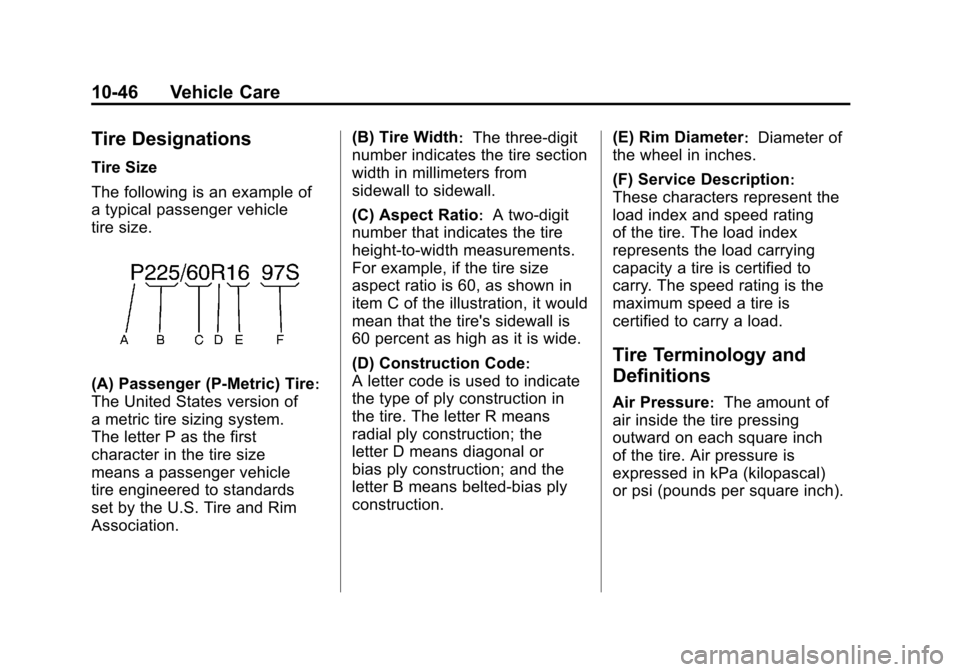
The following is an example of
a typical passenger vehicle
tire size.
(A) Passenger (P‐Metric) Tire:
The United States version of
a metric tire sizing system.
The letter P as the first
character in the tire size
means a passenger vehicle
tire engineered to standards
set by the U.S. Tire and Rim
Association.(B) Tire Width
:The three‐digit
number indicates the tire section
width in millimeters from
sidewall to sidewall.
(C) Aspect Ratio
:A two‐digit
number that indicates the tire
height‐to‐width measurements.
For example, if the tire size
aspect ratio is 60, as shown in
item C of the illustration, it would
mean that the tire's sidewall is
60 percent as high as it is wide.
(D) Construction Code
:
A letter code is used to indicate
the type of ply construction in
the tire. The letter R means
radial ply construction; the
letter D means diagonal or
bias ply construction; and the
letter B means belted‐bias ply
construction. (E) Rim Diameter
:Diameter of
the wheel in inches.
(F) Service Description
:
These characters represent the
load index and speed rating
of the tire. The load index
represents the load carrying
capacity a tire is certified to
carry. The speed rating is the
maximum speed a tire is
certified to carry a load.
Tire Terminology and
Definitions
Air Pressure:The amount of
air inside the tire pressing
outward on each square inch
of the tire. Air pressure is
expressed in kPa (kilopascal)
or psi (pounds per square inch).
Page 292 of 398
Black plate (52,1)Chevrolet Malibu Owner Manual - 2012
10-52 Vehicle Care
Tire Pressure Monitor
System
The Tire Pressure Monitor System
(TPMS) uses radio and sensor
technology to check tire pressure
levels. The TPMS sensors monitor
the air pressure in your tires and
transmit tire pressure readings to a
receiver located in the vehicle.
Each tire, including the spare
(if provided), should be checked
monthly when cold and inflated to
the inflation pressure recommended
by the vehicle manufacturer on the
vehicle placard or tire inflation
pressure label. (If your vehicle has
tires of a different size than the size
indicated on the vehicle placard or
tire inflation pressure label, you
should determine the proper tire
inflation pressure for those tires.)
As an added safety feature, your
vehicle has been equipped with a
tire pressure monitoring system
(TPMS) that illuminates a low tirepressure telltale when one or
more of your tires is significantly
under‐inflated.
Accordingly, when the low tire
pressure telltale illuminates, you
should stop and check your tires as
soon as possible, and inflate them
to the proper pressure. Driving on a
significantly under‐inflated tire
causes the tire to overheat and can
lead to tire failure. Under‐inflation
also reduces fuel efficiency and tire
tread life, and may affect the
vehicle's handling and stopping
ability.
Please note that the TPMS is
not a substitute for proper tire
maintenance, and it is the driver's
responsibility to maintain correct tire
pressure, even if under‐inflation has
not reached the level to trigger
illumination of the TPMS low tire
pressure telltale.
Your vehicle has also been
equipped with a TPMS malfunction
indicator to indicate when the
system is not operating properly.
The TPMS malfunction indicator is
combined with the low tire pressure
telltale. When the system detects a
malfunction, the telltale will flash for
approximately one minute and then
remain continuously illuminated.
This sequence will continue upon
subsequent vehicle start‐ups as
long as the malfunction exists.
When the malfunction indicator is
illuminated, the system may not be
able to detect or signal low tire
pressure as intended. TPMS
malfunctions may occur for a variety
of reasons, including the installation
of replacement or alternate tires or
wheels on the vehicle that prevent
the TPMS from functioning properly.
Page 297 of 398

Black plate (57,1)Chevrolet Malibu Owner Manual - 2012
Vehicle Care 10-57
Tire Inspection
We recommend that the tires,
including the spare tire, if the
vehicle has one, be inspected
for signs of wear or damage at
least once a month.
Replace the tire if:
.The indicators at three or
more places around the tire
can be seen.
.There is cord or fabric
showing through the tire's
rubber.
.The tread or sidewall is
cracked, cut, or snagged
deep enough to show cord or
fabric.
.The tire has a bump, bulge,
or split.
.The tire has a puncture, cut,
or other damage that cannot
be repaired well because of
the size or location of the
damage.
Tire Rotation
Tires should be rotated
every 12 000 km (7,500 mi).
SeeMaintenance Schedule on
page 11‑2.
Tires are rotated to achieve a
uniform wear for all tires.
The first rotation is the most
important.
Any time unusual wear is
noticed, rotate the tires as
soon as possible and check the
wheel alignment. Also check
for damaged tires or wheels.
See When It Is Time for New
Tires on page 10‑59 andWheel
Replacement on page 10‑64.
Page 300 of 398

Black plate (60,1)Chevrolet Malibu Owner Manual - 2012
10-60 Vehicle Care
Buying New Tires
GM has developed and matched
specific tires for the vehicle.
The original equipment tires
installed were designed to
meet General Motors Tire
Performance Criteria
Specification (TPC Spec)
system rating. When
replacement tires are needed,
GM strongly recommends
buying tires with the same
TPC Spec rating.
GM's exclusive TPC Spec
system considers over a dozen
critical specifications that
impact the overall performance
of the vehicle, including brake
system performance, ride and
handling, traction control, and
tire pressure monitoring
performance. GM's TPC Specnumber is molded onto the tire's
sidewall near the tire size. If the
tires have an all‐season tread
design, the TPC Spec number
will be followed by MS for mud
and snow. See
Tire Sidewall
Labeling on page 10‑44 for
additional information.
GM recommends replacing all
the tires at the same time.
Uniform tread depth on all tires
will help to maintain the
performance of the vehicle.
Braking and handling
performance may be adversely
affected if all the tires are not
replaced at the same time.
See Tire Inspection on
page 10‑57 andTire Rotation on
page 10‑57 for information on
proper tire rotation.{WARNING
Tires could explode during
improper service. Attempting to
mount or dismount a tire could
cause injury or death. Only your
dealer or authorized tire service
center should mount or dismount
the tires.
{WARNING
Mixing tires of different sizes,
brands, or types may cause
loss of control of the vehicle,
resulting in a crash or other
vehicle damage. Use the
correct size, brand, and type
of tires on all wheels.
Page 301 of 398

Black plate (61,1)Chevrolet Malibu Owner Manual - 2012
Vehicle Care 10-61
{WARNING
Using bias-ply tires on the
vehicle may cause the wheel
rim flanges to develop cracks
after many miles of driving.
A tire and/or wheel could fail
suddenly and cause a crash.
Use only radial-ply tires with
the wheels on the vehicle.
If the vehicle tires must be
replaced with a tire that does not
have a TPC Spec number, make
sure they are the same size,
load range, speed rating, and
construction (radial) as the
original tires.
Vehicles that have a tire
pressure monitoring system
could give an inaccurate
low‐pressure warning if non‐TPC
Spec rated tires are installed.
See Tire Pressure Monitor
System on page 10‑52. The Tire and Loading
Information label indicates the
original equipment tires on the
vehicle. See
Vehicle Load Limits
on page 9‑11 for the label
location and more information
about the Tire and Loading
Information label.
Different Size Tires and
Wheels
If wheels or tires are installed that
are a different size than the original
equipment wheels and tires, vehicle
performance, including its braking,
ride and handling characteristics,
stability, and resistance to rollover
may be affected. If the vehicle has
electronic systems such as antilock
brakes, rollover airbags, traction
control, and electronic stability
control, the performance of these
systems can also be affected.
{WARNING
If different sized wheels are used,
there may not be an acceptable
level of performance and safety
if tires not recommended for
those wheels are selected.
This increases the chance of
a crash and serious injury.
Only use GM specific wheel and
tire systems developed for the
vehicle, and have them properly
installed by a GM certified
technician.
See Buying New Tires on
page 10‑60 andAccessories
and Modifications on page 10‑3
for additional information.
Page 305 of 398

Black plate (65,1)Chevrolet Malibu Owner Manual - 2012
Vehicle Care 10-65
WARNING (Continued)
suspension, or other vehicle
parts. The area damaged by the
tire chains could cause loss of
control and a crash.
Use another type of traction
device only if its manufacturer
recommends it for the vehicle's
tire size combination and road
conditions. Follow that
manufacturer's instructions.
To avoid vehicle damage, drive
slow and readjust or remove the
traction device if it contacts the
vehicle. Do not spin the wheels.
If traction devices are used,
install them on the front tires.
If a Tire Goes Flat
It is unusual for a tire to blow out,
especially if the tires are maintained
properly. SeeTires on page 10‑42.
If air goes out of a tire, it is much
more likely to leak out slowly. But if
there is ever a blowout, here are a
few tips about what to expect and
what to do:
If a front tire fails, the flat tire
creates a drag that pulls the vehicle
toward that side. Take your foot off
the accelerator pedal and grip the
steering wheel firmly. Steer to
maintain lane position, and then
gently brake to a stop, well off the
road, if possible.
A rear blowout, particularly on a
curve, acts much like a skid and
may require the same correction as
used in a skid. Stop pressing the
accelerator pedal and steer to straighten the vehicle. It may be
very bumpy and noisy. Gently
brake to a stop, well off the road,
if possible.
{WARNING
Driving on a flat tire will cause
permanent damage to the tire.
Re-inflating a tire after it has
been driven on while severely
underinflated or flat may cause a
blowout and a serious crash.
Never attempt to re-inflate a tire
that has been driven on while
severely underinflated or flat.
Have your dealer or an authorized
tire service center repair or
replace the flat tire as soon as
possible.
Page 322 of 398

Black plate (82,1)Chevrolet Malibu Owner Manual - 2012
10-82 Vehicle Care
5. Place the jack in the spare tirewell. Make sure the stow bolt
goes through the hole in the
center of the wrench on the jack,
with the base of the jack towards
the front of the vehicle. Turn the
jack retainer nut until it firmly
contacts the wrench. Do not
over tighten.
6. Place the compact spare into the tire compartment with the stow
bolt going through the center
hole of the wheel.
7. Turn the spare tire retainer nut until it firmly contacts the wheel.
Do not over tighten.Compact Spare Tire
{WARNING
Driving with more than one
compact spare tire at a time could
result in loss of braking and
handling. This could lead to a
crash and you or others could be
injured. Use only one compact
spare tire at a time.
If this vehicle has a compact spare
tire it was fully inflated when the
vehicle was new, however, it can
lose air after a time. Check the
inflation pressure regularly. It should
be 60 psi (420 kPa). After installing the compact spare
on the vehicle, stop as soon as
possible and make sure the
spare tire is correctly inflated.
The compact spare is made to
perform well at speeds up to 65 mph
(105 km/h) for distances up to
3,000 miles (5 000 km), so you can
finish your trip and have the full-size
tire repaired or replaced at your
convenience. Of course, it is best to
replace the spare with a full-size tire
as soon as possible. The spare tire
will last longer and be in good
shape in case it is needed again.
Notice:
When the compact spare
is installed, do not take the
vehicle through an automatic
car wash with guide rails.
The compact spare can get
caught on the rails which can
damage the tire, wheel, and other
parts of the vehicle.