check engine CHEVROLET MONTE CARLO 1973 2.G User Guide
[x] Cancel search | Manufacturer: CHEVROLET, Model Year: 1973, Model line: MONTE CARLO, Model: CHEVROLET MONTE CARLO 1973 2.GPages: 86, PDF Size: 33.46 MB
Page 46 of 86
Downloaded from www.Manualslib.com manuals search engine Changing Tires
Preparations:
• Park on a level surface and set
parking brake firmly.
• Set automatic transmission in
"P ARK" (manual transmission
in reverse) .
• Activate hazard warning flasher.
• Block both the front and back
of the wheel diagonally oppo
site the
jack position.
Jacking Instructions
1. After removing spare wheel and
tire, jack, jack base, and jack
handle (wheel nut wrench) , pro
ceed with changing the wheel
as
follows: 2.
Remove hub cap
or wheel cover
with flat end of wheel nut wrench
and loosen, but do not remove
nuts, by turning counterclock
wise.
44
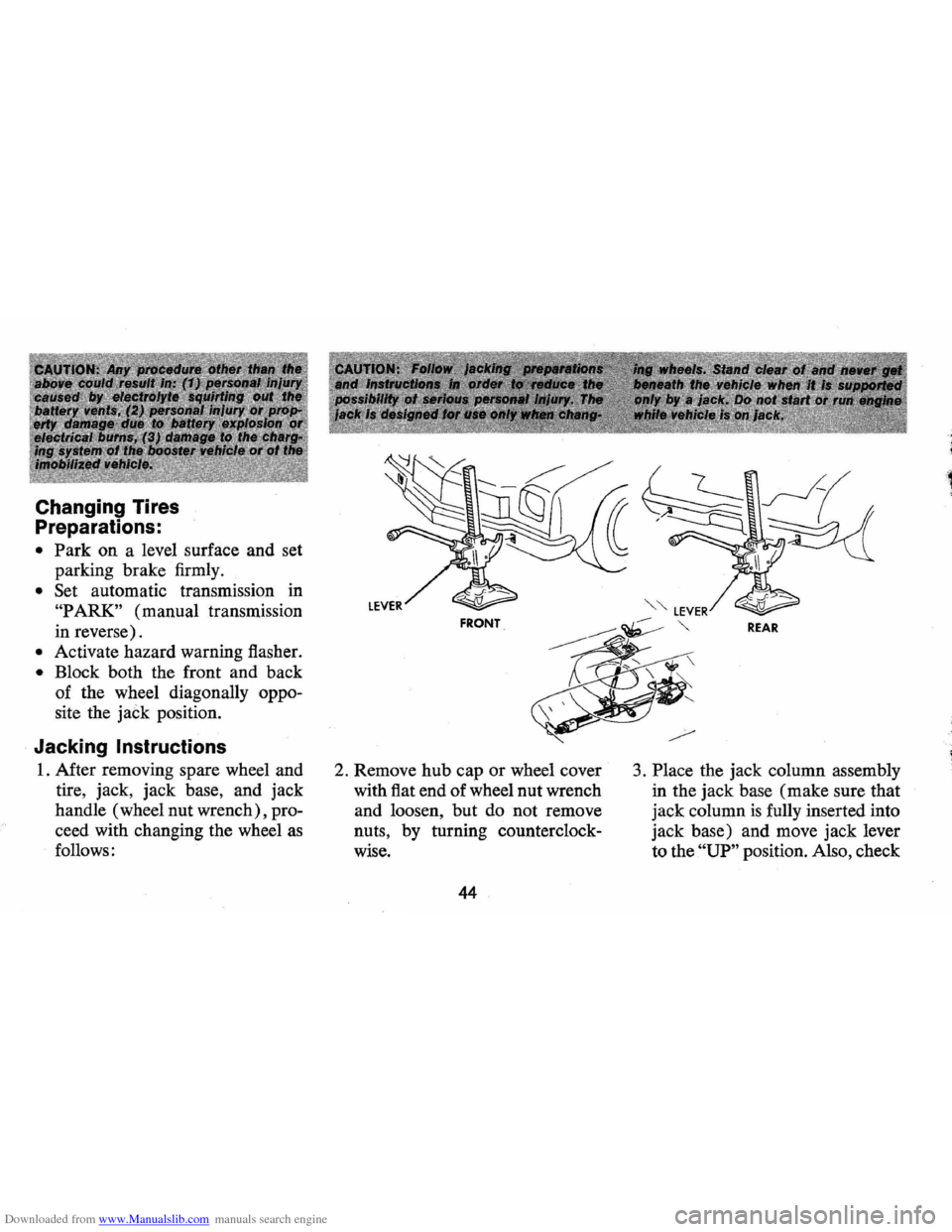
3. Place the jack column assembly
in the jack base (make sure that
jack column
is fully inserted into
jack base) and move jack lever
to the
"UP" position. Also, check
Page 47 of 86
Downloaded from www.Manualslib.com manuals search engine that jack base is level before
raising car.
4. When jacking the car, position
the jack
so that jack hook is fully
inserted in lift slot of the bumper.
NOTE: Always use a smooth mo
tion when raising or lowering car.
5. Insert jack handle in jack and and
raise car until wheel
is just
off the ground.
6. Remove wheel nuts and wheel.
7. Install spare wheel and install
wheel nuts (with beveled end of
nut facing inward) until all are
finger tight.
8. Place jack control lever in
"down" position and lower wheel
until tire just touches ground.
Tighten wheel nuts, lower car
45
and remove jack. Carefully in
stall hub cap or wheel cover.
9. Replace jack assembly and wheel
in luggage compartment.
When possible check inflation of
replacement tire to agree with tire
placard affixed to the left front door.
NOTE: Illustrated instructions on
jack operation and storage are also
provided on underside of trunk lid.
Page 54 of 86
Downloaded from www.Manualslib.com manuals search engine SE oils and quality oil filters. Oil
change intervals longer than those
listed above will seriously reduce
engine life and may affect Chevro
let's obligation under the provisions
of the New Vehicle Warranty.
A high quality
SE oil was in
stalled in your engine at the factory.
It is not necessary to change this
facory-installed oil prior
to the rec
ommended normal change period.
However, check the oil level more
NOTE: Non-detergent and other
low quality oils are specifically not
recommended.
Only the use of SE
engine oils and proper oil and filter
change intervals assure you of con
tinued proper lubrication of your
Chevrolet engine.
frequently during the break-in pe
riod since higher oil consumption
is normal until the piston rings be
come seated.
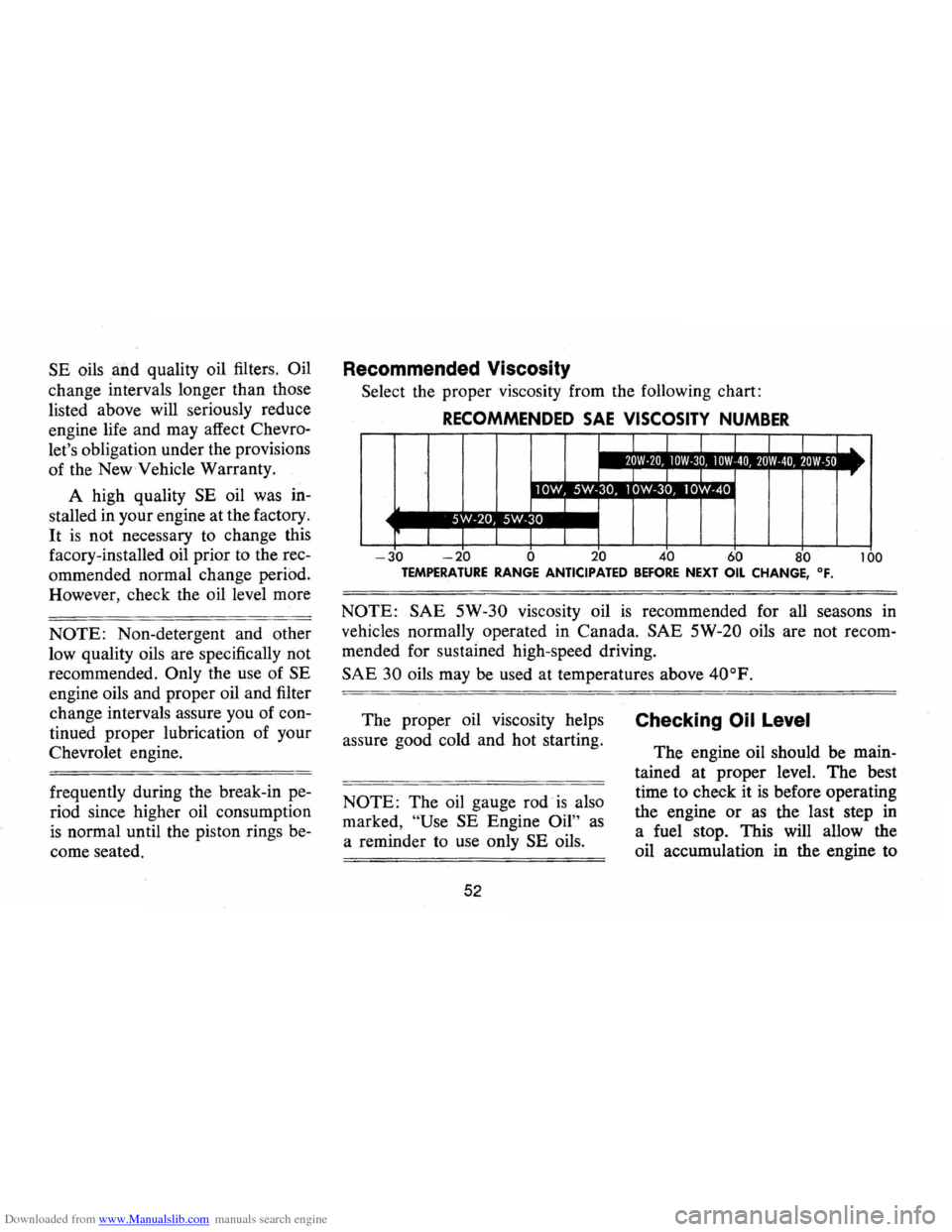
Recommended Viscosity
Select the proper viscosity from the following chart:
RECOMMENDED SAE VISCOSITY NUMBER
I ,.
.... ~.-."'). ... .II ••• :.; I
-30 -20 0 20 40 60 80 100 TEMPERATURE RANGE ANTICIPATED BEFORE NEXT OIL CHANGE, OF.
NOTE: SAE 5W-30 viscosity oil is recommended for all seasons in
vehicles normally operated in Canada.
SAE 5W-20 oils are not recom
mended for sustained high-speed driving.
SAE 30 oils may be used at temperatures above 40oP.
The proper oil viscosity helps
assure good cold and hot starting.
NOTE: The oil gauge rod is also
marked,
"Use SE Engine Oil" as
a reminder to use only SE oils.
52
Checking Oil Level
The engine oil should be main
tained at proper level. The best
time to check it
is before operating
the engine or
as the last step in
a fuel stop. This will allow the
oil accumulation in the engine to
Page 55 of 86
Downloaded from www.Manualslib.com manuals search engine drain back in the crankcase. To
check the level, remove the oil
gauge rod (dip stick), wipe
it
clean and reinsert it firmly for an
accurate reading. The oil gauge
rod is marked "FULL" and
"ADD." The oil level should be
maintained in the safety margin,
neither going above the
"FULL"
line nor below the "ADD" line.
Reseat the gauge firmly after tak
ing the reading.
Supplemental Engine Oil
Additives
The regular use of supplemental
additives
is specifically not recom
mended and will increase operat
ing costs. However, supplemental
additives are available that can
effectively and economically solve
certain specific problems without
causing other difficulties. For
example, if higher detergency is
required to reduce varnish and
sludge deposits resulting from some unusual
operational difficulty, a
thoroughly tested and approved
additive
- "Super Engine Oil Sup
plement " -
is available at your
Chevrolet dealer.
In the event of
an operational problem, consult
your dealer for advice before using
supplemental additives.
Drive Belts
Every 6,000 miles or 4 months
-inspect drive belts for wear,
fraying, cracking, and tension.
Belts which are in poor condition
should be replaced immediately.
Check tension by applying
moderate thumb pressure midway
between pulleys.
If the center-to
center distance · between pulleys
is
13 to 16 inches, the belt should
deflect
1/2 inch. If the center-to
center distance
is 7 to 10 inches ,
the belt should deflect
~ inch.
Loose belts should be retensioned
to give the correct deflection.
It
is recommended that belts be
53
replaced every 24 months or 24,000
miles, whichever occurs first.
Flame Arrester -Every 12,000
miles-Clean the arrester (located
in the base of the air cleaner) with
kerose:le or a suitable solvent. Dry
with compressed air.
Air Cleaner
Rear
Axle
Standard-Every 4 months or
6,000 miles, whichever occurs first,
check lubricant level and add lubri
cant, if necessary, to
fill to level of
filler plug hole.
Use SAE 80 or
SAE 90 GL-5 Gear Lubricant.
(For vehicles normally operated in
Canada use
SAE 80 GL-5 Gear
Lubricant.)
Positraction -Drain and refill
after
12,000 miles. Then maintain
Page 56 of 86
Downloaded from www.Manualslib.com manuals search engine same as standard axle but use only
the special positraction lubricant
available from your Chevrolet
Dealer.
Manual Transmissions
3-Speed -Every 6,000 miles or
4 months-Check at operating tem
perature and
fill as necessary to
level of filler plug hole with SAE
80
or SAE 90 GL-5 Gear Lubri
cant.
(For vehicles normally operated in
Canada use
SAE 80 GL-5 Gear
Lubricant.)
If temperatures below 32°F. are
expected, use
SAE 80 GL-5 Gear
Lubricant only.
Clutch Cross-Shaft -Every
36,000 miles or sooner if necessary
-Remove the plug, install a lubri
cation fitting and lubricate with
water resistant
EP Chassis Lubri
cant which meets GM Specific
a-
tion 6031M.
Automatic Transmissions
Fluid Recommendations
Use only automatic transmission
fluids identified with the mark
DEXRON ®. These fluids have been
specially formulated and tested for
use in your automatic transmission,
and are available from your Chev
rolet dealer or local service station.
Check the fluid level at each
engine oil change period. To make
an accurate fluid level check:
1. Drive car several miles, making
frequent starts and stops,
to
bring transmission up to normal
operating temperature (approxi
mately
180-190° F).
2. Park car on a level surface.
3. Place selector level in "PARK"
and leave engine running.
4. Remove dipstick and wipe clean.
54
5. Reinsert dipstick until cap seats.
6. Remove dipstick and note read
ing.
If fluid level is at or below the
ADD mark, add sufficient fluid
to
raise the level to the FULL mark.
One pint raises the level from ADD
to FULL.
Do not overfill.
Under normal driving condi
tions, the transmission fluid should
be changed every
24,000 miles.
If your car is driven extensively
in heavy city traffic during hot
weather, or
is used to pull a
trailer, {change fluid every
12,000
miles. Likewise, operators of cars
in commercial use (such
as taxicab,
limousine or patrol car service)
where the engine idles for long
periods, should change fluid every
12,000 miles.
Changing Fluid -Remove fluid
from the transmission sump and
Page 57 of 86
Downloaded from www.Manualslib.com manuals search engine add approximately 2.5 quarts U.S.
Measure (2.0 quarts Imperial
Measure) for Turbo Hydra-Matic
350. Operate transmission through
all shift ranges and recheck fluid
level
as described above.
Turbo Hydra-Matic 400-Lubri
cation of your Turbo Hydra-matic
400 will, except for fluid capacity
and filter change listed below,
follow previously stated automatic
transmission recommendations.
After checking transmission fluid
level it
is important that the dip
stick be pushed all the
way into
the
fill tube.
Changing Fluid-After removing
fluid from the transmission sump
approximately
7lh pints U.S.
Measure (6 pints Imperial Meas
ure) of fresh fluid will be required to
return level to proper mark in
the dipstick.
Every
24,000 miles the trans
mission sump filter should be re
placed.
Transmission Shift Linkage
(Manual and Automatic)
Transmission
Shift and Back·
drive Linkage (Manual and
Automatic) -Every 6,000 miles
or 4 months lubricate shift linkage
and on manual transmission floor
controls lever contacting faces with
water resistant EP chassis lubri
cant which meets GM Specifica
tion 6031M .
Chassis
Front Suspension
Every 6,000 miles or 4 months
Lubricate 4 fittings with water re
sistant
EP Chassis Lubricant which
meets GM Specification
6031 M.
55
Ball jOints should not be lu
bricated unless their tempera
ture
is 10°F. or higher. During
colder weather, they should be
allowed to warm up as neces
sary before
lubrication.
Steering Linkage
Every 6,000 miles or 4 months
Lubricate 7 fittings, one at each end
of each tie rod , one at each end of
relay rod, and one at idler lever
with water resistant EP Chassis
Lubricant which meets GM Speci
fication 6031M.
Front Wheel Bearings
Every 24,000 miles -clean and
repack with a high melting point
wheel bearing lubricant.
Use wheel
bearing lubricant GM Part No.
1051344 or equivalent. This
is a
premium high melting point lubri
cant. When replacement
is neces
sary specify Delco parts.
Page 58 of 86
Downloaded from www.Manualslib.com manuals search engine Brakes
Brake linings should be periodi
cally inspected for wear by a quali
fied technician. The frequency of
this inspection depends upon driv
ing conditions such
as traffic or
terrain, and also the driving tech
niques of individual owners. Your
Chevrolet Dealer
is best qualified
to advise you
as to how often this
inspection should be performed.
When replacement
is required,
specify GM and Delco parts.
Master
Cylinder - Every 6,000
miles or 4 months -Check fluid
level in each reservoir and maintain
~ " below lowest edge of each filler opening
with Delco, Supreme No.
11 or DOT-3 Hydraulic Brake
Fluid.
Parking Brake
Pulley, Cables
and Linkage -Every 6,000 miles
or 4 months-Apply water resistant
EP Chassis Lubricant which meets
GM Specification 6031 M, to park
ing brake cable at cable guides and
at all operating links and levers.
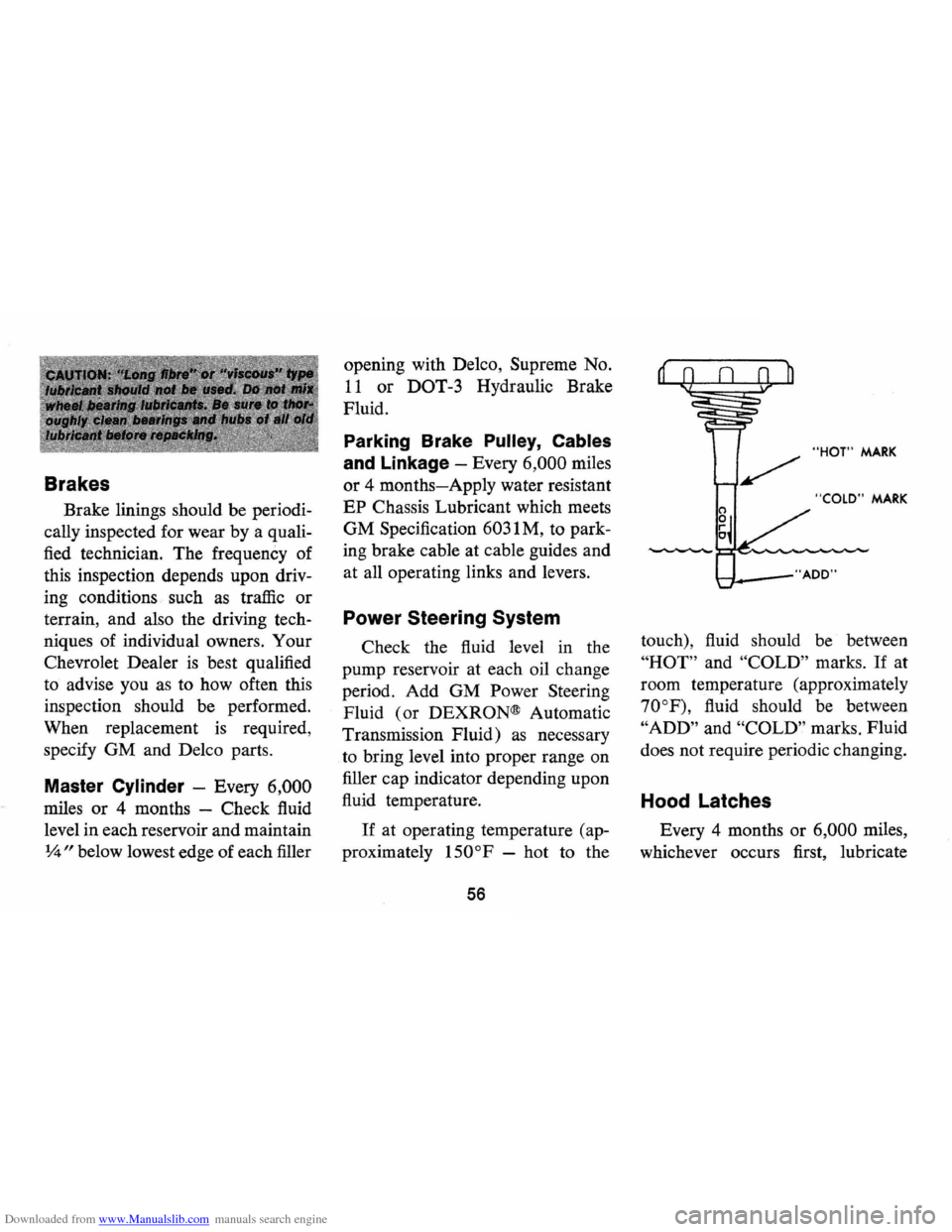
Power
Steering System
Check the fluid level in the
pump reservoir at each oil change
period. Add GM Power Steering
Fluid (or
DEXRON® Automatic
Transmission Fluid)
as necessary
to bring level into proper range on
filler cap indicator depending upon
fluid temperature.
If at operating temperature (ap
proximately
150 °F - hot to the
56
"HOT" MARK
"COLD" MARK
touch), fluid should be between
"HOT" and "COLD" marks. If at
room temperature (approximately
70°F), fluid should be between
"ADD" and "COLD" marks. Fluid
does not require periodic changing.
Hood
Latches
Every 4 months or 6,000 miles,
whichever occurs first, lubricate
Page 59 of 86
Downloaded from www.Manualslib.com manuals search engine hood latch assembly and hood
hinge assembly as follows:
1. Wipe off any accumulation of
dirt or contamination on latch
parts.
2. Apply Lubriplate or equivalent
to latch pilot bolts and latch
locking plate.
3. Apply light engine oil to all
pivot points in release mecha
nism, as well
as primary and
secondary latch mechanisms.
4. Lubricate hood hinges.
5. Make hood hinge and latch
mechanism functional check to
assure the assembly
is working
correctly.
Air Conditioning
Have your Chevrolet Dealer
check your Air Conditioning
sys
tem at some time during the winter
months to be sure there has been no
loss in cooling output. During
NOTE: On vehicles equipped with
a
Pour Season Air Conditioning
System, the system will not operate
below ambient temperatures of
300P. regardless of control posi
tion.
the summer,
see your Chevrolet
Dealer immediately if you suspect
the system
is not performing as it
should .
Cooling System Care
Check the coolant level at each
engine oil change.
Engine Cooling System
The recovery type cooling sys
tem is standard on all Chevrolet
passenger cars and
is designed to
maintain the engine at proper op-
57
erating temperatures. The recovery
tank collects coolant that expands
with rising temperature that would
otherwi se overflow from the sys
tem. When the system temperature
drops, the coolant
is drawn from
the recovery tank back into the
radiator by the suction created by
coolant contraction. The cooling
system has been filled at the factory
with a high-quality , inhibited, year
around coolant that meets the stan
dards of General Motors Specifica
tion 1899-M. This coolant solution
provides freezing protection to
-20oP (-32° P in Canada), and
it has been formulated to be used
for two full calendar years or
24,000 miles, whichever first oc
curs, of normal operation without
replacement.
Cooling System Care
Check the coolant level in the
'see thru' coolant recovery tank
Page 60 of 86
Downloaded from www.Manualslib.com manuals search engine and in the radiator at least as fre
quently
as engine oil changes.
NOTE: Do not remove radiator
cap when coolant
is hot and under
pressure.
Level should be at the
"FULL
COLD"
mark on the recovery tank
and at the bottom of the radiator
filler neck when the system
is cold.
During normal warm weather op
eration the coolant should be at
the
"FULL HOT" mark on the re
covery tank.
If the recovery tank is
empty or coolant is below the
"FULL COLD" mark the radiator
level should be checked and cool
ant added to the radiator and re
covery tank
as needed. Use a 50/50
mixture of high-quality ethylene gly
col antifreeze and water for coolant
additions.
If regular additions are
required see your dealer for a cool
ing system check.
NOTE: If recommended quaIily
antifreeze is used, supplemental in
hibitors or additives claiming to
provide increased capability are
not necessary. They may be detri
mental
to the efficient operation of
the system, and represent an un
necessary operating expense.
Every year, the cooling system
should be serviced
as follows:
1 . Wash radiator cap and filler
neck with clean water.
2. Check coolant for proper
level and freeze protection.
3. Pressure test system and radi
ator cap for proper pressure
holding capacity (15 psi).
If
replacement of cap is re
quired, use the special AC
cap designed for coolant re
covery systems, specified for
your car model.
4. Tighten hose clamps and in
spect all hoses. Replace hoses
58
whenever swollen, checked or
otherwise deteriorated.
5. Clean frontal area of radiator
core and air conditioning
condenser.
Every two years or
24,000 miles,
whichever first occurs, the cooling
system should be flushed and re
filled using the following recom
mended procedure:
1. Run engine, with radiator cap
removed, until normal operat
ing temperature
is reached
and upper radiator hose
is hot
(indicates thermostat
is open.)
2. Stop engine and open radiator
drain valve to drain coolant.
(To speed this operation, the
drain plugs in the block can
also be removed.)
Page 62 of 86
Downloaded from www.Manualslib.com manuals search engine • Maintain cooling system freeze
protection at
.;...200 F or below
to ensure protection against
corrosion and loss of coolant
from boiling , even though freez
ing temperatures are not
ex
pected.
• Add ethylene glycol base cool
ant that meets GM Specification
1899-M when coolant additions
are required because of coolant
loss or to provide additional
protection against freezing at
temperatures lower than
_200 F
(_320 F in Canada).
NOTE: Alcohol or methanol base
coolants or plain water are not
recommended for your Monte
Carlo at any time.
Radiator Pressure Cap
The radiator cap, a 15 lb. pres
sure type, must be installed tightly,
otherwise coolant may be lost and
damage to engine may result from
overheating. Radiator pressure caps
should be checked periodically for
proper operation.
If replacement is
required specify AC.
Thermostat
The cooling system is protected
and controlled by a thermostat in
stalled in the engine coolant outlet
to maintain a satisfactory operating
temperature of the engine. This
thermostat
is designed for continu
ous use through both winter and
summer and need not be changed
seasonally . When replacement
is
necessary, Delco parts are recom
mended.
60
Tires
The factory installed tires on
your car
as shown on the following
Tire Usage chart are designed to
provide the best all around per
formance for normal vehicle op
eration. When inflated
as recom
mended on the tire pressure plac
ard, located on the left door of
your vehicle, they have the load
carrying capacity to operate satis
factorily at all normal highway
speeds.
Tire Care
Tires should be checked regu
larly for proper inflation pressure,
wear, and damage. The following
information will assist you in prop
erly caring for your tires: