ignition CHEVROLET MONTE CARLO 1973 2.G User Guide
[x] Cancel search | Manufacturer: CHEVROLET, Model Year: 1973, Model line: MONTE CARLO, Model: CHEVROLET MONTE CARLO 1973 2.GPages: 86, PDF Size: 33.46 MB
Page 31 of 86
Downloaded from www.Manualslib.com manuals search engine _ '\' ' 2
1
5 , / '/ ,
[ e /~
O'v RPM !lOa -"-50
Optional Instrument and
Gauges
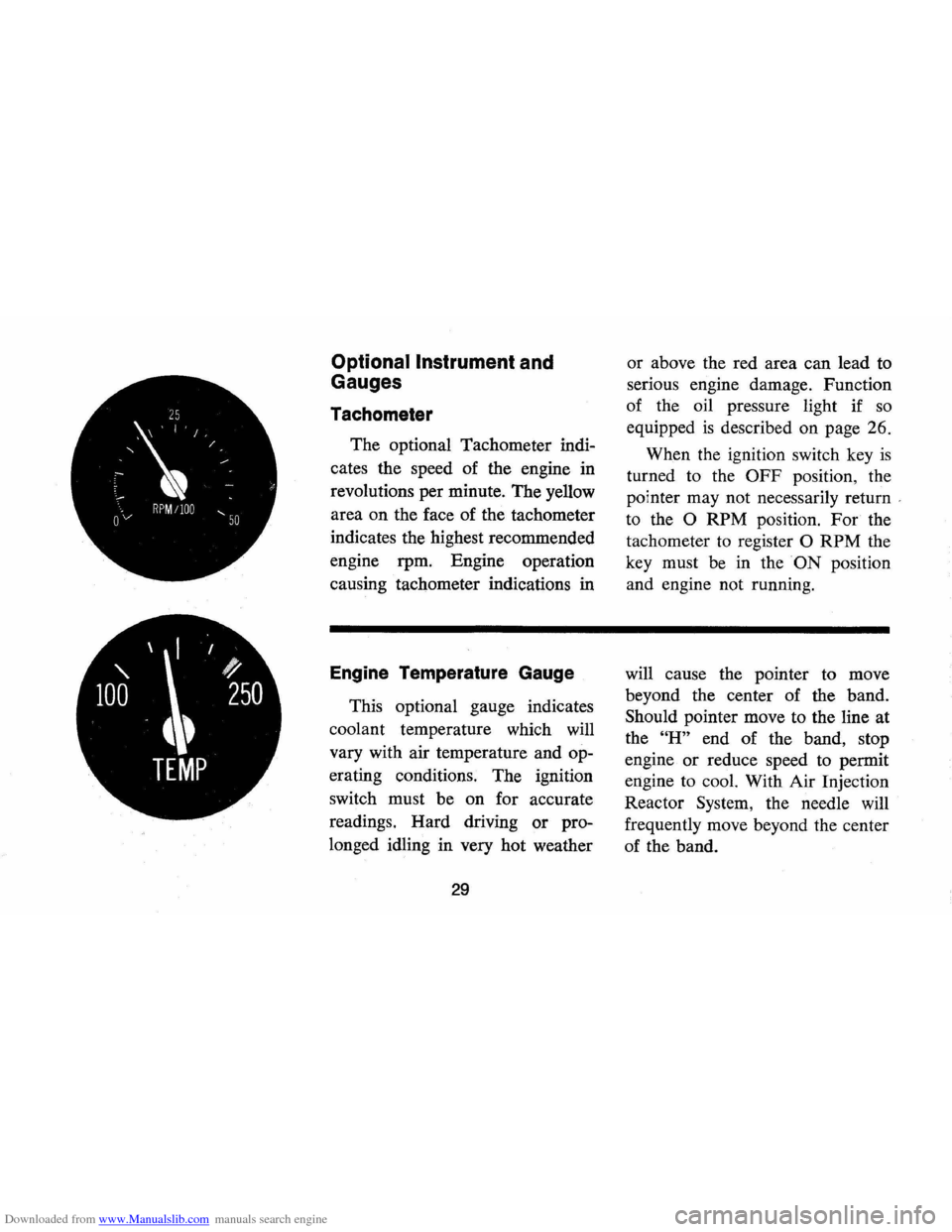
Tachometer
The optional Tachometer indi
cates the speed of the engine in
revolutions per minute. The yellow
area on the face of the tachometer
indicates the highest recommended
engine rpm. Engine operation
causing tachometer indications in
Engine Temperature Gauge
This optional gauge indicates
coolant temperature which will
vary with air temperature and op
erating conditions. The ignition
switch must be on for accurate
readings. Hard driving
or pro
longed idling in very hot weather
29
or above the red area can lead to
serious engine damage. Function
of the oil pressure light if
so
equipped is described on page 26.
When the ignition switch key
is
turned to the OFF position, the
pointer may not necessarily return
'
to the 0 RPM position. For the
tachometer
to register 0 RPM the
key must be in the
ON position
and engine not running.
will cause the pointer to move
beyond the center of the band.
Should pointer move to the line at
the
"H" end of the band, stop
engine
or reduce speed to permit
engine to cool. With Air Injection
Reactor System, the needle will
frequently move beyond the center
of the band.
Page 34 of 86
Downloaded from www.Manualslib.com manuals search engine VENT
CONTROLS
using washer -to help prevent
icing that may seriously obscure
vision.
Air Vents
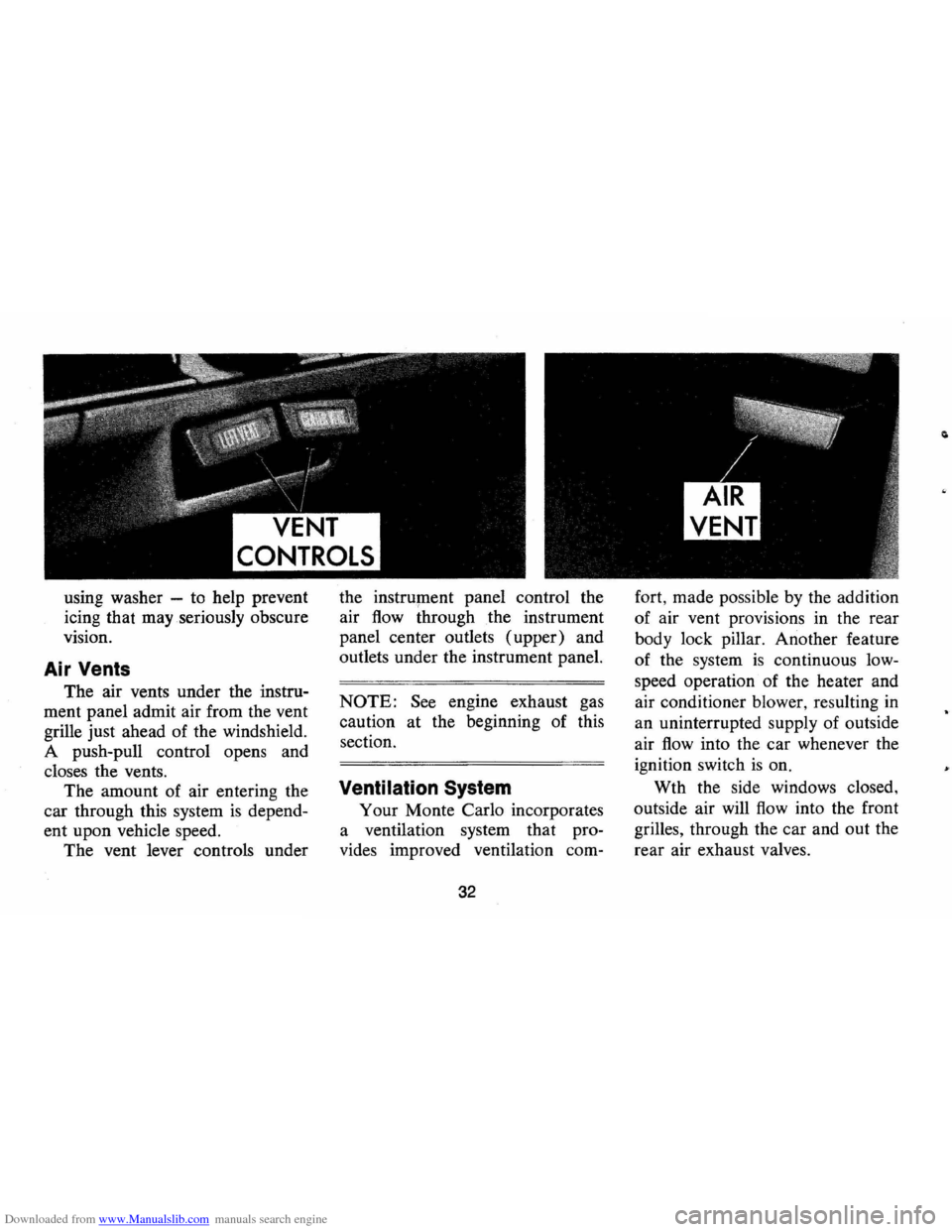
The air vents under the instru
ment panel admit air from the vent
grille just ahead of the windshield.
A push-pull control opens and
closes the vents.
The amount of air entering the
car through this system
is depend
ent upon vehicle speed.
The vent lever controls under the
instrument panel control the
air
flow through the instrument
panel center outlets (upper) and
outlets under the instrument panel.
NOTE: See engine exhaust gas
caution at the beginning of this
section.
Ventilation System
Your Monte Carlo incorporates
a ventilation system that pro
vides improved ventilation com-
32
fort, made possible by the addition
of air vent provisions in the rear
body lock pillar. Another feature
of the system
is continuous low
speed operation of the heater and
air conditioner blower, resulting
in
an uninterrupted supply of outside
air
flow into the car whenever the
ignition switch
is on.
Wth the side windows closed,
outside air will
flow into the front
grilles, through the car and out the
rear air exhaust valves.
Page 36 of 86
Downloaded from www.Manualslib.com manuals search engine Heater
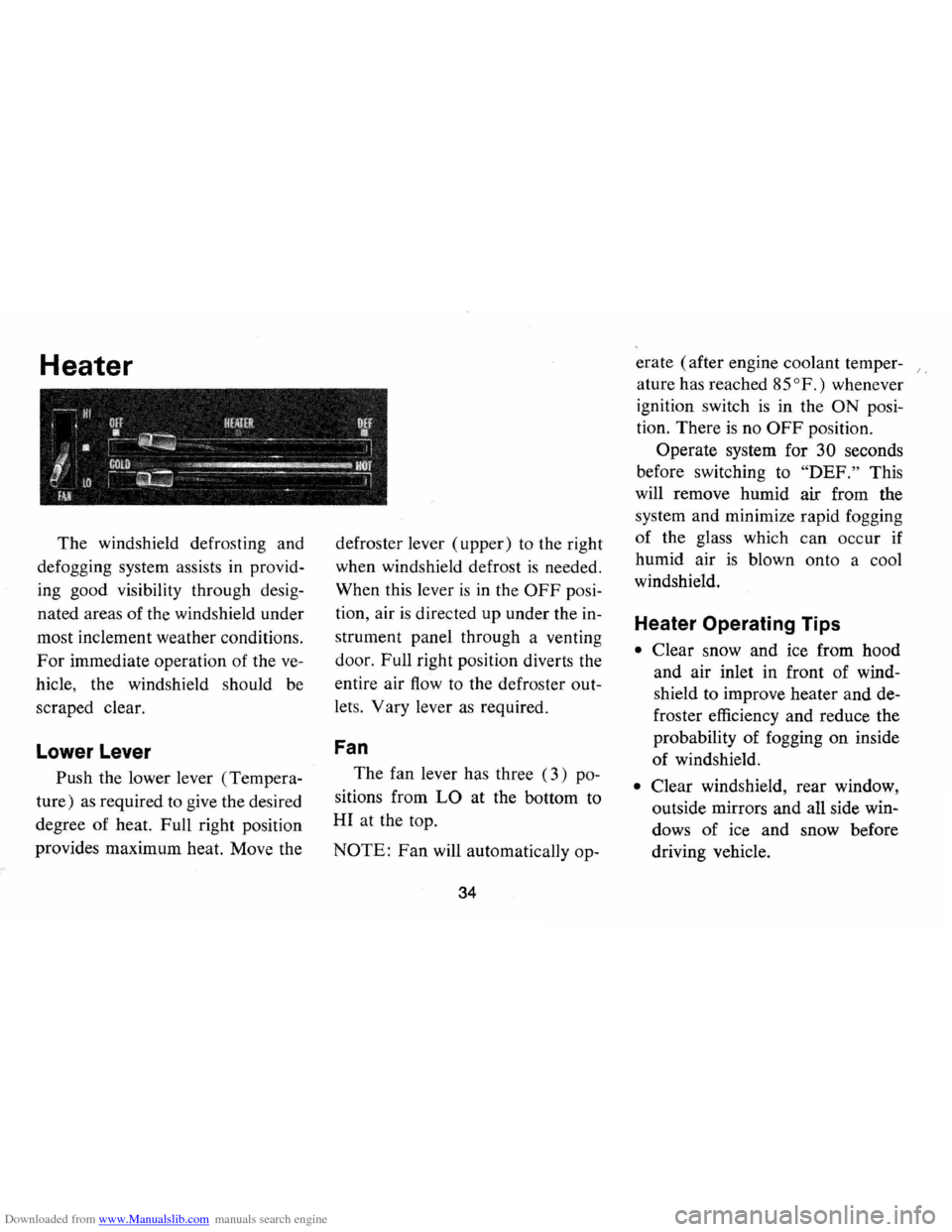
The windshield defrosting and
defogging system assists in provid
ing good visibility through desig
nated areas of the windshield under
most inclement weather conditions.
For immediate operation of the ve
hicle , the windshield should be
scraped clear.
Lower Lever
Push the lower lever (Tempera
ture)
as required to give the desired
degree of heat. Full right position
provides maximum heat. Move the defroster
lever (upper) to the right
when windshield defrost
is needed.
When this lever
is in the OFF posi
tion , air
is directed up under the in
strument panel through a venting
door. Full right position diverts the
entire air
flow to the defroster out
lets. Vary lever
as required.
Fan
The fan lever has three (3) po
sitions from
LO at the bottom to
HI at the top.
NOTE: Fan will automatically op-
34
erate (after engine coolant temper- /,
ature has reached 85°
F.) whenever
ignition switch
is in the ON posi
tion. There
is no OFF position.
Operate system for
30 seconds
before switching to
"DEF." This
will remove humid air from the
system and minimize rapid fogging
of the glass which
can occur if
humid air
is blown onto a cool
windshield.
Heater Operating Tips
• Clear snow and ice from hood
and air inlet in front of wind
shield to improve heater and de
froster efficiency and reduce the
probability of fogging on inside
of windshield.
• Clear windshield, rear window,
outside mirrors and all side win
dows
of ice and snow before
driving vehicle.
Page 41 of 86
Downloaded from www.Manualslib.com manuals search engine and repeat procedures outlined
for AM band setting.
NOTE: Bands cannot be changed
if push button
is unlocked.
Antenna
The radio antenna is incorpo
rated in the windshield glass.
If
necessary, adjustments for maxi
mum antenna effectiveness can be
made
by your authorized Chevro
let dealer.
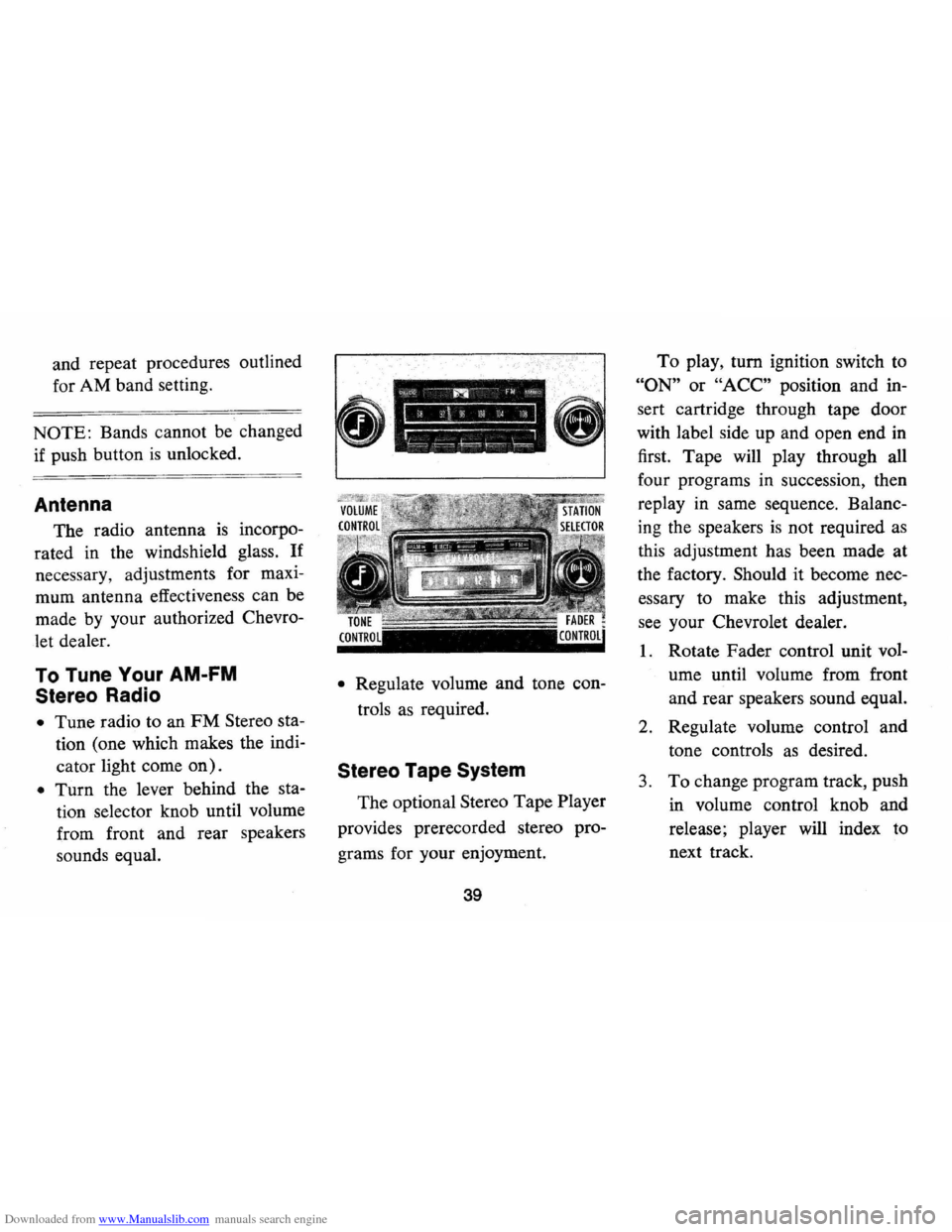
To Tune Your AM-FM
Stereo Radio
• Tune radio to an FM Stereo sta
tion (one which makes the indi
cator light come
on).
• Turn the lever behind the sta
tion selector knob until volume
from front and rear speakers
sounds equal.
• Regulate volume and tone con
trols
as required.
Stereo Tape System
The optional Stereo Tape Player
provides prerecorded stereo pro
grams for your enjoyment.
39
To play, turn ignition switch to
"ON" or "ACC" position and in
sert cartridge through tape door
with label side up and open end
in
first. Tape will play through all
four programs in succession , then
replay in same sequence. Balanc
ing the speakers
is not required as
this adjustment has been made at
the factory. Should it become nec
essary to make this adjustment,
see your Chevrolet dealer.
1. Rotate Fader control unit vol
ume until volume from front
and rear speakers sound equal.
2. Regulate volume control and
tone controls
as desired.
3. To change program track, push
in volume control knob and
release; player will index to
next track.
Page 71 of 86
Downloaded from www.Manualslib.com manuals search engine The chart on the previous page, and the information on the pages which follow, contains information designed to aid the average driver to discover, and possibly correct, conditions resulting in minor
mechanical difficulties in his cor. The chart, designed to point out
possible solutions to several of the most common automotive malfunctions and point out a logical checking sequence, will lead step by step to the most likely causes and corrective procedures. If, after making the checks and adjustments suggested,' the source of the
trouble has not been found and corrected, it is strongly recommended that an Authorized Chevrolet Dealer inspect the vehicle and make whatever repairs or adjustments are necessary.
FUEL SYSTEM AND ENGINE
If the ignition switch will cause the engine to "turn over" or "crank" but the cor will not start,
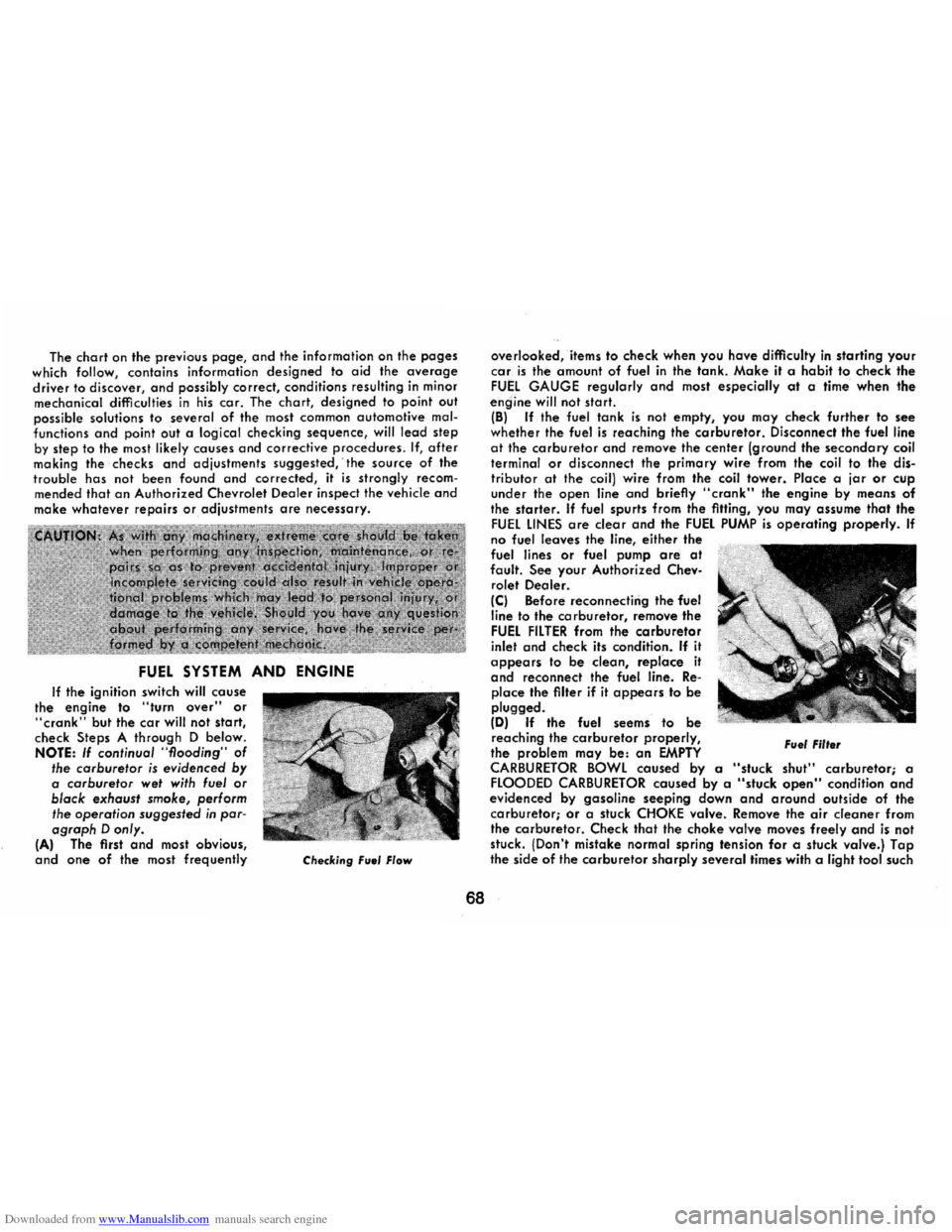
check Steps A through D below. NOTE: If continual "f1ooding" of the carburetor is evidenced by a carburetor wet with fuel or black exhaust smoke, perform the operation suggested in paragraph 0 only. (A) The first and most obvious, and one of the most frequently Checlcing Fuel Flow
68
overlooked, items to check when you have difficulty in starting your car is the amount of fuel in the tank. Make it a habit to check the FUEL GAUGE regularly and most especially at a time' when the engine will not start. (B) If the fuel tank is not empty, you may check further to see whether the fuel is reaching the carburetor_ Disconnect the fuel line at the carburetor and remove the center (ground the secondary coil
terminal or disconnect the primary wire from the coil to the distributor at the coil) wire from the coil tower. Place a jar or cup under the open line and briefly "crank" the engine by means of the starter. If fuel spurts from the fitting, you may assume that the FUEL LINES are clear and the FUEL PUMP is operating properly. If no fuel leaves the line, either the
fuel lines or fuel pump are at fault. See your Authorized Chevrolet Dealer. (C) Before reconnecting the fuel
line to the carburetor, remove the FUEL FILTER from the carburetor inlet and check its condition. If it appears to be clean, replace it and reconnect the fuel line. Replace the filter if it appears to be plugged. (0) If the fuel seems to be reaching the carburetor properly, the problem may be: an EMPTY Fuel Filter
CARBURETOR BOWL caused by a "stuck shut" carburetor; a flOODED CARBURETOR caused by a "stuck open" condition and evidenced by gasoline seeping down and around outside of the carburetor; or a stuck CHOKE valve. Remove the air cleaner from
the carburetor. Check that the choke valve moves freely and is not
stuck. (Don't mistake normal spring tension for a stuck valve.) Tap the side of the carburetor sharply several times with a light tool such
Page 72 of 86
Downloaded from www.Manualslib.com manuals search engine as a screwdriver handle or pliers. Replace the oir cleaner and attempt to start the engine in the normal manner. (E) If the car will start but stalls when hot or has a rough idle, you can suspect a faulty IDLE ADJUSTMENT, a malfunctioning AUTOMATIC CHOKE or an extremely dirty and blocked AIR CLEANER ELEMENT. Replace paper element air cleaner if necessary. Idle adjustment or automatic choke service (other than that outlined in paragraph 0 above) should be performed by your Chevrolet
Dealer. If the above Fuel System checks and the checks suggested under
the Electrical System following do not correct the malfunction, it is recommended that you turn to your Authorized Chevrolet Dealer
for further checks, adjustments or repairs. ELECTRICAL SYSTEM If when the ignition key is turned to "Start", the engine will not turn' over, yOu have good reason to suspect electrical trouble. NOTE: Never'remove Delcotron bat lead without first disconnecting battery ground cable. IF) When there is no response at all to attempts to start the car,
check the obvious-your AUTOMATIC TRANSMISSION SELECTOR LEVER must be in Neutral or Park position (manual transmission
must have clutch depressed all the way to floor) before the engine
can be starfed. Turning the IGNITION SWITCH rapidly back and forth several times will sometimes correct a poor internal switch
contact.
(GI The BATTERY may be discharged. If so, lights will be dim and the horn will have a poor tone if it will blow at all.
Usually a garage recharge will be necessary to return the battery to operation. Occasionally, however, a long drive will recharge the battery. . , •
NOTE: If the baHery is determined to be dead, and for no apparent reason, have your :Aflthori~ed Chevrolet Dealer check the baHery, the GENERATOR and the VOLTAGE REGULATOR.
GENERATOR trouble shqiJld already have been indicated by
69
the generator indicator light on the instrument panel.
POOR BATTERY CONNECTIONS may be suspected if the car has operated properly a short time before and now not even the horn will operate. Check both ends of both battery cables. If the connections are corroded, a car may sometimes be restored to operation by removing all cable ends, scraping all contacting surfaces
clean with a pen knife, and reassembling. If the cables are broken,
they must be replaced. The power supply should now be restored unless-the battery is dead.
(HI If, however, the lights and horn work properly but the starter will still not turn over, check the STARTER connections. A "click" from the starter solenoid indicates that the wiring to the starter is properly installed. If the wiring seems to be clean and tightly installed, the trouble is probably in the starter itself and should be referred to your Authorized Chevrolet Dealer.
When the engine will "turn over" but will not start, the following
items may be checked along with the Fuel Systems Checks listed previously.
(II With a clean dry cloth wipe the ce-amic portions of the spark plugs dry. In particularly damp or rainy weather dampness may be the cause of not starting, espe
cially when the engine is cold.
(JI Check the cables at the top
of the distributor and coil as well as each spark plug cable for
tightness.
(KI If the car will still not start,
check for spark at the spark plugs in the following manner: Pull one of the spark plug
wires off its spark plug. Insert a
short piece of bare wire (such as Distributor and Coli Cables
Page 73 of 86
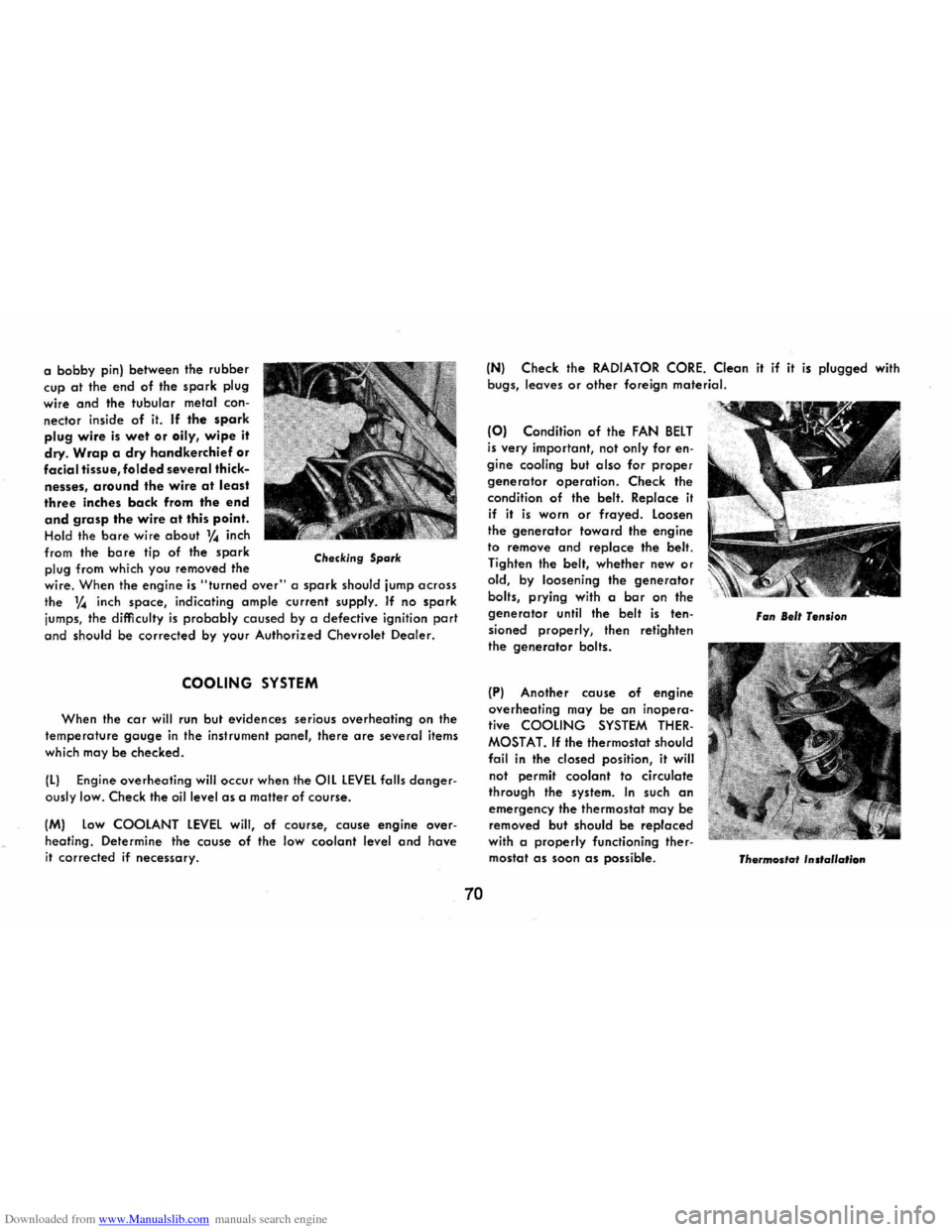
Downloaded from www.Manualslib.com manuals search engine a bobby pin) between the rubber
cup
at the end of the spark plug
wire
and the tubular metal con
nector inside
of it. If the spark plug wire is wet or oily, wipe it
dry.
Wrap a dry handkerchief or
facial tissue, folded several thick
nesses,
around the wire at least
three inches back from the end and grasp the wire at this point.
Hold the bare wire about V4 inch
from the
bore tip of the spark plug from which you removed the Checking Spark
wire. When the engine is "turned over" a spark should jump across
the 1,4 inch space, indicating ample current supply. If no spark
jumps, the difficulty is probably caused by a defective ignition part
and should be corrected by your Authorized Chevrolet Dealer.
COOLING SYSTEM
When the car will run but evidences serious overheating on the
temperature gauge in the instrument panel, there are several items
which may
be checked.
IL) Engine overheating will occur when the OIL LEVEL falls danger
ously low. Check the oil level as a mailer of course.
1M) Low COOLANT LEVEL will, of course, cause engine over
heating . Determine the
cause of the low coolant level and have it corrected if necessary.
70
IN) Check the RADIATOR CORE. Clean it if it is plugged with
bugs, leaves or other foreign material.
(0) Condition of the FAN BELT
is very important, not only for en
gine cooling but
also for proper
generator operation. Check the
condition of the belt. Replace it
if it is worn or frayed. Loosen
the generator toward the engine
to remove
and replace the belt.
Tighten the belt, whether new or
old, by loosening the generator
bolts, prying with a bar on the
generator until the belt is ten
sioned properly , then retighten
the
generator bolts.
(P) Another couse of engine
overheating may be
an inopera
tive
COOLING SYSTEM THER
MOSTAT. If the thermostat should
foil in the dosed position, it will
not permit
coolant to circulate
through the system. In such an
emergency the thermostat may be
removed but should be
replaced with a properly functioning ther
mostat as soon as possible.
Fan Belt Tension
Thermostat
'ns'alla"on
Page 83 of 86
Downloaded from www.Manualslib.com manuals search engine Gasoline (See Also Fuel) Do Not Use For Cleaning ........... 46 Filler Cap Location. .. .. .. . . . .. .. ... 51 Gauge ............................. 25 Low-Lead .......................... 50 Recommendations. . . . . . . . . . . . . . . . .. 50 Gauge, Fuel.. . . . . . . . . . . . . . . . . . . . . . . .. 26 Gearshift Lever. . . . . . . . . . . . . . . . . . . . . .. 18 Generator Indicator Light ("AMP") .......................... 27 Glove Box. . . . . . . . . . . . . . . . . . . . . . . . . .. 25 Harness, Safety (See Seat Belts)
Hazard Warning Flasher. .............. 41 Headlamp
Flickering (Circuit Breaker). . . . . . . . .. 73 High Beam Dimmer Switch .......... 24 High Beam Indicator ........... ; . . .. 28 Light and Instrument Panel
Switch ........................... 28 Head Restraints . . . . . . . . . . . . . . . . . . . . .. 10 Heater Operation. . . . . . . . . . . . . . . . . . . .. 34 High Speed Operation
During Break-In.. .... .. .. .. .... .... 2
Tires .............................. 60 Hitches, Trailer... . . . . . . . . . . . . . . . . . . .. II
Hood Latch Maintenance
.................. 56 Release .............. Inside Back Cover
Horn ................................ 22 "HOT" Light (See Engine
Temperature Light)
Hub Caps, Replacing.. . . . . . . . . . . . . . . .. 43 Hydroplaning. . . . . . . . . . . . . . . . . . . . . . .. 65 Identification Numbers
Body ........................... : .. 71 Engine ............................ 71 Vehicle ............................ 71
Ignition Keys.................. ............ 3
Lock ..... ......................... 15 In Case Of Emergency. . . . . . . . . . . . . . . .. 41 Indicator Lights
Brake ................ ............. 27 Electrical Charging (Generator) ....... 27 Engine Temperature. . . . . . . . . . . . . . . .. 27 Fuel .............................. 26 Oil Pressure. . . . . . . . . . . . . . . . . . . . . . .. 26 Infant Restraining Methods. . . . . . . . . . .. 10 Infant Safety Carrier. . . . . . . . . . . . . . . . .. 10 Inflation Pressure, Tires. . . . . . . . . . . . . . .. 60 InIets, Ventilation System .............. 32 Inside Rearview Mirror. . . . . . . . . . . . . . . . 6
Instrument Panel. . . . . . . . . . . . . . . . . . . .. 25 Interior Appearance Care .............. 47 Jack
Operation .......................... 44 Storage .............. ............. , 44 Jump Starting With Booster Battery. . . .. 43 Key Buzzer System ....... , ............ 15 Keys................................ 3
Knocking Engine (See Fuel)
(Recommendations)
Lacquer, Acrylic Care .
................ 49 Lane Changer and Turn Signal. . . . . . . .. 20 Lap and Shoulder Belts... . . . . . . . . . . . . . 6
Latches
Door............. ................. 4
Folding Seat Back. . . . . . . . . . . . . . . . .. 4
Hood ................. ............ 56 Lighter, Cigarette ......... ............ 31 Lights ...................... , ........ 73 Backup ............................ 73 Brake Warning . . . . . . . . . . . . . . . . . . . .. 27 Bright Beam Indicator ............... 28
80
Bright Beam Switch .............. , .. 24 Bulb Chart. . . . . . . . . . . . . . . . . . . . . . . .. 73 Courtesy. . . . . . . . . . . . . . . . . . . . . . . . . .. 73 Engine Temperature Indicator. . . . . . .. 27 Generator Indicator. . . . . . . . . . . . . . . .. 27 Hazard Flasher. . . . . . . . . . . . . . . . . . . .. 41 Headlamp Circuit Breaker. . . . . . . . . .. 73 Headlamps. . . . . . . . . . . . . . . . . . . . . . . .. 28 Maintenance . . . . . . . . . . . . . . . . . . . . . .. 73 Oil Pressure Indicator. . . . . . . . . . . . . .. 26 Sidemarker. . . . . . . . . . . . . . . . . . . . . . .. 73 Switch ............................. 28 Tail and Brake. . . . . . . . . . . . . . . . . . . .. 73 Turn Signal Indicator. . . . . . . . . . . . . .. 20 Turn Signals. . . . . . . . . . . . . . . . . . . . . .. 20 Linings, Brake ..................... 24, 56 Liquid Tire Chain .................... 41 Load, Full Rated (See Tires)
Locks
Door......................... .. ... 4
Glove Box....... .................. 4
Ignition. . . . . . . . . . . . . . . . . . . . . . . . . .. 15 Steering Column .................... 15 Low-Lead Fuels ...................... 51 "Low" (L) Transmission Range ........ 18 Lubrication Oils ............................... 51 Recommendations. . . . . . . . . . . . . . . . .. 51 Luggage Compartment, Driving
While Open ........................ 15 Luggage Or Cargo Caution. . . . . . . . . . .. 15 Maintenance
Appearance Care. . . . . . . . . . . . . . . . . .. 46 Schedule. . . . . . . . . . . . . . . . . . . . . . . . . .. 50 Manual Transmission ................. 19 Master Cylinder, Brake. . . . . . . . . . . . . . .. 56 Metal Cleaners. . . . . . . . . . . . . . . . . . . . . .. 49 Methods Of Restraining Children ....... 10