check engine CHEVROLET MONTE CARLO 1976 2.G User Guide
[x] Cancel search | Manufacturer: CHEVROLET, Model Year: 1976, Model line: MONTE CARLO, Model: CHEVROLET MONTE CARLO 1976 2.GPages: 102, PDF Size: 23.79 MB
Page 53 of 102
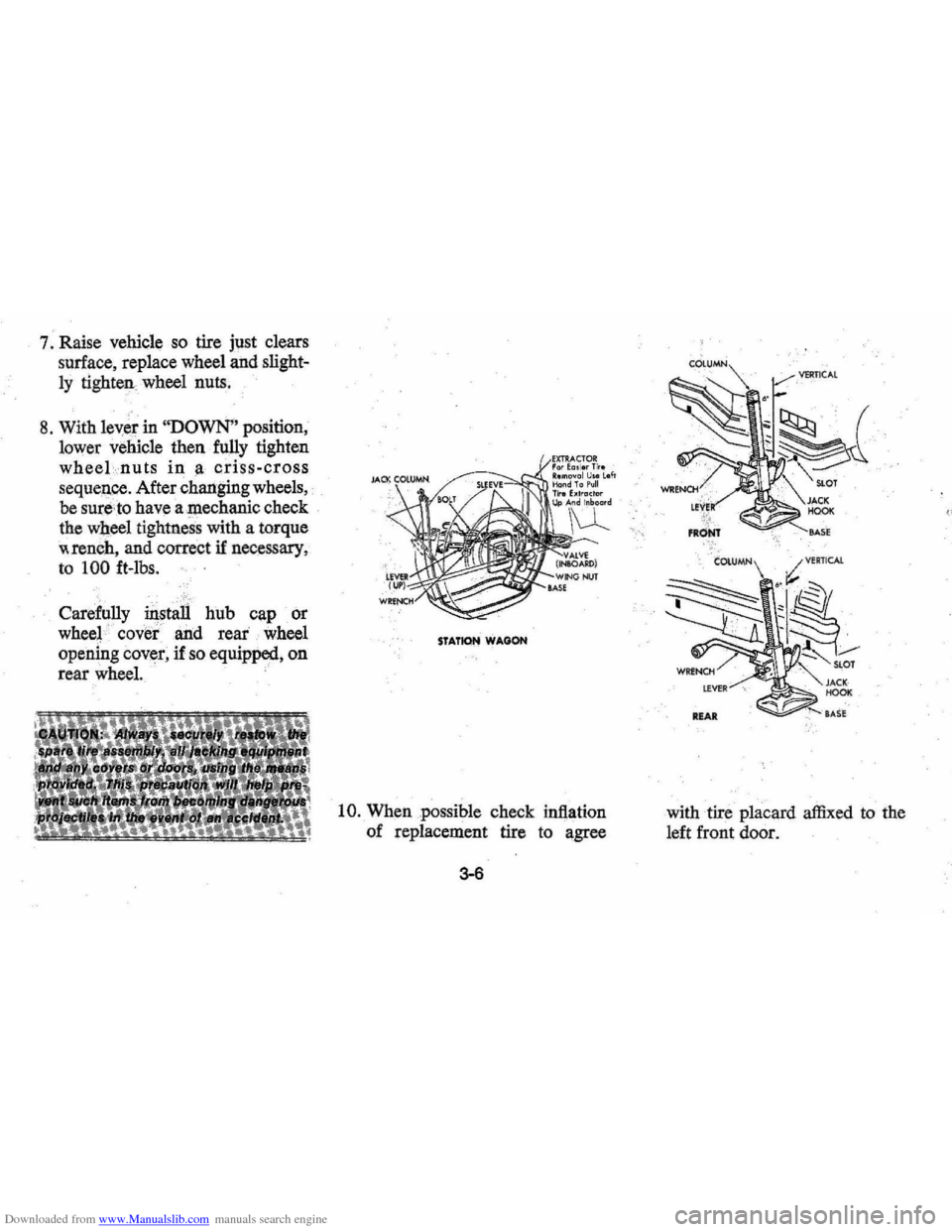
Downloaded from www.Manualslib.com manuals search engine 7. Raise vehicle so tire just clears
surface, replace wheel and
slight
ly tighteawheel nuts.
8. With leyer in "DOWN" position,
lower vehicle then fully tighten
wheeLnuts in a criss-cross
seq ueIice. After chariging wheels,
be sure,to have a mechanic check
the wheel tightness with a torque
"rench, and correct if necessary ,
to 100 ft-lbs.
Carefully instali hub cap or
wheel '
covet and rear.' wheel
opening cover, if
so equipped, on
rear wheel.
.
STATION WAGON
10. When possible check inflation
of replacement tire
to a,gree
3-6
with tire placard affixed to the
left front door.
Page 64 of 102
Downloaded from www.Manualslib.com manuals search engine A high quality SE oil was in
stalled in
your engine at the factory.
It is not necessary to change this
factory-irtstalled oil prior to the
recommended normal chartge pe
riod . However , check the oil level
more frequently during the break
in period since higher oil consump
tion is normal until the piston rings
becom e sea ted.
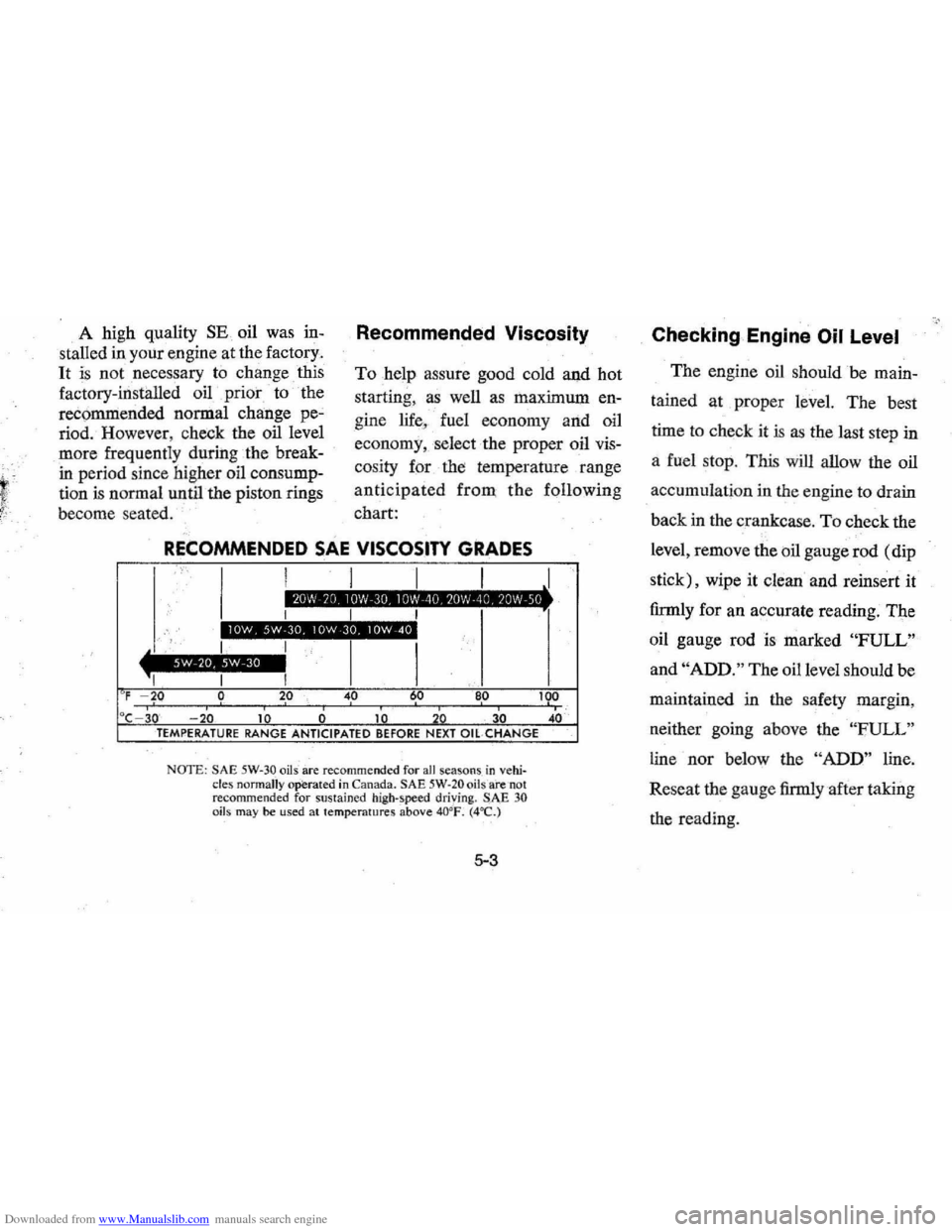
Recommended Viscosity
To help assure good cold and hot
starting, as well as maximum en
gine life, fuel economy and oil
economy , select the proper oil vis
cosity for
the temperature range
anticipated from the following
chart:
RECOMMENDED SAE VISCOSITY GRADES
I I I I 20W 20 lOW 30 lOW 10 7(lV, 10 JOW 50
JOW 5w 30 lOW 30 lOW 40
sw 20 5W 30
F --;fO , ? ,2,0 ,4,0 ~O 8,0 , 1~
°c 30' 20 10 0 1 30 40 TEMPERATURE RANGE ANTICIPATED BEFORE NEXT OIL,CHANGE
NOTE: SAE 5W-30 oils· are rec ommended for all seasons in vehicles normally operated in Canada. SAE 5W-20oi ls are nol recommended fur su stained high-speed driving. SAE 30 oi ls may be used at tempera tures above 4O"F. (4"C.)
5-3
Checking Engine Oil Level
The engine oil should be main
tained
at proper level. The best
time
to check it is as the last step in
a fuel stop. This will allow the oil
accumulation in
the engine to drain
back in the crankcase.
To check the
level, remove the oil gauge rod (dip
stick), wipe it clean and reinsert it
firmly for an accurate reading. The
oil gauge rod is marked
"FULL"
and "ADD." The oil level should be
maintained in the safety margin,
neither going above the
"FULL"
line nor below the "ADD" line.
Re sea t the gauge firmly after taking
the reading.
Page 65 of 102
Downloaded from www.Manualslib.com manuals search engine Supplemental Engine 011
Additives·
The regular use of sUpplemental
additives is specific ally not recom
mended
and will increase operat
ing costs . However , supplemental
additives are avail able that can ef
fectively and economicall y solve
certain specific problems without
c ausing other difficulties . F
or ex
ample , if higher detergen cy i s re
quired to reduce varnish and sludge
deposit
s. resulting from some un
usual operational difficulty, a thor
oughly te sted and approved addi
tive-"G.M. Super Engine Oil Sup
plement "
-is availabl e at your Chev
r olet dealer.
In the event of an
operation al problem, consult your
dealer for advice before using sup
plemental additives.
Air Cleaner
When replacement of Air Cleaner
filter element
is ne cessary , an AC
ACron air filter element is recom
mended ,
Drive Belts
Every 12 mOJ.1ths or 15,000
mil es-inspect drive belts for wear ,
fraying,
qracking, and tension. Belts
which
are in poor condition should
be replaced immediately .
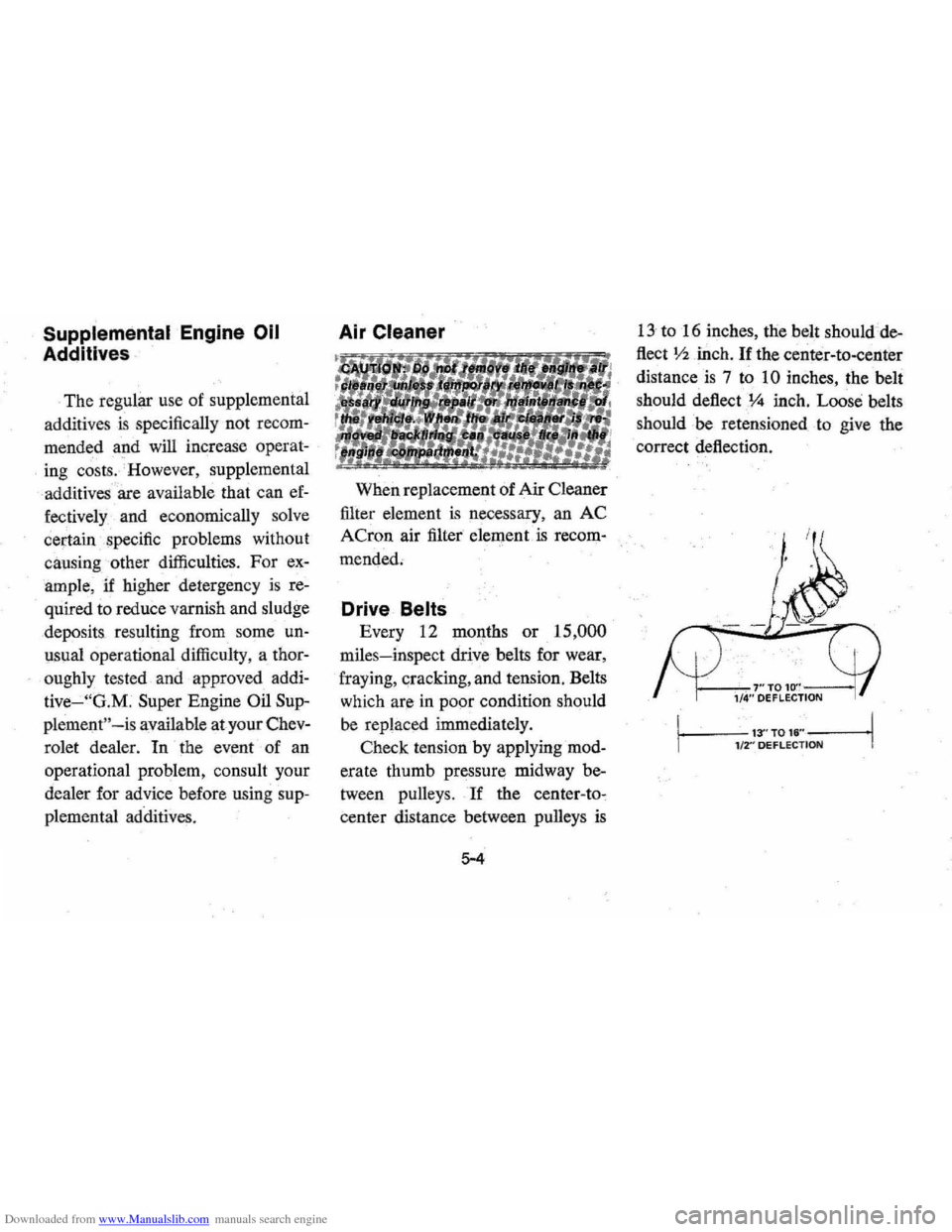
Check tension by applying mod
erate thumb pressure midway be
tween
pUlle y s. If the center-to ,
center distance between pulleys is
5-4
13 to 16 inches, the belt should de
flect Y
2inch. If the center -to-center
distance
is 7 to 10 inches, the belt
should
deflect .v.. inch. Loose belts
should be retensioned
.to give the
correct deflection.
>-~-7"TO'O"---1/4" DEFLECTION
I ... '3"TO"" I r-m"DEFLECTI~
Page 66 of 102
Downloaded from www.Manualslib.com manuals search engine TRANSMISSION ITEMS
Automatic Transmission
Fluid Level
Recommendations
Use automatic transmission
fluids identified with the mark
DEXRON®-II available from your
Chevrolet dealer
or local service
station.
Check the fluid level
at each en
gine oil change period.
Automatic transmissions are
fre
quently overfill¢
level
is checked when the fluid is
cold and the dipsick indicates fluid
should be added. However, the low
reading may
be normal since the
fluid level will rise as the fluid tem
perature increases. A level change
of over
% inch will occur as fluid
temperature rises from
60° F. to
180° F. (16° C. to 82° C.)
Overfilling can cause foaming
and loss of fluid through the vent.
(650 -8S"F.) (18" _29°C.) COOL HOT
WARM
NOTE, DO NOT OVERFill. It takes only one pint to raise level from ADD to FULL with a hot transmission.
Slippage and transmission failure
can result.
Fluid level too low can cause
slipping, particularly when the
transmission is cold or the car is
on a hill.
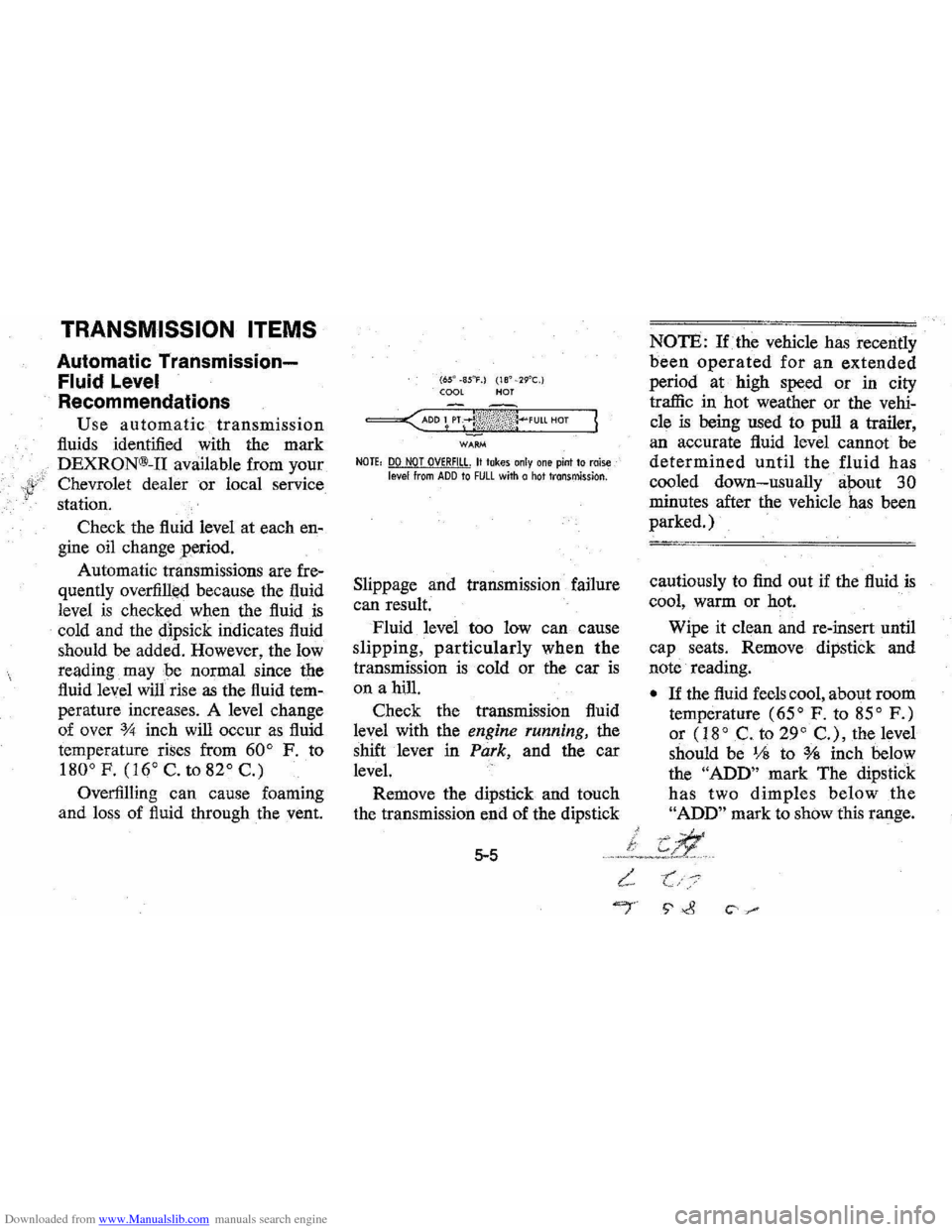
Check the transmission fluid
level with the
engine running, the
shift lever
in Park, and the car
level.
Remove the dipstick and touch
the transmission
end of the dipstick
5-5
L.
NOTE: lithe vehicle has recently
been operated for an extended
period at high speed or in city
traffic
in hot weather or the vehi
cle is being used to pull a trailer,
an accurate fluid level cannot be
determined until the fluid has
cooled down-usually apout 30
minutes after the vehicle has been
parked.)
cautiously to find out if the fluid is
cool, warm or hot.
Wipe it clean and re-insert until
cap seats. Remove dipstick and
note reading.
• If the fluid feels cool, about room
temperature
(65° F. to 85° F.)
or (18° C. to 29° C.), the level
should
be 1;8 to % inch below
the
"ADD" mark The dipstick
has two dimples below the
"ADD" mark to show this range.
"'j' S' ~ c· "
Page 68 of 102
Downloaded from www.Manualslib.com manuals search engine ENGINE COOLING
SYSTEM
The recovery type cooling sys
tem is standard on all Chevrolet
pasSenger cars. The coolant ex~
pands with rising temperature and
the overflow
is dOllected in the
recovery tank.
When the system
temperature drops, the coolant is
drawn back
intocthe radiator. The
cooling system has been filled at
the factory with a high-quality, in
hibited , year-around coolant that
meets the standards
of General
Motors Specification I
899"M. This
coolant solution provides freezing
protection
to -20oP (-28°C),
and in Canada to _35°P
( -37°C), and it h~s been formu
lated to be used without replace
ment for two years or 30,000 miles.
After two years
or 30,000 miles,
the coolant should be drained to
prevent rust or corrosion in the
radiator and engine.
Cooling System Care
Do not remove radiator cap to
check coolantlevel , but
checkvisu
ally in the "see 'thru " coolant re
covery tank at least as frequently
as ,needed. LeveL should be at the
"full cold" mark on the recovery
tank when the system
is cold and
at the
"full hot" roark at Iiormal
operating temperature. Add'~ 501
50 mixture of high-quality ethylene
glycol antifreeze and
waler for
coolant additions.
If frequent addi
tionsare required, see your dealer
for
a cooling system check.
NOTE: If recommended quality
antifreeze
is used,supplemental in
hibitors or additives claiming to
provide increased capability are
not
necessary. They may be detrimen
tal to the efficient operation of the
system, and represent an
unneces
sary operating expense.
5-7
The cooling system should be
serviced every year as follows:
1. Wash radiator cap and filler neck
with clean water.
2. Check coolant for proper level
and freeze protection.
3. Test system
and radiator cap for
, properpresslire holding capacity
(15 psi).
Ifreqitired, use cap
designed by
AC for coolant re
co~ery systems, and specified for
your model.
4, Tighten hose clamps and
inspect
all hoses. Replace hoses if swol
len, checked or otherwise deteri
orated.
5. Clean frontal area of radiator
, qcire and air conditioning con
denser.
Page 70 of 102
Downloaded from www.Manualslib.com manuals search engine --;
protection at-20op (-2S0C) or
below to ensure pro;tection against
corrosion and loss
of coolant
from boiling even though freezing '
temperatures are not expected.
• Add ethylene glycol base coolant
that meets
GM Specification
IS99-M when coolant additions
are required because of coolant
loss
Or to provide additional pro"
tection against freezing at tem_
peratures lower than _20oP,
(-2S0C),' and in Canada to
_35°P ( -3JOC).
NOTE: AlcOhol Or methanol base
coolants or plain water are not
recommended for your vehicle at
any time.
Radiator Pressure Cap
The radiator cap, a 15 lb. pres
sure type, must be installed tightly,
otherwise coolant may be lost and
damage
, to engine may result from
overheating. Radiator pressure caps
should
be chef'ked periodically for
' proper operation.
If replacement is
required specify·AC.
Thermostat
The cooling system is protected
and controlled by a thermostat that
maintains a satisfactory
" engine
operating temperature . This
ther
mostat is installed in the engine
coolant outlet
arid is designed for
continuous use through both winter
and
s ·ummer. When replacement is
necessary, Delco parts are recom
mended.
5-9
CHASSIS ITEMS
Rear Axle Lubricant
Standard -
Every 6 months or
7,500 miles , whichever occurs first,
check lubricant level and add
lubri
cant, if necessary, to fill to level of
filler plug hole.
Use SAE SOW or
SAE SOW-90 GL-5 Gear Lubricant.
cant.
(Por vehicles operated in
Canada, use
SAE SOW Gear Lubri
cant.)
Posilraction -Drain and refill
after
the first 15,000 miles then
maintain same
as standard axle but
use only the special positraclion lu-·
bricant available from yo ur Chev
roletDealer , part number 1051022.
Rear Universal Joint Fitting
-Except Wagons
Every 6 months or 7,500 miles
lubricate universal joint with water
resistant
EP Chassis Lubricant
Part number 1050679 which meets
GM Specification 6040M.
Page 71 of 102
Downloaded from www.Manualslib.com manuals search engine Front suspension
Every 6 months or 7,500 miles
Lubricat~ fittings with water re
sistant EP Chassis Lubricant which
meets
GM Specification6031M.
NOTE: , Ball joints should not be
lubricated unless their temperature
is
+10° F (- 12 °C), or higher.
During cold weather, they should
be allowed to
warm up as necessary
before being
l\lbricated.
Steering Linkage
Every six months or 7,500 miles,
lubri cate fittings with water
resist
ant EP Chassis Lubricant which
meets GM Specification
6031M.
Power Steering System
Check the fluid level in the pump
reservoir at each oil change period.
Add GM
Power Steering Fluid
(or Automatic Transmission Fluid
DEXRON"-II) as necessary to
bririg level into proper range on
filler cap indicator depending upon
fluid temperature.
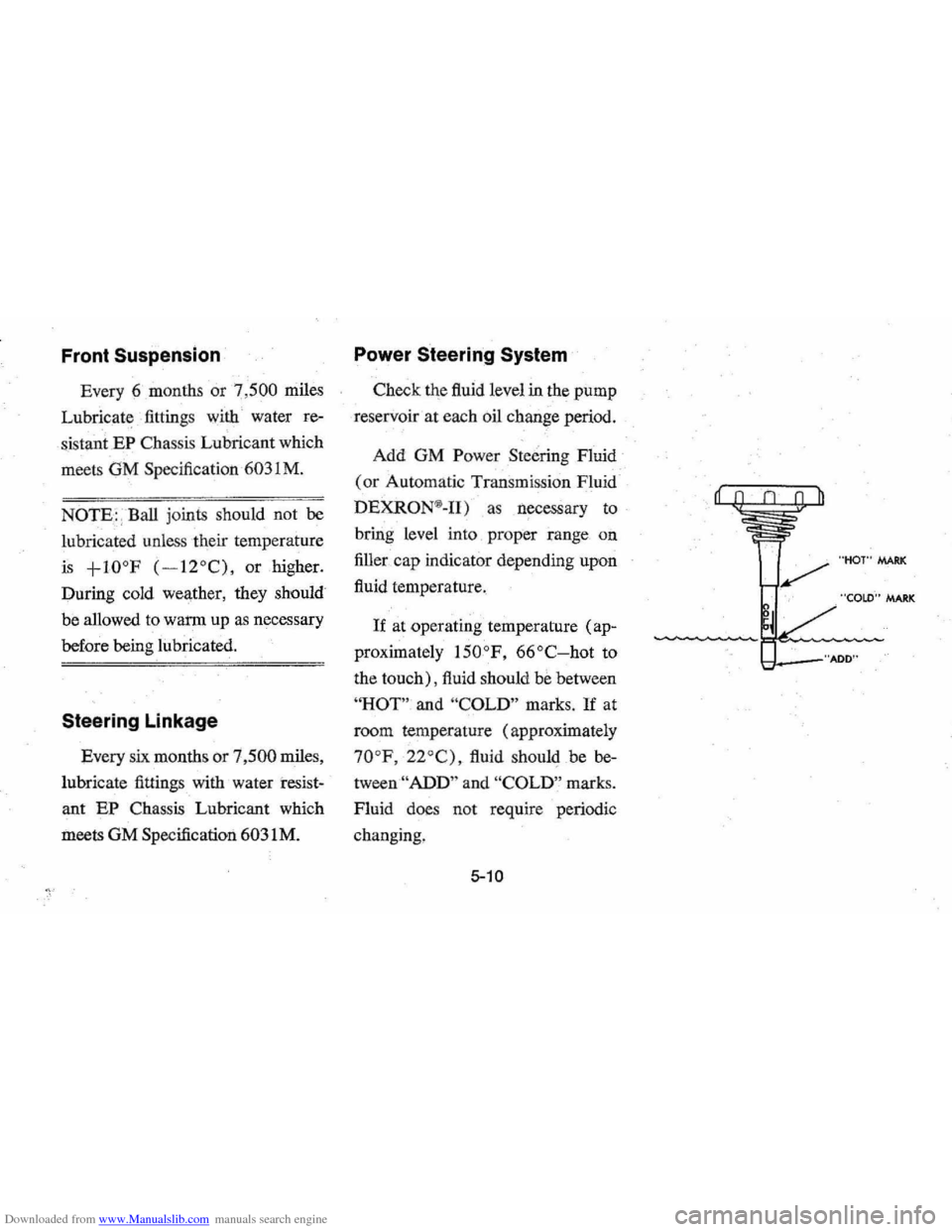
If at operating temperature (ap
proximately 150°F, 66°C-hot to
the touch), fluid should be between
"HOT" and "COLD" marks. If at
room temperature (approximately
70°F, 22°C), fluid should be be
tween "ADD " and "COLD " marks.
Fluid does not require periodic
changing.
5-10
"HOT" MARK
''COL~'' MARK
\::::j. __ "ADD"
Page 72 of 102
Downloaded from www.Manualslib.com manuals search engine Front Wheel Bearings
Every 30,000 miles-clean and
repack with
a. high melting point
wheel bearing lubricant.
Use wheel
bearing lubricant GM Part No.
1051344 or equivalent. This
is a
premium high
~elting point lubri
cant. When replacement is neces
sary specify Delco parts.
Brakes
Brake linings should be periodi
cally inspected for wear
by a quali
fied technician. The frequency of
this inspection depends upon
driv
ing conditions such as traffic or
terrain, and also the driving tech
niques of individual owners .. Your
Chevrolet Dealer is best qualified
to advise you
as to how often this
inspection should be performed.
When replacement is required,
specify
GM and Delco parts.
REMINDER: The front disc
brakes have a built-in wear indica
tor
thatis designed to make a high
frequency , squealing
or cricket-like
warning
sOl!l1d when the linings are
worn to where replacement is re
quired. The sound will occur inter
mittently or continuously when
wheels are rolling, but will
dis
appear when the brake pedal is
firmly applied. Also see the brake
checks listed. in the Maintenance
Schedule folder.
5-11
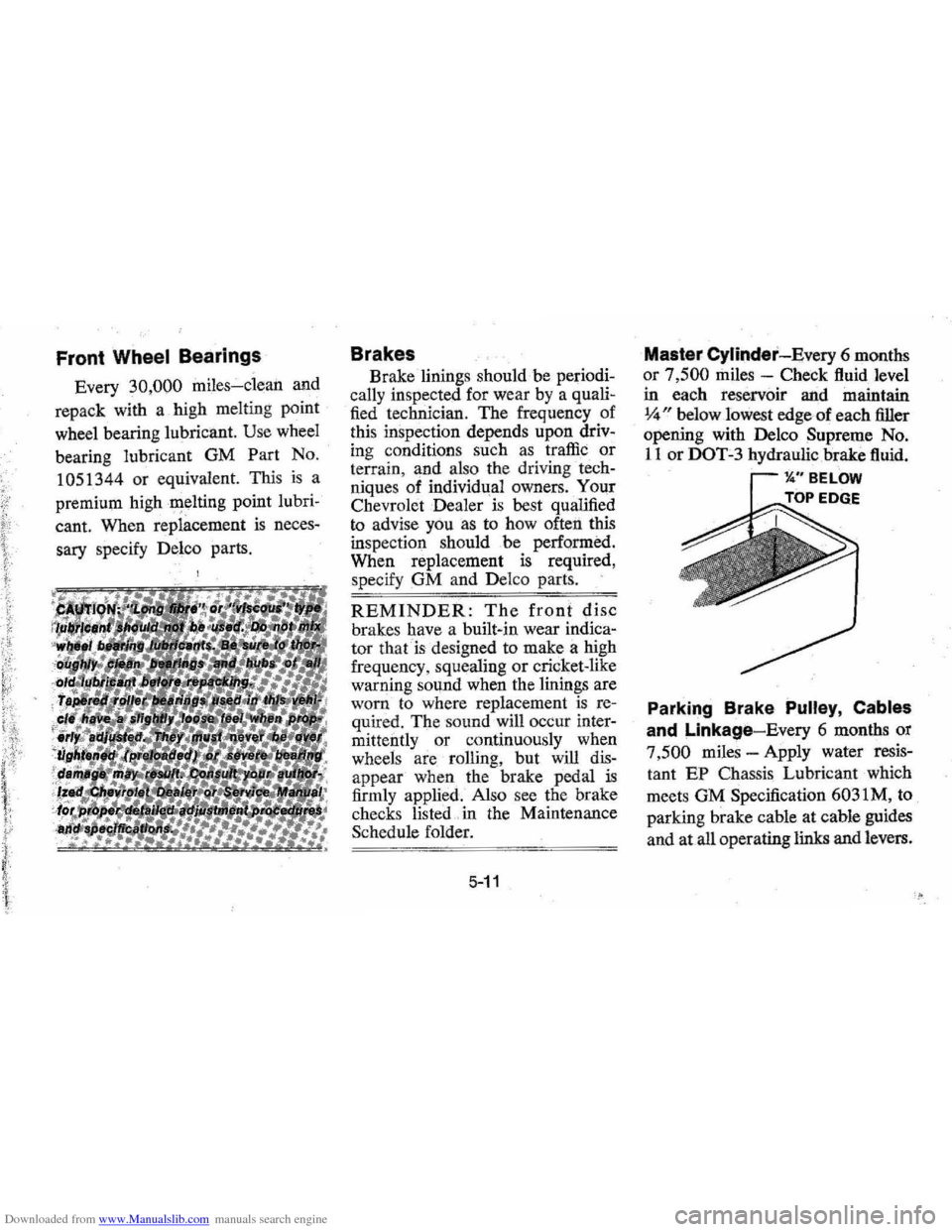
Master Cylinder-Every 6 months
or
7,500 miles -Check fluid level
in each reservoir and maintain
14" below lowest edge-of each filler
opening with Delco Supreme No.
liar DOT-3 hydraulic brake fluid.
11." BELOW
TOP EDGE .k:::O"',
Parking Brake Pulley, Cables
and Linkage-Every 6 months or
7
,500 miles -Apply water resis
tant EP Chassis Lubricant which
meets GM Specification 6031M, to
parking brake cahle at cable guides
and at all operating links and levers.
Page 73 of 102
Downloaded from www.Manualslib.com manuals search engine Accelerator Linkage
Lubricate with engine oil every
15,000 .miles as follows:
1. V-8 Engine-lubricate cable pin
at the carburetor lever.
Hinges
The following points should be
checked and lubricated every 6
months or
7,500 miles, whichever
occurs first: hinges on all doors,
fuel filler door, trunk lid, door lock
striker and door jamb switches.
Hood Latches
Every 6 months or 7,500 miles
whichever occurs first, lubricate
hood latch assembly and hood
hinge assembly
as follows:
1. Wipe off any accumulation of
dirt or contamination on latch
parts.
2. Apply Lubriplate
or equivalent
to latch pilot bolts and latch
locking
plate,
3. Apply light engine oil to all
pivot points in release
mecha
nism, as well as primary and
secondary latch mechanisms.
4. Lubricate hood hinges.
5. Make hood hinge and latch
mechanism functional check to
5-12
asSUre the assembly is working
correctly.
Air Conditioning
Have your Chevrolet Dealer
check your Air Conditioning
sys
tem at some time during the winter
months to be sure there has been
no loss in cooling output. During
the summer, see your Chevrolet
Dealer immediately if you suspect
the system
is nof performing as it
should.
NOTE: Your car's air condition
ing system will not operate be
low ambient temperatures of 300P
( -1°C) regardless of control
position.
Page 76 of 102
Downloaded from www.Manualslib.com manuals search engine co mfort, the reduced tire pressures
listed on the placard may
be used
when reduced loads of 5 occupants
or
less are carried. Improper tire
inflation pressures
c,an adversely
affect tire life and vehicle perform-
l' ance.
Too Iowan air 'pressure results
I in increased tire flellingand heat
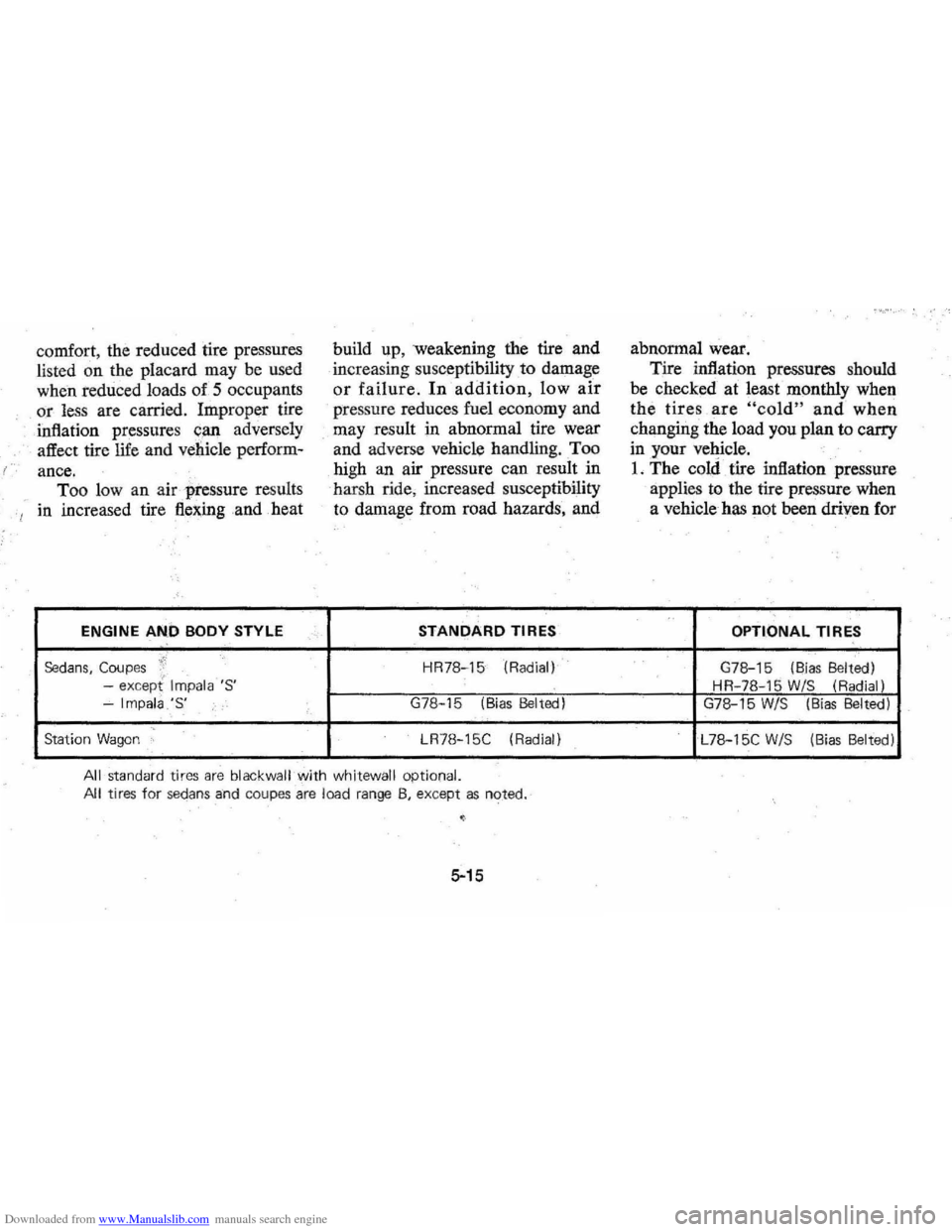
ENGINE AN,D BODY STYLE
4' Sedans, Coupe s ;;' " -except Imp ala 'S '
~ Impala ,'S' ,
Station Wagon
,
.',
build up, weakening the tire and
increasing
sus ceptibility to damage
or failure. In addition, low air
pre ssure reduces fuel economy and
may result in abnormal tire wear
and adverse vehicle handling. Too
high an air pressure can re sult
in
har sh ride , increas ,ed su sceptibility
to dam a
ge fr om road hazards, and
STANDARD TIRES
HR78-15 (R adial)
G78-1 5 (Bias Belted)
LR7
8-1 5C (Radial)
All
sta ndard tires are blackwall With whi tewall optional.
All tires fo r sedan s a-nd co upes are load range 8, except as n ote d.
5-15
abnormal wear.
Tire inflation pressures should
be checked at least monthly when
the
tires , are "cold" and when
changing the load you plan
to carry
in your vehicle .
L The cold tire inflation pressure
applies
to the tire pressure when
a vehicle has not been driven for
OPTIONAL TIRES
G78-15 (Bias Belted)
HR-78-1 5
W/S (Ra dial)
G
78-15 W/S (Bias Belted)
L78-1 5C W/S (Bias Belted)