ignition CHEVROLET MONTE CARLO 1981 4.G User Guide
[x] Cancel search | Manufacturer: CHEVROLET, Model Year: 1981, Model line: MONTE CARLO, Model: CHEVROLET MONTE CARLO 1981 4.GPages: 104, PDF Size: 23.92 MB
Page 37 of 104
Downloaded from www.Manualslib.com manuals search engine "
• The lighl is also designed to come oi, briefly during engine starting so you . can check that the bulb is okay .
• Have the system repaired ifth'e light .d~es· not .come on during engine
. starting or when th.e Parking brake is set.
•
This warning light does not do away with the heed for brake inspection and
maintenance. The brake fluid level must be checked regularly . See your
Maintenance
Schedule folder for other brake checks.
If the light 'comes on andstavson when the ignition key is on, after the brake pedal has been firmly pushed down, it may mean that there is somelhing
'
wrongwith I?"" of the br"kesyjitem.
What to do:
1. Check to see that the parking brake hec been released . If it has been ..
2. Pull off the road and stop carefully, And remember that:
" .• " Stopping ,distances may be longer.
•
You may have to push harder on the pedal.
•
The pedal may go down farther than normal.
3, Try out the brakes by starting and stopping on the road shoulder--then:
• If you judge it to be safe, drive cautiously at a safe speed to the .near,est dealer for ,repair, or
• Have vooicle t6w~ to the nearest dealer for repair.
Continued driving without getting necessary repairs could be dangerous .
"'''''''~''., ENGINE" LIGHT
All gasoline"~~gine VehiCles sold in ttwl,lnited States (aridsorne ' vehidle. sok:!
in Canada) have the Computer Command Control sYstem, (canadian owners
should
also ' read the Nole on the. inside front cover of this manual. )
If your vehicle has thElCoTP\Jter :,eommand:'ContrOI-system, ,a , "CHECK
ENGINE" light
on the instrument panel is designed to come on during engine
starting to let you know the bulb is working ; (The light will stay on a short time .
after
the engine starts,) If the light comes on while driving, service to the
Computer , Command
Control system may be required , Although. the. v.ehicle
may still be drivable, see , your Chevrolet dealer as soon as possible . for an inspection of the system , (Some vehicles sold in Canada, DO NOT HAVE the
Computer Command Controtsystem ,
ILyeur vehicle does not have a "Check
Engine " light, then it does not have the Computer Command Control system,)
Continued, driving without having the Computer Command Control system
serviced
could cause damegeto' the emission control system, It could also affect fuel economy and drivability, .
See also "Computer
Command Control' system" in "Service and Maintenance," Section: 5 of this manual.
Tachometer
The optional tachometer i. ndicates the speed of the engine in revolutions per
minute, The' indicated num,ber, times 100, gives the engine speed, Operating
the engine
with. the tachometer . reading .in the colQr-coded high-speed area could lead to seriOUS engine damage,
Page 38 of 104

Downloaded from www.Manualslib.com manuals search engine When the ignition key is turned to the OFF position, the pointer may nO\". necessarily return to the 0 RPM position. For the tachometer to regster 0 RPM .
the key
must be in the RUN position and engine not running.
Engine Temperature Gage
This gage indicates coolant temperature which will vary with air temperature
and operating
cond~ions. The ignition must be on for accurate readings. Hard
driving
or prolonged idling in very hot weather will cause the pointer to move
beyond the center of the band. Should pcinter move to the line at the "H" end
of the band , see "Engine Cooling
System" on page 3-3.
Voltmeter
When the engine is operating, the voltmeter indicates the electrical system
voltage. During minimum electrical load, the pointer will read
to the right of the
center. As the electrical load is
increaSed, or in stop-and-go driving, the pointer
will rotate to the
left . A meter reading continuously in the left or right red zone
indicates an electrical system failure. Cause of the failure should be determined
and corrected.
Oil Pressure Gage
The oil pressure gage indicates the pressure at which oil is being delivered to
the various parts of the engine requiring lubrication. Pressures registered by the gage may vary according to outside air temperatures or weight of oil being
used. Oil pressure
of a cold engine being operated at a given speed will be
somewhat higher than when the engine is at normal operating temperature at
the same speed. Prolonged high speed operation on a hot day at the given
speed will result
in somewhat lower oil pressure readings. Readings of 205 to
275 kPa (30 to 40 psi) may be considered normal during moderate road
speeds of 35 to 40 mph (55 to 60 km/h) with the engine at proper operating
temperature . Gage readi'rig;rwhich are ·consistently high or low under these
conditions may indicate lubrication system and/or engine malfunction.
Windshield Wiper and Washer
The windshield wiping system operates at two speeds and is designed to wipe
clear
specijic areas of the windshield under most inclement weather conditions.
The windshield wipers work electrically and are not affected by engine
operation .
Push the control lever to the right to start
the electric windshield wiper. The
two-speed electric wiper has both a "low " and a "high " speed position .
2-19
Page 40 of 104
Downloaded from www.Manualslib.com manuals search engine The Mist feature, intended to remove incidental windshield spray such as from."
passing vehicles is activated by moving the control knob to the extreme left ,
and holding it in this posnion. The wipers will continue to operate until tile
control knob is released and allowed to return to the OFF position . .
The washer system is operated by depressing the control knob for one or two
seconds in any position.
In the OFF position the wipers will oper,ate 3 to 5
times and then stop .
Ught Switch
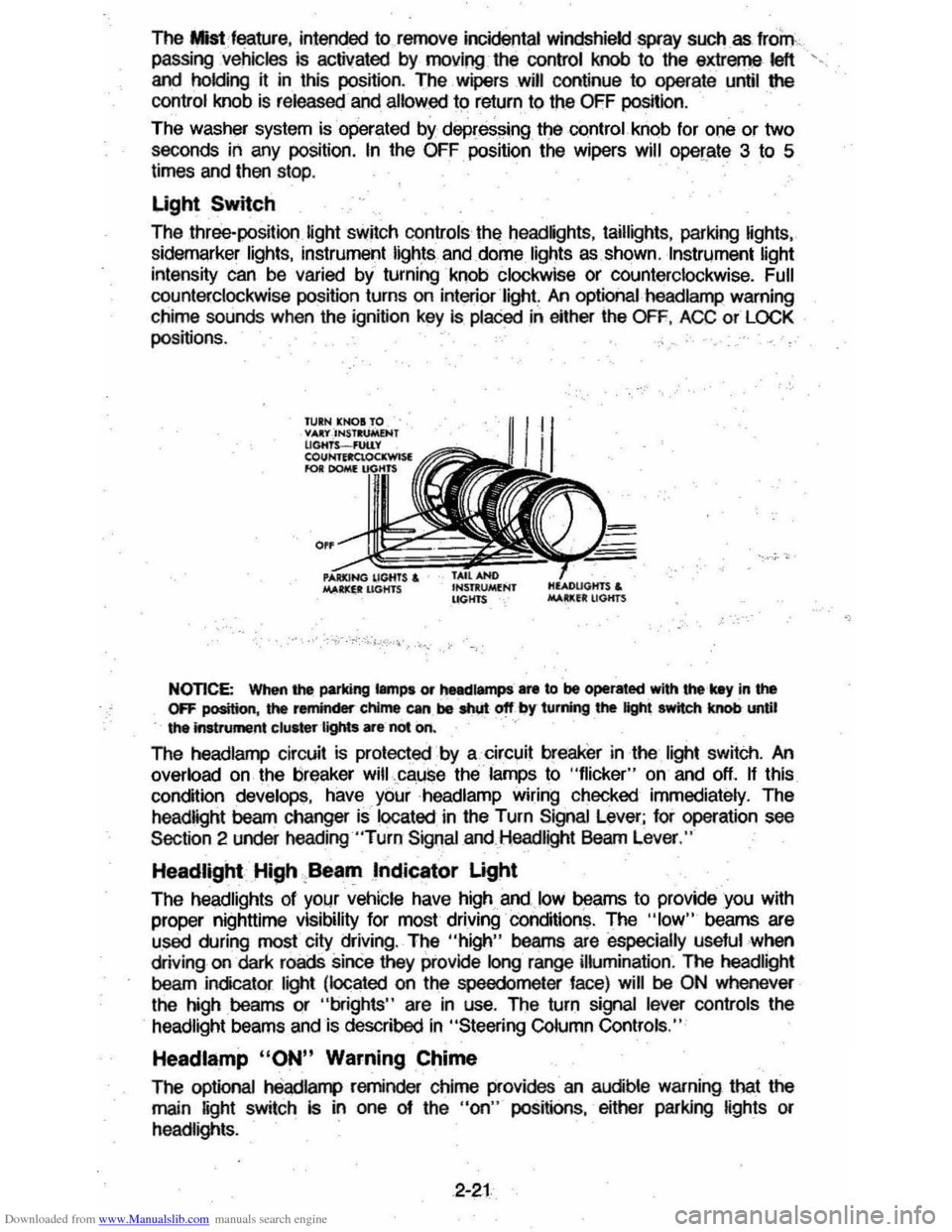
The three-position light switch controls the headlights, taillights, parking ~ghts, sidemarker lights, instrument lights. and dome lights as shown. Instrument light
intensity can
be varied by turning knob clockwise or counterclockwise. Full
counterclockwise position turns on interior light An optional head lamp warning
chime sounds when the ignition key is. placed in either the OFF, ACC or LOCK
positions. , ....
. ,-"",,.
NOTICE: When the parking lamps or t)Hd1ampS .... to be operated with the key in the OFF position, the reminder-chime can be shUt-Of' by turning the light switch knob until the instrument elu.1er Ifghts are not on. '
The headlarnp circuit is protected by a circuit breaker in the light switch. An
overload on the breaker will,cau$e the lamps to "flicker" on and off. If this
condnion develops , have your ·headlamp wiring checked immediately. The
headlight beam changer is located in the Turn Signal Lever; for operation see
Section 2 under heading "Turo Signal and Headlight Beam Lever."
Headlight High ,Beam Indicator Ught
The he!).dlights of your vehicle have high and ... loW beams to provide you with
proper nighttime visibility for most driving condnions. The "low" beams are
used during most city driving . The
"high" beams are especially useful when
driving on dark roads sinCe they provide long range illumination . The headlight
beam indicator light (located on the speedometer face) will be
ON whenever
the high beams or "brights " are in use. The turn signal l
Headlamp "ON" Warning Chime
The optional headlarrl> reminder chime provides' an audible warning thai the
main
light switch is in one 0/ the "on" posnions, either parking lights or
headlights. .
2-21
Page 41 of 104
Downloaded from www.Manualslib.com manuals search engine The reminder chime is actuated only when the ignition -switch is--turned to
"OFF," "LOCK" or "ACCESSORY" position,
When the parking lamps or headlamps are
to be operated with the key in the
OFF position , the reminder chime can be shut off by turning the light switch
knob until the instrument cluster lights are not on.
Electric Clock
Reset the dock by pulling out the knOb and turning the hand s clockwise ~
slow, counterclockwise if fast. This is designed to, if the clock error is five minutes or mo"e~ -automatically --'compensate for time gain or ,lag. Several
resettings, several days apart, may be needed to properly adjust the clock
meChanism.
Cigarette Lighter
The cigarette lighter is located to the right of the heater control. To operate,
. push it in. When it becomes heated, it
automatically pops out ready for use .
Electric Trunk Release
An electric trunk release is available which permrts opening the trunk from'
inside the car. With the ignition key on, pUsh the release button located in the .
glove box.
Always
lock . the glove compartment when leaving the car unattended to prevent unauthorized entry into·tne trurik .
VENTILATION SYSTEM
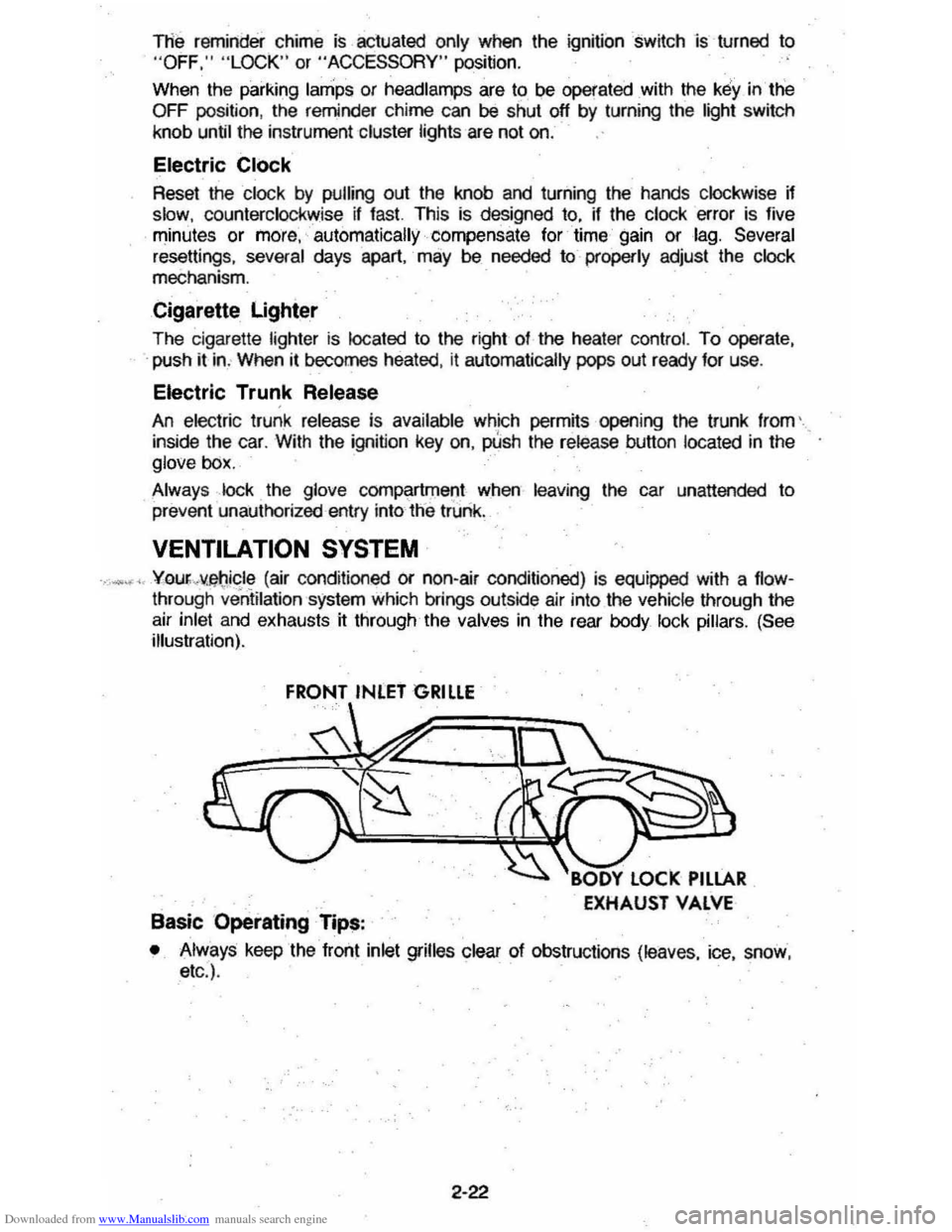
.• _<, YOUf.,v.~Jc.le (air conditioned Of non -air conditioned) is equipped with a flowthrough ventilation system which brings outside air into the vehicle through the
air inlet a
nd exhausts it through the valves in the rear body lock pillars. (See
illustration).
FRONT INLET GRILLE
Basic Operating Tip!!:
• Always keep the front inlet grilles clear of obstructions (leaves, ice, snow ,
etc .) .
2-22
Page 44 of 104
Downloaded from www.Manualslib.com manuals search engine Air Selector Lever
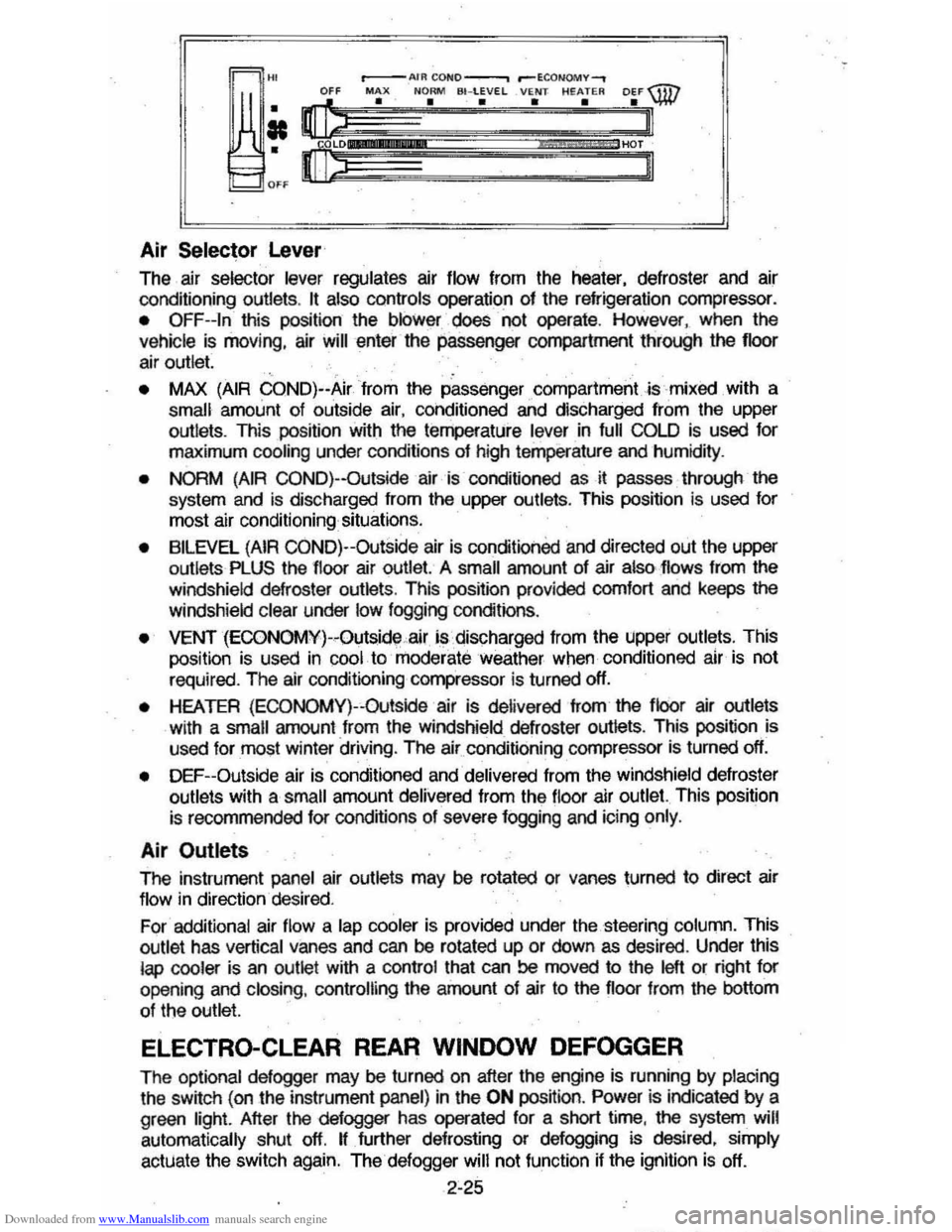
The air selector lever regulates air flow from the heater, defroster and air
conditioning outlets. It also controls operation of the refrigeration compressor.
• OFF--In this position the blower doeS not operate . However , when the
vehicle is moving, air will enter the passenger compartment through the floor
air outlet.
• MAX (AIR COND)--Air from the p~ssengercompartment is· mixed with a
small amount of outside air, conditioned and discharged from the upper
outlets. This position with the
temperature lever in full COLD is used for
maximum cooling under conditions
of high temperatu re and humidity .
• NORM (AIR COND) --Outside air is conditioned as it passes through the
system and is discharged from the upper outlets. This position is used for
most air conditioning situations.
• BILEVEL (AIR COND)--Outside air is conditioned and directed out the upper
outlets PlUS the floor air outlet. A small amount of air also flows trom the
windshield defroster outlets.
This position provided comfort and keeps the
windshield clear under low fogging conditions .
• VENT (ECONOMY)--Outsid~,air is discharged from the upper outlets. This position is used in cool. to moderate weather when· conditioned air· is not
required. The air conditioning compressor is turned off.
• HEATER (ECONOMY)-'-Outside air is delivered from the floor air outlets
with a small amount from the windshield defroster outlets. This position is
used for most winter driving. The air conditioning compressor is turned off.
• DEF--Outside air is conditioned and delivered from the windshield defroster
outlets with a smail amount delivered from the floor air outlet. This position
is recommended for conditions
Of severe fogging and icing only.
Air Outlets
The instrument panel air outlets may be rotated or vanes turned to direct air flow in direction' desired.
For additional air flow a lap cooler is provided under the steering column. This outlet has vertical vanes and can be rotated up or down as desired . Under this
lap cooler is an outlet with a control that can
be moved to the IefI or right for
opening and closing , controlling the amount of air
to the floor from the bottom
of the outlet.
ELECTRO-CLEAR REAR WINDOW DEFOGGER
The optional defogger may be turned on after the engine is running by placing
the switch (on the instrument panel) in the
ON postlion . Power is indicated by a
green light. After the defogger has operated for a short time, the system will
automatically
shut off. If further defrosting or defogging is des ired, simply
actuate the switch again.
The defogger will not function if the ignition is off.
2-25
Page 45 of 104
Downloaded from www.Manualslib.com manuals search engine Refrain from removing decals or other material from the inside of rear window
with a razor or other sharp instrument since this may
damage the heating
element. . .
Clear snow and ice from the rear window to Improve the efficiency of the rear
window defogger .
RADIOS AND TAPE PLAYERS
Your vehicle may have one of several optional Delco GM Sound Systems.
GENERAL INFORMATION
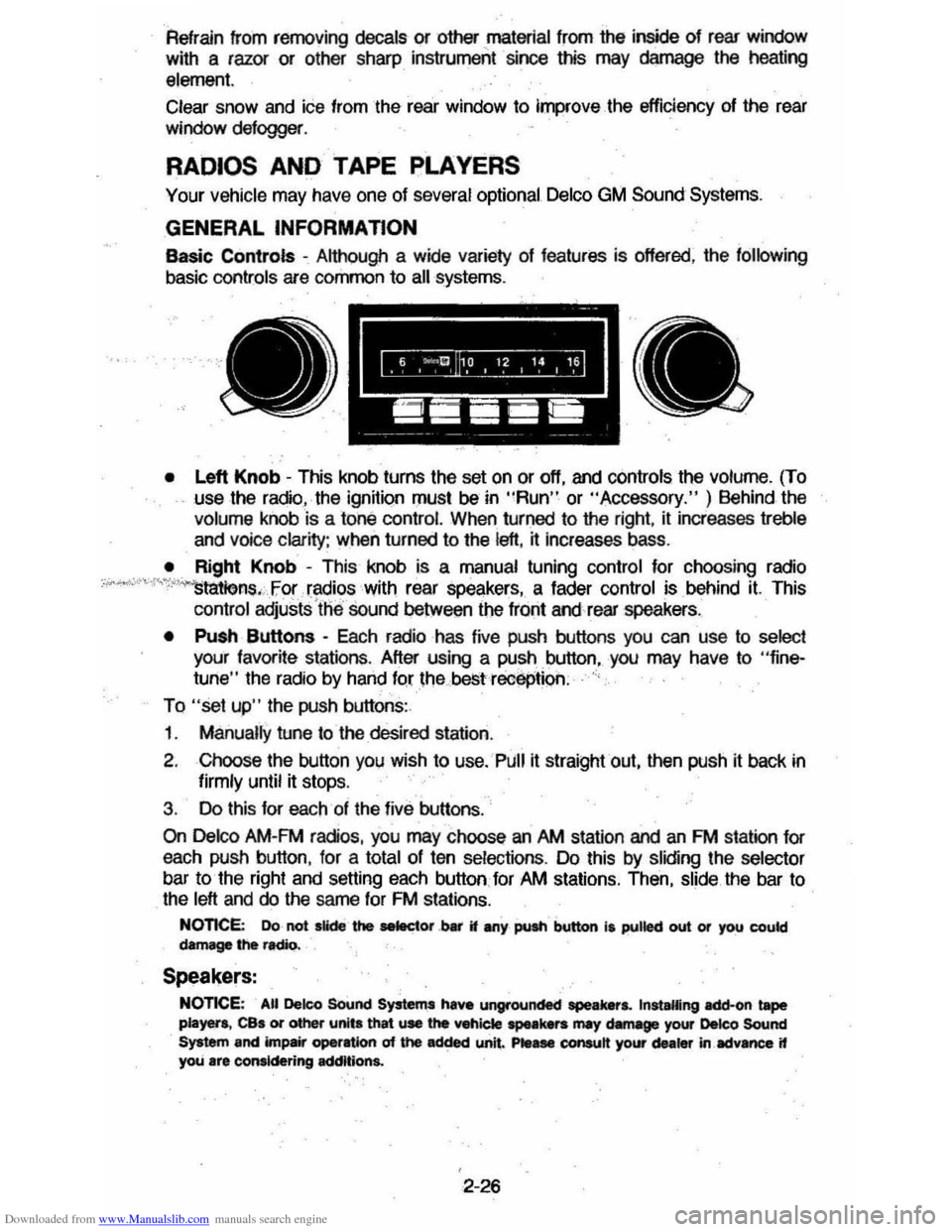
Basic Controls -Although a wide variety of features is offered, the following
basic controls are common to all systems.
til!!! !!i!!!! !iii - -- -
• Left Knob -This knob turns the set on or off, and controls the volume. (To
use the radio, the ignition must be in '!Run" or "Accessory." ) Behind the
volume knob is a tone control. When turned to the right, it increases treble
and voice
Clarity; when turned to the left, ~ increases bass.
• Right Knob -This knob is a manual tuning control for choosing radio
'-"""''''-'''''''StatiGns, for. ,adios with rear speakers, . a fader control is behind it. This
control adjusts 'the Sound between the front and rear speakers .
• Push Buttons -Each radio has five push buttons you can use to select
your favorite stations. After using a push button, you may have to "fine
tune"
the radio by hand for .tl]ebest rec~tion.
To "set up" the push buttons:
1 .
Manually tune to the desired station.
2. Choose the button yoU wish to use. Pull it straight out. then push it back in
firmly until it stops.
3 .
Do this for each of the five buttons.
On Delco AM-FM radios, you may choose an AM station and an FM station for
each push button, for a total of ten selections .
Do this by Sliding the selector
bar to the right and setting each button for AM stations. Then, slide. the bar to
the left and do the same for FM stations.
NOTICE: Do-not stide the setector .bar if any putf button ia pul~ out Of you couki darMge 1M rldiQ.
Spea~ers:
NOTICE: All Delco SoUnd system. hav. ungrounded speakers. InstaHing add-on tape player_, ca_ or other unitt: that use the W1hk:te speak..-s may ct.mage '(OUf o..co Sound S)'Item and imp_ oper.uotl of the added unit. Pte ... consult your dealer in .c:Ivance H you are considering additions.
2-26
Page 48 of 104
Downloaded from www.Manualslib.com manuals search engine This radio combines the features of anAM-FM stereo radio with a stereo
casselletape
player. To playa casselle tape:
1. Turn the radio on. (On'very cok;! days , allow a few minutes for warm-Up)
2. Insert the casselle squarely through the door above lhe radiO dial, as
shown on the door. This automatically switches the unit from radio to tape
operation .
If the sound is garbled (or there is no sound), eject the tape and reinser1 it squarely .
3. After the casselle has snapped into position, adjust the volume and fader
controls to your prefe(ence.
4. To quickly advance to the next selection , lift the COmbination Fast
Forward /Fast Reverse
(FF /FA) bullon (to the left of the tape door) until ij locks. To release the fast forward lock, return the FF / FR bullon to its
center position. To
listen to an earlier selection, push down the FF/FR
button. To release fast reverse, move the bullon to its center position . The
sound will·be mufed during fast forward or fast reverse operation.
The tape player will automatically shut off at the end of the tape, but the radio
will not resume playing until you eject the casselle.
I. To remove the casselle, fully press in the "Eject " bullOn .
2. To change to the second program: eject the cassette, turn it over (end-for-
end) and reinser1 it, again according to the oulline on the door .
Remove the casselle
when not in use. Casselles which are 30 or 60 mnufes
long will give the best results.
See also "Tape and Tape Player Care"for maintenance information.
AM-FM Stereo with Citizens Band Transceiver
If your vehicle has an optional DelCo GM Citizens Band radio, please refer to
the
separate booklet suppiied With this unil.
MOBILE RADIO SYSTEMS
Mobile two-way units are subject to Federal Communications Commission
(FCC) regulations and must be installed by trained radio people. Mobile
telephones installed by your local phone company, Citizens Band (CB) radios, and garage door openers normally will not affect vehicle operation. If any other
mobile radio transmitters are installed, there can possibly be adverse eftects on
vehicle operation .
Antenna
The standard radio antenna is incorporated in the . windshield glass. If
necessary, adjustments for maximum antenna eftectiveness can be made by
your Authorized
Dealer.
Power Antenna
The optional power antenna is controlled by the radio . When the radio is ON
the antenna will go up. When the radio is turned OFF either by the ON /OFF
knob or by turning the ignition switch to the OFF position, the antenna is
designed to gb down.
2-29
Page 49 of 104
Downloaded from www.Manualslib.com manuals search engine OTHER CONTROLS AND FEATURES
LIMITED-SLIP REAR AXLE
On vehicles that have it. the optional limited-slip rear axle can give added
traction on snow, ice, mud, sand, gravel, etc. Normally , the limited-slip axle
unit works like a standard axle. However, when either drive wheel meets a
slippery enough surface, and the opposite wheel is on a surface with greater traction, the ,limited-slip 'unit can continue to give driving force tathe wheel
having the greater traction,instead 01 merely spinning the wheel that has the
least traction .
Whether your
vehicle has an optional limited-slip rear axle or a standard axle, take care when speeding up or, whera shifting into a lower gear or lower gear
range , when either or both rear wheels are traveling over a slippery surface .
Sudden acceleration or engine braking action (due to shifting to a lower gear)
could cause one or both drive wheels to spinorskid and the rear 01 the vehicle to slide sideways on the crowned, ·surface of a road or in a turn. Normal skid correction and cautious driving are called for at these times.
COURTJ:SY LIGHT DELAY SYSTEM
If your vehicle is equipped with this optional feature, whenever the door is opened, then closed, on entry or exit, the dome and courtesy lights stay on for thirty seconds for convenience of driver and passengers. This presumes the
ignition is in the off position . When the ignition key is turned on. the lights will
go off. When the ignition key is turned to off, the dome and courtesy lights go
",'" of>.lor. ~.R~riod 01 fifteen seconds.
SUNROOF
The optional Sunroof is a slid ing metal panel, electrically operated. controlled
by a switch on the front center area ,Qf theroof. The ignition must be in "Run" to move the panel. " .
To' open. press the control switch rearward. To close. press it forward. The
Sunroof can
be lett partly open by releasing the control switch while you are
opening or closing the panel.
The Sunrool can be closed manually il your car has an electrical power lailure.
To do this , remoVe the small round plug in the rool (near the control switch) by pulling the plug downward with your lingers . Then insert the hex end 01 the
crank handle (supplied in your glove box) into the drive gear and turn it
clockwise to close the rool panel, and counterclockwise to open it. Remove the
crank handle and replace the plug . (See illustration.)
2-30
Page 53 of 104
Downloaded from www.Manualslib.com manuals search engine SECTION 3
IN CASE OF ,EM,ERGENCY
See also "Engine ,ExhausIGas Caution (Carbon Monoxide)" at the beginning
of
"Starting and Operating ." Section 2 of this manual.
FOUR.WAYHAZARD WARNING FLASHER
• Use the hazard warning flasher to warn other drivers any time your vehicle
becomes a traffic hazard , day or night
• 'Avoid stopping 00 the roadway if. possible .
•
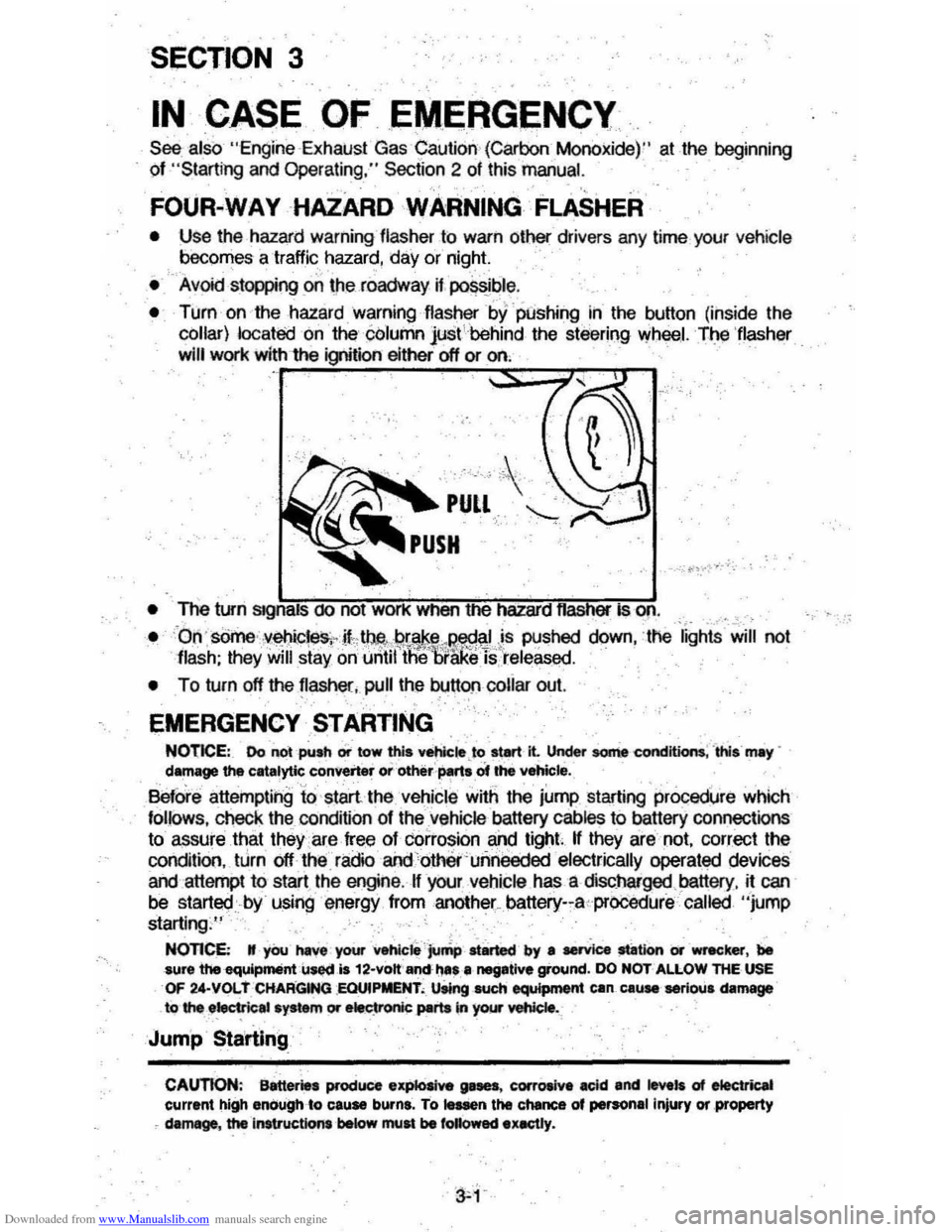
Turn on ·the haz,ard warning flasherb{ pushing In the button (inSide the COllar) located on the cOlumn just'behind the steering whee ,l. The 'flasher wUl work with1he ignition either off or on,
",'
• The turn SIgnalS ao not wOl1< wnen me hazard flasher is on,
• 'On·$ome·,V:!>tJiC~S;,j\tj:l~i9[~~",~}S pushed down,the fights will not
flash; they will stay on utitiltne 'Brake iS,'released , ,
•
To turn off the flasher . pull the buttOflcoliar out.
EMERGENCY STARTING
NOtICE:. Do not-~.h oi tow this -Y~le_to stlW1 it. Under some cond~: "this-may· d.~a,ge the catalytic e,onverter or'other:~rt~ofthe vehicle.
Before attempting to' start. the vehicle with the jump starting 'procedUre which
tollows, check the condition of the vehicle battery cables to battery connections
to
8$sure that, theye,e free of corro~i(>n an,d tight, n they are not. correct the, condition . tJrn off the radio and ,'ot1\
II your vehicle has a discharged , battery. it can
be started ,bY' using energy from anotheL battery-,a,,'prQCedure 'called "jump starting ,'" ,
NOTICE; II yiK'-haVe yoUr 'vehiclt"'jU4 .flirted by. "";kie _Uon or 'wrecker. be sur. iheequlpm8ntu~ ,is 12-yott and' ~":' neg.tlve ground. DO NOT · ALLOW THE USE OF 2A-VOL t 'CHAR'GINO .EOlHPMENT,,_ uSingsucti equipment cn cau .. serioUl damage to the e~ar system Of efre%nic~rta in your V'8hide._
Jump Starting
CAUTION: Better •• produce expJOlive gnea , corroaive acid and "vela of electrical current high enough 10 cause burns. To IeUen the chance of person.1 injury or property -damage, the Instruction, below must be fOllowed ex.ctly.
"
Page 54 of 104
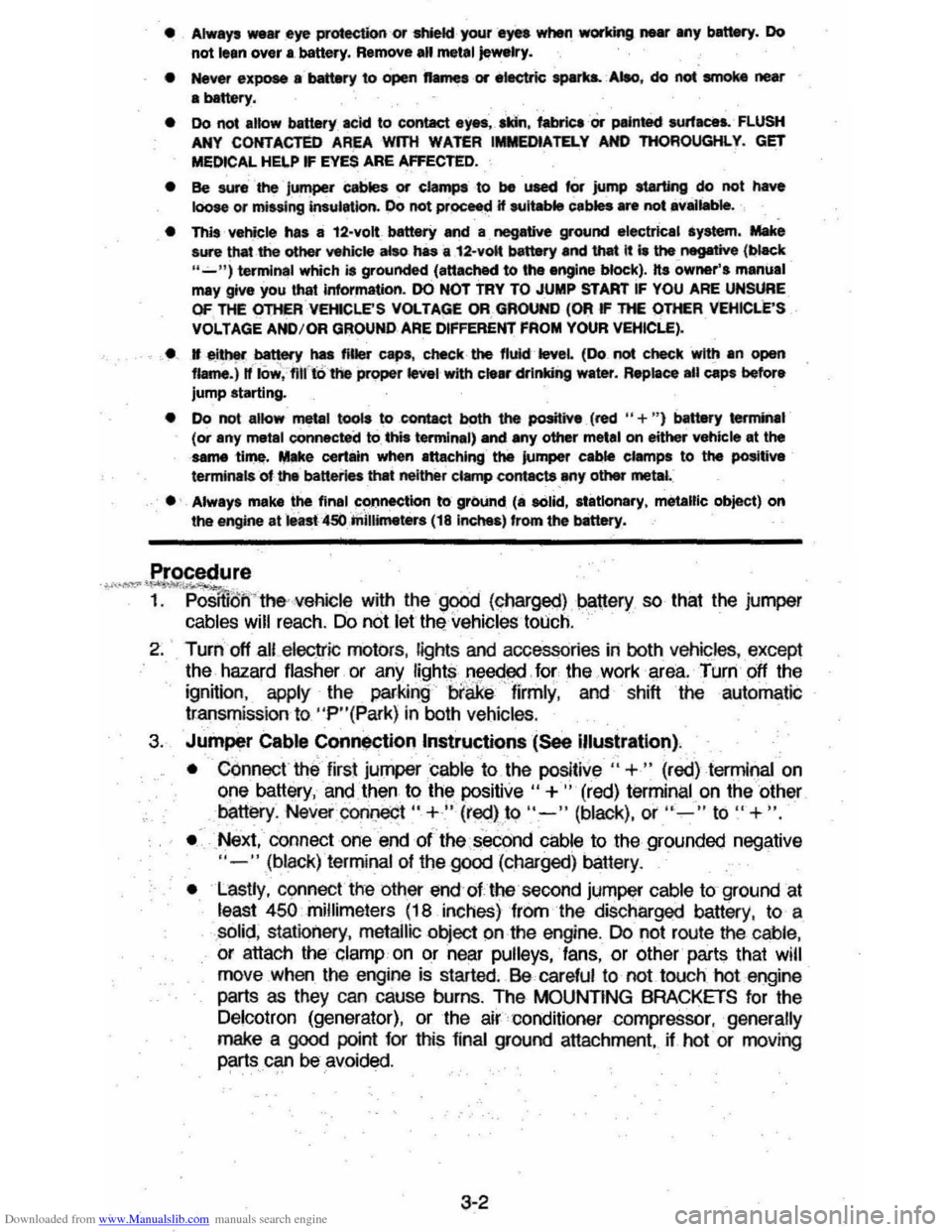
Downloaded from www.Manualslib.com manuals search engine • Always wear eye protection or shiekI your eyet when ,workmg .....,. My battery. Do not lean over a, battery. Remove .11 met.1 jewelry.
• Never expose .-battery to open fIanea eM' e~ sparb. -AlIa. do no( smoke near a battery.
• 00 not .llow battery acid to c:ontact eyes._IIdn. f~or painted autfaces. FLUSH ANY CONTACTED ARE"WlTH W"TER '_OtATELY AND THOIlOUGHLY. GET MEDICAL HELP IF EYES ARE AFFECTED.
• Be sure ' the Jumper cabie. or clampt to be used for jump starting do not have lOose or missing insulation. Do not prPCeed if $Uitable c.bae. .... not avanable. "
• Thi" vehicle has • 12-volt. batt.ry and a _ negative ground electrical .ystem. Make sure that -the other vehkte abo ha. a 12-vott battery .nd that tt .. the negative (~k II";"''') terminal which i. grounded (anached to the engine btoc:k). Hs owner's manual may give you that information. 00 NOT TRY TO JUMP START IF YOU ARE UNSURE OF THE OTHER VEHICLES VOl.TAGE ORGROOND (OR F THE OTHER VEHICLE'S VOLTAGE AND/OR Gr:tOUND ARE DIFFERENT FROM YOUR VEHICLE).
e. • eithel t'latIetY has flUer c:ap', check the flukt -leveL (Do _ no( cheek wlUl an open ta.M.> If lOw, flll'tO-ttle proper leVel with cia.,. drinking water. Replace aU c:aps before jump atarting.
e Do not allow metal tools to contact both the positive (red "+ ") battMy tennil\al (or any metal connected to thl. tenninal) and .ny other metal on either vehicle at the -same -tIme. ",.ke c:ertillin when .ftaching th6 Jumper c.~ elamps to the positive terminals Of the batteriet: _that neither clamp contacts. MY other metal •
• ' Alway. make the final ~o-"nectlon to' ground, (a adlid, .tatlon.ty, metallic object) on the engine at '~ast4SO 'millimeter. (18 Inches) from the battery.
Procedure ~~~i~._ 1. posill oW\he ·,verncJe with the good (cnarged) .!>allery so that the jumper cables will reach. Do not let th'1vehiclestouch ..
2. Turn off all elec .ltic motors, lights and accessories in both vehicles, except
the hazard flasher or any light~ need!ld for the work area. Turn ott the
ignition ,. apply the perkingbiilke' fi'rmly, and· shift the automatic
tr.ansmission to
"P"(Park) in both vehicles.
3. Jum~r Cable Connj!ction Instructions (See Illustration).
• Connecflhe
first jurnpercable to the positive " +" (red) terminal on
one battery, and. then to the positive" +" (red) terminal on the other
battery .
Never conlledt " +" (redl,to "-" (black), or "-" to " + ".
• Next, COnnect one endot theseC(jnd cable to the grounded negative "-"(black) terminal of the good (charged) battery.
• Lastly. c<;>nnect the other end· of the second jumP'l' cable to ground at least 450 millimeters (18 inches) from the discharged battery, to a solid, stationery, metallic object on the engine. Do not route the cable,
or
attach the clamp on or near pulleys, fans, or other parts that will
move when the engine is started , Be careful to noUouch hot engine
parts
as they can cause burns. The MOUNTING BRACKETS for the Delcotron (generator), or the ainlOnditioner compressor, generally
make a good point for this final ground attachment, ~ hot· or moving
parts c"" be avoided.
3-2