ignition CHEVROLET MONTE CARLO 1981 4.G Owners Manual
[x] Cancel search | Manufacturer: CHEVROLET, Model Year: 1981, Model line: MONTE CARLO, Model: CHEVROLET MONTE CARLO 1981 4.GPages: 104, PDF Size: 23.92 MB
Page 6 of 104
Downloaded from www.Manualslib.com manuals search engine SEcnON 1
BEFORE DRIVING YOUR MONTE
CARLO
DRIVER DAILY CHECKLIST
Be sure you know your vehicle and its equipment and how to use it safely .
Before Entering the Vehicle '
1. See that windows, mirrors and lights are clean and unobstructed.
2. Check whether any tire is low or flat (H any tire ,looks different from
normal,
we recommend you check it with a tire pressure gage.)
3. Look for fluid leaks.
4. Be sure everything is properly stowed.
5. Check the area behind the vehicle ~ you are about to back up.
Before Driving Off
1. Lock all doors .
2. Adjust the seat and movable head restraints, if so equipped .
3. Adjust inside and outside mirrors.
4. Fasten seat belts.
5. Check that all the warning lights work as the ,key is turned to "Start."
6. Check all gages (including the fuel gage).
7 . Release the parking brake
(and see that the "Brake" light turns off).
See related topics in this manual , or the Maintenance Schedule folder, il
~" problems are found.
Guard Against Theft
For tips on how to protect your vehicle and its contents, see "'Starting and
Operating," Section 2 of this manual.
KEYS
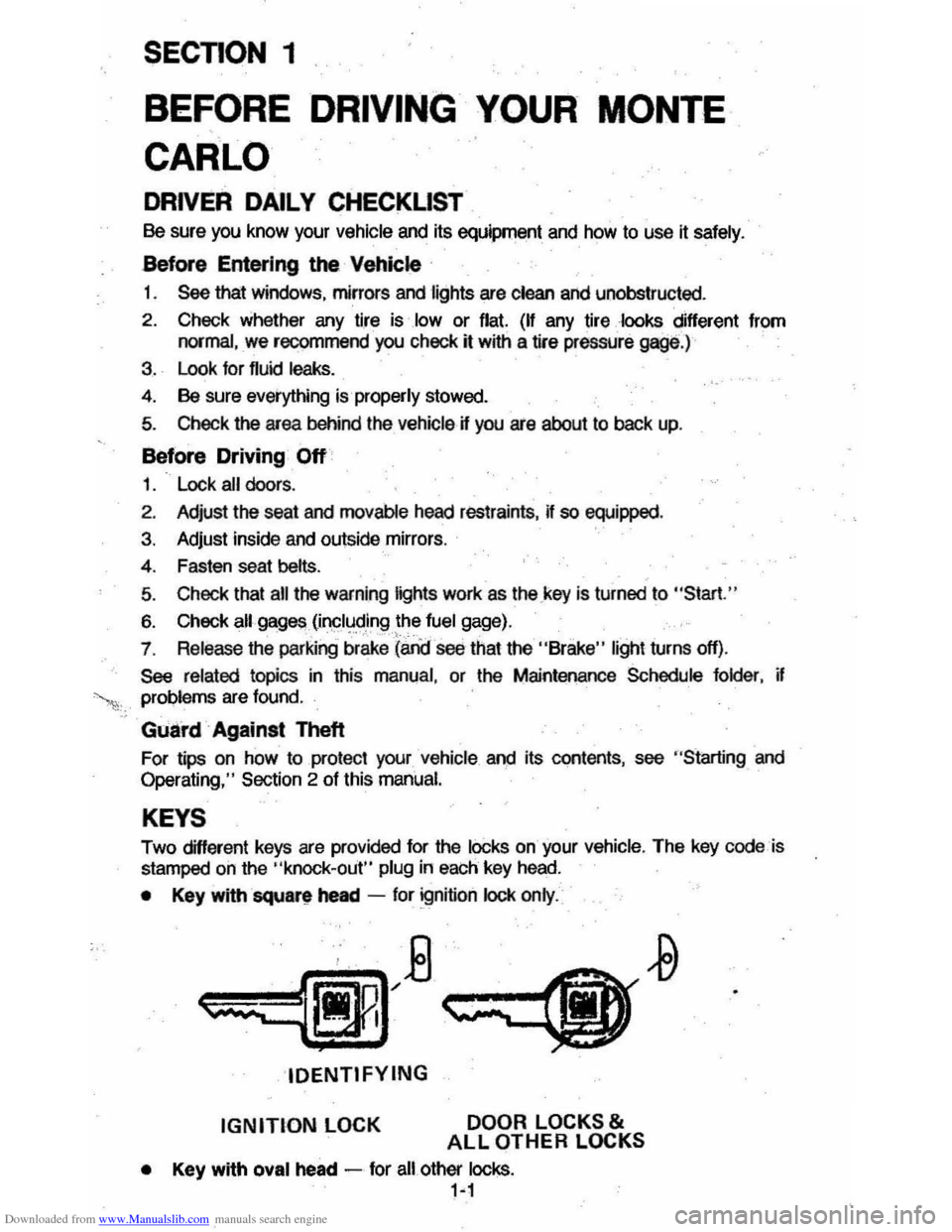
Two different keys are provided for the locks on your vehicle. The key code is
stamped
on the "knock-out" plug in each key head.
• Key withsquar, head -for ignition lock only .
'IDENTIFYING
IGNITION LOCK DOOR LOCKS & ALL OTHER LOCKS
• Key with oval head -for all other locks.
1-1
Page 7 of 104
Downloaded from www.Manualslib.com manuals search engine For vehicle security:
• RecoId the key code IlUIT1b8rs, then lmock the plUQ$ out of the keys .
• Keep the key. codes In a sale place(SU<;h as your wallet) , NOT IN THE
VEHIClE.
Stamped on the key is a letter indicating the proper key blank needed if
duplicates are required . .
If the original keys are lost, duplicates can be made using the key ~s,
Co,nlaet any GM dea,lerora locksmith.
If you park in an atteOOadlOt , leave only your square -head ignition key.
Lock your
glove box and take the oval-head key w~h you. This will help
prevent illegal entry into the glove box (if locked) and trunk compartments .
DOOR LOCKS
•• Bo,th .dQQrs can be locked , from the inside by depressing the passenger guard
door lock ' buttons located on the upper door panel. The doors can be locked
from the outside by first depressing the door lock button and closing the door.
The doors can
also be locked by USing the oval-head key.
All models
have as a standard Safety feature overriding . door locks. When the
doors are locked, the door latch mechanism is inoperative, preventing
inadvertent opening of the
door by movement 01 the inside handle .
Power Door Locks
The optionally available power door locks allow you to lock or unl""k your
.... .
;., .. 2~rs by operating the switch marked LOCK located on either door panel. The auton ratiC' ·locking mechanism does not interfere wjthmanual operation . of any
door
lock button. The, doors will not unlock or open with the inside door handle when the lock button is depressed , but can be unlocked individually by Ufting the lock button. .
CAUTION: To help IHlen the chance and /or severity of Injury in an accident , ~IW'ya Ioek'-the doora when drivinv. Along with uSing the aelt beltl properly, locking the doors, etC~1 helps prevent occupants from being thrown from the vehicte during accident •. It also, helP. prevent unintended opening of the doors I'nd help.' keep out intruder. \jVMn the vehi,cle is stopped.
STOWING THINGS IN (OR ON) THE CAR
CAUTION: , Luggage or other cargo shouId-not be piled higher than the SHtbllc::k& . When at all poss6bIe, luggage or cargo should be c.n.d in the trUnk. The filler panel In front of the rew window should, not be used to cerry objects-even those thlit are small and light. AU items shoukj M secured in place. 'This will help 'keep such things from
being thrown about al1~, injuring people, In the car dUrl,ng a sudden maneuver or an, accident. Cargo weight" 'whether , Inside or on the root, ahould be positionecl as far forward as possibl8~ .
Manual Window Control
Turn manual window conlrol clockwise " to raise right windows and
counterclockwise to raise lell windows . Reverse direction to lower window .
1-2
Page 8 of 104
Downloaded from www.Manualslib.com manuals search engine Power Windows (OptIonal)
Power windows have an ignition interlock SO the windows cannot be operated
unless the Ignition switch is in the "RUN" poSition A master control for all
windows is provided at the driver's position. Individual switches are provided
under each
window for passenger use.
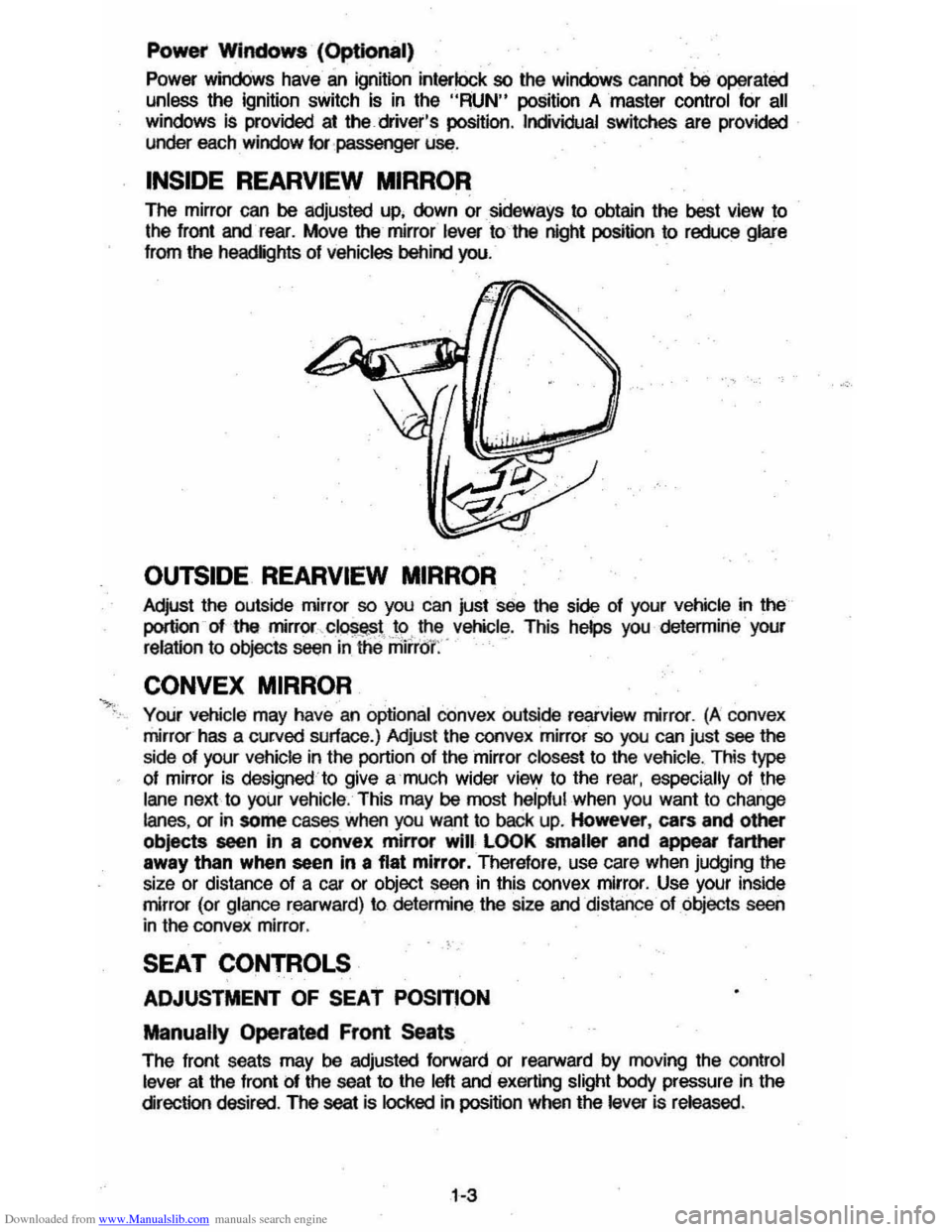
INSIDE REARVIEW MIRROR
The mirror can be adjusted up, down or sideways to obtain the best v.iew to
the front and rear. Move the mirror lever to the night position to reduce glare
from the headlights of vehicles behind you.
OUTSIDE REARVIEW MIRROR
Adjust the outside mirror so you can just see the side of your vehicle in the
portion 01 the mirror clo§!tsu.o .. the vehicle. This helps youdetermirie your
relation to objects seen in the mirr or:" .
CONVEX MIRROR
YoUr vehicle may have an optional convex outside rearview mirror. (A convex
mirror has a
cu
vehicle in the portion of the mirror closest to the vehicle. Thi s type
of mirror is designed to give a much wider view to the rear. especially of the
lane next to your vehicle . This may be most helpful when you want to change
lanes , or in some cases when you want to back up. Ho_ver, cars and other objects seen in a convex mirror will· LOOK smaller and appear farther
away than when seen
in a flat mirror. Therefore, use care when judging the
size or distance of a car or object seen in this convex mirror. Use your inside
mirror (or
glance rearward) to determine the size and distance of objects seen
in the convex mirror.
SEAT CONTROLS
ADJUSTMENT OF SEAT POSITION
Manually Operated Front Seats
The front seats may be adjusted forward or rearward by moving the control
lever at the front Of the seat to the left and exerting slight body pressure in the
direction desired.
The seat is locked in position when the lever is released .
1-3
Page 21 of 104
Downloaded from www.Manualslib.com manuals search engine The trunk lid should be closed while driving to help prevent drawing exhaust gas into the vehicle. If the trunk must remain open for some reason while
moving . or ff electricai wiring or other cable conneclionS to a trailer must pass through the sealbelweeri the trunk lid and the body, follow these precautionS :
• Close all windows.
• Adjust the heating or cooling system to force outside air into the vehicle as
described above. but set the fan to high speed .
• On vehicles with outside ' air vents in or under the instrument panel ; open
the vents
fully.
NEW VEHICLE "BREAK-IN" PERIOD
You can drive your new vehicle from its very first mile/kilometer without
following a formal "break-in" schedule. However. there are things you can do during the first few hundred miles/kilometers of driving . that will add to the
future performance and economy of your
vehicle. We recommend you limit
your speed during the first 500 miles (800 kilometers) to a maximum of 55 mph (90 km /h) ; but do not drive for long periods at anyone constant speed. either
fast or
slow. During this time. avoid full throttle starts and. if possible. avoid
hard stops especially during the first 200 miles (320 kilometers) of driving .
Always drive at moderate speed until the engine has COfl'4lletely warmed up.
If you plan to use your new vehicle for trailer towing . see additional information
under " Trailer Towing" in Section 1 of this manual.
GUARD AGAINST THEFT
y~~; '~ew Monte carlo has many features to help prevent theft of the vehicle
itself.
its equipment. and its contents. But these anti-theft features depend
upon you to work.
THE
TIME TO BE MOST ON GUARD ISWHEN LEAVING THE VEHICLE ...
• PARK IN A LIGHTED SPOT WHEN YOU CAN AND FULLY ClOSE BOTH WINDOWS AND ANY ROOF PANaS
• LOCK THE STEERING COLUMN AND TAKE THE KEYS:
•
Turn the key to "Lock " and remove the key. This locks the ignition
and both steering and shift controls.
• If you must leave a kilY with the vehicle . leave the square-head key only. Take the oval· head key with you. This will help prevent unwanted
entry into your
vehicle at a later date . or into your glove box (if locked) or trun k
• LOCK ALL DOORS .
•
KEEP ITEMS OUT OF SIGHT AND LOCKED UP WHEN POSSIBLE.
• Never leave things of va lue in plain sight on seats or floor.
• The glove box otTers a place to hide small item s and if locked, protects even better.
• Lock larger item s in the trunk.
Page 23 of 104
Downloaded from www.Manualslib.com manuals search engine OPERATION IN FOREIGN COUNTRIES
All models which have the Computer Command Control system, (see "Service
and Maintenance," Section 5), are designed
to use unleaded gasoline as
specified under
"Fuel Requirements" in this section of the manual. Therefore,
these cars are not intended for use in areas where unleaded gasoline is
not readily available,
There also is a chance the gasolines available in some countries will not meet the needs of your gasoline engine even if it is not equipped with the Computer
Command Control system; Low~octane-ratedgasolines may cause engine pre
ignition and serious engine damage, for which Chevrolet is not responsible.
In either case (with or without the Computer Command Control system), the
use of leaded gasoline will cause the emission control system to lose its
effectiveness.
It could also affect coverage· under the emission warranty. In
case of emergency, leaded gasoline may be used in your vehicle if unleaded gasoline is not available, but it should not be used exclusively. If you must use
leaded gasoline exclusively
in a vehicle designed for unleaded gasoline,
different maintenance intervals will be required. For additional information and
a copy of the maintenance schedule write to: Chevrolet Motor Division, Consumer Relations Department, Warren, Michigan 48090, (in Canada, write
to General Motors of Canada Limited, Customer Service Department, Oshawa,
Ontario
L 1J 5Z6).
When writing, please
include:
•
the Vehicle Identification Number and
• the countries in which you plan to travel.
Tires
If you plan to use your vehicle in countries where speeds over 75 mph (120
km/h) are allowed, see lIem3 on page 5-12.
IMPORTANT FACTS YOU SHOULD KNOW ABOUT FUEL
ECONOMY AND HOW
TO IMPROVE IT
How you drive, where you drive and when you drive all affect how many miles/
kilometers you can get from a galion/liter of fuel. The careful attention you give
your vehicle as far as maintenance and repairs are concerned
will also help
fuel economy.
Fuel Selection
Use only unleaded gasoline meeting the octane ratings given under "Fuel Requirements" in "Starting and Operating," Section 2 of this manual.
Unleaded gasoline must be used. for the. emission control ,system to operate
properly. Leaded gasoline will damage the Computer Command Control system
oxygen sensor and affect emission control. Using leaded gasoline can also
damage other parts of the emission control system and
CQuld result in 19s8 of
emission warranty coverage.
"Jackrabbit" Starts
You can save fuel (and prolong engine and tire life) by avoiding fast starts
away from lights and stop signs.
2-4
Page 25 of 104
Downloaded from www.Manualslib.com manuals search engine Tire Inflation
Underinflation not only causes needless wear 01 the tires, but can also waste ' fuel. It's a good idea to check tire pressures often and, fO( the best fuel
eccnomy, keep your tires inflated to the highest pressures shown on the Tire
Placard on the left front door of your vehicle .
Wheel Alignment
Improper toe alignment will cause the tires to roll at an angle, which will result in faster tire wear. It takes' power to overcome this improper alignment which.
in turn, wastes fuel.
STEERING COLUMN CONTROLS
ANTI-THEFT STEERING COLUMN LOCK
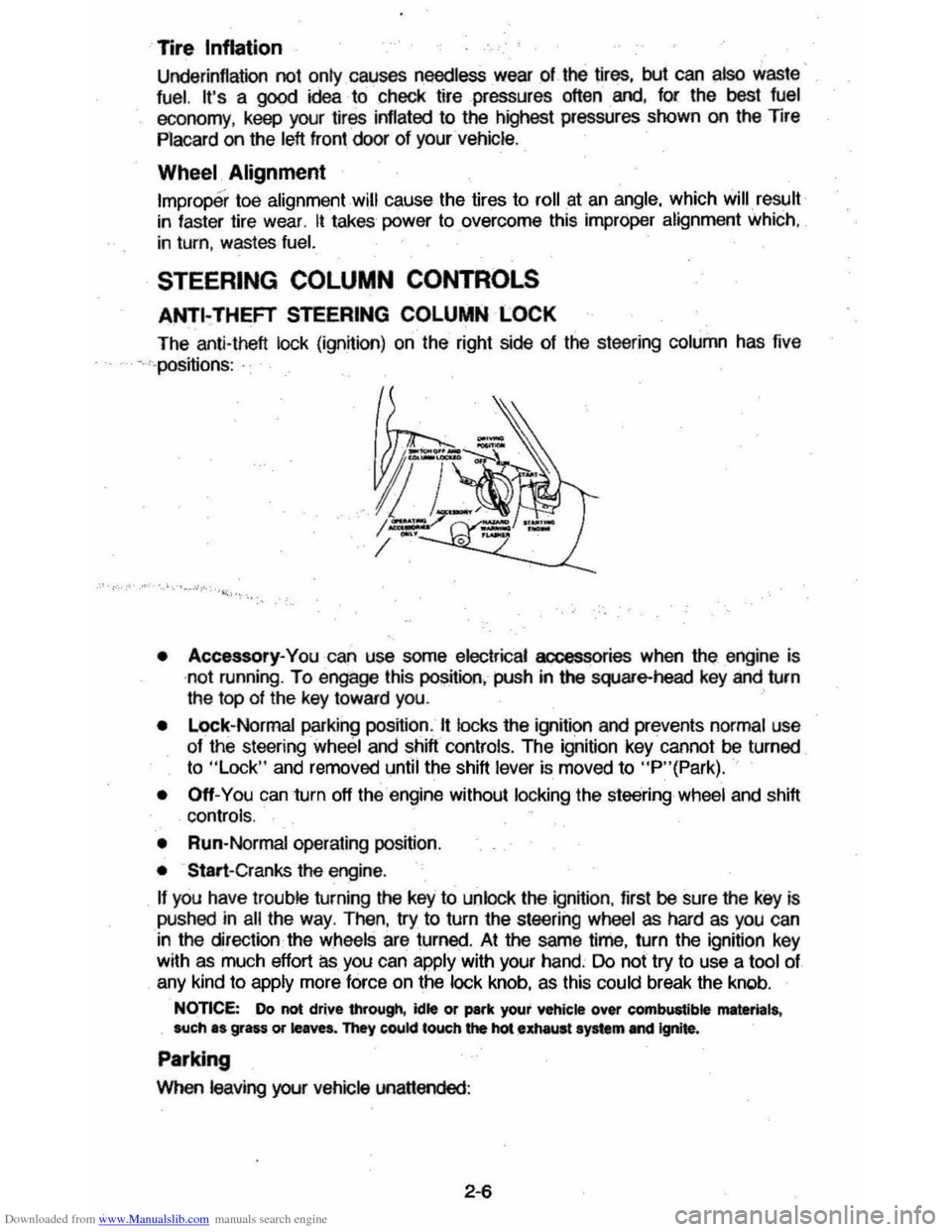
The anti-theft lock (ignition) on the right side of the steering column has five
-""'positions: .
• Accessory-You can use SO
• Lock -Normal parking position. It locks the ignition and prevents normal use
of the steering
wheel and shift controls. The ignition key cannot be turned
to "Lock" and removed until the shift lever is moved to "P"(Park).
• Off-You
can turn off the engine without locking the steering wheel and shift controls.
• Run-Normal operating position.
• Start-Cranks the engine.
If you have trouble turning the key to uniock the ignition, first be sure the key is
pushed in
all the way . Then , try to turn the steering wheel as hard as you can
in the direction the
wheels are turned. At the same time, turn the ignition key
with as much effort as you can apply with your hand; Do not try to use a tool of
any kind to
apply more force on the lock knob, as this could break the knob .
NOncE: Do not drive through, idle or park your vehicle over combustible marla Is, .uch •• grass or leaves. They could touch the hot eJlhauat .ystem .-.cIlgnite.
Parking
When leaving your vehicle unattended :
2-6
Page 27 of 104
Downloaded from www.Manualslib.com manuals search engine STARTING THE ENGINE
For vehicles sold in Canada which do NOT. have the. Computer Command
Control system, pleru;e refer to the Owner's Manual Supplement supplied with
your
vehicle for engine starting procedures . (If a "Check Engine" light comes
on during engine starting, your
vehicle does have the Computer Command
Control system.)
1. Apply the parking brake.
2 . Move
the transmission shill lever to "P"(Park) or "N"(Neutral) ("P"
preferred). A starter . safety device is designed to keep the starter from
operating if the shift
lever is in .any drive position . (If you need to re-start
the engine while the vehicle is moving, move the shift lever to "N ." )
3 . Start the engine .as outlined below for different conditions . Be sure to
follow the instructions which apply to your engine . (The Engine Code is the
8th digit on the
VIN plate at the lower left side of your windshield . See
. "SpeCifications" .Section 7 oUhis manual for more details.) "~" ...
NOTICE: Do not crank the engine 'or more than about 15 seconcls at a time. Wait 10 to 15 seconds before trying again. Thla will hetp prevent damage to the starter.
• COLD ENGINE
•
All Engines -Press the accelerator pedal to the floor and slowly
release it. With your foot 011 the pedat, crank the engine by turning
the ignition key to "Start." Release the key when the engine starts.
If the engine does not start or starts, but fails to run, repeat this
procedure
.
• .• • .
,., .•..• ·Whe!\. '.he engine is running smoothly (about 30 seconds), you can reduce
the engine
idle speed by pressing clown onthe.accelerator · pedal. then slowly releasing ~. .
NOTICE : If the engine runS a long time (S minutes or more) without pressing down the accelerator pedal, overheating OOl,lkf'C;.auM : damage -to 'the engine and exhaust system. ' I, .
Do not Ie.Y~ yoot vehicle ,unattended with the engine . running. H the engine should overllut, you would not be there to I'NCt to the temperatwe wwnlng light Of gaga. This
could reaun if! costly damage to your vehicle and Ita contents.
• Warm Engine
• All -Do not press clown the accelerator pedal. With your foot off
the
pedal , crank the engine by turning the ignition key to "Start." II the
engine
does not start after 3 seconds of cranking, press clown the
accelerator pedal to 1 /3 of its. travel while cranking. Release the key
(and accelerator pedal) when the enginjl starts.
• Very Cold We'lther (Below -1S"C Or O"F Or After Vehicle Has Been Standing Idle Several Days) • Before cranking the engine, fully depress
and release the accelerator
pedal one or . two times more than stated for
your engine under
"Cold Engine" .starting. Then, with your foot-oil the
accelerator pedal, crank the engine by turning the ignition key to "Start." Release the key when the engine starts.
4 .
Apply the regular brakes and shift into. the proper gear. Release the
parking brake and
drive off.
2-8
Page 31 of 104
Downloaded from www.Manualslib.com manuals search engine CRUISE.
C~~~~L~_. --''--_=
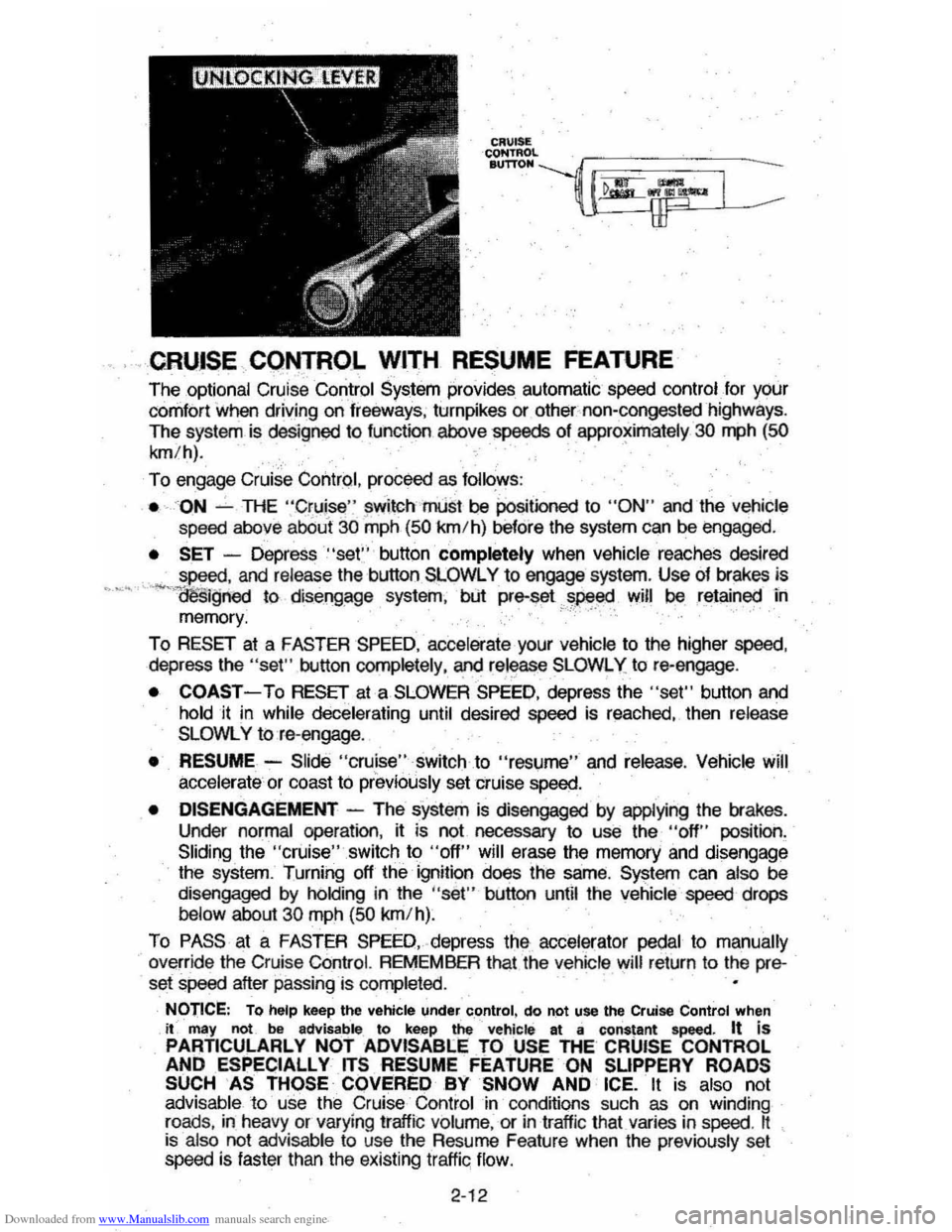
.CRUISE .CQNTROJ. WITH RESUME FEATURE
The optional Cruise Control System provides automatic speed control for your
comfort
when driving on freeways , turnpikes or othernon'congested highways.
The system is
designf;lCl to f.unction above gpeeds of approximately 30 "1'h (50 ~I~. .
To engage Cruise ContrQI, proceed as follows:
•
··ON ~ THE ' : Cruise " ~wltchmUst be Positioned to "ON" and the vehicle
speed above abOu'! 30 mph (50 km/h) before the system can be engaged.
• SET -Depress "set" button completely when vehicle reaches desired '. . speed. anc release the button SLOWLY to engage system. Use of brakes is
"-'''-'l'l/!Slgned to dis engage system, blit pre-set~peed Viill be retained in
memory. . '." ,
To RESET at a FASTER SPEED , accelerate your vehicle to the higher speed,
depress the "set" button completely , anc re",ase SLOWLy to re·engage .
•
COAST-To RESET at a SLOWER SPEED, depress the "set" button and holdi! in whil e decelerating until desired speed is reached, then release SLOWLY to re·engage .
• RESUME
-Slide "cruise"swi!ch to "resume" and release . Vehicl .e will
accelerate or coast to previously set cruise speed.
• DISENGAGEMENT -The system is disengaged by applying the brakes.
Under normal qperation, it is not necessary to use the. "off " position.
Sliding the "cruise" switch to "off" will erase the memory and disengage
the system. Turning off the ignition does the same . System can also be
disengaged by hOlding in the "set" button until the vehicle speed drops
below about
30 mph (50 km/h).
To
PASS at a FASTER SPEED, depress the accelerator pedal to manually
o verride the Cruise
COntrol. REMEMBER that the vehicle will return to the preset speed after passing is cO"1'leted .
NOTICE: To help keep the vehicle under control, do not use the Cruise Control when it may not be advisable to keep the·· vehicle at a constant speed. It is PARTICULARLY NOT ADVISABLE TO USE THE' CRUfSE CONTROL AND ESPECIALLY ITS RESUME FEATURE ON SUPPERY ROADS
SUCH AS THOSE COVERED BY SNOW AND ICE. It is also not advisable to use the Cruise Control in conditions such as on windin g
roads. in heavy or varying traffiC volume ; or in traffic that. varies in speed . tt is also not advisable to use the Resume Feature when the previously set
speed is faster than the existing traffic flow.
2-12
Page 34 of 104
Downloaded from www.Manualslib.com manuals search engine DISC BRAKE WEAR INDICATORS
Front disc brakes have bum-in we .ar indicators which are desigled to make a
high-pitched squeating or
cricket·tike warning sound when the brake pads are
worn to where new pads are needed . The sound will come
and go. or be heard
all the time when the wheels are rolling, but will stop when the brake pedal is
pushed down
firmly. Expensive damage can result if pads are not replaced When needed .
See also the brake checks listed in the Maintenance Schedule folder.
INSTRUMENT PANEL AND CONTROLS
INSTRUMENTS
The instruments . gages and indicator lights convenienlly grouped in the
instrument cluster are designed to tell you at a glance many important things
about the perform ance of your
vehicle. The following information will enabl e
you to more quickly understand and properly interpret these instruments.
Speedometer
The speedometer hand indicates vehicle speed in miles per hour and
kilometers per hour.
Odometer
The group of six figures in the, speedometer lower center sectiori indicates the
accumulated mileage.
Trip Odometer (optional)
The trip odometer may be reset to zero by turning stem to. the right This
instrument may be used to 1TI<\':!1 .. aPC~rately record trip mileages 'or kilometers .
Fuel Gage
The fuel gage will register the APPROXIMATE fuel level in the tank. when the
ignition is in the
RUN position .
When the
gage registers EMPTY. some fuel is still available as a reserve .
When the gage registers FULL. some
additional fuel can still be added to the
tank. The following conditions maybe considered normal:
•
Gas station pump may shut off before fuel gage indicates FULL
• Amount of gasoline reqUired ior fill~up may not exaclly correspond to gage.
• Needle
may not move awa y from FULL until some time aiter fill·up .
• Needle
may move during turns. stops and accelerations.
When the ignition switch is turned to the OFF position, the needle will not
necessarily return all the way·to the EMPTY mark.
2·15
Page 36 of 104
Downloaded from www.Manualslib.com manuals search engine Oil! Choke Indicator Light
This light will come on to prov~ a "bulb check", when the ignition is turnee
on, but should go out after the engine is startee. If light fails to come on with
ignition turnee on,
it could indicate a bumee -out bulb , a defective electric
choke heater circuit or a
blown instrument lamp fuse. Have system repairee if
light
does not come on during check.
Occasionally, this light may flicker . momentarily while the engine is running but
this will· not harm ,the ' system. However, if the ,light remains on during normal
engine operation , the engine shoutd be stopped until the cause of the
trouble can be Iocatee .andcorrectee. The source of the troubte could be any of the following.
•
Loss of engine oil pressure.
• Blown "Choke Heater" or Gage fuse.
• Loss of electric choke heater vo~age.
NOTICE: Continuing to run the engine with an illuminated oil/choke pressure light can cause serious damage to the engine or unusually high exhaust system temp*'ratures which could resuh in serious d8mage to the vehicte.
Choke Warning Indicator Light
On some vehicles equippec with tlie optional .Oil pressure gage, an amber
choke warning indicator
-light replaces the red oil pressure ' indicator light in the
instrument cluster. If this light comes on, indicating loss of electric choke
heater voltage , have your authorizee
Oealer locate and correct the trouble as
soon as possible.
Generator Indicator Light
The red .light VOLT is designee to come on when the ignition.key is in the "run " pos~ion,bul t>efiJrethe 'engine;;, startee. After the engine starts, the
light should go out and remain oul.
H the light remains on when engine is
running , have your Authorized Dealer locate and correct ' the trouble as soon as
possible .
Engine Temperature Indicator Light
This indicator light is providee .in the instrument cluster to. quickly warn of an
overheated engine. 'With the ignition in the START position, the ree TEMP
indicator (hot light) will light to
let you know that it is operating properly.
When the engine is starlee,
the ree light will go out immediately. tt will light up
at no other time unless for some
reason the engine reaches a dangerously
high operating temperature. Glance .at the instrument cluster freqtJentiyas you
drive, if this light is on see
"Engine Cooing System" on page 3,3.
Brake System Warning Light
The regular braking system is a dual system designee so that one part will
provide some braking action
n there is a loss of hydraulic pressure in the other
part of the system. The system has a "Brake" warning Ught Iocatee in the
instrument · panel.
• To serve as a reminder, the "6RAKE" light is designee to stay on when
the parking brake is not fully released and the ignition key is on.