light CHEVROLET MONTE CARLO 1981 4.G Owner's Manual
[x] Cancel search | Manufacturer: CHEVROLET, Model Year: 1981, Model line: MONTE CARLO, Model: CHEVROLET MONTE CARLO 1981 4.GPages: 104, PDF Size: 23.92 MB
Page 37 of 104
Downloaded from www.Manualslib.com manuals search engine "
• The lighl is also designed to come oi, briefly during engine starting so you . can check that the bulb is okay .
• Have the system repaired ifth'e light .d~es· not .come on during engine
. starting or when th.e Parking brake is set.
•
This warning light does not do away with the heed for brake inspection and
maintenance. The brake fluid level must be checked regularly . See your
Maintenance
Schedule folder for other brake checks.
If the light 'comes on andstavson when the ignition key is on, after the brake pedal has been firmly pushed down, it may mean that there is somelhing
'
wrongwith I?"" of the br"kesyjitem.
What to do:
1. Check to see that the parking brake hec been released . If it has been ..
2. Pull off the road and stop carefully, And remember that:
" .• " Stopping ,distances may be longer.
•
You may have to push harder on the pedal.
•
The pedal may go down farther than normal.
3, Try out the brakes by starting and stopping on the road shoulder--then:
• If you judge it to be safe, drive cautiously at a safe speed to the .near,est dealer for ,repair, or
• Have vooicle t6w~ to the nearest dealer for repair.
Continued driving without getting necessary repairs could be dangerous .
"'''''''~''., ENGINE" LIGHT
All gasoline"~~gine VehiCles sold in ttwl,lnited States (aridsorne ' vehidle. sok:!
in Canada) have the Computer Command Control sYstem, (canadian owners
should
also ' read the Nole on the. inside front cover of this manual. )
If your vehicle has thElCoTP\Jter :,eommand:'ContrOI-system, ,a , "CHECK
ENGINE" light
on the instrument panel is designed to come on during engine
starting to let you know the bulb is working ; (The light will stay on a short time .
after
the engine starts,) If the light comes on while driving, service to the
Computer , Command
Control system may be required , Although. the. v.ehicle
may still be drivable, see , your Chevrolet dealer as soon as possible . for an inspection of the system , (Some vehicles sold in Canada, DO NOT HAVE the
Computer Command Controtsystem ,
ILyeur vehicle does not have a "Check
Engine " light, then it does not have the Computer Command Control system,)
Continued, driving without having the Computer Command Control system
serviced
could cause damegeto' the emission control system, It could also affect fuel economy and drivability, .
See also "Computer
Command Control' system" in "Service and Maintenance," Section: 5 of this manual.
Tachometer
The optional tachometer i. ndicates the speed of the engine in revolutions per
minute, The' indicated num,ber, times 100, gives the engine speed, Operating
the engine
with. the tachometer . reading .in the colQr-coded high-speed area could lead to seriOUS engine damage,
Page 39 of 104
Downloaded from www.Manualslib.com manuals search engine Pressing the control will send waier' or 'other cleaning agent onto the
wlildshield until control is released and will also cause the wiper lever to move
thus starting the wiper mOtOL The wiper will continue to operate until manually
turned off at the wiper
control lever.
Fill the washer jar only 3/4 full during the winter to allow for expanson iI the
temperature
should fall low enough to freeze the solution.
• Check the washer fluid level regularly. Do it ofIen when the weattier . is bad.
• Use a fluid such as GM Optikleen to help prevent freezing damage, and for
better cleaning . Be sure to put the fluid in the proper reservoiL
• Do not use radiator antifreeze in the windshield washer; it could cause
paint damage.
• In cQld weather, warm the windshield with the defrosters before using the wesher--to help prevent Icing that may block the driver's vision.
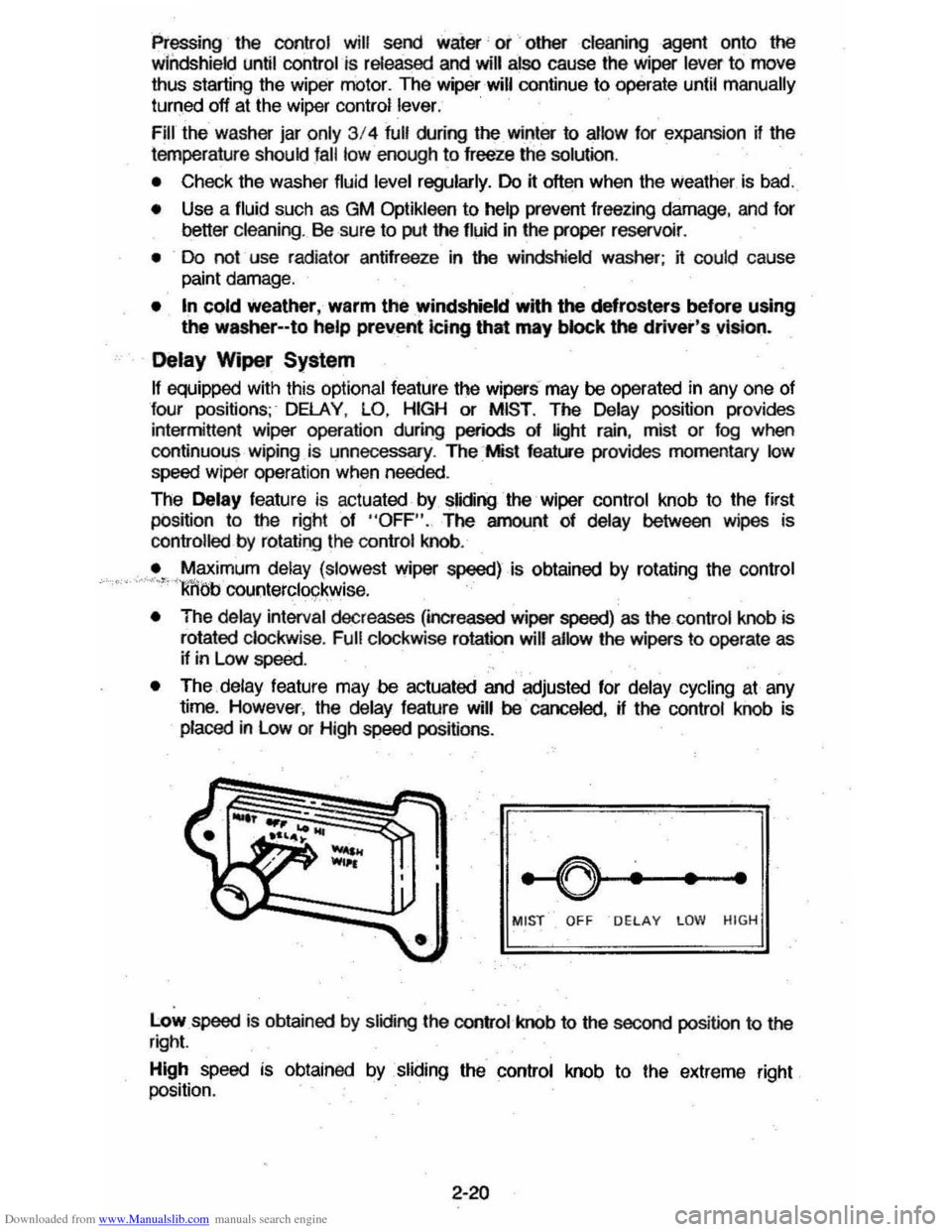
Delay Wiper System
If equipped with this optional feature the wipers may be operated in anyone of
four positions;
DELAY , LO, HIGH or MIST . The Delay position provides
intermittent wiper operation during periods of light rain, mist or fog when
continuous Wiping.
is unnecessary . The 'Mist feallJe provides momentary low
speed wiper operation when needed .
The
Delay feature is actuated by sliding the wiper control knob to the first pOsition to the right of "OFF" .. The amount of delay between wipes is controlled by rotating the control knob .
.• , Maximum delay (slowest wiper speed) is obtained by rotating the control " .. ",. 'l
The delay interval decreases (increased wiper speed) as the control knob is rotated clockwise. Full clockwise rotation will allow the wipers to operate as if in Low speed.
• The delay feature may be actuated and adjusted for delay cycling at any
time. However , the delay feature will be canceled, ij the control knob is
placed in Low or High speed positions,
MIST OFF DELAY LOW HIGH
Low speed is obtained by sliding the control knob to the second position to the right.
High speed is obtained by sliding the control knob to the extreme right position.
2-20
Page 40 of 104
Downloaded from www.Manualslib.com manuals search engine The Mist feature, intended to remove incidental windshield spray such as from."
passing vehicles is activated by moving the control knob to the extreme left ,
and holding it in this posnion. The wipers will continue to operate until tile
control knob is released and allowed to return to the OFF position . .
The washer system is operated by depressing the control knob for one or two
seconds in any position.
In the OFF position the wipers will oper,ate 3 to 5
times and then stop .
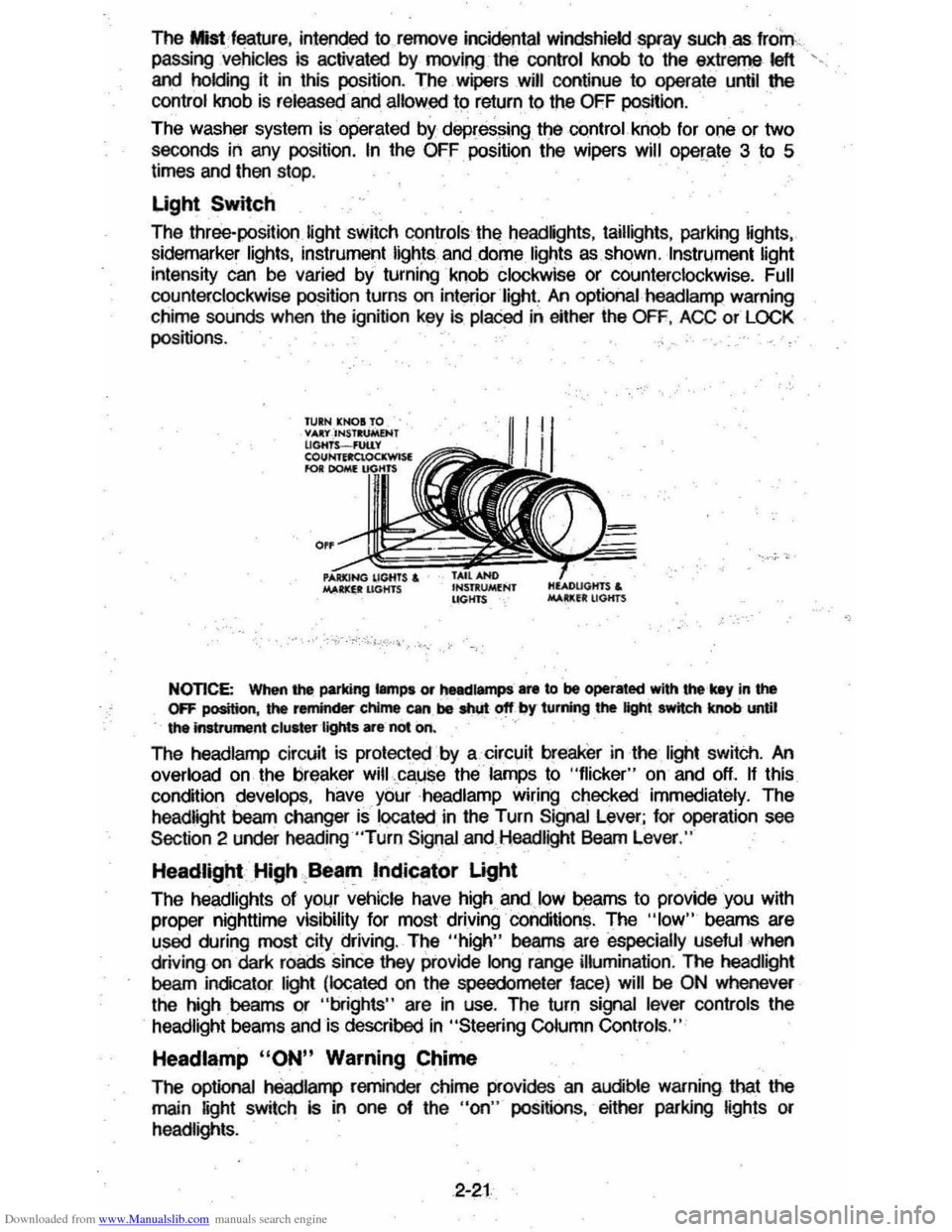
Ught Switch
The three-position light switch controls the headlights, taillights, parking ~ghts, sidemarker lights, instrument lights. and dome lights as shown. Instrument light
intensity can
be varied by turning knob clockwise or counterclockwise. Full
counterclockwise position turns on interior light An optional head lamp warning
chime sounds when the ignition key is. placed in either the OFF, ACC or LOCK
positions. , ....
. ,-"",,.
NOTICE: When the parking lamps or t)Hd1ampS .... to be operated with the key in the OFF position, the reminder-chime can be shUt-Of' by turning the light switch knob until the instrument elu.1er Ifghts are not on. '
The headlarnp circuit is protected by a circuit breaker in the light switch. An
overload on the breaker will,cau$e the lamps to "flicker" on and off. If this
condnion develops , have your ·headlamp wiring checked immediately. The
headlight beam changer is located in the Turn Signal Lever; for operation see
Section 2 under heading "Turo Signal and Headlight Beam Lever."
Headlight High ,Beam Indicator Ught
The he!).dlights of your vehicle have high and ... loW beams to provide you with
proper nighttime visibility for most driving condnions. The "low" beams are
used during most city driving . The
"high" beams are especially useful when
driving on dark roads sinCe they provide long range illumination . The headlight
beam indicator light (located on the speedometer face) will be
ON whenever
the high beams or "brights " are in use. The turn signal l
Headlamp "ON" Warning Chime
The optional headlarrl> reminder chime provides' an audible warning thai the
main
light switch is in one 0/ the "on" posnions, either parking lights or
headlights. .
2-21
Page 41 of 104
Downloaded from www.Manualslib.com manuals search engine The reminder chime is actuated only when the ignition -switch is--turned to
"OFF," "LOCK" or "ACCESSORY" position,
When the parking lamps or headlamps are
to be operated with the key in the
OFF position , the reminder chime can be shut off by turning the light switch
knob until the instrument cluster lights are not on.
Electric Clock
Reset the dock by pulling out the knOb and turning the hand s clockwise ~
slow, counterclockwise if fast. This is designed to, if the clock error is five minutes or mo"e~ -automatically --'compensate for time gain or ,lag. Several
resettings, several days apart, may be needed to properly adjust the clock
meChanism.
Cigarette Lighter
The cigarette lighter is located to the right of the heater control. To operate,
. push it in. When it becomes heated, it
automatically pops out ready for use .
Electric Trunk Release
An electric trunk release is available which permrts opening the trunk from'
inside the car. With the ignition key on, pUsh the release button located in the .
glove box.
Always
lock . the glove compartment when leaving the car unattended to prevent unauthorized entry into·tne trurik .
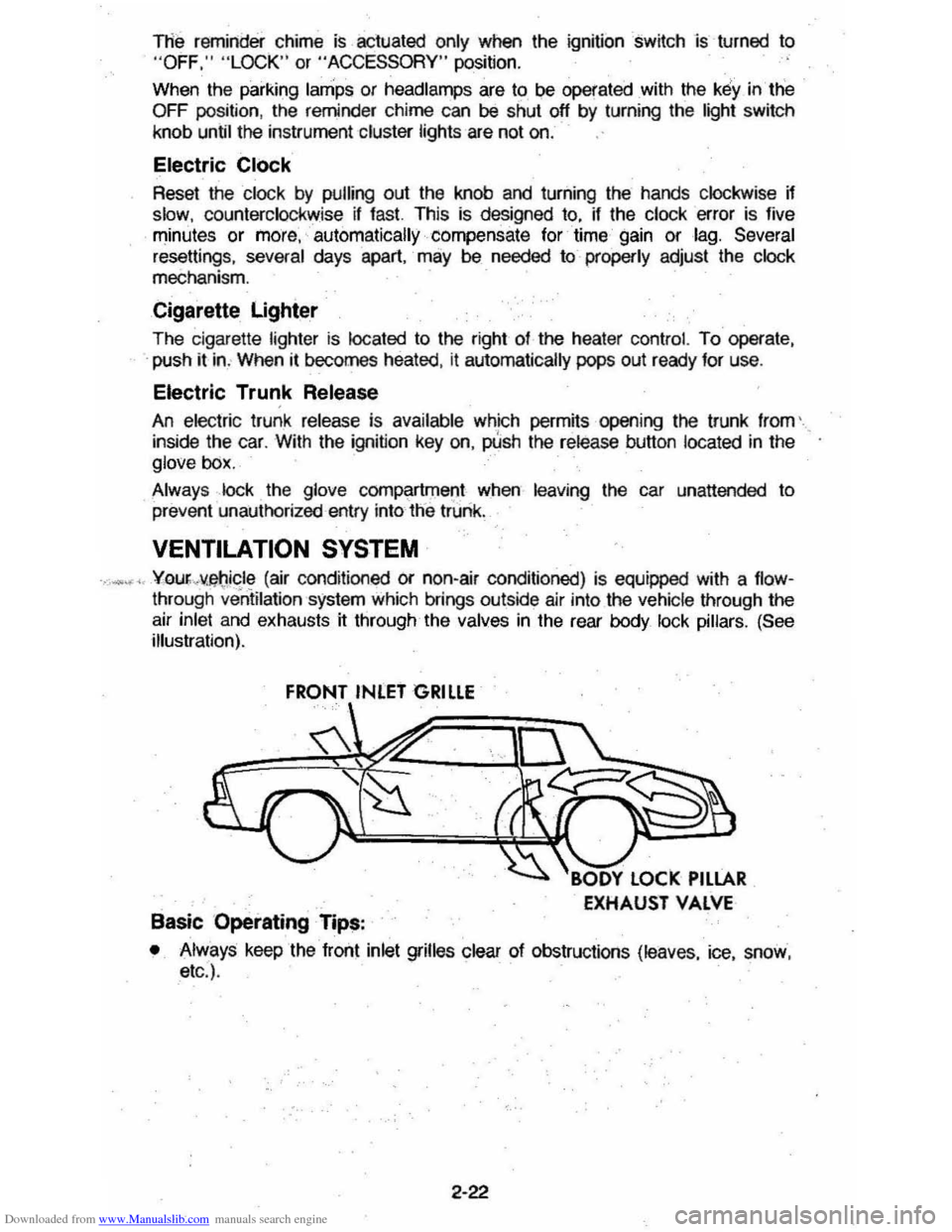
VENTILATION SYSTEM
.• _<, YOUf.,v.~Jc.le (air conditioned Of non -air conditioned) is equipped with a flowthrough ventilation system which brings outside air into the vehicle through the
air inlet a
nd exhausts it through the valves in the rear body lock pillars. (See
illustration).
FRONT INLET GRILLE
Basic Operating Tip!!:
• Always keep the front inlet grilles clear of obstructions (leaves, ice, snow ,
etc .) .
2-22
Page 42 of 104
Downloaded from www.Manualslib.com manuals search engine • Always keep the area under the front seat clear for maximum rear seat airflow . .: ,
• For optimum driving comfort in. heating or air conditioning modes keep ", windows . closed. .
•
Clear snow and ice from the hood and air inlet in front of the windshield . This improves heater ahd defroster performance and lowers the chance of
fogging
on the inside of the windshield.
• During winter operation
run the blower on "High" for a few moments
before driving off. This helps clear the Intake ducts of snow and further
lessens the chance of fogging on the insiele of the windshield.
The following pages of this manual proviele more operating tips for getting
maximum heating
and cooling comfort. (AlsO s"" "Engine Exhaust Gas Caution (Carbon Monoxidej"at the beginning of "Starting and Operating ."
Section 2 oHhismanual.)
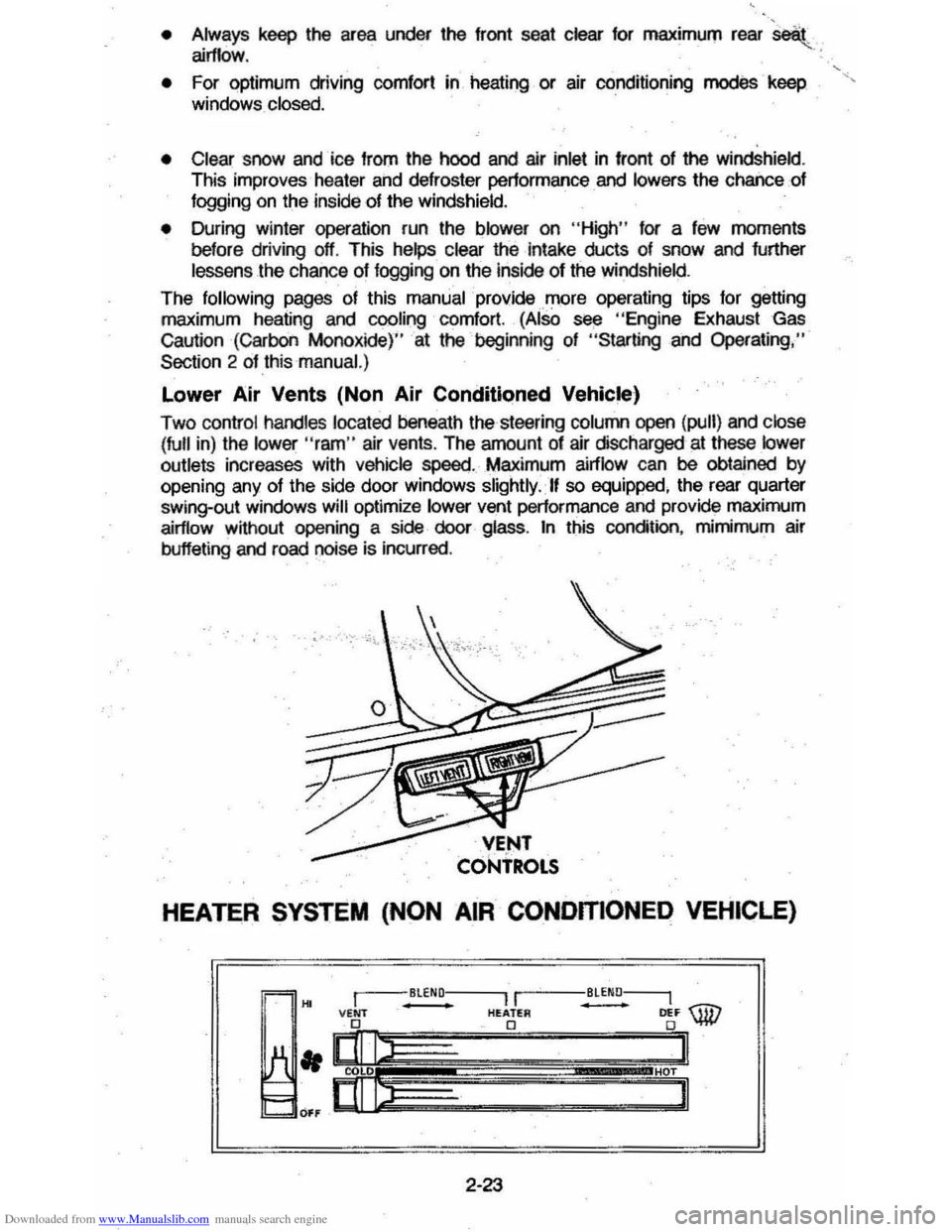
Lower Air Vents (Non Air Conditioned Vehicle)
Two control handles located beneath the steering colulTYl open (pull) and ciose
(full in) the
lower "ram" air vents . The amount of air discharged at these lower
outlets increases with vehicle speed. Maximum airflow can be obtained by
opening any of the side door windows slightly. If so equipped, the rear quarter SWing-out windows will optimize lower vent performance and provide maximum
airflow without opening a siele dIoor glass. In this condition, mimimum air
buffeting
and road noise is incurred .
HEATER SYSTEM (NON AIR CONDITIONED VEHICLE)
2-23
Page 43 of 104
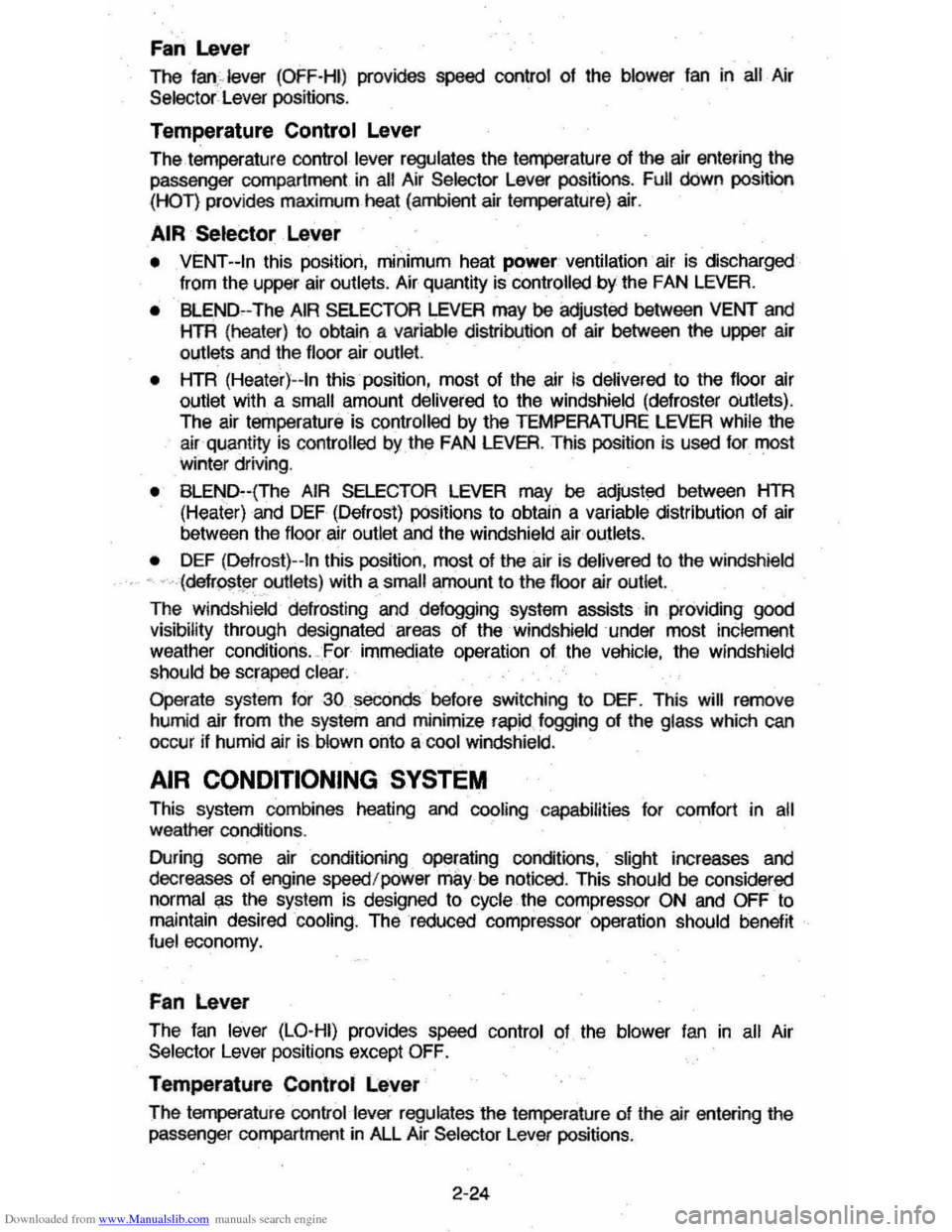
Downloaded from www.Manualslib.com manuals search engine Fan Lever
The fan;-lever (OFF-HI) provides speed control of the blower fan in all Air
Selector Lever positions.
Temperature Control Lever
The temperature control lever regulates the temperature of the air entering the passenger compartment in all Air Selector lever positions. Full down position
(HOT) provides maximum heat
(ambient air temperature) air.
AIR Selector Lever
• VENT --In this pOSition, minimum heat power. ventilation air is discharged
from the upper air oullets. Air quantity is
controlled by the FAN LEVER.
• BlEND_-The AIR SELECTOR LEVER may be adjusted between VENT and HTR (heater) to obtain a variable distribution of air between the uppe r air
outlets and the floor air outlet
• HTR (Heater )--In this position , most of the .air Is delivered to the floor air
outlet with a small amount deliVered to the windshield (defroster oullets).
The air temperature is
cpntrolled by the TEMPERATURE LEVER while the
air quantity is controlled by the FAN LEVER. This position is used for most winter driving. .
• BlEND--(The AIR SELECTOR LEVER may be adjUsted between HTR
(Heater) and DEF (Defrost) pOSitions to obtain a variable distribution of air
between the floor . air outlet
and the windshield air outlets.
• DEF (Defro st)--In this position , most of the air is delivered to the windshield
• ··-.(defrjl$t"routletS) with a small amount to the floor air outlet
The windsh ield de frost i
ng and defogging system assists in providing good
visibility through designated areas Of the windshield under most inclement
weather conditions. _For immediate operation of the vehicle, the windshield
should be scraped clear.
Operate system for
30 seconds before switching to DEF. This will remove
humid air from the system and minimize
rapid fogging of the glass which can occur jf humid air i s blown onto a cool windshield.
AIR CONDITIONING SYSTEM
This system combines heating and cooling capabilities for comfort in all
weather conditions .
During some air conditioning operating conditions , slight increases and
decreases of engine speedfpower may be noticed . This should be considered
normal as the system is designed to cycle the compressor ON and OFF to
maintain desired cooling. The reduced compressor operation should benefit
fuel economy.
Fan Lever
The Ian lever (LO-HI) provide s speed control of the blower fan in all Air Selector Lever positions except OFF.
Temperature Control Lever
The temperature control lever regulates the temperature of the air entering the
passenger compartment in ALL Air Selector Lever positions.
2-24
Page 44 of 104
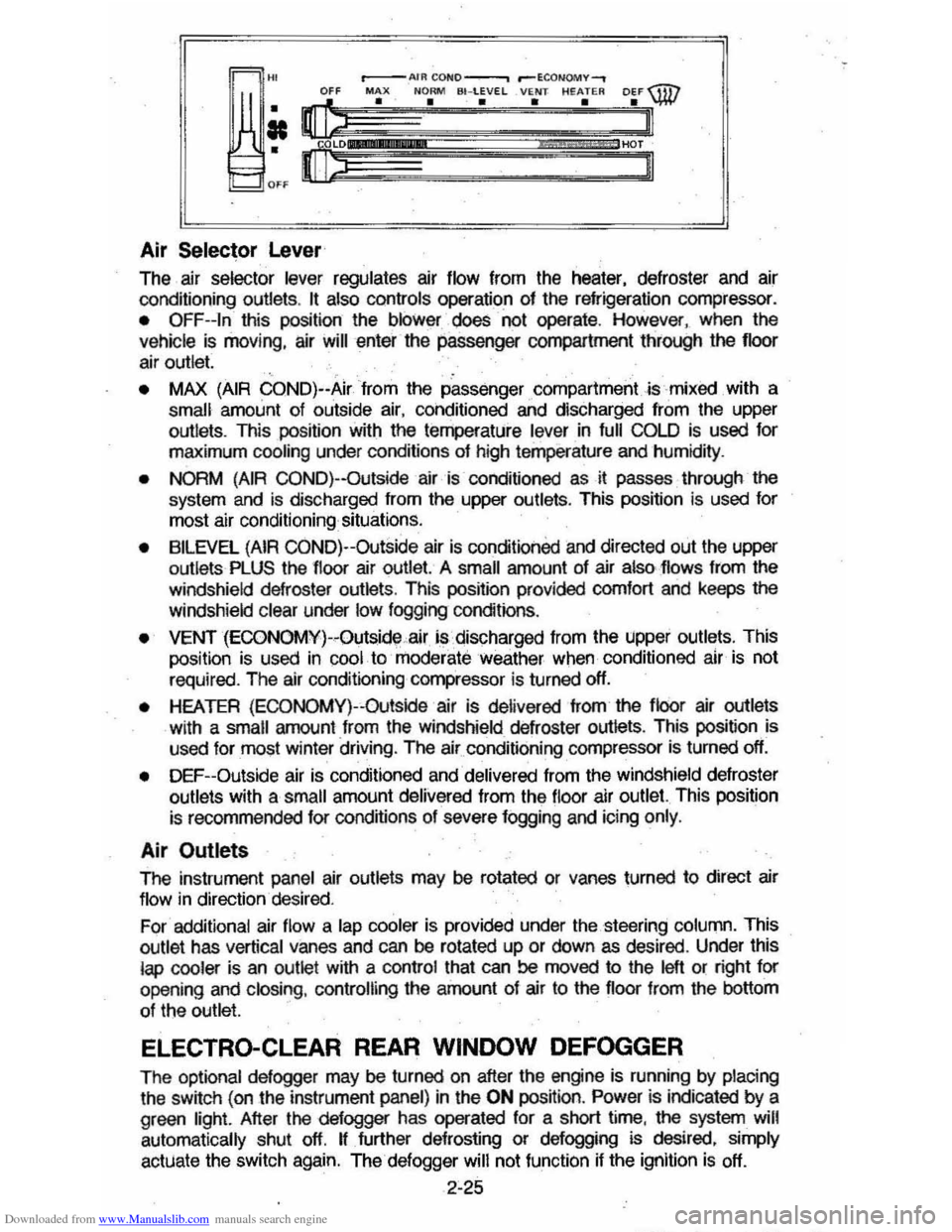
Downloaded from www.Manualslib.com manuals search engine Air Selector Lever
The air selector lever regulates air flow from the heater, defroster and air
conditioning outlets. It also controls operation of the refrigeration compressor.
• OFF--In this position the blower doeS not operate . However , when the
vehicle is moving, air will enter the passenger compartment through the floor
air outlet.
• MAX (AIR COND)--Air from the p~ssengercompartment is· mixed with a
small amount of outside air, conditioned and discharged from the upper
outlets. This position with the
temperature lever in full COLD is used for
maximum cooling under conditions
of high temperatu re and humidity .
• NORM (AIR COND) --Outside air is conditioned as it passes through the
system and is discharged from the upper outlets. This position is used for
most air conditioning situations.
• BILEVEL (AIR COND)--Outside air is conditioned and directed out the upper
outlets PlUS the floor air outlet. A small amount of air also flows trom the
windshield defroster outlets.
This position provided comfort and keeps the
windshield clear under low fogging conditions .
• VENT (ECONOMY)--Outsid~,air is discharged from the upper outlets. This position is used in cool. to moderate weather when· conditioned air· is not
required. The air conditioning compressor is turned off.
• HEATER (ECONOMY)-'-Outside air is delivered from the floor air outlets
with a small amount from the windshield defroster outlets. This position is
used for most winter driving. The air conditioning compressor is turned off.
• DEF--Outside air is conditioned and delivered from the windshield defroster
outlets with a smail amount delivered from the floor air outlet. This position
is recommended for conditions
Of severe fogging and icing only.
Air Outlets
The instrument panel air outlets may be rotated or vanes turned to direct air flow in direction' desired.
For additional air flow a lap cooler is provided under the steering column. This outlet has vertical vanes and can be rotated up or down as desired . Under this
lap cooler is an outlet with a control that can
be moved to the IefI or right for
opening and closing , controlling the amount of air
to the floor from the bottom
of the outlet.
ELECTRO-CLEAR REAR WINDOW DEFOGGER
The optional defogger may be turned on after the engine is running by placing
the switch (on the instrument panel) in the
ON postlion . Power is indicated by a
green light. After the defogger has operated for a short time, the system will
automatically
shut off. If further defrosting or defogging is des ired, simply
actuate the switch again.
The defogger will not function if the ignition is off.
2-25
Page 46 of 104
Downloaded from www.Manualslib.com manuals search engine FM Reception -Although FM is normally static free, reception can be limited
by terrain, atmospheric conditions, station strength and distance from the
transmitter, Buildings or other obstructions can ·cause moment ary static, flutter
or station swapping . If you cannot keep good reception, tuning to a stronger
station will bring improvement.
Stereo Sound -All Delco Sound Systems with an FM stereo radio will switch
to stereo operat ion when ever
an FM stereo broadcast" is being rec eived and an
indicator will light. "Stet"eo" operation means the radio is separating a stereo broadcast back into the original two channels, called "left " and "right. :' Stereo
sound is, noticeably more realistic , to the ear.
Tape and Tape Player Care
On Delco Sound Systems with 8-Track or casse)te tape units,take out the tape
cartridge (or cassette) when not in Use to prevent possible damage to the tape
player and to the cartridge (or cassette) .
Store
cartridges and ca sse)tes away from extreme heat or direct sunlight. Protect th.e open ends from. dirt or damage .. We suggest you stote them in their original cases or in any oth.er protective cases. Eight·Track cartridges and
cassettes eventually wear out and replacement may be neces sary if they
become noisy.
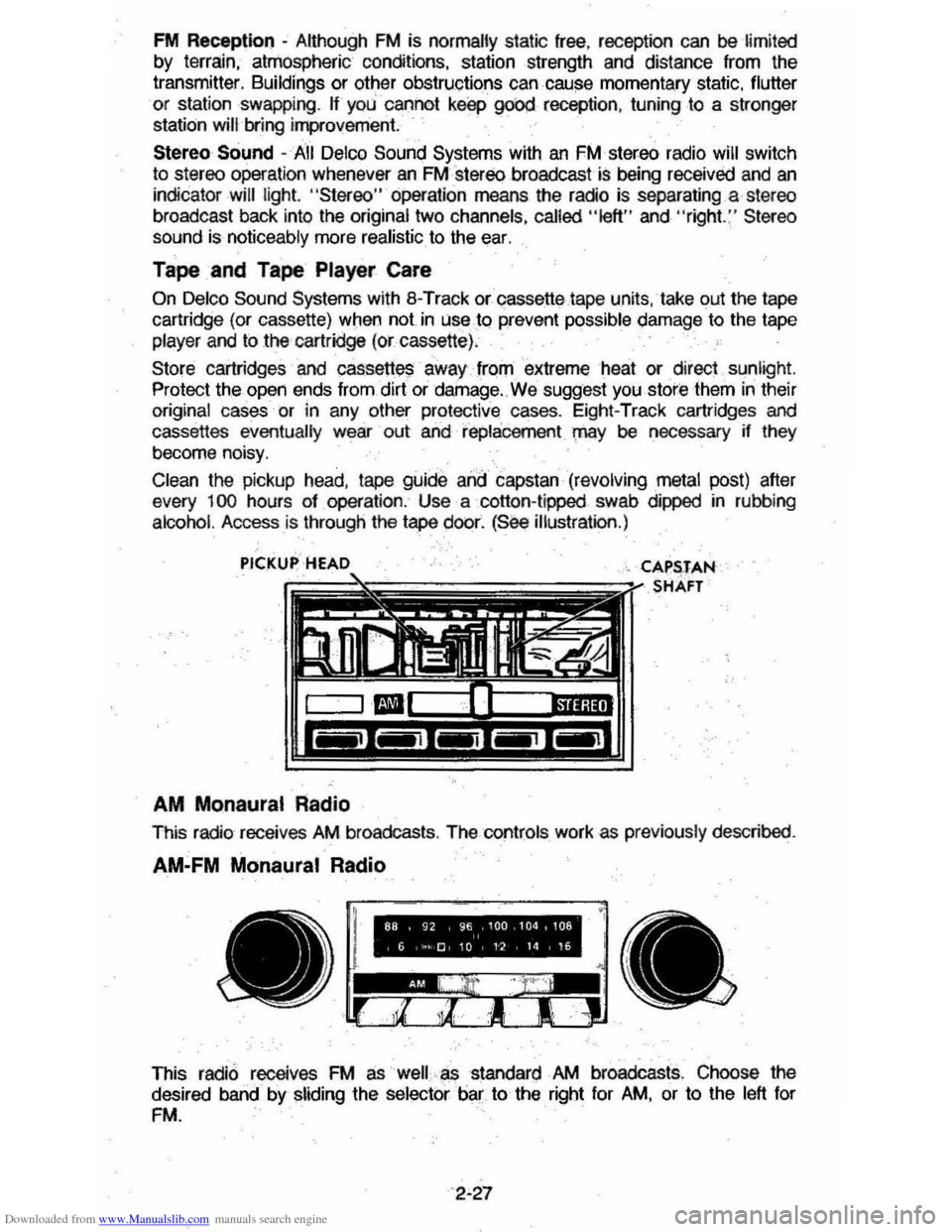
Clean the pickup head, tape guide arid capstan (revolving metal post) after evet"Y 100 hours of operation . Use a cotton-tipped swab dipped in rubbing
alcohol. A cc es s is through the tape door. (Sile illustration .)
AM Monaural Radio
This radio receives AM broadcasts . The controls work as previously described.
AM-FM Monaural Radio
68 92 96 100 104. 106 6 0 10 11 ,~ 16
This radio receives FM as well, as .standard AM broadcasts . Choose the
desired band by sliding the selecta, bar to the right for AM, or to the left for
FM .
'2-27
Page 49 of 104
Downloaded from www.Manualslib.com manuals search engine OTHER CONTROLS AND FEATURES
LIMITED-SLIP REAR AXLE
On vehicles that have it. the optional limited-slip rear axle can give added
traction on snow, ice, mud, sand, gravel, etc. Normally , the limited-slip axle
unit works like a standard axle. However, when either drive wheel meets a
slippery enough surface, and the opposite wheel is on a surface with greater traction, the ,limited-slip 'unit can continue to give driving force tathe wheel
having the greater traction,instead 01 merely spinning the wheel that has the
least traction .
Whether your
vehicle has an optional limited-slip rear axle or a standard axle, take care when speeding up or, whera shifting into a lower gear or lower gear
range , when either or both rear wheels are traveling over a slippery surface .
Sudden acceleration or engine braking action (due to shifting to a lower gear)
could cause one or both drive wheels to spinorskid and the rear 01 the vehicle to slide sideways on the crowned, ·surface of a road or in a turn. Normal skid correction and cautious driving are called for at these times.
COURTJ:SY LIGHT DELAY SYSTEM
If your vehicle is equipped with this optional feature, whenever the door is opened, then closed, on entry or exit, the dome and courtesy lights stay on for thirty seconds for convenience of driver and passengers. This presumes the
ignition is in the off position . When the ignition key is turned on. the lights will
go off. When the ignition key is turned to off, the dome and courtesy lights go
",'" of>.lor. ~.R~riod 01 fifteen seconds.
SUNROOF
The optional Sunroof is a slid ing metal panel, electrically operated. controlled
by a switch on the front center area ,Qf theroof. The ignition must be in "Run" to move the panel. " .
To' open. press the control switch rearward. To close. press it forward. The
Sunroof can
be lett partly open by releasing the control switch while you are
opening or closing the panel.
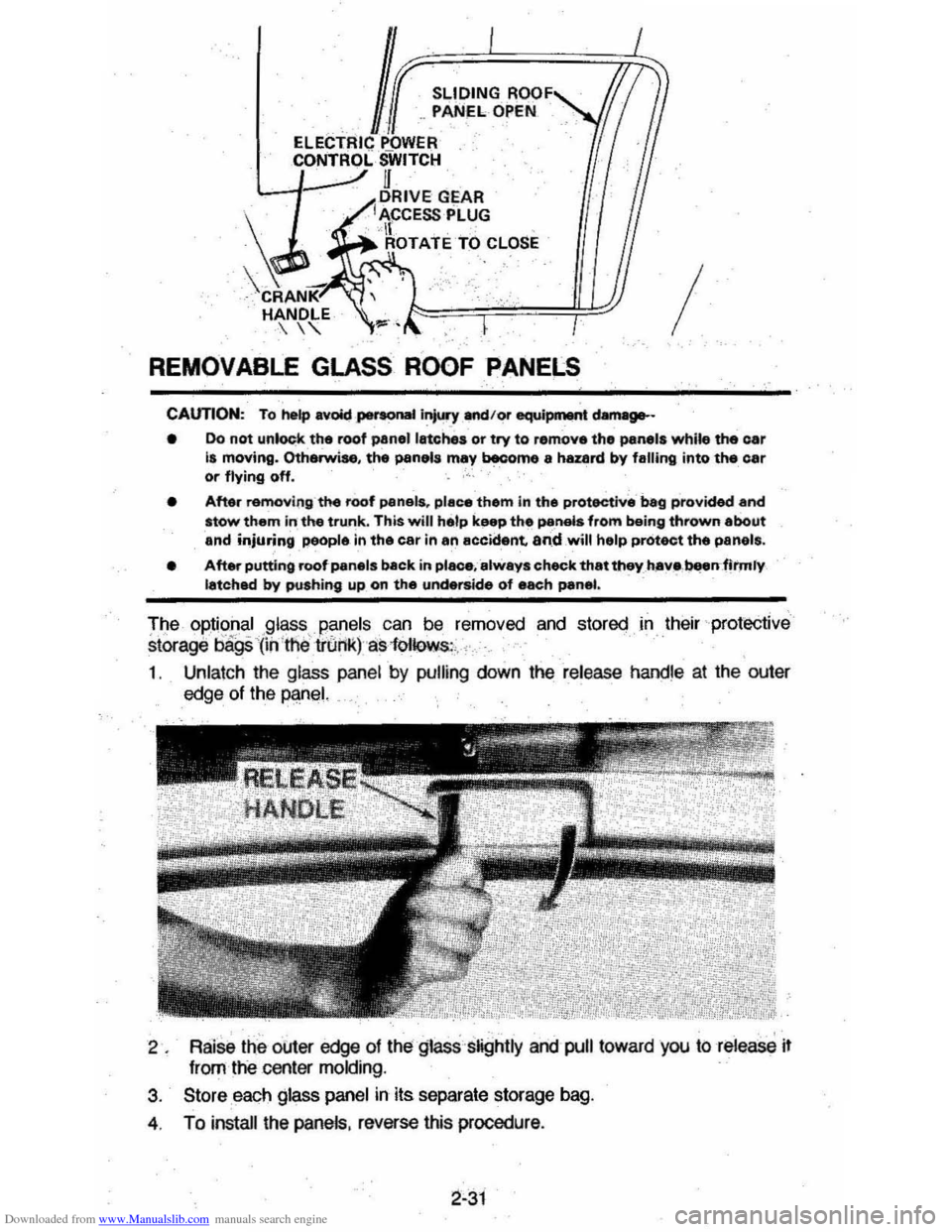
The Sunrool can be closed manually il your car has an electrical power lailure.
To do this , remoVe the small round plug in the rool (near the control switch) by pulling the plug downward with your lingers . Then insert the hex end 01 the
crank handle (supplied in your glove box) into the drive gear and turn it
clockwise to close the rool panel, and counterclockwise to open it. Remove the
crank handle and replace the plug . (See illustration.)
2-30
Page 50 of 104
Downloaded from www.Manualslib.com manuals search engine ~
SLiOING ROOF .. PANEL OPEN
ELECTRIC POWER CONTROLSWITCI:I
~ ~RIVEGEAR I~(CCESS PLUG
ROTATE TO CLOSE
REMOVABLE GLASS ROOF PANELS
CAUTION: To help avoid personal i~ Mdtor equi~ ctamage..
/
• Do not unkK:k the roof pane' latehe. or try to remove the penefs whi.., the car I, moving. Otherwise. the panels may become 8 hazard by falling into the car Or flying off.
• A.fter removiOg -me roof panels. place them in the protectiv.' bag provided and stow them in'the trunk. This will help keep the parwNS from being thrown about and injuring people . in the car in an accident. an.d will help prOtect the panels.
•
After putting roof panels back in place. always check th8tthey __ h.av .. ,~n-fil1Tlly latched by pushing up on the underside of MCh pan ...
The op)ipnal .gl¥s. p~nelscan be removed and stored in their protective
storage bags (in'the trtJrik)·asfoilOws:.. .'
1 . Unlatch the glass panel by pulling down the release handle at the outer
edge of the
p~nel.
2. Raise th;' outer edge of the glasS slightly and pull toward you to release it
from the center
molding.
3. Store eaCh glass panel in its separate storage bag.
4 . To install the panels, reverse this procedure .
2-31