light CHEVROLET MONTE CARLO 1996 5.G Owner's Manual
[x] Cancel search | Manufacturer: CHEVROLET, Model Year: 1996, Model line: MONTE CARLO, Model: CHEVROLET MONTE CARLO 1996 5.GPages: 340, PDF Size: 17.79 MB
Page 104 of 340
Downloaded from www.Manualslib.com manuals search engine Anti-Lock Brake System Active Light
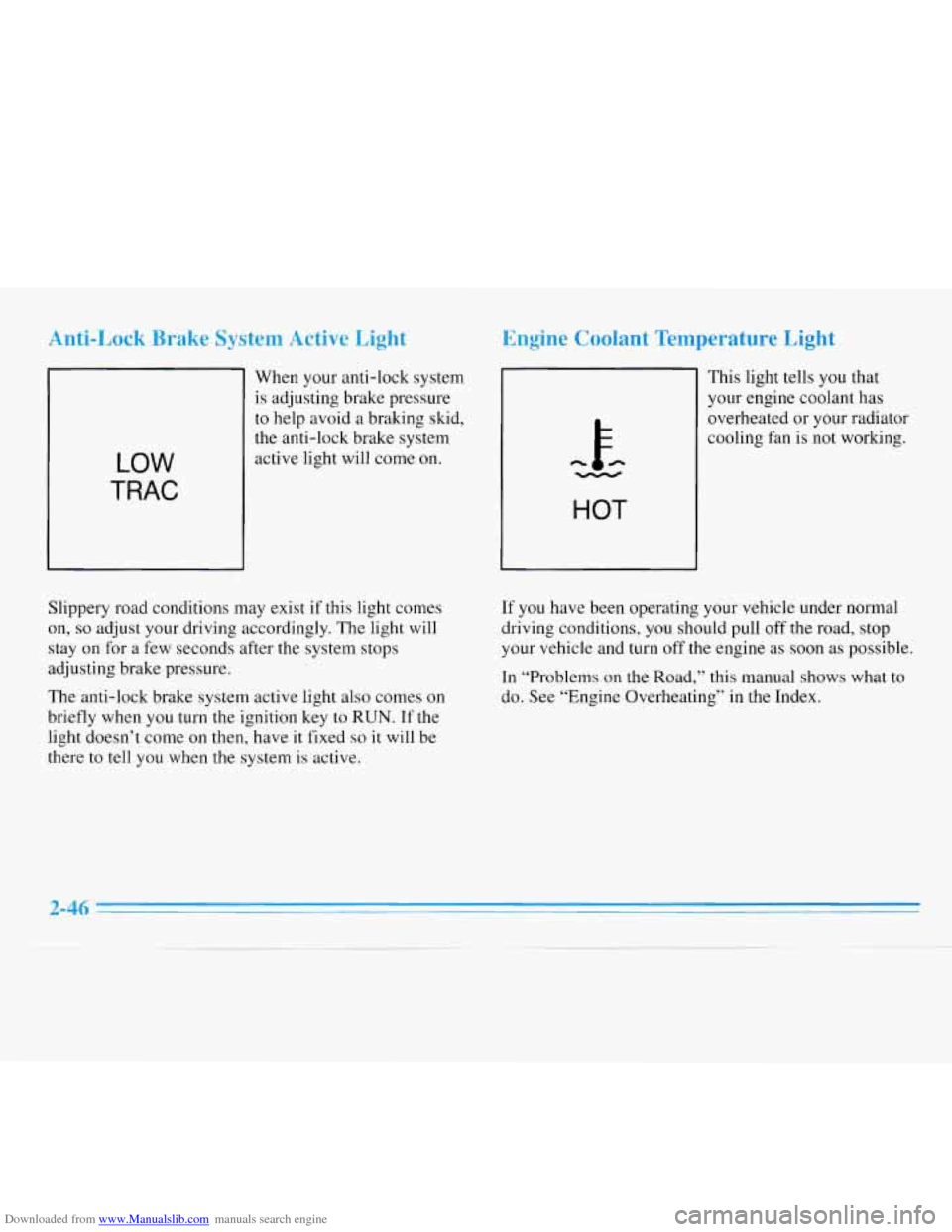
LOW
TRAC
When your anti-lock system
is adjusting brake pressure
to help avoid a braking skid,
the anti-lock brake system
active light will come on.
Engine Coolant Temperature Light
This light tells you that
your engine coolant has
overheated or your radiator
HOT
cooling fan is not working.
Slippery road conditions may exist if this light comes
on, so adjust your driving accordingly. The light will
stay on for a few seconds after the system stops
adjusting brake pressure.
The anti-lock brake system active light also comes on
briefly when you turn the ignition key to RUN. If the
light doesn’t come on then, have it fixed
so it will be
there
to tell you when the system is active. If
you have been operating your vehicle under normal
driving conditions,
you should pull off the road, stop
your vehicle and turn off the engine as soon
as possible.
In “Problems on the Road,” this manual shows what to
do. See “Engine Overheating”
in the Index.
Page 105 of 340

Downloaded from www.Manualslib.com manuals search engine Engine Coolant Temperature Gage
-loo @ 260
You have a gage that
shows the engine coolant
temperature.
If the gage
pointer moves into the red area, your engine is too hot!
That reading means the same thing as the warning light.
It means that your engine coolant has overheated.
If you
have been operating your vehicle under normal driving
conditions, you should pull
off the road, stop your
vehicle and
turn off the engine as soon as possible.
In “Problems on the Road”, this manual shows what to
do. See “Engine Overheating” in the Index.
Low Coolant Warning Light
LOW
If this light comes on, your
system is low on coolant
and the engine
may
overheat. See “Engine
Coolant” in the Index and
have your vehicle serviced
as soon as
you can.
2-47
Page 106 of 340
Downloaded from www.Manualslib.com manuals search engine Malfunction Indicator Lamp
(Service Engine Soon Light)
I
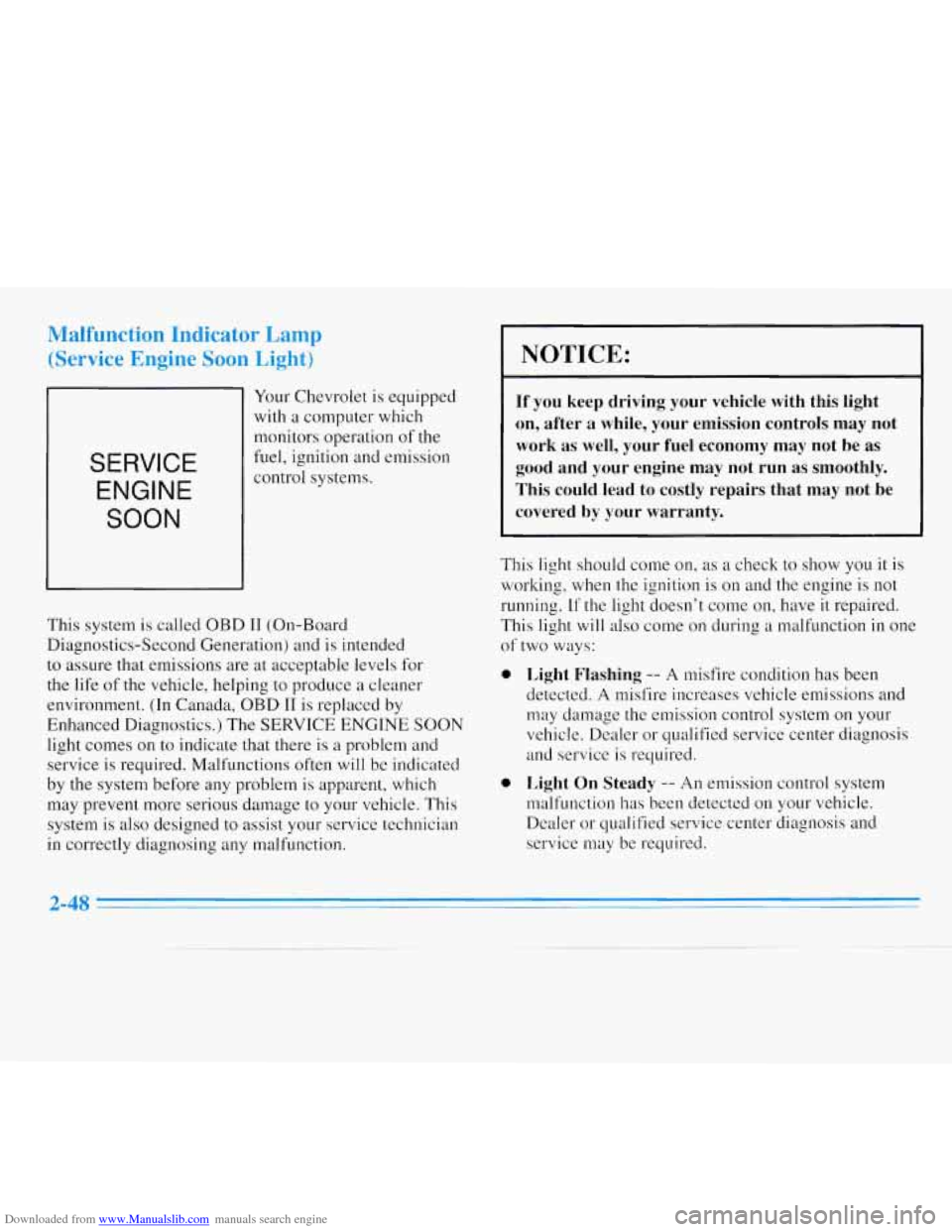
SERVICE
ENGINE
SOON
Your Chevrolet is equipped
with
a computer which
monitors operation
of the
fuel, ignition and emission
control systems.
This system is called OBD I1 (On-Board
Diagnostics-Second Generation) and is intended
to assure that emissions are at acceptable levels .for
the
life of the vehicle, helping to produce a cleaner
environment. (In Canada, OBD
I1 is replaced by
Enhanced Diagnostics.) The
SERVICE ENGINE SOON
light comes on to indicate that there is a problem and
service is required. Malfunctions often
will be indicated
by
the system before any problem is apparent, which
may prevent more serious damage to your vehicle. This
system is also designed to assist your service technician
in correctly diagnosing any malfunction.
0
0
NOTICE:
If you keep driving your vehicle with this light
on, after a while, your emission controls may not
work as well, your fuel economy may not
be as
good and your engine may not run as smoothly.
This could lead to costly repairs that may not be
covered by your warranty.
This light should come on, as a check to show you it is
working, when the ignition
is on and the engine is not
running.
If the light doesn’t come on, have it repaired.
This light
will also come on during a malfunction in one
of two ways:
Light Flashing -- A misfire condition has been
detected.
A misfire increases vehicle emissions and
may damage the emission control system on your
vehicle. Dealer or qualified service center diagnosis
and service is required.
Light On Steady -- An emission control system
malfunction
has been detected on your vehicle.
Dealer or qualified service center diagnosis and
service may be required.
2-48
Page 107 of 340

Downloaded from www.Manualslib.com manuals search engine If the Light Is Flashing If the Light Is On Steady
The following may prevent more serious damage to
your vehicle:
Reduce vehicle speed.
0 Avoid hard accelerations.
0 Avoid steep uphill grades.
If towing a trailer, reduce the amount of cargo being
hauled as soon as it is possible.
If the light stops flashing and remains on steady, see
“If
the Light Is On Steady” following.
If the light continues to flash, when it is safe to do
so,
stop the vehicle. Put your vehicle in PARK (P). Turn the %
key off, wait at least 10 seconds and restart the engine.
If
the light remains on steady, see “If the Light Is On
Steady’’ following.
If the light is still flashing follow the
previous steps, and drive the vehicle to your dealer or qualified service center for service. You
may be able to correct the emission system
malfunction by considering the following:
Did you just put fuel into your vehicle?
If
so, reinstall the fuel cap, making sure to fully install
the cap. The diagnostic system can determine if the fuel
cap has been left
off or improperly installed. This will
allow fuel to evaporate into the atmosphere. A few
driving trips should turn the light off.
Did you just drive through a deep puddle of water?
If
so, your electrical system may be wet. The condition
will usually be corrected when the electrical system
dries out. A few driving trips should
turn the light off.
m-e you low on fuel?
As your engine starts to run out of fuel, your engine may
not run as efficiently as designed since small amounts of
air
are sucked into the fuel line causing a misfire. The
system can detect this. Adding fuel should correct this
condition. Make sure to install the fuel cap properly. It
will take a few driving trips to turn the light
off.
2-49
Page 108 of 340
Downloaded from www.Manualslib.com manuals search engine Have you recently changed brandsl’of fuel? Oil Warning Light
If so, be sure to fuel your vehicle with quality fuel (see
“Fuel” in the Index). Poor fuel quality will cause your
engine not to run as efficiently as designed. You may
notice this as stalling after start-up, stalling when
you put the vehicle into gear, misfiring, hesitation
on acceleration or stumbling on acceleration. (These
conditions may go away once the engine is warmed up.)
This will be detected by the system and cause the light
to turn on.
If you experience this condition, change the fuel brand
you use. It will require at least one full tank of the
proper
fuel to turn the light off.
If none of the above steps have made the light turn off,
have your dealer or qualified service center check the
vehicle. Your dealer has the proper test equipment and
diagnostic tools to fix any mechanical or electrical
problems that may have developed.
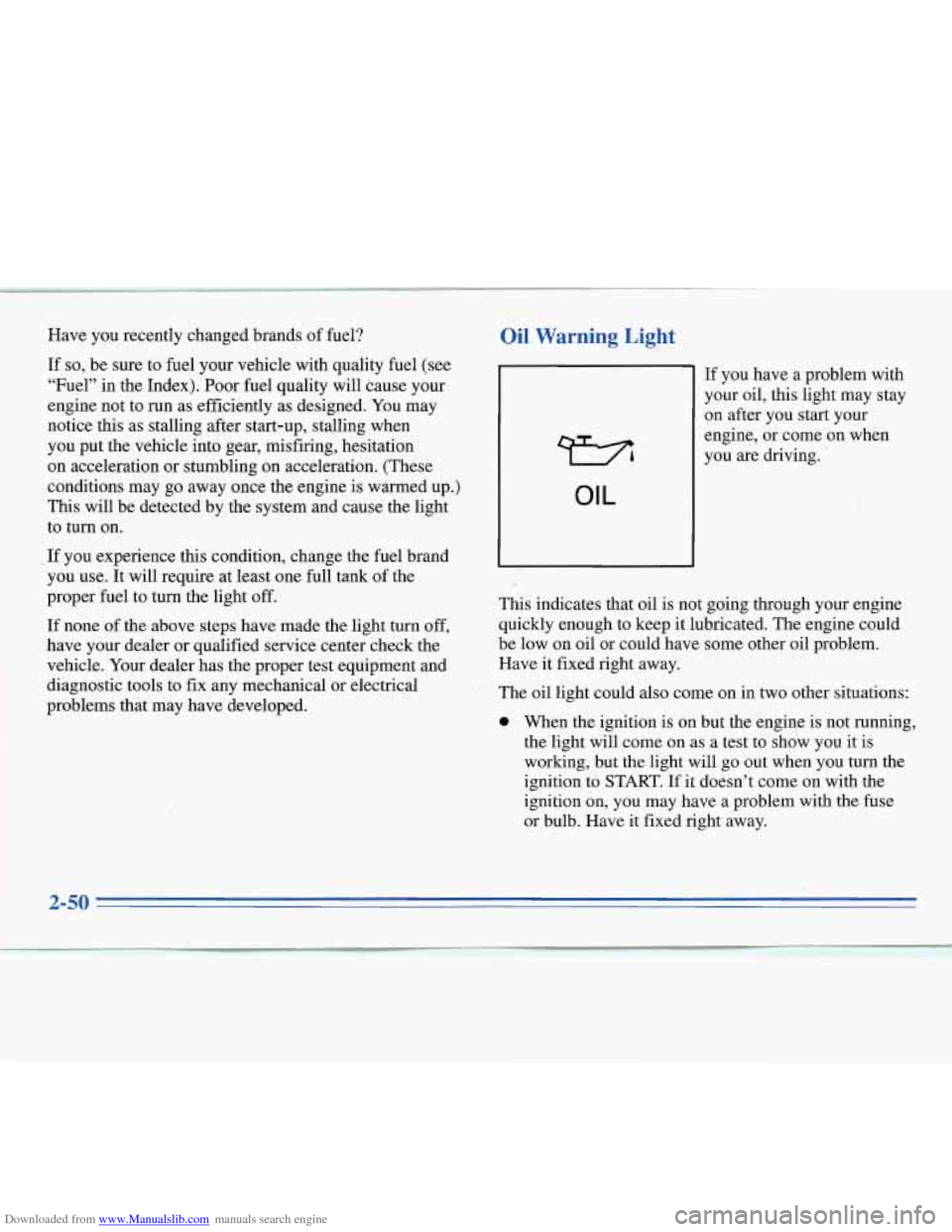
OIL
If you have a problem with
your oil,
this light may stay
on after
you start your
engine, or come on when
you are driving.
.
This indicates that oil is not going through your engine
quickly enough to keep it lubricated. The engine could
be low on oil or could have some other oil problem.
Have it fixed right away.
The oil light could also come on in two other situations:
0 When the ignition is on but the engine is not running,
the light will come on as ,a test.to show you it is
working, but the light will go out when you turn the
ignition to START.
If it doesn’t come on with the
ignition on, you may have a problem with
the fuse
or bulb. Have
it fixed right away.
2-50
Page 109 of 340
Downloaded from www.Manualslib.com manuals search engine 0 If you make a hard stop, the light may come on for a
moment. This is normal.
Low Oil Level Light
Don’t keep driving if the oil pressure is low. If
you do, your engine can become
so hot that it
catches fire. You or others could be burned.
Check your oil as soon as possible and have your
vehicle serviced.
I NOTICE:
Damage to your engine from neglected oil
problems can be costly and
is not covered by your
warranty.
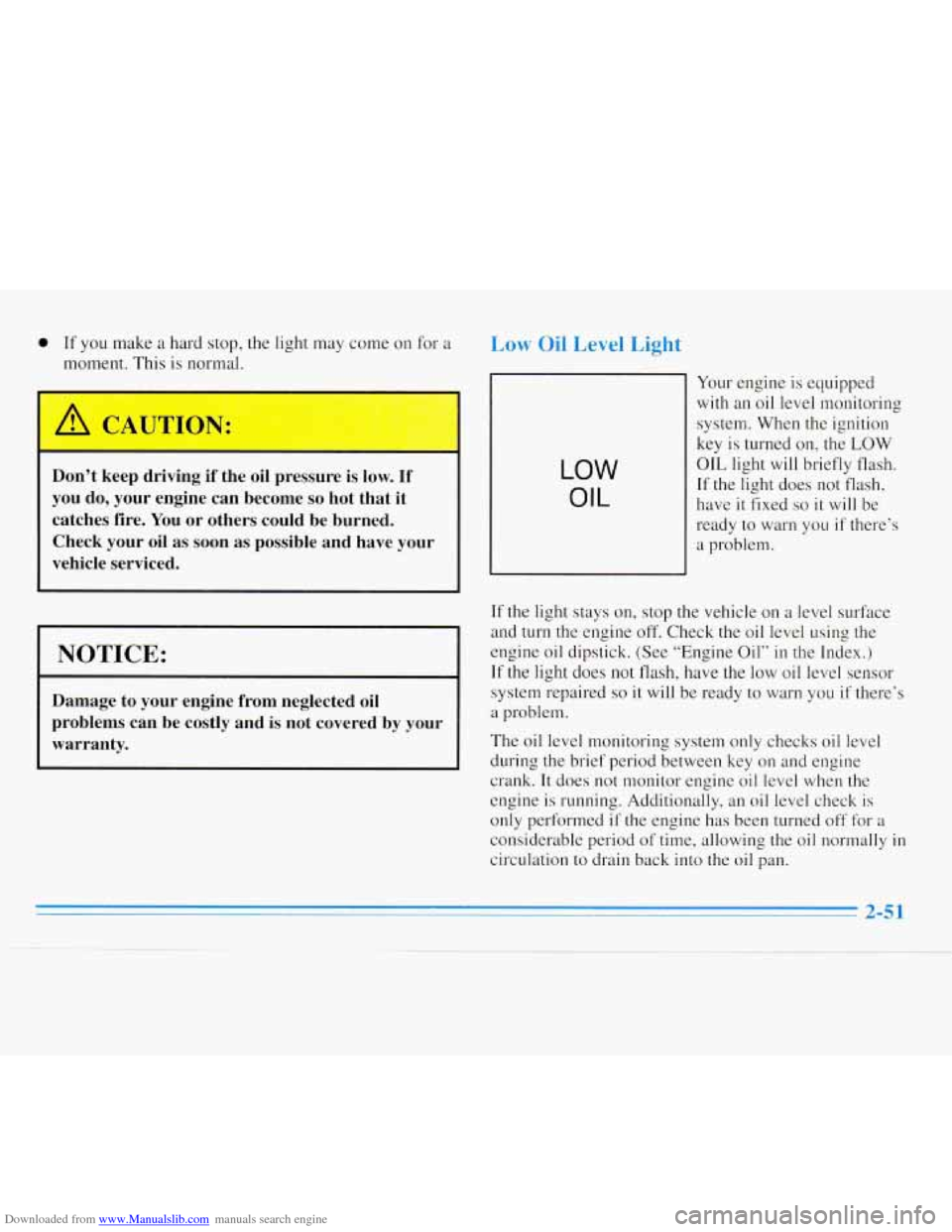
LOW
OIL
Your engine is equipped
with an oil level monitoring
system. When the ignition
key
is turned on, the LOW
OIL light will briefly flash.
If the light does not flash,
have
it fixed so it will be
ready to warn you if there’s
a problem.
If the light stays on, stop the vehicle on a level surface
and turn
the engine off. Check the oil level using the
engine oil dipstick. (See “Engine Oil”
in the Index.)
If the light does not flash, have the low oil level sensor
system repaired
so it will be ready to warn you if there’s
a problem.
The oil level monitoring system only checks oil level
during the brief period between key
on and engine
crank. It does not monitor engine oil level when the
engine is running. Additionally, an oil level check
is
only performed if the engine has been turned off for a
considerable period of time, allowing the oil normally in
circulation to drain back into the oil pan.
Page 110 of 340
Downloaded from www.Manualslib.com manuals search engine Security Light
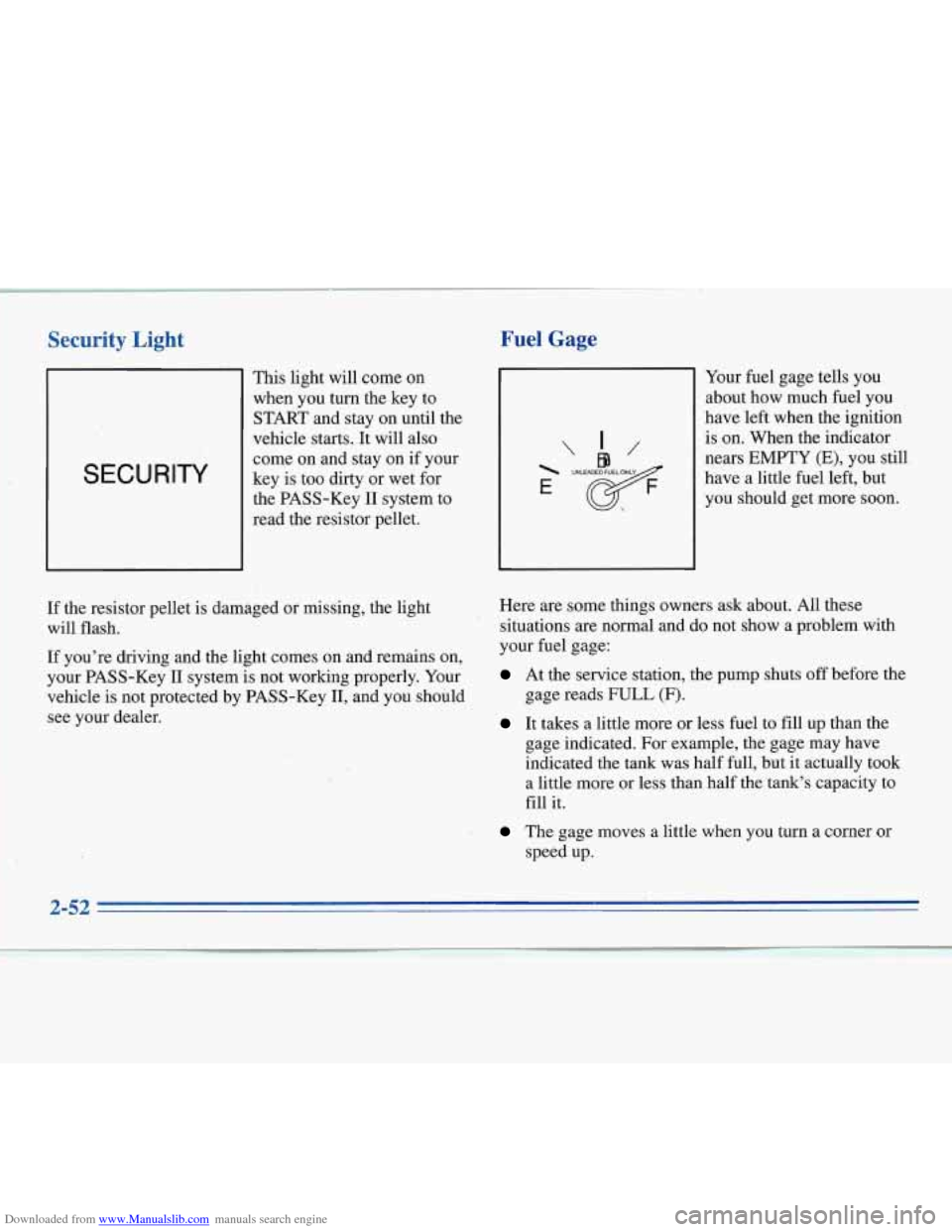
SECURITY
This light will come on
when you turn the key to
START and stay on until the
vehicle starts. It will also
come on and stay on if your
key is too dirty or wet for
the PASS-Key
I1 system to
read the resistor pellet.
Fuel Gage
"/@9 I/
E
If the resistor pellet is damaged or missing, the light
will flash.
If you're driving and the light comes on and remains on,
your PASS-Key
I1 system is not working properly. Your
vehicle is not protected by PASS-Key
11, and you should
see your dealer. Here are some
things owners ask about. All these
situations are normal and do not show a problem with
your fuel gage:
At the service station, the pump shuts off before the
gage reads
FULL (F).
It takes a little more or less fuel to fill up than the
gage indicated. For example, the gage may have
indicated the tank was half full, but it actually took
a little more or less than half the tank's capacity to
fill it.
The gage moves a little when you turn a corner or
speed up. Your
fuel gage tells you
about how much fuel you
have left when the ignition
is on. When the indicator
nears EMPTY (E), you still
have a little fuel left, but
you should get more soon.
2-52 7. I
....
Page 115 of 340

Downloaded from www.Manualslib.com manuals search engine Air Conditioning
On very hot days, open the windows long enough to let
hot, inside air escape. This reduces
the time the
compressor has to
run, which should help fuel economy.
For quick cool-down on very hot days, use
MAX with
the temperature control all
the way in the blue area. If
this setting is used for long periods of time, the air in
your vehicle may become too dry.
For normal cooling on hot days, use A/C with
the
temperature control in the blue area. The system will
bring in outside air and cool
it.
On cool but sunny days, the sun may warm your upper
body, but your lower body may
not be warm enough.
You can use BI-LEVEL with the temperature control in
the middle. The system will bring in outside air and
direct
it to your upper body, while sending slightly
warmed air to your lower body.
You may notice this
temperature difference more at some times than others.
Heating
On cold days use FLOOR with the temperature control
all the way in the red area. The system will bring in
outside air, heat it and send it to the floor ducts. cold
outside
(0°F (-18°C) or lower). An engine coolant
heater warms the coolant your engine and heating
system use to provide heat. See “Engine Coolant
Heater”
in the Index.
Ventilation System
Adjust the direction of airflow by moving the
louvered vents.
Your vehicle’s flow-through ventilation system supplies
outside air into the vehicle when
it is moving. Outside
air
will also enter the vehicle when the air conditioning
fan is running.
If your vehicle has an engine coolant heater, you can use
it to help your system provide warm air faster when it’s
3-3
Page 121 of 340
Downloaded from www.Manualslib.com manuals search engine 1 g a Ca! tte Ta
Your tape player is built to work best with tapes that are
30 to 45 minutes long on each side. Tapes longer than
that are
so thin they may not work well in this player.
The longer side
with the tape visible goes in first. If you
hear nothing or hear just
a garbled sound, it may not
be in squarely. Press EJECT to remove the tape and
start over.
While the tape is playing, use the
VOLUME, FADE,
BAL, TREB and BASS controls just as you do for the
radio. Other controls may have different functions when
a tape
is inserted. The display will show an arrow to
show which side of the tape is playing.
Note that cassette tape adapter kits for portable compact
disc players will not work
in your cassette player. The
adapter cassette will be ejected.
FWD: Press and release the SEEK forward arrow and
the tape will rapidly advance until you press this button
again lightly.
REV: Press and release the SEEK reverse arrow and the
tape
will reverse rapidly until you press and release this
button again.
RECALL: Press this knob to hear the other side of a
tape that is playing.
EJECT Press this button to remove the tape. The radio
will play.
CLN: This message may appear on the display. If it
does, your cassette tape player needs to be cleaned. It
will still play tapes, but you should clean it as soon as
possible to prevent damage to your tapes and player.
See “Care of Your Cassette Tape Player” in the Index.
After you clean
the player, press and hold EJECT for
five seconds to reset the CLN indicator. The radio
will
display --- to show the indicator was reset.
Page 122 of 340
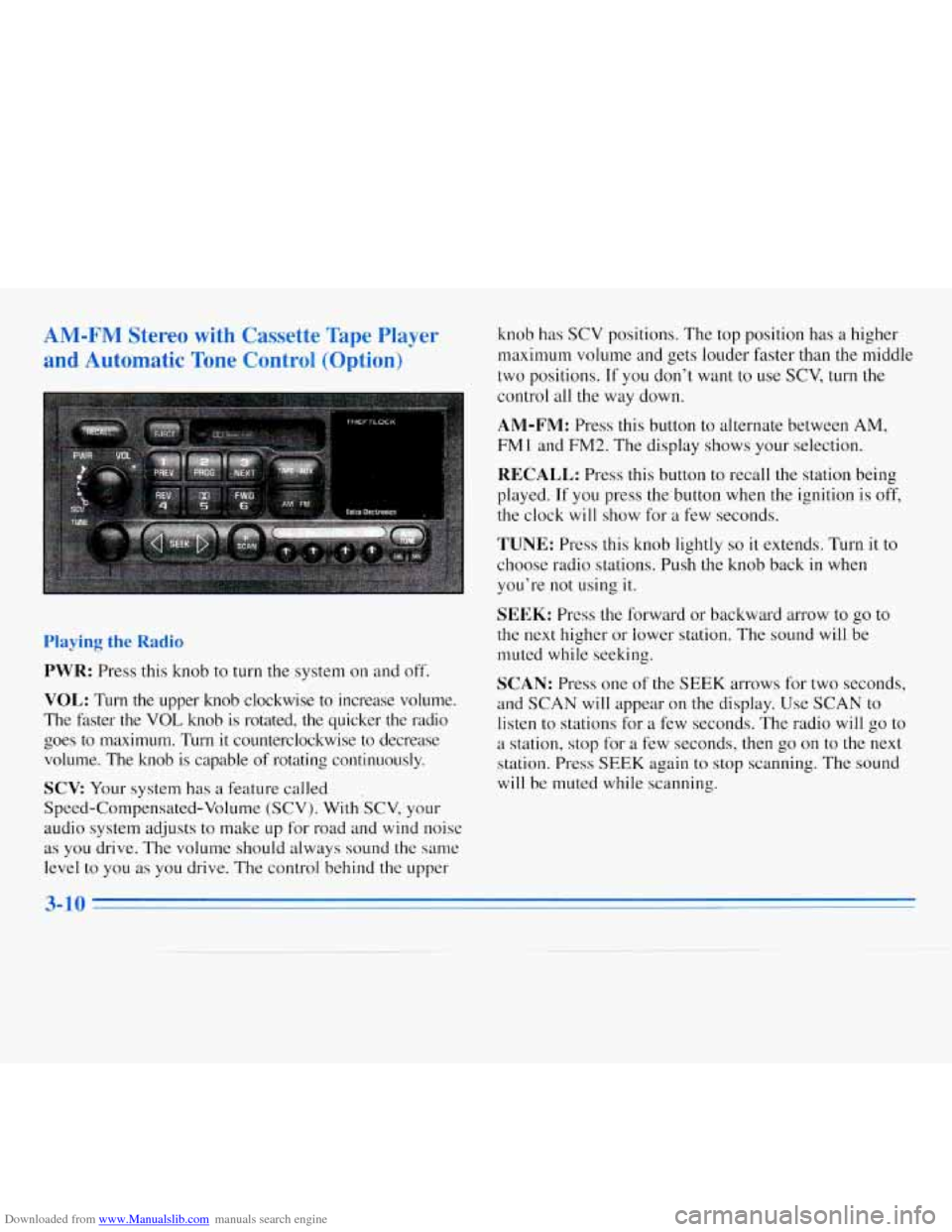
Downloaded from www.Manualslib.com manuals search engine AM-FM Stereo with Cassette Tape Player
and Automatic Tone Control (Option)
Playing the Radio
PWR: Press this knob to turn the system on and off.
VOL: Turn the upper knob clockwise to increase volume.
The faster the
VOL knob is rotated, the quicker the radio
goes to maximum. Turn it counterclockwise to decrease volume. The knob is capable
of rotating continuously.
SCV Your system has a feature called .
Speed-Compensated-Volume (SCV). With SCV, your
audio system adjusts to make
up for road and wind noise
as you drive. The volume should always sound the same
level to you
as you drive. The control behind the upper knob
has SCV positions.
The top position has a higher
maximum volume and gets louder faster than the middle
two positions.
If you don’t want to use SCV, turn the
control all the way down.
AM-FM: Press this button to alternate between AM,
FM 1 and FM2. The display shows your selection.
RECALL: Press this button to recall the station being
played. If you press the button when the ignition is off,
the clock will show for a few seconds.
TUNE: Press this knob lightly so it extends. Turn it to
choose radio stations. Push the knob back in when
you’re not using it.
SEEK: Press the forward or backward arrow to go to
the next higher
or lower station. The sound will be
muted while seeking.
SCAN: Press one of the SEEK arrows for two seconds,
and SCAN will appear on the display. Use
SCAN to
listen to stations for a few seconds. The radio will
go to
a station, stop for a few seconds, then go on to the next
station. Press
SEEK again to stop scanning. The sound
will be muted while scanning.
3-10