light CHEVROLET MONTE CARLO 1996 5.G Workshop Manual
[x] Cancel search | Manufacturer: CHEVROLET, Model Year: 1996, Model line: MONTE CARLO, Model: CHEVROLET MONTE CARLO 1996 5.GPages: 340, PDF Size: 17.79 MB
Page 227 of 340
Downloaded from www.Manualslib.com manuals search engine How to Add Fluid Engine Coolant
Refer to the Maintenance Schedule to determine what
kind
of transaxle fluid to use. See “Recommended
Fluids and Lubricants”
in the Index.
If the fluid
level is low, add only enough of the proper
fluid to bring the level into the cross-hatched area on
the dipstick.
1. Pull out the dipstick.
2. Using a long-neck funnel, add enough fluid at the
dipstick hole to bring
it to the proper level. It doesn’t
take much fluid, generally less than
a pint (OSL).
Don ’t overfill. We recommend you use only fluid
labeled DEXRON@-111, because fluid with that
label is made especially for your automatic transaxle.
Damage caused by fluid other than DEXRON@-I11
is
not covered by your new vehicle warranty.
0 After adding fluid, recheck the fluid level as
described under “How to Check.”
0 When the correct fluid level is obtained, push the
dipstick back
in all the way. The cooling
system in your vehicle is filled with new
DEX-COOL
TM (orange-colored, silicate-free) engine
coolant. This coolant is designed
to remain in your
vehicle for
5 years or 100,000 miles ( 166 000 km),
whichever occurs first.
The following explains your cooling system and how
to
add coolant when it is low. If you have a problem with
engine overheating
or if you need to add coolant to your
radiator, see “Engine Overheating”
in the Index.
A 50/50 mixture of water and the proper coolant for
your Chevrolet will:
0 Give freezing protection down to -34°F (-37°C).
0 Give boiling protection up to 265°F (129°C).
Protect against rust and corrosion.
0 Help keep the proper engine temperature.
0 Let the warning lights and gages work as they
should.
Page 230 of 340
Downloaded from www.Manualslib.com manuals search engine LOW
COOLANT
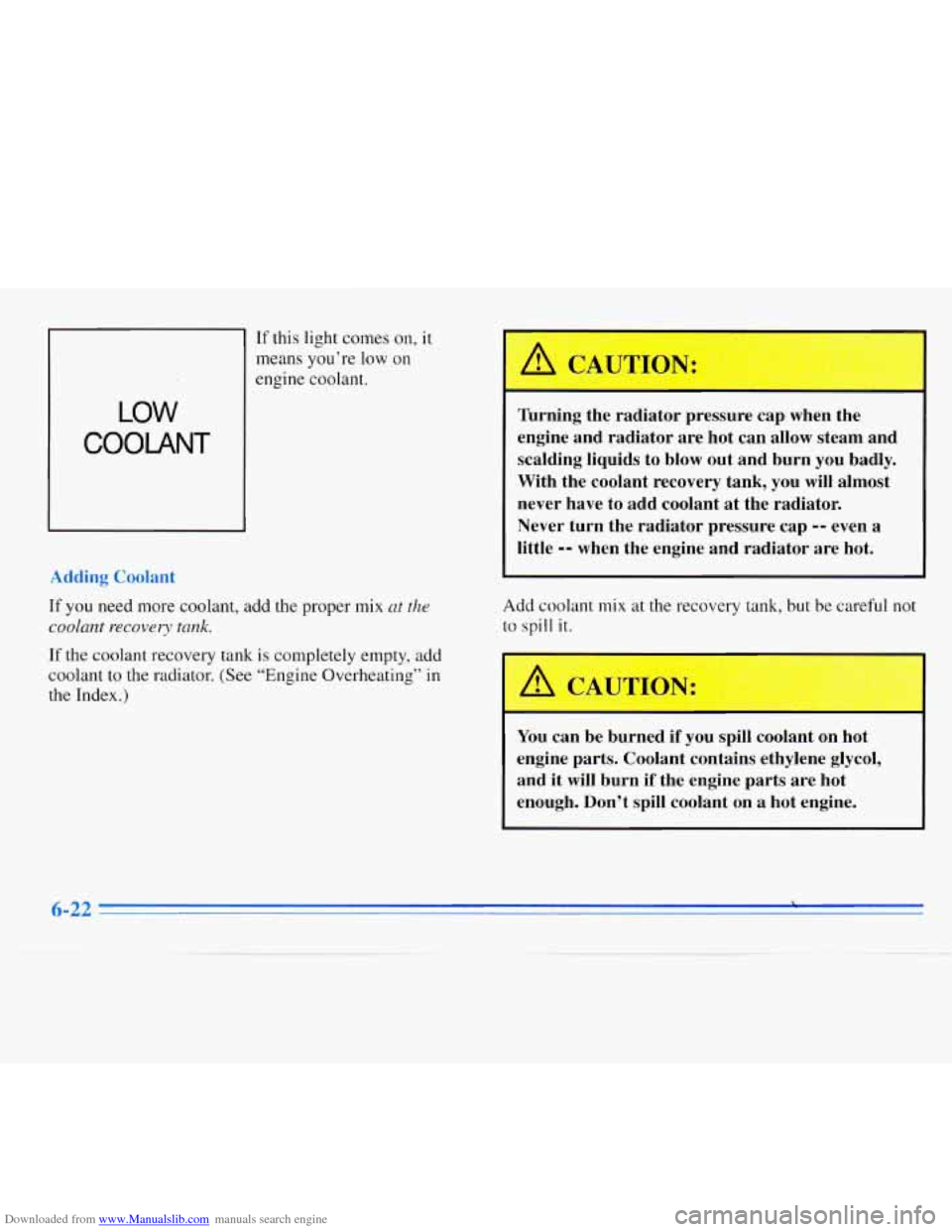
If this light comes on, it
means you’re low on
engine coolant.
Adding Coolant
If you need more coolant, add the proper mix at the
coolant recovery tank.
If the coolant recovery tank is completely empty, add
coolant
to the radiator. (See “Engine Overheating” in
the Index.)
Thrning the radiator pressure cap when the
engine and radiator are hot can allow steam and
scalding liquids to blow out and burn you badly.
With the coolant recovery tank, you will almost
never have to add coolant at the radiator.
Never turn the radiator pressure cap
-- even a
little
-- when the engine and radiator are hot.
Add coolant mix at the recovery tank, but be careful not
to spill it.
A CAUTION:
You can be burned if you spill coolant on hot
engine parts. Coolant contains ethylene glycol,
and it will burn if the engine parts are hot
enough. Don’t spill coolant on a hot engine.
6-22 ,
Page 234 of 340
Downloaded from www.Manualslib.com manuals search engine There are only two reasons why the brake fluid level in the
reservoir might
go down. The first is that the brake fluid
goes down to an acceptable level during normal brake
lining wear. When new linings are put in, the fluid level
goes back up. The other reason is that fluid
is leaking out
of the brake system.
If it is, you should have your brake
system fixed, since a leak means that sooner or later your
brakes won’t work well, or won’t work at all.
So, it isn’t a good idea to “top off’ your brake fluid.
Adding brake fluid won’t correct a leak.
If you add fluid
when your linings are worn, then
you’ll have too much
fluid when you get new brake linings. You should add
(or remove) brake fluid, as necessary, only when work is
done on the brake hydraulic system. When your brake fluid falls to a low level, your brake
warning light will come on. See “Brake System Warning
Light” in the Index.
What to Add
When you do need brake fluid, use only DOT-3 brake
fluid
-- such as Delco Supreme 11 @ (GM Part
No. 1052535). Use new brake fluid from a sealed
container only, and always clean the brake fluid
reservoir cap before removing it.
If you have too much brake fluid, it can spill on
the engine. The fluid
will burn if the engine is hot
enough. You or others could be burned, and your
vehicle could be damaged. Add brake fluid only
when work is done on the brake hydraulic system. With
the wrong kind
of fluid in your brake
system, your brakes may not work well,
or they
may not even work at all. This could cause
a
crash. Always use the proper brake fluid.
6-26
Page 236 of 340
Downloaded from www.Manualslib.com manuals search engine I NOTICE:
Continuing to drive with worn-out brake pads
could result in costly brake repair.
Some driving conditions or climates may cause a brake
squeal when the brakes are first applied or lightly applied.
This does
not mean something is wrong with your brakes.
Free movement
of brake calipers and properly torqued
wheel nuts are necessary to help prevent brake
pulsation. When tires are rotated, inspect brake calipers
for movement, brake pads for wear, and evenly torque
wheel nuts in the proper sequence to
GM specifications.
Brake linings should always be replaced
as complete
axle sets.
Brake Pedal Travel
See your dealer if the brake pedal does not return to
normal height, or if there is a rapid increase
in pedal
travel. This could be
a sign of brake trouble.
Brake Adjustment
Every time you apply the brakes, with or without the
vehicle moving, your brakes adjust for wear.
Replacing Brake System Parts
The braking system on a modern vehicle is complex.
Its many parts have to be
of top quality and work well
together
if the vehicle is to have really good braking.
Vehicles we design and test have top-quality
GM brake
parts in them,
as your Chevrolet does when it is new.
When you replace parts
of your braking system -- for
example, when your brake linings wear down and you
have to have new ones put
in -- be sure you get new
genuine
GM replacement parts. If you don’t, your
brakes may no longer work properly. For example, if
someone puts in brake linings that are wrong for your
vehicle, the balance between your front and rear brakes
can change
-- for the worse. The braking performance
you’ve come to expect can change in many other ways
if
someone puts in the wrong replacement brake parts.
Battery
Every new Chevrolet has a Delco Freedom@ battery.
You never have to add water to one
of these. When
it’s time for
a new battery, we recommend a Delco
Freedom@ battery. Get one
that has the replacement
number shown on the original battery’s label.
6-28
Page 249 of 340
Downloaded from www.Manualslib.com manuals search engine While the tires available on General Motors passenger
cars and light trucks may vary with respect to these
grades,
they must also conform to Federal safety
requirements and additional General Motors Tire
Performance Criteria‘(TPC) standards.
Tread wear
The treadwear grade is a comparative rating based on
the wear rate of the tire when tested under controlled
conditions on
a specified government test course. For
example,
a tire graded 150 would wear one and a half
( I 1/2) times as well on the government course as a tire
graded
100. The relative performance of tires depends
upon the actual conditions of their use, however, and
may depart significantly from the norm due to variations
in driving habits, service practices and differences in
road characteristics and climate.
Traction - A, B, C
The traction grades, from highest to lowest, are A, B, and
C, and they represent the tire’s ability to stop on wet
pavement
as measured under controlled conditions on
specified government test surfaces
of asphalt and concrete.
A tire marked C may have poor traction performance. Warning:
The traction grade assigned to this tire
is based
on braking (straightahead) traction tests and does not
include cornering (turning) traction.
Temperature - A, B, C
The temperature grades are A (the highest), B, and C,
representing the tire’s resistance to the generation of
heat and its ability to dissipate heat when tested under
controlled conditions on a specified indoor laboratory
test wheel. Sustained high temperature can cause the
material of the tire to degenerate and reduce tire life,
and excessive temperature can lead to sudden tire
failure. The grade C corresponds to
a level of
performance which all passenger car tires must meet
under
the Federal Motor Vehicle Safety Standard
No. 109. Grades B and A represent higher levels of
performance on
the laboratory test wheel than the
minimum required by law.
Warning: The temperature grade for
this tire is
established for a tire that is properly inflated and not
overloaded. Excessive speed, underinflation, or
excessive loading, either separately or in combination,
can cause heat buildup and possible tire failure.
Page 253 of 340
Downloaded from www.Manualslib.com manuals search engine Using Foam-Type Cleaner on Fabric
0
0
0
0
0
0
0
0
0
0
e
Vacuum and brush the area to remove any loose dirt.
Always clean a whole trim panel or section. Mask
surrounding trim along stitch or welt lines.
Mix Multi-Purpose Powdered Cleaner following the
directions on the container label.
Use suds only and apply with a clean sponge.
Don’t saturate
the material.
Don’t rub
it roughly.
As soon as you’ve cleaned the section, use a sponge
to remove the suds.
Rinse the section with a clean, wet sponge.
Wipe off what’s left with
a slightly damp paper towel
or cloth.
Then dry
it immediately with a blow dryer.
Wipe with a clean cloth.
Using Solvent-wpe Cleaner on Fabric
First, see if you have to use solvent-type cleaner at all.
Some spots and stains will clean off better with just
water and mild soap. If you
need to use a solvent:
0 Gently scrape excess soil from the trim material with a
clean, dull knife or scraper. Use very little cleaner, light
pressure and clean cloths (preferably cheesecloth).
Cleaning should
start at the outside of the stain,
“feathering” toward the center. Keep changing to a
clean section
of the cloth.
0 When you clean a stain from fabric, immediately
dry the area with a blow dryer to help prevent a
cleaning ring.
Fabric Protection
Your Chevrolet has upholstery and carpet that has been
treated with Scotchgard” Fabric Protector,
a 3M
product. It protects fabrics by repelling oil and water,
which are the carriers of most stains. Even with this
protection, you still need to clean your upholstery and
carpet often to keep it looking new.
Further information on cleaning
is available by calling
1-800-433-3296 (in Minnesota, 1-800-642-6
167).
6-45
Page 254 of 340
Downloaded from www.Manualslib.com manuals search engine Special Cleaning Problems
Greasy or Oily Stains
Stains caused by grease, oil, butter, margarine, shoe
polish, coffee with cream, chewing gum, cosmetic
creams, vegetable
oils, wax crayon, tar and asphalt can
be removed as follows:
0
0
0
Carefully scrape off excess stain.
Follow the solvent-type instructions
described earlier.
Shoe polish, wax crayon, tar and asphalt will stain
if left
on a vehicle's seat fabric. They should be
removed as soon
as possible. Be careful, because
the cleaner will dissolve them and
may cause them
to spread.
Non-Greasy Stains
Stains caused by catsup, coffee (black), egg, fruit, fruit
juice, milk, soft drinks, wine, vomit, urine and blood can
be removed
as follows:
0 Carefully scrape off excess stain, then sponge the
soiled area with cool water.
0 If a stain remains, follow the foam-type instructions
described earlier.
0 If an odor lingers after cleaning vomit or urine,
treat
the area with a watedbaking soda solution:
1 teaspoon (5 ml) of baking soda to 1 cup (250 ml)
of lukewarm water.
If needed, clean lightly with solvent-type cleaner.
Combination Stains
Stains caused by candy, ice cream, mayonnaise, chili
sauce and unknown stains can be removed as follows:
0 Carefully scrape off excess stain, then clean with
cool water and allow to dry.
0 If a stain remains, clean it with solvent-type cleaner.
Cleaning Vinyl
Use warm water and a clean cloth.
Rub with a clean, damp cloth to remove dirt. You
may have to do it more than once.
0 Things like tar, asphalt and shoe polish will stain if
you don't get them off quickly. Use a clean cloth and
a GM VinyVLeather Cleaner or equivalent product.
6-46
Page 262 of 340
Downloaded from www.Manualslib.com manuals search engine [,) -A B C D E
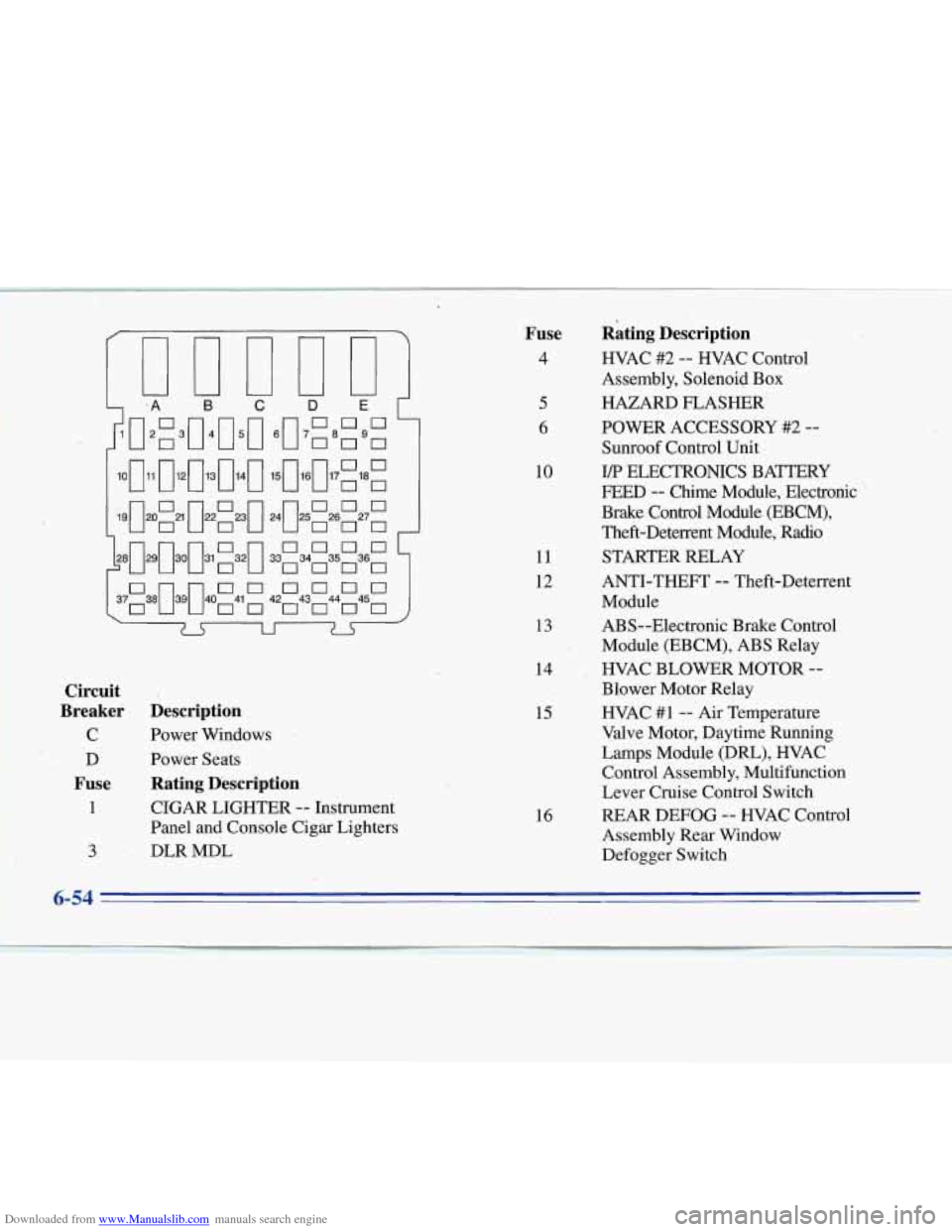
Circuit .
Breaker Description
C Power Windows
D Power Seats
Fuse Rating Description
1 CIGAR LIGHTER -- Instrument
Panel and Console Cigar Lighters
3. DLRMDL
5
6
10
11
12 13
14
15
Fuse Rating Description
4 HVAC #2 -- WAC Control
Assembly, Solenoid Box
HAZAP
FLASHER
Sunroof Control Unit
I/P ELECTRONICS BATTERY
FEED -- Chime Module, Electronic "
Brake Control Module (EBCM),
Theft-Deterrent Module, Radio
STARTER RELAY
ANTI-THEFT
-- Theft-Deterrent
Module
ABS--Electronic Brake Control
Module (EBCM), ABS Relay
Blower Motor Relay WAC
#1 -- Air Temperature
Valve Motor, Daytime Running
Lamps Module
@RL), HVAC
Control Assembly, Multifunction
Lever Cruise Control Switch
16 REAR DEFOG
-- HVAC Control
Assembly Rear Window
Defogger Switch
POWER ACCESSORY
#2 --
, WAC
BLOWER MOTOR --
6-54
Page 263 of 340
Downloaded from www.Manualslib.com manuals search engine I
I'
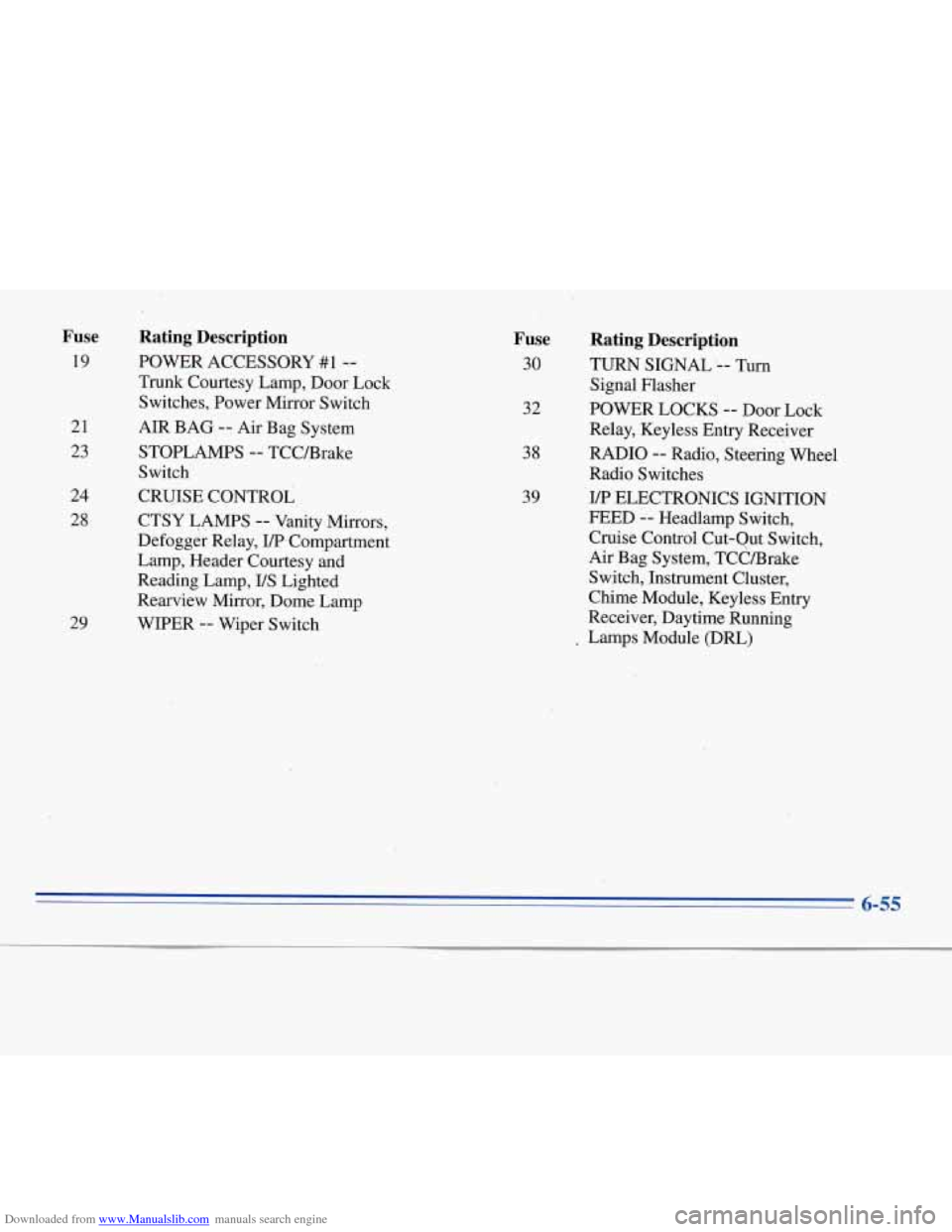
Fuse
19
29
Rating Description
Trunk Courtesy Lamp, Door Lock Switches, Power Mirror S-witch
POWER ACCESSORY
#1--
21
AIR BAG -- Air Bag System
23 STOPLAMPS
-- TCCIBrake
24 CRUISE CONTROL Switch
28 CTSY LAMPS
-- Vanity Mirrors,
Defogger Relay,
I/P Compartment
Lamp, Header Courtesy and
Reading Lamp,
US Lighted
Rearview Mirror, Dome Lamp
WIPER
-- Wiper Switch
Fuse Rating Description
30 TURN SIGNAL -- Turn
Signal Flasher
32 POWER LOCKS
-- Door Lock
Relay, Keyless Entry Receiver
3-8 RADIO
-- Radio, Steering Wheel
Radio Switches
39
I/P ELECTRONICS IGNITION
FEED
-- Headlamp Switch,
Cruise Control Cut-Out Switch,
Air Bag System, TCClBrake
Switch, Instrument Cluster,
Chime Module, Keyless Entry
Receiver, Daytime Running
, Lamps Module (DRL)
6-55
Page 309 of 340
Downloaded from www.Manualslib.com manuals search engine Cassette Deck Service Automatic Transaxle Check
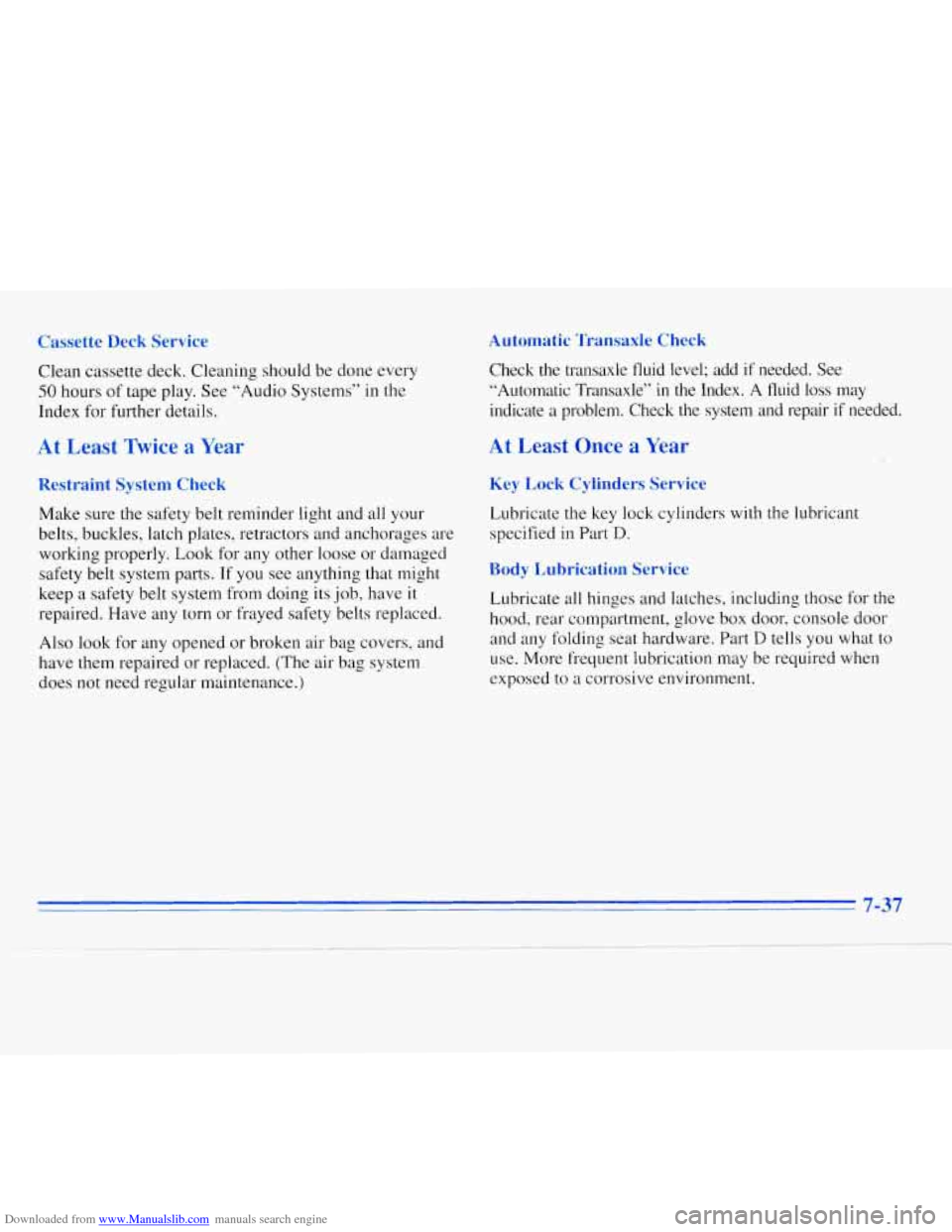
Clean cassette deck. Cleaning should
be done every
50 hours of tape play. See “Audio Systems” in the
Index for further details.
At Least Twice a Year
Restrain ystem Chc -1,
Make sure the sarety belt reminder light and all your
belts, buckles, latch plates, retractors and anchorages are
working properly. Look for any other loose
or damaged
safety belt system parts.
If you see anything that might
keep a safety belt system from doing its job, have
it
repaired. Have any torn or frayed safety belts replaced.
Also look for any opened
or broken air bag covers, and
have them repaired or replaced. (The air bag system
does not need regular maintenance.) Check the transaxle fluid level; add
if needed.
See
“Automatic Transaxle”
in the Index. A fluid loss may
indicate
a problem. Check the system and repair if needed.
At Least Once a Year
Key Lock Cylinders Service
Lubricate the key lock cylinders with the lubricant
specified in Part
D.
Body Lubrication Service
Lubricate all hinges and latches, including those for the
hood, rear compartment, glove box door, console door
and any folding seat hardware. Part
D tells you what to
use. More frequent lubrication may be required when
exposed to a corrosive environment.