window CHEVROLET MONTE CARLO 2003 6.G User Guide
[x] Cancel search | Manufacturer: CHEVROLET, Model Year: 2003, Model line: MONTE CARLO, Model: CHEVROLET MONTE CARLO 2003 6.GPages: 394, PDF Size: 2.73 MB
Page 81 of 394
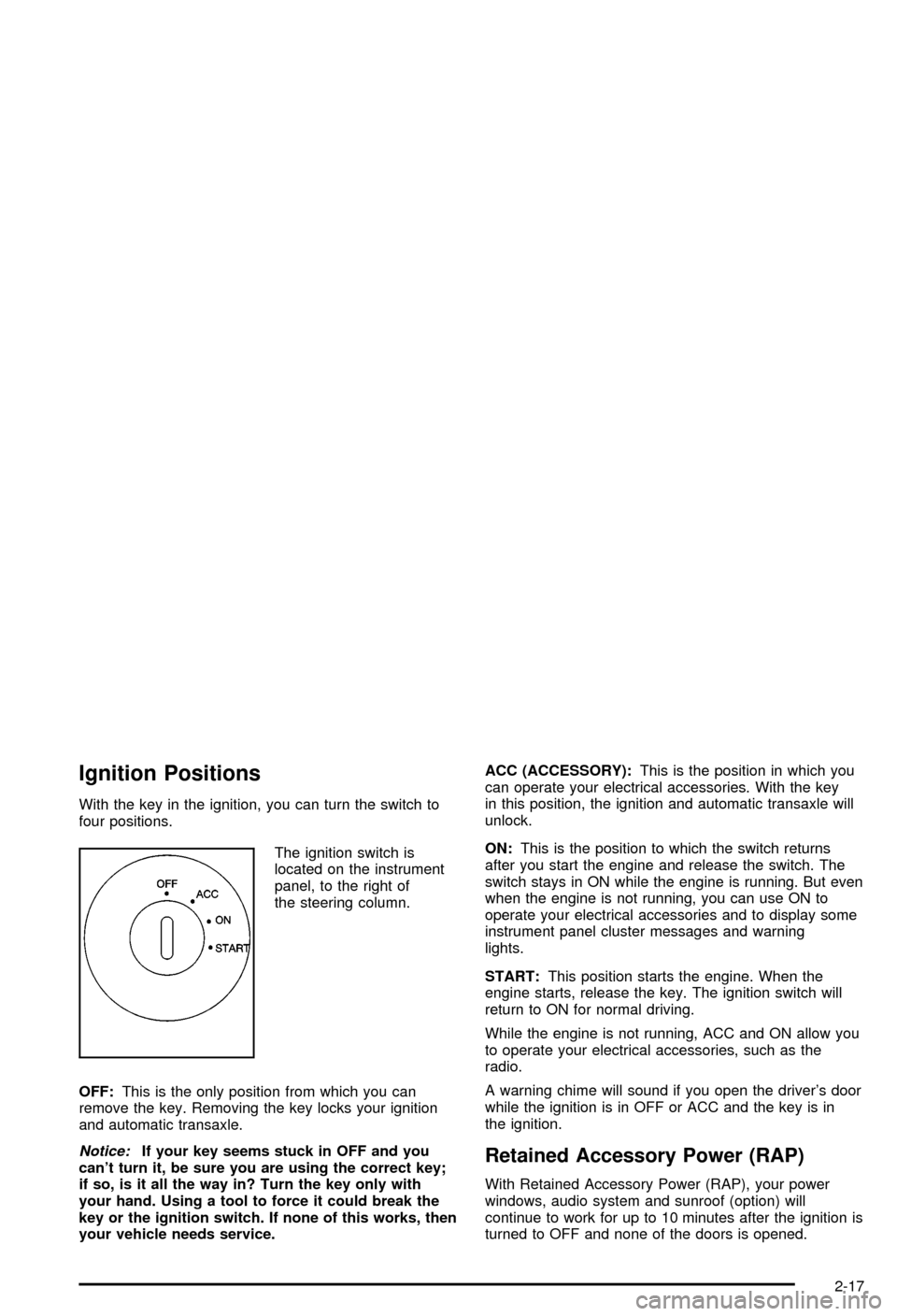
Ignition Positions
With the key in the ignition, you can turn the switch to
four positions.
The ignition switch is
located on the instrument
panel, to the right of
the steering column.
OFF:This is the only position from which you can
remove the key. Removing the key locks your ignition
and automatic transaxle.
Notice:If your key seems stuck in OFF and you
can't turn it, be sure you are using the correct key;
if so, is it all the way in? Turn the key only with
your hand. Using a tool to force it could break the
key or the ignition switch. If none of this works, then
your vehicle needs service.ACC (ACCESSORY):This is the position in which you
can operate your electrical accessories. With the key
in this position, the ignition and automatic transaxle will
unlock.
ON:This is the position to which the switch returns
after you start the engine and release the switch. The
switch stays in ON while the engine is running. But even
when the engine is not running, you can use ON to
operate your electrical accessories and to display some
instrument panel cluster messages and warning
lights.
START:This position starts the engine. When the
engine starts, release the key. The ignition switch will
return to ON for normal driving.
While the engine is not running, ACC and ON allow you
to operate your electrical accessories, such as the
radio.
A warning chime will sound if you open the driver's door
while the ignition is in OFF or ACC and the key is in
the ignition.Retained Accessory Power (RAP)
With Retained Accessory Power (RAP), your power
windows, audio system and sunroof (option) will
continue to work for up to 10 minutes after the ignition is
turned to OFF and none of the doors is opened.
2-17
Page 92 of 394

Engine Exhaust
{CAUTION:
Engine exhaust can kill. It contains the gas
carbon monoxide (CO), which you can not see
or smell. It can cause unconsciousness and
death.
You might have exhaust coming in if:
·Your exhaust system sounds strange or
different.
·Your vehicle gets rusty underneath.
·Your vehicle was damaged in a collision.
·Your vehicle was damaged when driving
over high points on the road or over road
debris.
·Repairs were not done correctly.
·Your vehicle or exhaust system had been
modi®ed improperly.
If you ever suspect exhaust is coming into
your vehicle:
·Drive it only with all the windows down to
blow out any CO; and
·Have your vehicle ®xed immediately.
Running Your Engine While You
Are Parked
It's better not to park with the engine running. But if you
ever have to, here are some things to know.
{CAUTION:
Idling the engine with the climate control
system off could allow dangerous exhaust into
your vehicle. See the earlier Caution under
ªEngine Exhaust.º
Also, idling in a closed-in place can let deadly
carbon monoxide (CO) into your vehicle even if
the climate control fan is at the highest setting.
One place this can happen is a garage.
Exhaust Ð with CO Ð can come in easily.
NEVER park in a garage with the engine
running.
Another closed-in place can be a blizzard.
See ªWinter Drivingº in the Index.
2-28
Page 97 of 394

Outside Power Mirrors
The outside power mirror
controls are located near
the driver's side window,
on the armrest.
Use the selector switch located above the four-way
control panel to choose either the left or right outside
mirror. Then press any of the four arrows located on the
control pad to move each mirror in the desired direction.
Adjust each mirror so you can see the side of your
vehicle and the area beside and behind your vehicle.
Heated Outside Mirrors
If your vehicle has this feature, the surface of the
outside mirrors will heat when the rear window defogger
is activated.
Outside Convex Mirror
Your passenger's side mirror is convex. A convex
mirror's surface is curved so you can see more from the
driver's seat.
{CAUTION:
A convex mirror can make things (like other
vehicles) look farther away than they really are.
If you cut too sharply into the right lane, you
could hit a vehicle on your right. Check your
inside mirror or glance over your shoulder
before changing lanes.
2-33
Page 98 of 394
Outside Heated Mirrors
If your vehicle has this option, the surface of both
outside mirrors will heat when you activate the rear
window defogger. See ªRear Window Defoggerº under
Dual Climate Control System on page 3-22.
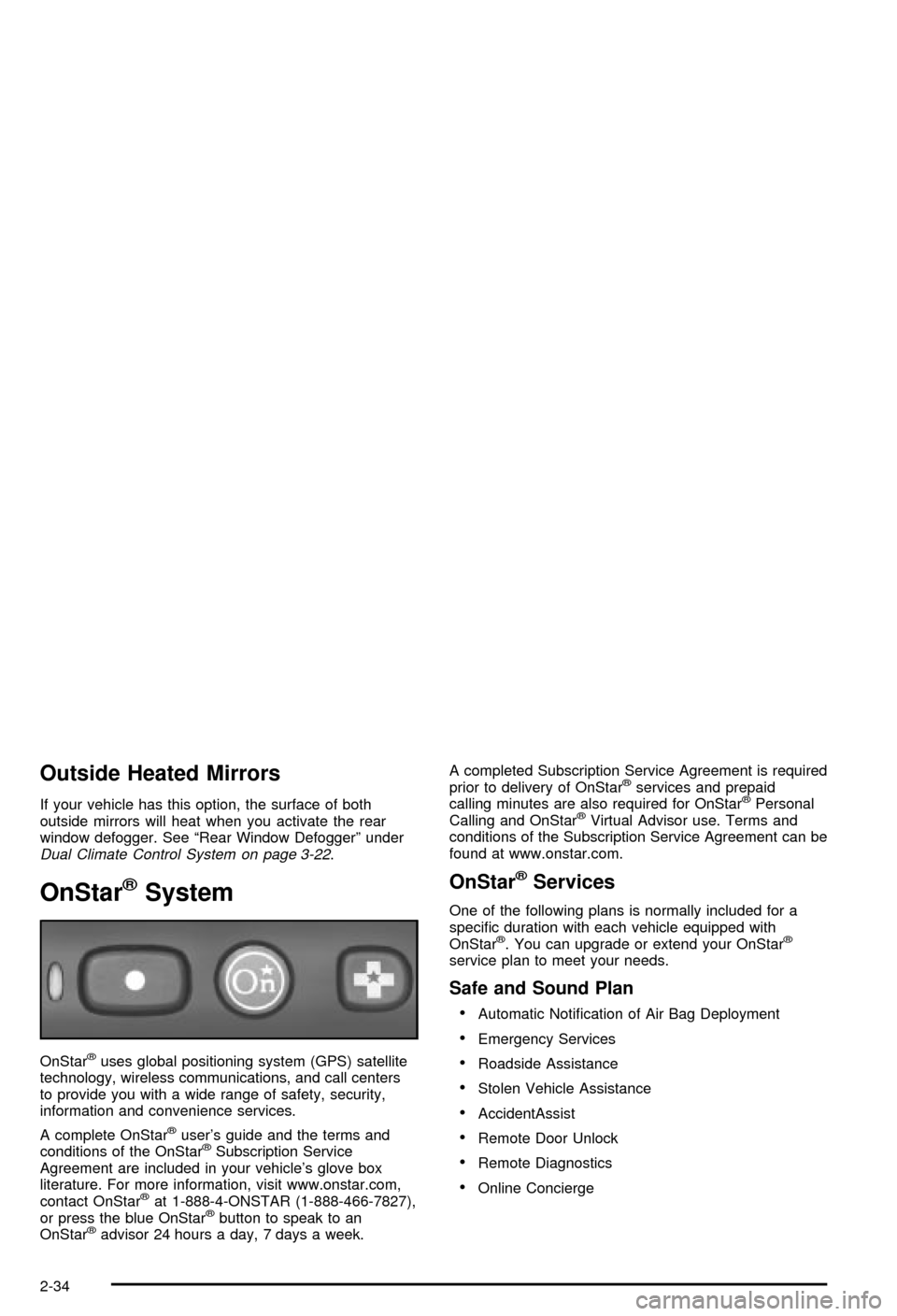
OnStaržSystem
OnStaržuses global positioning system (GPS) satellite
technology, wireless communications, and call centers
to provide you with a wide range of safety, security,
information and convenience services.
A complete OnStar
žuser's guide and the terms and
conditions of the OnStaržSubscription Service
Agreement are included in your vehicle's glove box
literature. For more information, visit www.onstar.com,
contact OnStar
žat 1-888-4-ONSTAR (1-888-466-7827),
or press the blue OnStaržbutton to speak to an
OnStaržadvisor 24 hours a day, 7 days a week.A completed Subscription Service Agreement is required
prior to delivery of OnStar
žservices and prepaid
calling minutes are also required for OnStaržPersonal
Calling and OnStaržVirtual Advisor use. Terms and
conditions of the Subscription Service Agreement can be
found at www.onstar.com.
OnStaržServices
One of the following plans is normally included for a
speci®c duration with each vehicle equipped with
OnStar
ž. You can upgrade or extend your OnStarž
service plan to meet your needs.
Safe and Sound Plan
·
Automatic Noti®cation of Air Bag Deployment
·Emergency Services
·Roadside Assistance
·Stolen Vehicle Assistance
·AccidentAssist
·Remote Door Unlock
·Remote Diagnostics
·Online Concierge
2-34
Page 136 of 394
Climate Controls
Dual Climate Control System
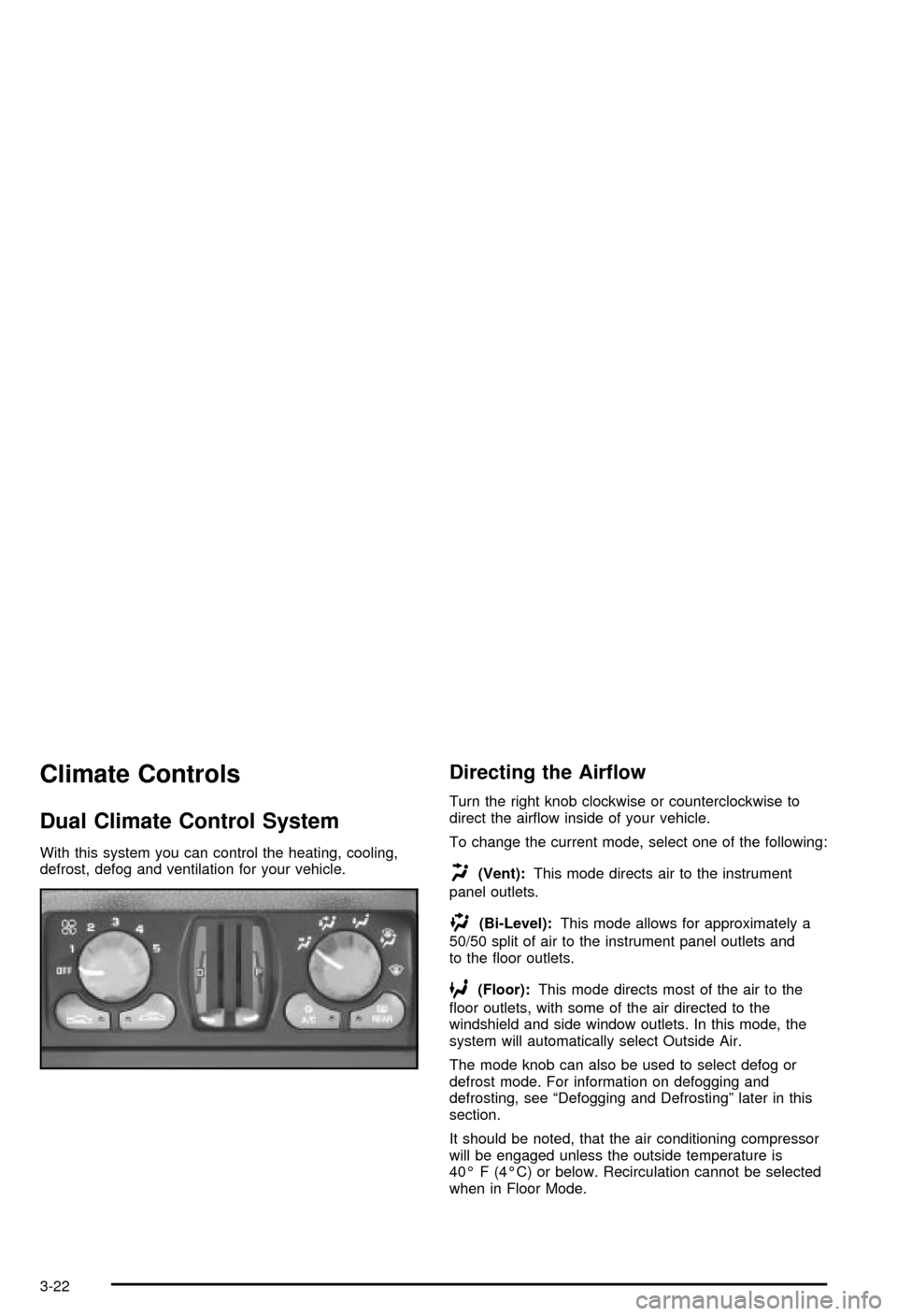
With this system you can control the heating, cooling,
defrost, defog and ventilation for your vehicle.
Directing the Air¯ow
Turn the right knob clockwise or counterclockwise to
direct the air¯ow inside of your vehicle.
To change the current mode, select one of the following:
H(Vent):This mode directs air to the instrument
panel outlets.
)(Bi-Level):This mode allows for approximately a
50/50 split of air to the instrument panel outlets and
to the ¯oor outlets.
6(Floor):This mode directs most of the air to the
¯oor outlets, with some of the air directed to the
windshield and side window outlets. In this mode, the
system will automatically select Outside Air.
The mode knob can also be used to select defog or
defrost mode. For information on defogging and
defrosting, see ªDefogging and Defrostingº later in this
section.
It should be noted, that the air conditioning compressor
will be engaged unless the outside temperature is
40É F (4ÉC) or below. Recirculation cannot be selected
when in Floor Mode.
3-22
Page 137 of 394
Selecting the Fan Speed
9
(Fan):Turn the left knob clockwise or
counterclockwise to increase or decrease the fan speed.
Turn the knob to OFF to turn off the fan. The fan
must be turned on for the air conditioning compressor to
operate.
If the air¯ow seems low when the fan is at the highest
setting, the passenger compartment air ®lter, if
equipped, may need to be replaced. For more
information, see
Passenger Compartment Air Filter on
page 3-28andScheduled Maintenance on page 6-5.
Selecting Outside Air or Recirculation
The outside air mode is used to bring outside air
into your vehicle; also use this mode to remove excess
moisture from the inside of the windows. The
recirculation mode is used to recirculate the air inside of
your vehicle; also use this mode to help prevent
outside odors and/or dust from entering your vehicle or
to help heat or cool the air inside of your vehicle
quickly.
:(Outside Air):Press this button to turn the
outside air mode on. When this button is pressed, an
indicator light in the button will come on to let you know
that it is activated. During daylight hours, you may
have to adjust the instrument panel brightness control to
the highest setting in order to see the indicator light.
See
Interior Lamps on page 3-17for more information.
When this mode is on, outside air will circulate
throughout your vehicle. The outside air mode can be
used with all modes, except the recirculation mode.
If you are in city traffic and your vehicle is stopped and
idling, or the weather is hot, you may switch the
system from Outside Air to Recirculation. This will help
prevent the air inside of your vehicle from becoming
stale, be sure to return to Outside Air periodically.
3-23
Page 138 of 394
?(Recirculation):Press this button to turn the
recirculation mode on. When this mode is on, inside air
and a small percentage of outside air will recirculate
throughout your vehicle. This selection will reduce
the entry of outside air and odors from entering your
vehicle, it may also help heat or cool your vehicle more
quickly. When this button is pressed, an indicator
light in the button will also come on to let you know that
it is activated. During daylight hours, you may have
to adjust the instrument panel brightness control to the
highest setting in order to see the indicator light.
See
Interior Lamps on page 3-17for more information.
The recirculation mode can be used with vent and
bi-level modes, but it cannot be used with ¯oor, defog,
defrost or outside air modes.
This system will default back to the outside air setting,
so you will have to re-select this setting every time
that you start the vehicle.
If the weather is cold and damp, the system may cause
the windows to fog while using the recirculation
mode. If the windows do start to fog, do the following:
1. Select the defog or defrost mode.
2. Select the temperature.
3. Select the highest fan speed.
4. Operate the system in the outside air mode, to help
prevent a recurrence.
Heating
Adjust the air temperature by using the following levers:
D (Driver):Slide this lever up or down to raise or
lower the temperature on the driver's side of the vehicle.
P (Passenger):Slide this lever up or down to raise
or lower the temperature on the passenger's side of the
vehicle.
To warm your vehicle on cold days, do the following:
1. Select the ¯oor mode.
2. Select the warmest temperature.
3. Select the fan speed.
4. Select outside air mode, after the air has warmed,
to prevent it from becoming too stale.
When it's cold outside 0ÉF (-18ÉC) or lower, use the
engine coolant heater, if equipped, to provide warmer air
faster to your vehicle. An engine coolant heater warms
the coolant that the engine uses to provide heat to
warm the inside of your vehicle. For more information,
see
Engine Coolant Heater on page 2-20.
3-24
Page 139 of 394
Cooling
On hot days, open the windows to let hot air escape;
then close them. This helps to reduce the time it takes
for your vehicle to cool down. It also helps the system
to operate more efficiently.
#A/C (Air Conditioning):Press this button to turn
the air-conditioning system on or off. When the system is
on, an indicator light will come on and the system will
begin to cool and dehumidify the air inside of your
vehicle. During daylight hours, you may have to adjust
the instrument panel brightness control to the highest
setting in order to see the indicator light. See
Interior
Lamps on page 3-17for more information.
You may notice a slight change in engine performance
when the air-conditioning compressor shuts off and
turns on again. This is normal. The system is designed
to make adjustments to help with fuel economy while
still maintaining the selected temperature.
The Air Conditioning System removes moisture from the
air, so you may notice a small amount of water
dripping underneath your vehicle when idling or after
turning off the engine.For quicker cool down on hot days, do the following:
1. Select the vent mode.
2. Select A/C.
3. Select the recirculation mode.
4. Select the coolest temperature for both zones.
5. Select the highest fan speeds.
Using these settings together for long periods of time
may cause the air inside of your vehicle to become too
dry. To prevent this, after the air inside of your vehicle
has cooled, switch to Outside Air.
On cool, but sunny days, the sun may warm the upper
part of your body, but the lower part may not be
warm enough. To remedy this, do the following:
1. Select the bi-level mode.
2. Select A/C.
3. Select the temperature.
4. Select the fan speed.
The air-conditioning system removes moisture from the
air, so you may sometimes notice a small amount of
water dripping underneath your vehicle while idling
or after turning off the engine. This is normal.
3-25
Page 140 of 394
Defogging and Defrosting
Fog on the inside of your windows is a result of high
humidity (moisture) condensing on the cool window
glass. This can be minimized if the climate control
system is used properly.
There are two modes to choose from to clear fog or
frost from your windshield. Use the defog mode to clear
fog or moisture from the windows and warm the
passengers. Use the defrost mode to quickly remove
fog or frost from the windshield.
Turn the right knob clockwise or counterclockwise to
select one of the following modes:
/(Defog):This mode directs half of the air to the
windshield and side window vents and half to the ¯oor
vents. In this mode, the system will automatically
force outside air into your vehicle. The recirculation
mode cannot be selected while in the defog mode. The
air conditioning compressor will run automatically in
this setting, unless the outside temperature is below
40ÉF (4ÉC).
Do not drive the vehicle until all the windows are clear.
0(Defrost):This mode directs most of the air to the
windshield and the side window vents, with only a
little air directed to the ¯oor vents. In this mode, the
system will automatically force outside air into your
vehicle. There is a 5 minute timer linked to this function.
The recirculation mode cannot be selected while in
the defrost mode. The air conditioning compressor will
run automatically in this setting, unless the outside
temperature is below 40ÉF (4ÉC).
Do not drive the vehicle until all the windows are clear.
To circulate outside air and clear the windshield
quickly and bring outside air into your vehicle, do the
following:
1. Select defrost mode.
2. Select the temperature.
3. Select the highest fan speed.
3-26
Page 141 of 394
Rear Window Defogger
The rear window defogger uses a warming grid to
remove fog from the rear window.
<(REAR):Press this button to turn the rear window
defogger on or off. An indicator light in the button
will come on to let you know that the rear window
defogger is activated. During daylight hours, you may
have to adjust the instrument panel brightness control to
the highest setting in order to see the indicator light.
See
Interior Lamps on page 3-17for more information.
The rear window defogger will turn off approximately
20 minutes after the button is pressed. If turned on
again, the defogger will run for the same amount of time.
The defogger can also be turned off by pressing the
button again or by turning off the engine.
If your vehicle has heated outside rearview mirrors, the
Rear Window Defogger also warms the heated
driver's and passenger's outside rearview mirrors to
help clear them of ice, snow and condensation.
Do not drive the vehicle until all the windows are clear.
Notice:Don't use a razor blade or something
else sharp on the inside of the rear window. If you
do, you could cut or damage the defogger and
the repairs would not be covered by your warranty.
Do not attach a temporary vehicle license, tape,
a decal or anything similar to the defogger grid.
Outlet Adjustment
The ¯ow through ventilation system on your vehicle
allows outside air to enter your vehicle when it is moving.
Outside air will also enter your vehicle when the
air-conditioning compressor is running and even in small
amounts when the recirculation mode is activated.
Use the control located
below or to the side of the
vent, to change the
direction of the air ¯owing
through them or to shut
them off.
For mild outside temperatures when little heating or
cooling is needed, do the following:
1. Select the vent mode.
2. Select outside air mode.
3. Select the temperature.
4. Select the fan speed.
3-27