trunk CHEVROLET MONTE CARLO 2004 User Guide
[x] Cancel search | Manufacturer: CHEVROLET, Model Year: 2004, Model line: MONTE CARLO, Model: CHEVROLET MONTE CARLO 2004Pages: 416, PDF Size: 4.56 MB
Page 104 of 416

Storage Areas
Glove Box
Use the key to lock and unlock the glove box. To open,
lift the latch.
Center Console Storage Area
The console has cupholders and a cassette tape
storage area. To open the console’s storage area, press
the latch located toward the front of the console lid on
the driver’s side of the vehicle.
Rear Storage Area
To access the rear cupholders, pull down on the cloth
strap located toward the top of the center back seat
cushion. You will then have access to the dual
cupholders.Convenience Net
Your vehicle may have a convenience net. You’ll see it
on the back wall of the trunk.
Put small loads, like grocery bags, behind or inside the
net. It can help keep them from falling over during
sharp turns or quick starts and stops.
The net isn’t for larger, heavier loads. Store those in the
trunk as far forward as you can.
You can unhook the net so that it will lie at when
you’re not using it.
2-40
Page 106 of 416
Vehicle Personalization
Some of the convenience features can be reset or
customized to perform according to your preference. The
features you can program depend upon the options
that came with your vehicle. The following list shows
features that can be reset or customized along with
those options.
Settings (Available for All)
GM Oil Life System Reset (Available for All)
Low Tire Pressure Reset
Delayed Headlamp Illumination (Available for All)
Automatic Door Lock and Unlock (Available for All)
Remote Visual Verication (Available with
Remote Keyless Entry)
Remote Audible Verication (Available with
Remote Keyless Entry)
Content Theft Operation (Available with Content
Theft System)
Trunk Jamb (Available with Content Theft System)
Horn Chirp On Timer (Available with Remote
Keyless Entry)
Remote Keyless Entry Transmitter Programming
(Available with Remote Keyless Entry)
Return to Original Factory Settings
(Available for All)
Exit Vehicle Customization Mode
Programming Mode
To reset or customize the features, rst enter the
vehicle customization main menu. To enter the main
menu, do the following:
1. Turn the ignition to ACC or ON. The radio
must be off.
2. Press and hold the TUNE DISP knob on the radio
for at least ve seconds until SETTINGS is
displayed.
3. Press the SEEK PSCAN up or down arrows to
scroll through each available feature on your
main menu.
4. Press the 1 PREV or 2 NEXT buttons to scroll
through the lower menu. An asterisk (*) will
appear next to the item that is the current setting.
The following information shows how to reset or
customize features after entering the main menu.
2-42
Page 112 of 416
TRNKJAMB (Trunk Jamb)
This feature allows the content theft system trunk lock
sensor to be disabled or enabled.
Programmable Modes
Mode 1:TRNK OFF
Mode 2:TRNK ON
Your vehicle was originally programmed to Mode 2. The
mode may have been changed since then. To determine
the current mode, or to change the mode, do the
following:
1. Scroll, using the SEEK PSCAN up or down arrows,
until TRNKJAMB appears on the display.
2. Press the 1 PREV or 2 NEXT button to enter the
submenu. The current selection will have an
asterisk (*) next to it. If you do not wish to change
the current mode, you can either exit the
programming mode by following the directions later
in this section or program the next feature
available on your vehicle.3. Scroll, using the 1 PREV or 2 NEXT buttons,
through the modes to change the current mode.
4. With your preference displayed, press the TUNE
DISP button to select. A chime will be heard to
verify the new setting. The new selection will
be displayed with an asterisk (*) for one second.
The mode you selected is now set. You can either exit
the programming mode by following the instructions
later in this section or program the next feature available
on your vehicle.
CHIRP (Horn Chirp Timer)
This feature allows you to choose between short or long
horn chirp sounds when the remote keyless entry
transmitter is used.
Programmable Modes
Mode 1:SHORT
Mode 2:LONG
2-48
Page 115 of 416
Instrument Panel Overview...............................3-3
Hazard Warning Flashers................................3-5
Other Warning Devices...................................3-5
Horn.............................................................3-6
Tilt Wheel.....................................................3-6
Turn Signal/Multifunction Lever.........................3-6
Cruise Control..............................................3-10
Exterior Lamps.............................................3-13
Interior Lamps..............................................3-15
Accessory Power Outlets...............................3-18
Ashtrays and Cigarette Lighter........................3-19
Climate Controls............................................3-20
Dual Climate Control System..........................3-20
Passenger Compartment Air Filter...................3-26
Warning Lights, Gages and Indicators.............3-27
Instrument Panel Cluster................................3-28
Speedometer and Odometer...........................3-31
Tachometer.................................................3-32
Safety Belt Reminder Light.............................3-32
Air Bag Readiness Light................................3-33
Voltmeter Gage............................................3-34
Brake System Warning Light..........................3-34
Anti-Lock Brake System Warning Light.............3-36Traction Control System (TCS) Warning Light . . .3-36
Engine Coolant Temperature Gage..................3-37
Malfunction Indicator Lamp.............................3-38
Oil Pressure Indicator Light............................3-40
Cruise Control Light......................................3-41
Fuel Gage...................................................3-42
Message Center.............................................3-43
Service Traction System Warning Message......3-43
Traction Active Message................................3-43
Battery Warning Message..............................3-44
Hot Coolant Temperature Warning Message.....3-44
Low Oil Pressure Message............................3-45
Low Engine Oil Level Message.......................3-45
Change Engine Oil Message..........................3-46
Low Tire Message........................................3-46
Door Ajar Warning Message...........................3-47
Trunk Ajar Warning Message.........................3-47
Security Message.........................................3-48
Low Washer Fluid Warning Message...............3-48
Low Fuel Warning Message...........................3-49
Low Brake Fluid Warning Message.................3-49
Service Vehicle Soon Message.......................3-50
Highbeam Out Warning Message....................3-50
Section 3 Instrument Panel
3-1
Page 119 of 416
The main components of your instrument panel are listed here:
A. Instrument Panel Fuse Block. See “Instrument Panel
Fuse Block” underFuses and Circuit Breakers on
page 5-104.
B. Turn Signal/Multifunction Lever. SeeTurn
Signal/Multifunction Lever on page 3-7.
C. Audio Steering Wheel Controls (If Equipped).
SeeAudio Steering Wheel Controls on page 3-92.
D. Instrument Panel Cluster. SeeInstrument Panel
Cluster on page 3-29.
E. Hazard Warning Flasher Button. SeeHazard
Warning Flashers on page 3-6.
F. Audio System. SeeAudio System(s) on page 3-55.
G. Air Outlet. See “Outlet Adjustment” underDual
Climate Control System on page 3-21.
H. Exterior Lamps Control. SeeExterior Lamps on
page 3-14.I. Remote Trunk Release. See “Remote Trunk
Release” underTrunk on page 2-10.
J. Tilt Steering Wheel Lever. SeeTilt Wheel on
page 3-7.
K. Hood Release. SeeHood Release on page 5-10.
L. Steering Wheel Cruise Contol (If Equipped).
SeeCruise Control on page 3-11.
M. Ignition Switch. See “Ignition Positions” under
New Vehicle Break-In on page 2-17.
N. Automatic Transaxle Shift Lever. SeeAutomatic
Transaxle Operation on page 2-21.
O. Climate Controls. SeeDual Climate Control System
on page 3-21.
P. Glove Box. SeeGlove Box on page 2-40.
3-5
Page 133 of 416
Battery Rundown Protection
Your vehicle has a feature to help prevent you from
draining the battery in case you accidentally leave on the
interior courtesy lamps, reading/map lamps, visor
vanity lamps, trunk lamp or glove box lamps. If you leave
any of these lamps on, they will automatically turn off
after 10 minutes, if the ignition is off. The lamps
won’t come back on again until you do the following:
Turn the ignition on or
turn the exterior lamps control off, then on again.
If your vehicle has less than 15 miles (25 km) on
the odometer, the battery saver will turn off the lamps
after only three minutes.
Battery rundown protection will also work if the
headlamps are left on. After having been left on for
10 minutes, the headlamps and the parking lamps will
ash three times. They will remain on for one more
minute before turning off automatically.
Accessory Power Outlets
Your vehicle has a 12-volt outlet which can be used to
plug in electrical equipment such as a cellular telephone,
a compact disc player, etc.
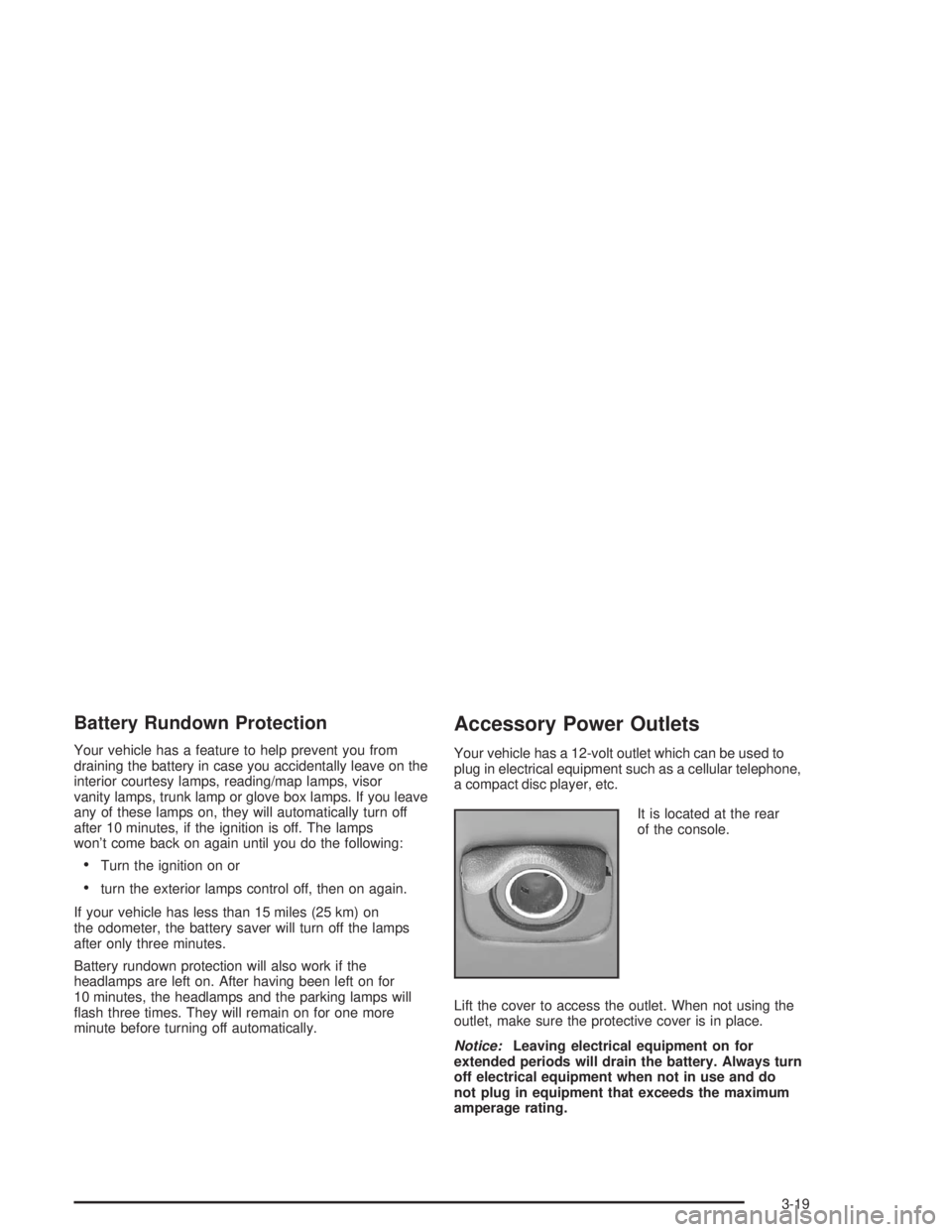
It is located at the rear
of the console.
Lift the cover to access the outlet. When not using the
outlet, make sure the protective cover is in place.
Notice:Leaving electrical equipment on for
extended periods will drain the battery. Always turn
off electrical equipment when not in use and do
not plug in equipment that exceeds the maximum
amperage rating.
3-19
Page 162 of 416
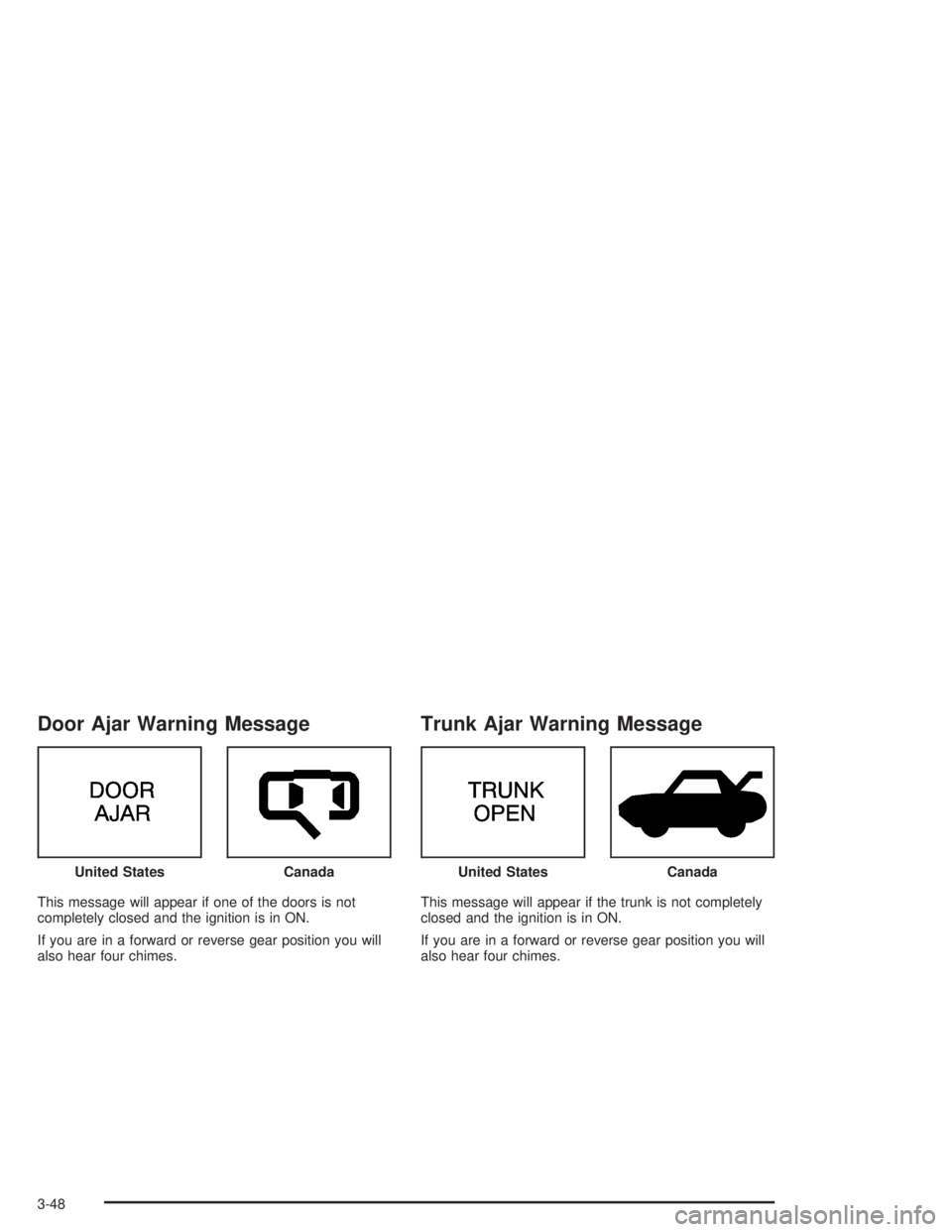
Door Ajar Warning Message
This message will appear if one of the doors is not
completely closed and the ignition is in ON.
If you are in a forward or reverse gear position you will
also hear four chimes.
Trunk Ajar Warning Message
This message will appear if the trunk is not completely
closed and the ignition is in ON.
If you are in a forward or reverse gear position you will
also hear four chimes. United States
CanadaUnited StatesCanada
3-48
Page 236 of 416
Winter Driving
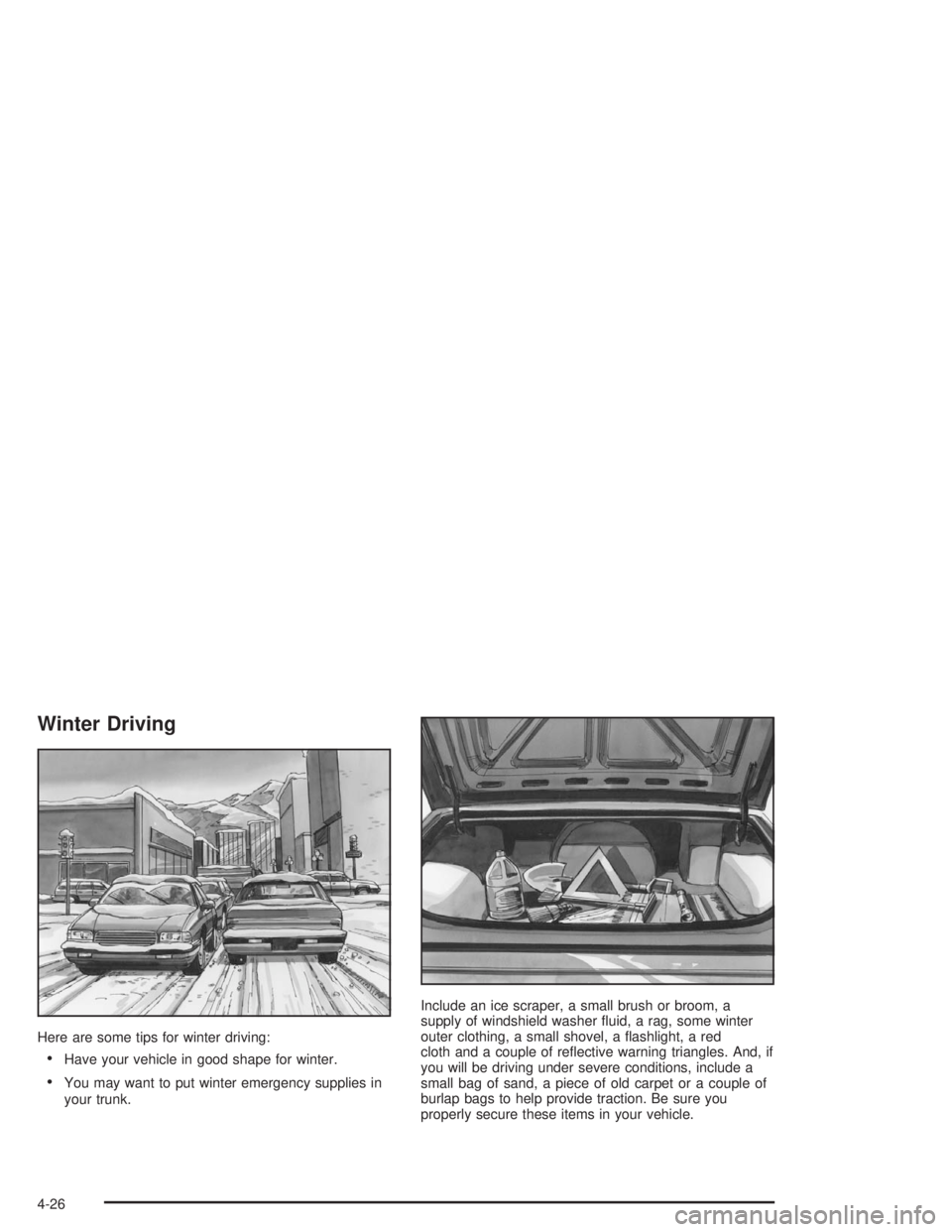
Here are some tips for winter driving:
Have your vehicle in good shape for winter.
You may want to put winter emergency supplies in
your trunk.Include an ice scraper, a small brush or broom, a
supply of windshield washer uid, a rag, some winter
outer clothing, a small shovel, a ashlight, a red
cloth and a couple of reective warning triangles. And, if
you will be driving under severe conditions, include a
small bag of sand, a piece of old carpet or a couple of
burlap bags to help provide traction. Be sure you
properly secure these items in your vehicle.
4-26
Page 244 of 416

A. Vehicle Capacity Weight
The Tire and Loading Information label shows the
seating capacity and the total weight your vehicle can
properly carry. This weight is called the vehicle capacity
weight. If your vehicle has the Tire and Loading
Information label, Example 1, the label is attached to
the center pillar, near the driver’s door latch. If your
vehicle has the Tire-Loading Information label, Example
2, the label is on the inside trunk lid.
The Tire and Loading Information label also gives you
the size and recommended ination pressure for
the factory-installed, original equipment tires on your
vehicle. For more information on tires and ination see
Tires on page 5-65andInation - Tire Pressure on
page 5-72.
There is also important loading information on the
Certication label. It tells you the Gross Vehicle Weight
Rating (GVWR) and the Gross Axle Weight Rating
(GAWR) for the front and rear axle; see “Certication
Label” later in this section. Example 2
4-34
Page 247 of 416
Refer to your vehicle’s tire and loading information label
for specic information about your vehicle’s capacity
weight and seating positions. The combined weight of
the driver, passengers and cargo should never
exceed your vehicle’s capacity weight. Also seeTowing
a Trailer on page 4-38.
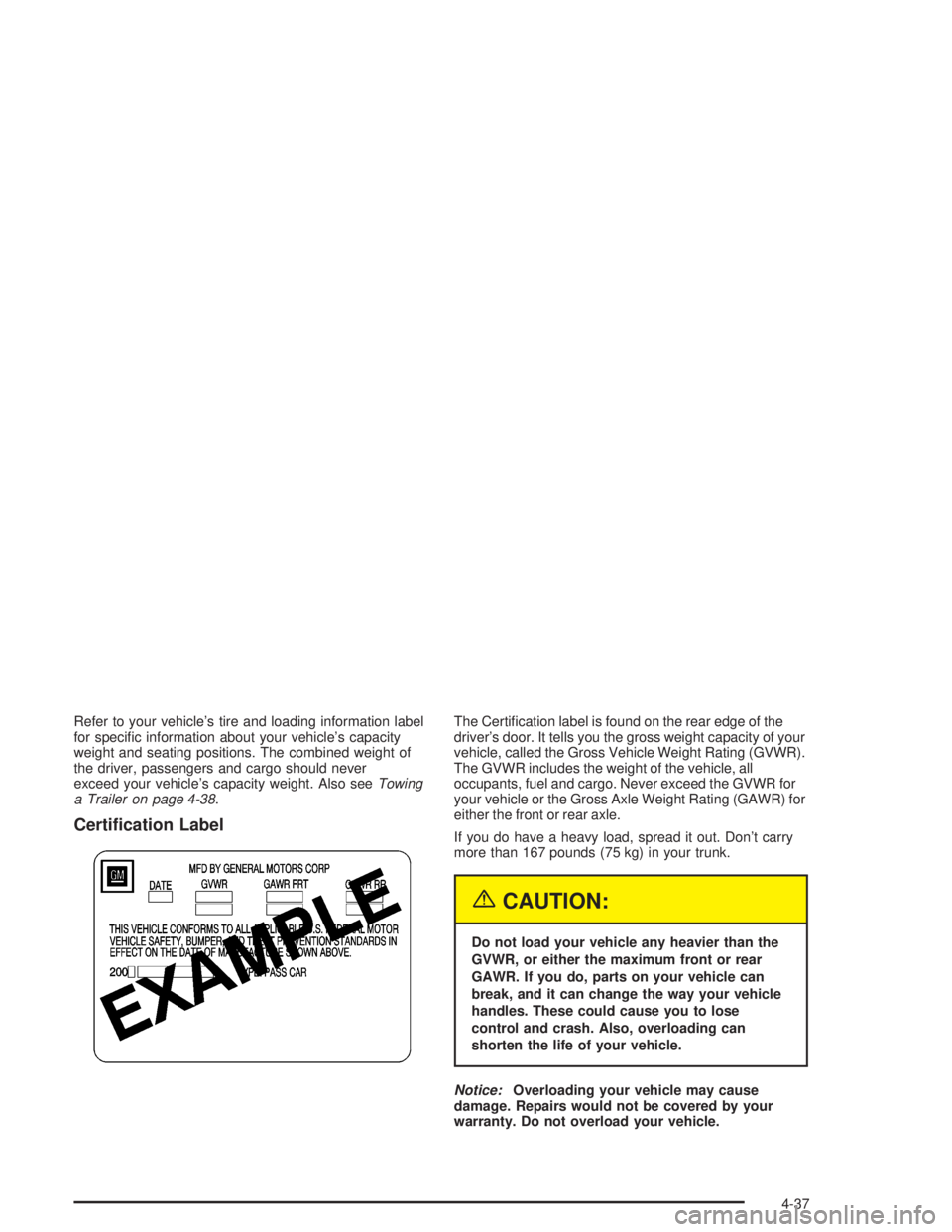
Certication Label
The Certication label is found on the rear edge of the
driver’s door. It tells you the gross weight capacity of your
vehicle, called the Gross Vehicle Weight Rating (GVWR).
The GVWR includes the weight of the vehicle, all
occupants, fuel and cargo. Never exceed the GVWR for
your vehicle or the Gross Axle Weight Rating (GAWR) for
either the front or rear axle.
If you do have a heavy load, spread it out. Don’t carry
more than 167 pounds (75 kg) in your trunk.
{CAUTION:
Do not load your vehicle any heavier than the
GVWR, or either the maximum front or rear
GAWR. If you do, parts on your vehicle can
break, and it can change the way your vehicle
handles. These could cause you to lose
control and crash. Also, overloading can
shorten the life of your vehicle.
Notice:Overloading your vehicle may cause
damage. Repairs would not be covered by your
warranty. Do not overload your vehicle.
4-37