wheel torque CHEVROLET MONTE CARLO 2004 Owners Manual
[x] Cancel search | Manufacturer: CHEVROLET, Model Year: 2004, Model line: MONTE CARLO, Model: CHEVROLET MONTE CARLO 2004Pages: 416, PDF Size: 4.56 MB
Page 308 of 416
Brake Wear
Your vehicle has four-wheel disc brakes.
Disc brake pads have built-in wear indicators that make a
high-pitched warning sound when the brake pads are
worn and new pads are needed. The sound may come
and go or be heard all the time your vehicle is moving
(except when you are pushing on the brake pedal rmly).
{CAUTION:
The brake wear warning sound means that soon
your brakes will not work well. That could lead
to an accident. When you hear the brake wear
warning sound, have your vehicle serviced.
Notice:Continuing to drive with worn-out brake
pads could result in costly brake repair.Some driving conditions or climates may cause a brake
squeal when the brakes are rst applied or lightly applied.
This does not mean something is wrong with your brakes.
Properly torqued wheel nuts are necessary to help
prevent brake pulsation. When tires are rotated, inspect
brake pads for wear and evenly tighten wheel nuts in
the proper sequence to GM torque specications.
Brake linings should always be replaced as complete
axle sets.
Brake Pedal Travel
See your dealer if the brake pedal does not return to
normal height, or if there is a rapid increase in
pedal travel. This could be a sign of brake trouble.
Brake Adjustment
Every time you apply the brakes, with or without the
vehicle moving, your brakes adjust for wear.
5-52
Page 331 of 416
Tire Inspection and Rotation
Tires should be rotated every 5,000 to 8,000 miles
(8 000 to 13 000 km).
Any time you notice unusual wear, rotate your tires as
soon as possible and check wheel alignment. Also
check for damaged tires or wheels. SeeWhen It Is Time
for New Tires on page 5-76andWheel Replacement
on page 5-79for more information.
The purpose of regular rotation is to achieve more
uniform wear for all tires on the vehicle. The rst rotation
is the most important. SeeScheduled Maintenance
on page 6-4for scheduled rotation intervals.
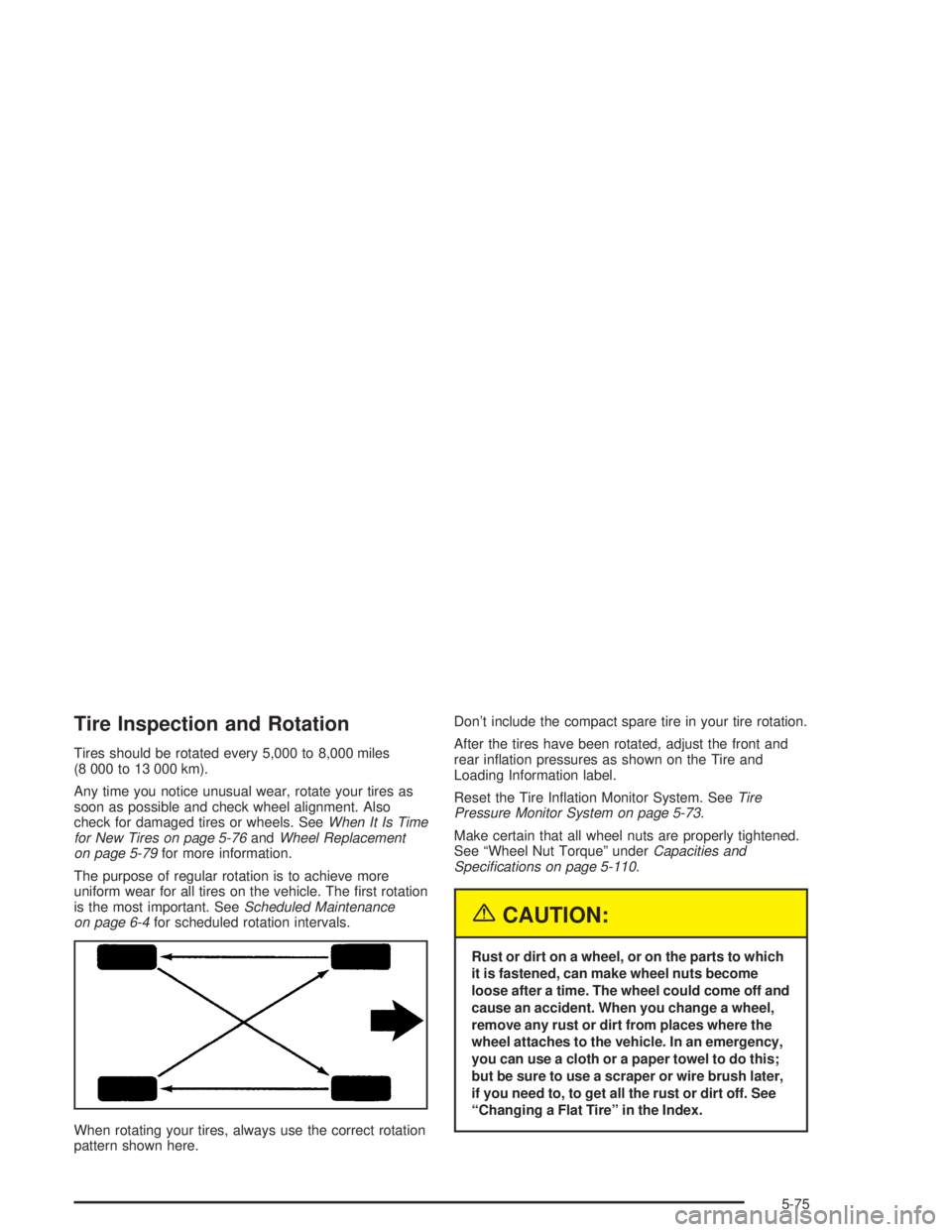
When rotating your tires, always use the correct rotation
pattern shown here.Don’t include the compact spare tire in your tire rotation.
After the tires have been rotated, adjust the front and
rear ination pressures as shown on the Tire and
Loading Information label.
Reset the Tire Ination Monitor System. SeeTire
Pressure Monitor System on page 5-73.
Make certain that all wheel nuts are properly tightened.
See “Wheel Nut Torque” underCapacities and
Specications on page 5-110.
{CAUTION:
Rust or dirt on a wheel, or on the parts to which
it is fastened, can make wheel nuts become
loose after a time. The wheel could come off and
cause an accident. When you change a wheel,
remove any rust or dirt from places where the
wheel attaches to the vehicle. In an emergency,
you can use a cloth or a paper towel to do this;
but be sure to use a scraper or wire brush later,
if you need to, to get all the rust or dirt off. See
“Changing a Flat Tire” in the Index.
5-75
Page 346 of 416
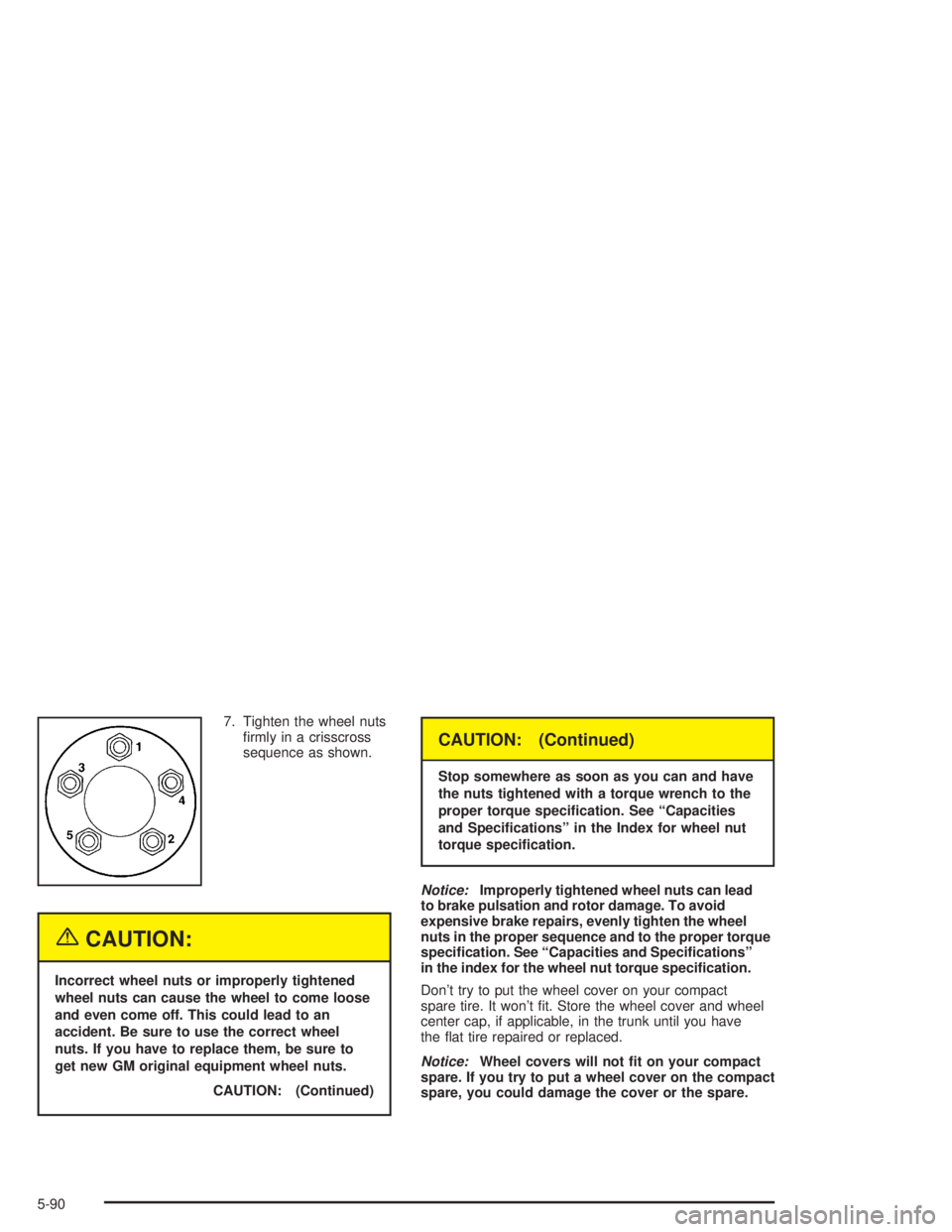
7. Tighten the wheel nuts
rmly in a crisscross
sequence as shown.
{CAUTION:
Incorrect wheel nuts or improperly tightened
wheel nuts can cause the wheel to come loose
and even come off. This could lead to an
accident. Be sure to use the correct wheel
nuts. If you have to replace them, be sure to
get new GM original equipment wheel nuts.
CAUTION: (Continued)
CAUTION: (Continued)
Stop somewhere as soon as you can and have
the nuts tightened with a torque wrench to the
proper torque specication. See “Capacities
and Specications” in the Index for wheel nut
torque specication.
Notice:Improperly tightened wheel nuts can lead
to brake pulsation and rotor damage. To avoid
expensive brake repairs, evenly tighten the wheel
nuts in the proper sequence and to the proper torque
specication. See “Capacities and Specications”
in the index for the wheel nut torque specication.
Don’t try to put the wheel cover on your compact
spare tire. It won’t t. Store the wheel cover and wheel
center cap, if applicable, in the trunk until you have
the at tire repaired or replaced.
Notice:Wheel covers will not t on your compact
spare. If you try to put a wheel cover on the compact
spare, you could damage the cover or the spare.
5-90
Page 414 of 416
T
Tachometer....................................................3-33
Taillamps
Turn Signal, Stoplamps and Sidemarker
Lamps....................................................5-62
TCS Warning Light..........................................3-37
Theft-Deterrent, Radio.....................................3-91
Theft-Deterrent Systems...................................2-15
Content Theft-Deterrent................................2-15
Passlock
®...................................................2-16
Tilt Wheel........................................................ 3-7
Tire
Low Message.............................................3-47
Tire Ination Check........................................... 6-9
Tire Sidewall Labeling......................................5-66
Tire Size.......................................................5-69
Tire Terminology and Denitions........................5-70
Tires.............................................................5-65
Buying New Tires........................................5-76
Chains.......................................................5-80
Changing a Flat Tire....................................5-82
Compact Spare Tire.....................................5-93
If a Tire Goes Flat.......................................5-81
Ination - Tire Pressure................................5-72
Inspection and Rotation................................5-75
Pressure Monitor System..............................5-73
Uniform Tire Quality Grading.........................5-77Tires (cont.)
Wheel Alignment and Tire Balance.................5-79
Wheel Replacement.....................................5-79
When It Is Time for New Tires......................5-76
TIRE MON (Tire Ination Monitor Reset)...............2-43
To Use the Engine Coolant Heater....................2-20
Top Strap......................................................1-38
Top Strap Anchor Location...............................1-40
Torque Lock...................................................2-27
Total Weight on Your Vehicle’s Tires..................4-41
Towing
Recreational Vehicle.....................................4-31
Towing a Trailer..........................................4-38
Your Vehicle...............................................4-31
Traction
Active Message...........................................3-44
Control System (TCS)..................................4-10
Control System Warning Light.......................3-37
Service Traction System Warning Message.....3-44
Trailer Brakes.................................................4-41
Transaxle
Fluid, Automatic...........................................5-28
Transaxle Operation, Automatic.........................2-21
Transmission, Transaxle, Transfer Case Unit
Repair Manual............................................7-13
Transmitter Verication...................................... 2-5
Transportation Options...................................... 7-9
14