fuses CHEVROLET MONTE CARLO 2007 6.G Owners Manual
[x] Cancel search | Manufacturer: CHEVROLET, Model Year: 2007, Model line: MONTE CARLO, Model: CHEVROLET MONTE CARLO 2007 6.GPages: 456, PDF Size: 2.43 MB
Page 107 of 456
PASS-Key®III+ Operation
Your vehicle has PASS-Key®III+ (Personalized
Automotive Security System) theft-deterrent
system. PASS-Key
®III+ is a passive
theft-deterrent system. This means you do not
have to do anything special to arm or disarm the
system. It works when you transition the key
to RUN, ACCESSORY or START from the OFF
position.
When the PASS-Key
®III+ system senses that
someone is using the wrong key, it prevents the
vehicle from starting. Anyone using a
trial-and-error method to start the vehicle will be
discouraged because of the high number of
electrical key codes.
If the engine does not start and the security light
on the instrument panel cluster comes on
when trying to start the vehicle, the key may have
a damaged transponder. Turn the ignition off
and try again.If the engine still does not start, and the key
appears to be undamaged, try another ignition
key. At this time, you may also want to check
the fuse, seeFuses and Circuit Breakers on
page 395. If the engine still does not start with the
other key, your vehicle needs service. If your
vehicle does start, the rst key may be faulty. See
your dealer who can service the PASS-Key
®III+
to have a new key made. In an emergency,
contact Roadside Assistance.
It is possible for the PASS-Key
®III+ decoder
to learn the transponder value of a new or
replacement key. Up to nine additional keys may
be programmed for the vehicle. The following
procedure is for programming additional keys only.
If all the currently programmed keys are lost or
do not operate, you must see your dealer or
a locksmith who can service PASS-Key
®III+ to
have keys made and programmed to the system.
See your dealer or a locksmith who can service
PASS-Key
®III+ to get a new key blank that is cut
exactly as the ignition key that operates the system.
107
Page 150 of 456
Turn and Lane-Change Signals
The turn signal has two upward (for right) and
two downward (for left) positions. These positions
allow you to signal a turn or a lane change.
To signal a turn, move the lever all the way up or
down. When the turn is nished, the lever will
return automatically.
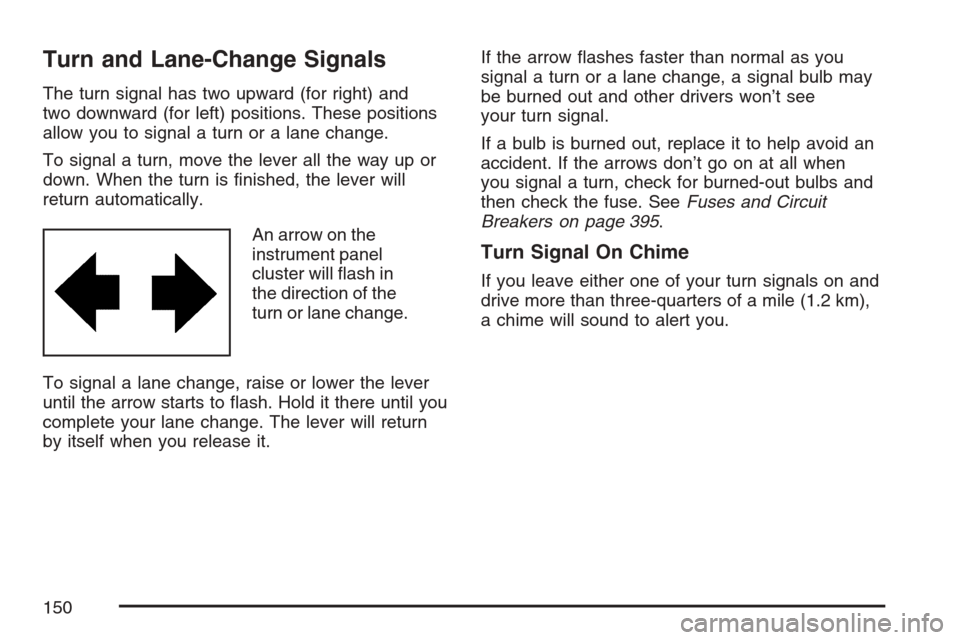
An arrow on the
instrument panel
cluster will ash in
the direction of the
turn or lane change.
To signal a lane change, raise or lower the lever
until the arrow starts to ash. Hold it there until you
complete your lane change. The lever will return
by itself when you release it.If the arrow ashes faster than normal as you
signal a turn or a lane change, a signal bulb may
be burned out and other drivers won’t see
your turn signal.
If a bulb is burned out, replace it to help avoid an
accident. If the arrows don’t go on at all when
you signal a turn, check for burned-out bulbs and
then check the fuse. SeeFuses and Circuit
Breakers on page 395.
Turn Signal On Chime
If you leave either one of your turn signals on and
drive more than three-quarters of a mile (1.2 km),
a chime will sound to alert you.
150
Page 163 of 456
One is located at the front of the console and the
other is located at the rear of the console. Lift the
cover to access the outlet. When not using the
outlet, make sure the protective cover is in place.
Notice:Leaving electrical equipment on for
extended periods will drain the battery. Always
unplug electrical equipment when not in use
and do not plug in equipment that exceeds the
maximum 20 ampere rating.
Certain accessory power plugs may not be
compatible with the accessory power outlet and
could result in blown vehicle or adapter fuses. If you
experience a problem see your dealer for additional
information on the accessory power plugs.Notice:Adding any electrical equipment to
your vehicle may damage it or keep other
components from working as they should.
The repairs would not be covered by your
warranty. Do not use equipment exceeding
maximum amperage rating of 20 amperes.
Check with your dealer before adding electrical
equipment.
When adding electrical equipment, be sure to
follow the proper installation instructions included
with the equipment. Check with your dealer
before adding electrical equipment, and never use
anything that exceeds the amperage rating of
20 amperes.
Notice:Improper use of the power outlet can
cause damage not covered by your warranty.
Do not hang any type of accessory or
accessory bracket from the plug because the
power outlets are designed for accessory
power plugs only.
163
Page 295 of 456
Appearance Care........................................ 385
Cleaning the Inside of Your Vehicle.......... 385
Fabric/Carpet............................................. 386
Leather...................................................... 387
Instrument Panel, Vinyl, and Other
Plastic Surfaces..................................... 388
Care of Safety Belts.................................. 388
Weatherstrips............................................ 388
Washing Your Vehicle............................... 389
Cleaning Exterior Lamps/Lenses................ 389
Finish Care............................................... 389
Windshield and Wiper Blades.................... 390
Aluminum Wheels...................................... 390
Tires......................................................... 391
Sheet Metal Damage................................. 391
Finish Damage.......................................... 392
Underbody Maintenance............................ 392Chemical Paint Spotting............................ 392
Vehicle Care/Appearance Materials............ 393
Vehicle Identication.................................. 394
Vehicle Identication Number (VIN)........... 394
Service Parts Identication Label............... 394
Electrical System........................................ 395
Add-On Electrical Equipment..................... 395
Headlamp Wiring....................................... 395
Windshield Wiper Fuses............................ 395
Power Windows and Other
Power Options....................................... 395
Fuses and Circuit Breakers....................... 395
Instrument Panel Fuse Block..................... 396
Underhood Fuse Block.............................. 397
Capacities and Specications.................... 400
Section 5 Service and Appearance Care
295
Page 395 of 456
Electrical System
Add-On Electrical Equipment
Notice:Do not add anything electrical to your
vehicle unless you check with your dealer
rst. Some electrical equipment can damage
your vehicle and the damage would not
be covered by your warranty. Some add-on
electrical equipment can keep other
components from working as they should.
Add-on equipment can drain your vehicle’s battery,
even if your vehicle is not operating.
Your vehicle has an airbag system. Before
attempting to add anything electrical to your
vehicle, seeServicing Your Airbag-Equipped
Vehicle on page 82.
Headlamp Wiring
The headlamp circuit is protected by individual
fuses in the underhood fuse block. An electrical
overload will cause the fuse to blow. If this
happens, have your headlamp system checked
right away.
Windshield Wiper Fuses
The windshield wiper motor is protected by a fuse.
If the motor overheats due to heavy snow, etc.,
the wiper will stop until the motor cools. If the
overload is caused by some electrical problem,
have it xed.
Power Windows and Other
Power Options
A circuit breaker in the instrument panel fuse
block protects the power windows and other power
accessories. When the current load is too heavy,
the circuit breaker opens and closes, protecting
the circuit until the problem is xed.
Fuses and Circuit Breakers
The wiring circuits in your vehicle are protected
from short circuits by a combination of fuses
and circuit breakers. This greatly reduces
the chance of res caused by electrical problems.
Look at the silver-colored band inside the fuse.
If the band is broken or melted, replace the fuse.
Be sure you replace a bad fuse with a new
one of the identical size and rating.
395
Page 396 of 456

Instrument Panel Fuse Block
The fuse block is located on the passenger side of
the vehicle in the carpet molding. Remove the
fuse block door to access the fuses.
Fuses Usage
PWR/SEAT Power Seats
PWR/WNDW Power Window
RAP Retained Accessory Power
HTD/SEAT Heated Seats
AUX Auxiliary Outlets
AMP Amplier
S/ROOF Sunroof
XM XM™ Radio
CNSTR Canister
DR/LCK Door Locks
PWR/MIR Power Mirrors
AIRBAG Airbags
TRUNK Trunk
TRUNK Trunk Relay
396
Page 397 of 456
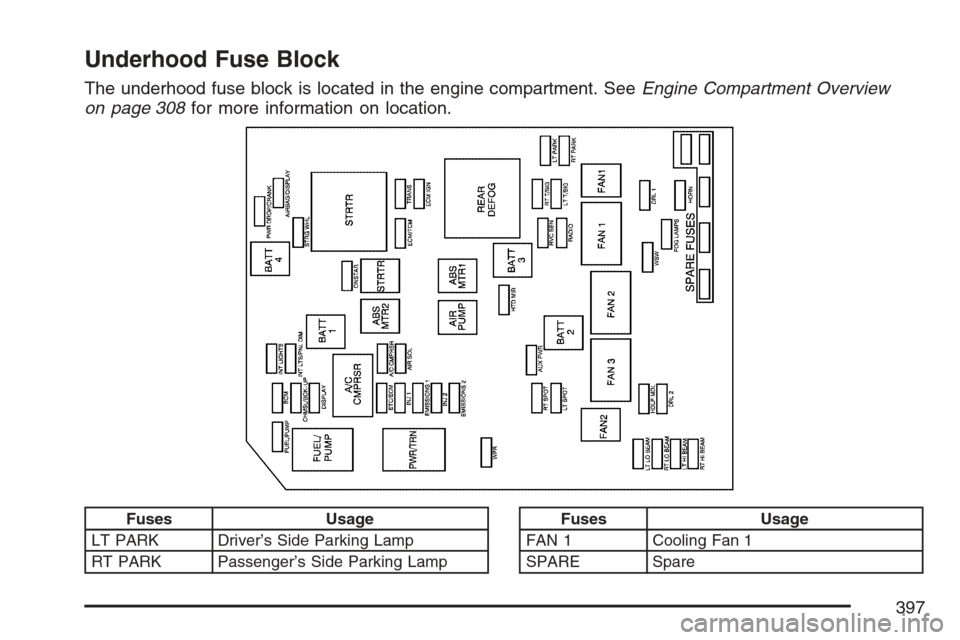
Underhood Fuse Block
The underhood fuse block is located in the engine compartment. SeeEngine Compartment Overview
on page 308for more information on location.
Fuses Usage
LT PARK Driver’s Side Parking Lamp
RT PARK Passenger’s Side Parking LampFuses Usage
FAN 1 Cooling Fan 1
SPARE Spare
397
Page 398 of 456
Fuses Usage
SPARE Spare
AIRBAG/
DISPLAYAirbag, Display
TRANS Transaxle
ECM IGN Engine Control Module, Ignition
RT T/SIG Passenger’s Side Turn Signal
LT T/SIG Driver’s Side Turn Signal
DRL 1 Daytime Running Lamps 1
HORN Horn
SPARE Spare
PWR DROP/
CRNKPower Drop, Crank
STRG WHL Steering Wheel
ECM/TCMEngine Control Module,
Transaxle Control Module
RVC SEN Regulated Voltage Control Sensor
RADIO Audio System
FOG LAMPS Fog Lamps
SPARE Spare
BATT 4 Battery 4
ONSTAR OnStar
®
STRTR Starter
ABS MTR1 Anti-lock Brake System Motor 1
BATT 3 Battery 3
Fuses Usage
WSW Windshield Wiper
HTD MIR Heated Mirror
SPARE Spare
BATT 1 Battery 1
ABS MTR2 Anti-lock Brake System Motor 2
AIR PUMP Air Pump
BATT 2 Battery 2
INT LIGHTS Interior Lamps
INT LTS/
PNL DIMInterior Lamps, Instrument
Panel Dimmer
A/C CMPRSR Air Conditioning Compressor
AIR SOL AIR (Air Injection Reactor) Solenoid
AUX PWR Auxiliary Power
BCM Body Control Module
CHMSL/
BCK-UPCenter High-Mounted Stoplamp,
Back-up Lamps
DISPLAY Display
ETC/ECMElectronic Throttle Control,
Engine Control Module
INJ 1 Injector 1
EMISSIONS 1 Emissions 1
INJ 2 Injector 2
EMISSIONS 2 Emissions 2
RT SPOT Right Spot
398
Page 399 of 456

Fuses Usage
LT SPOT Left Spot
HDLP MDL Headlamp Module
DRL 2 Daytime Running Lamps 2
FAN 2 Cooling Fan 2
FUEL/PUMP Fuel Pump
WPR Wiper
LT LO BEAM Driver’s Side Low-Beam
RT LO BEAM Passenger’s Side Low-Beam
LT HI BEAM Driver’s Side High-Beam
RT HI BEAM Passenger’s Side High-BeamRelay Usage
STRTR Starter
REAR DEFOG Rear Defogger
FAN 1 Cooling Fan 1
FAN 2 Cooling Fan 2
A/C CMPRSR Air Conditioning Compressor
FAN 3 Cooling Fan 3
FUEL/PUMP Fuel Pump
PWR/TRN Powertrain
399
Page 447 of 456
E
Easy Entry Seat............................................ 15
Electric Power Management........................ 161
Electrical System
Add-On Equipment................................... 395
Fuses and Circuit Breakers...................... 395
Headlamp Wiring..................................... 395
Instrument Panel Fuse Block................... 396
Power Windows and Other Power
Options................................................. 395
Underhood Fuse Block............................. 397
Windshield Wiper Fuses........................... 395
Engine
Air Cleaner/Filter...................................... 316
Battery..................................................... 336
Check and Service Engine Soon Light..... 181
Coolant.................................................... 320
Coolant Heater......................................... 112
Coolant Temperature Gage...................... 180
Coolant Temperature Warning Light.......... 179
Drive Belt Routing.................................... 417
Engine Compartment Overview................ 308
Exhaust................................................... 121
Oil ........................................................... 311
Oil Life System........................................ 314
Overheated Protection Operating Mode.... 325Engine (cont.)
Overheating............................................. 323
Starting.................................................... 110
Entry Lighting.............................................. 160
Event Data Recorders (EDR)...................... 434
Extender, Safety Belt..................................... 40
Exterior Lamps............................................ 156
F
Filter
Engine Air Cleaner................................... 316
Finish Damage............................................ 392
Flashers, Hazard Warning........................... 148
Flash-to-Pass.............................................. 151
Flat Tire...................................................... 371
Flat Tire, Changing...................................... 372
Flat Tire, Storing......................................... 382
Fluid
Automatic Transaxle................................. 317
Power Steering........................................ 331
Windshield Washer.................................. 332
Fog Lamp Light........................................... 185
Fog Lamps.................................................. 158
Folding Rear Seat......................................... 16
447