headlamp CHEVROLET OPTRA 2004 1.G User Guide
[x] Cancel search | Manufacturer: CHEVROLET, Model Year: 2004, Model line: OPTRA, Model: CHEVROLET OPTRA 2004 1.GPages: 346, PDF Size: 2.38 MB
Page 189 of 346
{CAUTION:
Snow can trap exhaust gases under your
vehicle. This can cause deadly CO (carbon
monoxide) gas to get inside. CO could
overcome you and kill you. You can not see it
or smell it, so you might not know it is in your
vehicle. Clear away snow from around the
base of your vehicle, especially any that is
blocking your exhaust pipe. And check around
again from time to time to be sure snow does
not collect there.
Open a window just a little on the side of the
vehicle that is away from the wind. This will
help keep CO out.Run your engine only as long as you must. This saves
fuel. When you run the engine, make it go a little
faster than just idle. That is, push the accelerator
slightly. This uses less fuel for the heat that you get and
it keeps the battery charged. You will need a
well-charged battery to restart the vehicle, and possibly
for signaling later on with your headlamps. Let the
heater run for a while.
Then, shut the engine off and close the window almost all
the way to preserve the heat. Start the engine again and
repeat this only when you feel really uncomfortable from
the cold. But do it as little as possible. Preserve the fuel
as long as you can. To help keep warm, you can get out
of the vehicle and do some fairly vigorous exercises
every half hour or so until help comes.
4-29
Page 199 of 346
Service............................................................5-3
Doing Your Own Service Work.........................5-4
Adding Equipment to the Outside of Your
Vehicle......................................................5-5
Fuel................................................................5-5
Gasoline Octane............................................5-5
Gasoline Specifications....................................5-5
California Fuel...............................................5-6
Additives.......................................................5-6
Fuels in Foreign Countries...............................5-7
Filling Your Tank............................................5-7
Filling a Portable Fuel Container.......................5-9
Checking Things Under the Hood....................5-10
Hood Release..............................................5-10
Engine Compartment Overview.......................5-12
Engine Oil...................................................5-14
Engine Air Cleaner/Filter................................5-18
Automatic Transaxle Fluid..............................5-20
Manual Transaxle Fluid..................................5-20
Hydraulic Clutch...........................................5-20
Engine Coolant.............................................5-21
Coolant Surge Tank Pressure Cap..................5-24
Engine Overheating.......................................5-24
Cooling System............................................5-27
Power Steering Fluid.....................................5-33Windshield Washer Fluid................................5-34
Brakes........................................................5-35
Battery........................................................5-38
Jump Starting...............................................5-39
Headlamp Aiming...........................................5-44
Bulb Replacement..........................................5-44
Halogen Bulbs..............................................5-44
Headlamps..................................................5-44
Front Turn Signal and Parking Lamps..............5-45
Turn Signal Lamps (Side)..............................5-46
Fog Lamps..................................................5-46
Sidemarker Lamps (Front)..............................5-47
Sidemarker Lamps (Rear)..............................5-47
Center High-Mounted Stoplamp (CHMSL).........5-48
Taillamps, Turn Signal, Stoplamps and
Back-up Lamps.........................................5-48
Replacement Bulbs.......................................5-49
Windshield Wiper Blade Replacement..............5-50
Tires..............................................................5-51
Inflation - Tire Pressure.................................5-57
Tire Inspection and Rotation...........................5-58
When It Is Time for New Tires.......................5-59
Buying New Tires.........................................5-60
Uniform Tire Quality Grading..........................5-60
Section 5 Service and Appearance Care
5-1
Page 200 of 346
Wheel Alignment and Tire Balance..................5-62
Wheel Replacement......................................5-62
Tire Chains..................................................5-63
If a Tire Goes Flat........................................5-63
Changing a Flat Tire.....................................5-64
Compact Spare Tire......................................5-72
Appearance Care............................................5-73
Cleaning the Inside of Your Vehicle.................5-73
Care of Safety Belts......................................5-76
Weatherstrips...............................................5-76
Cleaning the Outside of Your Vehicle.................5-76
Sheet Metal Damage.....................................5-78
Finish Damage.............................................5-78
Underbody Maintenance................................5-79Chemical Paint Spotting.................................5-79
Vehicle Care/Appearance Materials..................5-79
Vehicle Identication......................................5-81
Vehicle Identification Number (VIN).................5-81
Service Parts Identification Label.....................5-81
Electrical System............................................5-82
Add-On Electrical Equipment..........................5-82
Headlamp Wiring..........................................5-82
Windshield Wiper Fuses................................5-82
Power Windows and Other Power Options.......5-82
Fuses and Circuit Breakers............................5-83
Capacities and Specications..........................5-90
Normal Maintenance Replacement Parts..........5-91
Section 5 Service and Appearance Care
5-2
Page 242 of 346
Headlamp Aiming
If your vehicle is damaged in an accident, the headlamp
aim may be affected. Aim adjustment to the low beam
may be necessary if it is difficult to see lane markers
(for horizontal aim), or if oncoming drivers flash
their high beams at you (for vertical aim). If you believe
your headlamps need to be re-aimed, we recommend
that you take your vehicle to the dealer for service.
However, it is possible for you to re-aim your headlamps
by following the procedure in the service manual for
your vehicle.
Notice:To make sure your headlamps are aimed
properly, read all the instructions before beginning.
Failure to follow these instructions could cause
damage to headlamp parts.
Bulb Replacement
For bulb types, seeReplacement Bulbs on page 5-49.
For any bulb changing procedures not listed in this
section, contact your dealer.
Halogen Bulbs
{CAUTION:
Halogen bulbs have pressurized gas inside and
can burst if you drop or scratch the bulb. You or
others could be injured. Be sure to read and
follow the instructions on the bulb package.
Headlamps
1. Open the hood.
2. Remove the two bolts and the one nut that retain
the headlamp assembly.
3. Disconnect the wiring harness connector from the
rear of the bulb.
5-44
Page 243 of 346
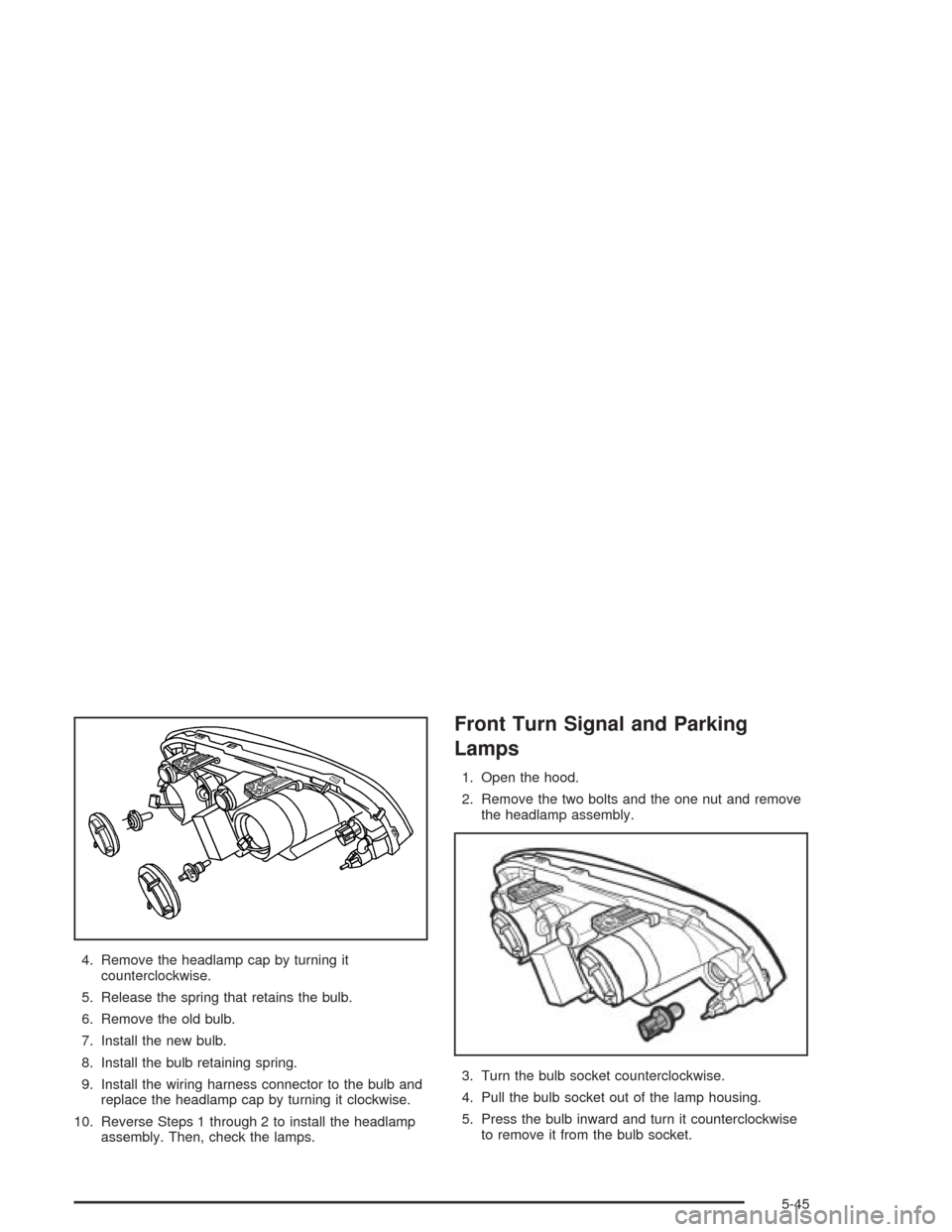
4. Remove the headlamp cap by turning it
counterclockwise.
5. Release the spring that retains the bulb.
6. Remove the old bulb.
7. Install the new bulb.
8. Install the bulb retaining spring.
9. Install the wiring harness connector to the bulb and
replace the headlamp cap by turning it clockwise.
10. Reverse Steps 1 through 2 to install the headlamp
assembly. Then, check the lamps.
Front Turn Signal and Parking
Lamps
1. Open the hood.
2. Remove the two bolts and the one nut and remove
the headlamp assembly.
3. Turn the bulb socket counterclockwise.
4. Pull the bulb socket out of the lamp housing.
5. Press the bulb inward and turn it counterclockwise
to remove it from the bulb socket.
5-45
Page 245 of 346
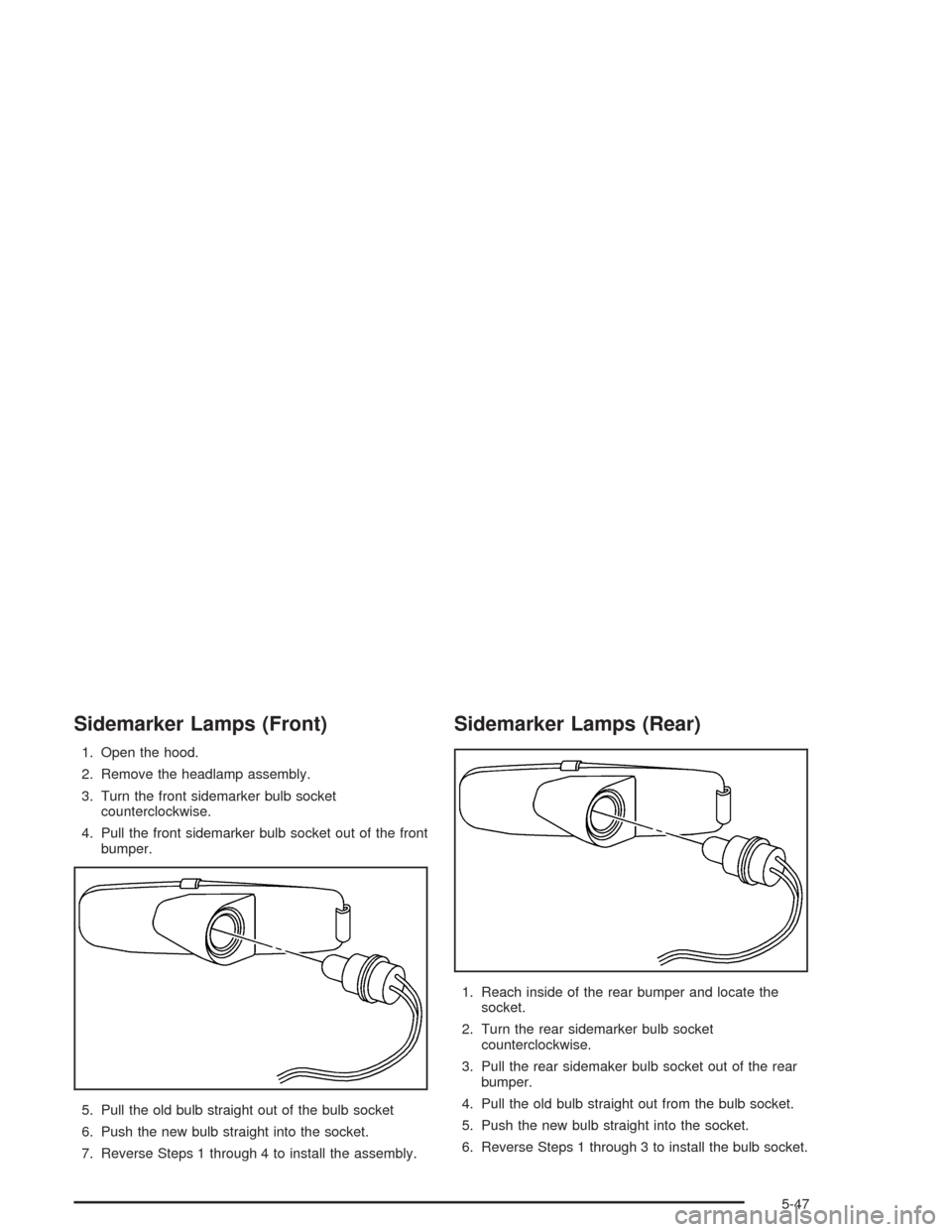
Sidemarker Lamps (Front)
1. Open the hood.
2. Remove the headlamp assembly.
3. Turn the front sidemarker bulb socket
counterclockwise.
4. Pull the front sidemarker bulb socket out of the front
bumper.
5. Pull the old bulb straight out of the bulb socket
6. Push the new bulb straight into the socket.
7. Reverse Steps 1 through 4 to install the assembly.
Sidemarker Lamps (Rear)
1. Reach inside of the rear bumper and locate the
socket.
2. Turn the rear sidemarker bulb socket
counterclockwise.
3. Pull the rear sidemaker bulb socket out of the rear
bumper.
4. Pull the old bulb straight out from the bulb socket.
5. Push the new bulb straight into the socket.
6. Reverse Steps 1 through 3 to install the bulb socket.
5-47
Page 247 of 346
3. Remove the bulb socket by turning it
counterclockwise.
4. Remove the bulb from the socket by pressing the
bulb and turning it counterclockwise.
5. Install the appropriate bulb into the socket.
6. Replace the bulb socket into the lamp housing.
Turn the bulb socket clockwise to secure.
7. Replace the trim cover.
8. Close the trunk or liftgate.Replacement Bulbs
Lamps Bulb Number
Back-Up 94535571
Center High-Mounted
Stoplamp/Sidemarker - Front
and Rear94535587
Headlamps - High-Beam 94535541
Headlamps - Low-Beam 94535546
Tail/Stoplamp 94535574
Turn Signal - Front and Parking
Lamp94535578
Turn Signal - Rear 94535572
For any bulb not listed here, contact your dealer.
5-49
Page 260 of 346
Wheel Alignment and Tire Balance
The wheels on your vehicle were aligned and balanced
carefully at the factory to give you the longest tire life
and best overall performance.
Scheduled wheel alignment and wheel balancing are
not needed. However, if you notice unusual tire wear or
your vehicle pulling one way or the other, the alignment
may need to be reset. If you notice your vehicle
vibrating when driving on a smooth road, your wheels
may need to be rebalanced.
Wheel Replacement
Replace any wheel that is bent, cracked or badly rusted
or corroded. If wheel nuts keep coming loose, the
wheel, wheel bolts and wheel nuts should be replaced.
If the wheel leaks air, replace it (except some
aluminum wheels, which can sometimes be repaired).
See your dealer if any of these conditions exist.
Your dealer will know the kind of wheel you need.
Each new wheel should have the same load-carrying
capacity, diameter, width, offset and be mounted
the same way as the one it replaces.If you need to replace any of your wheels, wheel bolts or
wheel nuts, replace them only with new GM original
equipment parts. This way, you will be sure to have the
right wheel, wheel bolts and wheel nuts for your vehicle.
{CAUTION:
Using the wrong replacement wheels, wheel
bolts or wheel nuts on your vehicle can be
dangerous. It could affect the braking and
handling of your vehicle, make your tires lose
air and make you lose control. You could have
a collision in which you or others could be
injured. Always use the correct wheel, wheel
bolts and wheel nuts for replacement.
Notice:The wrong wheel can also cause problems
with bearing life, brake cooling, speedometer or
odometer calibration, headlamp aim, bumper height,
vehicle ground clearance and tire or tire chain
clearance to the body and chassis.
SeeChanging a Flat Tire on page 5-64for more
information.
5-62
Page 280 of 346
Electrical System
Add-On Electrical Equipment
Notice:Don’t add anything electrical to your
vehicle unless you check with your dealer rst.
Some electrical equipment can damage your vehicle
and the damage wouldn’t be covered by your
warranty. Some add-on electrical equipment can
keep other components from working as they
should.
Your vehicle has an air bag system. Before attempting
to add anything electrical to your vehicle, see
Servicing Your Air Bag-Equipped Vehicle on page 1-60.
Headlamp Wiring
The headlamp wiring is protected by fuses, one for each
headlamp, in the fuse block. An electrical overload
will cause the lamps to turn off. If this happens, have
your headlamp wiring checked right away.
Windshield Wiper Fuses
The windshield wiper motor is protected by an internal
circuit breaker and a fuse. If the motor overheats due to
heavy snow, etc., the wiper will stop until the motor
cools. If the overload is caused by some electrical
problem and not snow, etc., be sure to get it fixed.
Power Windows and Other Power
Options
Circuit breakers in the fuse block protect the power
windows and other power accessories. When the current
load is too heavy, the circuit breaker opens and
closes, protecting the circuit until the problem is fixed or
goes away.
5-82
Page 286 of 346
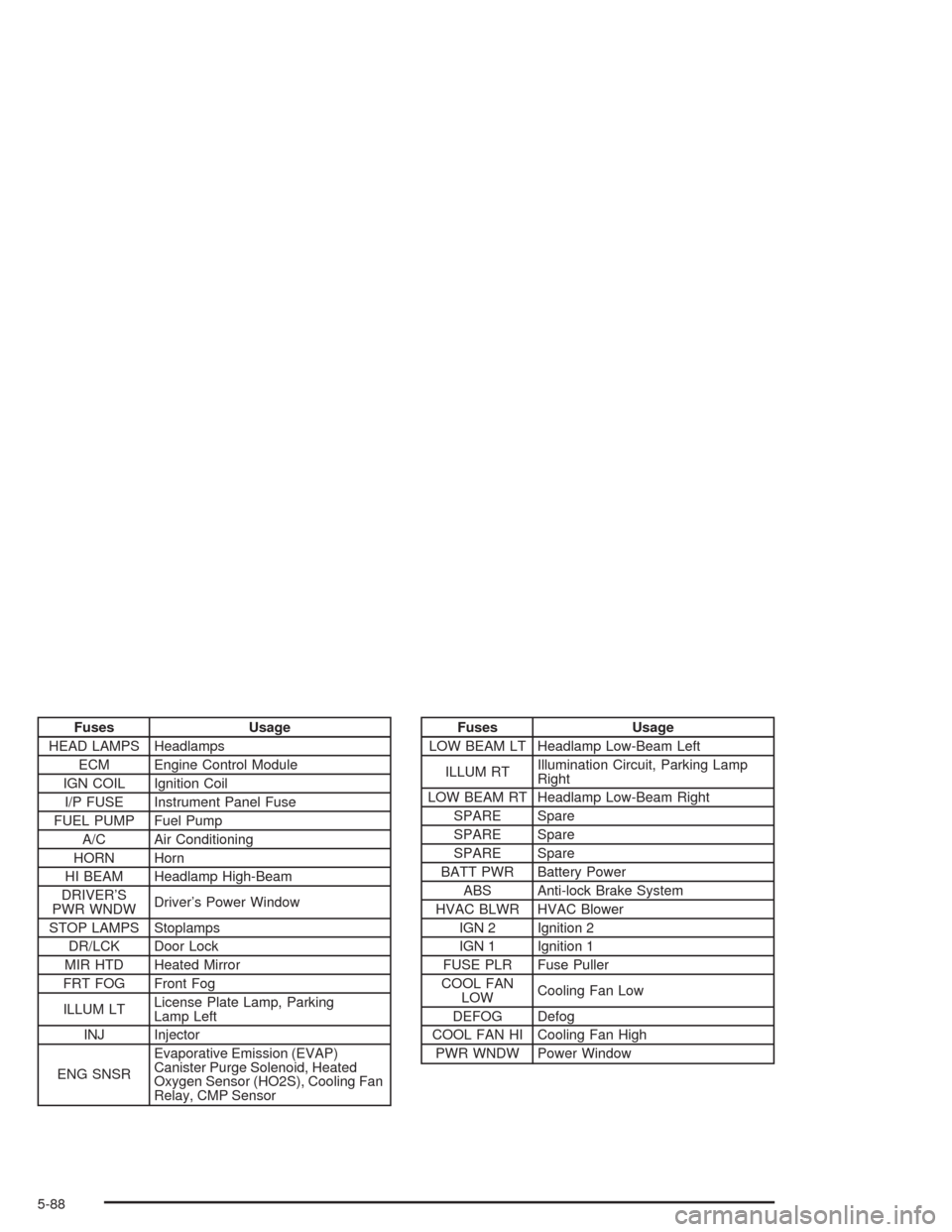
Fuses Usage
HEAD LAMPS Headlamps
ECM Engine Control Module
IGN COIL Ignition Coil
I/P FUSE Instrument Panel Fuse
FUEL PUMP Fuel Pump
A/C Air Conditioning
HORN Horn
HI BEAM Headlamp High-Beam
DRIVER’S
PWR WNDWDriver’s Power Window
STOP LAMPS Stoplamps
DR/LCK Door Lock
MIR HTD Heated Mirror
FRT FOG Front Fog
ILLUM LTLicense Plate Lamp, Parking
Lamp Left
INJ Injector
ENG SNSREvaporative Emission (EVAP)
Canister Purge Solenoid, Heated
Oxygen Sensor (HO2S), Cooling Fan
Relay, CMP SensorFuses Usage
LOW BEAM LT Headlamp Low-Beam Left
ILLUM RTIllumination Circuit, Parking Lamp
Right
LOW BEAM RT Headlamp Low-Beam Right
SPARE Spare
SPARE Spare
SPARE Spare
BATT PWR Battery Power
ABS Anti-lock Brake System
HVAC BLWR HVAC Blower
IGN 2 Ignition 2
IGN 1 Ignition 1
FUSE PLR Fuse Puller
COOL FAN
LOWCooling Fan Low
DEFOG Defog
COOL FAN HI Cooling Fan High
PWR WNDW Power Window
5-88