Section 3 CHEVROLET OPTRA 2004 1.G Owner's Manual
[x] Cancel search | Manufacturer: CHEVROLET, Model Year: 2004, Model line: OPTRA, Model: CHEVROLET OPTRA 2004 1.GPages: 346, PDF Size: 2.38 MB
Page 250 of 346
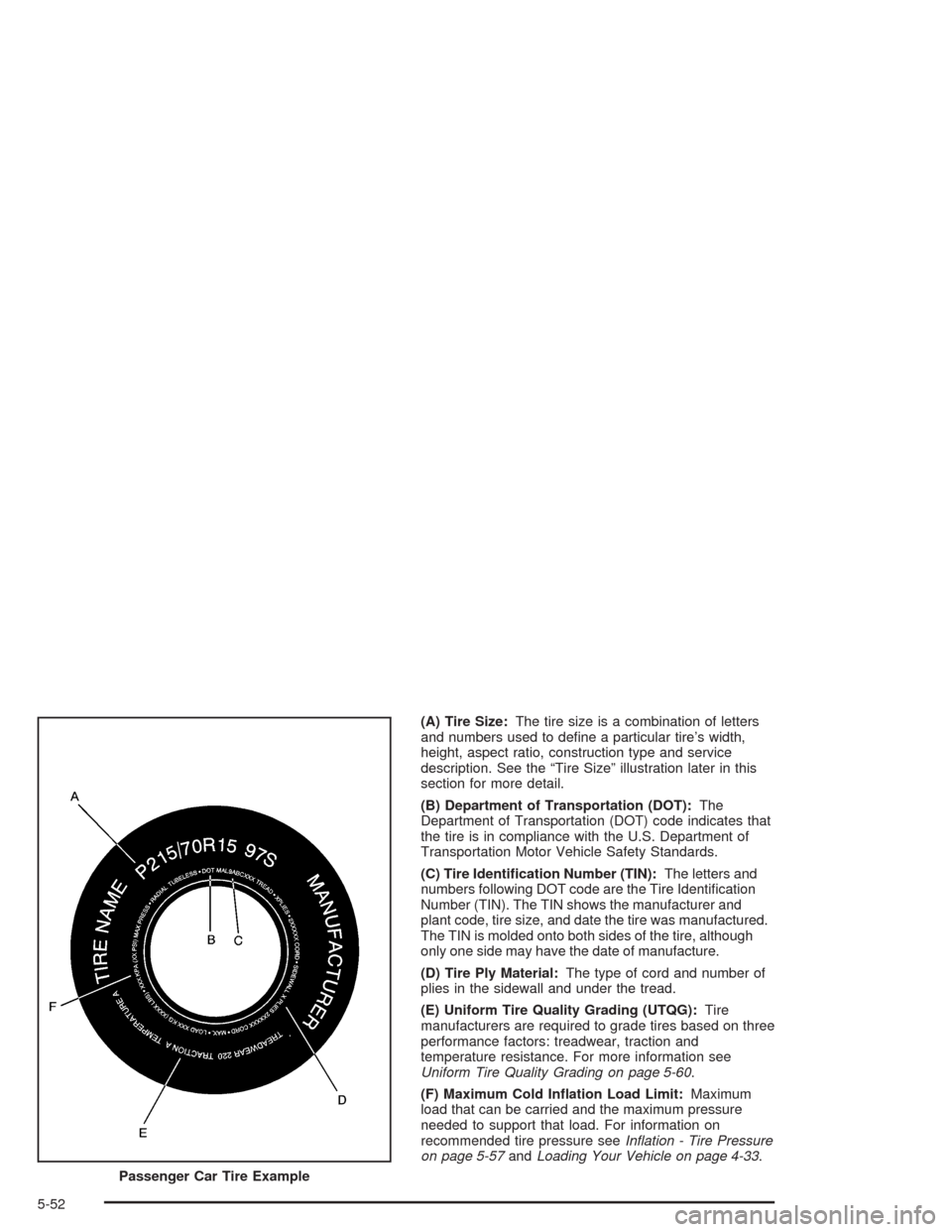
(A) Tire Size:The tire size is a combination of letters
and numbers used to define a particular tire’s width,
height, aspect ratio, construction type and service
description. See the “Tire Size” illustration later in this
section for more detail.
(B) Department of Transportation (DOT):The
Department of Transportation (DOT) code indicates that
the tire is in compliance with the U.S. Department of
Transportation Motor Vehicle Safety Standards.
(C) Tire Identication Number (TIN):The letters and
numbers following DOT code are the Tire Identification
Number (TIN). The TIN shows the manufacturer and
plant code, tire size, and date the tire was manufactured.
The TIN is molded onto both sides of the tire, although
only one side may have the date of manufacture.
(D) Tire Ply Material:The type of cord and number of
plies in the sidewall and under the tread.
(E) Uniform Tire Quality Grading (UTQG):Tire
manufacturers are required to grade tires based on three
performance factors: treadwear, traction and
temperature resistance. For more information see
Uniform Tire Quality Grading on page 5-60.
(F) Maximum Cold Ination Load Limit:Maximum
load that can be carried and the maximum pressure
needed to support that load. For information on
recommended tire pressure seeInflation - Tire Pressure
on page 5-57andLoading Your Vehicle on page 4-33.
Passenger Car Tire Example
5-52
Page 252 of 346
Tire Size
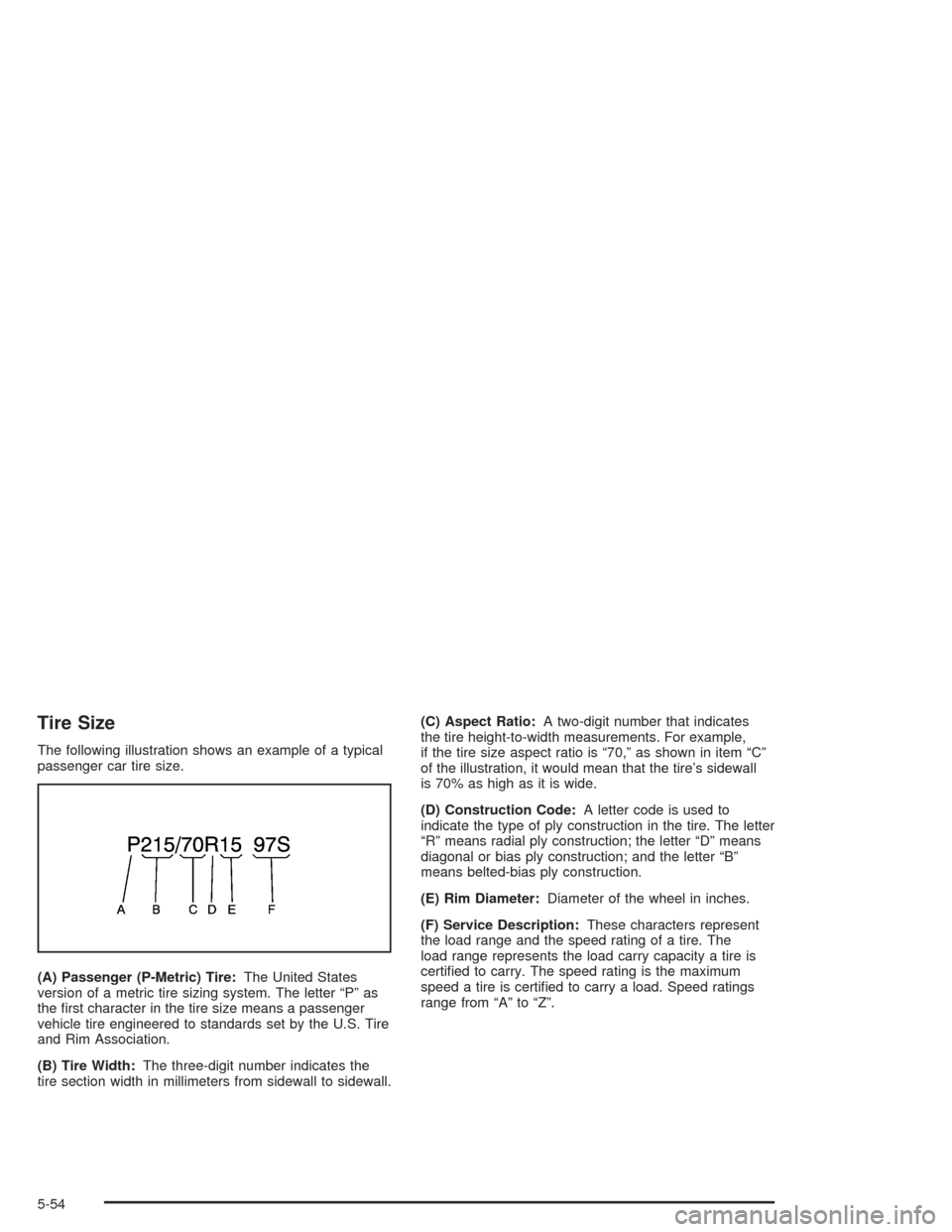
The following illustration shows an example of a typical
passenger car tire size.
(A) Passenger (P-Metric) Tire:The United States
version of a metric tire sizing system. The letter “P” as
the first character in the tire size means a passenger
vehicle tire engineered to standards set by the U.S. Tire
and Rim Association.
(B) Tire Width:The three-digit number indicates the
tire section width in millimeters from sidewall to sidewall.(C) Aspect Ratio:A two-digit number that indicates
the tire height-to-width measurements. For example,
if the tire size aspect ratio is “70,” as shown in item “C”
of the illustration, it would mean that the tire’s sidewall
is 70% as high as it is wide.
(D) Construction Code:A letter code is used to
indicate the type of ply construction in the tire. The letter
“R” means radial ply construction; the letter “D” means
diagonal or bias ply construction; and the letter “B”
means belted-bias ply construction.
(E) Rim Diameter:Diameter of the wheel in inches.
(F) Service Description:These characters represent
the load range and the speed rating of a tire. The
load range represents the load carry capacity a tire is
certified to carry. The speed rating is the maximum
speed a tire is certified to carry a load. Speed ratings
range from “A” to “Z”.
5-54
Page 258 of 346
Buying New Tires
To find out what kind and size of tires you need, look at
the Tire-Loading Information label.
Make sure the replacements are the same size, load
range, speed rating and construction type (bias,
bias-belted or radial) as your original tires.
{CAUTION:
Mixing tires could cause you to lose control
while driving. If you mix tires of different sizes
or types (radial and bias-belted tires), the
vehicle may not handle properly, and you
could have a crash. Using tires of different
sizes may also cause damage to your vehicle.
Be sure to use the same size and type tires on
all wheels. It’s all right to drive with your
compact spare temporarily, it was developed
for use on your vehicle. See “Compact Spare
Tire” in the index.
{CAUTION:
If you use bias-ply tires on your vehicle, the
wheel rim anges could develop cracks after
many miles of driving. A tire and/or wheel
could fail suddenly, causing a crash. Use only
radial-ply tires with the wheels on your vehicle.
Uniform Tire Quality Grading
Quality grades can be found where applicable on the
tire sidewall between tread shoulder and maximum
section width. For example:
Treadwear 200 Traction AA Temperature A
The following information relates to the system
developed by the United States National Highway
Traffic Safety Administration, which grades tires by
treadwear, traction and temperature performance. (This
applies only to vehicles sold in the United States.)
The grades are molded on the sidewalls of most
passenger car tires. The Uniform Tire Quality Grading
system does not apply to deep tread, winter-type
snow tires, space-saver or temporary use spare tires,
tires with nominal rim diameters of 10 to 12 inches
(25 to 30 cm), or to some limited-production tires.
5-60
Page 272 of 346
Here are some cleaning tips:
•Always read the instructions on the cleaner label.
•Clean up stains as soon as you can — before
they set.
•Carefully scrape off any excess stain.
•Use a clean cloth or sponge, and change to a clean
area often. A soft brush may be used if stains are
stubborn.
•If a ring forms on fabric after spot cleaning, clean
the entire area immediately or it will set.
Using Cleaner on Fabric
1. Vacuum and brush the area to remove any
loose dirt.
2. Always clean a whole trim panel or section. Mask
surrounding trim along stitch or welt lines.
3. Follow the directions on the container label.
4. Apply cleaner with a clean sponge. Do not saturate
the material and do not rub it roughly.
5. As soon as you have cleaned the section, use a
sponge to remove any excess cleaner.
6. Wipe cleaned area with a clean, water-dampened
towel or cloth.
7. Wipe with a clean cloth and let dry.
Special Fabric Cleaning Problems
Stains caused by such things as catsup, coffee (black),
egg, fruit, fruit juice, milk, soft drinks, vomit, urine
and blood can be removed as follows:
1. Carefully scrape off excess stain, then sponge the
soiled area with cool water.
2. If a stain remains, follow the cleaning instructions
described earlier.
3. If an odor lingers after cleaning vomit or urine, treat
the area with a water and baking soda solution:
1 teaspoon (5 ml) of baking soda to 1 cup (250 ml)
of lukewarm water.
4. Let dry.
Stains caused by candy, ice cream, mayonnaise, chili
sauce and unknown stains can be removed as follows:
1. Carefully scrape off excess stain.
2. Clean with cool water and allow to dry completely.
3. If a stain remains, follow the cleaner instructions
described earlier.
5-74
Page 291 of 346
Maintenance Schedule......................................6-2
Introduction...................................................6-2
Maintenance Requirements..............................6-2
Your Vehicle and the Environment....................6-2
How This Section is Organized.........................6-3
Part A: Scheduled Maintenance Services...........6-4
Using Your Maintenance Schedule....................6-4
Selecting the Right Schedule...........................6-5
Short Trip/City Scheduled Maintenance..............6-6
Long Trip/Highway Scheduled Maintenance......6-13
Part B: Owner Checks and Services................6-18
At Each Fuel Fill..........................................6-18
At Least Once a Month.................................6-18At Least Twice a Year...................................6-19
At Least Once a Year...................................6-20
Part C: Periodic Maintenance Inspections.........6-23
Steering, Suspension and Front Drive Axle
Boot and Seal Inspection............................6-23
Exhaust System Inspection............................6-23
Fuel System Inspection..................................6-23
Engine Cooling System Inspection...................6-23
Throttle System Inspection.............................6-24
Brake System Inspection................................6-24
Part D: Recommended Fluids and Lubricants......6-24
Part E: Maintenance Record...........................6-26
Section 6 Maintenance Schedule
6-1
Page 293 of 346
How This Section is Organized
This maintenance schedule is divided into five parts:
“Part A: Scheduled Maintenance Services”explains
what to have done and how often. Some of these
services can be complex, so unless you are technically
qualified and have the necessary equipment, you should
let your GM dealer’s service department do these jobs.
Your GM dealer has GM-trained and supported service
people that will perform the work using genuine GM parts.
{CAUTION:
Performing maintenance work on a vehicle can
be dangerous. In trying to do some jobs, you
can be seriously injured. Do your own
maintenance work only if you have the
required know-how and the proper tools and
equipment for the job. If you have any doubt,
have a qualied technician do the work.If you want to get the service information, seeService
Publications Ordering Information on page 7-12.
“Part B: Owner Checks and Services”tells you what
should be checked and when. It also explains what
you can easily do to help keep your vehicle in good
condition.
“Part C: Periodic Maintenance Inspections”
explains important inspections that your dealer’s
service department can perform for you.
“Part D: Recommended Fluids and Lubricants”
lists some recommended products necessary to help
keep your vehicle properly maintained. These products,
or their equivalents, should be used whether you do
the work yourself or have it done.
“Part E: Maintenance Record”is a place for you to
record and keep track of the maintenance performed on
your vehicle. Keep your maintenance receipts. They may
be needed to qualify your vehicle for warranty repairs.
6-3
Page 319 of 346
Customer Assistance and Information...............7-2
Customer Satisfaction Procedure......................7-2
Online Owner Center......................................7-3
Customer Assistance for Text Telephone
(TTY) Users...............................................7-4
Customer Assistance Offices............................7-4
GM Mobility Program for Persons with
Disabilities..................................................7-5
Roadside Assistance Program..........................7-6
Courtesy Transportation...................................7-7
Vehicle Data Collection and Event Data
Recorders................................................7-10Reporting Safety Defects................................7-11
Reporting Safety Defects to the United States
Government..............................................7-11
Reporting Safety Defects to the Canadian
Government..............................................7-12
Reporting Safety Defects to General Motors.....7-12
Service Publications Ordering Information.........7-12
Section 7 Customer Assistance and Information
7-1
Page 340 of 346
Light (cont.)
Door Ajar...................................................3-38
Fog Lamp..................................................3-37
Highbeam On.............................................3-38
Hold Mode.................................................3-32
Low Fuel Warning.......................................3-39
Malfunction Indicator....................................3-33
Oil Pressure...............................................3-36
Safety Belt Reminder...................................3-28
Safety Belt Reminder Tone...........................3-28
Speed Sensitive Power Steering (SSPS)
Warning Light..........................................3-31
Loading Your Vehicle.......................................4-33
Lockout Protection..........................................2-10
Locks
Central Door Unlocking System....................... 2-8
Door........................................................... 2-7
Leaving Your Vehicle....................................2-10
Lockout Protection.......................................2-10
Power Door.................................................. 2-9
Rear Door Security Locks............................... 2-9
Long Trip/Highway Definition.............................. 6-6
Long Trip/Highway Intervals............................... 6-6
Long Trip/Highway Scheduled Maintenance........6-13
Loss of Control...............................................4-13
Low Fuel Warning Light...................................3-39
Lumbar
Manual Controls............................................ 1-4M
Maintenance, Normal Replacement Parts............5-91
Maintenance Schedule
At Each Fuel Fill.........................................6-18
At Least Once a Month................................6-18
At Least Once a Year..................................6-20
At Least Twice a Year..................................6-19
Brake System Inspection..............................6-24
Engine Cooling System Inspection.................6-23
Exhaust System Inspection...........................6-23
Fuel System Inspection................................6-23
How This Section is Organized....................... 6-3
Introduction.................................................. 6-2
Long Trip/Highway Scheduled Maintenance.....6-13
Maintenance Requirements............................. 6-2
Part A - Scheduled Maintenance Services......... 6-4
Part B - Owner Checks and Services.............6-18
Part C - Periodic Maintenance Inspections......6-23
Part D - Recommended Fluids and
Lubricants...............................................6-24
Part E - Maintenance Record........................6-26
Selecting the Right Schedule.......................... 6-5
Short Trip/City Scheduled Maintenance............. 6-6
Steering, Suspension and Front Drive Axle
Boot and Seal Inspection..........................6-23
Throttle System Inspection............................6-24
Using Your................................................... 6-4
Your Vehicle and the Environment................... 6-2
8