Oil CHEVROLET OPTRA 2005 1.G Owner's Manual
[x] Cancel search | Manufacturer: CHEVROLET, Model Year: 2005, Model line: OPTRA, Model: CHEVROLET OPTRA 2005 1.GPages: 336, PDF Size: 2.21 MB
Page 247 of 336
Aspect Ratio:The relationship of a tire’s height to
its width.
Belt:A rubber coated layer of cords that is located
between the plies and the tread. Cords may be made
from steel or other reinforcing materials.
Bead:The tire bead contains steel wires wrapped by
steel cords that hold the tire onto the rim.
Bias Ply Tire:A pneumatic tire in which the plies are
laid at alternate angles less than 90 degrees to the
centerline of the tread.
Cold Ination Pressure:The amount of air pressure in
a tire, measured in pounds per square inch (psi) or
kiloPascals (kPa) before a tire has built up heat from
driving. SeeInflation - Tire Pressure on page 5-51.
Curb Weight:This means the weight of a motor vehicle
with standard and optional equipment including the
maximum capacity of fuel, oil and coolant, but without
passengers and cargo.
DOT Markings:A code molded into the sidewall of a
tire signifying that the tire is in compliance with the U.S.
Department of Transportation (DOT) motor vehicle
safety standards. The DOT code includes the Tire
Identification Number (TIN), an alphanumeric designator
which can also identify the tire manufacturer, production
plant, brand and date of production.
GVWR:Gross Vehicle Weight Rating, seeLoading
Your Vehicle on page 4-28.GAWR FRT:Gross Axle Weight Rating for the front
axle, seeLoading Your Vehicle on page 4-28.
GAWR RR:Gross Axle Weight Rating for the rear axle,
seeLoading Your Vehicle on page 4-28.
Intended Outboard Sidewall:The side of an
asymmetrical tire, that must always face outward when
mounted on a vehicle.
KiloPascal (kPa):The metric unit for air pressure.
Light Truck (LT-Metric) Tire:A tire used on light duty
trucks and some multipurpose passenger vehicles.
Load Index:An assigned number ranging from
1 to 279 that corresponds to the load carrying capacity
of a tire.
Maximum Ination Pressure:The maximum air
pressure to which a cold tire may be inflated. The
maximum air pressure is molded onto the sidewall.
Maximum Load Rating:The load rating for a tire at the
maximum permissible inflation pressure for that tire.
Maximum Loaded Vehicle Weight:The sum of curb
weight; accessory weight; vehicle capacity weight;
and production options weight.
Normal Occupant Weight:The number of occupants a
vehicle is designed to seat multiplied by 150 lbs (68 kg).
SeeLoading Your Vehicle on page 4-28.
5-49
Page 262 of 336
10. Place the compact spare tire on the wheel-mounting
surface.
{CAUTION:
Never use oil or grease on studs or nuts. If
you do, the nuts might come loose. Your wheel
could fall off, causing a serious accident.
11. Install the wheel nuts with the rounded end of the
nuts toward the wheel. Tighten each nut by hand
clockwise until the wheel is held against the hub.
12. Lower the vehicle by turning the wheel wrench
counterclockwise. Lower the jack completely.
{CAUTION:
Incorrect wheel nuts or improperly tightened
wheel nuts can cause the wheel to come loose
and even come off. This could lead to an
accident. Be sure to use the correct wheel
nuts. If you have to replace them, be sure to
get new GM original equipment wheel nuts.
Stop somewhere as soon as you can and have
the nuts tightened with a torque wrench to the
proper torque specication. SeeCapacities
and Specifications on page 5-82for wheel nut
torque specication.
Notice:Improperly tightened wheel nuts can lead
to brake pulsation and rotor damage. To avoid
expensive brake repairs, evenly tighten the wheel
nuts in the proper sequence and to the proper
torque specication. SeeCapacities and
Specifications on page 5-82for the wheel nut torque
specication.
5-64
Page 265 of 336
Do not use any of these products unless this manual
says you can. In many uses, these will damage
the vehicle:
•Alcohol
•Laundry Soap
•Bleach
•Reducing Agents
Fabric/Carpet
Use a vacuum cleaner often to get rid of dust and loose
dirt. Wipe vinyl, leather, plastic, and painted surfaces
with a clean, damp cloth.
GM-approved cleaning products can be obtained from
your dealer.
Here are some cleaning tips:
•Always read the instructions on the cleaner label.
•Clean up stains as soon as you can before they set.
•Carefully scrape off any excess stain.
•Use a clean cloth or sponge, and change to a clean
area often. A soft brush may be used if stains are
stubborn.
•To avoid forming a ring on the fabric after spot
cleaning, clean the entire area immediately or it
will set.Most stains can be removed with club soda water. To
clean, use the following instructions:
1. For liquids: blot with a clean, soft, white cloth. For
solids: remove as much as possible and then
vacuum or brush.
2. Apply club soda water to a clean, soft, white cloth.
Do not over-saturate; the cloth should not drip water.
3. Clean the entire area. Avoid getting the fabric
too wet.
4. Start cleaning from the seams into the stain to
avoid a ring effect.
5. Continue cleaning, using a clean area of the cloth
each time it becomes soiled.
6. When the stain is removed, blot the cleaned area
with another dry, clean, soft, white cloth.
Using Cleaner on Fabric
1. First, try the cleaner on an area of the fabric that is
not easily seen to make sure the cleaner does not
affect the color of the fabric.
2. For liquids: blot with a clean, soft, white cloth. For
solids: remove as much as possible and then
vacuum or brush.
3. Spray a small amount of the cleaner onto a clean
soft, white, cloth. Do not apply spray directly to
the fabric.
5-67
Page 266 of 336
4. Start cleaning from the seams into the stain to
avoid a ring effect.
5. Continue cleaning, using a clean area of the cloth
each time it becomes soiled.
6. When the stain is removed, blot the cleaned area
with another dry, clean, soft, white cloth.
7. If the cleaner leaves a ring effect, follow up with the
club soda water instructions given earlier in this
section.
Special Fabric Cleaning Problems
Stains caused by such things as catsup, black coffee,
egg, fruit, fruit juice, milk, soft drinks, vomit, urine,
and blood can be removed using the club soda water
instructions given earlier in this section. If an odor lingers
after cleaning vomit or urine, treat the area with a
water and baking soda solution: 1 teaspoon (5 ml) of
baking soda to 1 cup (250 ml) of lukewarm water.
Let dry.
Stains caused by oil and grease can be cleaned with an
approved GM cleaner and a clean, white cloth.
1. Carefully scrape off excess stain.
2. Clean with cool water and allow to dry completely.
3. If a stain remains, follow the “Using Cleaner on
Fabric” instructions described earlier.
Vinyl
Use warm water and a clean cloth.
•Rub with a clean, damp cloth to remove dirt. This
may have to be done more than once.
•Things like tar, asphalt, and shoe polish will stain if
they are not removed quickly. Use a clean cloth
and vinyl cleaner. See your dealer for this product.
Leather
Use a soft cloth with lukewarm water and a mild soap or
saddle soap and wipe dry with a soft cloth. Then, let
the leather dry naturally. Do not use heat to dry.
•For stubborn stains, use a leather cleaner.
•Never use oils, varnishes, solvent-based or abrasive
cleaners, furniture polish, or shoe polish on leather.
•Soiled or stained leather should be cleaned
immediately. If dirt is allowed to work into the finish,
it can harm the leather.
5-68
Page 268 of 336
Cleaning Exterior Lamps/Lenses
Use only lukewarm or cold water, a soft cloth and a car
washing soap to clean exterior lamps and lenses.
Follow instructions underWashing Your Vehicle on
page 5-69.
Finish Care
Occasional waxing or mild polishing of the vehicle by
hand may be necessary to remove residue from
the paint finish. GM-approved cleaning products can be
obtained from your dealer. SeeVehicle
Care/Appearance Materials on page 5-74.
Notice:Machine compounding or aggressive
polishing on a basecoat/clearcoat paint nish may
damage it. Use only non-abrasive waxes and
polishes that are made for a basecoat/clearcoat
paint nish on your vehicle.The vehicle has a “basecoat/clearcoat” paint finish. The
clearcoat gives more depth and gloss to the colored
basecoat. Always use waxes and polishes that are
non-abrasive and made for a basecoat/clearcoat
paint finish.
Foreign materials such as calcium chloride and other
salts, ice melting agents, road oil and tar, tree sap, bird
droppings, chemicals from industrial chimneys, etc.,
can damage the vehicle’s finish if they remain on painted
surfaces. Wash the vehicle as soon as possible. If
necessary, use non-abrasive cleaners that are marked
safe for painted surfaces to remove
foreign matter.
Exterior painted surfaces are subject to aging, weather,
and chemical fallout that can take their toll over a
period of years. To help keep the paint finish looking
new, keep the vehicle in a garage or covered
whenever possible.
5-70
Page 272 of 336
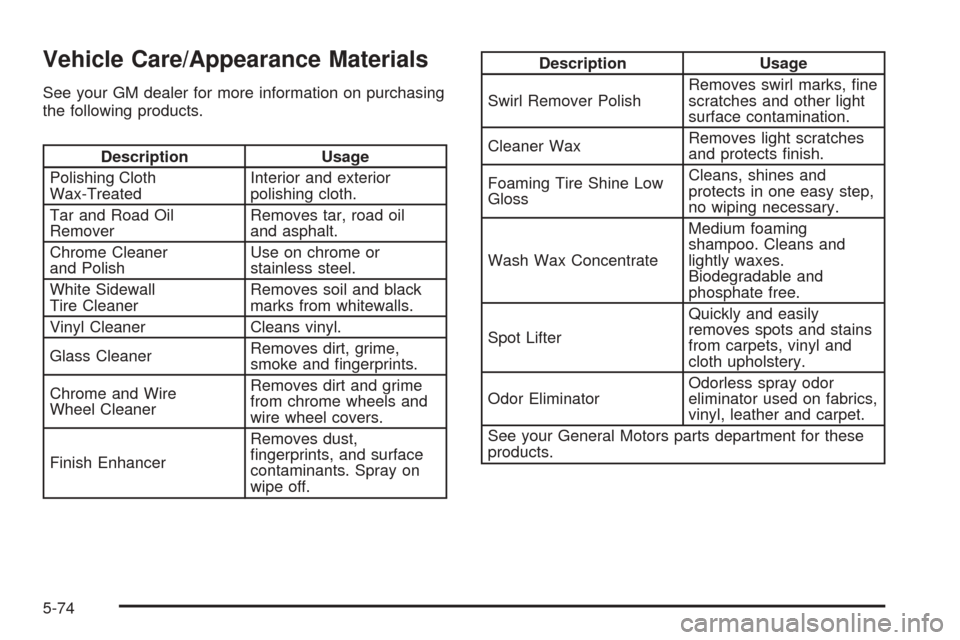
Vehicle Care/Appearance Materials
See your GM dealer for more information on purchasing
the following products.
Description Usage
Polishing Cloth
Wax-TreatedInterior and exterior
polishing cloth.
Tar and Road Oil
RemoverRemoves tar, road oil
and asphalt.
Chrome Cleaner
and PolishUse on chrome or
stainless steel.
White Sidewall
Tire CleanerRemoves soil and black
marks from whitewalls.
Vinyl Cleaner Cleans vinyl.
Glass CleanerRemoves dirt, grime,
smoke and fingerprints.
Chrome and Wire
Wheel CleanerRemoves dirt and grime
from chrome wheels and
wire wheel covers.
Finish EnhancerRemoves dust,
fingerprints, and surface
contaminants. Spray on
wipe off.
Description Usage
Swirl Remover PolishRemoves swirl marks, fine
scratches and other light
surface contamination.
Cleaner WaxRemoves light scratches
and protects finish.
Foaming Tire Shine Low
GlossCleans, shines and
protects in one easy step,
no wiping necessary.
Wash Wax ConcentrateMedium foaming
shampoo. Cleans and
lightly waxes.
Biodegradable and
phosphate free.
Spot LifterQuickly and easily
removes spots and stains
from carpets, vinyl and
cloth upholstery.
Odor EliminatorOdorless spray odor
eliminator used on fabrics,
vinyl, leather and carpet.
See your General Motors parts department for these
products.
5-74
Page 277 of 336
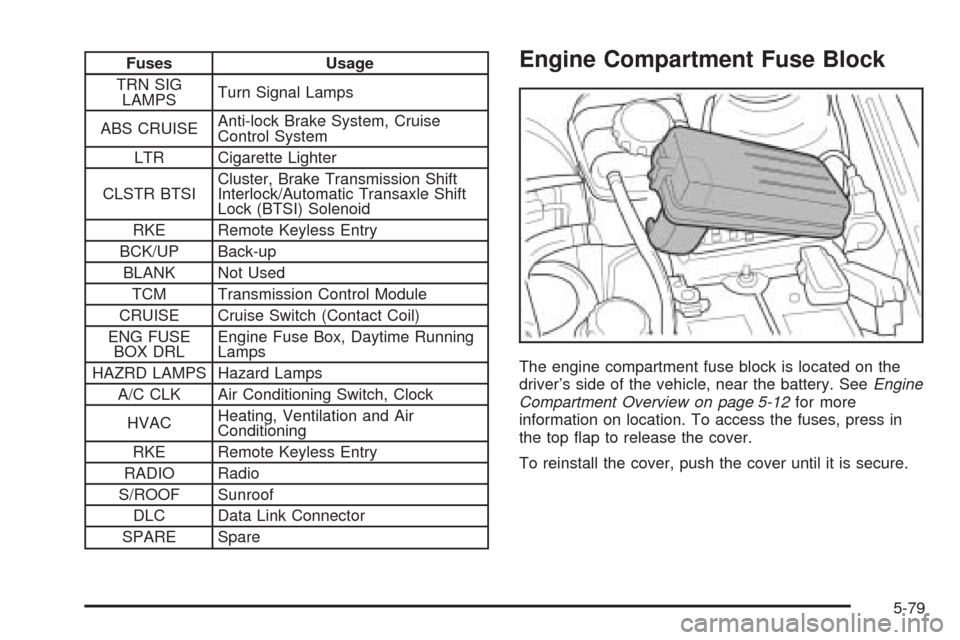
Fuses Usage
TRN SIG
LAMPSTurn Signal Lamps
ABS CRUISEAnti-lock Brake System, Cruise
Control System
LTR Cigarette Lighter
CLSTR BTSICluster, Brake Transmission Shift
Interlock/Automatic Transaxle Shift
Lock (BTSI) Solenoid
RKE Remote Keyless Entry
BCK/UP Back-up
BLANK Not Used
TCM Transmission Control Module
CRUISE Cruise Switch (Contact Coil)
ENG FUSE
BOX DRLEngine Fuse Box, Daytime Running
Lamps
HAZRD LAMPS Hazard Lamps
A/C CLK Air Conditioning Switch, Clock
HVACHeating, Ventilation and Air
Conditioning
RKE Remote Keyless Entry
RADIO Radio
S/ROOF Sunroof
DLC Data Link Connector
SPARE SpareEngine Compartment Fuse Block
The engine compartment fuse block is located on the
driver’s side of the vehicle, near the battery. SeeEngine
Compartment Overview on page 5-12for more
information on location. To access the fuses, press in
the top flap to release the cover.
To reinstall the cover, push the cover until it is secure.
5-79
Page 278 of 336
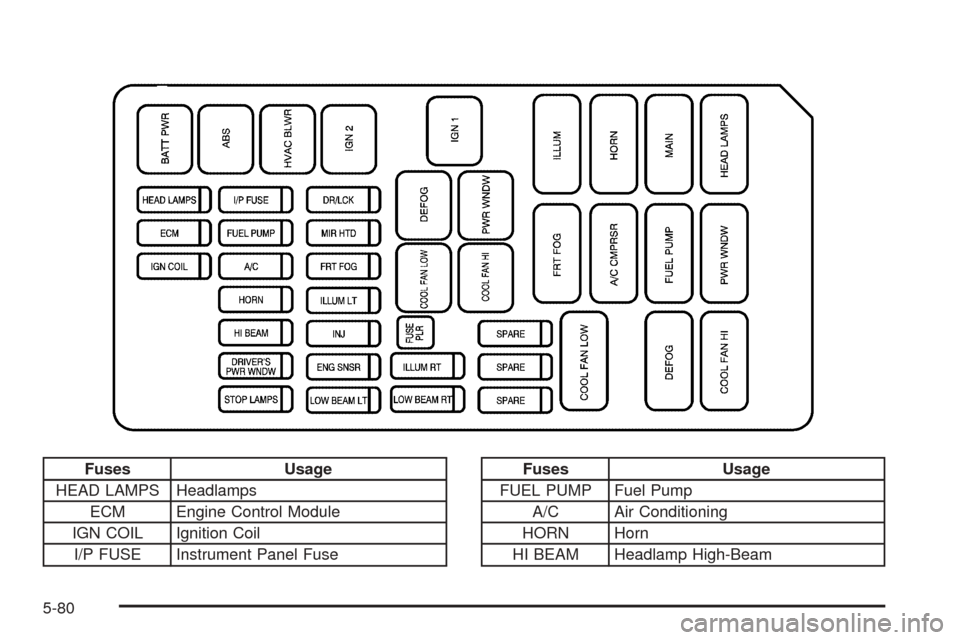
Fuses Usage
HEAD LAMPS Headlamps
ECM Engine Control Module
IGN COIL Ignition Coil
I/P FUSE Instrument Panel FuseFuses Usage
FUEL PUMP Fuel Pump
A/C Air Conditioning
HORN Horn
HI BEAM Headlamp High-Beam
5-80
Page 280 of 336
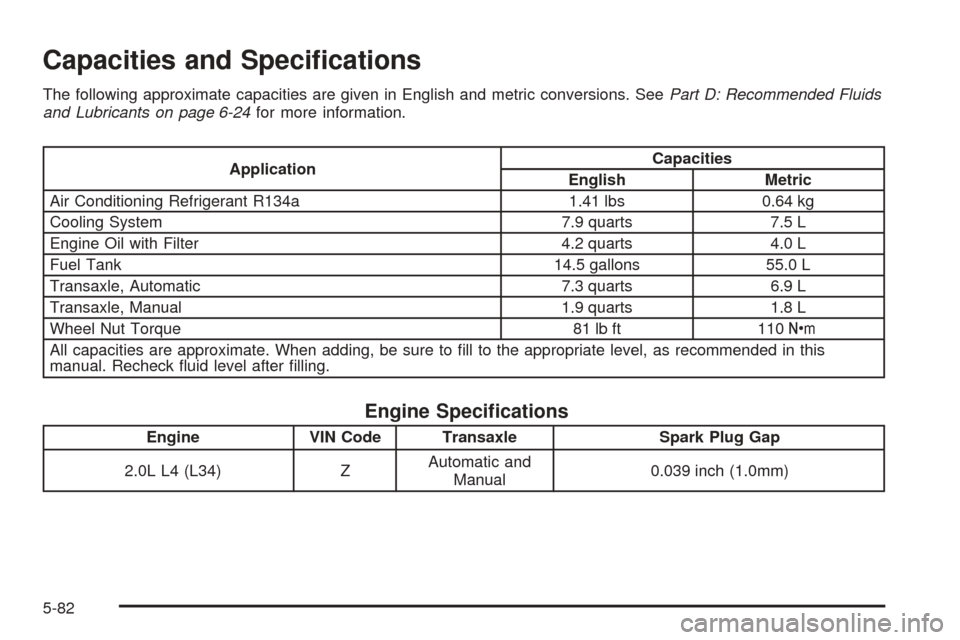
Capacities and Specications
The following approximate capacities are given in English and metric conversions. SeePart D: Recommended Fluids
and Lubricants on page 6-24for more information.
ApplicationCapacities
English Metric
Air Conditioning Refrigerant R134a 1.41 lbs 0.64 kg
Cooling System 7.9 quarts 7.5 L
Engine Oil with Filter 4.2 quarts 4.0 L
Fuel Tank 14.5 gallons 55.0 L
Transaxle, Automatic 7.3 quarts 6.9 L
Transaxle, Manual 1.9 quarts 1.8 L
Wheel Nut Torque 81 lb ft 110Y
All capacities are approximate. When adding, be sure to fill to the appropriate level, as recommended in this
manual. Recheck fluid level after filling.
Engine Specications
Engine VIN Code Transaxle Spark Plug Gap
2.0L L4 (L34) ZAutomatic and
Manual0.039 inch (1.0mm)
5-82
Page 281 of 336
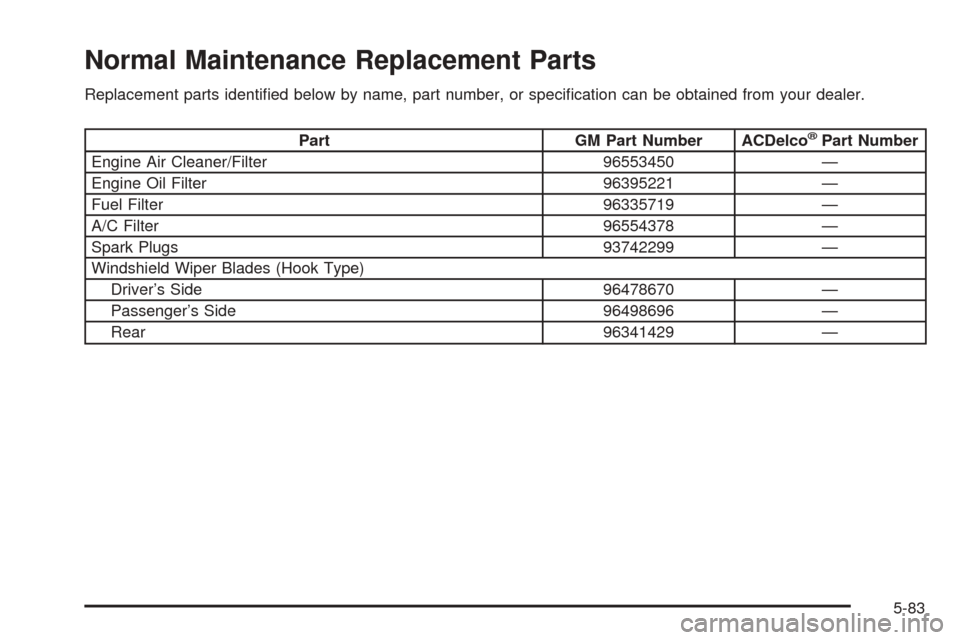
Normal Maintenance Replacement Parts
Replacement parts identified below by name, part number, or specification can be obtained from your dealer.
Part GM Part Number ACDelco®Part Number
Engine Air Cleaner/Filter 96553450 —
Engine Oil Filter 96395221 —
Fuel Filter 96335719 —
A/C Filter 96554378 —
Spark Plugs 93742299 —
Windshield Wiper Blades (Hook Type)
Driver’s Side 96478670 —
Passenger’s Side 96498696 —
Rear 96341429 —
5-83