IGN CHEVROLET OPTRA 5 2005 1.G User Guide
[x] Cancel search | Manufacturer: CHEVROLET, Model Year: 2005, Model line: OPTRA 5, Model: CHEVROLET OPTRA 5 2005 1.GPages: 336, PDF Size: 2.21 MB
Page 45 of 336
Lower Anchorages and Top Tethers
for Children (LATCH System)
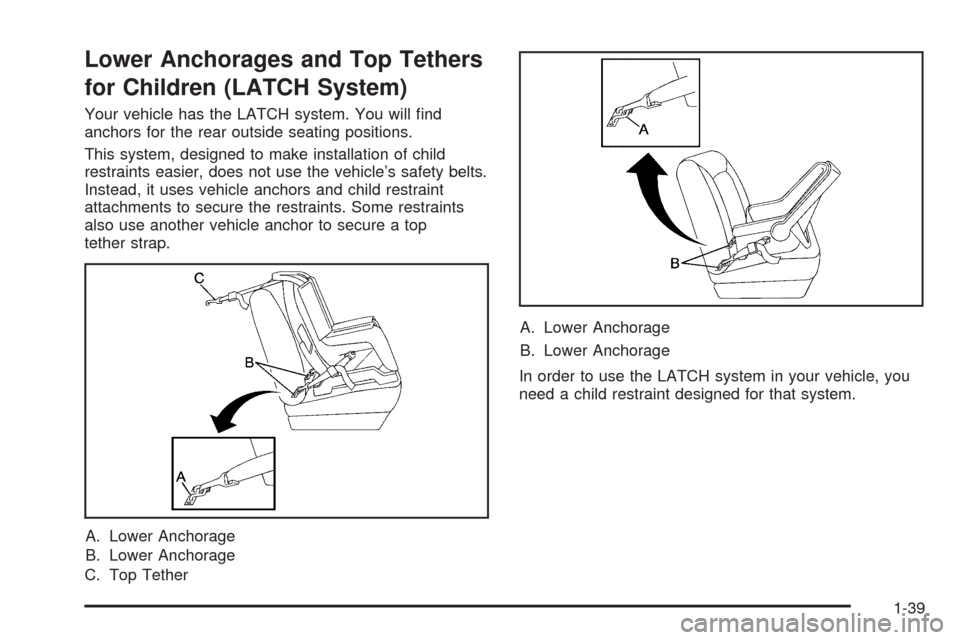
Your vehicle has the LATCH system. You will find
anchors for the rear outside seating positions.
This system, designed to make installation of child
restraints easier, does not use the vehicle’s safety belts.
Instead, it uses vehicle anchors and child restraint
attachments to secure the restraints. Some restraints
also use another vehicle anchor to secure a top
tether strap.
A. Lower Anchorage
B. Lower Anchorage
C. Top TetherA. Lower Anchorage
B. Lower Anchorage
In order to use the LATCH system in your vehicle, you
need a child restraint designed for that system.
1-39
Page 47 of 336
Securing a Child Restraint Designed
for the LATCH System
1. Find the LATCH anchorages for the seating
position you want to use, where the bottom of the
seatback meets the back of the seat cushion.
SeeLower Anchorages and Top Tethers for
Children (LATCH System) on page 1-39.
2. Put the child restraint on the seat.
3. Attach and tighten the LATCH attachments on the
child restraint to the LATCH anchorages in the
vehicle. The child restraint instructions will show
you how.
4. If the child restraint is forward-facing, attach and
tighten the top tether to the top tether anchorage.
The child restraint instructions will show you
how. Also seeTop Strap on page 1-35.
5. Push and pull the child restraint in different
directions to be sure it is secure.
To remove the child restraint, simply unhook the top
tether from the top tether anchorage and then
disconnect the LATCH attachments from the LATCH
anchorages.
Securing a Child Restraint in a Rear
Seat Position
If your child restraint is equipped with the LATCH
system, seeLower Anchorages and Top Tethers for
Children (LATCH System) on page 1-39. SeeTop Strap
on page 1-35if the child restraint has one.
If your child restraint does not have the LATCH system,
you will be using the lap-shoulder belt to secure the
child restraint. Be sure to follow the instructions
that came with the child restraint. Secure the child in the
child restraint when and as the instructions say.
1. Put the child restraint on the seat.
2. Pick up the latch plate, and run the lap and shoulder
portions of the vehicle’s safety belt through or
around the restraint. The child restraint instructions
will show you how.
1-41
Page 49 of 336
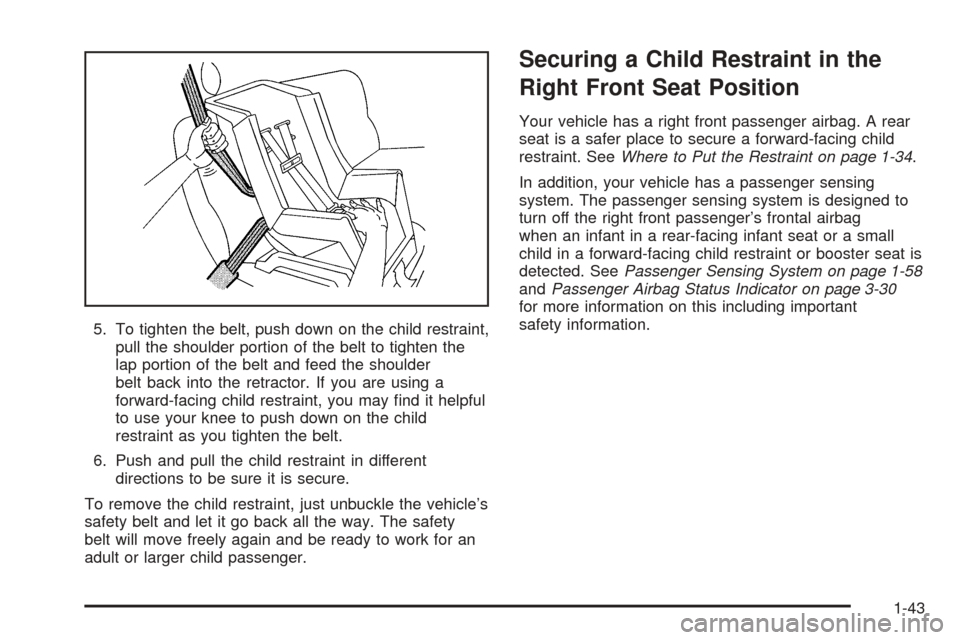
5. To tighten the belt, push down on the child restraint,
pull the shoulder portion of the belt to tighten the
lap portion of the belt and feed the shoulder
belt back into the retractor. If you are using a
forward-facing child restraint, you may find it helpful
to use your knee to push down on the child
restraint as you tighten the belt.
6. Push and pull the child restraint in different
directions to be sure it is secure.
To remove the child restraint, just unbuckle the vehicle’s
safety belt and let it go back all the way. The safety
belt will move freely again and be ready to work for an
adult or larger child passenger.
Securing a Child Restraint in the
Right Front Seat Position
Your vehicle has a right front passenger airbag. A rear
seat is a safer place to secure a forward-facing child
restraint. SeeWhere to Put the Restraint on page 1-34.
In addition, your vehicle has a passenger sensing
system. The passenger sensing system is designed to
turn off the right front passenger’s frontal airbag
when an infant in a rear-facing infant seat or a small
child in a forward-facing child restraint or booster seat is
detected. SeePassenger Sensing System on page 1-58
andPassenger Airbag Status Indicator on page 3-30
for more information on this including important
safety information.
1-43
Page 50 of 336
A label on your sun visor says, “Never put a rear-facing
child seat in the front.” This is because the risk to the
rear-facing child is so great, if the airbag deploys.
{CAUTION:
A child in a rear-facing child restraint can be
seriously injured or killed if the right front
passenger’s airbag inates. This is because
the back of the rear-facing child restraint
would be very close to the inating airbag.
Even though the passenger sensing system is
designed to turn off the passenger’s frontal
airbag if the system detects a rear-facing child
restraint, no system is fail-safe, and no one can
guarantee that an airbag will not deploy under
some unusual circumstance, even though it is
turned off. General Motors recommends that
rear-facing child restraints be secured in the
rear seat, even if the airbag is off.If you need to secure a forward-facing child restraint in
the right front seat position, move the seat as far
back as it will go before securing the forward-facing
child restraint. SeeManual Seats (With Sliding Storage
Tray) on page 1-2orManual Seats (Without Sliding
Storage Tray) on page 1-3.
If your child restraint is equipped with the LATCH
system, seeLower Anchorages and Top Tethers for
Children (LATCH System) on page 1-39.
There is no top strap anchor in the right front
passenger’s position. Do not secure a child seat in this
position if a national or local law requires that the
top strap be anchored, or if the instructions that come
with the child restraint say that the top strap must
be anchored. SeeTop Strap on page 1-35if your child
restraint has one.
1-44
Page 51 of 336
You will be using the lap-shoulder belt to secure the
child restraint in this position. Be sure to follow the
instructions that came with the child restraint. Secure
the child in the child restraint when and as the
instructions say.
1. Your vehicle has a right front passenger’s frontal
airbag. SeePassenger Sensing System on
page 1-58. General Motors recommends that
rear-facing child restraints be secured in a rear seat,
even if the airbag is off. If your child restraint is
forward-facing, move the seat as far back as it will
go before securing the child restraint in this
seat. SeeManual Seats (With Sliding Storage Tray)
on page 1-2orManual Seats (Without Sliding
Storage Tray) on page 1-3.
When the passenger sensing system has turned off
the right front passenger’s frontal airbag, the off
indicator in the passenger airbag status indicator
should light and stay lit when you turn the ignition to
ON or START. SeePassenger Airbag Status
Indicator on page 3-30.
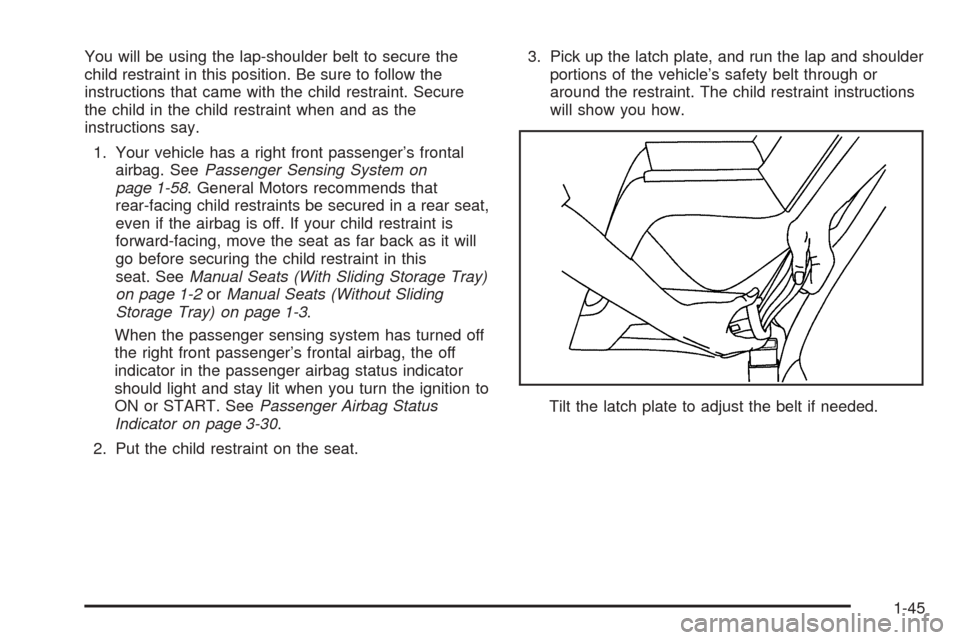
2. Put the child restraint on the seat.3. Pick up the latch plate, and run the lap and shoulder
portions of the vehicle’s safety belt through or
around the restraint. The child restraint instructions
will show you how.
Tilt the latch plate to adjust the belt if needed.
1-45
Page 54 of 336
Airbag System
Your vehicle has airbags — a frontal airbag for the
driver and another frontal airbag for the right front
passenger. Your vehicle may also have side impact
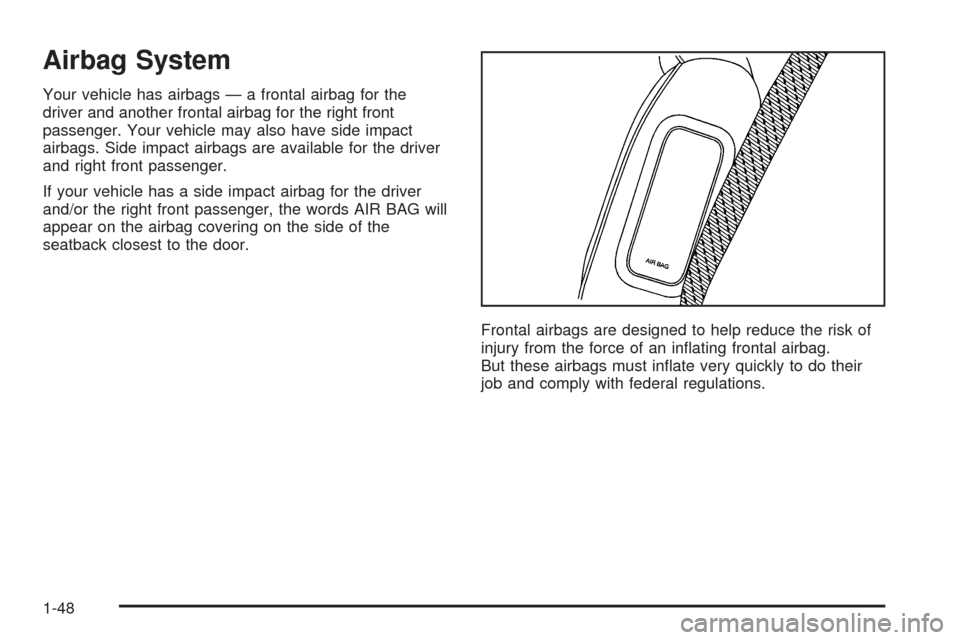
airbags. Side impact airbags are available for the driver
and right front passenger.
If your vehicle has a side impact airbag for the driver
and/or the right front passenger, the words AIR BAG will
appear on the airbag covering on the side of the
seatback closest to the door.
Frontal airbags are designed to help reduce the risk of
injury from the force of an inflating frontal airbag.
But these airbags must inflate very quickly to do their
job and comply with federal regulations.
1-48
Page 55 of 336
Here are the most important things to know about the
airbag system:
{CAUTION:
You can be severely injured or killed in a crash
if you are not wearing your safety belt — even
if you have airbags. Wearing your safety belt
during a crash helps reduce your chance of
hitting things inside the vehicle or being
ejected from it. Airbags are designed to work
with safety belts but do not replace them.
Frontal airbags for the driver and right front
passenger are designed to deploy only in
moderate to severe frontal and near frontal
crashes. They are not designed to inate in
rollover, rear or low-speed frontal crashes, or in
many side crashes. And, for some unrestrained
occupants, frontal airbags may provide less
protection in frontal crashes than more forceful
airbags have provided in the past.
Side impact airbags for the driver and right front
passenger are designed to inate only in
CAUTION: (Continued)
CAUTION: (Continued)
moderate to severe crashes where something
hits the side of your vehicle. They are not
designed to inate in frontal, in rollover or in
rear crashes.
Everyone in your vehicle should wear a safety
belt properly — whether or not there is an
airbag for that person.
{CAUTION:
Both frontal and side impact airbags inate
with great force, faster than the blink of an eye.
If you are too close to an inating airbag, as you
would be if you were leaning forward, it could
seriously injure you. Safety belts help keep you
in position for airbag ination before and during
a crash. Always wear your safety belt, even with
frontal airbags. The driver should sit as far back
as possible while still maintaining control of the
vehicle. Front occupants should not lean on or
sleep against the door.
1-49
Page 56 of 336
{CAUTION:
Anyone who is up against, or very close to,
any airbag when it inates can be seriously
injured or killed. Airbags plus lap-shoulder
belts offer the best protection for adults, but
not for young children and infants. Neither the
vehicle’s safety belt system nor its airbag
system is designed for them. Young children
and infants need the protection that a child
restraint system can provide. Always secure
children properly in your vehicle. To read how,
seeOlder Children on page 1-25orInfants and
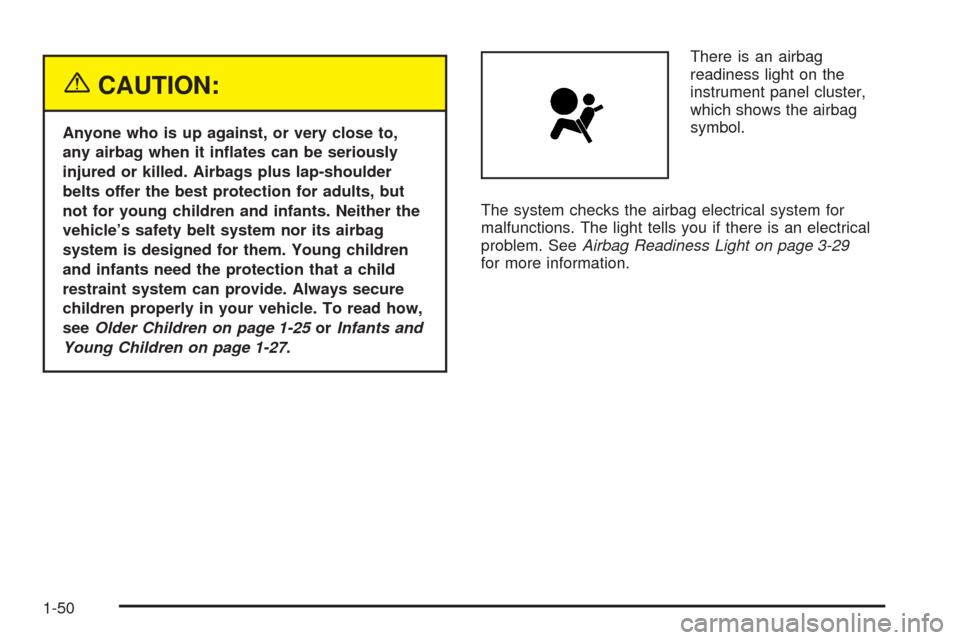
Young Children on page 1-27.There is an airbag
readiness light on the
instrument panel cluster,
which shows the airbag
symbol.
The system checks the airbag electrical system for
malfunctions. The light tells you if there is an electrical
problem. SeeAirbag Readiness Light on page 3-29
for more information.
1-50
Page 59 of 336
{CAUTION:
If something is between an occupant and an
airbag, the airbag might not inate properly or
it might force the object into that person
causing severe injury or even death. The path
of an inating airbag must be kept clear. Do
not put anything between an occupant and an
airbag, and do not attach or put anything on
the steering wheel hub or on or near any other
airbag covering. Do not let seat covers block
the ination path of a side impact airbag.
When Should an Airbag Inate?
The driver’s and right front passenger’s frontal airbags
are designed to inflate in moderate to severe frontal
or near-frontal crashes. But they are designed to inflate
only if the impact exceeds a predetermined deployment
threshold. Deployment thresholds take into account
a variety of desired deployment and non-deployment
events and are used to predict how severe a crash
is likely to be in time for the airbags to inflate and help
restrain the occupants. Whether your frontal airbags
will or should deploy is not based on how fast your
vehicle is traveling. It depends largely on what you hit,
the direction of the impact and how quickly your
vehicle slows down.
If the front of your vehicle goes straight into a wall that
does not move or deform, the threshold level is
about 9 to 14 mph (14 to 23 km/h). (The threshold level
can vary, however, with specific vehicle design, so
that it can be somewhat above or below this range.)
1-53
Page 60 of 336
Airbags may inflate at different crash speeds.
For example:
•If the vehicle hits a stationary object, the airbag
could inflate at a different crash speed than if
the object were moving.
•If the object deforms, the airbag could inflate at
a different crash speed than if the object does
not deform.
•If the vehicle hits a narrow object (like a pole) the
airbag could inflate at a different crash speed
than if the vehicle hits a wide object (like a wall).
•If the vehicle goes into an object at an angle the
airbag could inflate at a different crash speed
than if the vehicle goes straight into the object.
The frontal airbags (driver and right front passenger) are
not intended to inflate during vehicle rollovers, rear
impacts, or in many side impacts because inflation
would not likely help the occupants.Your vehicle may or may not have a side impact airbag.
SeeAirbag System on page 1-48. Side impact airbags
are designed to inflate in moderate to severe side
crashes. A side impact airbag will inflate if the crash
severity is above the system’s designed “threshold
level.” The threshold level can vary with specific vehicle
design. Side impact airbags are not designed to
inflate in frontal or near-frontal impacts, rollovers or rear
impacts, because inflation would not likely help the
occupant. A side impact airbag will only deploy on the
side of the vehicle that is struck.
In any particular crash, no one can say whether an
airbag should have inflated simply because of the
damage to a vehicle or because of what the repair costs
were. For frontal airbags, inflation is determined by
the angle of the impact and how quickly the vehicle
slows down in frontal and near-frontal impacts. For side
impact airbags, inflation is determined by the location
and severity of the impact.
1-54