lock CHEVROLET OPTRA 5 2006 1.G Repair Manual
[x] Cancel search | Manufacturer: CHEVROLET, Model Year: 2006, Model line: OPTRA 5, Model: CHEVROLET OPTRA 5 2006 1.GPages: 370, PDF Size: 2.32 MB
Page 212 of 370
•Put on extra clothing or wrap a blanket around you. If
you do not have blankets or extra clothing, make
body insulators from newspapers, burlap bags, rags,
floor mats — anything you can wrap around yourself
or tuck under your clothing to keep warm.
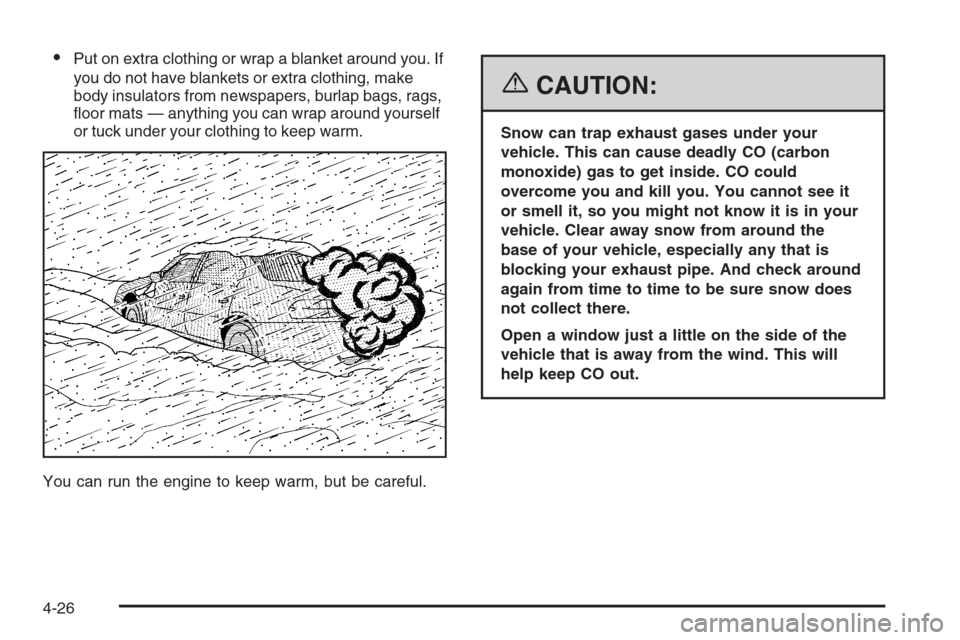
You can run the engine to keep warm, but be careful.
{CAUTION:
Snow can trap exhaust gases under your
vehicle. This can cause deadly CO (carbon
monoxide) gas to get inside. CO could
overcome you and kill you. You cannot see it
or smell it, so you might not know it is in your
vehicle. Clear away snow from around the
base of your vehicle, especially any that is
blocking your exhaust pipe. And check around
again from time to time to be sure snow does
not collect there.
Open a window just a little on the side of the
vehicle that is away from the wind. This will
help keep CO out.
4-26
Page 224 of 370
Tires..............................................................5-50
Tire Sidewall Labeling...................................5-51
Tire Terminology and Definitions.....................5-53
Inflation - Tire Pressure.................................5-56
Tire Inspection and Rotation...........................5-57
When It Is Time for New Tires.......................5-58
Buying New Tires.........................................5-59
Different Size Tires and Wheels......................5-60
Uniform Tire Quality Grading..........................5-60
Wheel Alignment and Tire Balance..................5-61
Wheel Replacement......................................5-62
Tire Chains..................................................5-63
If a Tire Goes Flat........................................5-63
Changing a Flat Tire.....................................5-64
Removing the Spare Tire and Tools................5-66
Removing the Flat Tire and Installing the
Spare Tire................................................5-69
Storing a Flat or Spare Tire and Tools............5-73
Compact Spare Tire......................................5-73
Appearance Care............................................5-74
Cleaning the Inside of Your Vehicle.................5-74
Fabric/Carpet...............................................5-75
Leather.......................................................5-76
Instrument Panel, Vinyl, and Other Plastic
Surfaces..................................................5-76
Weatherstrips...............................................5-76Washing Your Vehicle...................................5-77
Cleaning Exterior Lamps/Lenses.....................5-77
Finish Care..................................................5-77
Windshield and Wiper Blades.........................5-78
Aluminum Wheels.........................................5-78
Tires...........................................................5-79
Sheet Metal Damage.....................................5-79
Finish Damage.............................................5-79
Underbody Maintenance................................5-79
Chemical Paint Spotting.................................5-80
Vehicle Care/Appearance Materials..................5-80
Vehicle Identication......................................5-81
Vehicle Identification Number (VIN).................5-81
Service Parts Identification Label.....................5-81
Electrical System............................................5-81
Add-On Electrical Equipment..........................5-81
Headlamp Wiring..........................................5-82
Windshield Wiper Fuses................................5-82
Power Windows and Other Power Options.......5-82
Fuses and Circuit Breakers............................5-82
Instrument Panel Fuse Block..........................5-83
Engine Compartment Fuse Block....................5-85
Capacities and Specications..........................5-88
Normal Maintenance Replacement Parts..........5-89
Section 5 Service and Appearance Care
5-2
Page 225 of 370
Service
Your dealer knows your vehicle best and wants you to
be happy with it. We hope you will go to your dealer
for all your service needs. You will get genuine GM parts
and GM-trained and supported service people.
We hope you will want to keep your GM vehicle all GM.
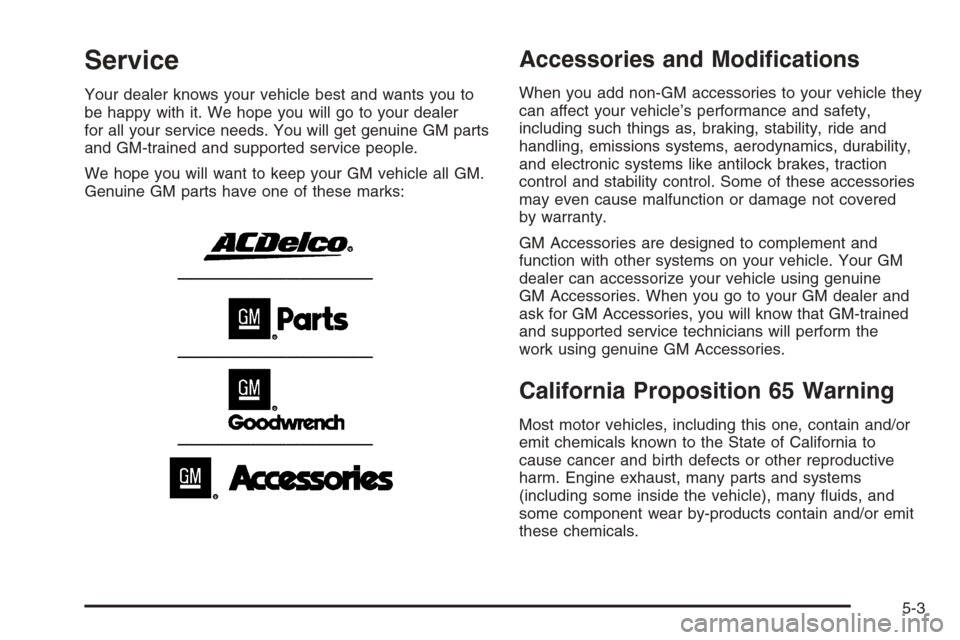
Genuine GM parts have one of these marks:
Accessories and Modications
When you add non-GM accessories to your vehicle they
can affect your vehicle’s performance and safety,
including such things as, braking, stability, ride and
handling, emissions systems, aerodynamics, durability,
and electronic systems like antilock brakes, traction
control and stability control. Some of these accessories
may even cause malfunction or damage not covered
by warranty.
GM Accessories are designed to complement and
function with other systems on your vehicle. Your GM
dealer can accessorize your vehicle using genuine
GM Accessories. When you go to your GM dealer and
ask for GM Accessories, you will know that GM-trained
and supported service technicians will perform the
work using genuine GM Accessories.
California Proposition 65 Warning
Most motor vehicles, including this one, contain and/or
emit chemicals known to the State of California to
cause cancer and birth defects or other reproductive
harm. Engine exhaust, many parts and systems
(including some inside the vehicle), many fluids, and
some component wear by-products contain and/or emit
these chemicals.
5-3
Page 230 of 370
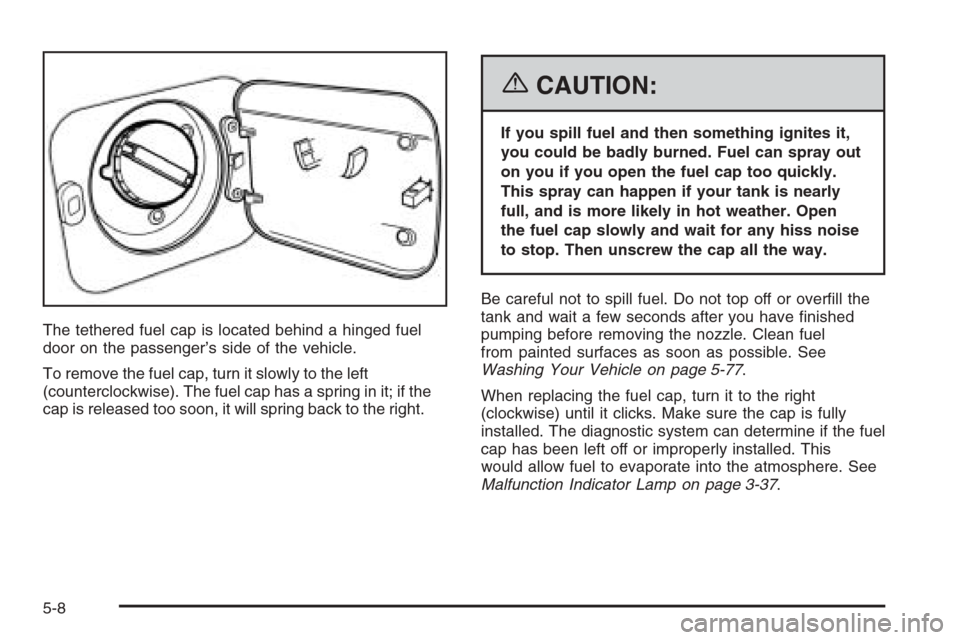
The tethered fuel cap is located behind a hinged fuel
door on the passenger’s side of the vehicle.
To remove the fuel cap, turn it slowly to the left
(counterclockwise). The fuel cap has a spring in it; if the
cap is released too soon, it will spring back to the right.
{CAUTION:
If you spill fuel and then something ignites it,
you could be badly burned. Fuel can spray out
on you if you open the fuel cap too quickly.
This spray can happen if your tank is nearly
full, and is more likely in hot weather. Open
the fuel cap slowly and wait for any hiss noise
to stop. Then unscrew the cap all the way.
Be careful not to spill fuel. Do not top off or overfill the
tank and wait a few seconds after you have finished
pumping before removing the nozzle. Clean fuel
from painted surfaces as soon as possible. See
Washing Your Vehicle on page 5-77.
When replacing the fuel cap, turn it to the right
(clockwise) until it clicks. Make sure the cap is fully
installed. The diagnostic system can determine if the fuel
cap has been left off or improperly installed. This
would allow fuel to evaporate into the atmosphere. See
Malfunction Indicator Lamp on page 3-37.
5-8
Page 235 of 370
A. Engine Air Cleaner/Filter. SeeEngine Air
Cleaner/Filter on page 5-17.
B. Engine Oil Fill Cap. See “When to Add Engine Oil”
underEngine Oil on page 5-13.
C. Engine Oil Dipstick. See “Checking Engine Oil”
underEngine Oil on page 5-13.
D. Brake Fluid/Hydraulic Clutch Fluid Reservoir. See
“Brake Fluid” underBrakes on page 5-31and
Hydraulic Clutch on page 5-19.
E. Power Steering Fluid Reservoir. SeePower Steering
Fluid on page 5-29.
F. Engine Coolant Surge Tank. SeeCooling System on
page 5-24.
G. Engine Compartment Fuse Block. SeeEngine
Compartment Fuse Block on page 5-85.
H. Windshield Washer Fluid Reservoir. See “Adding
Washer Fluid” underWindshield Washer Fluid
on page 5-30.
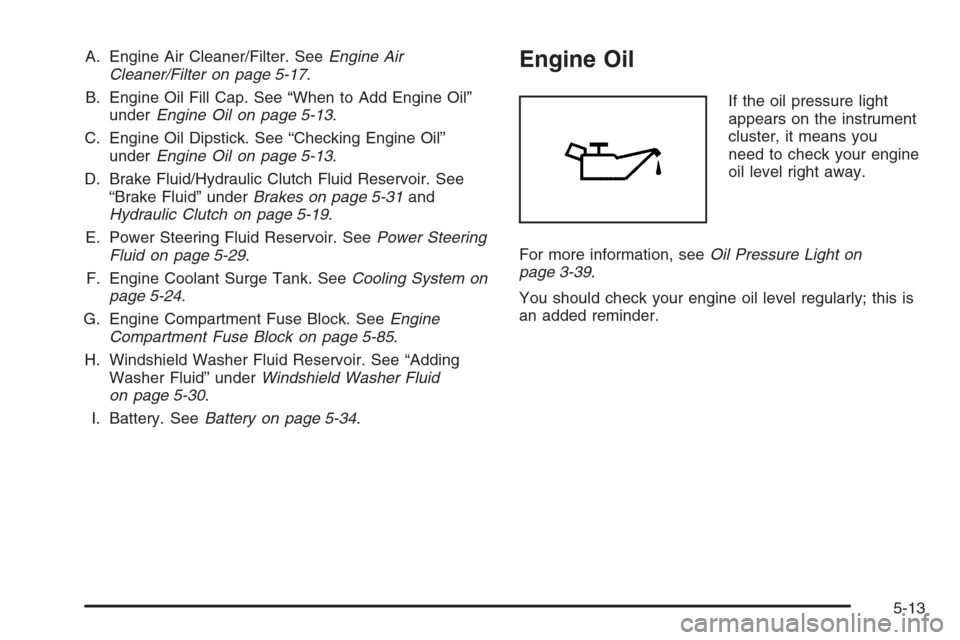
I. Battery. SeeBattery on page 5-34.Engine Oil
If the oil pressure light
appears on the instrument
cluster, it means you
need to check your engine
oil level right away.
For more information, seeOil Pressure Light on
page 3-39.
You should check your engine oil level regularly; this is
an added reminder.
5-13
Page 249 of 370
{CAUTION:
Adding only plain water to your cooling
system can be dangerous. Plain water, or
some other liquid such as alcohol, can boil
before the proper coolant mixture will. Your
vehicle’s coolant warning system is set for the
proper coolant mixture. With plain water or the
wrong mixture, your engine could get too hot
but you would not get the overheat warning.
Your engine could catch re and you or others
could be burned. Use a 50/50 mixture of clean,
drinkable water and a proper coolant.
Notice:In cold weather, water can freeze and crack
the engine, radiator, heater core and other parts.
Use the recommended coolant and the proper
coolant mixture.
{CAUTION:
You can be burned if you spill coolant on hot
engine parts. Coolant contains ethylene glycol
and it will burn if the engine parts are hot
enough. Do not spill coolant on a hot engine.
1. You can remove the coolant surge tank pressure cap
when the cooling system, including the coolant surge
tank pressure cap and upper radiator hose, is
no longer hot. Turn the pressure cap slowly
counterclockwise about two or two and one-half
turns.
If you hear a hiss, wait for that to stop. This will
allow any pressure still left to be vented out
the discharge hose.
5-27
Page 263 of 370
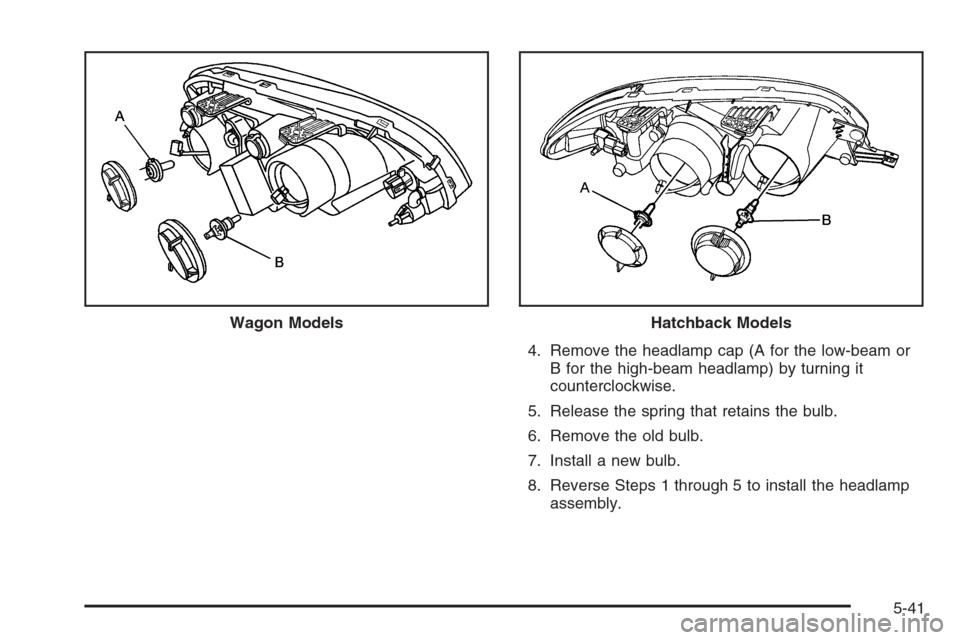
4. Remove the headlamp cap (A for the low-beam or
B for the high-beam headlamp) by turning it
counterclockwise.
5. Release the spring that retains the bulb.
6. Remove the old bulb.
7. Install a new bulb.
8. Reverse Steps 1 through 5 to install the headlamp
assembly. Wagon Models
Hatchback Models
5-41
Page 264 of 370
Front Turn Signal and Parking
Lamps
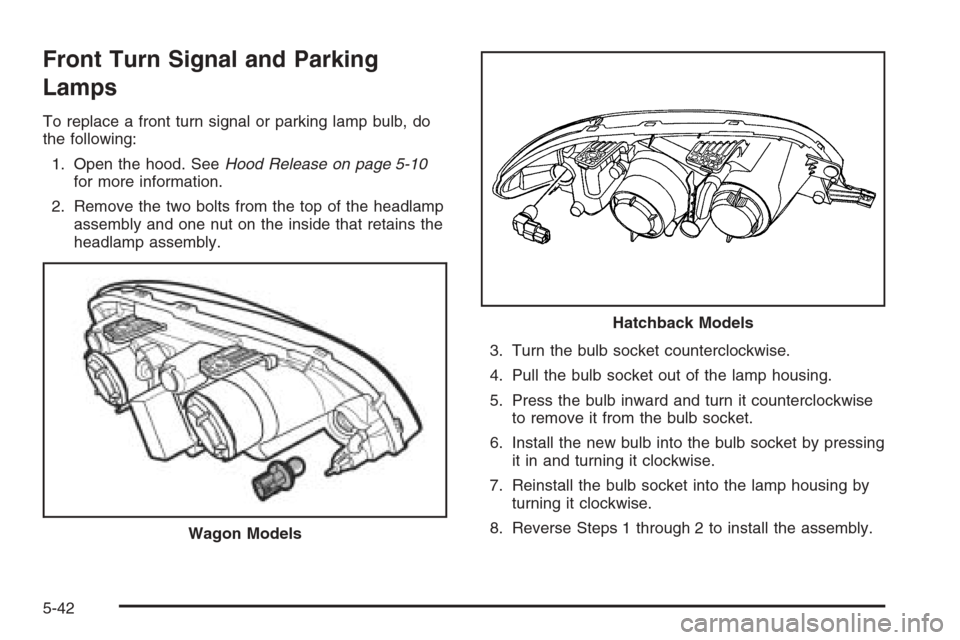
To replace a front turn signal or parking lamp bulb, do
the following:
1. Open the hood. SeeHood Release on page 5-10
for more information.
2. Remove the two bolts from the top of the headlamp
assembly and one nut on the inside that retains the
headlamp assembly.
3. Turn the bulb socket counterclockwise.
4. Pull the bulb socket out of the lamp housing.
5. Press the bulb inward and turn it counterclockwise
to remove it from the bulb socket.
6. Install the new bulb into the bulb socket by pressing
it in and turning it clockwise.
7. Reinstall the bulb socket into the lamp housing by
turning it clockwise.
8. Reverse Steps 1 through 2 to install the assembly.
Wagon Models
Hatchback Models
5-42
Page 265 of 370
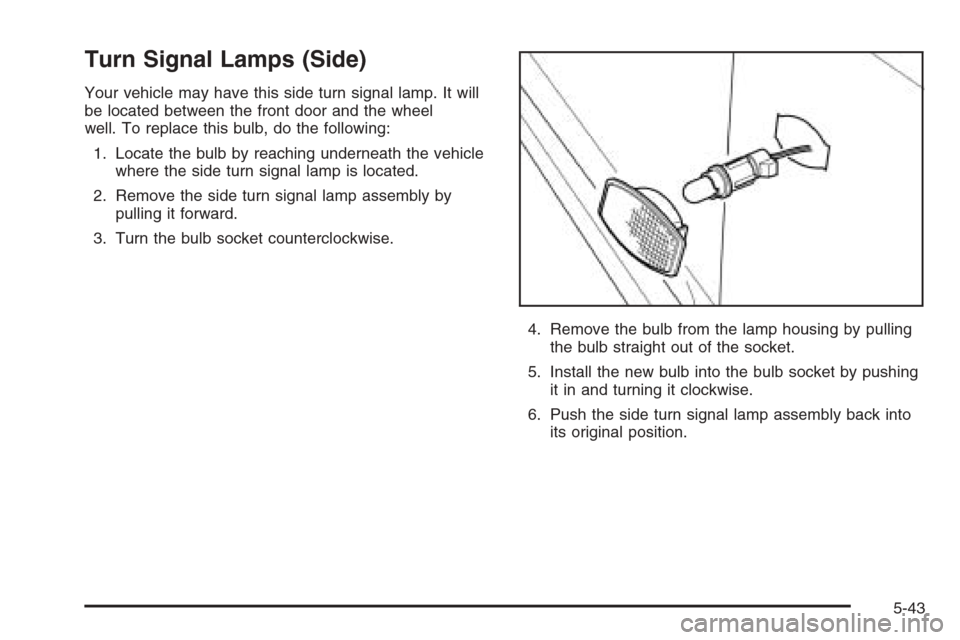
Turn Signal Lamps (Side)
Your vehicle may have this side turn signal lamp. It will
be located between the front door and the wheel
well. To replace this bulb, do the following:
1. Locate the bulb by reaching underneath the vehicle
where the side turn signal lamp is located.
2. Remove the side turn signal lamp assembly by
pulling it forward.
3. Turn the bulb socket counterclockwise.
4. Remove the bulb from the lamp housing by pulling
the bulb straight out of the socket.
5. Install the new bulb into the bulb socket by pushing
it in and turning it clockwise.
6. Push the side turn signal lamp assembly back into
its original position.
5-43
Page 266 of 370
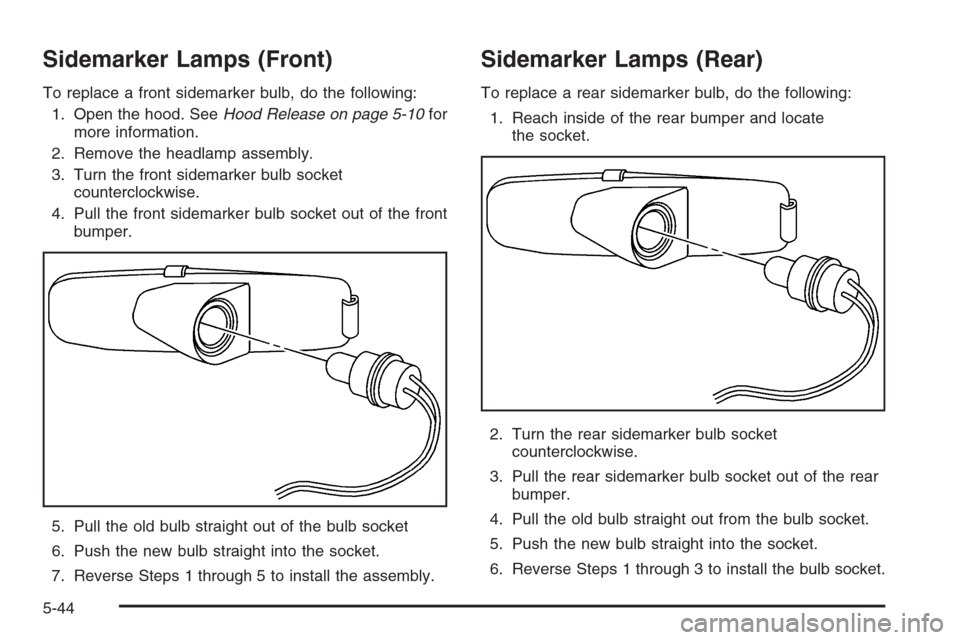
Sidemarker Lamps (Front)
To replace a front sidemarker bulb, do the following:
1. Open the hood. SeeHood Release on page 5-10for
more information.
2. Remove the headlamp assembly.
3. Turn the front sidemarker bulb socket
counterclockwise.
4. Pull the front sidemarker bulb socket out of the front
bumper.
5. Pull the old bulb straight out of the bulb socket
6. Push the new bulb straight into the socket.
7. Reverse Steps 1 through 5 to install the assembly.
Sidemarker Lamps (Rear)
To replace a rear sidemarker bulb, do the following:
1. Reach inside of the rear bumper and locate
the socket.
2. Turn the rear sidemarker bulb socket
counterclockwise.
3. Pull the rear sidemarker bulb socket out of the rear
bumper.
4. Pull the old bulb straight out from the bulb socket.
5. Push the new bulb straight into the socket.
6. Reverse Steps 1 through 3 to install the bulb socket.
5-44