motor CHEVROLET OPTRA 5 2007 1.G User Guide
[x] Cancel search | Manufacturer: CHEVROLET, Model Year: 2007, Model line: OPTRA 5, Model: CHEVROLET OPTRA 5 2007 1.GPages: 422, PDF Size: 2.39 MB
Page 251 of 422
Adding Equipment to the Outside
of Your Vehicle
Things you might add to the outside of your
vehicle can affect the airflow around it. This may
cause wind noise and affect windshield washer
performance. Check with your dealer before
adding equipment to the outside of your vehicle.
Fuel
Use of the recommended fuel is an important part
of the proper maintenance of your vehicle.
To help keep the engine clean and maintain
optimum vehicle performance, GM recommends
the use of gasoline advertised as TOP TIER
Detergent Gasoline.
Gasoline Octane
Use regular unleaded gasoline with a posted
octane rating of 87 or higher. If the octane rating is
less than 87, you may notice an audible knocking
noise when you drive, commonly referred to as
spark knock. If this occurs, use a gasoline rated at
87 octane or higher as soon as possible. If you are
using gasoline rated at 87 octane or higher and you
hear heavy knocking, your engine needs service.
Gasoline Specications
At a minimum, gasoline should meet ASTM
specification D 4814 in the United States or
CAN/CGSB-3.5 in Canada. Some gasolines may
contain an octane-enhancing additive called
methylcyclopentadienyl manganese tricarbonyl
(MMT). General Motors recommends against the
use of gasolines containing MMT. SeeAdditives
on page 252for additional information.
251
Page 252 of 422
California Fuel
If your vehicle is certified to meet California
Emissions Standards, it is designed to operate
on fuels that meet California specifications.
See the underhood emission control label. If this
fuel is not available in states adopting California
emissions standards, your vehicle will operate
satisfactorily on fuels meeting federal
specifications, but emission control system
performance may be affected. The malfunction
indicator lamp may turn on and your vehicle may
fail a smog-check test. SeeMalfunction Indicator
Lamp on page 172. If this occurs, return to
your authorized GM dealer for diagnosis. If it is
determined that the condition is caused by the type
of fuel used, repairs may not be covered by
your warranty.
Additives
To provide cleaner air, all gasolines in the United
States are now required to contain additives
that will help prevent engine and fuel system
deposits from forming, allowing your emission
control system to work properly. In most cases,
you should not have to add anything to your fuel.
However, some gasolines contain only the
minimum amount of additive required to meet
U.S. Environmental Protection Agency regulations.
To help keep fuel injectors and intake valves
clean, or if your vehicle experiences problems due
to dirty injectors or valves, look for gasoline that
is advertised as TOP TIER Detergent Gasoline.
Also, your dealer has additives that will help
correct and prevent most deposit-related problems.
Gasolines containing oxygenates, such as
ethers and ethanol, and reformulated gasolines
may be available in your area. General Motors
recommends that you use these gasolines if they
comply with the specifications described earlier.
252
Page 253 of 422
However, E85 (85% ethanol) and other fuels
containing more than 10% ethanol must not be
used in vehicles that were not designed for
those fuels.
Notice:Your vehicle was not designed for
fuel that contains methanol. Do not use
fuel containing methanol. It can corrode metal
parts in the fuel system and also damage
plastic and rubber parts. That damage would
not be covered under your warranty.
Some gasolines that are not reformulated for low
emissions may contain an octane-enhancing
additive called methylcyclopentadienyl manganese
tricarbonyl (MMT); ask the attendant where you
buy gasoline whether the fuel contains MMT.
General Motors recommends against the use of
such gasolines. Fuels containing MMT can reduce
the life of spark plugs and the performance of
the emission control system may be affected.
The malfunction indicator lamp may turn on.
If this occurs, return to your dealer for service.Fuels in Foreign Countries
If you plan on driving in another country outside
the United States or Canada, the proper fuel might
be hard to find. Never use leaded gasoline or
any other fuel not recommended in the previous
text on fuel. Costly repairs caused by use of
improper fuel would not be covered by your
warranty.
To check the fuel availability, ask an auto club, or
contact a major oil company that does business
in the country where you will be driving.
253
Page 304 of 422
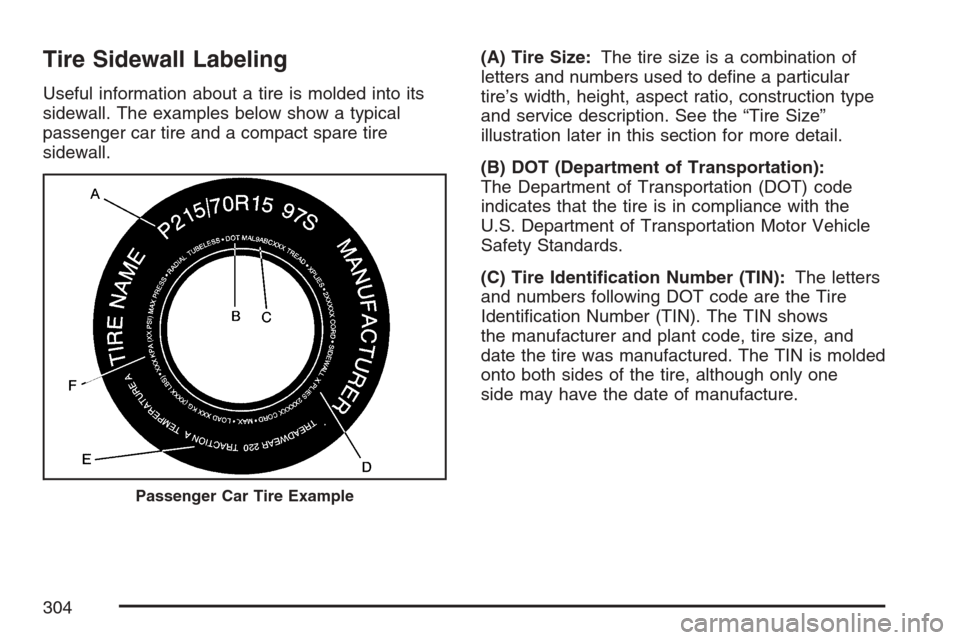
Tire Sidewall Labeling
Useful information about a tire is molded into its
sidewall. The examples below show a typical
passenger car tire and a compact spare tire
sidewall.(A) Tire Size:The tire size is a combination of
letters and numbers used to define a particular
tire’s width, height, aspect ratio, construction type
and service description. See the “Tire Size”
illustration later in this section for more detail.
(B) DOT (Department of Transportation):
The Department of Transportation (DOT) code
indicates that the tire is in compliance with the
U.S. Department of Transportation Motor Vehicle
Safety Standards.
(C) Tire Identication Number (TIN):The letters
and numbers following DOT code are the Tire
Identification Number (TIN). The TIN shows
the manufacturer and plant code, tire size, and
date the tire was manufactured. The TIN is molded
onto both sides of the tire, although only one
side may have the date of manufacture.
Passenger Car Tire Example
304
Page 308 of 422

Bias Ply Tire:A pneumatic tire in which the plies
are laid at alternate angles less than 90 degrees
to the centerline of the tread.
Cold Tire Pressure:The amount of air pressure in
a tire, measured in pounds per square inch (psi) or
kilopascals (kPa) before a tire has built up heat
from driving. SeeInflation - Tire Pressure on
page 311.
Curb Weight:This means the weight of a motor
vehicle with standard and optional equipment
including the maximum capacity of fuel, oil, and
coolant, but without passengers and cargo.
DOT Markings:A code molded into the sidewall
of a tire signifying that the tire is in compliance
with the U.S. Department of Transportation (DOT)
motor vehicle safety standards. The DOT code
includes the Tire Identification Number (TIN),
an alphanumeric designator which can also identify
the tire manufacturer, production plant, brand,
and date of production.
GVWR:Gross Vehicle Weight Rating.
SeeLoading Your Vehicle on page 236.GAWR FRT:Gross Axle Weight Rating for the
front axle. SeeLoading Your Vehicle on page 236.
GAWR RR:Gross Axle Weight Rating for the
rear axle. SeeLoading Your Vehicle on page 236.
Intended Outboard Sidewall:The side of an
asymmetrical tire, that must always face outward
when mounted on a vehicle.
Kilopascal (kPa):The metric unit for air pressure.
Light Truck (LT-Metric) Tire:A tire used on
light duty trucks and some multipurpose passenger
vehicles.
Load Index:An assigned number ranging from
1 to 279 that corresponds to the load carrying
capacity of a tire.
Maximum Ination Pressure:The maximum
air pressure to which a cold tire may be inflated.
The maximum air pressure is molded onto the
sidewall.
308
Page 320 of 422
Uniform Tire Quality Grading
Quality grades can be found where applicable on
the tire sidewall between tread shoulder and
maximum selection width. For example:
Treadwear 200 Traction AA Temperature A
The following information relates to the system
developed by the Unites States National Highway
Traffic Safety Administration (NHTSA), which
grades tires by treadwear, traction, and
temperature performance. This applies only to
vehicles sold in the United States. The grades are
molded on the sidewalls of most passenger car
tires. The Uniform Tire Quality Grading (UTQG)
system does not apply to deep tread, winter-type
snow tires, space-saver, or temporary use
spare tires, tires with nominal rim diameters of
10 to 12 inches (25 to 30 cm), or to some
limited-production tires.
While the tires available on General Motors
passenger cars and light trucks may vary with
respect to these grades, they must also conform
to federal safety requirements.
Treadwear
The treadwear grade is a comparative rating based
on the wear rate of the tire when tested under
controlled conditions on a specified government
test course. For example, a tire graded 150 would
wear one and a half (1
1⁄2) times as well on the
government course as a tire graded 100. The
relative performance of tires depends upon the
actual conditions of their use, however, and may
depart significantly from the norm due to variations
in driving habits, service practices, and differences
in road characteristics and climate.
Traction — AA, A, B, C
The traction grades, from highest to lowest, are
AA, A, B, and C. Those grades represent the tire’s
ability to stop on wet pavement as measured
under controlled conditions on specified
government test surfaces of asphalt and concrete.
A tire marked C may have poor traction
performance.
Warning:The traction grade assigned to this tire
is based on straight-ahead braking traction tests,
and does not include acceleration, cornering,
hydroplaning, or peak traction characteristics.
320
Page 321 of 422
Temperature — A, B, C
The temperature grades are A (the highest), B,
and C, representing the tire’s resistance to the
generation of heat and its ability to dissipate heat
when tested under controlled conditions on a
specified indoor laboratory test wheel. Sustained
high temperature can cause the material of the tire
to degenerate and reduce tire life, and excessive
temperature can lead to sudden tire failure.
The grade C corresponds to a level of performance
which all passenger car tires must meet under the
Federal Motor Vehicle Safety Standard No. 109.
Grades B and A represent higher levels of
performance on the laboratory test wheel than the
minimum required by law.
Warning:The temperature grade for this tire is
established for a tire that is properly inflated
and not overloaded. Excessive speed,
underinflation, or excessive loading, either
separately or in combination, can cause heat
buildup and possible tire failure.
Wheel Alignment and Tire Balance
The tires and wheels on your vehicle were aligned
and balanced carefully at the factory to give you
the longest tire life and best overall performance.
Adjustments to wheel alignment and tire
balancing will not be necessary on a regular basis.
However, if you notice unusual tire wear or your
vehicle pulling to one side or the other, the
alignment may need to be checked. If you notice
your vehicle vibrating when driving on a smooth
road, your tires and wheels may need to be
rebalanced. See your dealer for proper diagnosis.
321
Page 346 of 422
Headlamp Wiring
The headlamp wiring is protected by fuses in the
fuse block. An electrical overload will cause
the lamps to turn off. If this happens, have your
headlamp wiring checked right away.
Windshield Wiper Fuses
The windshield wiper motor is protected by an
internal circuit breaker and a fuse. If the motor
overheats due to heavy snow, etc., the wiper will
stop until the motor cools. If the overload is
caused by some electrical problem and not snow,
etc., be sure to get it fixed.
Power Windows and Other Power
Options
Circuit breakers in the fuse block protect the
power windows and other power accessories.
When the current load is too heavy, the circuit
breaker opens and closes, protecting the circuit
until the problem is fixed or goes away.
Fuses and Circuit Breakers
The wiring circuits in your vehicle are protected
from short circuits by a combination of fuses,
circuit breakers and fusible thermal links in
the wiring itself.
Look at the silver-colored band inside the fuse.
If the band is broken or melted, replace the fuse.
Be sure you replace a bad fuse with a new
one of the identical size and rating.
346
Page 358 of 422
Part A: Scheduled Maintenance
Services
In this part are scheduled maintenance services
which are to be performed at the mileage intervals
specified.
Using the Maintenance Schedule
We at General Motors want to keep your vehicle
in good working condition. But we do not know
exactly how you will drive it. You may drive short
distances only a few times a week. Or you
may drive long distances all the time in very hot,
dusty weather. You may use your vehicle in
making deliveries. Or you may drive it to work, to
do errands, or in many other ways.
Because of the different ways people use their
vehicles, maintenance needs may vary. You may
need more frequent checks and replacements.
So please read the following and note how
you drive. If you have questions on how to keep
your vehicle in good condition, see your dealer.This part tells you the maintenance services you
should have done and when to schedule them.
When you go to your dealer for your service
needs, you will know that GM-trained and
supported service people will perform the work
using genuine GM parts.
The proper fluids and lubricants to use are listed
in Part D. Make sure whoever services your
vehicle uses these. All parts should be replaced
and all necessary repairs done before you or
anyone else drives the vehicle.
These schedules are for vehicles that:
•carry passengers and cargo within
recommended limits. You will find these on
the Tire and Loading Information label.
SeeLoading Your Vehicle on page 236.
•are driven on reasonable road surfaces within
legal driving limits.
•use the recommended fuel. SeeGasoline
Octane on page 251.
358
Page 387 of 422
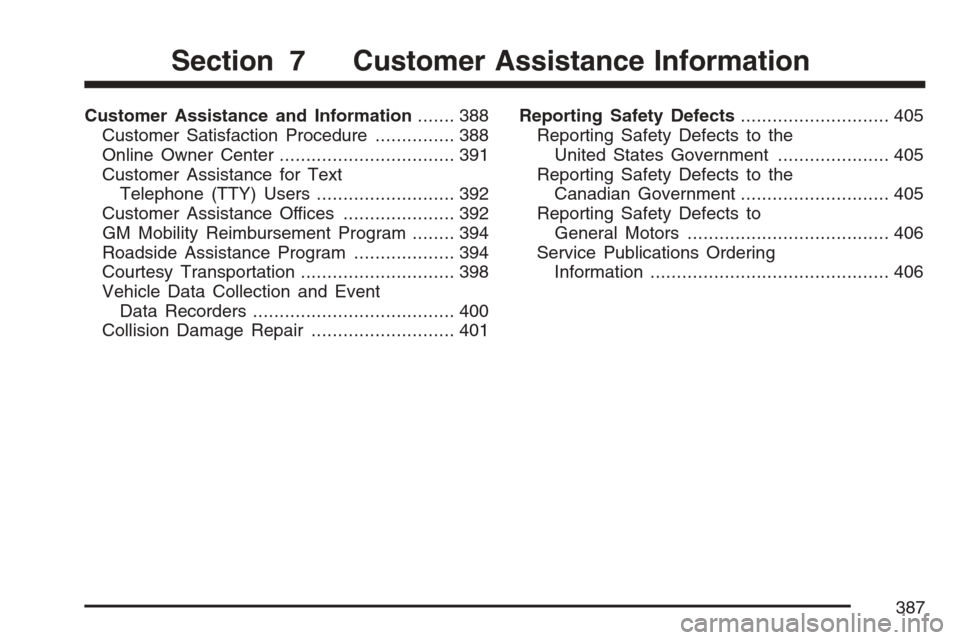
Customer Assistance and Information....... 388
Customer Satisfaction Procedure............... 388
Online Owner Center................................. 391
Customer Assistance for Text
Telephone (TTY) Users.......................... 392
Customer Assistance Offices..................... 392
GM Mobility Reimbursement Program........ 394
Roadside Assistance Program................... 394
Courtesy Transportation............................. 398
Vehicle Data Collection and Event
Data Recorders...................................... 400
Collision Damage Repair........................... 401Reporting Safety Defects............................ 405
Reporting Safety Defects to the
United States Government..................... 405
Reporting Safety Defects to the
Canadian Government............................ 405
Reporting Safety Defects to
General Motors...................................... 406
Service Publications Ordering
Information............................................. 406
Section 7 Customer Assistance Information
387