service CHEVROLET OPTRA 5 2007 1.G User Guide
[x] Cancel search | Manufacturer: CHEVROLET, Model Year: 2007, Model line: OPTRA 5, Model: CHEVROLET OPTRA 5 2007 1.GPages: 422, PDF Size: 2.39 MB
Page 169 of 422
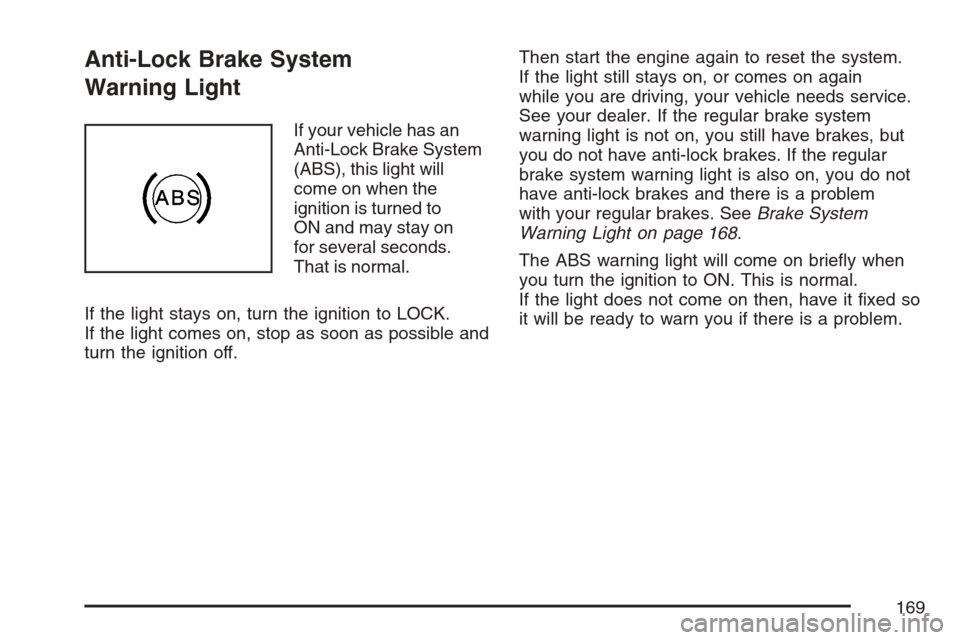
Anti-Lock Brake System
Warning Light
If your vehicle has an
Anti-Lock Brake System
(ABS), this light will
come on when the
ignition is turned to
ON and may stay on
for several seconds.
That is normal.
If the light stays on, turn the ignition to LOCK.
If the light comes on, stop as soon as possible and
turn the ignition off.Then start the engine again to reset the system.
If the light still stays on, or comes on again
while you are driving, your vehicle needs service.
See your dealer. If the regular brake system
warning light is not on, you still have brakes, but
you do not have anti-lock brakes. If the regular
brake system warning light is also on, you do not
have anti-lock brakes and there is a problem
with your regular brakes. SeeBrake System
Warning Light on page 168.
The ABS warning light will come on briefly when
you turn the ignition to ON. This is normal.
If the light does not come on then, have it fixed so
it will be ready to warn you if there is a problem.
169
Page 170 of 422
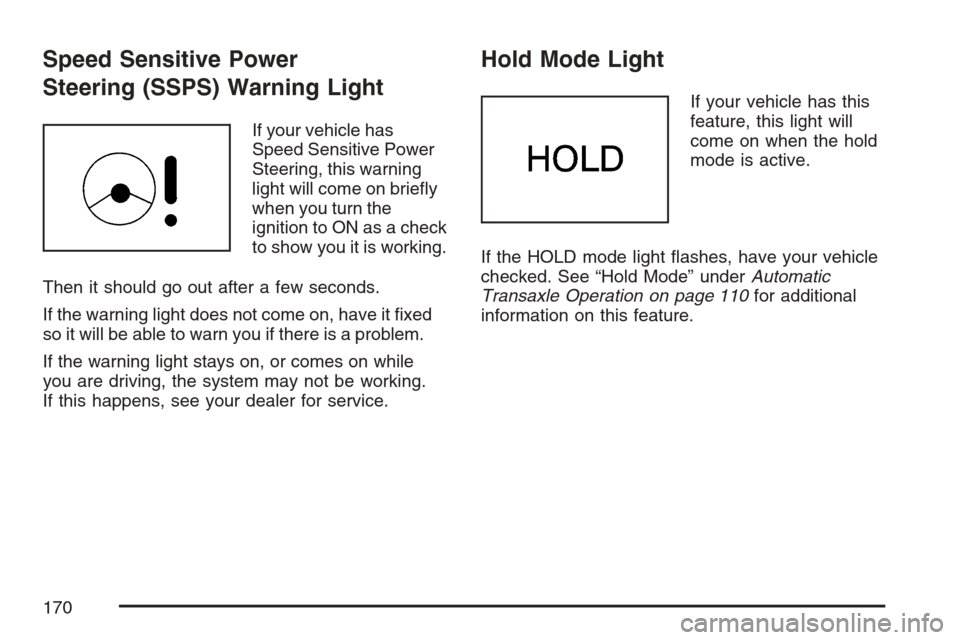
Speed Sensitive Power
Steering (SSPS) Warning Light
If your vehicle has
Speed Sensitive Power
Steering, this warning
light will come on briefly
when you turn the
ignition to ON as a check
to show you it is working.
Then it should go out after a few seconds.
If the warning light does not come on, have it fixed
so it will be able to warn you if there is a problem.
If the warning light stays on, or comes on while
you are driving, the system may not be working.
If this happens, see your dealer for service.
Hold Mode Light
If your vehicle has this
feature, this light will
come on when the hold
mode is active.
If the HOLD mode light flashes, have your vehicle
checked. See “Hold Mode” underAutomatic
Transaxle Operation on page 110for additional
information on this feature.
170
Page 172 of 422
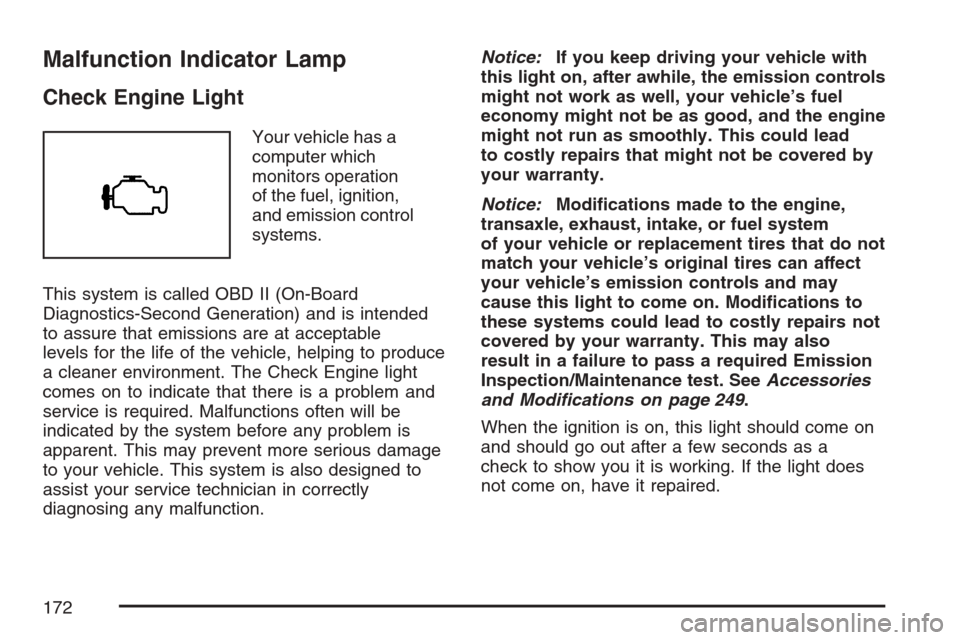
Malfunction Indicator Lamp
Check Engine Light
Your vehicle has a
computer which
monitors operation
of the fuel, ignition,
and emission control
systems.
This system is called OBD II (On-Board
Diagnostics-Second Generation) and is intended
to assure that emissions are at acceptable
levels for the life of the vehicle, helping to produce
a cleaner environment. The Check Engine light
comes on to indicate that there is a problem and
service is required. Malfunctions often will be
indicated by the system before any problem is
apparent. This may prevent more serious damage
to your vehicle. This system is also designed to
assist your service technician in correctly
diagnosing any malfunction.Notice:If you keep driving your vehicle with
this light on, after awhile, the emission controls
might not work as well, your vehicle’s fuel
economy might not be as good, and the engine
might not run as smoothly. This could lead
to costly repairs that might not be covered by
your warranty.
Notice:Modications made to the engine,
transaxle, exhaust, intake, or fuel system
of your vehicle or replacement tires that do not
match your vehicle’s original tires can affect
your vehicle’s emission controls and may
cause this light to come on. Modications to
these systems could lead to costly repairs not
covered by your warranty. This may also
result in a failure to pass a required Emission
Inspection/Maintenance test. SeeAccessories
and Modifications on page 249.
When the ignition is on, this light should come on
and should go out after a few seconds as a
check to show you it is working. If the light does
not come on, have it repaired.
172
Page 173 of 422
This light will also come on during a malfunction in
one of two ways:
•Light Flashing— A misfire condition has
been detected. A misfire increases vehicle
emissions and may damage the emission
control system on your vehicle. Diagnosis and
service may be required.
•Light On Steady— An emission control
system malfunction has been detected on
your vehicle. Diagnosis and service may
be required.
If the Light Is Flashing
The following may prevent more serious damage
to your vehicle:
•Reducing vehicle speed
•Avoiding hard accelerations
•Avoiding steep uphill grades
If the light stops flashing and remains on steady,
see “If the Light Is On Steady” following.If the light continues to flash, when it is safe to do
so, stop the vehicle. Find a safe place to park
your vehicle. Turn the key off, wait at least
10 seconds and restart the engine. If the light
remains on steady, see “If the Light Is On Steady”
following. If the light is still flashing, follow the
previous steps, and see your dealer for service as
soon as possible.
If the Light Is On Steady
You also may be able to correct the emission
system malfunction by considering the following:
Did you recently put fuel into your vehicle?
If so, reinstall the fuel cap, making sure to fully
install the cap. SeeFilling the Tank on page 254.
The diagnostic system can determine if the
fuel cap has been left off or improperly installed.
A loose or missing fuel cap will allow fuel to
evaporate into the atmosphere. A few driving trips
with the cap properly installed should turn the
light off.
173
Page 175 of 422
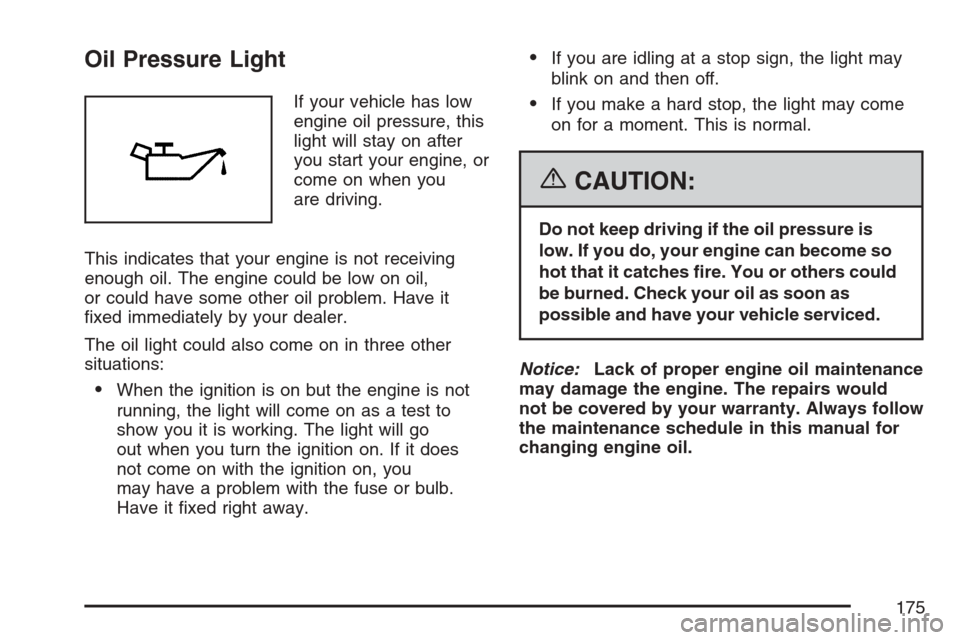
Oil Pressure Light
If your vehicle has low
engine oil pressure, this
light will stay on after
you start your engine, or
come on when you
are driving.
This indicates that your engine is not receiving
enough oil. The engine could be low on oil,
or could have some other oil problem. Have it
fixed immediately by your dealer.
The oil light could also come on in three other
situations:
•When the ignition is on but the engine is not
running, the light will come on as a test to
show you it is working. The light will go
out when you turn the ignition on. If it does
not come on with the ignition on, you
may have a problem with the fuse or bulb.
Have it fixed right away.
•If you are idling at a stop sign, the light may
blink on and then off.
•If you make a hard stop, the light may come
on for a moment. This is normal.
{CAUTION:
Do not keep driving if the oil pressure is
low. If you do, your engine can become so
hot that it catches re. You or others could
be burned. Check your oil as soon as
possible and have your vehicle serviced.
Notice:Lack of proper engine oil maintenance
may damage the engine. The repairs would
not be covered by your warranty. Always follow
the maintenance schedule in this manual for
changing engine oil.
175
Page 178 of 422
Here are four things that some owners ask about.
None of these show a problem with your fuel gage:
•At the service station, the gas pump shuts off
before the gage reads full.
•It takes a little more or less fuel to fill up than
the gage indicated. For example, the gage may
have indicated the tank was half full, but it
actually took a little more or less than half the
tank’s capacity to fill the tank.
•The indicator moves a little when you turn a
corner or speed up.
•The gage goes back to empty when you turn off
the ignition.
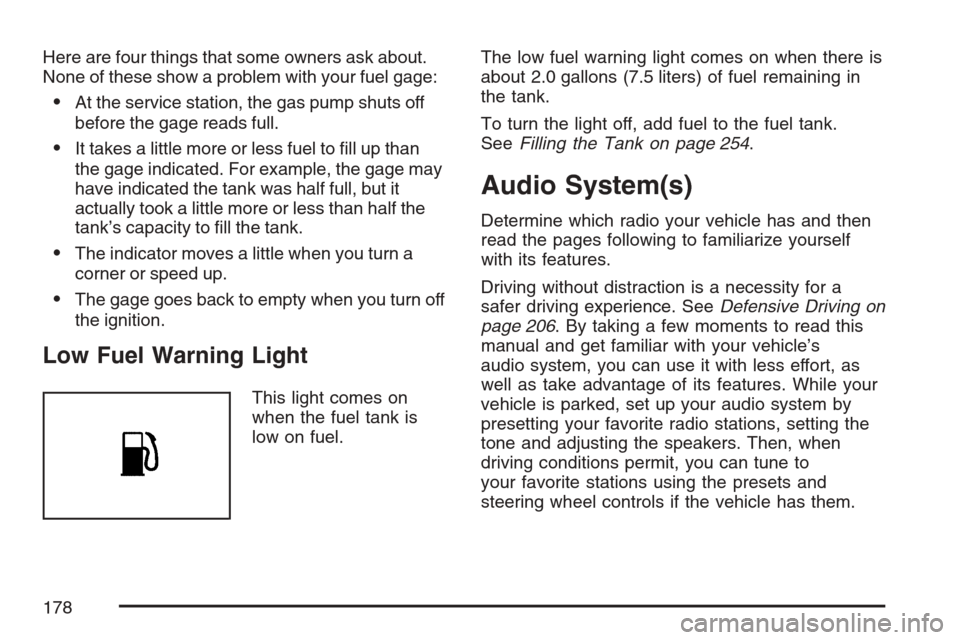
Low Fuel Warning Light
This light comes on
when the fuel tank is
low on fuel.The low fuel warning light comes on when there is
about 2.0 gallons (7.5 liters) of fuel remaining in
the tank.
To turn the light off, add fuel to the fuel tank.
SeeFilling the Tank on page 254.
Audio System(s)
Determine which radio your vehicle has and then
read the pages following to familiarize yourself
with its features.
Driving without distraction is a necessity for a
safer driving experience. SeeDefensive Driving on
page 206. By taking a few moments to read this
manual and get familiar with your vehicle’s
audio system, you can use it with less effort, as
well as take advantage of its features. While your
vehicle is parked, set up your audio system by
presetting your favorite radio stations, setting the
tone and adjusting the speakers. Then, when
driving conditions permit, you can tune to
your favorite stations using the presets and
steering wheel controls if the vehicle has them.
178
Page 227 of 422
Before changing lanes, check your mirrors. Then
use your turn signal.
Just before you leave the lane, glance quickly
over your shoulder to make sure there is not
another vehicle in your blind spot.
Once you are moving on the freeway, make
certain you allow a reasonable following distance.
Expect to move slightly slower at night.
When you want to leave the freeway, move to the
proper lane well in advance. If you miss your
exit, do not, under any circumstances, stop and
back up. Drive on to the next exit.
The exit ramp can be curved, sometimes quite
sharply. The exit speed is usually posted. Reduce
your speed according to your speedometer, not
to your sense of motion. After driving for any
distance at higher speeds, you may tend to think
you are going slower than you actually are.Before Leaving on a Long Trip
Make sure you are ready. Try to be well rested.
If you must start when you are not fresh — such as
after a day’s work — do not plan to make too
many miles that first part of the journey. Wear
comfortable clothing and shoes you can easily
drive in.
Is your vehicle ready for a long trip? If you keep it
serviced and maintained, it is ready to go. If it
needs service, have it done before starting
out. Of course, you will find experienced and able
service experts in GM dealerships all across
North America. They will be ready and willing to
help if you need it.
227
Page 228 of 422
Here are some things you can check before a trip:
•Windshield Washer Fluid:Is the reservoir
full? Are all windows clean inside and outside?
•Wiper Blades:Are they in good shape?
•Fuel, Engine Oil, Other Fluids:Have you
checked all levels?
•Lamps:Are they all working? Are the lenses
clean?
•Tires:They are vitally important to a safe,
trouble-free trip. Is the tread good enough
for long-distance driving? Are the tires
all inflated to the recommended pressure?
•Weather Forecasts:What is the weather
outlook along your route? Should you
delay your trip a short time to avoid a major
storm system?
•Maps:Do you have up-to-date maps?
Highway Hypnosis
Is there actually such a condition as highway
hypnosis? Or is it just plain falling asleep at the
wheel? Call it highway hypnosis, lack of
awareness, or whatever.
There is something about an easy stretch of road
with the same scenery, along with the hum of the
tires on the road, the drone of the engine, and the
rush of the wind against the vehicle that can make
you sleepy. Do not let it happen to you! If it does,
your vehicle can leave the road in less than a
second, and you could crash and be injured.
What can you do about highway hypnosis?
First, be aware that it can happen.
Then here are some tips:
•Make sure your vehicle is well ventilated, with
a comfortably cool interior.
•Keep your eyes moving. Scan the road ahead
and to the sides. Check your rearview mirrors
and your instruments frequently.
•If you get sleepy, pull off the road into a rest,
service, or parking area and take a nap, get
some exercise, or both. For safety, treat
drowsiness on the highway as an emergency.
228
Page 241 of 422
{CAUTION:
Things you put inside your vehicle can
strike and injure people in a sudden stop
or turn, or in a crash.
Put things in the trunk of your vehicle.
In a trunk, put them as far forward as
you can. Try to spread the weight
evenly.
Never stack heavier things, like
suitcases, inside the vehicle so that
some of them are above the tops of
the seats.
Do not leave an unsecured child
restraint in your vehicle.
When you carry something inside the
vehicle, secure it whenever you can.
Do not leave a seat folded down
unless you need to.
Towing
Towing Your Vehicle
Consult your dealer or a professional towing
service if you need to have your disabled vehicle
towed. SeeRoadside Assistance Program on
page 394.
If you want to tow your vehicle behind another
vehicle for recreational purposes (such as
behind a motorhome), see “Recreational Vehicle
Towing” following.
241
Page 245 of 422
Service........................................................ 248
Accessories and Modifications................... 249
California Proposition 65 Warning.............. 249
Doing Your Own Service Work.................. 250
Adding Equipment to the Outside of
Your Vehicle.......................................... 251
Fuel............................................................. 251
Gasoline Octane........................................ 251
Gasoline Specifications.............................. 251
California Fuel........................................... 252
Additives................................................... 252
Fuels in Foreign Countries........................ 253
Filling the Tank......................................... 254
Filling a Portable Fuel Container............... 256
Checking Things Under the Hood.............. 256
Hood Release........................................... 257
Engine Compartment Overview.................. 258
Engine Oil................................................. 260
Engine Air Cleaner/Filter............................ 264
Automatic Transaxle Fluid......................... 266Manual Transaxle Fluid............................. 266
Hydraulic Clutch........................................ 266
Engine Coolant.......................................... 268
Coolant Surge Tank Pressure Cap............ 271
Engine Overheating................................... 271
Cooling System......................................... 273
Power Steering Fluid ................................. 279
Windshield Washer Fluid........................... 280
Brakes...................................................... 281
Battery...................................................... 284
Jump Starting............................................ 285
Headlamp Aiming........................................ 290
Bulb Replacement....................................... 290
Halogen Bulbs........................................... 290
Headlamps................................................ 290
Front Turn Signal and Parking Lamps.......... 292
Turn Signal Lamps (Side).......................... 293
Sidemarker Lamps (Front)......................... 294
Sidemarker Lamps (Rear).......................... 295
Section 5 Service and Appearance Care
245