belt CHEVROLET OPTRA 5 2007 1.G Workshop Manual
[x] Cancel search | Manufacturer: CHEVROLET, Model Year: 2007, Model line: OPTRA 5, Model: CHEVROLET OPTRA 5 2007 1.GPages: 422, PDF Size: 2.39 MB
Page 133 of 422
Instrument Panel Overview........................ 136
Hazard Warning Flashers.......................... 140
Other Warning Devices............................. 140
Horn.......................................................... 140
Tilt Wheel.................................................. 141
Turn Signal/Multifunction Lever.................. 141
Turn and Lane-Change Signals................. 142
Headlamp High/Low-Beam Changer.......... 142
Flash-to-Pass............................................ 143
Windshield Wipers..................................... 143
Windshield Washer.................................... 144
Rear Window Wiper/Washer
(Hatchback and Wagon Only)................ 145
Cruise Control........................................... 145
Exterior Lamps.......................................... 148
Headlamps on Reminder........................... 149
Daytime Running Lamps (DRL)................. 149
Fog Lamps................................................ 150
Instrument Panel Brightness...................... 150
Dome Lamp.............................................. 151
Map Lamps............................................... 151
Inadvertent Power Battery Saver............... 152Accessory Power Outlet(s)........................ 152
Ashtray(s) and Cigarette Lighter................ 153
Clock......................................................... 154
Climate Controls......................................... 155
Climate Control System............................. 155
Outlet Adjustment...................................... 159
Passenger Compartment Air Filter............. 159
Warning Lights, Gages, and Indicators........ 161
Instrument Panel Cluster........................... 161
Speedometer and Odometer...................... 163
Trip Odometer........................................... 163
Tachometer............................................... 163
Safety Belt Reminder Light........................ 164
Safety Belt Reminder Tone....................... 164
Airbag Readiness Light............................. 164
Passenger Airbag Status Indicator............. 165
Charging System Light.............................. 167
Brake System Warning Light..................... 168
Anti-Lock Brake System Warning Light........ 169
Speed Sensitive Power Steering (SSPS)
Warning Light......................................... 170
Section 3 Instrument Panel
133
Page 164 of 422
Safety Belt Reminder Light
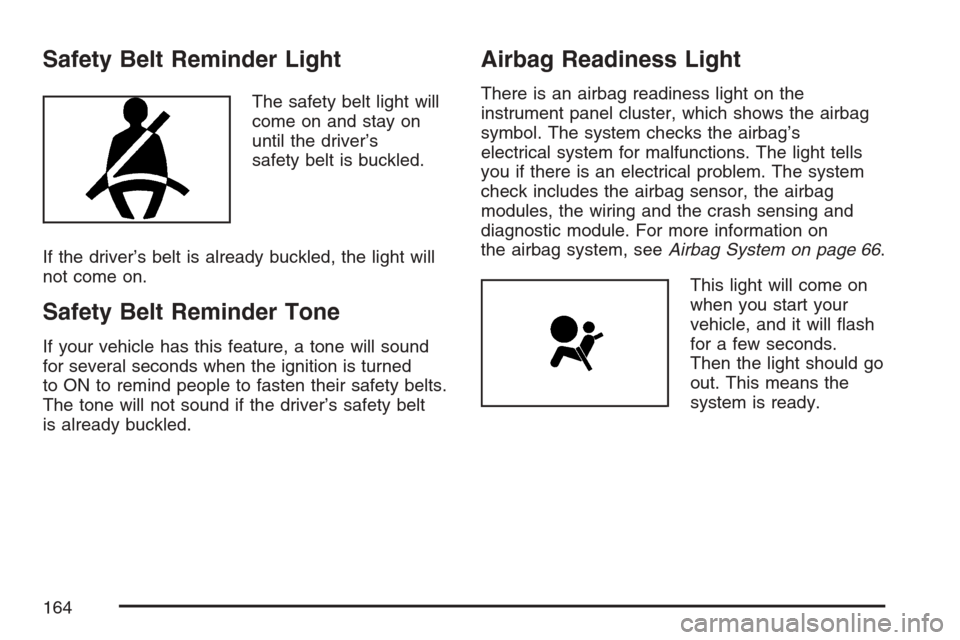
The safety belt light will
come on and stay on
until the driver’s
safety belt is buckled.
If the driver’s belt is already buckled, the light will
not come on.
Safety Belt Reminder Tone
If your vehicle has this feature, a tone will sound
for several seconds when the ignition is turned
to ON to remind people to fasten their safety belts.
The tone will not sound if the driver’s safety belt
is already buckled.
Airbag Readiness Light
There is an airbag readiness light on the
instrument panel cluster, which shows the airbag
symbol. The system checks the airbag’s
electrical system for malfunctions. The light tells
you if there is an electrical problem. The system
check includes the airbag sensor, the airbag
modules, the wiring and the crash sensing and
diagnostic module. For more information on
the airbag system, seeAirbag System on page 66.
This light will come on
when you start your
vehicle, and it will flash
for a few seconds.
Then the light should go
out. This means the
system is ready.
164
Page 206 of 422
Your Driving, the Road, and
Your Vehicle
Defensive Driving
The best advice anyone can give about driving is:
Drive defensively.
Please start with a very important safety device in
your vehicle: Buckle up. SeeSafety Belts: They
Are for Everyone on page 18.
{CAUTION:
Defensive driving really means “Be ready
for anything.” On city streets, rural roads,
or expressways, it means “Always expect
the unexpected.” Assume that pedestrians
or other drivers are going to be careless
and make mistakes. Anticipate what they
might do and be ready. Rear-end
collisions are about the most preventable
of accidents. Yet they are common. Allow
enough following distance. Defensive
driving requires that a driver concentrate
on the driving task. Anything that
distracts from the driving task makes
proper defensive driving more difficult
and can even cause a collision, with
resulting injury. Ask a passenger to help
do these things, or pull off the road in a
safe place to do them. These simple
defensive driving techniques could save
your life.
206
Page 216 of 422
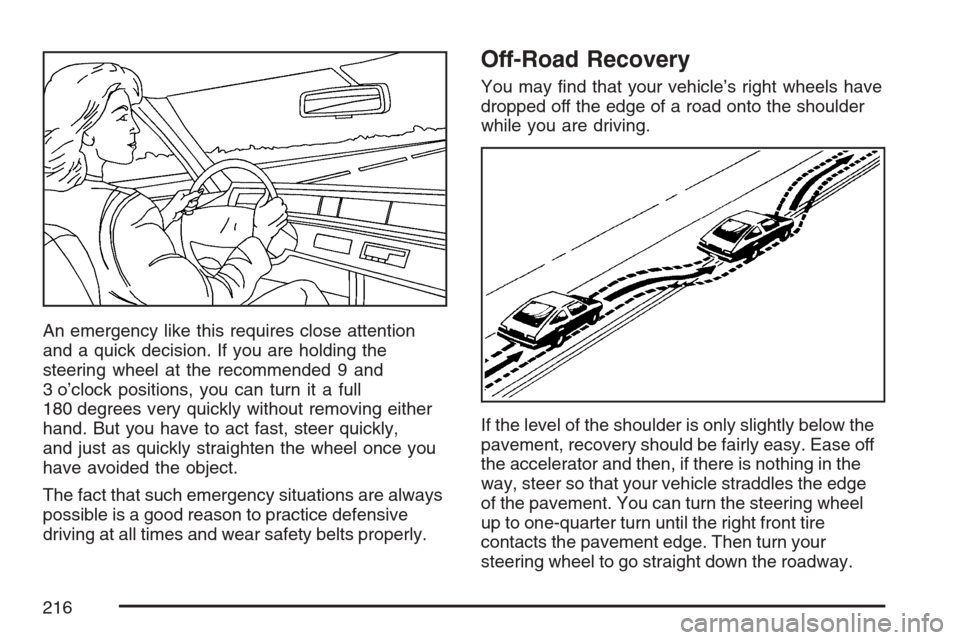
An emergency like this requires close attention
and a quick decision. If you are holding the
steering wheel at the recommended 9 and
3 o’clock positions, you can turn it a full
180 degrees very quickly without removing either
hand. But you have to act fast, steer quickly,
and just as quickly straighten the wheel once you
have avoided the object.
The fact that such emergency situations are always
possible is a good reason to practice defensive
driving at all times and wear safety belts properly.
Off-Road Recovery
You may find that your vehicle’s right wheels have
dropped off the edge of a road onto the shoulder
while you are driving.
If the level of the shoulder is only slightly below the
pavement, recovery should be fairly easy. Ease off
the accelerator and then, if there is nothing in the
way, steer so that your vehicle straddles the edge
of the pavement. You can turn the steering wheel
up to one-quarter turn until the right front tire
contacts the pavement edge. Then turn your
steering wheel to go straight down the roadway.
216
Page 246 of 422
Center High-Mounted Stoplamp (CHMSL)
(Hatchback)............................................ 296
Center High-Mounted Stoplamp (CHMSL)
(Wagon)................................................. 297
Taillamps, Turn Signal, and Stoplamps
(Hatchback)............................................ 298
Taillamps, Turn Signal, Stoplamps and
Back-up Lamps (Wagon)........................ 299
Taillamps, Stoplamps and Back-up Lamps
(Hatchback)............................................ 300
License Plate Lamp................................... 301
Replacement Bulbs................................... 301
Windshield Wiper Blade Replacement....... 302
Tires............................................................ 303
Tire Sidewall Labeling............................... 304
Tire Terminology and Definitions............... 307
Inflation - Tire Pressure............................. 311
Tire Pressure Monitor System................... 312
Tire Inspection and Rotation...................... 316
When It Is Time for New Tires.................. 317Buying New Tires...................................... 318
Different Size Tires and Wheels................ 319
Uniform Tire Quality Grading..................... 320
Wheel Alignment and Tire Balance............ 321
Wheel Replacement.................................. 322
Tire Chains............................................... 323
If a Tire Goes Flat.................................... 324
Changing a Flat Tire................................. 324
Removing the Spare Tire and Tools.......... 326
Removing the Flat Tire and Installing the
Spare Tire............................................. 329
Storing a Flat or Spare Tire and Tools...... 333
Compact Spare Tire.................................. 334
Appearance Care........................................ 335
Cleaning the Inside of Your Vehicle.......... 335
Fabric/Carpet............................................. 337
Leather...................................................... 338
Instrument Panel, Vinyl, and Other
Plastic Surfaces..................................... 338
Care of Safety Belts.................................. 339
Section 5 Service and Appearance Care
246
Page 247 of 422
Weatherstrips............................................ 339
Washing Your Vehicle............................... 339
Cleaning Exterior Lamps/Lenses................ 340
Finish Care............................................... 340
Windshield and Wiper Blades.................... 340
Aluminum Wheels...................................... 341
Tires......................................................... 342
Sheet Metal Damage................................. 342
Finish Damage.......................................... 342
Underbody Maintenance............................ 342
Chemical Paint Spotting............................ 343
Vehicle Care/Appearance Materials............ 343
Vehicle Identication.................................. 344
Vehicle Identification Number (VIN)........... 344
Service Parts Identification Label............... 345Electrical System........................................ 345
Add-On Electrical Equipment..................... 345
Headlamp Wiring....................................... 346
Windshield Wiper Fuses............................ 346
Power Windows and Other Power
Options.................................................. 346
Fuses and Circuit Breakers....................... 346
Instrument Panel Fuse Block..................... 347
Engine Compartment Fuse Block............... 349
Capacities and Specications.................... 352
Normal Maintenance Replacement Parts..... 353
Engine Drive Belt Routing......................... 354
Section 5 Service and Appearance Care
247
Page 307 of 422
(C) Aspect Ratio:A two-digit number that
indicates the tire height-to-width measurements.
For example, if the tire size aspect ratio is 70,
as shown in item C of the illustration, it would
mean that the tire’s sidewall is 70% as high as it
is wide.
(D) Construction Code:A letter code is used
to indicate the type of ply construction in the tire.
The letter R means radial ply construction; the
letter D means diagonal or bias ply construction;
and the letter B means belted-bias ply
construction.
(E) Rim Diameter:Diameter of the wheel in
inches.
(F) Service Description:These characters
represent the load range and the speed rating
of a tire. The load range represents the load carry
capacity a tire is certified to carry. The speed
rating is the maximum speed a tire is certified to
carry a load. Speed ratings range from A to Z.Tire Terminology and Denitions
Air Pressure:The amount of air inside the tire
pressing outward on each square inch of the
tire. Air pressure is expressed in pounds
per square inch (psi) or kilopascal (kPa).
Accessory Weight:This means the combined
weight of optional accessories. Some examples
of optional accessories are, automatic
transmission/transaxle, power steering, power
brakes, power windows, power seats, and
air conditioning.
Aspect Ratio:The relationship of a tire’s height
to its width.
Belt:A rubber coated layer of cords that is located
between the plies and the tread. Cords may be
made from steel or other reinforcing materials.
Bead:The tire bead contains steel wires wrapped
by steel cords that hold the tire onto the rim.
307
Page 318 of 422
Buying New Tires
To find out what kind and size of tires you need,
look at the tire and loading information label
attached to your vehicle. SeeLoading Your
Vehicle on page 236for a label example and
where it is attached to your vehicle.
Make sure the replacements are the same size,
load range, speed rating and construction type
(bias, bias-belted or radial) as your original tires.
{CAUTION:
Mixing tires could cause you to lose
control while driving. If you mix tires of
different sizes, brands, or types (radial
and bias-belted tires), the vehicle may not
handle properly, and you could have a
crash. Using tires of different sizes,
brands, or types may also cause damage
to your vehicle. Be sure to use the correct
CAUTION: (Continued)
CAUTION: (Continued)
size, brand, and type of tires on all
wheels. It is all right to drive with your
compact spare temporarily, as it was
developed for use on your vehicle.
SeeCompact Spare Tire on page 334.
{CAUTION:
If you use bias-ply tires on your vehicle,
the wheel rim anges could develop
cracks after many miles of driving. A tire
and/or wheel could fail suddenly, causing
a crash. Use only radial-ply tires with the
wheels on your vehicle.
318
Page 339 of 422
Care of Safety Belts
Keep belts clean and dry.
{CAUTION:
Do not bleach or dye safety belts. If you
do, it may severely weaken them. In a
crash, they might not be able to provide
adequate protection. Clean safety belts
only with mild soap and lukewarm water.
Weatherstrips
Silicone grease on weatherstrips will make them
last longer, seal better, and not stick or squeak.
Apply silicone grease with a clean cloth. During
very cold, damp weather frequent application may
be required.
Washing Your Vehicle
The paint finish on the vehicle provides beauty,
depth of color, gloss retention, and durability.
The best way to preserve the vehicle’s finish is to
keep it clean by washing it often with lukewarm
or cold water.
Do not wash the vehicle in the direct rays of the
sun. Use a car washing soap. Do not use
strong soaps or chemical detergents. Be sure to
rinse the vehicle well, removing all soap residue
completely. Approved cleaning products can
be obtained from your dealer. SeeVehicle
Care/Appearance Materials on page 343.Donot
use cleaning agents that are petroleum based,
or that contain acid or abrasives. All cleaning
agents should be flushed promptly and not
allowed to dry on the surface, or they could stain.
Dry the finish with a soft, clean chamois or an
all-cotton towel to avoid surface scratches
and water spotting.
High pressure car washes may cause water to
enter the vehicle.
339
Page 354 of 422
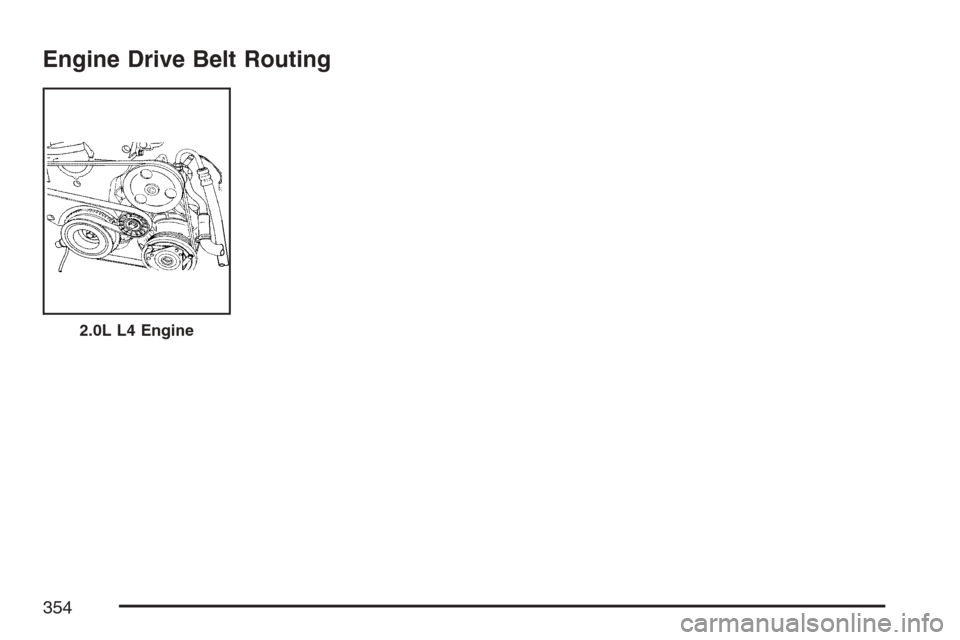
Engine Drive Belt Routing
2.0L L4 Engine
354