ignition CHEVROLET PRIZM 1998 3.G Owners Manual
[x] Cancel search | Manufacturer: CHEVROLET, Model Year: 1998, Model line: PRIZM, Model: CHEVROLET PRIZM 1998 3.GPages: 364, PDF Size: 18.79 MB
Page 43 of 364
Downloaded from www.Manualslib.com manuals search engine If your vehicle ever gets into a lot of water -- such as
water up to the carpeting or higher
-- or if water enters
your vehicle and soaks the carpet, the air bag controller
can be soaked and ruined. If this ever happens, and then
you start your vehicle, the damage could make the
frontal and side impact air bags inflate and safety belt
pretensioners activate, even if there’s
no crash. You
would have to replace the air bags, all the sensors and
related parts, parts of the safety belt system and parts of
the driver and right front passenger’s seatbacks.
If your
vehicle is ever in a flood, or if it’s exposed to water that
soaks the carpet, you can avoid needless repair costs by
turning off the vehicle immediately. Don’t let anyone
start the vehicle, even to tow it, unless the battery cables
are first disconnected.
Servicing Your Air Bag-Equipped Vehicle
Air bags affect how your vehicle should be serviced.
There are parts of the air bag systems in several
places around your vehicle. Your dealer and the
Prizm Service Manual have information about servicing
your vehicle and the air bag systems. To purchase a
service manual, see “Service and Owner Publications”
in the Index.
1
For up to 90 seconds after the ignition key is
’ turned off and the battery disconnected, an air
bag can still inflate during improper service. You
can be injured if you are close to an air bag when
it inflates. Avoid wires wrapped with yellow tape
or yellow connectors. They are probably part of
the air bag system. Be sure to follow proper
service procedures, and make sure the person
performing work for you is qualified to do
so.
The air bag systems should be inspected by a qualified
technician
10 years from the manufacture date on the
Certification label. After
10 years from the manufacture
date, have the systems inspected every
24 months. (The
Certification label is located at the rear edge of the
driver’s door.)
1-29
Page 79 of 364
Downloaded from www.Manualslib.com manuals search engine a Section 2 Features and Controls
Here you can learn about the many standard and optional features on your vehicle, and information on starting,
shifting and braking. Also explained are the instrument panel and the warning systems that tell
you if everything is
working properly -- and what to do if you have a problem.
2-2 2-4
2-6
2-9
2-10 2-1
1
2-1 1
2-13 2- 14
2-18
2-20
2-2 1
2-23
2-24 Keys
Door Locks
Keyless Entry System (If Equipped)
Trunk
Theft
New Vehicle “Break-In”
Ignition Switch
Starting Your Engine
Automatic Transaxle Operation
Manual Transaxle Operation
Parking Brake
Shifting Into Park (P) (Automatic
Transaxle Only) Parking Over Things That Burn
Engine Exhaust 2-24
2-25
2-26
2-26
2-27
2-32
2-34
2-3
5
2-37
2-38
2-3
8
2-39
2-40
2-45 Running
Your Engine While You’re Parked
(Automatic Transaxle)
Windows
Horn
Tilt Column (Option)
Turn Signalhlultifunction Lever
Exterior Lamps
Interior Lamps
Mirrors Storage Compartments
Ashtrays and Lighter
Sun Visors
Sunroof (Option)
Instrument Panel
Warning Lights, Gages and Indicators
2-1
Page 80 of 364
Downloaded from www.Manualslib.com manuals search engine Keys
1-
A CAUTION:
I
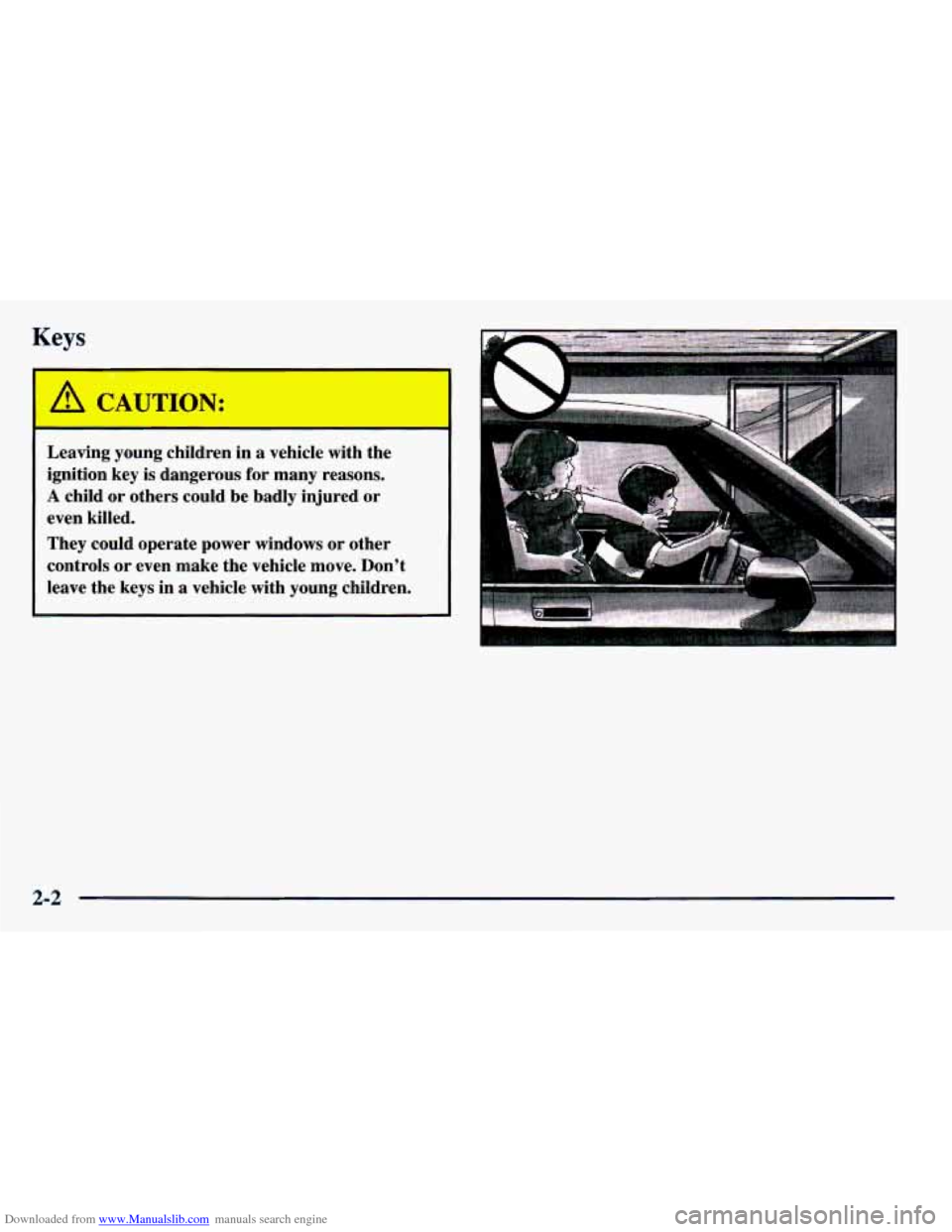
Leaving young children in a vehicle with the
ignition key is dangerous for many reasons.
A child or others could be badly injured or
even killed.
They could operate power windows or other
controls
or even make the vehicle move. Don't
leave the keys in a vehicle with young children.
T, :,. .,. ,* ..'! ,, '
2-2
Page 81 of 364
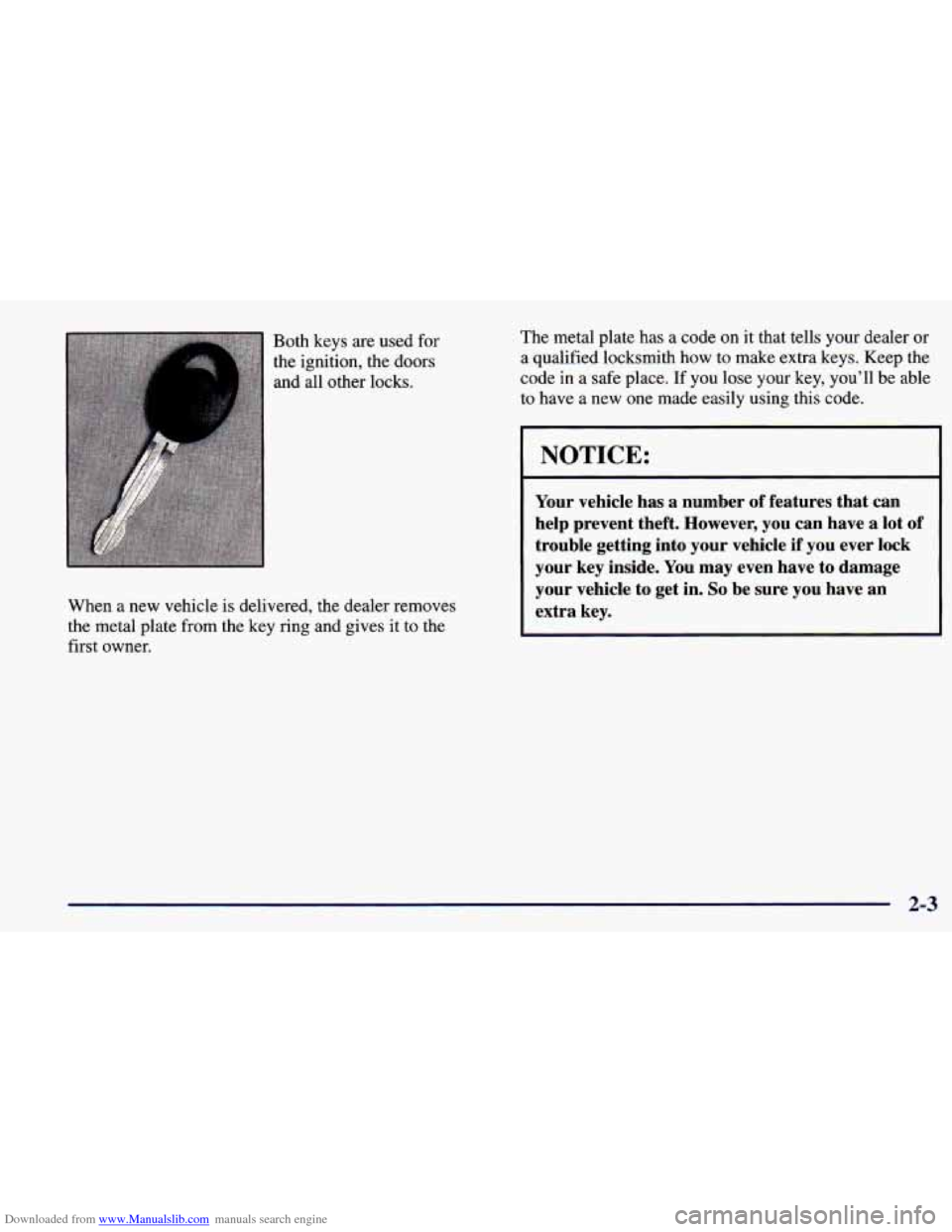
Downloaded from www.Manualslib.com manuals search engine Both keys are used for
the ignition, the doors
and all other locks.
When a new vehicle is delivered, the dealer removes
the metal plate from the key ring and gives it to the
first owner. The
metal plate has a code on it that tells your dealer or
a qualified locksmith how to make extra keys. Keep the
code in a safe place. If you lose your key, you’ll be able
to have a new one made easily using this code.
NOTICE:
Your vehicle has a number of features that can
help prevent theft. However, you can have a lot of
trouble getting into your vehicle if you ever lock
your key inside. You may even have to damage
your vehicle to get in. So be sure you have an
extra key.
2-3
Page 85 of 364
Downloaded from www.Manualslib.com manuals search engine This device complies with Part 15 of the FCC Rules.
Operation is subject
to the following two conditions:
(1)
this device may not cause harmful interference, and
(2) this device must accept any interference received,
including interference that may cause undesired operation.
This device complies with RSS-210
of Industry Canada.
Operation is subject to the following two conditions:
(1) this device may not cause interference, and (2) this
device must accept any interference received, including
interference that may cause undesired operation
of
the device.
Changes or modifications to this system by other than
an authorized service facility could void authorization
to use this equipment.
This system has
a range of about 3 feet (1 m) up to
30 feet (9 m). At times you may notice a decrease in
range. This is normal for any remote keyless entry
system. If the transmitter does not work or if you have
to stand closer to your vehicle for the transmitter to
work, try this:
0 Check to determine if battery replacement is
necessary. See the instructions that follow.
Check the distance. You may be too far from your
vehicle.
You may need to stand closer during rainy
or snowy weather.
0 Check the location. Other vehicles or objects may
be blocking the signal. Take
a few steps to the left
or right, hold
the transmitter higher, and try again.
0 If you’re still having trouble, see your dealer or a
qualified technician for service.
Operation
The following functions are available with the remote
keyless entry system:
LOCK: All doors will automatically lock when the
LOCK button on the transmitter is pressed. The
taillamps will flash once, to confirm that the doors
have locked. The interior lamps will stay on for two
seconds after all of the doors are closed. The remote
lock function will not work
if the key is in the ignition.
UNLOCK: The driver’s door will unlock automatically
when the UNLOCK button
on the transmitter is pressed.
The taillamps will flash twice and the interior
lamps will
come on to confirm that the doors have unlocked.
If the
unlock button is pressed again within five seconds, all
remaining doors will unlock. The interior lamps will
stay on for 15 seconds or until the ignition is turned on.
If unlock is pressed and no door is opened, the doors
will lock automatically after
30 seconds.
Page 88 of 364
Downloaded from www.Manualslib.com manuals search engine Trunk Lock Release Theft
To open the trunk lid, use your key and turn it to
the right.
To close the lid, lower and press down on it. After
closing the lid, try pulling it up to make sure it is closed.
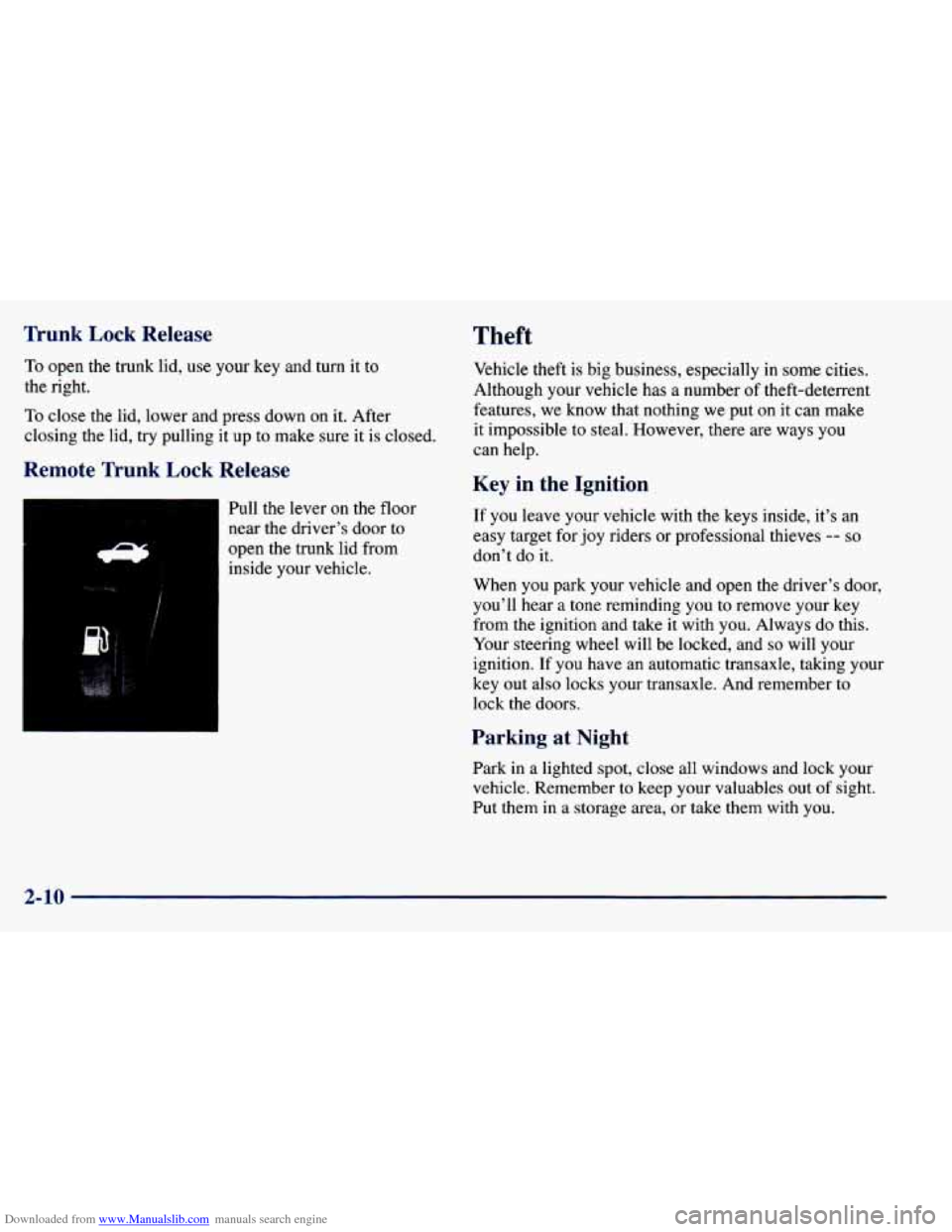
Remote Trunk Lock Release
nw Pull the lever on the floor
near the driver’s door to
open the trunk lid from
inside your vehicle. Vehicle
theft
is big business, especially in some cities.
Although your vehicle has a number
of theft-deterrent
features, we know that nothing we put
on it can make
it impossible to steal. However, there are ways you
can help.
Key in the Ignition
If you leave your vehicle with the keys inside, it’s an
easy target for joy riders or professional thieves
-- so
don’t do it.
When
you park your vehicle and open the driver’s door,
you’ll hear a tone reminding you to remove your key
from the ignition and take
it with you. Always do this.
Your steering wheel will be locked, and
so will your
ignition. If you have an automatic transaxle, taking your
key out also locks your transaxle. And remember to
lock the doors.
Parking at Night
Park in a lighted spot, close all windows and lock your
vehicle. Remember to keep your valuables out
of sight.
Put them in a storage area, or take them with you.
2-10
Page 89 of 364
Downloaded from www.Manualslib.com manuals search engine New Vehicle “Break-In”
NOTICE:
Your vehicle doesn’t need an elaborate
“break-in.” But it will perform better in the long
run
if you follow these guidelines:
Don’t drive at any one speed -- fast or
slow
-- for the first 500 miles (805 km).
Don’t make full-throttle starts.
200 miles (322 km) or so. During this time
your new brake linings aren’t yet broken
in. Hard stops with new linings can mean
premature wear and earlier replacement.
Follow this breaking-in guideline every
time you get new brake linings.
Don’t tow a trailer during break-in. See
“Towing a Trailer” in the Index for
more information.
Avoid making hard stops for the first
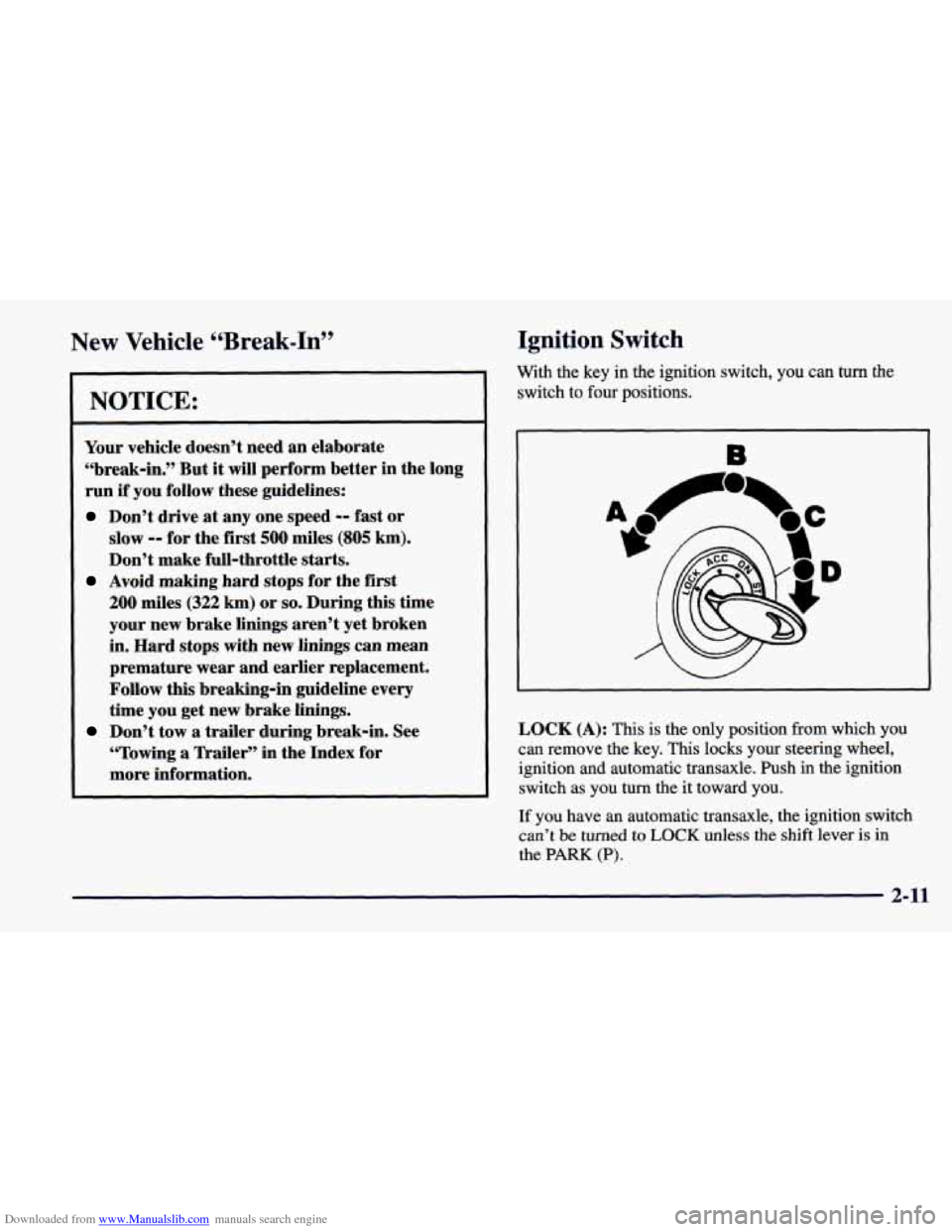
Ignition Switch
With the key in the ignition switch, you can turn the
switch to
four positions.
W
LOCK (A): This is the only position from which you
can remove the key. This locks your steering wheel,
ignition and automatic transaxle.
Push in the ignition
switch as you
turn the it toward you.
If you have an automatic transaxle, the ignition switch
can’t be turned to
LOCK unless the shift lever is in
the
PARK (P).
Page 90 of 364
Downloaded from www.Manualslib.com manuals search engine ACC (ACCESSORY) (B): In this position, you can
operate some of your electrical power accessories (such
as the radio, but not the ventilation fan). It unlocks the
steering wheel and ignition.
To move the key from ACC
to LOCK, push in the key and then turn it to LOCK.
ON (C): The switch returns to this position after you
start your engine and release the switch. The switch
stays in the
ON position when the engine is running. But
even when the ignition is not running, you can use ON
to operate your electrical power accessories (including
the ventilation fan) and to display some warning and
indicator lights.
START (D): This position starts the engine. When the
engine starts, release the key. The ignition switch will
return to ON for normal driving.
When the engine is not running,
ACC and ON allow
you to operate some
of your electrical accessories.
A warning tone will sound if you open the driver’s
door when the ignition
is in ACC or LOCK and the
key is in the ignition. On manual transaxle
vehicles, turning the key to
LOCK and removing it will lock the steering
column and result in
a loss of ability to steer the
vehicle. This could cause
a collision. If you need
to turn the engine off while the vehicle is moving,
turn the key only to
ACC. Don’t push the key in
while the vehicle is moving.
NOTICE:
If your key seems stuck in LOCK and you can’t
turn it, be sure you are using the correct key; if
so, is it all the way in? If it is, then turn the
steering wheel left and right while you turn the
key hard. But turn the key only with your hand.
Using
a tool to force it could break the key or the
ignition switch. If none
of this works, then your
vehicle needs service.
2-12
Page 91 of 364
Downloaded from www.Manualslib.com manuals search engine Starting Your Engine
Automatic Transaxle
Move your shift lever to PARK (P) or NEUTRAL (N).
Your engine won’t start in any other position -- that’s a
safety feature. To restart when you’re already moving,
use NEUTRAL (N) only.
I NOTICE:
Don’t try to shift to PARK (P) if your Chevrolet
is moving. If you do, you could damage the
transaxle, Shift to PARK (P) only when your
vehicle is stopped.
Manual Transaxle
The gear selector should be in NEUTRAL (N) and the
parking brake engaged. Hold the clutch pedal to the
floor and start the engine. Your vehicle won’t start if
the clutch pedal is not all the way down
-- that’s a
safety feature.
Starting Your 1.8 Liter Engine
1. Without pushing the accelerator pedal, turn your
ignition key to START. When the engine starts, let
go
of the key. The idle speed will go down as your
engine gets warm.
NOTICE:
Holding your key in START for longer than
15 seconds at a time will cause your battery to
be drained much sooner. And the excessive heat
can damage your starter motor.
2. If it doesn’t start in three seconds, wait about
15 seconds and try again to start the engine by
turning the ignition key to START. Wait about
15 seconds between each try to help avoid draining
your battery
or damaging your starter.
When your engine has run about
10 seconds to warm
up, your vehicle is ready to be driven. Don’t “race”
your engine when it’s cold.
If the weather is below freezing (32” F or O’C), let
the engine
run for a few minutes to warm up.
2-13
Page 93 of 364
Downloaded from www.Manualslib.com manuals search engine It is dangc- JUS to get out of your vehicle if the
shift lever
is not fully in PARK (P) with the
parking brake firmly set. Your vehicle can roll.
Don’t leave your vehicle when the engine is
running unless you have to.
If you have left the
engine running, the vehicle can move suddenly.
You or others could be injured.
To be sure your
vehicle won’t move, even when you’re
on fairly
level ground, always set your parking brake and
move the shift lever to
PARK (P).
you’re pulling a trailer, see “Towing a Trailer’’
~ See “Shifting Into PARK (P)” in the Index. If
~ in the Index.
Ensure the shift lever is fully in PARK (P) range
before starting the engine. Your vehicle has
a
brake-transaxle shift interlock. You have to fully apply
your regular brakes before you can shift from
PARK (P)
when the ignition key is in ON. If you cannot shift out
of PARK (P), ease pressure on the shift lever -- push the
shift lever all the way into PARK
(P) and release the
shift lever button as you maintain brake application.
Then press the shift lever button and move the shift
lever into the gear you wish. See “Shifting Out of
PARK (P)” in the index.
REVERSE (R): Use this gear to back up.
NOTICE:
Shifting to REVERSE (R) while your vehicle is
moving forward could damage your transaxle.
Shift to
REVERSE (R) only after your vehicle
is stopped.
To rock your vehicle back and forth to get out of snow,
ice or sand without damaging your transaxle, see
“Stuck: In Sand,
Mud, Ice or Snow” in the Index.
2-15