automatic transmission CHEVROLET S10 1993 2.G User Guide
[x] Cancel search | Manufacturer: CHEVROLET, Model Year: 1993, Model line: S10, Model: CHEVROLET S10 1993 2.GPages: 356, PDF Size: 20.85 MB
Page 107 of 356

Downloaded from www.Manualslib.com manuals search engine Storage Compartments
PO1 58
Your vehicle may have a console compartment between the bucket seats\
. To
open it, just lift the top of the console while pressing the button on the
driver’s side.
If you have an automatic transmission, your console also includes
a handy place to hold cups.
If you have a manual transmission, your console
will have a tray.
t
KO258
To open your glove box, squeeze the buttons on either side of the keyhole
together and pull the door open.
Two cup holders are provided for your
convenience. Use your door key to lock your glove box.
2-55
Page 204 of 356
Downloaded from www.Manualslib.com manuals search engine Your Driving and the Road
I ~~~~~~~~~~~~~~~~~~~~~~~~~~~~~~~~~~~~~
",.*,lcG~2*"*w" "* .**b;.. "~~" nl ~ -; *_ -~ ,,-,., ',.".~
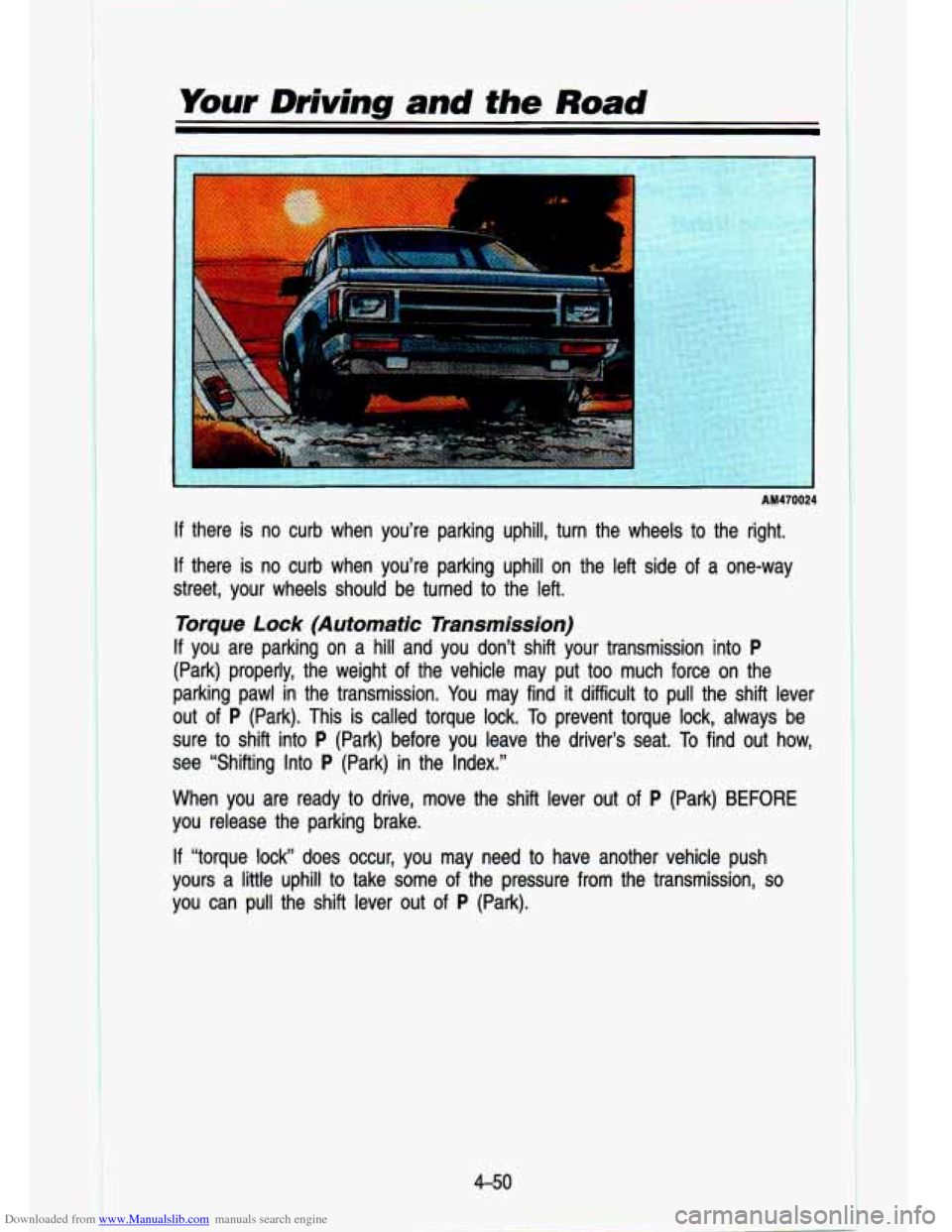
If there is no curb when you're parking uphill, turn the wheels to the right.
If there is no curb when you're parking uphill on the left side \
of a one-way
street, your wheels should be turned
to the left.
Torque Lock (Automatic Transmission)
If you are parking on a hill and you don't shift your transmissi\
on into P
(Park) properly, the weight of the vehicle may put too much \
force on the
parking pawl in the transmission.
You may find it difficult to pull the shift lever
out of
P (Park). This is called torque lock. To prevent torque lock, always be
sure to shift into
P (Park) before you leave the driver's seat. To find out how,
see "Shifting Into
P (Park) in the Index."
When you are ready
to drive, move the shift lever out of P (Park) BEFORE
you release the parking brake.
AM470024
If "torque lock" does occur, you may need to have another vehicle push
yours a little uphill
to take some of the pressure from the transmission, so
you can pull the shift lever out of P (Park).
4-50
Page 209 of 356
Downloaded from www.Manualslib.com manuals search engine Before towing you should:
1. Set the parking brake firmly.
2. Place the auto’matic transmission in P (Park) or the manual transmission
in th:e lowest gear
(1 st gear).
3. Firmly attach the vehicle being towed to the tow vehicle. Refer to the
hitch manufacturer’s instructions.
Shifting the transfer case to N (Neutral) can cause your veh\
icle
to
roll even if the transmission is in P (Park), for an automatic
transmission, or
if your vehicle is in gear, for a manual transmission.
This is because the transfer case overrides the transmission.
I
1 NOTICE
6. Insert the ignition key into the iginition switch and turn it one notch .for-
ward of the “LOCK’ position. This places the key into the “OFF” position,
which unlocks the steering column while preventing battery drain\
. Unlock-
ing the steering column will allow for proper movement of the front
wheelshires during towing.
4-55
Page 214 of 356

Downloaded from www.Manualslib.com manuals search engine Your Driving and the Road
Following Distance
Stay at least twice as far behind the vehicle ahead as you w\
ould when
driving your vehicle without a trailer. This can help you avoi\
d situations that require heavy braking and sudden turns.
Passing
You’ll need more passing distance up ahead when you’re to\
wing a trailer.
And, because you’re a good deal longer, you’ll need
to go much farther
beyond the passed vehicle before you can return
to your lane.
Backing Up
Hold the bottom of the steering wheel with one hand. Then, to move the
trailer left, just move your hand to the left. To move the trailer to the right,
move your hand
to the right. Always back up slowly and, if possible, have
someone guide you.
Making Turns
When you’re turning with a trailer, make wider turns than n\
ormal. Do this so
your trailer wheels won’t strike soft shoulders, curbs, road \
signs, trees, or
other objects. Avoid jerky or sudden maneuvers. Signal well in advance.
Turn Signals When Towing a Trailer
When you tow a trailer, your vehicle has to have a different turn signal
flasher and extra wiring. The green arrows on your instrument \
panel will flash
whenever you signal a turn or lane change. Properly hooked up,\
the trailer lights will also flash, telling other drivers you’re about
to turn, change lanes,
or stop.
When towing a trailer, the green arrows on your instrument pan\
el will flash for
turns even
if the bulbs on the trailer are burned out. Thus, you may think \
drivers behind you are seeing your signal when they are not.
It’s important to
check occasionally to be sure the trailer bulbs are still work\
ing.
Driving on Grades
Reduce speed and shift to a lower gear before you start down a long or
steep downgrade.
If you don’t shift down, you might have to use your brakes
so much that they would get hot and no longer work well.
On a long uphill grade, shift down and reduce your speed to \
around
45 mph
(70 km/h) to reduce the possibility of engine and transmission ove\
rheating.
If you have an automatic transmission, you should use D when towing a
trailer. Operating your vehicle in
D when towing a trailer will minimize heat
buildup and extend the life of your transmission. Or, if you have a manual
transmission with fifth gear, it’s better not to use fifth \
gear, just drive in fourth
gear (or, as you need
to, a lower gear).
4-60
Page 216 of 356
Downloaded from www.Manualslib.com manuals search engine Your Driving and the Road
2. Let up on the brake pedal.
3. Drive slowly until the trailer is clear of the chocks.
4. Stop and have someone pick up and store the chocks.
Maintenance When Trailer Towing
Your vehicle will need service more often when you’re pulling a \
trailer. See
the Maintenance Schedule for more on this. Things that are esp\
ecially important in trailer operation are automatic transmission fluid (don’t ove\
rfill),
engine oil, axle lubricant, belt, cooling system, and brake adj\
ustment. Each of
these is covered in this manual, and the Index will help you find them
quickly.
If you’re trailering, it’s a good idea to review these sections before
you start your trip.
Check periodically to see that all hitch nuts and bolts are tight.
Trailer Light Wiring
See “Trailer Wiring Harness” in the Index.
Power Winches
If you wish to use a power winch on your vehicle, only use it when your
vehicle is stationary or anchored.
NOTICE
Use the regular brakes, set the parking brake Or UIWK ihe wheels IW keep
your vehicle from rolling.
4-62
Page 220 of 356
Downloaded from www.Manualslib.com manuals search engine 2. Get the vehicles close enough so the jumper cables can reach, but be
sure the vehicles aren’t touching each other. If they are, \
it could cause
a
ground connection you don’t want. You wouldn’t be able to start your
vehicle, and the bad grounding could damage the electrical syst\
ems.
1 CAUTION
* You could be injured if the vehicles roll. Set the parking brake \
firmly I
on each vehicle. Put an automatic transmission in P (Park) or a
manual transmission in
N (Neutral).
If you have a four-wheel-drive vehicle with a manual transfer case\
shift lever, be sure the tra-fer case is not in
N (Neut--’).
3. Turn off the ignition on both vehicles. Turn off all lights that aren’t
I
needed, and radios. This will avoid sparks and help save both \
batteries.
And it could save your radio!
4. Open the hoods and locate the batteries. Find the positive (t) arlu
negative
(-) terminals on each battery.
* Using a match near a battery can cause battery gas to explode. I
People have been hurt doing this, and some have been blinded. \
Use
a flashlight if you need more light.
You don’t need to add water to the Delco Freedom@ battery \
installer’
in every new
GM vehicle. But if a battery has filler caps, be sure thG
right amount of fluid is there.
If it is low, add water to take care of
that first.
If you don’t, explosive gas could be present.
Battery fluid contains acid that can burn you. Don’t get it on you.
If
you accidentally get it in your eyes or on your skin, flush the place
I with water and get medical help immediately.
5. Check that the jumper cables don’t have loose or missing insulation. If
they do, you could get a shock. The vehicles could be damaged, too.
5-4
I
Page 224 of 356
Downloaded from www.Manualslib.com manuals search engine , vr
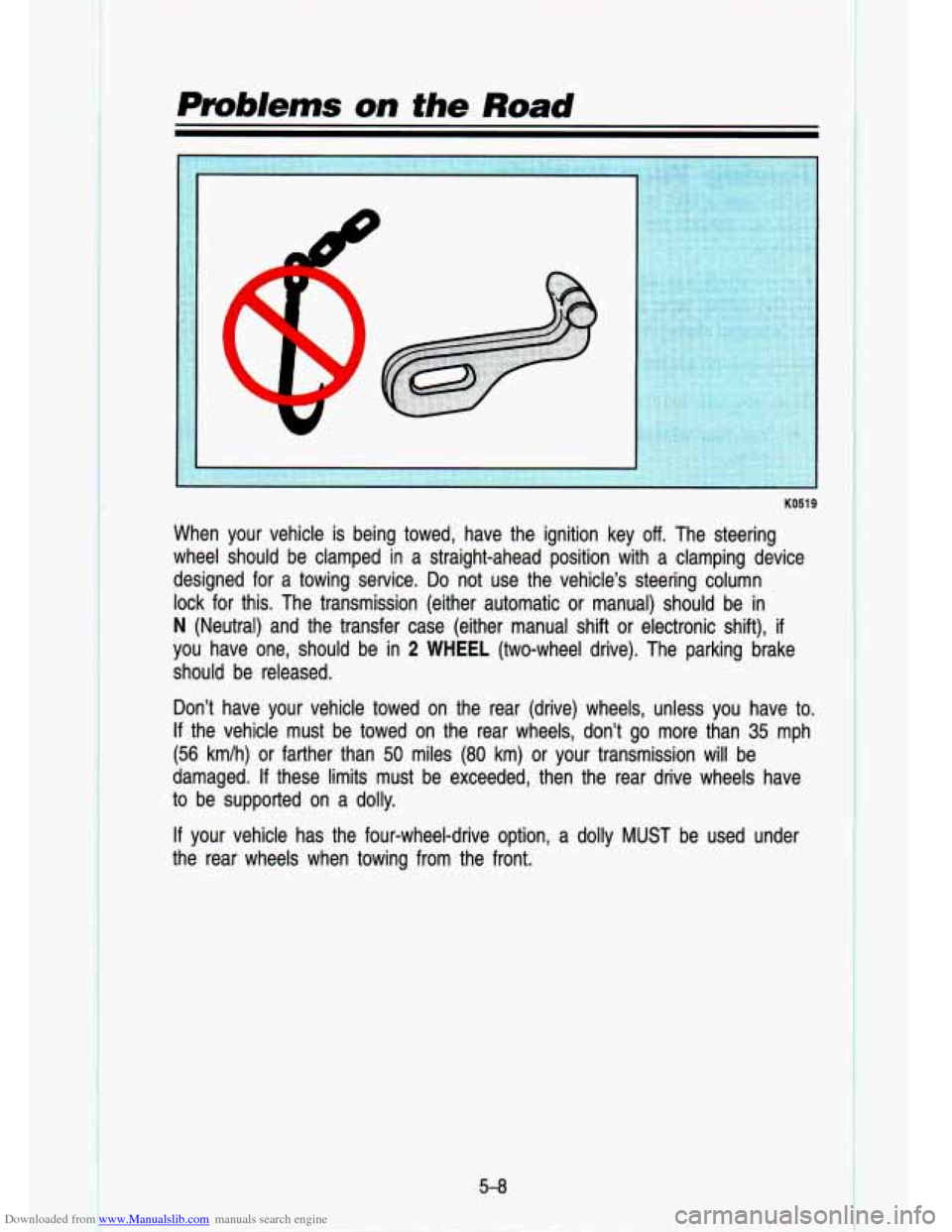
KO51 9
When your vehicle is being towed, have the ignition key off. The steering
wheel should be clamped in a straight-ahead position with a clamping device
designed for a towing service. Do not use the vehicle's steeri\
ng column
lock for this. The transmission (either automatic or manual) should\
be in
N (Neutral) and the transfer case (either manual shift or elec\
tronic shift), if
you have one, should be in 2 WHEEL (two-wheel drive). The parking brake
should be released.
Don't have your vehicle towed on the rear (drive) wheels, un\
less you have
to,
If the vehicle must be towed on the rear wheels, don't go more than 35 mph
(56 km/h) or farther than 50 miles (80 km) or your transmission will be
damaged.
If these limits must be exceeded, then the rear drive wheels have\
to be supported on a dolly.
If your vehicle has the four-wheel-drive option, a dolly
MUST be used under
the rear wheels when towing from the front.
5-8
Page 249 of 356
Downloaded from www.Manualslib.com manuals search engine Service & Appearance Care
-
Section
Here you will find information about the care of your vehicle. This part begins
with service and fuel information, and then it shows how to check important
fluid and lubricant levels. There
is also technical information about your
vehicle, and a section devoted to its appearance care.
Service
.. . . .. . . . . , . , . . r.l. .. . . .. ,. . . . . . . . . , , . . . . . . .. , . . .. , . . . . . . . . . . . . . . . . . . . . ..,. . . . . . . . . . . . . . . .=. . . . . . . . . . . . .. . .=. . . . . 6-3
Fuel
...... . .. .. . . . . ....... , .. . .. . . . . . . ... . .. ... .. ... .... .. . . . . . . ... . . .. . .. . ... ,..,, ,. .. . .. .. . .. . . .... . *. . . ., . . . .. .. .. 6-4
Checking Things Under the
Hood .................................................................,..... \
6-7
Engine Oil
I.....................1............11..........,.......,.,..I...........\
........r............. .......,. .... 6-9
Air Cleaner
..................,................................................. ...... .... ...- ......... - ..... ...... 6-14
Automatic Transmission Fluid
....... . .. . . .. . . . . .. ....-. . ... . . . . . .. .. . . . . . . . . . ... .. . . . . .. . ... . . ...... .. 6-16
Manual Transmission Fluid
....,. , . . . . ....... ... . . . .. .. . . . .. .. . .. .. . . ... . .. . . . . .. . ... . ... . . ... . . ... . . . .. 6-1 9
Hydraulic Clutch
,..........,......,....,..........I...I....I...................... ...................... ..... 6-20
Rear Axle
............ ..................... = .............I...............I..I........................ -.. ..... . .... ..... 6-21
Transfer Case
................................................,.~.....................\
..........................6-21
Front Axle .......I.............I......I.....................r..........I...r......\
............I......I.II...I...... 6-22
Engine Coolant
........................... ~ ................................. r..l ................................ 6-23
Power Steering Fluid
.....,. 3.,Iri.1111r ..................................................................... 6-27
Windshield Washer Fluid
...................................................... .................... 6-28
Brake Master Cylinder
........ . . . . .. . .... . .. .. . . . . ... . . . . .. . . . .. ..... .... . . . . . . . .. .. . . . . . .6-29
Replacing Brake System Parts
............................................................,..........,\
.. 6-30
6-1
Page 264 of 356
Downloaded from www.Manualslib.com manuals search engine Service & Appearance Care
Automatic Transmission Fluid
When to Check and Change:
A good time to check your automatic transmission fluid level is when the
engine oil is changed. Refer to the Maintenance Schedule to de\
termine when
to change your fluid. See “Scheduled Maintenance Services” \
in the Index.
How to Check:
Because this operation can be a little difficult, you may choo\
se to have this
done at a dealership Service Department.
If you
do it yourself, be sure to follow all the instructions here, or \
you could
get a false reading on the dipstick.
I NOTICE
Wait at least 30 minutes before checking the transmission fluid level if you
have been driving:
When outside temperatures are above 90°F (32°C).
At high speed for quite a while.
In heavy traffic-especially in hot weather.
While pulling a trailer.
To get the right reading, the fluid must be at normal operating \
temperature,
which is 180°F to 200°F (82°C to 93°C).
To check transmission fluid hot: Get the vehicle warmed up by driving
about
15 miles (24 km) when outside temperatures are above 50°F (10°C). If
it’s colder then 50°F (IO’C), drive the vehicle in D (3rd gear) until the
temperature gage moves and then remains steady for ten minutes.\
Then
follow the hot check procedures.
To check transmission fluid cold: A cold check is made after the vehicle
has been sitting for eight hours or more with the engine off and is used
only
as a reference. Let the engine run at idle for five minutes if outside
temperatures are
50°F (10°C) or more. If it’s colder than 50°F (lO°C), you
may have to idle the engine longer. A hot check must follow when fluid is
added during a cold check.
6-1 6
I
Page 266 of 356

Downloaded from www.Manualslib.com manuals search engine Service & Appearance Care
If you have a 4.3L engine, you will have a flip-top handle. Flip\
the
handle up and then pull out the dipstick and wipe it clean with a rag or
paper towel.
2. Push it back in all the way, wait three seconds and then pull it back out
again. Flip top handle should remain in open position.
c
PO1 65
3. Check both sides of the dipstick, and read the lower level. The fluid
level must be in the COLD area for a cold check or in the HOT area or
cross-hatched area for a hot check.
4.
If the fluid. level is where it should be, push the dipstick bac\
k in all the
way.
If you have a flip-top handle, flip the handle down to lock it in place.
How To Add Fluid:
Refer to the Maintenance Schedule to determine what kind of transmission
fluid to use. See “Recommended Fluids and Lubricants” in \
the Index.
If the fluid level is low, add only enough of the proper fluid to bring the level
up to the COLD area for a cold check or the HOT area for a hot c\
heck. It
doesn’t take much fluid, generally less than a pint. Don’\
t overfill. We
recommend you use only fluid labeled DEXRON@lIE, because fluids \
with that
label are made especially for your automatic transmission. Damag\
e caused by
fluid other than DEXRON@IIE is not covered by your new vehicle\
warranty.
After adding fluid, recheck the fluid level as described under \
“How To
Check”.
When the correct fluid level is obtained, push the dipstick ba\
ck in all the
way. Flip the handle down
if you have a flip-top handle.
6-1 8
1