ignition CHEVROLET S10 1993 2.G Owner's Guide
[x] Cancel search | Manufacturer: CHEVROLET, Model Year: 1993, Model line: S10, Model: CHEVROLET S10 1993 2.GPages: 356, PDF Size: 20.85 MB
Page 201 of 356
Downloaded from www.Manualslib.com manuals search engine CAUTION
A Coasting downhill in N (Neutral) or with the ignition off is dangerous. I
2 Your brakes will have to do all the work of slowing down. They could
get
so hot that they wouldn’t work well. You could crash. Always
have your ignition on and your vehicle in gear when you go d\
ownhill.
e
Know how to go uphill. You may want to shift down to a lower gear.
The lower gears help cool your engine and transmission, and yo\
u can climb the hill better.
Stay in your own lane when driving on two-lane roads in hills or
mountains. Don’t swing wide or cut across the center
of the road. Drive
at speeds that let you stay in your own lane. That way, you won’t be
surprised by a vehicle coming toward you in the same lane.
It takes longer to pass another vehicle when you’re going u\
phill. You’ll
want
to leave extra room to pass. If a vehicle is passing you and
doesn’t have enough room, slow down to make
it easier for the other
vehicle to get by.
As you go over the top
of a hill, be alert. There could be something in
your lane, like a stalled car or an accident.
You may see highway signs on mountains that warn
of special. problems.
Examples are long grades, passing or no-passing zones, a fallin\
g rocks
area, or winding roads. Be alert to these and take appropriate\
action.
Winter driving can present special problems. See “Winter Driving” in the
Index.
Page 209 of 356
Downloaded from www.Manualslib.com manuals search engine Before towing you should:
1. Set the parking brake firmly.
2. Place the auto’matic transmission in P (Park) or the manual transmission
in th:e lowest gear
(1 st gear).
3. Firmly attach the vehicle being towed to the tow vehicle. Refer to the
hitch manufacturer’s instructions.
Shifting the transfer case to N (Neutral) can cause your veh\
icle
to
roll even if the transmission is in P (Park), for an automatic
transmission, or
if your vehicle is in gear, for a manual transmission.
This is because the transfer case overrides the transmission.
I
1 NOTICE
6. Insert the ignition key into the iginition switch and turn it one notch .for-
ward of the “LOCK’ position. This places the key into the “OFF” position,
which unlocks the steering column while preventing battery drain\
. Unlock-
ing the steering column will allow for proper movement of the front
wheelshires during towing.
4-55
Page 220 of 356
Downloaded from www.Manualslib.com manuals search engine 2. Get the vehicles close enough so the jumper cables can reach, but be
sure the vehicles aren’t touching each other. If they are, \
it could cause
a
ground connection you don’t want. You wouldn’t be able to start your
vehicle, and the bad grounding could damage the electrical syst\
ems.
1 CAUTION
* You could be injured if the vehicles roll. Set the parking brake \
firmly I
on each vehicle. Put an automatic transmission in P (Park) or a
manual transmission in
N (Neutral).
If you have a four-wheel-drive vehicle with a manual transfer case\
shift lever, be sure the tra-fer case is not in
N (Neut--’).
3. Turn off the ignition on both vehicles. Turn off all lights that aren’t
I
needed, and radios. This will avoid sparks and help save both \
batteries.
And it could save your radio!
4. Open the hoods and locate the batteries. Find the positive (t) arlu
negative
(-) terminals on each battery.
* Using a match near a battery can cause battery gas to explode. I
People have been hurt doing this, and some have been blinded. \
Use
a flashlight if you need more light.
You don’t need to add water to the Delco Freedom@ battery \
installer’
in every new
GM vehicle. But if a battery has filler caps, be sure thG
right amount of fluid is there.
If it is low, add water to take care of
that first.
If you don’t, explosive gas could be present.
Battery fluid contains acid that can burn you. Don’t get it on you.
If
you accidentally get it in your eyes or on your skin, flush the place
I with water and get medical help immediately.
5. Check that the jumper cables don’t have loose or missing insulation. If
they do, you could get a shock. The vehicles could be damaged, too.
5-4
I
Page 224 of 356
Downloaded from www.Manualslib.com manuals search engine , vr
KO51 9
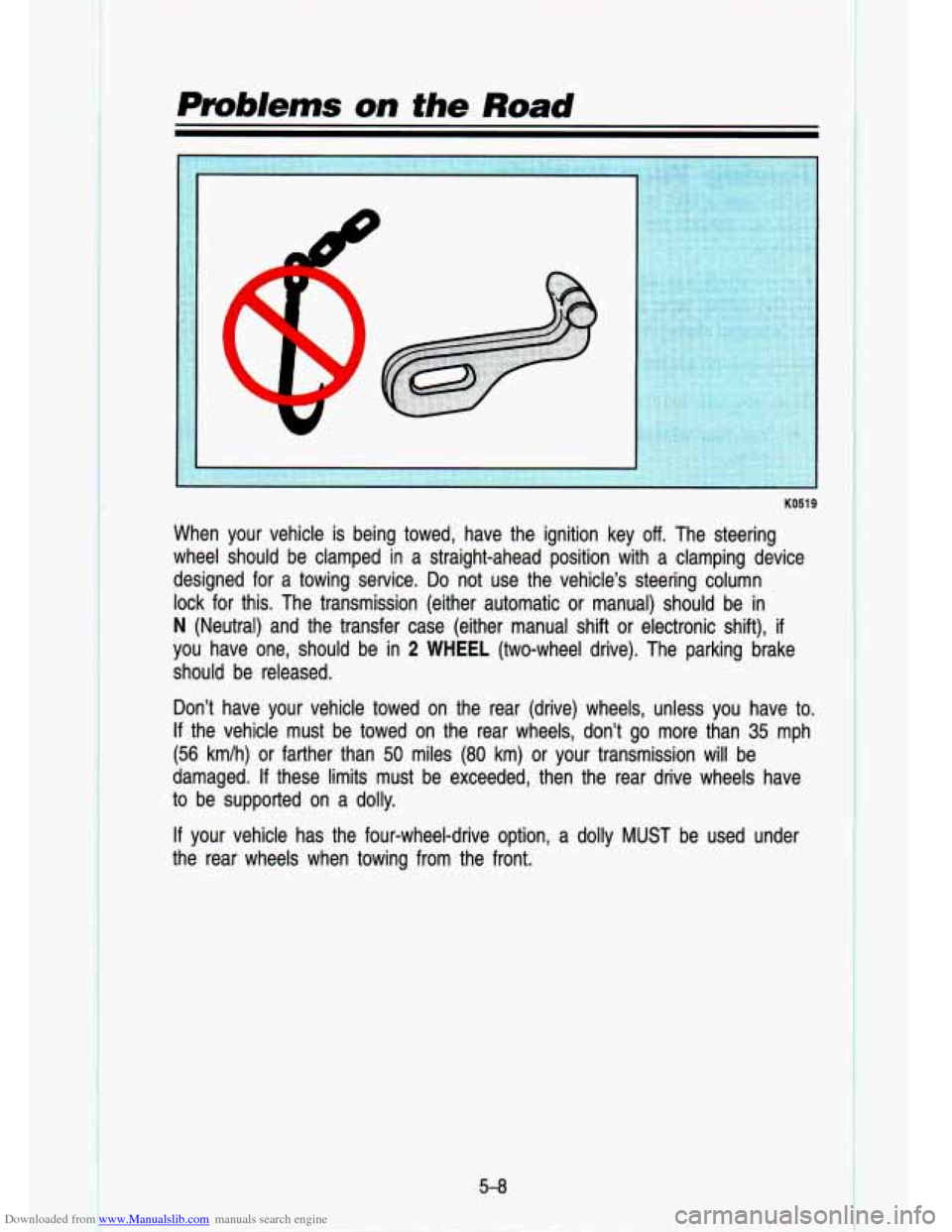
When your vehicle is being towed, have the ignition key off. The steering
wheel should be clamped in a straight-ahead position with a clamping device
designed for a towing service. Do not use the vehicle's steeri\
ng column
lock for this. The transmission (either automatic or manual) should\
be in
N (Neutral) and the transfer case (either manual shift or elec\
tronic shift), if
you have one, should be in 2 WHEEL (two-wheel drive). The parking brake
should be released.
Don't have your vehicle towed on the rear (drive) wheels, un\
less you have
to,
If the vehicle must be towed on the rear wheels, don't go more than 35 mph
(56 km/h) or farther than 50 miles (80 km) or your transmission will be
damaged.
If these limits must be exceeded, then the rear drive wheels have\
to be supported on a dolly.
If your vehicle has the four-wheel-drive option, a dolly
MUST be used under
the rear wheels when towing from the front.
5-8
Page 350 of 356
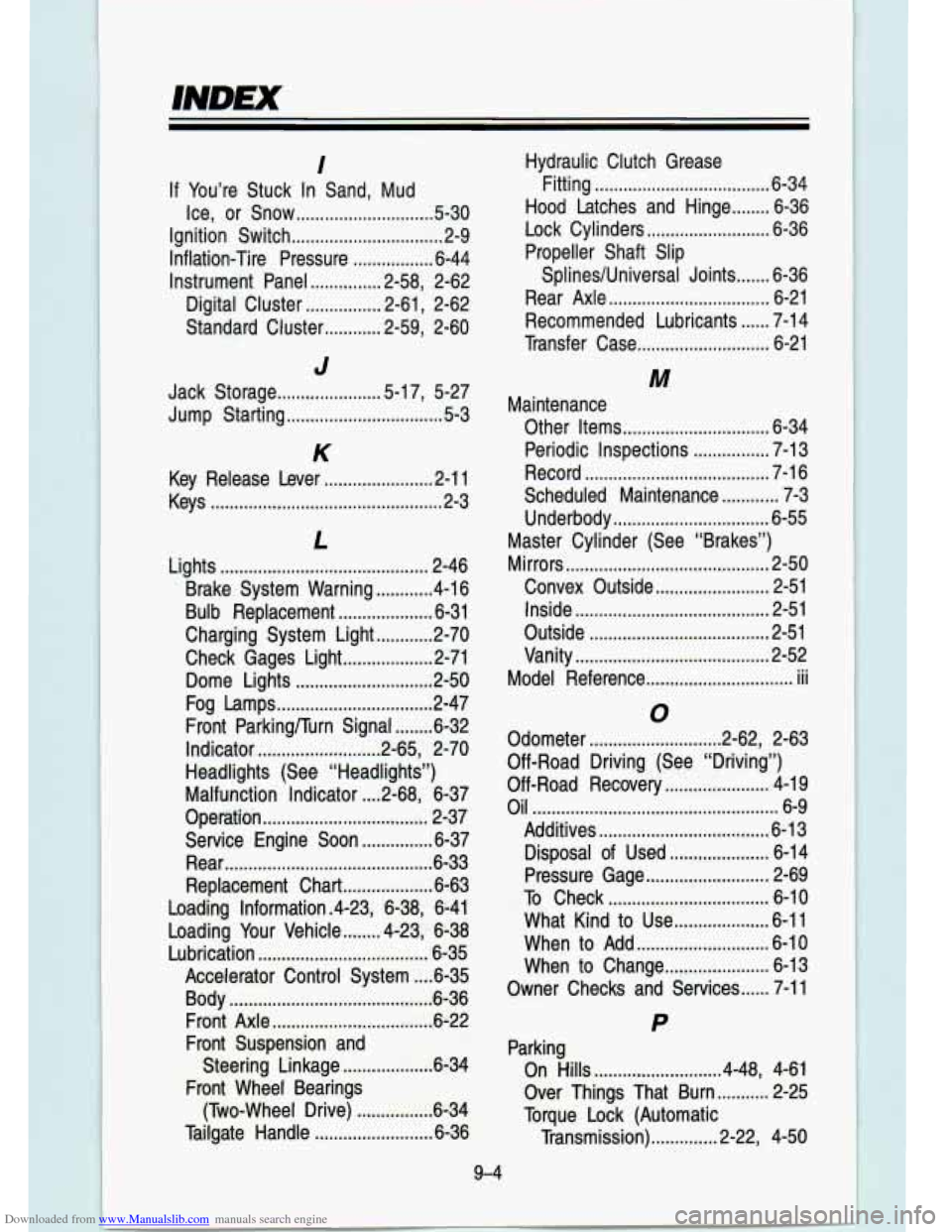
Downloaded from www.Manualslib.com manuals search engine I
If You’re Stuck In Sand. Mud
Ice. or Snow
............................. 5-30
Ignition Switch ................................ 2-9
Inflation-Tire Pressure ................. 6-44
Instrument Panel ............... 2-58, 2-62
Digital Cluster ................ 2-61, 2-62
Standard Cluster ............ 2-59, 2-60
J
Jack Storage ...................... 5-17, 5-27
Jump Starting ................................. 5-3
K
Key Release Lever ....................... 2-1 1
Keys ................................................. 2-3
L
Lights ........ ................................... 2-46
Brake System Warning ............ 4-1 6
Bulb Replacement .................... 6-31
Charging System Light ............ 2-70
Check Gages Light ................... 2-71
Dome Lights ............................. 2-50
Fog Lamps ................................. 2-47
Indicator ........................ ..2-65, 2-70
Headlights (See “Headlights”)
Malfunction Indicator
.... 2-68, 6-37
Operation ................................... 2-37
Service Engine Soon ............... 6-37
Rear ............................................ 6-33
Loading Information .4-23, 6-38, 6-41
Loading Your Vehicle ........ 4-23, 6-38
Lubrication .................................... 6-35
Front Parkingnurn Signal ........ 6-32
Replacement Chart ................... 6-63
Accelerator Control System .... 6-35
Body ........................................... .- 36
Front Axle ........................ ..... 6-22
Front Suspension and
Steering Linkage
................... 6-34
Front Wheel Bearings
(Two-Wheel Drive)
................ 6-34
Tailgate Handle ......................... 6-36
Hydraulic Clutch Grease
Fitting
..................................... 6-34
Hood Latches and Hinge ........ 6-36
Lock Cylinders .......................... 6-36
Propeller Shaft Slip
SplineslUniversal Joints
....... 6-36
Rear Axle .................................. 6-21
Recommended Lubricants ...... 7-14
Transfer Case ............................ 6-21
M
Other Items ............................... 6-34
Periodic Inspections ................ 7-13
Record ....................................... 7-16
Scheduled Maintenance ............ 7-3
Underbody ................................. 6-55
Master Cylinder (See “Brakes”)
Mirrors
........................................... 2-50
Convex Outside ........................ 2-51
inside ......................................... 2-51
Outside ...................................... 2-51
Vanity ......................................... 2-52
Model Reference ............................... iii
Maintenance
0
Odometer ............................ 2-62, 2-63
Off-Road Driving (See “Driving”)
Off-Road Recovery
...................... 4-1 9
Oil .................................................... 6-9
Additives .................................... 6-13
Disposal of Used ...................... 6-14
Pressure Gage .......................... 2-69
To Check .................................. 6-10
What Kind to Use .................... 6-11
When to Add ............................ 6-10
When to Change ...................... 6-13
Owner Checks and Services ...... 7-11
P
On Hills ........................... 4-48, 4-61
Torque Lock (Automatic
Parking
Over Things That Burn
........... 2-25
Transmission) .............. 2-22, 4-50