belt CHEVROLET S10 1993 2.G Service Manual
[x] Cancel search | Manufacturer: CHEVROLET, Model Year: 1993, Model line: S10, Model: CHEVROLET S10 1993 2.GPages: 356, PDF Size: 20.85 MB
Page 216 of 356
Downloaded from www.Manualslib.com manuals search engine Your Driving and the Road
2. Let up on the brake pedal.
3. Drive slowly until the trailer is clear of the chocks.
4. Stop and have someone pick up and store the chocks.
Maintenance When Trailer Towing
Your vehicle will need service more often when you’re pulling a \
trailer. See
the Maintenance Schedule for more on this. Things that are esp\
ecially important in trailer operation are automatic transmission fluid (don’t ove\
rfill),
engine oil, axle lubricant, belt, cooling system, and brake adj\
ustment. Each of
these is covered in this manual, and the Index will help you find them
quickly.
If you’re trailering, it’s a good idea to review these sections before
you start your trip.
Check periodically to see that all hitch nuts and bolts are tight.
Trailer Light Wiring
See “Trailer Wiring Harness” in the Index.
Power Winches
If you wish to use a power winch on your vehicle, only use it when your
vehicle is stationary or anchored.
NOTICE
Use the regular brakes, set the parking brake Or UIWK ihe wheels IW keep
your vehicle from rolling.
4-62
Page 282 of 356
Downloaded from www.Manualslib.com manuals search engine Service & Appearance Care
Other Maintenance Items
Hydraulic Clutch Grease Fitting
If you have the 4.3L (VIN code Z) engine with a manual transmission, a
grease fitting is on the clutch housing for lubricating the cl\
utch fork ball stud.
Refer to the Maintenance Schedule for information on how to lu\
bricate the
clutch housing, and what type of lubricant to use. Be sure no\
t to over-fill
because you could
damage your clutch.
Front Suspension and Steering Linkage
Refer to the Maintenance Schedule to determine how often to lubricate the
fittings and what type of lubricant to use.
Front Wheel Bearings (Two-Wheel Drive)
If your vehicle is two-wheel drive, it has wheel bearings that mu\
st be cleaned
and repacked.
Refer
to the Maintenance Schedule to determine how often this must be
done.
Single Belt Accessory Drive
Your new vehicle uses a serpentine belt that is lighter, and more durable than
systems with several belts.
The belt runs over or around the pulleys
on the engine. A tensioner is used
to keep the belt tight at all times. The tensioner also makes replacing the
belt easier.
If you need to replace the belt, be sure to get the correct
replacement belt. Your dealership or parts supplier can help yo\
u with this.
The Accessory Drive Belt Routing label on your vehicle will sh\
ow you how to
route the belt your vehicle uses.
6-34
Page 295 of 356
Downloaded from www.Manualslib.com manuals search engine If you ever replace your tires with those not having a TPC Spec number,
make sure they are the same size, load range, speed rating an\
d construction
type (bias, bias-belted or radial) as your original tires.
Mixing tires
could cause you to lose control while driving. If you mix
tires of different types (like radial and bias-belted tires) the vehicl\
e
may nlot handle properly, an'd you could have a cras'h. Be sure to
use the same size 'and type tires on all four wheels.
It's all right to drive with your compact spare (if you have one). It
I was developed for use on your vehicle.
Uniform Tire Quality Grading
The following information relates to the system developed by th\
e United
States National Highway Traffic Safety Administration which grade\
s tires by
treadwear, traction and temperature performance. (This applies o\
nly to
vehicles
sold in the United States.)
Treadwear
The treadwear grade is a comparative rating based on the wear rate of the
tire when tested under controlled conditions on a specified government test
course. For example, a tire graded
150 would wear one and a half (1 -1/2)
times as well on the government course as a tire graded 100. The relative
performance of tires depends upon the actual conditions of their use,
however, and may depart significantly from the norm due to var\
iations in
driving habits, service practices and differences in road charac\
teristics and
climate.
Traction-A, B, C
The traction grades, from highest to lowest are: A, B, and C. They represent
the tire's ability to stop on wet pavement as measured under controlled
conditions on specified government test surfaces of asphalt and concrete.
A
tire marked C may have poor traction performance.
Warning: The traction grade assigned to this tire is based on braking
(straight-ahead) traction tests and does not include cornering \
(turning) traction.
Temperature-A, B, C
The temperature grades are A (the highest), B, and C, representing the tire's
resistance
to the generation of heat and its ability to dissipate heat when
tested under controlled conditions on a specified indoor laboratory test wheel,
Sustained high temperature can cause the material of the tire
to degenerate
and reduce tire life, and excessive temperature can lead to sudden tire
6-47
Page 301 of 356
 of bak")
Downloaded from www.Manualslib.com manuals search engine If an odor lingers after cleaning vomit or urine, treat the area \
with a
watedbaking soda solution:
1 teaspoon (5 ml) of baking soda to 1 cup
(250 ml) of lukewarm water.
Finally, if needed, clean lightly with solvent-type cleaner.
Combination Stains: Like candy, ice cream, mayonnaise,
c i sauce and
unknown stains.
Carefully scrape off excess stain, then clean with cool water and allow to
dry.
If a stain remains, clean it with solvent-type cleaner.
Cleaning Vinyl or Leather
Just use warm water and a clean cloth.
Rub with a clean, damp cloth to remove dirt. You may have to do it
more than once.
Things like tar, asphalt and shoe polish will stain if you^ don’t get them
off quickly. Use a clean cloth and solvent-type vinylheather cleaner.
Cleaning the Top of the Instrument Panel
Use only mild soap and water to clean the top surfaces of the instrument
panel. Sprays containing silicones or waxes may cause annoying \
reflections in
the windshield and even make it difficult to see through the windshield under
certain conditions.
Care of Safety Belts
Keep belts clean and dry.
I
CAUTION
I
A
Do not bleach or dye safety kits. If you do, it may severely weaken
them. In a crash they might not be able to provide adequate
protection. Clean safety belts only with mild
soap and lukewarm
water.
Glass
Glass should be cleaned often. GM Glass Cleaner (GM Part No. 1050427) or
a liquid household glass cleaner will remove normal tobacco smo\
ke and dust
films.
Don’t use abrasive cleaners
on glass, because they may cause scratches.
Avoid placing decals on the inside rear window, since they may have to be
scraped off later.
6-53
Page 312 of 356
Downloaded from www.Manualslib.com manuals search engine Service & Appearance Cam
Lamp And Bulb Data
Exterior Lamps
Check Gages Indicator' Daytime Running Lights Indicator'
Daytime Running Lights Indicator2
..-
Charging System Indicator' High Beam Indicator'
High Beam lndicato?
I
Quantity 1 1
Trade No.
PC1 94
PC1 74
PC1 94
-
Instrument Cluster Illumination' 6 3 PC1 68
Malfunction Indicator Lamp (Service Engine 1 .7 PC74
Soon)'
Malfunction Indicator Lamp (Service Engine
Soon)'
I I pc194
Seat Belt Indicator'" 1 2 PC1 94
Shift Indicator (PRNDL)'
1 2 PC1 94
Tachometer Warning Band'
1 2 PC1 94
Turn Signal Indicator'
2 .7 PC74
Upshift Indicator' 1 .7 PC74
Upshift Indicator2 1
2 PC1 94
'With Standard Instrument Cluster 'With Digital Instrument Cluster
6-64
Page 315 of 356
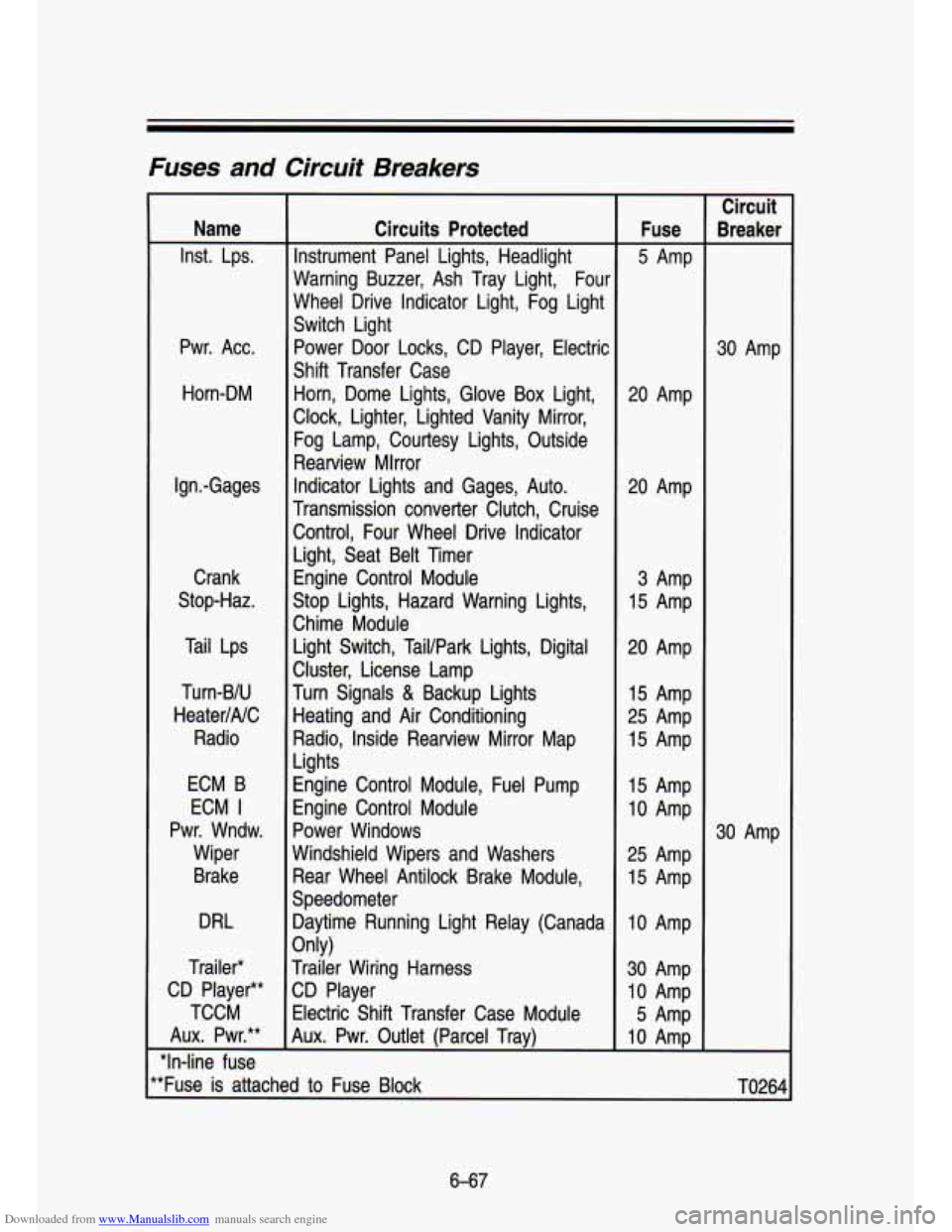
Downloaded from www.Manualslib.com manuals search engine Fuses and Circuit Breakers
Name
Inst. Lps.
Pwr. Acc. Horn-DM
Ign.-Gages Crank
Stop-Haz.
Tail Lps
Turn-BIU
HeaterINC Radio
ECM B
ECM
I
Pwr. Wndw. Wiper
Brake
DRL
Trailer*
CD Player**
TCCM
Aux. Pwr.**
"In-line fuse Circuits Protected
Instrument Panel Lights, Headlight
Warning Buzzer, Ash Tray Light, Four
Wheel Drive Indicator Light, Fog Light
Switch Light Power Door Locks, CD Player, Electric
Shift Transfer Case Horn, Dome Lights, Glove Box Light,
Clock, Lighter, Lighted Vanity Mirror,
Fog Lamp, Courtesy Lights, Outside
Rearview Mlrror
Indicator Lights and Gages, Auto.
Transmission converter Clutch, Cruise Control, Four Wheel Drive Indicator
Light, Seat Belt Timer Engine Control Module
Stop Lights, Hazard Warning Lights,
Chime Module Light Switch, Tail/Park Lights, Digital
Cluster, License Lamp
Turn Signals
& Backup Lights
Heating and Air Conditioning
Radio, Inside Rearview Mirror Map
Lights
Engine Control Module, Fuel Pump
Engine Control Module
Power Windows
Windshield Wipers and Washers Rear Wheel Antilock Brake Module,
Speedometer Daytime Running Light Relay (Canada
Trailer Wiring Harness
CD Player
Electric Shift Transfer Case Module
Aux. Pwr. Outlet (Parcel Trav)
Only) Fuse
5 Amp
20 Amp
20 Amp
3 Amp
15 Amp
20 Amp 15 Amp
25 Amp
15 Amp
15 Amp
10 Amp
25 Amp
15 Amp
10 Amp
30 Amp
10 Amp
5 Amp
10 AmD Circuit
kea ker
30 Amp
30 Amp
'*Fuse is attached to Fuse Block
TO264
6-67
Page 320 of 356
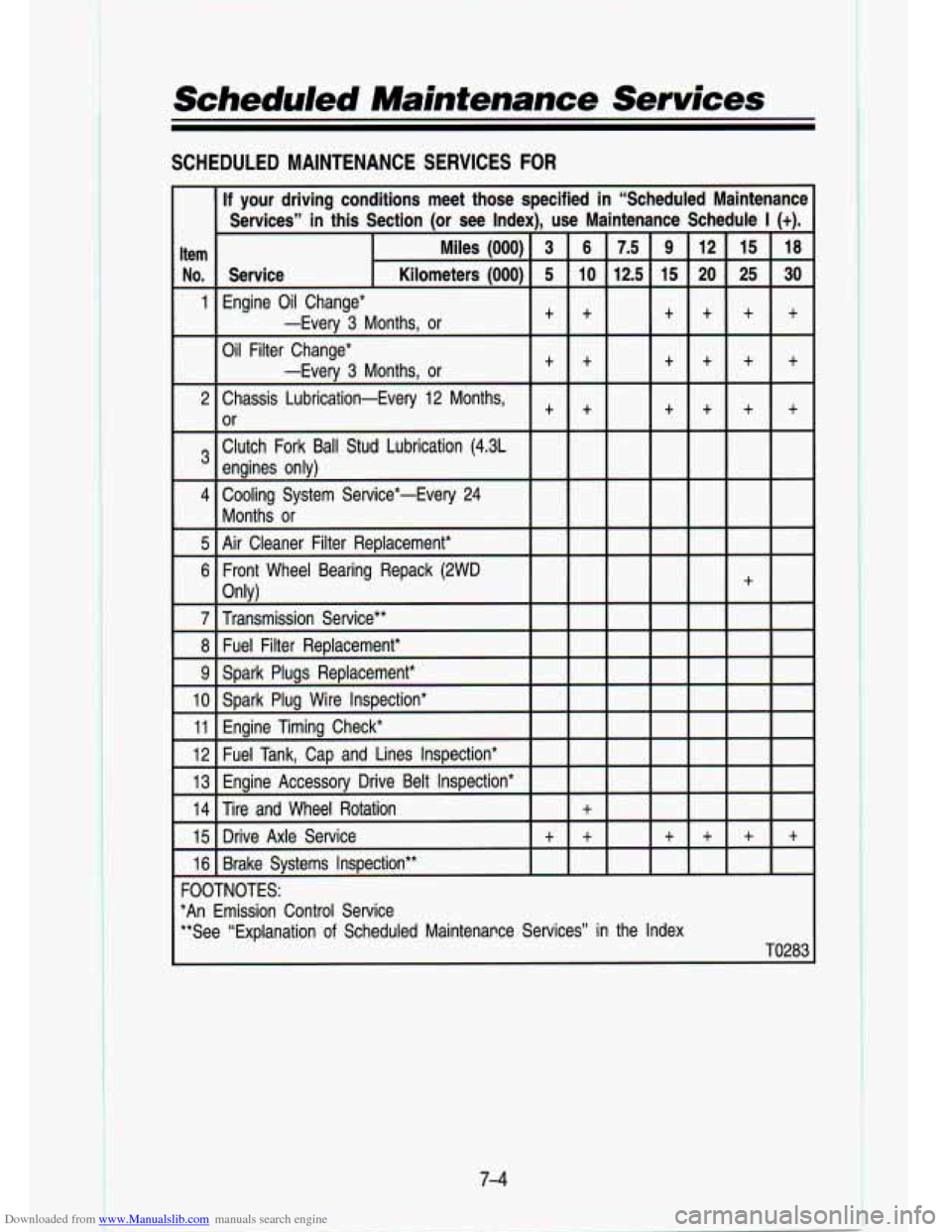
Downloaded from www.Manualslib.com manuals search engine Scheduled Maintenance Services
SCHEDULED MAINTENANCE SERVICES FOR
I
If your driving conditions meet those specified i
Services” in this Section (or see Index), use
M
Item I I Miles (000) I 3 I 6
No. Service Kilometers (000) 5 10
1 Engine Oil Change*
I -Even/ 3 Months, or
Oil Filter Change*
-Every 3 Months, or
tt
2 Chassis Lubrication-Every 12 Months,
,, Clutch Fork Ball Stud Lubrication (4.3L or J I engines only) I
4 Cooling System Service*-Every 24
1 Months or
5 I Air Cleaner Filter Replacement* I I
6 Front Wheel Bearing Repack (2WD
Only)
7 Transmission Service**
8 Fuel Filter Replacement*
9 Spark Plugs Replacement*
10 Spark Plug Wire Inspection*
11 Engine Timing Check*
12 Fuel Tank, Cap and Lines Inspection*
13 Engine Accessory Drive Belt Inspection*
14 Tire and Wheel Rotation
t
15 Drive Axle Service tt
16 Brake Systems Inspection**
FOOTNOTES:
*An Emission Control Service
**See “Explanation
of Scheduled Maintenapce Services” i n the Index
TO283
7-4
Page 322 of 356
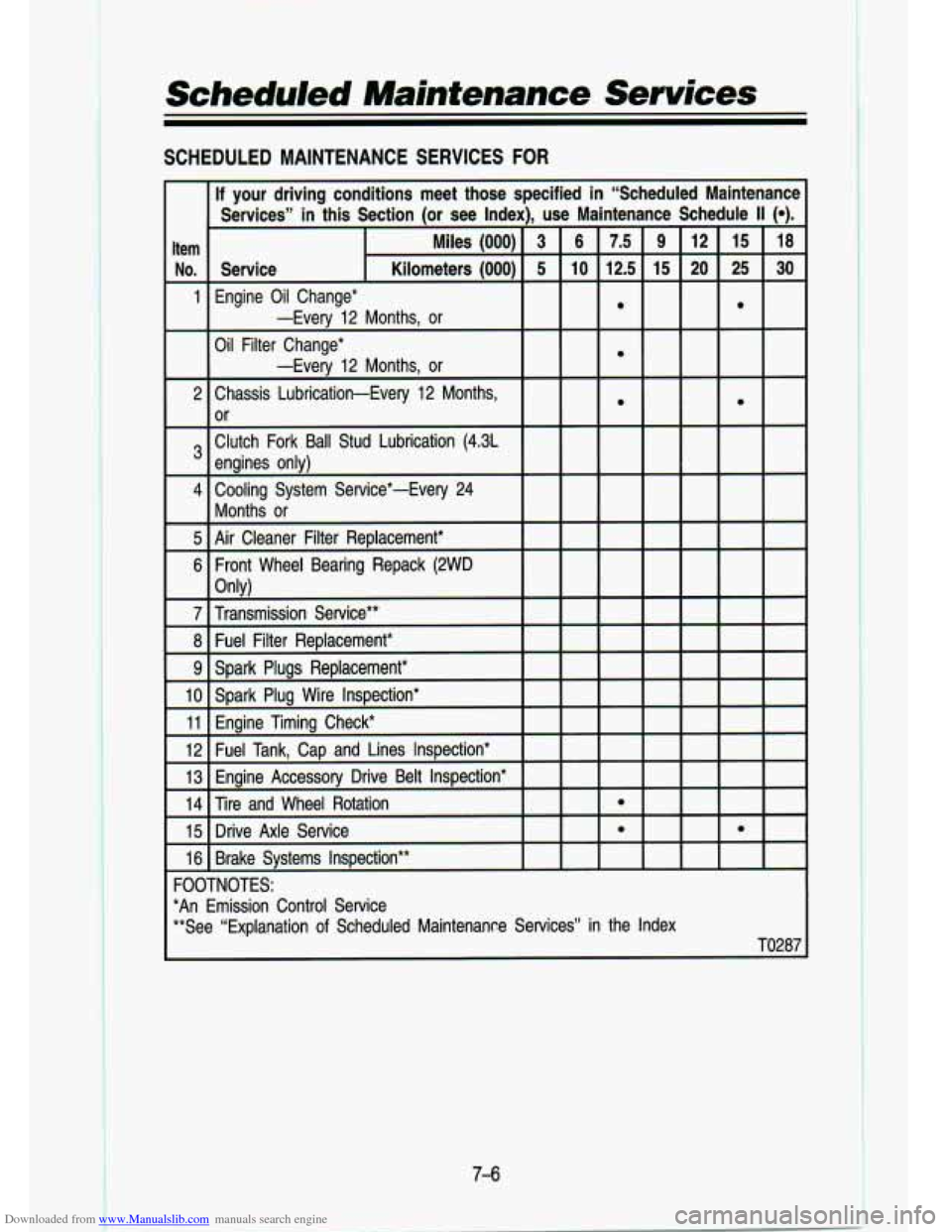
Downloaded from www.Manualslib.com manuals search engine scheduled Maintenance Services
I
SCHEDU--D MAIM 4ANCE SEf -7s FOR
If your driving conditions meet those I
Services” in this Section (or see lnde
Item Miles
(000)
No. Service Kilometers (000)
1 Engine Oil Change*
Oil Filter Change* -Every 12 Months,
or
-Every
12 Months, or
2 Chassis Lubrication-Every 12 Months, or
Clutch Fork Ball Stud Lubrication (4.3L
engines only)
Months or
3
4 Cooling System Service*-Every 24
5 Air Cleaner Filter Replacement*
6 Front Wheel Bearing Repack (2WD
7 Transmission Service**
8 Fuel Filter Replacement*
9 Spark Plugs Replacement*
10 Spark Plug Wire Inspection* 11 Engine Timing Check*
12 Fuel Tank, Cap and Lines Inspection*
13 Engine Accessory Drive Belt Inspection*
14 Tire and Wheel Rotation
15 Drive Axle Service
16 Brake Systems Inspection**
Only)
FOOTNOTES:
*An Emission Control Service
36
5 10
**See “Explanation of Scheduled Maintenance Services” in the Index
TO287
7-6
Page 326 of 356
Downloaded from www.Manualslib.com manuals search engine Scheduled Maintenance Services
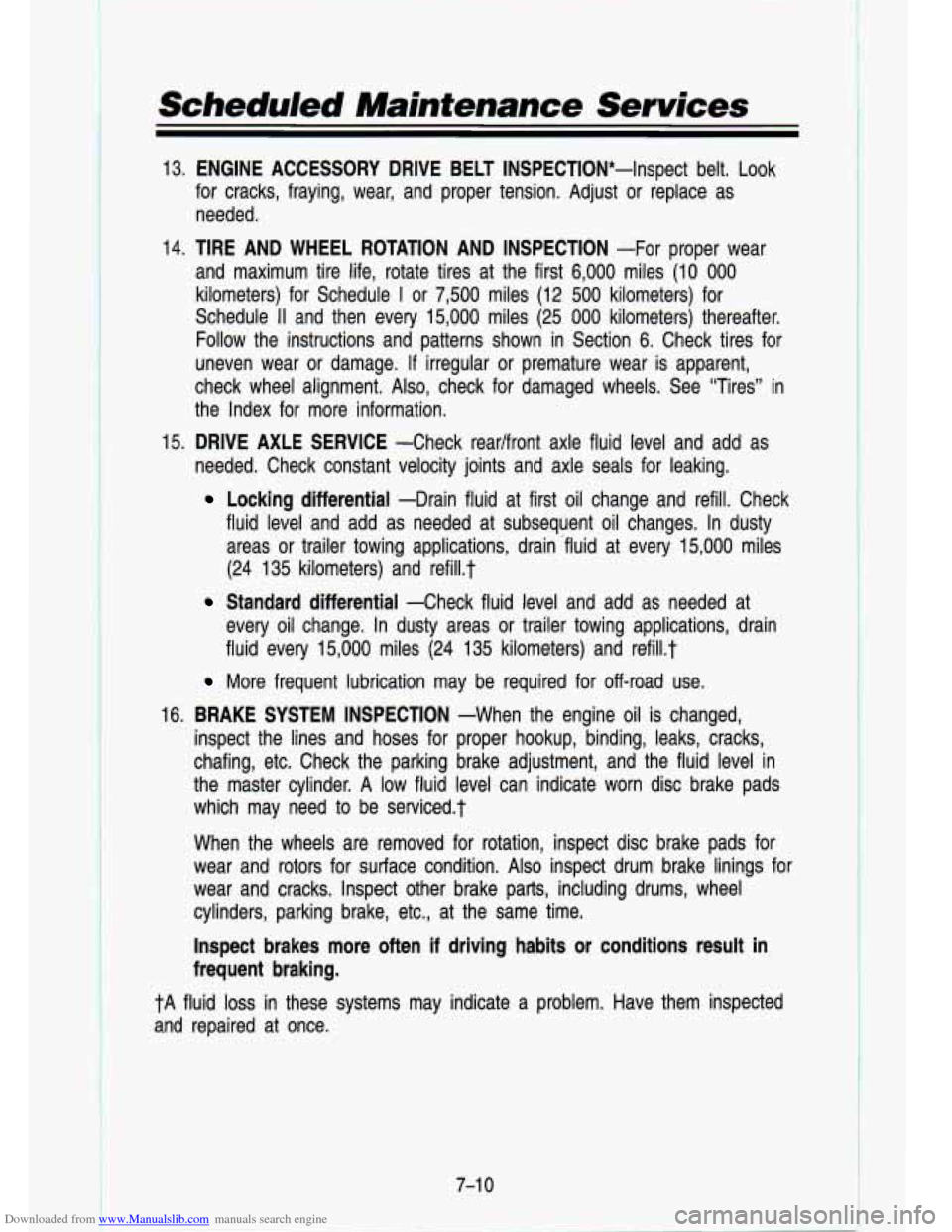
13. ENGINE ACCESSORY DRIVE BELT INSPECTION*-Inspect belt. Look
for cracks, fraying, wear, and proper tension. Adjust or replac\
e as needed.
14. TIRE AND WHEEL ROTATION AND INSPECTION -For proper wear and maximum tire life, rotate tires at the first
6,000 miles (10 000
kilometers) for Schedule I or 7,500 miles (12 500 kilometers) for
Schedule
II and then every 15,000 miles (25 000 kilometers) thereafter.
Follow the instructions and patterns shown in Section
6. Check tires for
uneven wear or damage.
If irregular or premature wear is apparent,
check wheel alignment. Also, check for damaged wheels. See “\
Tires” in
the Index for more information.
15. DRIVE AXLE SERVICE -Check rear/front axle fluid level and add \
as
needed. Check constant velocity joints and axle seals for leaki\
ng.
Locking differential -Drain fluid at first oil change and refill. Check
fluid level and add as needed at subsequent oil changes. In d\
usty areas
or trailer towing applications, drain fluid at every 15,000 miles
(24
135 kilometers) and refi1l.t
Standard differential -Check fluid level and add as needed at
every oil change. In dusty areas or trailer towing applications\
, drain
fluid every
15,000 miles (24 135 kilometers) and refil1.t
More frequent lubrication may be required for off-road use.
16. BRAKE SYSTEM INSPECTION -When the engine oil is changed,
inspect the lines and hoses for proper hookup, binding, leaks, \
cracks,
chafing, etc. Check the parking brake adjustment, and the fluid\
level in
the master cylinder. A low fluid level can indicate worn disc \
brake pads
which may need to be serviced.t
When the wheels are removed for rotation, inspect disc brake p\
ads for
wear and rotors for surface condition. Also inspect drum brake \
linings for
wear and cracks. Inspect other brake parts, including drums, wh\
eel cylinders, parking brake, etc., at the same time.
Inspect brakes more often if driving habits or conditions resul\
t
in
frequent braking.
tA fluid
loss in these systems may indicate a problem. Have them inspected
and repaired at once.
7-1 0
Page 328 of 356

Downloaded from www.Manualslib.com manuals search engine Scheduled Maintenance Services
Steering column lock operation -While parked, try to turn the \
key to Lock
in each gear shift position.
With an automatic transmission, the key should turn to LOCK only when
the gear shift is in P (Park).
With manual shift, the key should turn to LOCK only when you’re in R
(Reverse).
On vehicles with a key release lever, try
to turn the key to LOCK without
pressing the lever. The key should turn to LOCK only with the key lever
depressed.
On all vehicles, the key should come out only in LOCK.
Parking brake and transmission
P (Park) mechanism operation -
CAUTION
A When you are doing this check, your vehicle could begin to move.
You or others could be injured and property could be damaged.
Make sure there is room in front of your vehicle in case you begin
to roll. Be ready to apply the regular brake at once should the
vehicle begin to move.
Park on a fairly steep hill, with the vehicle facing downhill.\
1.- )ping your foot
on the regular brake, set the manual parking brake.
To check the parking brake: With the engine running and the
transmission in
N (Neutral), slowly remove foot pressure from the regular
brake pedal.
Do this until the vehicle is held by the parking brake only.
To check the P (Park) mechanism’s holding ability: Apply the \
regular
brake and shift to
P (Park). Release the manual parking brake, then
slowly release the regular brake.
Lap and shoulder belts condition and operation -Inspect belt sy\
stem,
including: webbing, buckles, latch plates, retractors, guide loop\
s and anchors. Have a belt assembly replaced
if the webbing has been cut or otherwise
damaged.
Body Lubrication Service -Lubricate all body door hinges including th\
e
tailgate, tailgate handle pivot points, and tailgate mounted spa\
re tire carrier (if equipped), lubricate the body hood, fuel door and rear compartment hinges,
latches and locks including interior glove box and console door\
s, and any
moving seat hardware. Lubricate the hood safety lever pivot and\
prop rod
pivot. More frequent lubrication may be required when exposed to a corrosive
environment.
7-1 2