light CHEVROLET S10 1993 2.G Manual PDF
[x] Cancel search | Manufacturer: CHEVROLET, Model Year: 1993, Model line: S10, Model: CHEVROLET S10 1993 2.GPages: 356, PDF Size: 20.85 MB
Page 214 of 356

Downloaded from www.Manualslib.com manuals search engine Your Driving and the Road
Following Distance
Stay at least twice as far behind the vehicle ahead as you w\
ould when
driving your vehicle without a trailer. This can help you avoi\
d situations that require heavy braking and sudden turns.
Passing
You’ll need more passing distance up ahead when you’re to\
wing a trailer.
And, because you’re a good deal longer, you’ll need
to go much farther
beyond the passed vehicle before you can return
to your lane.
Backing Up
Hold the bottom of the steering wheel with one hand. Then, to move the
trailer left, just move your hand to the left. To move the trailer to the right,
move your hand
to the right. Always back up slowly and, if possible, have
someone guide you.
Making Turns
When you’re turning with a trailer, make wider turns than n\
ormal. Do this so
your trailer wheels won’t strike soft shoulders, curbs, road \
signs, trees, or
other objects. Avoid jerky or sudden maneuvers. Signal well in advance.
Turn Signals When Towing a Trailer
When you tow a trailer, your vehicle has to have a different turn signal
flasher and extra wiring. The green arrows on your instrument \
panel will flash
whenever you signal a turn or lane change. Properly hooked up,\
the trailer lights will also flash, telling other drivers you’re about
to turn, change lanes,
or stop.
When towing a trailer, the green arrows on your instrument pan\
el will flash for
turns even
if the bulbs on the trailer are burned out. Thus, you may think \
drivers behind you are seeing your signal when they are not.
It’s important to
check occasionally to be sure the trailer bulbs are still work\
ing.
Driving on Grades
Reduce speed and shift to a lower gear before you start down a long or
steep downgrade.
If you don’t shift down, you might have to use your brakes
so much that they would get hot and no longer work well.
On a long uphill grade, shift down and reduce your speed to \
around
45 mph
(70 km/h) to reduce the possibility of engine and transmission ove\
rheating.
If you have an automatic transmission, you should use D when towing a
trailer. Operating your vehicle in
D when towing a trailer will minimize heat
buildup and extend the life of your transmission. Or, if you have a manual
transmission with fifth gear, it’s better not to use fifth \
gear, just drive in fourth
gear (or, as you need
to, a lower gear).
4-60
Page 216 of 356
Downloaded from www.Manualslib.com manuals search engine Your Driving and the Road
2. Let up on the brake pedal.
3. Drive slowly until the trailer is clear of the chocks.
4. Stop and have someone pick up and store the chocks.
Maintenance When Trailer Towing
Your vehicle will need service more often when you’re pulling a \
trailer. See
the Maintenance Schedule for more on this. Things that are esp\
ecially important in trailer operation are automatic transmission fluid (don’t ove\
rfill),
engine oil, axle lubricant, belt, cooling system, and brake adj\
ustment. Each of
these is covered in this manual, and the Index will help you find them
quickly.
If you’re trailering, it’s a good idea to review these sections before
you start your trip.
Check periodically to see that all hitch nuts and bolts are tight.
Trailer Light Wiring
See “Trailer Wiring Harness” in the Index.
Power Winches
If you wish to use a power winch on your vehicle, only use it when your
vehicle is stationary or anchored.
NOTICE
Use the regular brakes, set the parking brake Or UIWK ihe wheels IW keep
your vehicle from rolling.
4-62
Page 218 of 356

Downloaded from www.Manualslib.com manuals search engine Problems on the Road
AM505003
Your hazard warning flashers let you warn others. They also let pol\
ice know
you have a problem. Your front and rear turn signal lights will flash on and
off. But they won’t flash if you’re braking.
i
Press the button in to make your front and rear turn signal lights flash on
and
off.
Your hazard warning flashers work no matter what position your key is in,
and even if the key isn’t in.
Page 220 of 356
Downloaded from www.Manualslib.com manuals search engine 2. Get the vehicles close enough so the jumper cables can reach, but be
sure the vehicles aren’t touching each other. If they are, \
it could cause
a
ground connection you don’t want. You wouldn’t be able to start your
vehicle, and the bad grounding could damage the electrical syst\
ems.
1 CAUTION
* You could be injured if the vehicles roll. Set the parking brake \
firmly I
on each vehicle. Put an automatic transmission in P (Park) or a
manual transmission in
N (Neutral).
If you have a four-wheel-drive vehicle with a manual transfer case\
shift lever, be sure the tra-fer case is not in
N (Neut--’).
3. Turn off the ignition on both vehicles. Turn off all lights that aren’t
I
needed, and radios. This will avoid sparks and help save both \
batteries.
And it could save your radio!
4. Open the hoods and locate the batteries. Find the positive (t) arlu
negative
(-) terminals on each battery.
* Using a match near a battery can cause battery gas to explode. I
People have been hurt doing this, and some have been blinded. \
Use
a flashlight if you need more light.
You don’t need to add water to the Delco Freedom@ battery \
installer’
in every new
GM vehicle. But if a battery has filler caps, be sure thG
right amount of fluid is there.
If it is low, add water to take care of
that first.
If you don’t, explosive gas could be present.
Battery fluid contains acid that can burn you. Don’t get it on you.
If
you accidentally get it in your eyes or on your skin, flush the place
I with water and get medical help immediately.
5. Check that the jumper cables don’t have loose or missing insulation. If
they do, you could get a shock. The vehicles could be damaged, too.
5-4
I
Page 246 of 356
Downloaded from www.Manualslib.com manuals search engine Pm6/ems on the Road
If You’re Stuck: In Sand, Mud, Ice or
snow
What you don’t want to do when your vehicle is stuck is to spin your
wheels. The method known as “rocking” can help you get o\
ut when you’re
stuck, but you must use caution.
~
fi If you let your tires spin at high speed, they can explode and you1 or
others could be injured. And, the transmiss’ion or other parts of the
vehicle
can overheat. That could cause an engine comparlme’nt fire
or other damage. When you’re
stuck, spin the wheels as little as
possible.
Don’t spin the wheels above 35 rnph 1(55 krn/h) as shown
oln the speedometer.
Rocking Your Vehicle To Get It Out:
First, turn your steering wheel left and right. That will clear the area \
around
your front wheels. Then shift back and forth between
R (Reverse) and a
forward gear (or with a manual transmission, between
1 (First) or 2 (Second)
gear and
R (Reverse), spinning the wheels as little as possible. Release \
the
accelerator pedal while you shift, and press lightly on the accelerator pedal
when the transmission is in gear.
If that doesn’t get you out after a few tries,
you may need to be towed
out. Or, you can use your recovery hooks, if your
vehicle has them.
If you do need to be towed out, see “Towing Your Vehicle’’
in the Index.
5-30
Page 256 of 356

Downloaded from www.Manualslib.com manuals search engine Service & Appearance Care
Hood Release
To open the hood, first pull the handle inside the vehicle on th\
e lower left
side of the instrument panel. Then
go to the front of the vehicle and release
the secondary hood release. Lift the hood, release the hood pr\
op from its
retainer and put the hood prop into the slot in the hood. You may have a
light that comes on when you lift the hood.
L
Thing's that burn can .get on hot engine parts and s'hrt a fire. These I
include liqwids like gasoline, oil, coolant, brake fluid, windshiield
washer and .other fluids, and plastic oir rubber. You or others could
be blurned. Be careful not
to drop or spill thing.s that will bum onto a
hot eng,ine.
L
Before closing the hood, be sure all the filler caps are on properly. Then lift
the hood to relieve pressure on the hood prop.
Remove the hood prop from the slot in the hood and return th\
e prop to its
retainer. Then just pull the hood down and close
it firmly.
6-8
Page 261 of 356
Downloaded from www.Manualslib.com manuals search engine Energy Conserving II
Oils with these words on the container will help you save fuel.
This doughnut-shaped logo (symbol) is used
on most oil containers to help
you select the correct oil.
You should look for this on the oil container, and use
only those oils that
display the logo.
GM Goodwrench@ oil (in Canada, GM Engine Oil) meets all the requirements
for your vehicle.
Engine Oil Additives:
Don’t add anything to your oil. Your GM dealer is ready to advise if you think
something should be added.
When to Change Engine c)k
See if any one of these is true for you:
Most trips are less than 4 miles (6 km).
It’s below freezing outside and most trips are less than 10 miles
(16 km).
The engine is at low speed most of the time (as in door-to-door delivery,
You tow a trailer often.
or in stop-and-go traffic).
Most trips are through dusty places.
The vehicle is frequently operated off-road.
If any one of these is true for your vehicle, you need to chang\
e your oil and
filter every 3,000 miles (5000 km) or 3 months-whichever comes first.
If none of them are true, change the oil every 7,500 miles (12 500 km) or
12 months-whichever comes first. Change the filter at the first oil change
and at every other oil change after that.
If your vehicle has 4-wheel drive, you ,will have a remote oil filter located
under the hood.
It is mounted to the front left inner fender, behind the
headlights.
Engine Block Heater:
An engine block heater can be a big help if you have to park outside in very
cold weather,
-0°F (-18°C) or colder. If your vehicle has this option, see
“Engine Block Heater” in the Index.
6-1 3
Page 268 of 356
Downloaded from www.Manualslib.com manuals search engine Service & Amearance Cam
How to Add Fluid:
Here’s how to add fluid. Refer to the Maintenance Schedule to determine
what kind of fluid to use. See “Recommended Fluids and Lubricants” in the
Index.
1. Remove the filler plug.
2. Add fluid at the filler plug hole. Add only enough fluid to bring the fluid
3. Install the plug. Be sure it is fully seated.
level up to the bottom
of the filler plug hole.
Hydraulic Clutch
The hydraulic clutch in your vehicle is self-adjusting. A slight amount of play
[1/4
(6 mm)-112 inch (13 mm)] in the pedal is normal.
When to Check and What to Use:
i
c
PO257 I
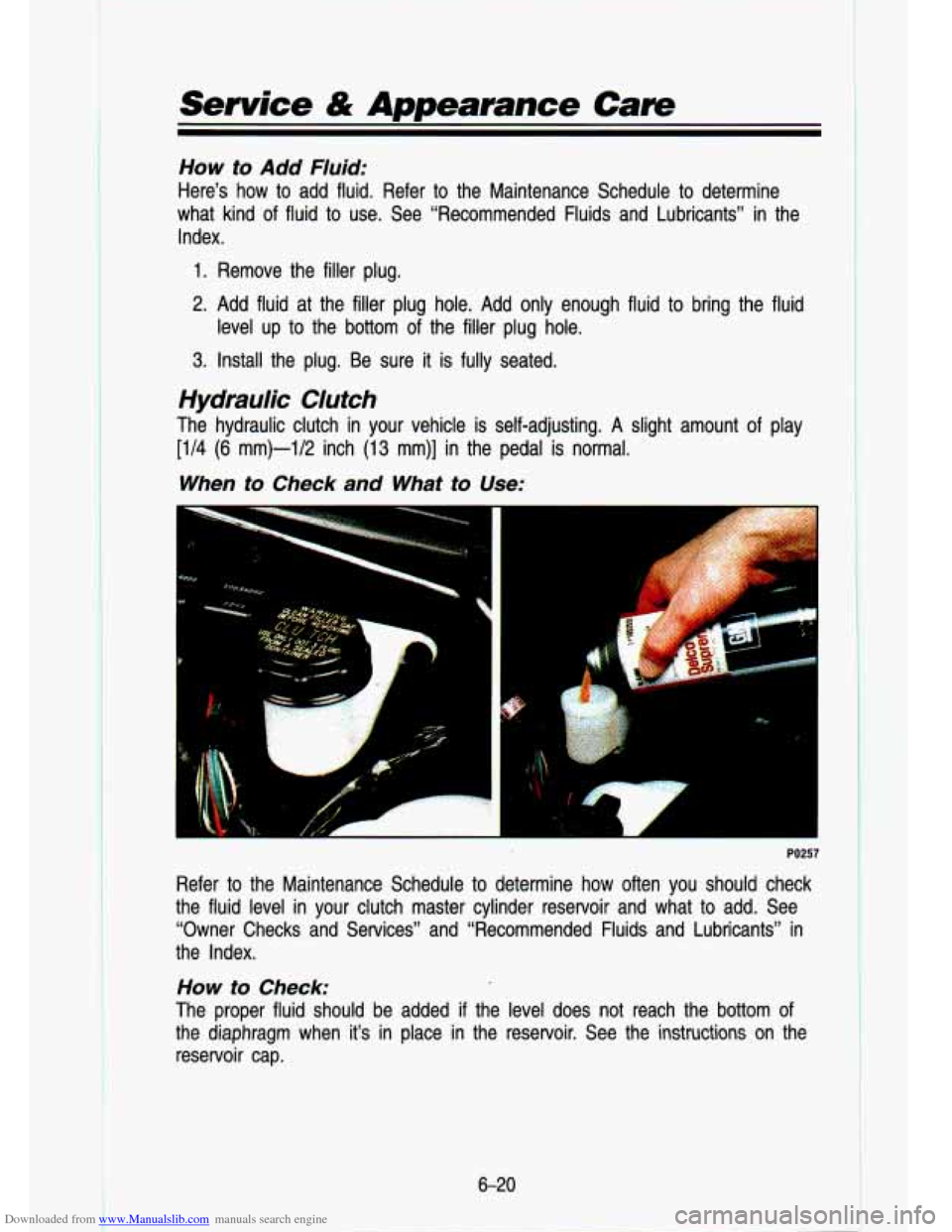
Refer to the Maintenance Schedule to determine how often you s\
hould check
the fluid level in your clutch master cylinder reservoir and w\
hat to add. See
“Owner Checks and Services” and “Recommended Fluids and \
Lubricants” in
the Index.
How to Check:
The proper fluid should be added if the level does not reach the bottom of
the diaphragm when it’s in place in the reservoir. See the
instructions on the
reservoir cap.
6-20
Page 271 of 356
Downloaded from www.Manualslib.com manuals search engine How to Check Lubricant:
i I
KO998
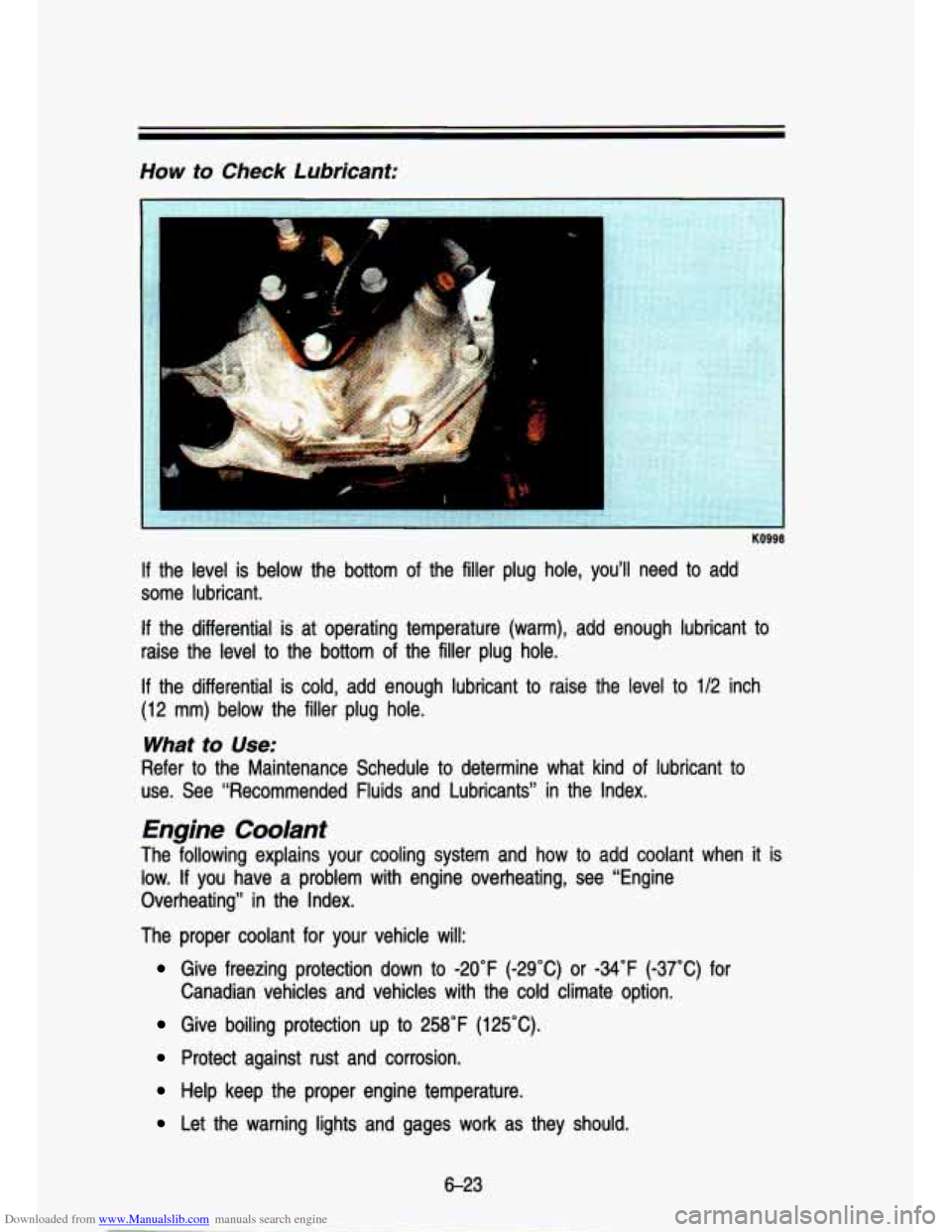
If the level is below the bottom of the filler plug hole, you’ll need to add
some lubricant.
If the differential is at operating temperature (warm), add enough lubricant to
raise the level
to the bottom of the filler plug hole.
If the differential is cold, add enough lubricant to raise the level to 1/2 inch
(12 mm) below the filler plug hole.
What to Use:
Refer to the Maintenance Schedule to determine what kind of lubricant to
use. See “Recommended Fluids and Lubricants” in the Index.\
Engine Coolant
The following explains your cooling system and how to add coolant when it is
low.
If you have a problem with engine overheating, see “Engine
Overheating’’ in the Index.
The proper coolant
for your vehicle will:
Give freezing protection down to -20°F (-29°C) or -34°F (-37°C) for
Give boiling protection up to 258°F (125°C).
Canadian vehicles and vehicles with the cold climate option.
Protect against rust and corrosion.
Help keep
the proper engine temperature.
Let the warning lights and gages work as they should.
6-23
Page 280 of 356
Downloaded from www.Manualslib.com manuals search engine Service & Appearance Care
Headlights
KO993
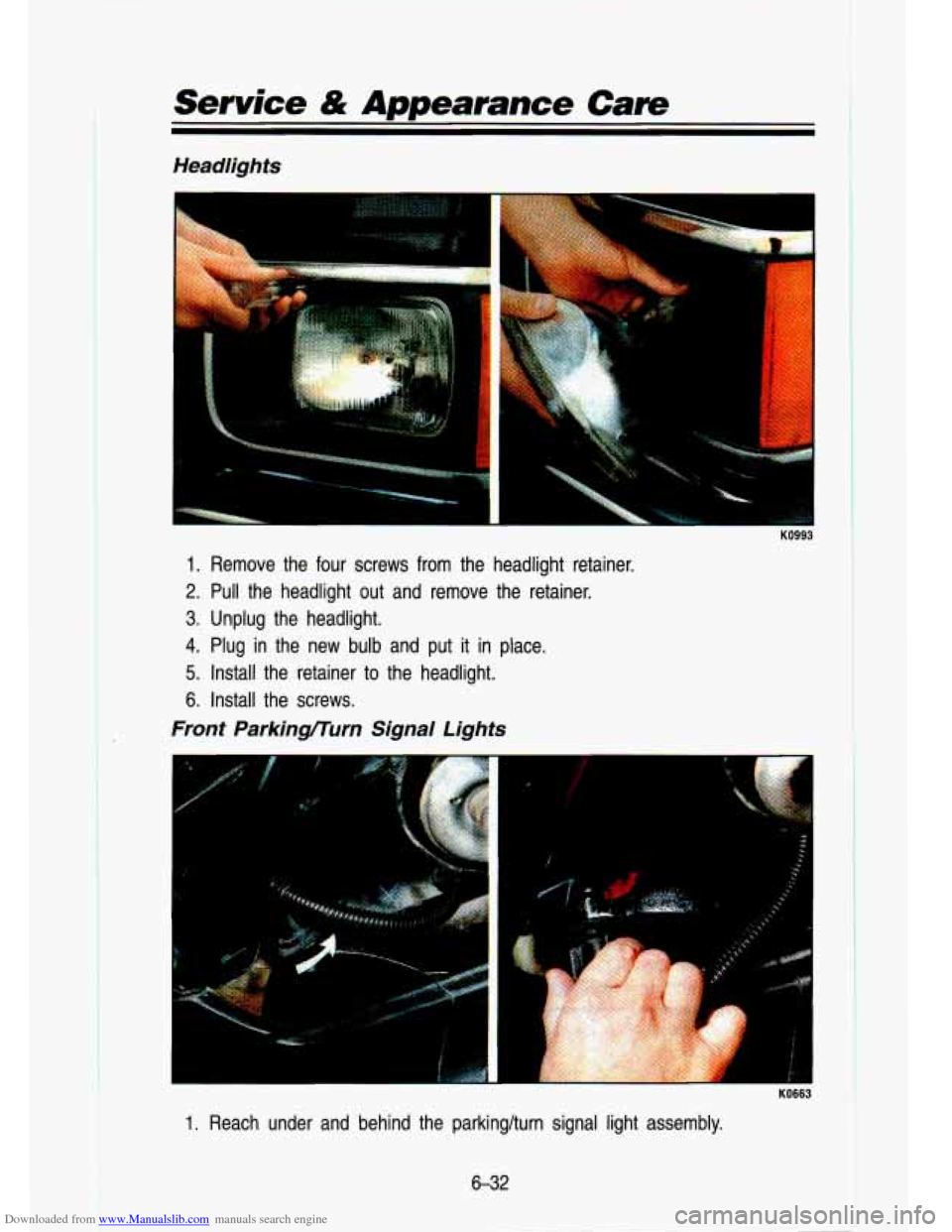
1. Remove the four screws from the headlight retainer.
2. Pull the headlight out and remove the retainer.
3. Unplug the headlight.
4. Plug in the new bulb and put it in place.
5. Install the retainer to the headlight.
6. Install the screws.
Front ParkingfTurn Signal Lights
KO663
1. Reach under and behind the parkingkurn signal light assembly.
6-32
i