light CHEVROLET S10 1993 2.G Service Manual
[x] Cancel search | Manufacturer: CHEVROLET, Model Year: 1993, Model line: S10, Model: CHEVROLET S10 1993 2.GPages: 356, PDF Size: 20.85 MB
Page 153 of 356
Downloaded from www.Manualslib.com manuals search engine 4. Depress the BAND knob. The radio will display 000.
5. Enter the second three digits of the code. The display will show the
numbers as entered.
6. Depress the BAND knob. If the display shows "- - -", the disabling
sequence was successful. The numbers matched the user-selected c\
ode
or the factory back-up code and the unit is in the UNSECURED \
mode.
If
the display shows SEC, the disabling sequence was unsuccessful and
the numbers did not match either
of the codes and. the .unit will rema-in
in the SECURED mode.
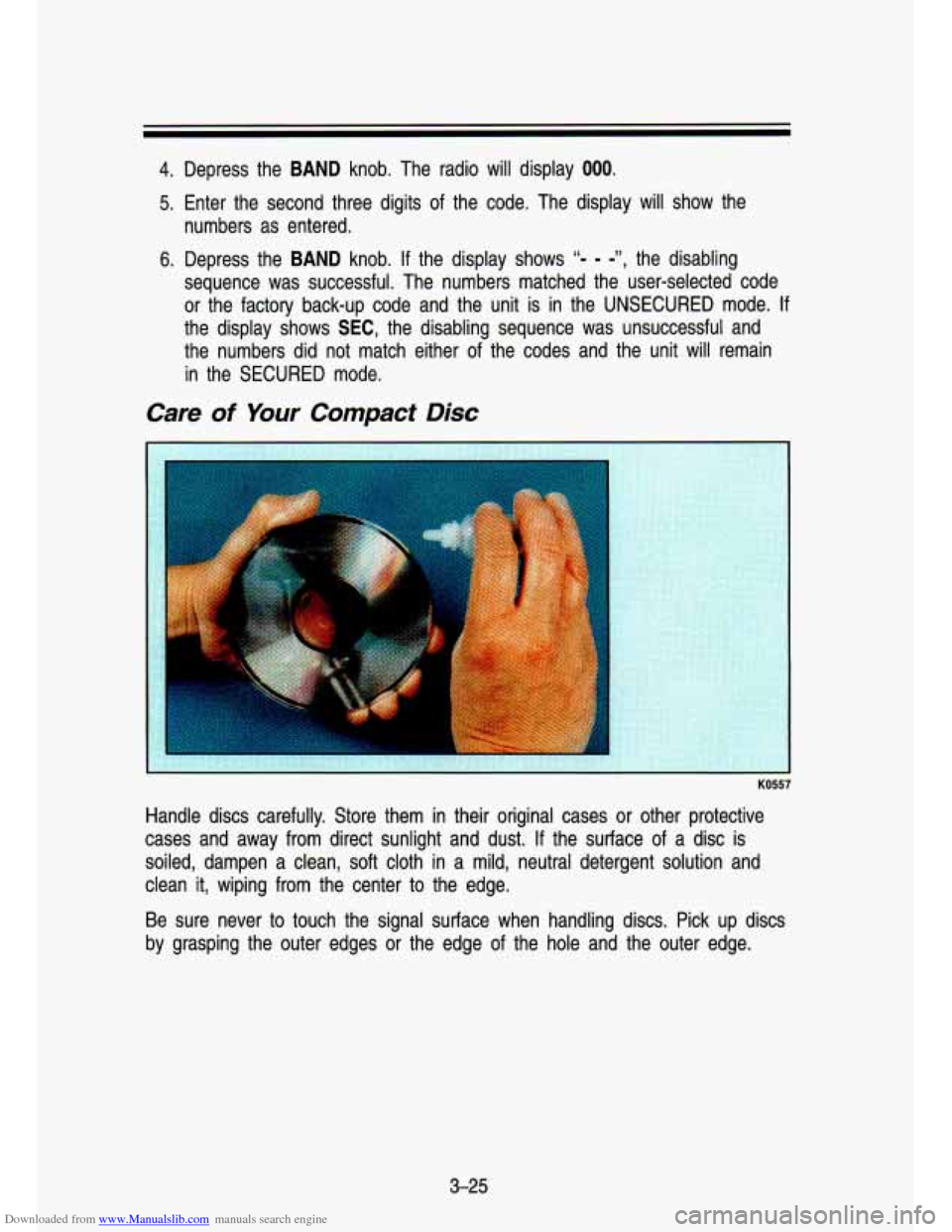
Care of Your Compact Disc
KO557
Handle discs carefully. Store them in their original cases or other protective
cases and away from direct sunlight and dust.
If the surface of a disc is
soiled, dampen a clean, soft cloth in a mild, neutral detergen\
t solution and
clean
it, wiping from the center to the edge.
Be sure never to touch the signal surface when handling discs.\
Pick up discs
by grasping the outer edges or the edge
of the hole and the outer edge.
3-25
Page 154 of 356
Downloaded from www.Manualslib.com manuals search engine L
Comfort Controls & Audio Systems
Fixed Mast Antenna
The fixed mast antenna can withstand most car washes without being
damaged.
If the mast should ever become slightly bent, you can straighten it
out by hand.
If the mast is badly bent, as it might be by vandals, you should
replace it.
Check every once in a while
to be sure the mast is still tiahtened to the
fender.
3-26
Page 160 of 356
Downloaded from www.Manualslib.com manuals search engine Your Driving and the Road
Symbols on Road Signs
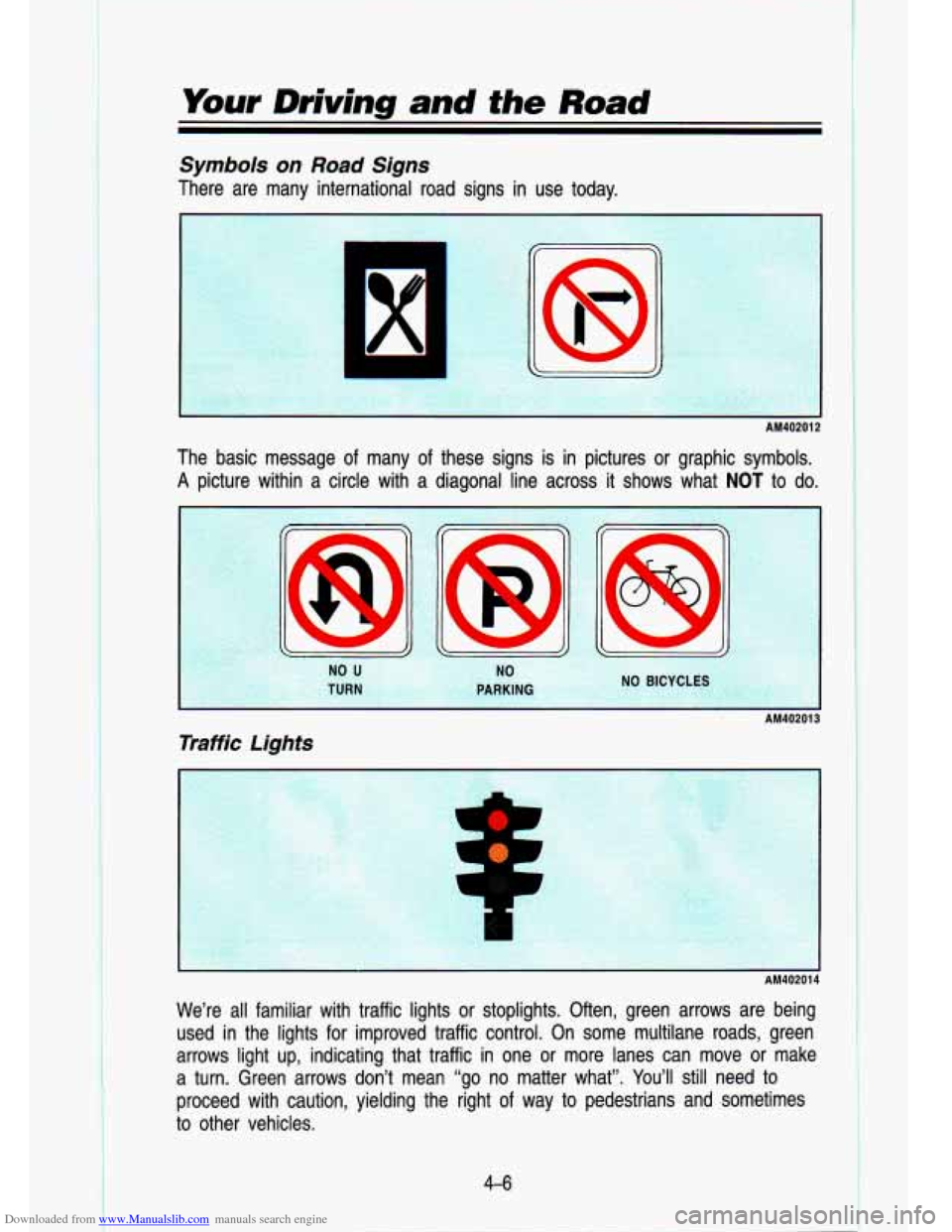
There are many international road signs in use today.
The basic message
of many of
A picture within a circle with a
r
C
I AM40201 2
these signs is in pictures or graphic symbols.
liagonal line across it shows what
NOT to do.
I AM40201 3
Traffic Lights
I AM40201 4
We’re all familiar with traffic lights or stoplights. Often, green ar\
rows are being
used in the lights for improved traffic control. On some multilane road\
s, green
arrows light up, indicating that traffic in one or more lanes can move or make
a turn. Green arrows don’t mean “go no matter what”.
You’ll still need to
proceed with caution, yielding the right of way to pedestrians and sometimes
to other vehicles.
4-6
Page 161 of 356
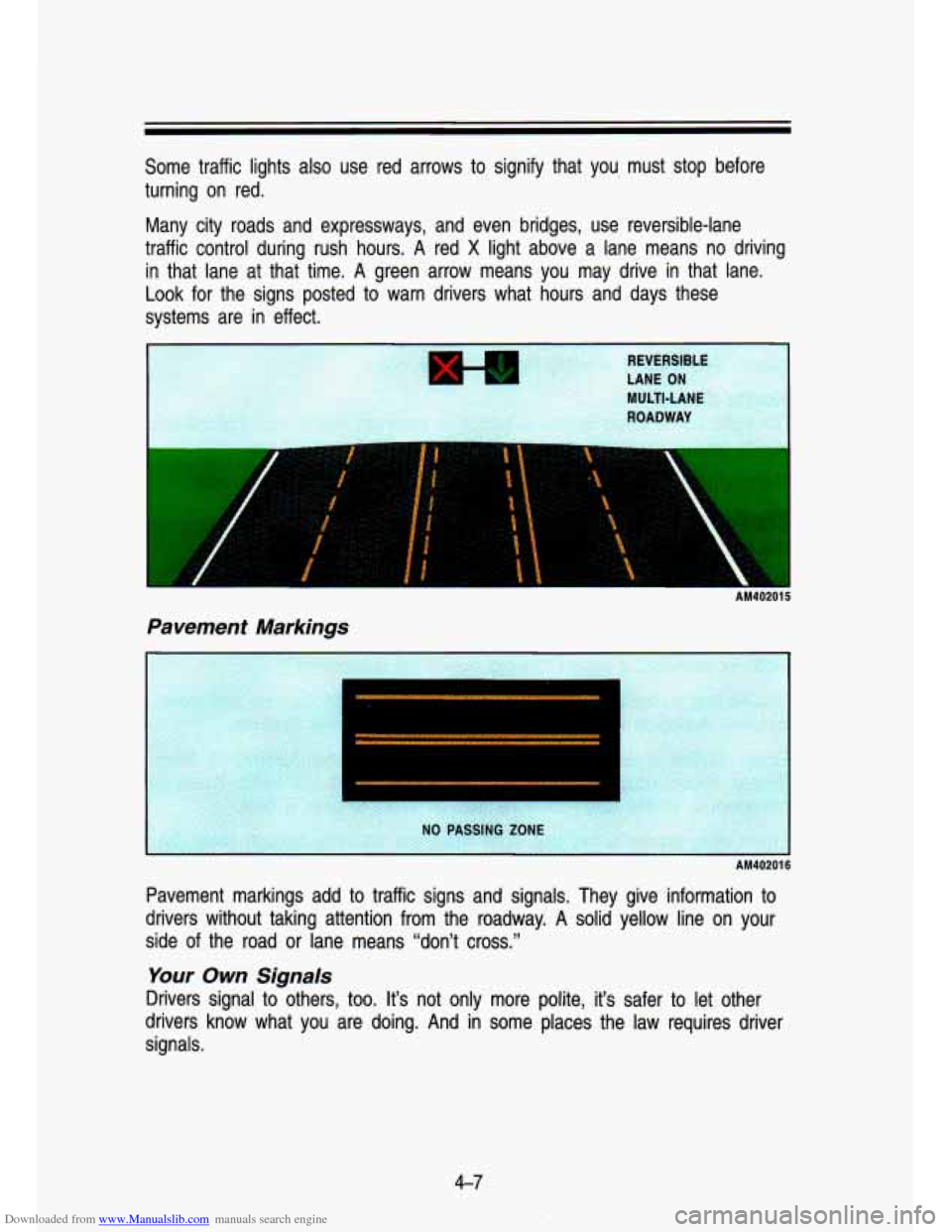
Downloaded from www.Manualslib.com manuals search engine Some traffic lights also use red arrows to signify that you must stop before
turning on red.
Many city roads and expressways, and even bridges, use reversib\
le-lane
traffic control during rush hours.
A red X light above a lane means no driving
in that lane at that time. A green arrow means you may drive in that lane.
Look for the signs posted to warn drivers what hours and days these
systems are in effect.
AM40201 5
Pavement Markings
AM40201 6
Pavement markings add to traffic signs and signals. They give information to
drivers without taking attention from the roadway.
A solid yellow line on your
side of the road or lane means “don’t cross.”
Your - Own Signals
Drivers signal to others, too. It’s not only more polite, it’s safer to let other
drivers know what you are doing. And in some places the law requires driver
signals.
4-7
Page 162 of 356

Downloaded from www.Manualslib.com manuals search engine c. -. .. .
Your Driving and the Road
Turn and lane change signals: Always signal when you plan to \
turn or
change lanes.
If necessary, you can use hand signals out the window: Left arm \
straight out
for a left turn, down for slow or about-to-stop, and up for a right turn.
Slowing down:
If time allows, tap the brake pedal once or twice in advance
of slowing or stopping. This warns the driver behind you.
Disabled: Your four-way flashers signal that your vehicle is disabled or is a
hazard. See “Hazard Warning Flasher’’ in the Index.
Traffic Officer
The traffic police officer is also a source of important information. The officer’s
signals govern, no matter what the traffic lights or other sig\
ns say.
The next part discusses some of the road conditions you may encounter.
Defensive Driving
The best advice anyone can give about driving is: Drive defens\
ively.
Please
start with a very important safety device in your vehicle: Buckle up.
(See “Safety Belts” in the Index.)
Defensive driving really means “be ready for anything.” On\
city streets, rural
roads, or freeways, it means “always expect the unexpected.”
Assume that pedestrians or other drivers are going to be careless and make
mistakes. Anticipate what they might
do. Be ready for their mistakes.
Expect children to dash out from behind parked cars, often followed by other
children. Expect occupants in parked cars to open doors into traffic. Watch for
movement in parked cars-someone may be about to open a door.
Expect other drivers to run stop signs .when you are on a through street. Be
ready to brake
if necessary as you go through intersections. You may not
have to use the brake, but if you
do, you will be ready.
If you’re driving through a shopping center parking lot where there are
well-marked lanes, directional arrows, and designated parking are\
as, expect
some drivers to ignore all these markings and dash straight toward one part
of the lot.
Pedestrians can be careless. Watch for them. In general, you m\
ust give way
to pedestrians even
if you know you have the right of way.
Rear-end collisions are about the most preventable of accidents. Yet they are
common. Allow enough following distance. It’s the best defens\
ive driving
4-8
Page 164 of 356
Downloaded from www.Manualslib.com manuals search engine Your Driving and the Road
..
..
.. ..
.- .. .- . .- -
I
i . . .-
t
AM407001
I
AM407002
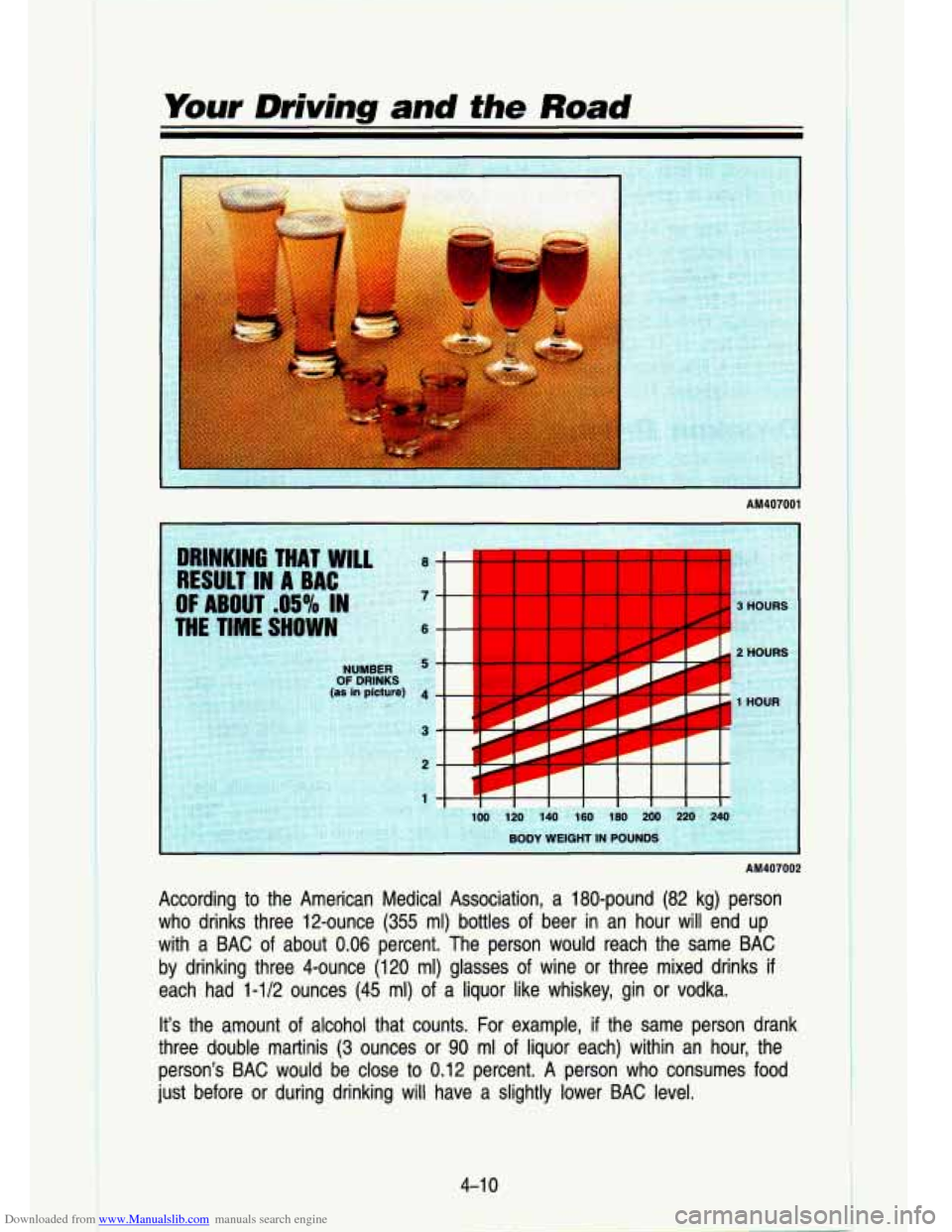
According to the American Medical Association, a 180-pound (82 kg) person
who drinks three 12-ounce
(355 ml) bottles of beer in an hour will end up
with a BAC of about
0.06 percent. The person would reach the same BAC
by drinking three 4-ounce
(120 ml) glasses of wine or three mixed drinks if
each had 142 ounces (45 ml) of a liquor like whiskey, gin or vodka.
It's the amount of alcohol that counts. For example,
if the same person drank
three double martinis
(3 ounces or 90 ml of liquor each) within an hour, the
person's BAC
would be close to 0.12 percent. A person who consumes food
just before or during drinking will have a slightly lower BAC level.
4-1
0
f
Page 167 of 356

Downloaded from www.Manualslib.com manuals search engine Most drivers treat their brakes with care. Some, however, overw\
ork the
braking system with poor driving habits.
Avoid needless heavy braking. Some people drive in spurts-heavy
acceleration followed by heavy braking-rather than keeping pace with
traffic. This is a mistake. Your brakes may not have time
to cool
between hard stops. Your brakes will wear out much faster
if you do a
lot of heavy braking.
Don’t “ride” the brakes by letting your left foot rest lightly on the brake
pedal while driving.
I
“Riding” your brakes can cause them to overheat to the point that
they won’t work well. You might not be able to stop your vehicle in
time
to avoid an accident. If you “ride” your brakes, they will get so
hot they will require a lot of pedal force to slow you down. Avoid
“riding” the brakes.
NOTICE
4-1 3
-
Page 170 of 356
Downloaded from www.Manualslib.com manuals search engine Your Driving and the Road
Brake System Warning Light
Standard Cluster
Digital Cluster
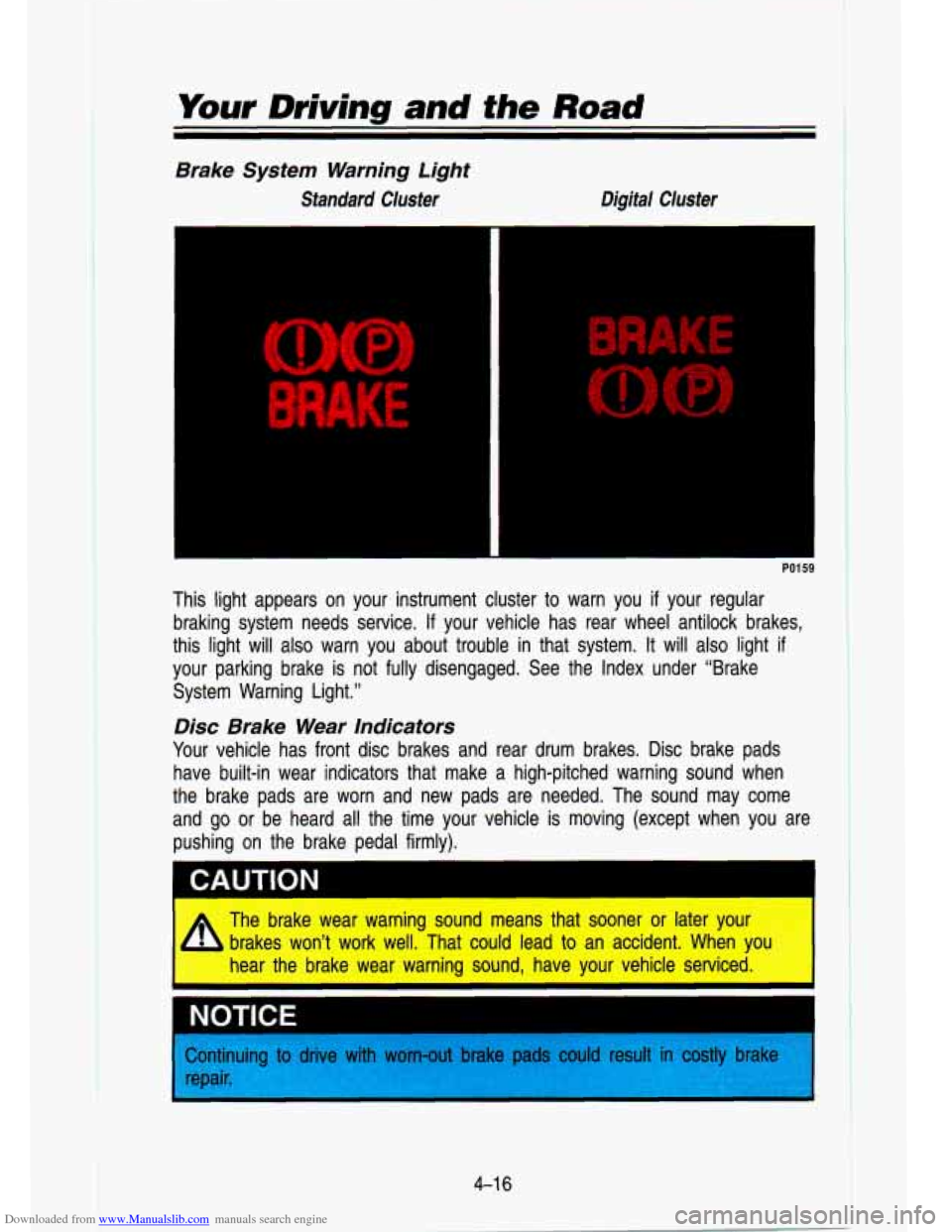
This light appears on your instrument cluster to warn you if your regular
braking system needs service.
If your vehicle has rear wheel antilock brakes,
this light will
also warn you about trouble in that system. It will also light if
your parking brake is not fully disengaged. See the Index unde\
r “Brake
System Warning Light.”
Disc Brake Wear Indicators
Your vehicle has front disc brakes and rear drum brakes. Disc brake pads
have built-in wear indicators that make a high-pitched warning \
sound when
the brake pads are worn and new pads are needed. The sound m\
ay come
and go or be heard all the time your vehicle is moving (except \
when you are
pushing on the brake pedal firmly).
The brake wear warning sound means that sooner or later your brakes won’t work well. That could lead to an accident. When yo
hear the brake wear warning sound, have your vehicle serviced. \
I NOTICE
>ontinuing ti
epair.
e with worn-out bra1 could sult in lstly brake
Page 171 of 356

Downloaded from www.Manualslib.com manuals search engine Some driving conditions or climates may cause a brake squeal w\
hen the brakes are first applied or lightly applied. This does not mea\
n something is
wrong with your brakes.
Rear Drum Brakes
Your rear drum brakes don’t have the wear indicators, but i\
f you ever hear a
rear brake rubbing noise, have the rear brake linings inspected\
. Also, the rear
brake drums should be removed and inspected each time the tire\
s are
removed for rotation or changing. When you have the front brak\
es replaced,
have the rear brakes inspected, too.
Brake linings should always be replaced as complete axle sets. \
Brake Pedal Travel
See your dealer if the brake pedal does not return to normal height, or if
there is a rapid increase in pedal travel. This could be a s\
ign of brake
trouble.
Brake Adjustment
Every time you make a brake stop, your disc brakes adjust for\
wear. If your
brake pedal goes down farther than normal, your rear drum brak\
es may need
adjustment. Adjust them by backing up and firmly applying the \
brakes a few
times.
Braking In Emergencies
At some time, nearly every driver gets into a situation that requires hard
braking. You have the rear wheel antilock braking system. Your front wheels
can stop rolling when you brake very hard. Once they do, the \
vehicle can’t respond to your steering. Momentum will carry
it in whatever direction it was
headed when the front wheels stopped rolling. That could be of\
f the road,
into the very thing you were trying to avoid, or into traffic.
So, use a “squeeze” braking technique. This will give you max\
imum braking
while maintaining steering control. You do this by pushing on the brake pedal
with steadily increasing pressure. When you do, it will help maintain steering
control. In many emergencies, steering can help you more than \
even the very
best braking.
Steering
Power Steering
If you lose power steering assist because the engine stops or the\
system
fails to function, you can steer but
it will take much more effort.
4-1 7
Page 172 of 356
Downloaded from www.Manualslib.com manuals search engine Your Driving and the Road
Steering Tips
Driving on Curves
It’s important to take curves at a reasonable speed.
A lot of the “driver lost control” accidents mentioned on the news \
happen on
curves. Here’s why:
Experienced driver or beginner, each of us is subject to the same laws of
physics when driving on curves. The traction of the tires against the road
surface makes it possible for the vehicle to change its path when you turn
the front wheels.
If there’s no traction, inertia will keep the vehicle going in
the same direction.
If you’ve ever tried to steer a vehicle on wet ice, you’ll \
understand this.
The traction you can get in a curve depends on the condition of your tires
and the road surface, the angle at which the curve is banked, and your
speed. While you’re in a curve, speed is the one factor you can control.
Suppose you’re steering through a sharp curve. Then you sudd\
enly apply the
brakes. Both control systems-steering and braking-have to do their work
where the tires meet the road. Adding the hard braking can de\
mand too
much at those places. You can lose control. The same thing can happen
if
you’re steering through a sharp curve and you suddenly accel\
erate. Those
two control systems-steering and acceleration-can overwhelm those places
where the tires meet the road and make you lose control.
What should you
do if this ever happens? Let up on the brake or accelerator
pedal, steer the vehicle the way you want it to go, and slow down.
Speed limit signs near curves warn that you should adjust your\
speed. Of
course, the posted speeds are based on good weather and road \
conditions. Under less favorable conditions you’ll want to go slower.
If you need to reduce your speed as you approach a curve, do it before you
enter the curve, while your front wheels are straight ahead. Try to adjust your
speed
so you can “drive” through the curve. Maintain a reasonable, \
steady
speed. Wait to accelerate until you are out of the curve, and then accelerate
gently into the straightaway.
When you drive into a curve at night, it’s harder to see the road ahead of
you because it bends away from the straight beams of your lights. This is
one
good reason to drive slower.
Steering in Emergencies
There are times when steering can be more effective than braki\
ng. For
example, you come over a hill and find a truck stopped in your lane, or a
4-1 %