mirror CHEVROLET S10 1993 2.G Owners Manual
[x] Cancel search | Manufacturer: CHEVROLET, Model Year: 1993, Model line: S10, Model: CHEVROLET S10 1993 2.GPages: 356, PDF Size: 20.85 MB
Page 54 of 356

Downloaded from www.Manualslib.com manuals search engine Features & Controls
Enain laust ........................................................................\
........................... 2-26
hunnlng Your Engine While You’re Parked
.................................................. 2-26
Four-wheel Drive
........................................................................\
........................ 2-27
Manual Transfer Case
........................................................................\
............. 2-28
Electronic Transfer Case
........................................................................\
......... 2-29
Windows
........................................................................\
....................................... 2-31
Tailgate
........................................................................\
......................................... 2-33
Horn
........................................................................\
.............................................. 2-33
Tilt Wheel
........................................................................\
..................................... 2-34
Turn Signal/MuItifunction Lever
........................................................................\
.. 2-35
Turn Signal and Lane Change Indicator
....................................................... 2-36
Headlight High-Low Beam
........................................................................\
...... 2-38
Windshield Wipers
........................................................................\
................... 2-38
Windshield Washer
........................................................................\
.................. 2-40
Cruise Control
........................................................................\
.......................... 2-41
Lights
........................................................................\
............................................ 2-46
Mirrors
........................................................................\
.......................................... 2-50
Accessory Power Outlet
........................................................................\
............. 2.53
Cigarette LighteVAshtrays
........................................................................\
........... 2-54
Storage Compartments
........................................................................\
............... 2.55
Instrument Cluster
........................................................................\
................... I.rr . 2-62
Warning Lights, Gages and Indicators
.......................................................... 2-65
Trailer Wiring Harness
........................................................................\
................ 2-75
2-2
Page 102 of 356
Downloaded from www.Manualslib.com manuals search engine Features & Controls
Dome Light
L J
KO1 87
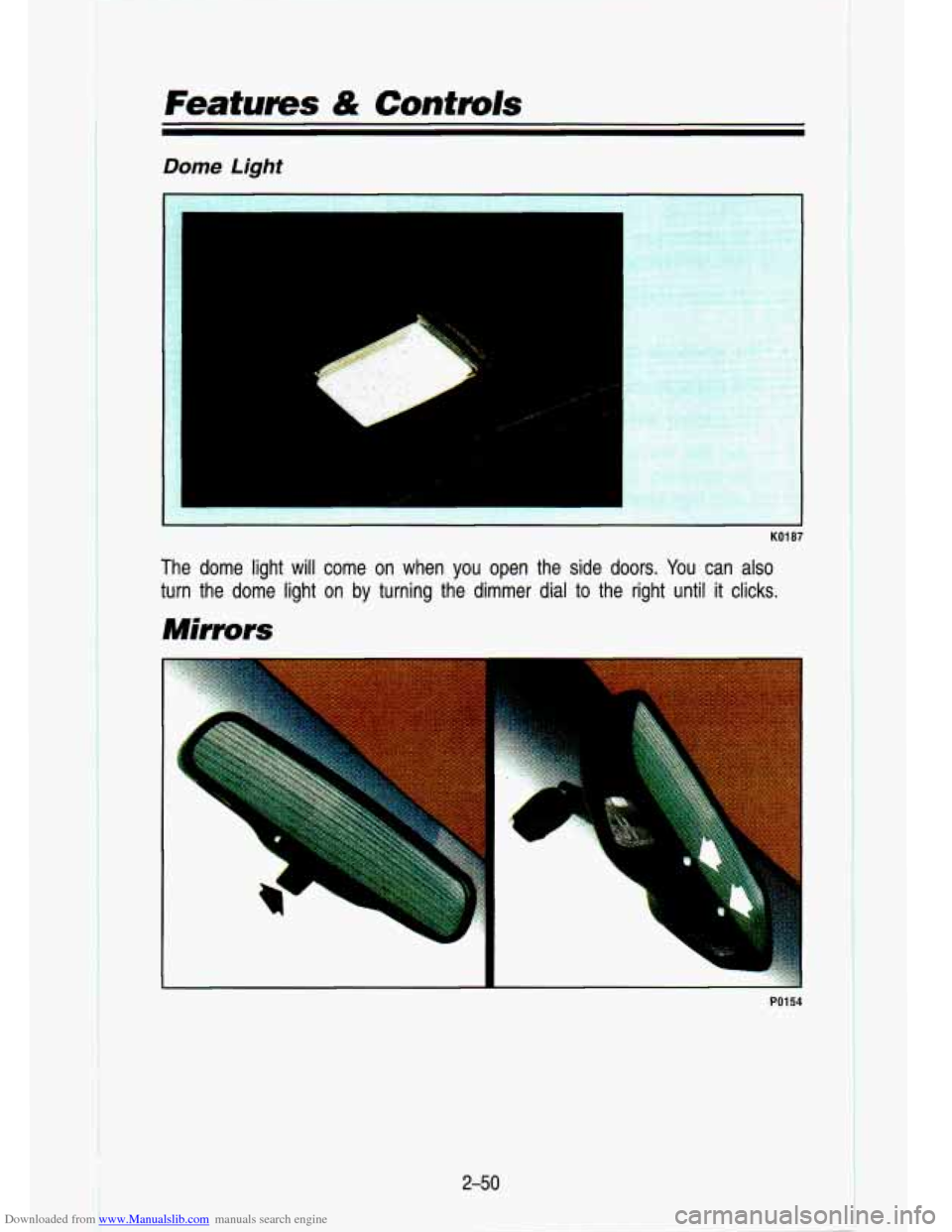
The dome light will come on when you open the side doors. You can also
turn the dome light on by turning the dimmer dial
to the right until it clicks.
Mirrors
’%
PO154
Page 103 of 356
Downloaded from www.Manualslib.com manuals search engine Inside Mirror
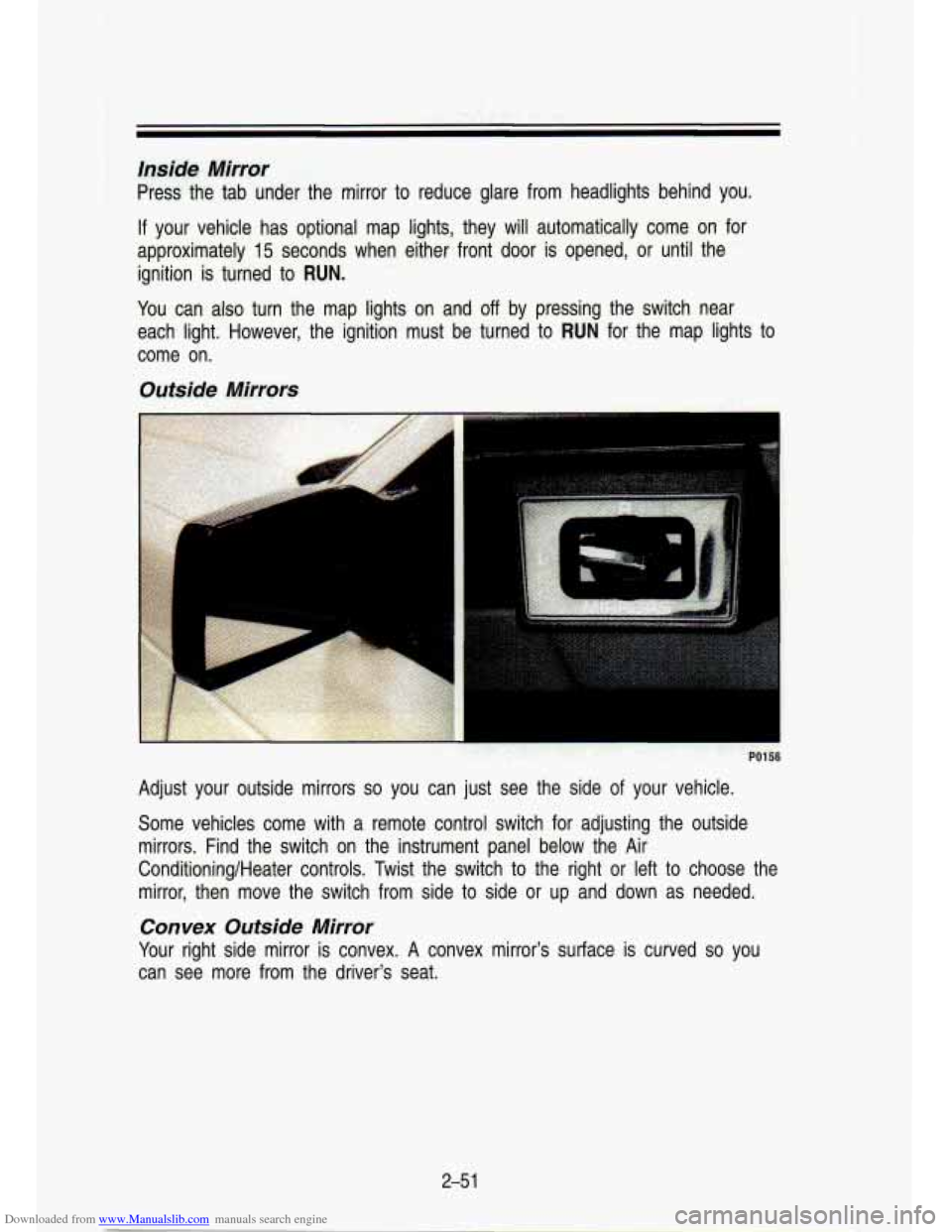
Press the tab under the mirror to reduce glare from headlights behind you.
If your vehicle has optio.nal map lights, they will automatically \
come on for
approximately
15 seconds when either front door is opened, or until the
ignition is turned to
RUN.
You can also turn the map lights on and off by pressing the switch near
each light. However, the ignition must be turned to
RUN for the map lights to
come on.
Outside Mirrors
I
Adjust your outside mirrors so you can just see the side of your vehicle.
Some vehicles come with a remote control switch for adjusting the o\
utside
mirrors. Find the switch on the instrument panel below the Air\
Conditioning/Heater controls. Twist the switch to the right or left to choose the
mirror, then move the switch from side to side or up and down as needed.
Convex Outside Mirror
Your right side mirror is convex. A convex mirror's surface is curved so you
can see more from the driver's seat.
2-5 1
Page 104 of 356
Downloaded from www.Manualslib.com manuals search engine Features & Controls
k If you aren't used to a convex mirror, you can hit another vehicle. A
- convex mirror can make things (like other vehicles) look farther away c
than they really are. If you cut too sharply into the right lane, you
could hit a vehicle on1 your right. Check your inside mirror or gla.nce L
over your shoulder before changinig lanes.
Sun VisorsNanify Mirrors
KO251
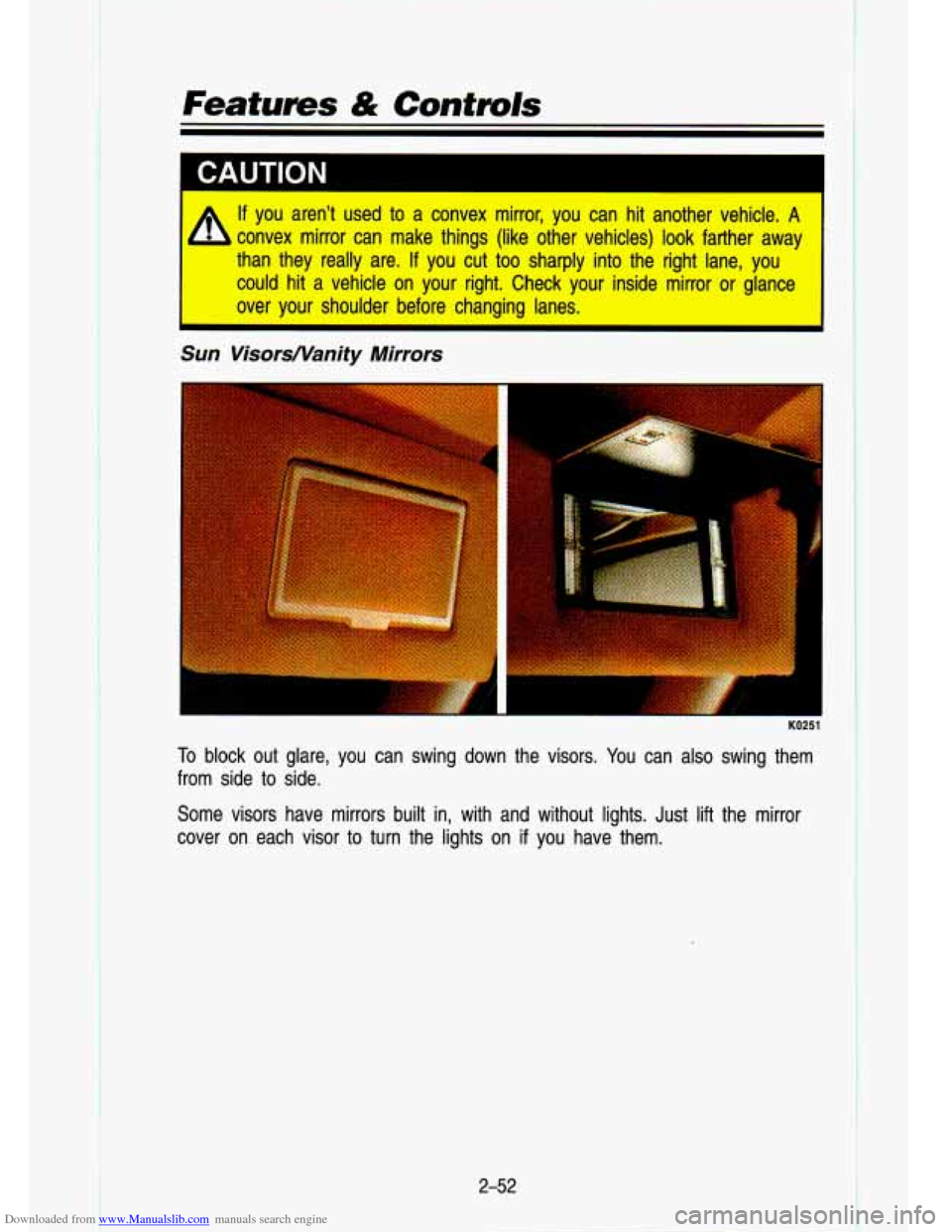
To block out glare, you can swing down the visors. You can also swing them
from side to side.
Some visors have mirrors built in, with and without lights. Ju\
st lift the mirror
cover on each visor to turn the lights on
if you have them.
2-52
1
Page 175 of 356

Downloaded from www.Manualslib.com manuals search engine So here are some tips for passing:
e
e
e
e
e
e
e
“Drive ahead.” Look down the road, to the sides, and to \
crossroads for
situations that might affect your passing patterns.
If you have any doubt
whatsoever about making a successful pass, wait for a better t\
ime.
Watch for traffic signs, pavement markings, and lines.
If you can see a
sign up ahead that might indicate a turn or an intersection, \
delay your pass.
A broken center line usually .indicates it’s all right to pass
(providing the road ahead is clear). Never cross a solid lin\
e on your side
of the lane or a double solid line, even
if the road seems empty of
approaching traffic.
If you suspect that the driver of the vehicle you want to pass isn’t aware
of your presence, tap the horn a couple of times before passing. \
Do not get too close to the vehicle you want to pass while you’re
awaiting an opportunity.
For one thing, following too closely reduces your
area of vision, especially
if you’re following a larger vehicle. Also, you
won’t have adequate space if the vehicle ahead suddenly
slows or stops.
Keep back a reasonable distance.
When it looks like a chance to pass is coming up, start to accelerate
but stay in the right lane and don’t get too close. Time your move
so
you will be increasing speed as the time comes to move into \
the other
lane.
If the way is clear to pass, you will have a “running start”\
that
more than makes up for the distance you would lose by droppin\
g back.
And if something happens to cause you to cancel your pass, you need
only
slow down and drop back again and wait for another opportunity.
If other cars are lined up to pass a slow vehicle, wait your tu\
rn. But
take care that someone isn’t trying to pass you as you pul\
l out to pass
the slow vehicle. Remember to glance over your shoulder and ch\
eck the
blind spot.
Check your mirrors, glance over your shoulder, and start your \
left lane
change signal before moving out of the right lane to pass. When you
are far enough ahead of the passed vehicle to see its front in your
inside mirror, activate your right lane change signal and move \
back into
the right lane. (Remember that
if your right outside mirror is convex, the
vehicle you just passed may seem to be further away from you \
than
it
really is.)
Try not to pass more than one vehicle at a time on two-lane roads.
Reconsider before passing the next vehicle.
4-21
Page 176 of 356

Downloaded from www.Manualslib.com manuals search engine Your Driving and the Road
Don’t overtake a slowly moving vehicle too rapidly. Even tho\
ugh the
brake lights are not flashing, it may be slowing down or starting to turn.
If you’re being passed, make it easy for the following driv\
er to get ahead
of you. Perhaps you can ease a little to the right.
Loss of Control
Let’s review what driving experts say about what happens whe\
n the three
control systems (brakes, steering and acceleration) don’t ha\
ve enough friction
where the tires meet the road to
do what the driver has asked.
In any emergency, don’t give up. Keep trying to steer, and constantly seek an
escape route or area of less danger.
Skidding
In a skid, a driver can lose control of the vehicle. Defensive drivers avoid
most skids by taking reasonable care suited to existing conditi\
ons, and by not
“overdriving” those conditions. But skids are always possib\
le.
The three types
of skids correspond to your vehicle’s three control systems.
In the braking skid, your wheels aren’t rolling. In the steering or cornering
skid, too much speed or steering in a curve causes tires to \
slip and lose
cornering force. And in the acceleration skid, too much throttle causes the
driving wheels to spin.
A cornering skid and an acceleration skid are best handled by easing your
foot off the accelerator pedal. If your vehicle starts to slide (as when you turn
a corner on a wet, snow- or ice-covered road), ease your foo\
t
off the
accelerator pedal as soon as you feel the tires start to slide. Quickly steer
the way you want the vehicle to go. If you start steering quickly enough, your
vehicle will straighten out.
As it does, straighten the front wheels.
Of course, traction is reduced when water, snow, ice, gravel, or other material
is on the road. For safety, you’ll want to slow down and adjust your driving to
these conditions.
It is important to slow down on slippery surfaces because
stopping distance will be longer and vehicle control more limit\
ed.
While driving on a surface with reduced traction, try your bes\
t to avoid
sudden steering, acceleration, or braking (including engine brak\
ing by shifting
to a lower gear). Any sudden move could cause the tires to slide. You may
not realize the surface is slippery until your vehicle is skidding. Learn to
recognize warning clues-such as enough water, ice or packed snow on the
road to make
a “mirrored surface”-and slow down when you have any
doubt.
4-22
Page 188 of 356

Downloaded from www.Manualslib.com manuals search engine Your Driving and the Road
After Off-Road Driving
Remove any brush or debris that has collected on the underbodv\
. chassis, or
under the hood. These accumulations can be a fire hazard.
After operation in mud or sand, have the brake linings cleaned\
and checked.
These substances can cause glazing and uneven braking. Check th\
e body
structure, steering, suspension, wheels, tires, and exhaust syste\
m for damage.
Also, check the fuel lines and cooling system for any leakage.\
Your vehicle will require more frequent service due to off-road use.\
Refer to
the Maintenance Schedule for additional information.
Driving at Night
AN450005
Night driving is more dangerous than day driving. One reason is that some
drivers are likely
to be impaired-by alcohol or drugs, with night vision
problems, or by fatigue.
Here are some tips on night driving.
Drive defensively. Remember, this is the most dangerous time.
Don’t drink and drive (See “Drunken Driving” in the Index for more on
this problem.)
Adjust your inside rearview mirror to reduce the glare from headlights
behind you.
4-34
Page 190 of 356
Downloaded from www.Manualslib.com manuals search engine Your Driving and the Road
On a freeway, use your high beams only in remote areas where you won’t
impair approaching drivers. In some places, like cities, using high beams is
illegal.
When you follow another vehicle on a freeway or highway, use \
low beams.
True, most vehicles now have day-night mirrors that enable the \
driver to
reduce glare. But outside mirrors are not of this type and high beams from
behind can bother the driver ahead.
A Few More Night Driving Suggestions
Keep your windshield and all the glass on your vehicle clean-i\
nside and out.
Glare at night is made much worse by dirt on the glass. Even the inside of
the glass can build up a film caused by dust. Tobacco smoke \
also makes inside glass surfaces very filmy and can be a vision hazard
if it’s left there.
Dirty glass makes lights dazzle and flash more than clean glas\
s would,
making the pupils of your eyes contract repeatedly. You might even want to
keep a cloth and some glass cleaner in your vehicle
if you need to clean
your glass frequently.
Remember that your headlights light up far less of a roadway when you are
in a turn or curve.
Keep your eyes moving; that way, it’s easier to pick out dimly lighted objects.
Just as your headlights should be checked regularly for proper \
aim,
so should
your eyes be examined regularly. Some drivers suffer from night\
blindness-the inability to see in dim light-and aren’t even aware of
it.
4-36
Page 197 of 356
Downloaded from www.Manualslib.com manuals search engine to merge into the gap at close to the prevailing speed. Switch on your turn
signal, check your rearview mirrors as you move along, and glance over your
shoulder as often as necessary.
Try to blend smoothly with the traffic flow.
Driving on the Freeway
Once you are on the freeway, adjust your speed to the posted limit or to the
prevailing rate
if it’s slower. Stay in the right lane unless you want to pass. If
you are on a two-lane freeway, treat the right lane as the slow lane and the
left lane as the passing lane.
If you are on a three-lane freeway, treat the right lane as the slower-speed
through lane, the middle lane as the higher-speed through lane, and the left
lane as the passing lane.
Before changing lanes, check your rearview mirrors. Then use yo\
ur turn
signal. Just before you leave the lane, glance quickly over your shoulder
to
make sure there isn’t another vehicle in your “blind” spot.
If you are moving from an outside to a center lane on a freeway having
more than
two lanes, make sure another vehicle isn’t about to move into the
same spot. Look
at the vehicles two lanes over and watch for telltale signs:
turn signals flashing, an increase in speed, or moving toward the edge
of the
lane. Be prepared to delay your move.
Once you are moving on the freeway, make certain you allow a reasonable
following distance. Expect to move slightly slower at night.
Leaving the Freeway
When you want to leave the freeway, move to the proper lane well in
advance. Dashing across lanes at the last minute is dangerous. \
If you miss
your exit do not, under any circumstances, stop and back up. \
Drive on to the
next exit.
At each exit point is a deceleration lane. Ideally
it should be long enough for
you to enter
it at freeway speed (after signaling, of course) and then do your
braking before moving onto the exit ramp. Unfortunately, not all deceleration
lanes are long enough-some are too short for all the braking. Decide when
to start braking.
If you must brake on the through lane, and if there is traffic
close behind you, you can allow a little extra time and flash your brake lights
(in addition to your turn signal) as extra warning that you are about to slow
down and exit.
The exit ramp can be curved, sometimes quite sharply. The exit\
speed
is
usually posted. Reduce your speed according to your speedometer, not to
your sense of motion. After driving for any distance at higher\
speeds, you
4-43
Page 199 of 356
Downloaded from www.Manualslib.com manuals search engine On the Road
Unless you are the only driver, it is good to share the driving task with
others. Limit turns behind the wheel to about
100 miles (160 km) or two
hours at a sitting. Then, either change drivers or stop for s\
ome refreshment
like coffee, tea or soft drinks and some limbering up. But
do stop and move
around. Eat lightly along the way. Heavier meals tend to make some people
sleepy.
On two-lane highways or undivided multilane highways that
do not have
controlled access, you’ll want to watch for some situations not usually found
on freeways. Examples are: stop signs and signals, shopping cen\
ters with
direct access to the highway, no passing zones and school zones, vehicles
turning left and right
off the road, pedestrians, cyclists, parked vehicles, and
even animals.
Highway Hypnosrs
Is there actually such a condition as “highway hypnosis?” Or \
is it just plain
falling asleep at the wheel? Call it highway hypnosis, lack of awareness, or
whatever.
There is something about an easy stretch of road with the same scenery,
along with the hum of the tires on the road, the drone of the engine, and the
rush of the wind against the vehicle that can make you sleepy. Don’\
t let it
happen to you!
If it does, your vehicle can leave the road in less than a
second, and you could crash and be injured.
What can you
do about highway hypnosis? First, be aware that it can
happen.
Then here are some tips:
Make sure your vehicle is well ventilated, with a comfortably \
cool interior.
Keep your eyes moving. Scan the road ahead and to the sides. \
Check
your rearview mirrors frequently and your instruments from time \
to time.
This can help you avoid a fixed stare.
Wear good sunglasses in bright light. Glare can cause drowsines\
s. But don’t wear sunglasses at night. They will drastically reduce \
your overall
vision at the very time you need all the seeing power you have.
If you get sleepy, pull off the road into a rest, service, or parking area
and take a nap, get some exercise, or both. For safety, treat drowsiness
on the highway as an emergency.
As in any driving situation, keep pace with traffic and allow adequat\
e
following distances.
4-45