clutch CHEVROLET S10 1994 2.G Owners Manual
[x] Cancel search | Manufacturer: CHEVROLET, Model Year: 1994, Model line: S10, Model: CHEVROLET S10 1994 2.GPages: 340, PDF Size: 18.45 MB
Page 58 of 340
Downloaded from www.Manualslib.com manuals search engine Starting Your Engine
Engines start differently. The 8th digit of your Vehicle Identification
Number (VIN) shows the code letter or number for your engine. You will
find the VIN at the top left of your instrument panel. (See “Vehicle
Identification Number” in the Index.) Follow the proper steps to start the
engine.
Automatic transmission:
Move your shift lever to “P” (Park) or “N’ (Neutral). Your engine won’t
start in any other position
- that’s a safety feature. To restart when you’re
already moving, use
“N” (Neutral) only.
NOTICE:
Don’t try to shift to “P” (Park) if your vehicle is moving. If you
do, you could damage the transmission. Shift to “P” (Park) \
only
when your vehicle is stopped.
Manual transmission:
Hold the clutch pedal to the floor, then shift your gear selector to neutral
while starting the engine. Your vehicle won’t start
if the clutch pedal is not
all the way down
- that’s a safety feature.
To start your 2.2 Liter engine:
1. Without pushing the accelerator pedal, turn your ignition key t\
o “Start.”
When the engine starts, let go of the key. The idle speed will go down
as your engine gets
warm.
NOTICE:
Holding your key in “Start” for longer than 15 seconds at a time
will cause your battery to be drained much sooner. And the
excessive heat can damage your starter motor.
2. If your engine still won’t start (or starts but then stops), it could be
flooded with too much gasoline. Try pushing your accelerator pe\
dal all
the way to the floor and holding it there as you hold the key in “Start”
for about three seconds. If
the vehicle starts briefly but then stops
again, do the same thing, but this time keep the pedal down for five or
six seconds. This clears the extra gasoline from the engine.
2-12
Page 65 of 340
Downloaded from www.Manualslib.com manuals search engine NOTICE:
If your rear wheels can’t rotate, don’t try to drive. This might
happen
if you were stuck in very deep sand or mud or were up
against a solid object. You could damage your transmission.
Also,
if you stop when going uphill, don’t hold your vehicle there
with only the accelerator pedal. This could overheat and damage
the transmission. Use your brakes or shift into
“P” Park to hold
your vehicle in position on
a hill.
Five-Speed Manual Transmission
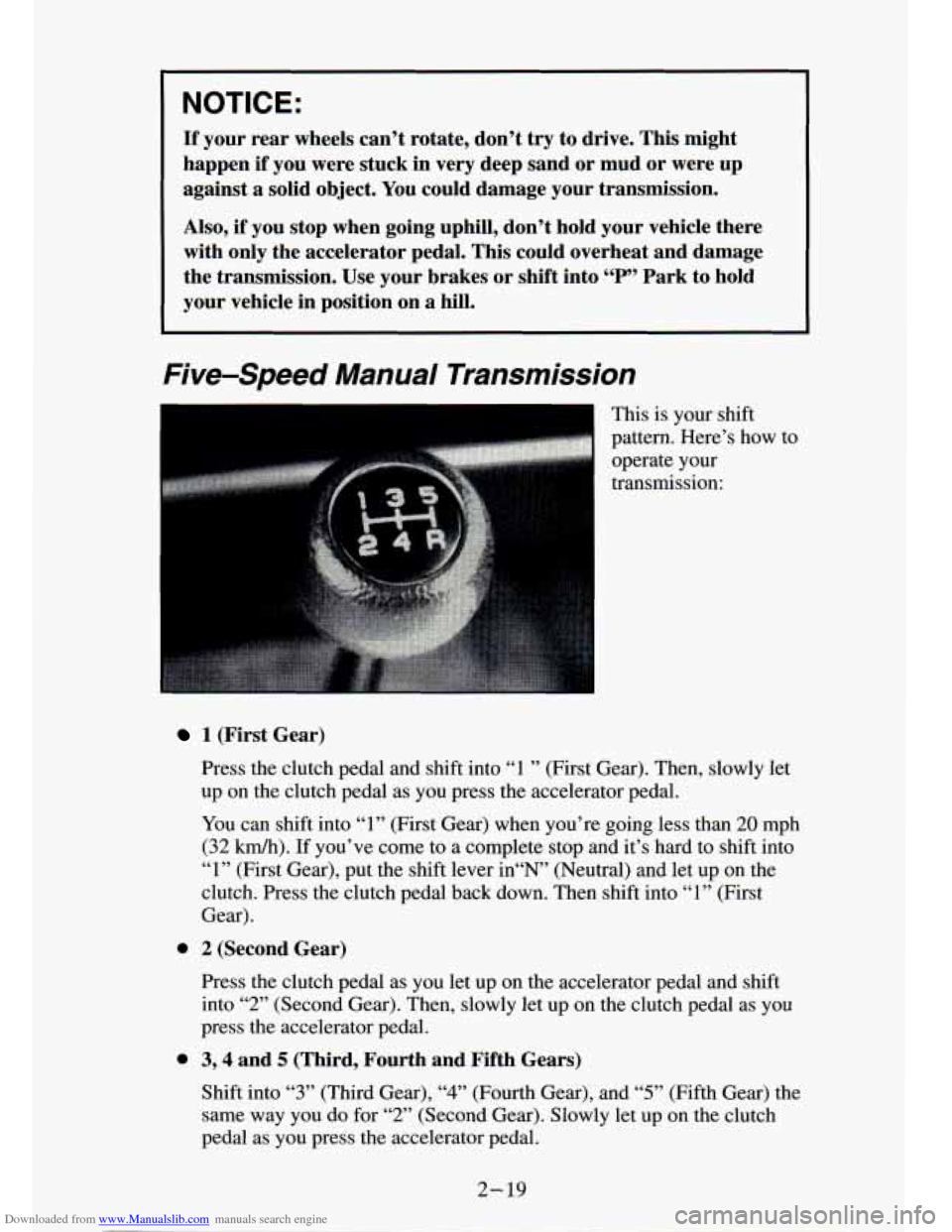
This is your shift
pattern. Here’s how to
operate your
transmission:
1 (First Gear)
Press the clutch pedal and shift into
“1 ” (First Gear). Then, slowly let
up on the clutch pedal as you press the accelerator pedal.
You can shift into
“1” (First Gear) when you’re going less than 20 mph
(32 km/h). If you’ve come to a complete stop and it’s hard to shift into
“1” (First Gear), put the shift lever in“N” (Neut\
ral) and let up
on the
clutch. Press the clutch pedal back down. Then shift into
“1” (First
Gear).
0 2 (Second Gear)
Press the clutch pedal as you let up
on the accelerator pedal and shift
into
“2” (Second Gear). Then, slowly let up on the clutch pedal as y\
ou
press the accelerator pedal.
0 3’4 and 5 (Third, Fourth and Fifth Gears)
Shift into
“3” (Third Gear), “4” (Fourth Gear), and “5” (Fifth Gear) the
same way
you do for “2” (Second Gear). Slowly let up on the clutch
pedal as
you press the accelerator pedal.
2-19
Page 66 of 340

Downloaded from www.Manualslib.com manuals search engine To Stop
Let up on the accelerator pedal and press the brake pedal. Just b\
efore
the vehicle stops, press the clutch pedal and the brake pedal, and\
shift
to
“N’ (Neutral).
N (Neutral)
Use this position when you start or idle your engine.
R (Reverse)
To back up, press down the clutch pedal, wait about 6 seconds, then
shift into
“R’ (Reverse). Then let up on the clutch pedal slowly while
pressing the accelerator pedal.
NOTICE:
Shift to “R” (Reverse) only after your vehicle is stopped.
Shifting to
“R” (Reverse) while your vehicle is moving could
damage your transmission.
Also, use “R” (Reverse), along with the parking brake, for parking your
vehicle.
Shift Light
If you have a manual
transmission, you
have a
SHIFT light.
This light will show
you when to shift to
the next higher gear
for best fuel economy.
When this light comes on, you can shift to the next high€ ;ear if weather,
road and traffic conditions let you. For the best fuel economy\
, accelerate slowly and shift when the light comes on.
While you accelerate, it is normal for the light to go on and
off if you
quickly change the position of the accelerator. Ignore the
SHIFT light when
you downshift.
2-20
F
Page 74 of 340
Downloaded from www.Manualslib.com manuals search engine ..
The front axle portion of the diagram on the indicator will light up when
you shift into four-wheel drive. A slight delay between shifting an\
d the
pattern’s lighting is normal. If the pattern does not light up, or if the front
axle does not go out after you shift out of four-wheel drive, have your
dealer check your system. Turn the
INT LIGHTS switch located to the
right of your headlight switch to dim your transfer case indicator light\
when
your headlights or parking lights are on. This will also cause\
your
instrument panel lights to dim.
2HI: This setting is for driving in most street and highway situations. Your
front axle is not engaged in two-wheel drive.
4HI: This setting engages your front axle to help drive your vehicl\
e. Use
4HI when you need extra traction, such as on snowy or icy roads, \
or in most
off-road situations.
N SET PARK BRAKE: Shift to this neutral setting only when your vehicle
needs to be towed.
4LO: This setting also engages your front axle to give you extra traction.
You may never need
4LO. It sends the maximum power to all four wheels.
You might choose
4LO if you were driving off-road in sand, mud, or deep
snow and climbing or descending steep hills.
You can shift from
2HI to 4HI or from 4HI to 2HI while the vehicle is
moving. It is not necessary for you to press the transfer case shift lever
button. Your front axle will engage faster
if you take your foot off of the
accelerator for a few seconds after you shift.
To shift your transfer case into N SET PARK BRAKE:
1. Stop the vehicle and shift your transmission into “N” (Neutral).
2. Set the parking brake. Your vehicle can roll unless the brakes are
applied.
To shift into or out of 4LO :
1. The vehicle must be stopped or moving less than 3 mph (4.8 Wh)
with the transmission in “N’ (Neutral) or the clutch pedal depressed.
2. Press the transfer case shift button and shift in one continuous motion.
Don’t pause in
N SET PARK BRAKE as you shift into or out of 4L0, or
your gears could clash.
Remember that driving in
4HI or 4LO may reduce fuel economy. Also,
driving in four-wheel drive on dry pavement could cause your t\
ires to wear
faster and make your transfer case harder to shift.
2-28
I
Page 76 of 340
Downloaded from www.Manualslib.com manuals search engine To shift from 2H1, or 4HI to 4LO : The vehicle must be stopped or
moving less than
3 rnph (4.8 km/h) with the transmission in “N” (Neutral)
or the clutch pedal depressed. The preferred method for shifting into
4LO is
to have your vehicle slowly moving
1 to 2 mph (1.6 to 3.2 ludh). Press and
release the
4LO switch. You must wait for the amber 4LO indicator light to
stop flashing and go solid amber before shifting your transmission into
gear
or releasing the clutch pedal.
If the
4LO switch is pressed when your vehicle is in gear and/or moving, \
the amber
4LO indicator light will flash for 30 seconds and not complete
the shift unless your vehicle is below
3 mph (4.8 km/h) and the transmission
is in “N” (Neutral)
or the clutch pedal depressed.
On automatic transmission equipped vehicles: If your transfer case does not
shift into
4L0, your transmission indicator switch may require adjustment.
With your transmission in
“N’ (Neutral), press and release the 4LO switch.
While the amber
4LO indicator light is flashing, shift your transmission into
P (Park).
Wait until the
4LO indicator light go - - solid amber before shifting your
transmission into gear. This will get
you into 4L0, but you should take your
vehicle in for service
so normal operation can be restored.
To shift from 4LO to 4HI: Your vehicle must be stopped or moving less
than
3 mph (4.8 km/h) with the transmission in “N” (Neutral) and the clutch
pedal depressed. The preferred method for shifting out of
4LO is to have
your vehicle slowly moving
1 to 2 mph (1.6 to 3.2 km/h). Press and release
the
4HI switch. You must wait for the 4HI indicator light to stop flashing
and
go solid amber before shifting your transmission into gear or rele\
asing
the clutch pedal.
If the
4HI switch is pressed when your vehicle is in gear and/or moving, the
4HI indicator light will flash for 30 seconds but not complete the shift
unless the vehicle is below
3 mph (4.8 km/h) and the transmission is in
“N’ (Neutral) or the clutch pedal depressed.
On automatic transmission equipped vehicles: If your transfer case does not
shift into
4H1, your transmission indicator switch may require adjustment.
With your transmission in
“N’ (Neutral), press and release the 4HI switch.
While the
4HI indicator light is flashing, shift your transmission into
P (Park). Wait until the 4HI indicator light goes solid amber before shifting
your transmission into gear. This will get you into
4H1, but you should take
your vehicle in for service
so normal operation can be restored.
2-30-
I
Page 85 of 340
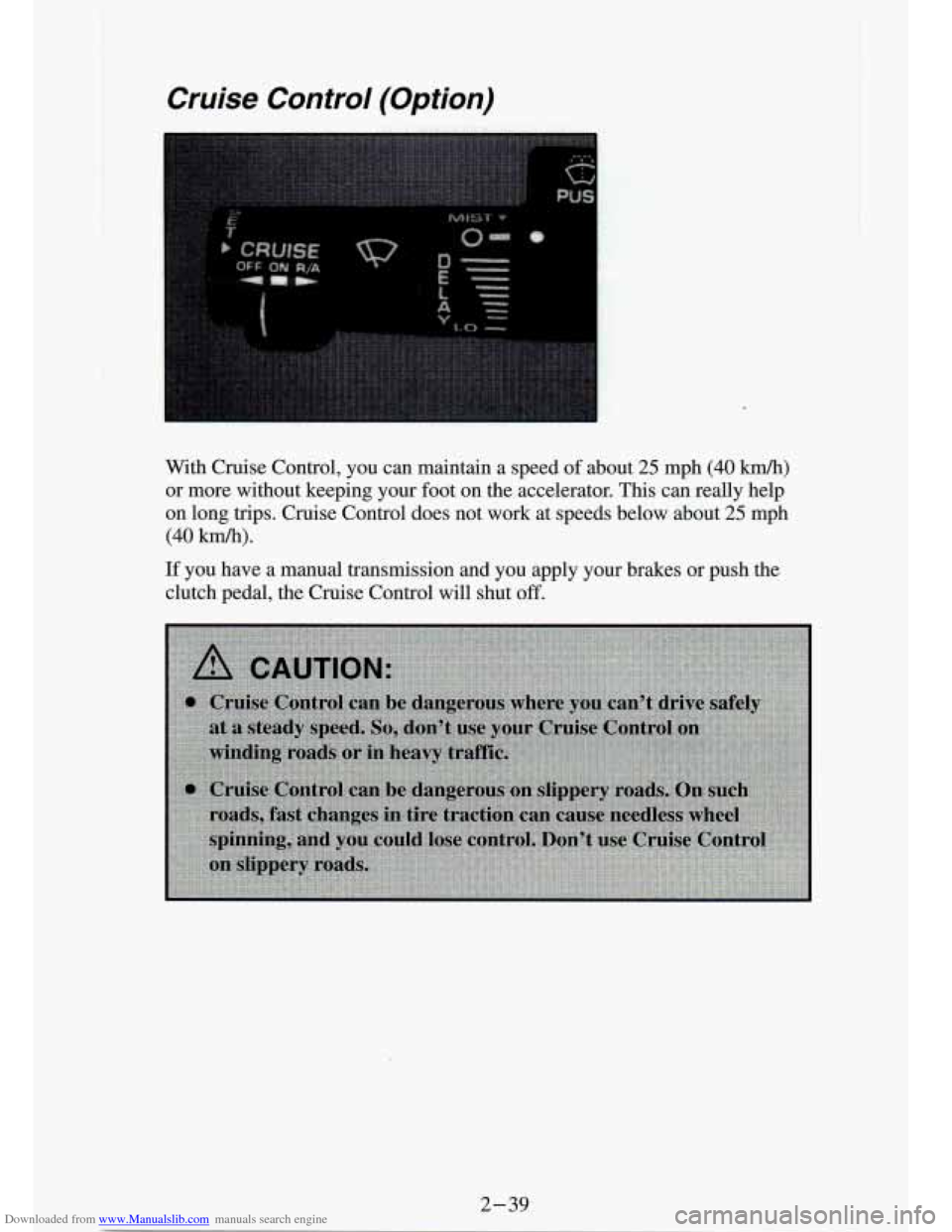
Downloaded from www.Manualslib.com manuals search engine Cruise Control (Option)
With Cruise Control, you can maintain a speed of about 25 mph (40 kndh)
or more without keeping your foot on the accelerator. This can really help
on
long trips. Cruise Control does not work at speeds below about 25 mph
(40 km/h).
If you have a manual transmission and you apply your brakes or p\
ush the
clutch pedal, the Cmise Control will shut off.
2-39
Page 90 of 340
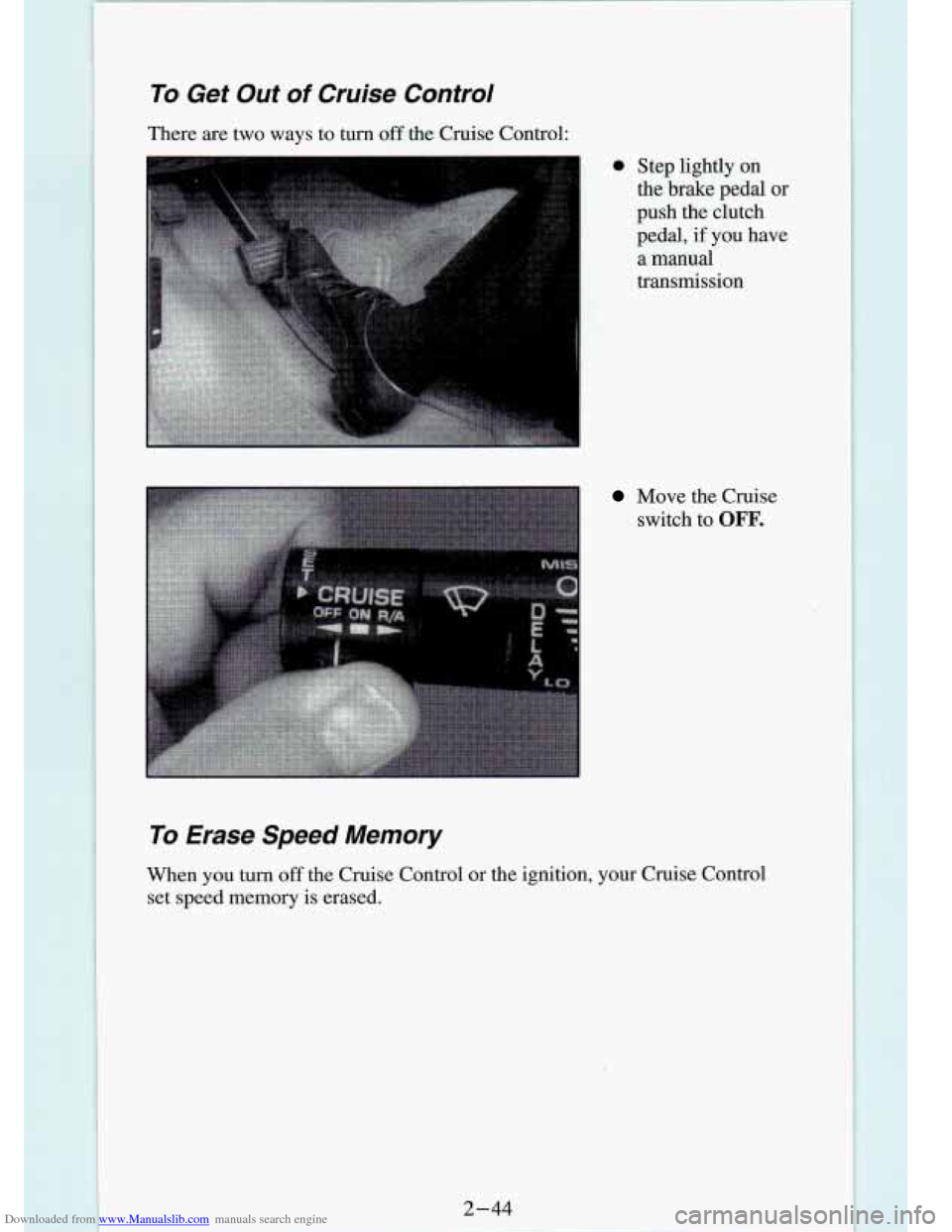
Downloaded from www.Manualslib.com manuals search engine To Get Out of Cruise Control
There are two ways to turn off the Cruise Control:
@ Step lightly on
the brake pedal or
push the clutch
pedal, if you have
a
manual
transmission
Move the Cruise switch to
OFF,
To Erase Speed Memory
When you turn off the Cruise Control or the ignition, your Cruise Control
set speed memory is erased.
Page 155 of 340
Downloaded from www.Manualslib.com manuals search engine Q: What should I do if my vehicle stalls, or is about to stall, and I
A: If this happens, there are some things you should do, and there are
some things you must not do. First, here’s what you
should do:
can’t make it up the hill?
Push the brake pedal to stop the vehicle and keep it from rolling
backwards. Also, apply
the parking brake.
If your engine is still running, shift the transmission into reverse,
release the parking brake, and slowly back down the hill in r\
everse.
If your engine has stopped running, you’ll need to restart it. With the
brake pedal depressed and the parking brake still applied, shift the
transmission to
“P” (Park) (or, shift to “N” (Neutral) if your vehicle h\
as
a manual transmission) and restart the engine. Then, shift to \
reverse,
release the parking brake, and slowly back down the hill as s\
traight
as
possible in reverse.
wheel at the
12 o’clock position. This way, you’ll be able to tell if your
wheels are straight and maneuver as you back down. It’s bes\
t that you
back down the hill with your wheels straight rather than in the left or
right direction. Turning the wheel too far to the left or right will
increase the possibility
of a rollover.
Here are some things you
must not do if you stall, or are about to stall,
when going up a hill.
0 As you are backing down the hill, put your left hand on the steering
0 Never attempt to prevent a stall by shifting into “N’ (Neutral) (or
depressing the clutch, if you have a manual transmission) to “rev-up”
the engine and regain forward momentum. This won’t work. Your
vehicle will roll backwards very quickly and you could go out \
of
control.
Instead, apply the regular brake to stop the vehicle. Then app\
ly the
parking brake. Shift into reverse, release the parking brake, and slowly
back straight down.
0 Never attempt to turn around if you are about to stall when going up a
hill.
If the hill is steep enough to stall your vehicle, it’s steep enough to
cause you to roll over
if you turn around. If you can’t make it up the
hill, you must back straight down the hill.
Page 201 of 340
Downloaded from www.Manualslib.com manuals search engine 7. By this time the coolant level inside the filler neck may be lower. If the
level is lower, add more of the proper
mix through the filler neck until
the level reaches the base of the filler neck.
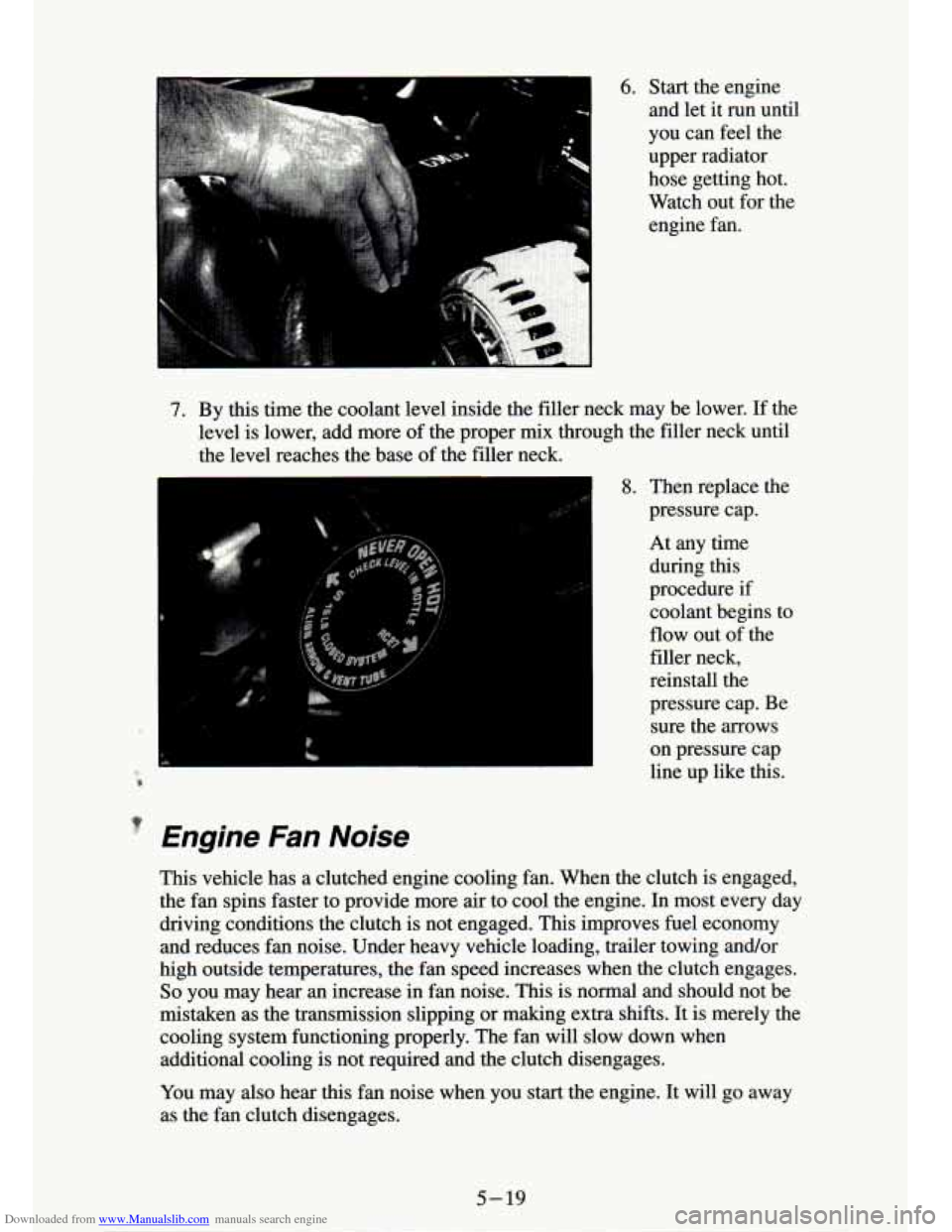
8. Then replace the
pressure cap.
At any time during
this
procedure if coolant begins to
flow out of the
filler neck,
reinstall the
pressure cap. Be sure the arrows
on pressure cap
line up like this.
P
' Engine Fan Noise
This vehicle has a clutched engine cooling fan. When the clutch is engaged,
the fan spins faster to provide more air
to cool the engine. In most every day
driving conditions the clutch is not engaged. This improves fuel economy
and reduces fan noise. Under heavy vehicle loading, trailer towing and/or
high outside temperatures, the fan speed increases when the clutch engages.
So you may hear an increase in fan noise. This is normal and should not be
mistaken as the transmission slipping or making extra shifts. It is merely the
cooling system functioning properly. The fan will slow down when
additional cooling is not required and the clutch disengages.
You may also hear this fan noise when you
start the engine. It will go away
as the
fan clutch disengages.
5-19
Page 219 of 340
Downloaded from www.Manualslib.com manuals search engine Service & Appearance Care
I
Section
Here you will find information about the care of your vehicle . This part
begins with service and fuel information. and then it shows ho\
w to check important fluid and lubricant levels
. There is also technical information
about your vehicle. and a section devoted to its appearance care
.
Service ................................................... 6-2
Fuel
..................................................... 6-3
Engineoil
.............................................. 6-9
Aircleaner
............................................ 6-14
Automatic Transmission Fluid
............................. 6-15
Manual Transmission Fluid
............................... 6-18
Hydraulic Clutch
........................................ 6-20
RearAxle
............................................. 6-20
Transfer Case
.......................................... 6-21
FrontAxle
............................................. 6-22
Power Steering Fluid
.................................... 6-26
Windshield Washer Fluid
................................. 6-28
Checking Things Under the Hood
.............................. 6-6
Engine Coolant
......................................... 6-23
Brake Master Cylinder
................................... 6-29
Replacing Brake System Parts
................................ 6-32
Bulb Replacement
......................................... 6-33
Battery
.................................................. 6-32
Vehiclestorage
........................................... 6-32
Other Maintenance Items
.................................... 6-39
Loading Your Vehicle
...................................... 6-45
Tires
.................................................... 6-51
Appearancecare
.......................................... 6-59
Vehicle Identification Number (VIN)
.......................... 6-68
Service Parts Identification Label
............................. 6-70
Fuses and Circuit Breakers
.................................. 6-70
Capacities and Specifications Charts
........................... 6-73
6-1